
Waiting for a decision on your paper is stressful, and silence after the notification date makes it worse. If you keep refreshing your inbox and wondering what the quiet means, you are in a spot many authors know well.
Quick answer: Yes, most reputable conferences tell authors when a paper is rejected. The notice usually goes to the corresponding author by email, through the submission portal, or both, on the notification date in the call for papers. Some notices include reviewer comments and others only state the decision. If nothing arrives, check the portal and spam folder first, then ask the program chair.
A rejection notice is part of the normal review process. It confirms that the paper was reviewed and that the program committee decided not to include it in the program. Once you know the decision, you can revise the paper, submit it elsewhere, ask for feedback, or plan your next submission.
Do Conferences Notify Authors About Rejection?
Yes, a reputable conference should tell authors the final decision, whether it is acceptance, rejection, revision, or another review outcome. Without that notice, authors would not know whether to wait, revise the paper, submit elsewhere, or contact the organizers.
In most cases the decision goes to the corresponding author listed during submission. Other co-authors may not receive the email unless the submission system updates everyone, so confirm who the main contact is before the notification date.
A notice may be short or detailed. Some conferences only say the paper was not accepted, while others add reviewer comments, scores, or suggestions for improvement.
What Named Platforms and Conferences Say
Published rules differ, which is why the call for papers matters more than any general rule:
- Optica: its help page says the decision is sent by email to the presenting author named at submission, and it advises setting your spam filter to accept mail from the sender address.
- EMBC 2019: the organizing committee notified the corresponding author of acceptance or rejection.
- EasyChair: its help page says automatically sent emails usually go only to the corresponding authors, while for manually sent emails the sender chooses between corresponding authors and all authors.
- Ex Ordo: organizers publish each decision so authors can see it after logging in, and the notification emails are sent separately to a recipient group the organizer picks, such as all authors, corresponding authors, or presenting authors.
- ICARE 2015 (HSE): notifications of acceptance or non-acceptance included reviewer comments, though the conference said it could not guarantee how detailed each reviewer’s comments would be.
How Conferences Send Acceptance or Rejection Notifications
Conferences usually send decisions by email, through a submission portal, or both. The method depends on the platform the conference uses and how the organizing committee manages decisions.
Email Notifications to the Corresponding Author
The decision email goes to the person listed as the main contact. For accepted papers it may also cover registration, presentation format, camera-ready submission, and final deadlines. For rejected papers it may simply say the paper was not accepted (the full list of what a notice contains is in the section below).
Submission Portal Updates
Many conferences also post decisions inside systems such as EasyChair, EDAS, Ex Ordo, OpenReview, or the conference’s own portal. Authors can log in and check the paper status even if the email is delayed or missed. Common status labels include:
- Accepted
- Rejected
- Revision required
- Poster accepted
- Camera-ready required
- Under review
In EasyChair, for example, the chairs send the acceptance and rejection emails, and reviews appear for authors only if the chairs choose to send them. In OpenReview, whether reviews of rejected papers become public depends on the venue’s own policy. If you see no email by the notification date, the portal is usually the fastest place to look.
Whether Reviewer Comments Are Included
Reviewer feedback depends on the conference. Some give detailed comments on strengths and weaknesses, while others send only the final decision with little or no explanation. The portal may also show scores, discussion notes, or final instructions. Even a short notice gives you the clarity to move forward, and a detailed one shows what to improve before submitting elsewhere.
When Do Conferences Send Rejection Notifications?
Conferences usually send rejection notices on the decision or notification date listed in the call for papers. That date tells authors when to expect the result.

The exact timeline depends on the size, type, and review structure of the conference. Larger conferences often take longer because they receive more submissions and may use several review stages. Smaller conferences, workshops, and symposiums may reply sooner. The table shows general patterns, not promises, so always trust the dates in the call for papers over any general estimate.
| Conference Type | Common Notification Pattern | Possible Decision Types |
| Large international conference | Several weeks to a few months after submission | Accept, reject, revision, poster, oral presentation |
| Regional or mid-sized conference | Varies, set by the call for papers | Accept, reject, sometimes revision |
| Workshop or small symposium | Often quicker, but the call for papers sets the date | Usually accept or reject |
Some conferences set separate dates by track, so main conference papers, workshop papers, posters, and student submissions may each have different timelines. Others release decisions in batches, which means some authors hear earlier than others. If the date has passed, do not assume the paper was rejected (see the steps further down).
What a Conference Rejection Notice Usually Includes
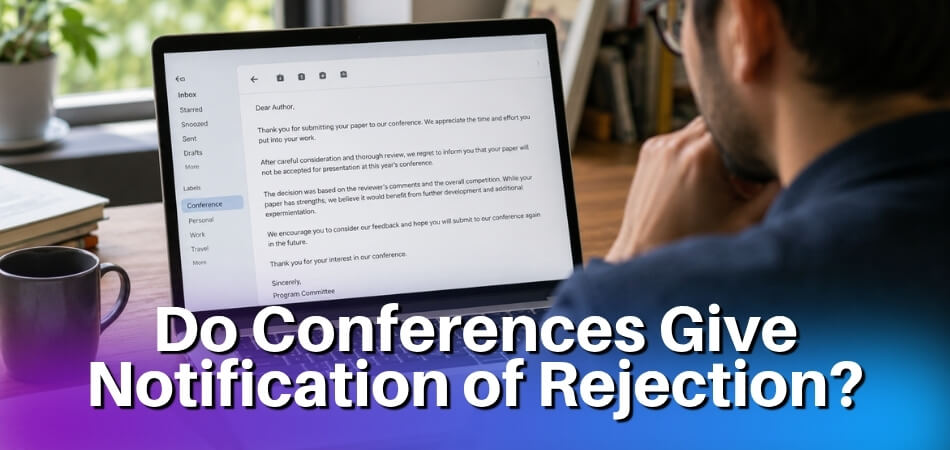
A rejection notice usually includes the conference name, paper title, submission ID, decision status, and a short message from the program committee. Some conferences also share reviewer comments, scores, or recommendations.
A typical notice may include:
- Conference name to confirm which event the decision belongs to
- Paper title so authors can identify the submission
- Submission ID for tracking and follow-up
- Decision status such as rejected, not accepted, or declined
- Program committee message explaining the outcome briefly
- Reviewer comments if the conference shares feedback
- Scores or ratings if the review system makes them available
- Next-step notes if revision, workshop transfer, or poster consideration is possible
Not every rejection email gives detailed reasons, especially when the conference receives many submissions. Full reports may discuss originality, methodology, clarity, relevance, contribution, or fit with the conference scope.
Read the notice carefully before reacting. A rejection does not always mean the research has no value. The paper may be outside the conference scope, the competition may be strong, or the submission may need clearer writing, stronger evidence, or better positioning.
Example Conference Decision Emails
Decision emails confirm the paper status and tell authors what to do next. A rejection email gives closure after review, while an acceptance email usually adds presentation, registration, and final submission instructions.
Sample Rejection Email
Subject: Decision on Your Submission: [Conference Name]
Dear [Author Name],
Thank you for submitting your paper, “[Paper Title]”, to [Conference Name].
After review by the program committee, we regret to inform you that your paper has not been accepted for this year’s conference program. The decision was based on reviewer evaluation, conference scope, available presentation slots, and the overall strength of submissions.
If reviewer comments are available, they can be found in the submission portal or attached to this email. We encourage you to use the feedback to improve the paper for a future submission.
Thank you for your interest in [Conference Name].
Sincerely,
[Program Chair or Organizing Committee]
Sample Acceptance Email
Subject: Acceptance Notification: [Conference Name]
Dear [Author Name],
We are pleased to inform you that your paper, “[Paper Title]”, has been accepted for presentation at [Conference Name].
Please review the next steps for registration, final paper submission, presentation format, and conference participation. The camera-ready version, if required, must be submitted by [Deadline].
Further details about the program schedule, session assignment, and presentation guidelines will be shared by the organizing committee.
Sincerely,
[Program Chair or Organizing Committee]
Sample Revision or Resubmission Request
Subject: Revision Request for Your Submission: [Conference Name]
Dear [Author Name],
Thank you for submitting your paper, “[Paper Title]”, to [Conference Name].
The program committee has reviewed your submission and requests revisions before a final decision is made. Please address the reviewer comments, update the paper as needed, and submit the revised version by [Deadline].
The final decision will be shared after the revised paper is reviewed.
Sincerely,
[Program Chair or Organizing Committee]
What Authors Should Check in Any Decision Email
Check the paper title and submission ID, the decision status, any reviewer comments or scores, the revision or camera-ready deadline, registration requirements, the presentation format, and the contact details for questions. For a rejection, save the email and the feedback. For an acceptance or revision request, note every deadline immediately so you do not miss the next step.
Why You Might Not See a Rejection Notification
You might not see a rejection notification because the email was filtered, sent to another author, delayed, or posted only inside the submission portal. A missing email does not always mean the conference has not made a decision.
- Spam or junk filtering: automated conference emails may land in spam, junk, or promotions folders.
- Wrong email address: a typo, old address, or inactive account in the submission profile can prevent delivery.
- Corresponding author settings: in multi-author papers, the decision may go only to the corresponding author.
- Portal-only updates: some conferences update the decision in EasyChair, EDAS, Ex Ordo, or OpenReview without sending a detailed email.
- Batch email delays: organizers may release decisions in groups.
- Changed notification date: the conference may update the timeline on the CFP or website.
What to Do If the Notification Date Has Passed
If the notification date has passed, first check the submission portal, email folders, CFP page, and co-author messages before contacting the organizers. Work through these steps in order.

Check the Submission Portal
Log in to the system where you submitted the paper, such as EasyChair, EDAS, Ex Ordo, OpenReview, or the conference’s own portal. The decision may already be visible there even if no email arrived.
Search Spam, Junk, and Promotions Folders
Search your inbox using the conference name, submission ID, paper title, or platform name. Automated conference emails are sometimes filtered away from the main inbox.
Recheck the CFP Notification Date
Visit the official call for papers page and confirm the decision date. Some authors accidentally check an old deadline, a workshop deadline, or an early notification date instead of the final one.
Ask the Corresponding Author or Co-Authors
If you are not the corresponding author, the decision may have gone to someone else on the author list. Ask your co-authors whether they received an email or portal update.
Allow a Short Delay, Then Send a Polite Inquiry
A small delay is not unusual, especially for large conferences or events with several tracks. If you still cannot find the decision, contact the program chair or organizing committee with the conference name, paper title, submission ID, and your contact details.
Polite Follow-Up Email Template for a Missing Decision
If the date has passed and you cannot find any update, send a short, respectful email to the program chair or organizing committee. Include the conference name, paper title, submission ID, and a simple request to confirm the decision status.
Follow-Up Email Template
Subject: Submission Decision Inquiry: [Conference Name], Paper #[Submission ID]
Dear [Program Chair/Organizing Committee],
I hope you are doing well. I am writing to ask about the decision status of my submission, “[Paper Title]”, submitted to [Conference Name] under submission ID #[Submission ID].
The listed notification date has passed, and I have not yet received a decision by email or through the submission portal. Could you please confirm whether the decision has been released?
Thank you for your time and assistance.
Best regards,
[Your Full Name]
[Your Affiliation]
[Your Email Address]
When to Send This Email
Send it only after checking the portal, spam folder, CFP page, and co-author emails. If the date passed only a short time ago, allow a small buffer before following up.
What to Avoid in the Follow-Up
Avoid repeated messages, emotional complaints, and long explanations. A clear, polite email is more effective and keeps the communication professional.
Can Authors Respond After a Rejection?
Authors can sometimes respond after a rejection, but only if the conference allows rebuttals, appeals, or clarification requests. In many conferences the rejection is final, so check the author guidelines before replying.
Rebuttal Phase
Some conferences include a rebuttal phase before final decisions. Authors can respond to reviewer comments, clarify misunderstandings, or correct factual errors. A rebuttal is short, focused, and professional, not a rewrite of the paper.
Appeal Request
Not every conference offers appeals. A conference may allow one if there was a serious issue in the review process, such as a conflict of interest, a technical error, or a clear misunderstanding of the submission scope. Appeal only with strong evidence, not simply because you disagree with the reviewers.
Clarification Request
If reviewer comments are unclear or missing, you may politely ask whether more feedback is available. Not every conference will provide it. Asking for guidance works better than challenging the decision directly.
Why Most Rejection Decisions Are Final
Program committees work under strict schedules, limited presentation slots, and fixed publication deadlines, and once decisions go out the program moves quickly toward registration, scheduling, and proceedings preparation. If no rebuttal or appeal option is listed, the best next step is usually to revise the paper and submit it to a better-matched conference, workshop, or journal.
What to Do After Receiving a Conference Rejection
After a rejection, read the decision carefully, review the feedback, improve the paper, and choose a better-matched venue. A rejection does not mean the research has no value; it usually means the paper needs revision, stronger positioning, or a more suitable conference.

Read the Decision Carefully
Read the full notice without rushing. Check whether it is a full rejection, a revision request, a poster option, or a suggestion to submit to another track. Also look for comments, scores, or summary notes that show whether the issue was scope, originality, methodology, clarity, formatting, or limited space in the program.
Use Reviewer Feedback to Improve the Paper
Organize the comments by theme, because repeated concerns usually point to the most important weaknesses. Even critical feedback can make the paper stronger if you use it carefully. You may need to improve:
- Research question clarity
- Methodology explanation
- Evidence or data presentation
- Literature review
- Results and discussion
- Writing structure
- Fit with the conference scope
Ask Mentors or Co-Authors for Input
Share the decision and comments with supervisors, mentors, co-authors, or trusted colleagues. They can help you separate useful feedback from less relevant comments and decide what to revise first, which matters most when reviews are brief, mixed, or hard to interpret.
Choose a Better-Matched Venue
Compare the paper with the next conference’s theme, tracks, audience, review criteria, and publication options. A strong paper can still be rejected if it does not match the event’s scope. Options include:
- Another conference in the same field
- A smaller or more specialized workshop
- A poster track
- A journal submission
- A future edition of the same conference after revision
Update the Paper Before Resubmitting
Avoid sending the same version to another venue. Use the feedback to revise the title, abstract, introduction, method, results, discussion, and conclusion where needed, and check formatting, references, word limit, and submission requirements for the new venue. The IEEE VIS 2025 paper chairs, in a blog post to reviewers, described resubmitting rejected papers with minimal or no revisions as damaging to the community, so a real revision also protects your next review.
Rejection vs. Revision vs. Poster Acceptance
A rejection, a revision request, and a poster acceptance are different outcomes, and each needs a different next step. Read the decision carefully before acting.
How Authors Should Respond to Each Outcome
Use the decision type to choose your next action:
| Decision Type | Meaning | Best Next Step |
| Rejected | Paper not accepted for the current program | Revise and submit to another suitable venue |
| Revision Required | Changes are needed before final decision or confirmation | Address reviewer comments and resubmit by the deadline |
| Poster Accepted | Work accepted for poster presentation | Prepare poster materials and check publication rules |
What Rejection Means
A rejection means the paper has not been accepted for the program in this submission cycle. It will not be presented or included in the official proceedings unless the conference offers another route, such as transfer to a workshop or future resubmission.
What Revision or Revise-and-Resubmit Means
A revision request means the committee wants changes before making or confirming a final decision, such as improving the method, clarifying results, addressing reviewer concerns, or fixing formatting. Follow the instructions exactly, meet the deadline, and clearly address each requested change.
What Poster Acceptance Means
A poster acceptance means the work is accepted for presentation in poster format instead of an oral talk. It is still a positive outcome with useful visibility, feedback, and networking. Check whether it includes proceedings or abstract publication, because policies differ by conference.
Common Mistakes Authors Should Avoid After Rejection
After a rejection, avoid reacting emotionally, ignoring feedback, or resubmitting the same paper without improvement.

Ignoring Reviewer Comments
Comments may not always be detailed, but they often point to issues that affected the decision. Ignoring them can lead to the same problems in the next submission. Look for remarks about scope, novelty, methods, evidence, writing clarity, formatting, or contribution.
Resubmitting Without Revising
If the paper had weaknesses in structure, argument, method, or fit, those issues may appear again in the next review. Revise it first, based on the feedback and the next conference’s guidelines.
Sending Emotional Replies to Organizers
A rejection can feel frustrating, but arguing with reviewers, demanding acceptance, or sending long complaint emails rarely helps. If you need clarification, write politely and ask a specific question.
Missing a Rebuttal or Revision Deadline
Some conferences allow rebuttals, revisions, or author responses within a fixed window. Missing it can remove your chance to clarify concerns, so check the decision email and portal for any response deadline.
Choosing the Next Venue Without Checking Fit
A paper can be rejected for poor fit even when the research is useful. Before submitting again, review the next venue’s topics, audience, paper categories, review criteria, and publication rules.
FAQs About Do Conferences Give Notification of Rejection?
Still waiting on a decision past the notification date? Rejection emails, who on the author list receives them, what the portal shows, reviewer comments and attending after a rejection are all dealt with.
Do All Conferences Send Rejection Emails?
Most reputable conferences send rejection emails or update the decision in the submission portal, but no rule covers every event. Some send a direct email, while others require authors to log in to the system to view the result.
Who Receives the Rejection Notification?
Usually the corresponding author. Some conferences notify only the presenting author, and some systems let all authors see the decision after logging in. Co-authors should confirm who the main contact is.
Do All Authors See the Decision in the Submission Portal?
Not always. Some platforms let all authors see the paper status, while others give full access only to the submitting or corresponding author. If you cannot see it, ask the corresponding author to check.
Do Conference Rejection Emails Include Reviewer Comments?
Sometimes, depending on the conference. Some notices include reviewer comments, scores, or summary feedback, and others state only the decision. A conference may promise comments without guaranteeing how detailed they are, so check its review policy.
Can a Rejected Paper Still Be Submitted Somewhere Else?
Yes, a rejected paper can usually be revised and submitted to another conference, workshop, or journal. Improve it first and follow the new venue’s scope, formatting, and submission rules.
Are Rejected Conference Papers Published?
No, rejected papers are generally not published by the conference. Only accepted papers, posters, abstracts, or proceedings entries are published, depending on the event’s policy. You remain free to submit the work elsewhere.
Can I Attend the Conference If My Paper Is Rejected?
Yes, authors can usually attend as regular participants. Attending is still useful for networking, learning from accepted work, and preparing a stronger future submission.
What Should I Do If I Never Receive a Decision?
Check the submission portal, spam folder, CFP page, and co-author emails first. If you still find nothing after a short delay, send a polite inquiry to the program chair with your paper title and submission ID.
Conclusion
In most cases, reputable conferences send a decision by email, update the submission portal, or do both, so authors learn whether the paper is accepted, rejected, revised, or moved to another format.
From our experience at MS International: our review is double-blind, and authors receive the decision by email, with reviewer comments where applicable. Most review decisions are returned within about 10 working days, although complex papers or revision rounds can take longer. The outcome can be acceptance, a revision request, or rejection, and accepted authors still need to complete registration before presenting. Other conferences set their own dates and rules, so always check their call for papers.
If the result is a rejection, save the feedback, discuss revisions with co-authors, and choose the next venue based on scope, audience, deadlines, and publication fit.