

You open the author guidelines, spot a line about abstract format, and realise the draft you already wrote may not fit. It is a small detail that can cause a surprising amount of rework.
Quick answer: A structured abstract splits the summary under labels such as Background, Methods, Results and Conclusion. An unstructured abstract is one block of continuous prose with no labels. Use the structured form for medical, clinical and most empirical research, and prose for humanities, theory and many qualitative or review papers. Your target journal’s or conference’s instructions always decide, so check them first.
Last verified against official sources: October 2026.
Picking the wrong format is an easy way to get a submission sent back before anyone reads the research. This guide shows how each format works, which fields use which, and how to handle theses, APA and biomedical journals.
The Core Difference Between Structured and Unstructured Abstracts at a Glance
A structured abstract uses labeled headings to organize its content. You will typically see Background, Methods, Results and Conclusion, which follow the same logic as the IMRAD layout (Introduction, Methods, Results, Discussion) of the full paper. Each heading introduces one chunk of information, and readers can jump straight to the part they need.
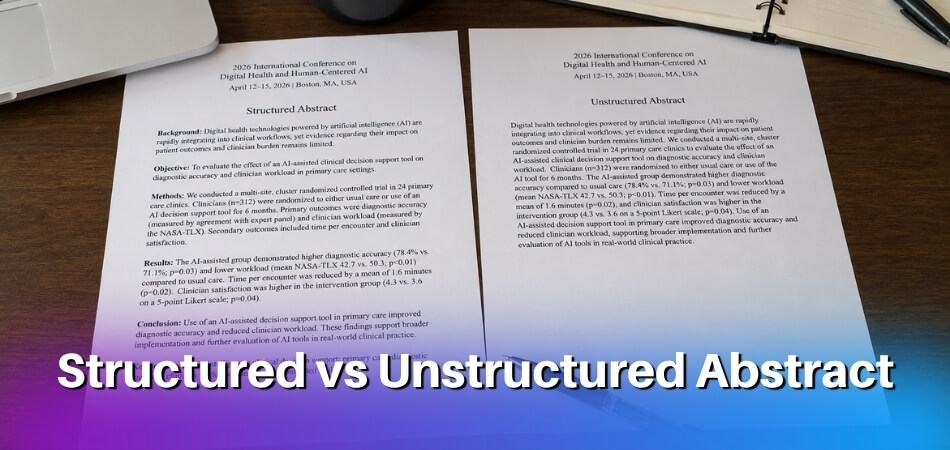
An unstructured abstract presents the same core information as continuous prose, with no labels. It reads as a single paragraph (sometimes two), and the writer decides the flow instead of a fixed template. That is the whole distinction. Which format you should use, what journals require and how long the abstract can be all follow from this one structural choice.
| Feature | Structured Abstract | Unstructured Abstract |
| Format | Labeled sections (Background, Methods, Results, Conclusion) | Continuous prose, no labels |
| Typical length (check the call) | About 200 to 350 words | About 150 to 250 words |
| Common in | Medical, clinical, empirical and systematic-review papers | Humanities, theory, qualitative work, narrative reviews |
| Reader behavior | Built for scanning | Built for reading through |
| Where you will see it | Clinical research, life-science journal submissions, many biomedical journals | Thesis and dissertation abstracts, theoretical papers, humanities journals |
In practice, the format is rarely your call alone. Author guidelines specify it, and submitting the wrong one is an easy rejection trigger during initial screening. Some journals are explicit (“structured abstract required, 300 words maximum”); others list the accepted headings in their submission instructions. Empirical research in psychology, education and related fields sits in the middle and can go either way depending on the journal or institution. A third pattern also exists: a single paragraph that follows the structured order (background, methods, results, conclusion) without headings, which some publishers ask for.
What Is a Structured Abstract and What Does Its Format Look Like
A structured abstract divides its content into labeled sections so the reader can scan directly to what they care about. The format was proposed for clinical articles in 1987, and by 1993 the ICMJE (the “Vancouver group” of medical journal editors) was recommending structured abstracts for biomedical journals, as a way to make dense scientific information easy to scan. It has since spread to nursing, public health, pharmacy, psychology and many social science journals that publish empirical research.
IMRAD-Based Section Breakdown (Background, Methods, Results, Conclusion)
The structured abstract mirrors IMRAD, usually with four labeled sections that map onto the body of the paper.
Background (sometimes “Introduction” or “Objective”) explains why the study exists. What problem prompted it, and what gap does it address? This is typically the shortest section, two or three sentences at most. You are explaining the motivation, not reviewing the literature.
Methods describes what you actually did: study design, sample size, participant criteria, interventions, data collection tools and statistical approach. Reviewers read this section closely because it shows whether the design can support your conclusions.
Results presents the findings with specific numbers, such as effect sizes, p-values, response rates and key measurements, without interpretation. Vagueness here is a red flag for peer reviewers.
Conclusion (sometimes “Discussion” or “Conclusions and Relevance”) says what the results mean, in one or two sentences on clinical, practical or theoretical implications. Some journals also ask for a “Limitations” heading.
Word limits depend on the journal. Structured abstracts in many biomedical journals fall between roughly 200 and 350 words, and some journals set limits per heading as well as overall, so read the guidelines before drafting. The ICMJE recommendations, which many biomedical journals follow, say that original research, systematic reviews and meta-analyses require structured abstracts. They add that the required format differs from journal to journal and that some journals use more than one format.
Reporting Guidelines That Shape Structured Abstracts
For some study types the headings are not the only thing a journal checks. Reporting guidelines list items the abstract must contain.
- Clinical trials: the ICMJE says trial abstracts should include the items the CONSORT group has identified as essential. It also recommends that journals publish the trial registration number at the end of the abstract, and that funding sources are listed separately after it.
- Systematic reviews: PRISMA 2020 for Abstracts is a 12-item checklist for condensing a systematic review into an abstract. Journals that endorse PRISMA may expect each item to be covered, under whatever headings they use.
- Deposited data: when data sit in a public repository, the ICMJE says authors should state the data set identifier, repository name and number at the end of the abstract.
If your study is a trial or a systematic review, check which of these your target journal endorses before you write.
Structured Abstract Example (Medical / Clinical Research)
This example is constructed to show the format. It is not taken from a real published study.
Background: Postoperative pain management in adult patients undergoing laparoscopic cholecystectomy remains inconsistent across surgical centers. This study examined whether a standardized multimodal analgesia protocol reduces opioid consumption in the 24-hour postoperative period compared with standard care.
Methods: A randomized controlled trial was conducted at two tertiary care hospitals between January 2021 and June 2022. Adult patients (n = 184) scheduled for elective laparoscopic cholecystectomy were randomly assigned to receive either a multimodal analgesia protocol (n = 92) or standard opioid-based analgesia (n = 92). The primary outcome was total morphine-equivalent consumption within 24 hours of surgery. Secondary outcomes included pain scores at 6 and 12 hours and length of hospital stay.
Results: Patients in the multimodal group consumed significantly less opioid medication in the 24-hour postoperative period (mean 8.3 mg morphine equivalent, SD 3.1) compared with the control group (mean 14.7 mg, SD 4.6; p < 0.001). Pain scores at 12 hours were also lower in the multimodal group (mean NRS 2.4 vs. 4.1; p = 0.003). No significant difference in length of hospital stay was observed between groups.
Conclusion: A structured multimodal analgesia protocol significantly reduced postoperative opioid consumption following laparoscopic cholecystectomy without affecting hospital stay duration. These findings support wider adoption of standardized multimodal approaches in elective abdominal surgery settings.
Notice that each section does exactly one job. The Background does not preview the results, the Methods do not editorialize, and the Results give actual numbers instead of saying the findings were “significant” and leaving it there. That discipline is what structured formatting enforces by design.
What Is an Unstructured Abstract and What Does Its Format Look Like
An unstructured abstract covers the same ground (purpose, methods, findings, implications) as one flowing paragraph with no headings or section markers. It has been standard in humanities, social science and theoretical disciplines for decades, and you will see it in philosophy, literary criticism, history, linguistics and review articles where the research does not follow a strict empirical sequence.

Continuous Prose Format: How to Fit All Key Information Into a Single Paragraph
You do the same organizational work as in a structured abstract, but the reader cannot see your scaffolding. The information still needs to flow in roughly the same order (what the paper investigates, how it was approached, what it found, what that means), but it must read as connected thinking rather than a checklist.
Transitions carry most of the weight. Instead of a “Results:” header, use a phrase such as “The analysis reveals…” or “Examining these texts shows…” to signal the move from setup to findings. Humanities and social science journals commonly set limits of roughly 150 to 300 words for this format, and some are strict about 200, so check the call.
A few practical points:
- State the research question or central argument in your first or second sentence. Readers scanning a database need to know quickly whether the paper is relevant to them.
- Be specific about your approach. “A close reading of three Elizabethan tragedies” tells the reader more than “an analysis of dramatic texts.”
- Avoid hedging so heavily that your findings disappear. If the paper makes a claim, the abstract should reflect it.
- End on the paper’s contribution or implication: what does it add to the conversation in the field?
A common weakness is drifting into generality. With no labels forcing you to account for methods or results, it is easy to describe your topic without ever saying what you did or found. Journal reviewers notice this immediately.
Unstructured Abstract Example (Humanities / Social Science)
Below is an unstructured abstract for a humanities paper on postcolonial identity in contemporary fiction. It is a constructed example of the continuous prose format.
This paper examines how writers of the South Asian diaspora negotiate competing claims of cultural belonging in anglophone fiction published between 1990 and 2015. Drawing on postcolonial theory and close reading of five novels, including works by Arundhati Roy and Mohsin Hamid, the study argues that diaspora fiction in this period constructs a mode of “provisional identity” that resists both assimilationist narratives and romanticized returns to origin. Rather than treating cultural hybridity as a resolution, these texts use structural fragmentation, unreliable narration, and code-switching to enact the instability of identity formation under conditions of displacement. The analysis identifies a recurring narrative pattern in which protagonists perform cultural authenticity for different audiences simultaneously, revealing the relational and audience-dependent nature of belonging. These findings complicate existing frameworks that position hybridity as inherently liberatory and suggest that diaspora fiction functions less as a literature of synthesis than as one of strategic self-presentation. The paper contributes to ongoing debates in postcolonial literary studies about the politics of voice, audience, and market reception in globally circulated minority literature.
In one paragraph this abstract identifies the corpus, names the theoretical framework, states the central argument, describes the method, reports the key finding and positions the contribution, all without a label. For theoretical, interpretive or archival work, continuous prose fits because the ideas connect rather than just sequence. A paper that is empirical and submitted to a journal expecting labeled sections would need the structured layout instead.
Structured vs Unstructured Abstract: A Side-by-Side Comparison
The content stays identical; what changes is the organization and the signals it sends before anyone reads the paper. The first table gave the basics. This section covers how the differences show up in practice.
Format and Visual Organization
A structured abstract uses its labels like mini-headings, so a physician or systematic reviewer who needs specific information fast can go directly to Results without reading your rationale first. An unstructured abstract usually follows a similar order (context, approach, findings, implications), but nothing is signposted and the reader moves through it like a short narrative paragraph. This suits humanities, social science and many qualitative fields, where the argument often cannot be sliced into separate methodological stages.
Word Limits and Space Efficiency
Neither format automatically gives you more room, since both sit under the limit your target sets. The labeled format spends a few words on the headings, but those labels replace phrases you would otherwise write out (“This study investigated…”, “The findings showed…”), so the net cost is small. Continuous prose gives slightly more room for nuance and does not force you to squeeze a central methodological approach into one sentence.
Scanning vs Reading
A structured abstract supports scanning, and an unstructured abstract requires reading. In clinical and scientific journals, scanability is a feature: reviewers, editors and readers working through databases such as PubMed go straight to Results or Conclusion. For a dissertation or a humanities or social science paper, the reader will usually read a short piece of prose, and the argument itself needs to be communicated, not just the data.
Tone and Register
Structured abstracts are more clinical by design. The labels push you toward concise statements such as “Methods: A randomized controlled trial of 240 participants across six sites,” with little room for hedging or context. Unstructured abstracts can carry the voice of the paper, signal the author’s theoretical position and show what kind of paper it is before anyone opens it. Neither tone is better in absolute terms. A polished humanities-style abstract will look out of place in a medical journal, and the reverse is also true.
The Same Study in Both Formats
Here is the clinical example above rewritten as an unstructured abstract, to show the content is the same and only the delivery changes.
Postoperative pain management after laparoscopic cholecystectomy remains inconsistent across surgical centers, so this randomized controlled trial at two tertiary care hospitals tested whether a standardized multimodal analgesia protocol reduces opioid use in the first 24 hours. Of 184 adult patients, 92 received the protocol and 92 received standard opioid-based analgesia. The multimodal group consumed significantly less opioid (mean 8.3 mg morphine equivalent versus 14.7 mg; p < 0.001) and reported lower pain at 12 hours (NRS 2.4 versus 4.1; p = 0.003), with no difference in length of stay. A standardized multimodal protocol can therefore reduce opioid consumption without lengthening hospital stay.
Comparison Table
| Feature | Structured Abstract | Unstructured Abstract |
| Effect on the word limit | Headings use a few words of the limit | The full count goes to content |
| Flexibility | Low, journals enforce specific sections | High, the writer controls structure and emphasis |
| Tone | Clinical, short declarative statements | Carries more of the paper’s own voice |
| Suits | IMRAD-style papers, scientific journal submissions | Interpretive, theoretical or narrative research |
| APA guidance | Some APA-style journals ask for labels on empirical papers; check the journal | APA’s own guidance describes one paragraph |
| Vancouver / biomedical journals | Typically paired with structured abstracts | Rarely used alongside it |
What Both Formats Share
Both have the same job: communicate purpose, approach and contribution in a tight word count so the right readers can find the paper and decide whether to read it. Neither is a mini-version of the paper. They are arguments for why the paper matters.
Which Format to Choose and When: Decisions Based on Discipline and Journal Type
Choose the structured format for empirical research with a defined method, and prose for argument-driven work, unless the call or journal says otherwise. The decision comes down to your field, the nature of your study and what the journal requires.
Even within medicine the headings are not uniform. A 2018 analysis published in the Journal of General Internal Medicine counted 314 different structured abstract formats among the medical journals that required one, so check the exact labels your target journal uses.
When to Choose a Structured Abstract (Medical, Clinical, and Empirical Research)
For a medical or clinical research abstract, the structured format is almost certainly what you need. Journals in medicine, nursing, public health and clinical psychology have used labeled sections since the late 1980s, and many now require them. The same logic applies to any empirical study with a hypothesis, a sample, a data collection procedure and measurable outcomes: the labels make each element easy to assess without reading the full paper.
Quantitative studies in psychology, economics, epidemiology and education tend to fit here too. Systematic reviews and meta-analyses are strong candidates as well, since reporting standards such as PRISMA expect transparent methods and the Background, Methods, Results and Conclusion headings support that. If a journal publishes in biomedical territory, assume a structured abstract unless its author guidelines say otherwise.
| Your Research Situation | Recommended Format |
| Clinical trial or medical study | Structured |
| Quantitative empirical study (any field) | Structured |
| Systematic review or meta-analysis | Structured |
| Humanities or arts-based research | Unstructured |
| Theoretical or conceptual paper | Unstructured |
| Review article without systematic methodology | Unstructured |
| Thesis or dissertation (check your institution) | Usually unstructured |
| Social science study, mixed methods | Check journal guidelines |
When to Choose an Unstructured Abstract (Humanities, Arts, and Review Articles)
A humanities paper does not follow a set procedure the way a clinical trial does. There is no Methods section to report and no measurable Results to summarize, because the argument develops through interpretation, textual analysis, theoretical framing or historical inquiry. Literature, history, philosophy, cultural studies and the arts all tend to use prose. Social science sits in the middle: quantitative work often uses structured abstracts, while qualitative, ethnographic or theoretical work typically does not.
Review articles that survey a body of scholarship without a formal systematic method also belong here. They build a narrative synthesis, and forcing them into IMRAD sections would misrepresent what the paper does.
How to Read Journal Author Guidelines Before Submission
Download the author guidelines and search for the word “abstract”. Most journals state the format and limit plainly, for example “structured abstract with the following headings” or “unstructured abstract of no more than 250 words”. The limit varies more than people expect, so do not rely on a general figure.
- Use their headings exactly. If the guidelines list required headings, those define your structure. Some specify the order (Background, Objectives, Methods, Results, Conclusions); others use different labels (Purpose, Design, Findings, Implications). Renaming or reordering them is a small thing that reviewers notice.
- If the guidelines are silent, open recent articles of the same type in that journal (original research, review, commentary) and copy the format those authors used.
- Check the article category. Some journals require a structured abstract for original research but an unstructured one for reviews or letters. Read the rules for your specific category to avoid reformatting at revision stage.
- For a conference, read the call for abstracts. It can set its own format and a tighter limit than the journal paper you may write later, so do not copy the journal format by default. Some calls ask for an extended abstract instead of a standard one, and that is a longer document.
- If it is still unclear, email the editorial office. A short message asking which format they prefer for your submission type takes two minutes and removes the doubt.
Which Abstract Format Works for Theses and Dissertations
Most theses and dissertations use an unstructured abstract, but institutional rules vary more than journal rules, so your graduate school’s guidelines come first.

Universities have traditionally preferred continuous prose for graduate work, partly because thesis research spans disciplines and does not always fit labeled sections. A philosophy dissertation, a comparative literature thesis or a historical study has no Methods section in any meaningful sense, and forcing IMRAD onto it produces something awkward.
Science and health disciplines differ. For a doctoral thesis in clinical research, epidemiology or pharmacology, your department may prefer or require the structured format, particularly if it expects graduates to turn chapters into journal papers later.
Check Your Institution’s Guidelines First
Outside a journal submission the choice opens up a little, but your institution’s style requirements, your supervisor’s preference and your discipline’s conventions still apply. Find the university’s official thesis submission guidelines and read the abstract section before writing. Look for:
- A word limit set by the institution
- Whether headings or labels are permitted or prohibited
- Whether the abstract goes to ProQuest, which has its own formatting standards. University library guides describe a 350-word abstract for doctoral dissertations and 150 words for master’s theses in that database, so check your graduate school’s own figure
- Any discipline-specific rules your department has added
Some universities say outright “no headings in the abstract”, and others leave it to departments. If the guidelines are silent, look at recent approved theses in your department, because that is the clearest sign of what your committee expects.
When a Structured Format Makes Sense for Graduate Work
If the thesis is genuinely empirical (you collected data, ran an experiment or a trial, or used a systematic review method) and your field uses structured abstracts, there is a reasonable case for the labeled format even where it is not mandated. It mirrors what reviewers in your field expect and is easier to scan. APA dissertations traditionally use a single prose paragraph with keywords below it, and if your field follows biomedical conventions, your thesis abstract may follow similar structural logic.
When Unstructured Prose Works Better
For humanities, arts, interpretive social science and interdisciplinary work, continuous prose is the better fit. It lets you frame the question in context, describe your approach without reducing it to a Methods label, and convey the argument as scholarship rather than a data entry form. Humanities abstracts often use more of the available limit because the argument needs more setup. Use that space to state the gap you address, your approach and what your findings add. A prose abstract also serves all three readers of graduate work: your committee, the graduate office and future scholars who find it in a database.
A Practical Suggestion for Mixed or Borderline Cases
If your research is empirical but your department uses prose abstracts, write in continuous prose but order the paragraph so a careful reader can pick out the background, method, results and conclusions, just without bold headings. You get the clarity of a structured format without breaking any style rule. This is common in social science and education dissertations where the research is quantitative but the abstract conventions are prose-based.
A thesis abstract also cannot simply become a journal abstract. Expect to rewrite it as a fresh draft that borrows content, because journal abstracts are tighter and thesis versions explain methodological context that journal readers do not need.
Abstract Formatting in APA, Vancouver, and Other Citation Styles
Citation style and abstract format are separate decisions. Knowing the style tells you about references, headings and layout, but not by itself whether to write a structured or unstructured abstract. Look at both together.
APA Format and Abstracts
The APA Publication Manual (7th edition) places the abstract on its own page after the title page, with the word “Abstract” in bold and centered at the top. APA’s guidance describes a single paragraph, not indented, of up to 250 words that covers purpose, method, results and conclusions, followed by three to five keywords on a new line with the label “Keywords:” in italics. APA treats the abstract as optional for student papers unless your instructor asks for one. Journals that use APA style often set their own, tighter limits.
APA does not require bold labels inside the abstract. Some APA-style journals nevertheless ask empirical authors for labeled sections covering the problem, participants, methods, findings and conclusions, while reviews and theoretical papers use prose. Always check the journal’s own submission template before finalizing.
Vancouver Style and Medical Abstracts
Vancouver is a reference style used widely in biomedical publishing. It does not itself require a structured abstract. The expectation comes from the journals themselves and from the ICMJE recommendations they follow (see the structured abstract section above). A typical biomedical abstract uses bold or capitalized labels (Background, Methods, Results, Conclusions), and limits of 200 to 350 words are common.
Systematic reviews in medical journals still tend to use a structured format with labels such as Objective, Data Sources and Synthesis. Narrative reviews sometimes use lighter structure or prose, depending on the journal.
Chicago, MLA, and Humanities Conventions
Neither Chicago nor MLA requires an abstract in its core rules, but many history, literature and philosophy journals and conferences ask for one through their own submission requirements. Humanities abstracts nearly always use continuous prose: one or two paragraphs conveying the central claim, scope and significance. Social science abstracts sit between the poles, with quantitative surveys, econometric analyses and experiments often structured, and qualitative, ethnographic or theoretical work more often in prose. House style matters as much as discipline.
Reading Author Guidelines Before You Write
A common mistake is choosing a format from general style knowledge alone. A journal might follow APA citation rules but require structured abstracts with four labeled sections, and another might follow Vancouver broadly but accept a short prose paragraph for case reports. For theses, your graduate school’s rules override any external style guide: a program may require APA throughout but prescribe its own abstract length and structure, often one unstructured paragraph.
| Style/Context | Typical Abstract Format | Common Word Limit |
| APA guidance (general) | One prose paragraph; some journals ask for labels on empirical papers | Up to 250 words |
| Vancouver / biomedical journals | Structured, IMRAD-based labels | About 200 to 350 words |
| Chicago / humanities journals | Unstructured, continuous prose | Varies by journal |
| Social science (quantitative) | Usually structured | Varies by journal |
| Social science (qualitative) | Usually unstructured | Varies by journal |
| Thesis / dissertation | Varies by institution | Set by the institution |
The table shows general patterns only. Your journal’s or institution’s guidelines override them.
Common Abstract Writing Mistakes That Hurt Your Publication Success
Most abstract problems are avoidable and show up in both formats, though some are specific to one.

Using the Wrong Format for the Journal
This is a common reason for an abstract to be sent back before peer review. If the guidelines specify labeled sections, a flowing paragraph marks you as someone who did not read the instructions. Do not assume that because a similar journal uses prose, this one does too, since requirements vary even within one publisher.
Ignoring the Abstract Word Limit
Limits are commonly enforced, and some submission systems will not accept an abstract over the cap, so editors may ask you to cut it before anyone reads the science. Count your words before you submit. In a structured abstract, budget the count across the sections deliberately. Methods tends to bloat, so cut it first.
Writing the Abstract Before the Paper Is Final
Drafting an abstract early as a planning tool is fine. The mistake is submitting that early draft without revisiting it. If your findings shifted, your conclusion changed or you added a limitation, the abstract and full text will not match, and reviewers and editors read both.
Not Revising the Abstract When You Revise the Paper
If reviewers ask for changes and you update your conclusions, add a limitation or change how you describe your methods, update the abstract too. An editor will catch a revised manuscript whose abstract still reflects the first draft during the final check before acceptance.
Omitting Key Information That the Format Requires
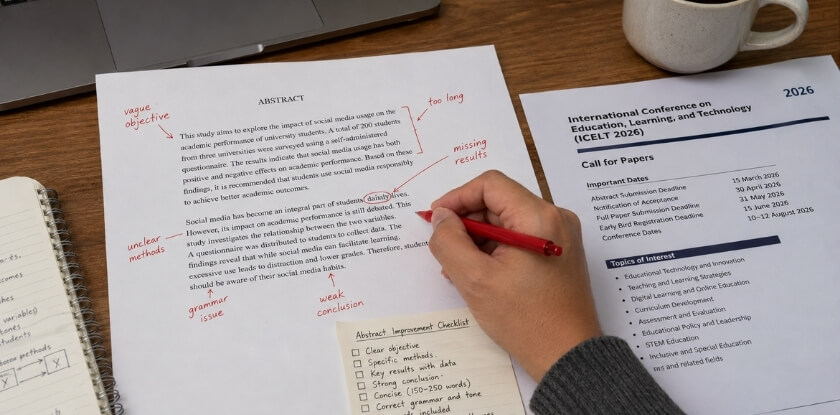
In a structured abstract, each section has a function. Methods needs enough detail for the reader to assess the design, and Results should report real findings (percentages, comparisons, effect sizes where applicable). “Results were significant” with no detail is almost useless to someone scanning. Unstructured abstracts have the same problem in another form: without labels it is easy to spend three sentences on background and one vague sentence on findings. A humanities or social science abstract still has to say what argument you make and what it contributes, not just what the topic is.
Treating the Abstract as a Table of Contents
This is common in thesis abstracts, where writers summarize structure instead of content. “Chapter two examines the methodology, and chapter three presents findings” says nothing about what the methodology was or what the findings showed. Write about your research, not about your document.
Copy-Pasting Sentences Directly from the Body Text
Body sentences are usually too detailed, too dependent on surrounding context or too long for a condensed abstract. Write the abstract as its own document that stands completely alone.
Getting the Tense Wrong
In a structured abstract, Background is typically in the present tense (what is known), Methods and Results are in the past tense (you conducted the study and found these results), and Conclusion often returns to the present to describe implications. This is not universal, but it is the usual pattern in medical abstracts, so follow it unless the guidelines say otherwise.
Including Citations or Abbreviations
An abstract should be self-contained. Citing a reference inside it is unnecessary and often disallowed. Unexplained abbreviations are just as problematic, because readers who meet the abstract in a database search have no context. Spell out every term on first use, even if you did so in the paper.
Overselling or Hedging Too Heavily
Claiming your findings are “groundbreaking” or “the first study ever” without evidence puts reviewers on edge. Burying the result in qualifications makes the abstract hard to evaluate. State what you found, how confident the evidence is and what it means.
For many readers the abstract is the only part they will read, so treat the format choice, the word count and the final revision pass as seriously as the rest of the paper.
From Our Experience: Abstracts for MS International Conferences
From our experience at MS International: Our submission guidelines ask that an abstract clearly explain the work’s purpose, method, key findings, significance and relevance to the selected conference, and that authors follow the paper template provided by the conference team. Papers go through double-blind peer review, and the work must not have been previously published or be under review elsewhere. Whichever format you choose, make sure all five of those points are easy to find, and read the call for the specific conference before you write.
FAQ
When the target journal names no abstract format, the choice between structured and unstructured turns on your field and on whether it is a systematic review, a humanities paper or a reworked thesis abstract.
Do all journals require a specific abstract format?
No. A 2018 study of 1,883 English-language medical journals found 60.1% required a structured abstract and 39.9% did not. Outside medicine, many humanities and social science journals leave the choice to the author, so read your target journal’s guidelines.
Can I use a structured abstract for a humanities paper?
You can, but it is unusual and may work against you. Humanities reviewers expect continuous prose that builds an argument, and Background, Methods and Results labels imply empirical research. Stick with prose unless the journal explicitly asks otherwise.
What is the standard word limit for an abstract?
There is no single standard. Most journals fall between about 150 and 300 words, APA guidance allows up to 250, and structured biomedical abstracts often run about 200 to 350. Always check the limit in the author guidelines or call for papers.
Is an unstructured abstract less rigorous than a structured one?
No. The format reflects convention and discipline, not quality. A well-written prose abstract for a philosophy dissertation can be more rigorous than a poor structured one in a medical journal. Rigor lives in the research and the writing, not in a “Results:” label.
Does the IMRAD format apply to abstracts or just to the paper body?
IMRAD is mainly the structure of the paper body. Structured abstracts often mirror it in miniature, but the labels vary by journal and field. Some use “Objective” instead of “Background,” or “Findings” instead of “Results.” Follow the labels the journal specifies.
My target journal doesn’t specify a format. What should I do?
Match recent abstracts in that journal. If it mostly publishes empirical work with labeled abstracts, follow that pattern, and if the abstracts are plain prose, write prose. When in genuine doubt, a clean prose abstract is rarely wrong where no preference is stated.
Can I convert my thesis abstract into a journal submission abstract?
Yes, but expect to rewrite it substantially. Thesis abstracts are often longer than journal limits and explain methodological context journal readers do not need. Treat the journal version as a fresh draft that borrows content, not a simple trim.
What happens if I submit the wrong abstract format?
The journal may ask you to revise the abstract before peer review begins, or may return the submission. Either way it causes delay and suggests the guidelines were not read, so check the format before you upload.
Are structured abstracts required for systematic reviews?
Usually yes in health research. The ICMJE recommendations say systematic reviews and meta-analyses require structured abstracts, and PRISMA 2020 for Abstracts gives a 12-item checklist. The headings differ by journal, so confirm them before writing.
Conclusion: Choose the Abstract Format Your Journal Expects
Follow the journal’s or conference’s instructions first. If they leave the choice open, use a structured abstract for medical, clinical and other empirical work and prose for humanities, theory and many qualitative studies, and follow your institution’s rules for theses. Before submitting, check the word limit and required headings, write the abstract after the paper is finished, and make sure it covers purpose, method, key findings and conclusion.