Your research might be brilliant — but if your abstract is weak, there is more than a 70% chance your conference submission will be rejected. Peer reviewers spend an average of two to three minutes on each submission. If your abstract fails to communicate the point of your work, the significance of your findings, or the rigor of your methodology in that window, it goes in the rejection pile — regardless of how strong the full paper is. Most researchers know this feeling: you have done the work, you are proud of the results, and yet you sit staring at a blank document, unsure where to start, what to include, or how to keep it under the word limit.
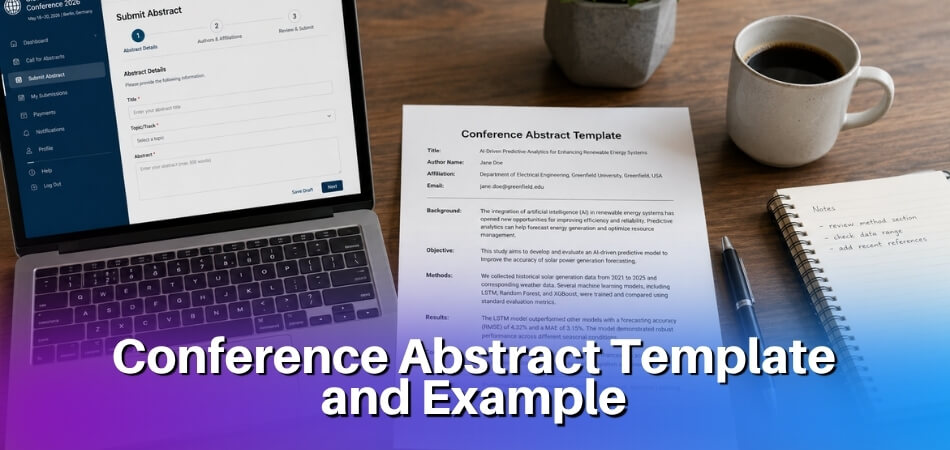
A strong conference abstract typically includes the following elements in this order: a clear, specific title; the author name and institutional affiliation; a body of no more than 300 words; five relevant keywords; a background or introduction section that states the research problem; a methodology section explaining how the study was conducted; a findings section summarizing the key results; and a conclusion or implication section explaining why those results matter. Whether you are writing a structured abstract with labeled sections or an unstructured abstract written as flowing prose, these components form the minimum standard that peer reviewers and conference committees expect to see.
This guide gives you every tool you need to write and submit with confidence. You will find a structured abstract template and an unstructured abstract template, ready to adapt to your own research. You will get field-specific examples covering STEM, humanities, social science, and medical and clinical conference submissions. There is a reviewer checklist so you can evaluate your own abstract before it reaches a committee, a breakdown of the Four C’s framework that strong abstracts follow, and a clear explanation of four distinct abstract formats — from the layman abstract and plain language summary to the full paper submission and abstract-only submission. By the end, writing a conference abstract will feel far less like guesswork.
What Does a Conference Abstract Include? (Direct Answer)
A conference abstract typically contains four core components: a background statement, a description of your methodology, a summary of key findings, and a brief implication or conclusion. Most conference submission guidelines also require a title, author affiliation, and a set of keywords. Some formats add a fifth element — an objectives or aims statement between the background and methodology.

That’s the short answer. Here’s what each piece actually means in practice.
The Background Section
This is your first sentence or two. It tells reviewers why the research exists — what gap, problem, or question you’re addressing. Keep it tight. A peer reviewer reading 200 submissions in a weekend doesn’t need three sentences of context before you get to the point.
One sentence is often enough. Two is fine. Three is too many.
The Methodology Section
Describe what you actually did. Not what you plan to do, not what “could be done” — what you did. Include your study design, data source, sample size, or analytical approach, depending on your field. A STEM abstract might say “randomized controlled trial, n=142.” A humanities abstract might describe a close reading of specific archival texts. Be concrete.
The Findings Section
This is the most important part of any conference abstract. Many researchers bury their results or hedge them with qualifiers. Don’t. State what you found, plainly. Numbers, outcomes, patterns — whatever your discipline counts as a result. If reviewers can’t identify your finding within 10 seconds of reading, you’ve written it wrong.
The Implication Section
What does your finding mean? Who should care, and why? This doesn’t need to be long — two sentences is standard. Spell out the practical or theoretical takeaway.
Beyond those four, a structured abstract format requires labeled headings (Background, Methods, Results, Conclusion) explicitly visible in the text. That’s common in medical and clinical conference abstracts. An unstructured abstract covers the same ground but flows as prose — more typical in social sciences and humanities.
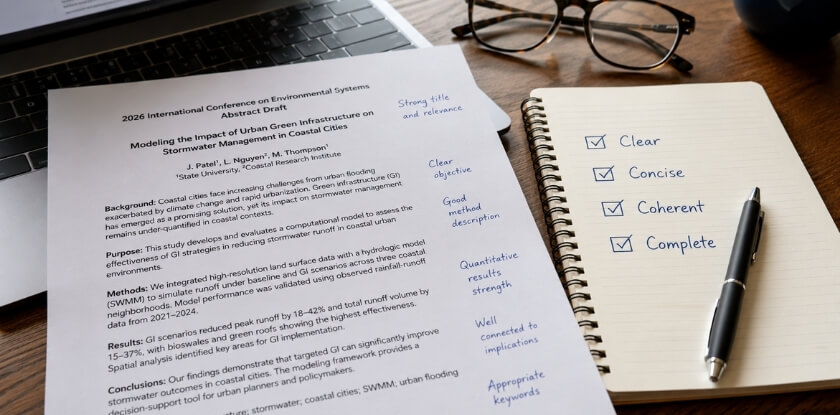
The Four C’s of an abstract — Clear, Concise, Compelling, Complete — are a useful internal checklist once you’ve drafted your content. They’re not a structure. They’re a quality filter.
One thing many early-career researchers miss: your abstract template should also account for word limit. Most conferences cap abstracts between 150 and 350 words. Some go up to 500 for structured formats. Check the conference submission guidelines before you write a single sentence — not after. Cutting a 400-word abstract down to 250 is painful, and you’ll usually lose the best parts.
Keywords matter more than people think. They affect how your abstract gets indexed in conference programs, databases, and increasingly in AI Overview results. Choose terms that are specific to your subfield, not just broad subject-area labels. “Machine learning” is too vague. “Transformer-based models for low-resource NLP” is searchable.
Conference Abstract Templates — Structured and Unstructured Formats
Most rejection letters don’t mention bad research. They mention a confusing abstract. The template you use — and how closely you follow it — often decides whether your work gets a slot at the conference or a polite pass.
There are two formats you’ll run into: structured and unstructured. Some conferences require one specifically. Others leave it up to you. Knowing both well means you’re never scrambling to reformat at the last minute.
Structured Abstract Template
A structured abstract uses labeled sections. Each section has a heading, and reviewers can scan it in seconds. This format is standard at medical conferences, clinical conference submissions, and a large chunk of STEM abstract submissions. If your conference submission guidelines specify “structured abstract,” this is what they mean.
Here’s a working template you can copy and adapt:
Title: [Descriptive and specific — ideally 10–15 words. Include your key variable and population.]
Author(s) and Affiliation: [Full name, department, institution, city, country. If multiple authors, list corresponding author clearly.]
Background: State the problem or gap in 2–3 sentences. What exists? What’s missing? Why does it matter enough to study?
Objective / Aim: One sentence. What were you trying to find, test, or answer?
Methods / Methodology: Describe your study design, sample size, data sources, and analytical approach. Be precise — “n = 240 adult participants” beats “a large sample.” Include time frame if relevant.
Results / Findings: Your actual numbers or outcomes. Not “results showed improvement” — write “scores improved by 34% (p < 0.01).” Reviewers spot vague results immediately.
Conclusions / Implications: What does this mean for the field? One or two sentences. Don’t overstate. Don’t undersell either.
Keywords: [4–6 terms. Match the conference’s subject vocabulary where possible.]
Word count: [Check against the conference word limit — usually 250–350 words for structured abstracts.]
A quick note on the sections: not every conference uses the same labels. Some use “Discussion” instead of “Conclusions.” Some medical abstract templates split “Results” and “Discussion” into separate headings. Always cross-check your conference’s exact required headings before you fill anything in.
Unstructured Abstract Template
An unstructured abstract is a single continuous paragraph — no section labels, no bold headings. It still covers the same ground (background, methodology, findings, implication), but it reads as flowing prose.
This format is the norm in humanities abstracts, many social science abstract submissions, and most arts conferences. It’s also common for shorter word limits (150–200 words).
Here’s a working template:
Title: [Can be more interpretive in humanities — a colon split often works: “Main Concept: Explanatory Subtitle”]
Author(s) and Affiliation: [Same as structured — don’t skip this even when the format feels informal.]
Abstract body (one paragraph, typically 150–300 words):
Open with the research problem or the question driving your work. Give enough context so a reviewer outside your subspecialty understands why this matters — but keep it tight, two sentences at most. Move directly into your approach: what sources, methods, or theoretical framework you used. Humanities abstracts often name specific texts, archives, or theoretical lenses here. Then state what you found or argue — this is where many writers go vague, and that’s a mistake. End with the contribution: what your findings add to the existing conversation, and ideally, why attendees at this specific conference should care.
Keywords: [3–5 terms]
Word count: [Match to the conference word limit]
The tone in an unstructured abstract can shift slightly by field. A philosophy abstract sounds different from a sociology one, even using the same template structure. Read two or three recent published abstracts from the same conference before you write yours — it calibrates your register fast.
Structured vs. Unstructured Abstract — Which Format Should You Use and When?
The short answer: use whatever the conference tells you to use. Always.
If the conference submission guidelines specify a format, that’s not optional. Submitting an unstructured abstract to a conference that requires structured format is a technical rejection waiting to happen — some committees don’t even send it to peer reviewers.
When there’s no specified format, the decision comes down to your field and your content.
Use a structured abstract when:
- You’re submitting to a medical, clinical, or life sciences conference
- Your research has clear, discrete stages (hypothesis → experiment → result → conclusion)
- Your word limit is 250 words or more
- Multiple reviewers with different specialties will read your submission — structured formatting helps them find what they need quickly
Use an unstructured abstract when:
- Your conference is in the humanities, arts, or interpretive social sciences
- Your argument unfolds through reasoning rather than data stages
- The word limit is under 200 words — section headers eat into that budget fast
- The conference explicitly uses “essay-style” or “narrative” abstract language in its guidelines
There’s one grey zone worth knowing: some social science abstract submissions can go either way. If you’re presenting quantitative social science research with a clean methods-results structure, a structured format actually serves you better even if it’s not required. If your work is ethnographic or theoretical, go unstructured.
One thing that doesn’t change between formats: The Four C’s of an abstract — Clear, Concise, Complete, Compelling — apply to both. A structured abstract with vague findings fails the same way an unstructured one does. The label on the section doesn’t do the work for you.
How to Write a Conference Abstract — A Step-by-Step Method

Step 1 — Read the Conference Guidelines and Understand the Word Limit
Before you write a single word, read the conference submission guidelines. All the way through. This sounds obvious, but most weak abstracts fail because the writer skipped this step.
Every conference sets its own rules. The word limit might be 150 words. It might be 500. Some conferences want a structured abstract with labeled sections. Others want a flowing paragraph. A few specify font size, margin width, and whether you can include a table. You cannot guess this — you have to check.
Pay close attention to:
- Word limit — Is it a hard cap or a guideline? Will the submission system reject you at 301 words if the limit is 300?
- Abstract type — Structured abstract or unstructured abstract?
- Keywords — How many? Controlled vocabulary (like MeSH terms for medical conferences) or free choice?
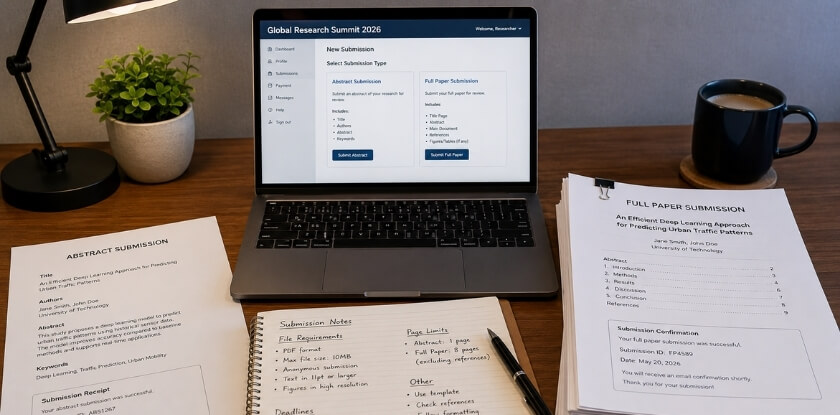
- Submission format — Abstract-only submission or does the full paper submission get reviewed separately?
Set up a document with these constraints at the top before you start drafting. Treat the word limit as a brief, not a suggestion.
Step 2 — Build Your Outline by Answering Four Core Questions
Don’t open a blank document and start typing. That’s how you end up with a rambling abstract that tries to say everything and communicates nothing.
Instead, answer these four questions in plain language first — a few bullet points each, no full sentences needed yet.
- Why does this research exist? What gap, problem, or question drove it?
- What did you actually do? Method, data source, sample size, analytical approach — just the key facts.
- What did you find? Your main result, not six results. One or two.
- So what? Who cares about this finding, and why does it matter beyond your own field?
These four questions map directly onto the Background, Methodology, Findings, and Implication sections of a structured abstract. But they’re also the skeleton of a strong unstructured abstract. Get your answers to these questions right, and the writing becomes a formatting exercise.
This is essentially The Four C’s of an abstract in action — Context, Content, Conclusion, and Contribution — just expressed differently. Whatever framework you use, the same logic applies.
Step 3 — How to Write Each Section (Background, Method, Findings, Implication)
Background section
One, maybe two sentences. State the problem or gap. Don’t write a literature review — that’s what the full paper is for. A conference abstract has no room for it.
Bad: “Numerous scholars have examined various dimensions of climate-related migration across multiple continents over several decades, and while significant progress has been made, gaps remain.”
Better: “Climate-related displacement in coastal Bangladesh remains chronically understudied at the household level.”
Be specific. Name the thing.
Methodology section
Reviewers want to know whether your findings are trustworthy. Tell them what you did. Sample size, data collection method, analytical framework — whatever is relevant to your field.
For a STEM abstract: name the experimental design, your n, and your primary measure. For a social science abstract: name your method (ethnographic fieldwork, survey, discourse analysis), sample, and timeframe. For a humanities abstract: describe your primary sources and interpretive framework. For a medical abstract or clinical conference abstract: include patient population, intervention, comparator, and outcome measure.
Keep it tight. Two to three sentences maximum in most cases.
Findings section
Give actual results. Numbers if you have them. Don’t write “significant results were observed.” Write “retention rates improved by 34% in the intervention group at 12 weeks.”
Vague findings are the single most common reason a peer reviewer ranks an abstract poorly. If your results aren’t ready yet — which happens with abstract-only submissions where data collection is still in progress — say what you expect to find and on what basis. Don’t pretend the data exists.
Implication section
Answer the “so what” question. Who benefits from this finding — clinicians, policymakers, educators, engineers? What should they do differently? Does this open a new research question?
One or two sentences. Don’t oversell. A clear, honest implication is more convincing than a sweeping claim about transforming an entire field.
Step 4 — Choosing Your Title and Keywords
Title
Your title is the first filter. A peer reviewer or conference chair reading 200 submissions will decide in three seconds whether yours is relevant. Title selection matters more than most researchers think.
A good abstract title does two things: it names the topic precisely, and it signals the finding or approach.
- Weak: “A Study of Online Learning Outcomes”
- Stronger: “Synchronous vs. Asynchronous Instruction: Completion Rates in Community College STEM Courses During 2021–2023”
Avoid vague openers like “An Investigation into…” or “Toward a Better Understanding of…” They waste title space. Get to the subject immediately.
For medical abstracts or structured abstract formats, some conferences specify a title character limit. Check that too.
Keywords
Keywords drive discoverability — both in conference programs and in post-conference databases. Choose terms that reflect your method, population, and topic. Don’t just repeat words from your title; add depth.
If the conference specifies a controlled vocabulary, use it exactly. If it’s free choice, think about what a researcher in your area would type into Google Scholar or PubMed to find work like yours. Use those terms.
Step 5 — Review and Edit Your Abstract Through a Reviewer’s Eyes
Once you have a draft, step away from it for at least a few hours. Then read it as if you’re a peer reviewer seeing it cold.
Here’s a practical reviewer checklist to run through before you submit:
- Does the background section state a clear problem? Or does it just describe a broad topic area?
- Is the methodology specific enough to evaluate? Could another researcher replicate the design from what you’ve written?
- Are the findings concrete? Any vague phrases like “results showed promise” or “outcomes were generally positive” need to be replaced with actual numbers or specific conclusions.
- Does the implication section answer “so what”? If it just says “this contributes to the literature,” cut it and try again.
- Is it within the word limit? Count carefully. Don’t assume.
- Are keywords relevant and specific? Not just broad disciplinary terms.
- Does the title match what the abstract actually delivers?
Then have someone outside your immediate research group read it. If they can’t explain back to you what you did and why it matters, the abstract isn’t clear enough — regardless of whether they’re a specialist.
Run the abstract against the conference submission guidelines one more time before you hit submit. Check the format, the file type, the author affiliation fields, and the keyword count. Small administrative errors have caused otherwise strong abstracts to be desk-rejected. Don’t let yours be one of them.
The Four C’s of an Abstract — What Every Strong Abstract Must Have
Every strong conference abstract shares four qualities. Reviewers may not name them explicitly, but they’re scanning for all four — consciously or not. Miss one and your abstract feels incomplete. Nail all four and it reads like a submission that belongs at the conference.

These are: Clarity, Concision, Completeness, and Contribution.
Clarity
Your abstract should be readable on the first pass. Not the third. Not after someone looks up your jargon.
This doesn’t mean dumbing things down. It means writing sentences that move in one direction. A peer reviewer reading thirty abstracts in a sitting doesn’t have patience for a sentence that bends back on itself three times.
A practical test: read your abstract aloud. If you stumble, the sentence is probably too dense. Cut it apart or rephrase.
Field-specific terminology is fine — expected, even. But unexplained acronyms, nested clauses, and passive constructions stacked on top of each other are not fine. “Data were collected using a mixed-methods approach which sought to explore variables previously identified in literature as potentially significant” says almost nothing. Compare: “We used surveys and interviews to examine two factors known to predict dropout rates.”
Same information. Very different clarity.
Concision
Word limits exist for a reason. Most conferences cap abstracts at 200–350 words. Some go up to 500 for structured abstracts in clinical or medical contexts. A few allow only 150.
Concision isn’t just about fitting inside that word limit. It’s about using every word you do have. Filler phrases waste space that could carry meaning. “The purpose of this study is to investigate” = “This study investigates.” That’s three words saved in one fix.
Go through your draft and cut:
- Throat-clearing openers (“This paper will attempt to…”)
- Redundant pairs (“various different”, “new innovation”)
- Hedges that add nothing (“somewhat”, “rather”, “quite”)
Short sentences carry weight. Use them.
Completeness
A complete abstract covers the four standard components — background, methodology, findings, and implication — even in an unstructured format. You don’t need subheadings for all four to be present.
This is where many abstracts fail. Writers spend 80% of their word count on background and squeeze findings into one vague line. Reviewers notice. The findings section is often what determines acceptance. What did you actually find? Be specific.
If your study produced a measurable result, put the number in the abstract. “Response rates improved” is weaker than “Response rates improved by 34% after the intervention.” One is a claim. The other is a finding.
For an abstract-only submission — where there’s no full paper submission attached — completeness matters even more. The abstract is the entire case you’re making.
Contribution
This is the one most writers leave implicit when it needs to be explicit.
What does your research add? Not what exists in the field. What does your work contribute that wasn’t there before?
The implication section is where this lives, but contribution can bleed into the opening too. Setting up the gap your research fills is part of making the contribution visible. A strong conference abstract tells the reviewer: here’s what we didn’t know, here’s what we did, here’s what we found, and here’s why that changes something.
That last part — why it changes something — is your contribution. One or two sentences. Direct.
Taken together, the Four C’s work as a self-check. Before you submit, read through your draft and ask: is every sentence clear? Is every word earning its place? Are all four components present? And have I actually said what my work contributes?
If the answer to all four is yes, you’ve got a strong abstract.
Field-Specific Conference Abstract Examples
The structure advice covered earlier applies everywhere, but what a strong abstract actually looks like changes a lot depending on your discipline. A STEM abstract reads nothing like a humanities abstract. The word choices, the emphasis, what counts as “evidence” — all of it shifts. Below are realistic examples you can study, adapt, and use as reference points when you sit down to write your own.
Science and STEM Abstract Example
STEM abstracts are tight. Reviewers expect numbers, methods, and results. If your findings section says “results showed improvement,” that’s not good enough. Show the improvement. Exactly how much?
Here’s a sample STEM abstract for a materials science conference:
Title: Low-Temperature Synthesis of Zinc Oxide Nanoparticles for Photocatalytic Degradation of Industrial Dye Effluents
Abstract: Industrial textile dyeing generates high volumes of toxic effluent that conventional wastewater treatment fails to fully remediate. This study investigates a low-temperature sol-gel synthesis route for zinc oxide (ZnO) nanoparticles and evaluates their photocatalytic efficiency against methylene blue (MB) dye under UV irradiation. Nanoparticles were synthesized at 60°C and characterized via X-ray diffraction (XRD) and scanning electron microscopy (SEM). Photocatalytic trials were conducted over 120 minutes using a 50 ppm MB solution under 365 nm UV light. Results showed 94.7% degradation of MB within 90 minutes — significantly higher than commercially sourced ZnO (71.3% under identical conditions). These findings suggest that low-temperature synthesis produces smaller particle sizes with higher surface area, directly improving catalytic activity. This approach offers a cost-effective route to scalable photocatalytic water treatment applicable to small-scale textile manufacturers in low-resource settings.
Keywords: zinc oxide nanoparticles, photocatalysis, methylene blue, sol-gel synthesis, wastewater treatment
Notice what’s happening here. The background is one sentence. The method is specific enough that another researcher could replicate the setup. The result is a number, not a vague positive outcome. And the implication points to a real-world application without overclaiming. Word count: 163. Well within a typical 250-word limit.
One thing STEM authors get wrong: they spend too long on background and run out of space for findings. Reviewers already know the general problem space. Get to what you did.
Humanities Abstract Example
Humanities abstracts work differently. There often isn’t a “methodology” in the experimental sense, and that’s fine. What reviewers want to see is your argument, your sources or texts, and your contribution to the scholarly conversation. The language can be more interpretive, but it still needs to be clear.
Vague thesis statements kill humanities abstracts. “This paper explores the relationship between X and Y” tells a reviewer nothing. What’s your actual claim?
Title: “The Archive Writes Back”: Colonial Memory and Counter-Narrative in Chimamanda Ngozi Adichie’s Half of a Yellow Sun
Abstract: This paper argues that Chimamanda Ngozi Adichie’s Half of a Yellow Sun (2006) functions as a deliberate act of archival reclamation — a literary counter-archive to the silences imposed by British colonial documentation of the Nigeria-Biafra War (1967–1970). Drawing on postcolonial archival theory, particularly Ann Laura Stoler’s work on the colonial archive as an instrument of governance, and Saidiya Hartman’s concept of “critical fabulation,” I examine how Adichie embeds competing historical accounts within her fictional structure to expose the constructed nature of official historiography. Close readings of the novel’s nested manuscript — written by a minor character, Richard Churchill — reveal how Adichie deliberately displaces the Western eyewitness narrator to centre Igbo testimony. Rather than supplementing historical record, the novel performs what I term “testimonial inversion,” elevating survivor voice above archival authority. This challenges established critical readings of the novel as straightforwardly realist and opens new directions for reading Afro-diasporic fiction as an archival practice rather than a historical supplement.
Keywords: postcolonial fiction, archival theory, Nigeria-Biafra War, counter-narrative, Adichie
This abstract has a clear thesis, named theoretical frameworks, a specific analytical move (close reading of the nested manuscript), and a contribution claim that other scholars can actually engage with. It’s 196 words. Focused.
The phrase “this paper argues” is your friend in humanities abstracts. Don’t bury your actual claim in the final sentence — state it early.
Social Science Abstract Example
Social science sits between STEM and humanities. You usually have a methodology worth naming, but your framing and theoretical positioning also matter to reviewers. Mixed-methods studies, survey data, ethnographic fieldwork — spell out what you did and how many participants, cases, or data points you worked with.
Title: Gig Economy Precarity and Psychological Wellbeing: Evidence from Ride-Hailing Workers in Lagos and Nairobi
Abstract: Gig economy platforms in sub-Saharan Africa have expanded rapidly since 2016, yet worker wellbeing in this sector remains underexamined in African urban contexts. This paper presents findings from a mixed-methods study examining the relationship between income precarity and psychological wellbeing among ride-hailing drivers in Lagos, Nigeria (n=214) and Nairobi, Kenya (n=189). Quantitative data were collected via structured survey, including the WHO-5 Wellbeing Index and a custom income volatility scale. In-depth interviews were conducted with a purposive subsample (n=28 across both cities). Logistic regression analysis showed that high weekly income volatility predicted significantly lower wellbeing scores (OR: 2.41, 95% CI: 1.78–3.26), after adjusting for age, family size, and platform tenure. Thematic analysis of interview data identified “earning anxiety” as a distinct affective state not fully captured by existing precarity frameworks. The study contributes original empirical data to debates on platform labour governance and suggests that wellbeing support mechanisms — including earnings floors and variance buffers — should be integrated into ride-hailing platform policy in African urban markets.
Keywords: gig economy, precarity, psychological wellbeing, ride-hailing, sub-Saharan Africa, platform labour
Specific sample sizes. Named instruments. A concrete statistical result. A qualitative finding that adds something the numbers couldn’t. This is what a solid social science abstract looks like. Reviewers can evaluate your claims because you’ve given them enough to work with.
Medical and Clinical Conference Abstract Example
Medical and clinical conference abstracts often follow the most rigid structure of any discipline. Many medical conferences require a formally structured abstract — with explicitly labelled sections like Background, Objective, Methods, Results, and Conclusions. Some conferences, particularly surgical or pharmacological ones, also require trial registration numbers or ethical approval statements.
Word limits here are often strict: 250–300 words is typical, and some major medical conferences enforce 250 words as a hard cap. Go over, and your submission may be auto-rejected without review.
Title: Comparative Outcomes of Laparoscopic Versus Open Appendectomy in Paediatric Patients With Perforated Appendicitis: A Retrospective Cohort Study
Background: Perforated appendicitis in paediatric patients carries elevated risk of post-operative complications. Whether laparoscopic appendectomy (LA) offers superior outcomes over open appendectomy (OA) in this population remains contested.
Objective: To compare 30-day complication rates, length of hospital stay, and readmission rates between LA and OA in children aged 2–16 with confirmed perforated appendicitis.
Methods: Retrospective cohort study using electronic health records from three tertiary paediatric centres (2017–2023). Patients with confirmed perforation on CT imaging or intraoperative findings were included. Primary outcome was 30-day surgical site infection (SSI). Secondary outcomes included length of stay (LOS), intra-abdominal abscess, and 30-day readmission. Statistical analysis used multivariable logistic regression, adjusted for age, ASA score, and time-to-surgery.
Results: 476 patients were included (LA: n=291; OA: n=185). LA was associated with significantly lower SSI rates (8.2% vs. 17.3%; aOR 0.41, 95% CI 0
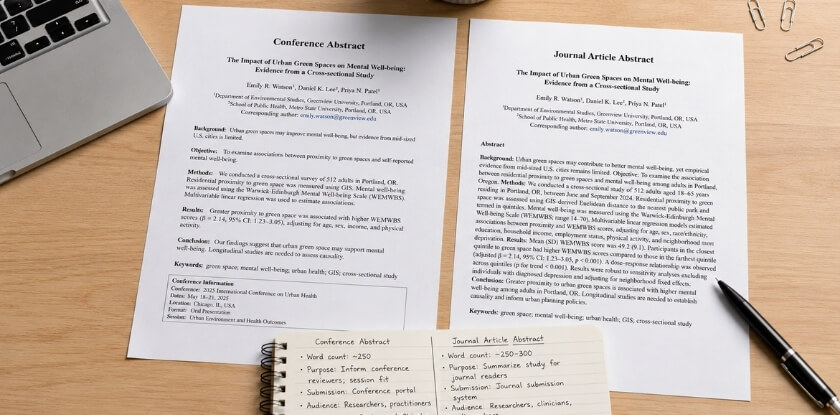
Conference Abstract vs. Journal Article Abstract — What Is the Difference?
Most researchers treat these two document types as interchangeable. They’re not. Submitting a conference abstract written like a journal abstract — or vice versa — is one of the fastest ways to get a rejection or a weak score from a peer reviewer.

Here’s the core difference: a conference abstract is a standalone pitch. A journal article abstract is a summary of work that already exists in full.
Purpose Is Different
A journal article abstract sits at the top of a published paper. Its job is to summarize what the reader will find if they keep reading. The full paper is right there. The abstract serves as a preview.
A conference abstract does something else entirely. It asks a selection committee to accept your work — often before the research is finished, and sometimes as an abstract-only submission with no full paper behind it. It’s a proposal as much as a summary.
That shift in purpose changes everything about how you write it.
Structure and Word Limit
Journal abstracts tend to follow strict journal-specific formatting. Many high-impact medical and scientific journals require a structured abstract with fixed section labels — background, methods, results, conclusions — often capped at 250 to 300 words.
Conference abstracts vary far more. Some conferences want 150 words. Some want 500. Some use a structured abstract format, some prefer unstructured abstract prose. You absolutely have to read the conference submission guidelines before you write a single sentence. What works for one event will get flagged at another.
The “Completed Research” Assumption
Here’s where many early-career researchers trip up.
A journal abstract describes completed, peer-reviewed work. Past tense. Everything is done. “We found,” “the results showed,” “we concluded.”
A conference abstract — especially for a large academic conference — often gets submitted months before the event. The research may still be in progress. In that case, you describe what you are doing and what you expect to find, with preliminary results if you have them. Some conferences explicitly allow this. Others don’t. Check.
If you’re submitting to a clinical conference abstract track in medicine or public health, completed data is usually non-negotiable. They won’t accept projected outcomes.
Audience Expectations
A journal abstract is read by specialists in your field. You can assume vocabulary, methodology familiarity, and context.
A conference abstract often goes to a broader review panel. The person scoring your abstract might be adjacent to your subfield, not deep inside it. That means your background section needs to do a little more work — enough context that someone slightly outside your area can see the relevance immediately.
This is also why keywords matter more in conference submissions than people realize. Selection committees search submitted abstracts by topic. If your keywords don’t match the conference’s session themes, your abstract gets routed poorly or missed.
Tone and Emphasis
Journal abstracts are neutral and descriptive. They report. The findings section and methodology section carry equal weight.
Conference abstracts — particularly for competitive slots or keynote consideration — benefit from a slightly stronger emphasis on the implication section. Why does your work matter to this audience, at this event? Reviewers are thinking about program fit, not just scientific rigor.
A humanities abstract for a literature conference should feel different in tone from a STEM abstract for an engineering symposium. The journal version of either paper would strip back that framing. The conference version needs it.
One Practical Table
| Feature | Conference Abstract | Journal Article Abstract |
|---|---|---|
| Audience | Selection committee + attendees | Journal readers, researchers |
| Research status | Often in progress | Always complete |
| Word limit | 150–500 (varies widely) | 150–300 (journal-specific) |
| Structure | Varies by conference | Often fixed by journal style |
| Purpose | Get accepted | Summarize published work |
| Keywords | Critical for program routing | Important for indexing |
| Tone | Can emphasize implications | Neutral and descriptive |
Can You Reuse One as the Other?
Sometimes, but rarely without edits. If your paper gets accepted by a journal after you’ve already presented at a conference, the two abstracts will likely diverge. The journal article abstract will become more precise once all data is in and peer review has shaped the framing. The original conference abstract may have been written speculatively.
Don’t just copy-paste and assume they’re the same document. They were written for different readers at different moments in the research lifecycle. Treat them that way.
How Reviewers Evaluate a Conference Abstract
Most researchers spend days writing a conference abstract and almost no time thinking about who reads it and how. That’s a mistake. Understanding the reviewer’s process changes what you prioritize.
Conference abstract reviewers are usually academics in your field — or adjacent to it. They’re reading dozens, sometimes hundreds, of submissions in a compressed window. They’re tired. They’re not hunting for reasons to accept yours. They’re looking for quick signals that tell them whether your work belongs at this conference.
Here’s what that means in practice.
What Reviewers Actually Look For
Most review panels use a scoring rubric, even if it’s informal. The categories vary by conference, but a few criteria show up almost universally.
- Relevance to the conference theme. This gets checked first. If your abstract doesn’t map clearly to the conference’s scope, it gets rejected regardless of quality. Always read the conference submission guidelines before you write a single word.
- Clarity of the research problem. Reviewers want to know what you studied and why it matters — fast. A vague or buried background section fails this immediately.
- Methodological credibility. In STEM abstracts, medical abstracts, and social science abstracts, reviewers pay close attention to whether your methodology section gives enough detail to assess soundness. You don’t need to list every tool. But they want to know your approach was principled.
- Significance of findings. Weak abstracts describe work. Strong abstracts tell reviewers what the work means. Your findings section and implication section carry more weight than most people realize.
- Fit with the word limit. Submissions that ignore the word limit signal carelessness. Peer reviewers notice. Some scoring systems flag overlength submissions automatically.
The Reviewer Checklist — What Gets Scored
Here’s a practical reviewer checklist based on common conference evaluation rubrics. Use this to self-audit before you submit.
- Does the abstract state a specific research question or problem?
- Is the context established clearly in the background section?
- Does the methodology section explain how the study was conducted?
- Are the findings concrete — numbers, outcomes, patterns — not vague summaries?
- Does the implication section connect results to the broader field?
- Is the abstract within the stated word limit?
- Are keywords present and accurate?
- Is the title selection strong — specific, not generic?
- Is author affiliation listed correctly?
- Is the writing clear enough for a reviewer who isn’t a narrow specialist?
That last point matters more than people expect. Even at highly technical conferences, reviewers aren’t always specialists in your exact sub-area. Jargon-heavy abstracts lose reviewers early. This is partly why plain language summary conventions from clinical conference abstract guidelines are now bleeding into other fields — because clarity scores well.
Structured vs. Unstructured — Does Format Affect Scoring?
Yes, indirectly. A structured abstract forces you to address each criterion explicitly. Reviewers can scan it faster. That reduces the chance they miss your strongest point. An unstructured abstract gives you more flexibility, but it also gives you more ways to accidentally skip something.
If the conference submission guidelines don’t specify a format, structured usually plays it safer for empirical work. Humanities conferences typically prefer unstructured prose — fitting the conventions of a humanities abstract — and reviewers there will read differently, looking more at argument quality and scholarly positioning than methods detail.
Common Reasons Abstracts Get Rejected
Knowing the reject patterns is useful. These come up repeatedly in reviewer feedback across disciplines.
- Overpromising. Saying your findings “revolutionize” or “fundamentally transform” something without evidence. Reviewers are skeptical by nature.
- No clear outcome. Abstract-only submissions that describe a study without reporting any results — unless the conference explicitly invites work-in-progress — signal an incomplete submission.
- Too broad. An abstract trying to cover too much reads as unfocused. Reviewers interpret that as unclear thinking, not ambition.
- Mismatched title. If the title selection doesn’t match the content of the abstract, reviewers notice. It suggests the work shifted after the title was written — or that the abstract was recycled from something else.
- Generic methodology. Saying “a qualitative approach was used” without any additional detail doesn’t satisfy reviewers who need to assess rigor. Even two or three specifics help.
What a High-Scoring Abstract Looks Like to a Reviewer
It answers the right questions in the right order. The research problem is clear within the first two sentences. The methods are identifiable. The findings are stated, not implied. The implications give the reviewer a reason to want to hear more at the actual conference.
That’s really it. A conference abstract doesn’t need to be elegant literature. It needs to be a reliable preview of work worth putting on a program. If your abstract delivers that, reviewers will score it accordingly.
Common Mistakes to Avoid When Writing a Conference Abstract
Most rejected abstracts don’t fail because the research is bad. They fail because the abstract is written badly. Reviewers read dozens — sometimes hundreds — of submissions. A single avoidable mistake can cost you a spot at the conference.

Here are the ones that show up most often.
Writing It as a Summary of Plans, Not Actual Results
This is the single most common rejection trigger. Phrases like “results will be discussed” or “findings are expected to show” tell reviewers nothing useful. If your conference submission guidelines allow abstract-only submissions before the full paper is finished, you still need to present actual preliminary findings — not promises.
Reviewers want to know what you found. Give them that, even if it’s early-stage data.
Ignoring the Word Limit
Every conference has one. Some cap abstracts at 250 words. Others allow 500. A few medical conferences using structured abstract formats push to 600.
Going over the word limit is an instant disqualification at many conferences. Going significantly under it is almost as bad — it signals that you haven’t developed your ideas enough. Read the conference submission guidelines carefully, then count your words before you submit. Don’t estimate.
Burying the Research Question
Your background section exists to set context, not to tell the history of your field. Two or three sentences on why the problem matters is enough. If a peer reviewer hits sentence six of your abstract and still doesn’t know what you actually studied, the abstract isn’t working.
Get to the point fast. This matters in a structured abstract and even more so in an unstructured one, where there are no headings to anchor the reader.
Using Jargon Without Justification
Know your audience. A STEM abstract submitted to a specialized physics conference can use technical terminology freely. A social science abstract submitted to an interdisciplinary conference probably can’t. If your conference draws a mixed audience, write as if the reviewer across the table is smart but not in your subfield.
Some funding bodies and public-facing conferences now ask for a plain language summary alongside the formal abstract. That’s a separate document — don’t confuse the two — but writing a layman abstract draft first can actually help you strip jargon from your main abstract before you realize it’s there.
Weak or Missing Implications
The implication section is often the last thing writers add and the first thing they cut when they’re over the word limit. That’s backwards. Reviewers want to know why your findings matter to someone beyond your immediate research group.
One or two sharp sentences on the implication of your work — practical, theoretical, clinical, whatever fits — does more for your acceptance odds than an extra sentence of methodology.
Mismatched Title
Your title sets expectations. If your abstract title promises a comparison study but your methodology section describes a single-cohort observation, reviewers notice the disconnect immediately. The title selection should accurately reflect what the abstract delivers.
Keep the title specific. Vague titles like “A Study of Factors Affecting Student Outcomes” tell reviewers almost nothing. Something like “Peer Mentorship Duration and First-Year Retention Rates in Community College Settings” tells them exactly what they’re evaluating.
Skipping Keywords Entirely
If the conference requires keywords, treat them seriously. Keywords affect how your abstract gets routed to relevant reviewers and, for published conference proceedings, how searchable your work becomes. Choose terms that reflect actual search behavior in your field — not synonyms of your title words, which add nothing.
For a medical abstract or clinical conference abstract, standard controlled vocabulary (like MeSH terms) often applies. Check the conference submission guidelines on this specifically.
Copying Structure from a Journal Article Abstract
A journal article abstract and a conference abstract serve different purposes. A journal abstract assumes the reader can access the full paper. A conference abstract often stands completely alone — especially in abstract-only submission scenarios.
That means your conference abstract needs to be self-contained. You can’t lean on “see Section 3 for full analysis” because there is no Section 3. Everything the reviewer needs to evaluate your work has to be right there in 250 to 500 words.
Not Applying the Four C’s Before You Submit
Before hitting submit, run your abstract against The Four C’s of an abstract: Clear, Concise, Compelling, and Complete. It’s a fast self-check that catches most of the problems listed above.
Clear — can someone outside your immediate subfield understand what you did and why? Concise — is every sentence earning its place? Compelling — is there a reason a program committee would want this presented? Complete — does it cover background, methodology, findings, and implication?
If the answer to any of those is no, you know exactly where to revise.
One more thing. Don’t write the abstract first. Write it last, after you’ve drafted or at least outlined the full paper. The abstract should reflect work you actually understand end-to-end — not research you’re still figuring out as you write. That shift alone tends to make abstracts sharper, more confident, and far easier for peer reviewers to say yes to.
Layman Abstract — How to Write an Abstract for a Broader, Non-Expert Audience
Most conference abstracts are written for a room full of specialists. But that’s not always who reads them.
Interdisciplinary conferences, public-facing symposia, science communication events, and funding body showcases often attract people with no background in your specific field. In those contexts, the standard abstract — packed with discipline-specific terminology and assumed prior knowledge — falls flat. That’s where the layman abstract comes in.
It’s also called a plain language summary. Same research. Completely different communication strategy.
What a Layman Abstract Actually Is
A layman abstract isn’t a dumbed-down version of your research. That framing will get you into trouble fast — it leads to oversimplification, loss of accuracy, and a tone that can come across as condescending.
Think of it differently. You’re translating, not simplifying. The goal is to make your work accessible without making it wrong.
These are increasingly required. Research councils, public health bodies, and interdisciplinary conferences often ask for a plain language summary alongside the standard structured or unstructured abstract. Word limits are usually tighter — 150 words is common — and the vocabulary requirements are strict. Some guidelines specify a maximum reading level (Grade 8 or below, for example).
The Core Shift in How You Write
Technical abstracts lead with methodology and background. Layman abstracts lead with why it matters.
Your typical conference abstract might open: “This study examines the neurological mechanisms underlying hippocampal atrophy in patients with early-onset Alzheimer’s disease using fMRI longitudinal analysis.”
A layman version of that same opening: “We wanted to understand why memory loss starts so early in some people with Alzheimer’s — and what’s happening in the brain when it does.”
Same research. The second version doesn’t talk down to anyone. It just removes the jargon barrier.
Here’s the shift in structure you need to make:
Standard abstract order: Background → Methodology → Findings → Implications
Layman abstract order: Problem (in human terms) → What we did → What we found → Why it matters to real people
The methodology section shrinks dramatically. Reviewers and specialists care about how you did it. A general audience cares about what you found and what changes because of it.
Step-by-Step: Writing Your Plain Language Summary
1. Write your technical abstract first. Don’t try to write the layman version cold. Get your full, accurate, technical summary down first. That becomes your source document.
2. List every piece of jargon. Go line by line. Underline every term a non-specialist might not know — including things you’ve stopped noticing, like “cohort study,” “regression analysis,” or “p-value.”
3. Replace or explain each one. Not every term needs to disappear. Some can be briefly explained in parentheses the first time. But if you’re using more than one or two of those parenthetical explanations, you’re leaning on jargon too heavily.
4. Rewrite the opening around the human problem. Ask yourself: who is affected by this issue in real life? Start there. “Every year, X number of people experience Y” is a far more effective layman opening than a background section referencing prior literature.
5. Cut the methodology to one sentence. Seriously, one sentence is usually enough. “We surveyed 400 adults across three cities” or “We analysed 10 years of hospital records.” If your method is genuinely unusual or noteworthy for a general audience, give it two. No more.
6. Lead your findings with outcomes, not statistics. “We found that patients who received the intervention were twice as likely to recover within 30 days” works. “The intervention group demonstrated statistically significant improvement (p < 0.01) across primary outcome measures” does not.
7. End with a concrete implication. What should change? What can someone do, advocate for, or think differently about because of your work? Make it tangible. “This suggests that early screening at age 50, rather than 65, could catch the condition before major damage occurs” is the kind of ending a general reader actually remembers.
Common Traps to Avoid
Passive voice overload. Academic writing defaults to passive constructions. “Data were collected and analysed” works in a journal article abstract. In a plain language summary, “we collected data from 200 patients over six months” is cleaner and easier to follow.
Assuming shared context. You know your research field’s current debates and landmark studies. Your reader doesn’t. Don’t reference them as if they’re obvious.
Burying the finding. This is the biggest mistake. Researchers trained to present methodology rigorously sometimes spend 80% of their layman abstract on background and method, leaving one rushed sentence for findings. Flip that ratio.
Making it vague to avoid being wrong. Overcautious hedging produces abstracts that say nothing. “The results may have potential implications for future policy directions” tells a general reader exactly nothing. Be specific about what you found, even if you also note limitations.
When Conference Submission Guidelines Require Both
Some conferences now require you to submit both a standard abstract and a plain language summary as separate fields in the submission form. Read the conference submission guidelines carefully before you start writing either one.
If the form asks for both, write them as genuinely separate documents — not the same text reformatted. They serve different readers. Peer reviewers will read your technical abstract. A conference organiser deciding which sessions to market to a wider public, a journalist covering the event, or a funding body reading your submission summary will read the plain language version.
Word limits differ too. Your technical abstract might have a 300-word limit. The plain language summary might cap at 150. Plan for that gap before you start writing, not after.
A Quick Before/After Example
Technical version (STEM abstract, medical): “Longitudinal analysis of EHR data across 12 hospital sites (n=8,400) revealed a statistically significant association between delayed antibiotic administration and 30-day mortality in sepsis patients (HR 1.43, 95% CI 1.21–1.69, p<0.001), independent of comorbidity burden.”
Layman version: “We looked at health records from more than 8,000 sepsis patients treated at 12 hospitals. Patients who received antibiotics within the first hour of diagnosis were significantly less likely to die within 30 days than those who experienced delays. The finding held true regardless of whether patients had other health conditions. Faster treatment decisions could save lives — and that has direct implications for emergency department protocols.”
Same data. Neither version is wrong. They’re just written for different people, which is exactly the point.
Full Paper Submission vs. Abstract-Only Submission — What Is Different?
Not every conference works the same way. Some want your abstract first, then invite the full paper if accepted. Others only ever want the abstract — and that’s it, that’s the entire submission. Knowing which type you’re dealing with changes how you write, what you include, and what happens after you hit submit.

The Two Tracks, Explained Simply
An abstract-only submission means the conference publishes or presents based solely on what’s in those 250–350 words. No full paper follows. This is common in humanities conferences, many social science gatherings, and large interdisciplinary events. Your abstract is the scholarship being evaluated.
A full paper submission uses the abstract as a gatekeeper. Reviewers read your abstract first, decide if the research fits the conference’s scope, and then — if you pass that stage — you submit the complete research paper. The abstract here is essentially a pitch.
Both formats still require a strong conference abstract. The stakes are just slightly different.
How Your Writing Should Shift
For abstract-only submissions, completeness matters more. Since reviewers and attendees never see a full paper, your findings section and implication section carry more weight. Vague phrases like “results will be discussed” are basically disqualifying. You need actual findings, actual claims. If your data isn’t ready yet and the conference is abstract-only, that’s a problem you need to think through before submitting.
For full paper submissions, the abstract functions more like an executive summary. You still need all the core components — background, methodology, findings, implications — but reviewers know they’ll see the full paper if they advance your submission. A peer reviewer evaluating an abstract-gated full paper submission is partly asking “does this project look complete and credible?” rather than “is this the entire intellectual contribution?”
That said, don’t use this as a reason to write a weaker abstract. First impressions carry.
Word Limit and Structural Expectations
Most conference submission guidelines specify word limits separately for each track. Abstract-only submissions often allow 300–500 words — slightly more room than the 150–250 word abstracts common in full paper pipelines. Some conferences also require a structured abstract format (with explicit Background, Methods, Findings headers) specifically for one track but not the other.
Read the guidelines carefully. Don’t assume the same template works for both.
Keywords and Author Affiliation
Both submission types typically ask for keywords and author affiliation. In full paper submissions, these details appear again on your actual paper. For abstract-only submissions, they carry more indexing importance — keywords are how your abstract gets found in conference programs, and in some cases, how it surfaces in AI Overview results or featured snippets if the conference publishes abstracts publicly.
If your abstract appears in a searchable proceedings database, keyword selection directly affects discoverability. That matters whether you’re submitting a STEM abstract, a clinical conference abstract, or a humanities abstract.
After Acceptance — What You’re Actually Committing To
This is where researchers sometimes get caught off guard. Abstract-only acceptance usually means you’re presenting at the conference, full stop. No follow-up document required. Full paper submission acceptance means you need to deliver a complete, polished research paper by a separate deadline — often 6–10 weeks after the abstract acceptance notification.
Miss that deadline and you may lose your presentation slot. Some conferences also tie publication in their proceedings directly to full paper submission. So if you’re aiming for a citation-worthy proceedings entry, confirm early whether abstract-only submissions are included in the published volume or not.
One Practical Check Before You Submit
Pull up the conference submission guidelines before you finalize anything. Look for these three things specifically:
- Does the conference expect a full paper after acceptance, or is the abstract the final deliverable?
- What’s the exact word limit for your submission type?
- Are proceedings publications tied to full paper delivery?
Two minutes with those guidelines saves significant confusion later.
FAQ
How long should a conference abstract be?
Most conferences set a word limit between 200 and 500 words. The most common target is 250–300 words. Always check the conference submission guidelines first — some fields run shorter (150 words for certain medical conferences), and some interdisciplinary events allow up to 750. When in doubt, aim for 250 words and cut from there.
What is the difference between a structured and an unstructured abstract?
A structured abstract uses labeled sections — Background, Methodology, Findings, Implication — with each one visually separated. An unstructured abstract covers the same ground in flowing paragraph form, without headers. STEM and medical conferences almost always want the structured format. Humanities and social science conferences tend to prefer unstructured prose.
Do I need to include keywords in my abstract?
Many conferences ask for 3–6 keywords below the abstract. Even when they’re optional, include them. Keywords affect how your abstract gets indexed, searched, and assigned to the right peer reviewers. Pick terms that match the language your field actually uses — not synonyms you prefer.
Can I submit an abstract before the full paper is written?
Yes. Abstract-only submission is standard at most academic conferences. You’re committing to present the work, not to deliver a finished paper. That said, your findings section should reflect real results, not speculative ones you hope to have by conference day.
What makes a reviewer reject an abstract?
The most common reasons: unclear research question, vague or missing methodology, no findings (just promises of findings), and exceeding the word limit. A weak title hurts too. Reviewers read dozens of abstracts in a session — if yours doesn’t land the point in the first two sentences, it’s already fighting an uphill battle.
Should my conference abstract match my journal article abstract exactly?
No. A journal article abstract speaks to readers of a specific publication. A conference abstract is a pitch to a selection committee, often from mixed backgrounds. The framing, emphasis, and sometimes the level of technical detail will differ. Write each one fresh for its audience.
What are The Four C’s of an abstract?
The Four C’s — Context, Contribution, Conclusions, and Credibility — are a practical checklist for making sure your abstract covers what reviewers actually look for. Context sets up the problem. Contribution explains what you did. Conclusions give your findings. Credibility signals that the methodology holds up. If any of the four is missing, the abstract feels incomplete.
Do I need to write a layman abstract as well?
Some conferences — particularly in health research, public policy, and interdisciplinary fields — ask for a plain language summary alongside the main abstract. It’s written for a non-specialist reader: no jargon, no assumed knowledge, usually 100–150 words. Check your conference submission guidelines to see if it’s required or optional.
How important is the title?
Very. Title selection affects whether reviewers even read your abstract carefully. A good title is specific, contains your key concept, and ideally signals your findings or angle. “A Study on Climate Policy” loses to “Carbon Tax Implementation and Industry Compliance Rates in Emerging Economies” every time.
Can AI tools write my conference abstract for me?
They can draft one. But AI-generated abstracts tend to be generic, miss field-specific norms, and often misrepresent your actual methodology or findings if the tool doesn’t have access to your full research. Use AI to pressure-test your draft or check clarity — not to replace your own writing. Reviewers notice when an abstract doesn’t match the work being described.
Conclusion — Write Your Abstract Now
You’ve covered the whole picture — templates, examples, reviewer checklists, common mistakes, field-specific formats, the difference between a layman abstract and a technical one. Now there’s only one thing left to do: write the abstract.
Don’t wait until the night before the conference submission deadline.
Seriously. A conference abstract that gets accepted is almost never written in one sitting. The best ones go through at least two or three drafts. You write a rough version, step away, then come back and ask: does this actually tell the reviewer what I did, why it matters, and what I found? If you can’t answer yes to all three, it needs another pass.
Here’s a simple way to start if you’re staring at a blank page. Open your abstract template — structured or unstructured, depending on what the conference submission guidelines ask for. Write one sentence for each section: background, methodology, findings, implication. Don’t worry about the word limit yet. Just get something down. Four ugly sentences beat four hours of nothing.
Then refine. Cut anything the reviewer doesn’t need. Add your keywords naturally. Check your title selection against what the abstract actually delivers — they need to match. Read it out loud once. If you stumble, the reviewer will too.
A few things worth keeping on your desk as you finish:
- Your abstract should stand alone. A peer reviewer reading it in isolation should understand the whole study.
- If the conference accepts both full paper submission and abstract-only submission, make sure your abstract works for both contexts — the stakes are different, but the clarity requirement is the same.
- The Four C’s — clear, concise, compelling, complete — are the fastest gut-check before you hit submit.
- Run through the reviewer checklist one final time. Not as a formality. As a real question: would you accept this abstract?
Whether you’re submitting a STEM abstract, a medical abstract, a humanities abstract, or a social science abstract, the core job is identical. Tell people what you did and why anyone should care. That’s it. The format changes. The purpose doesn’t.
Writing a strong conference abstract is a skill. It gets easier every time you do it. The first one is always the hardest, and it’s never as polished as you want it to be. That’s fine. Submit it anyway, incorporate the feedback, and write a better one next time.
Your research deserves to be in that room. Get the abstract right, and it will be.