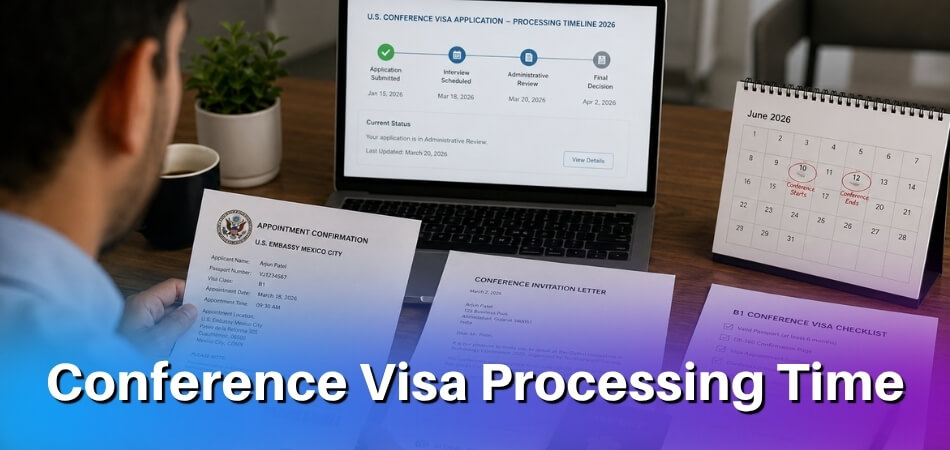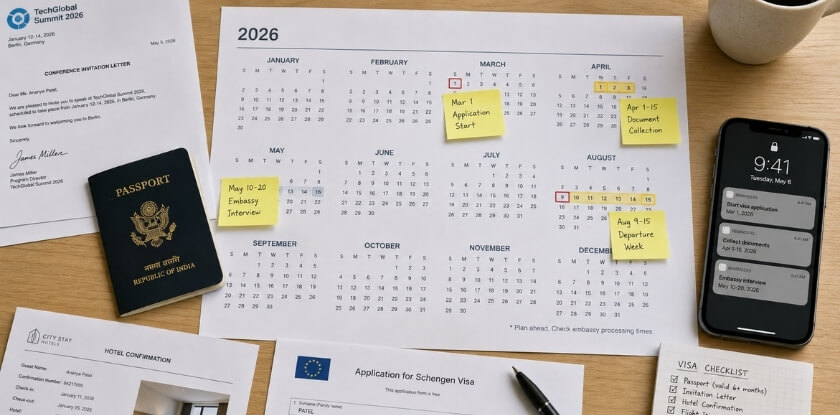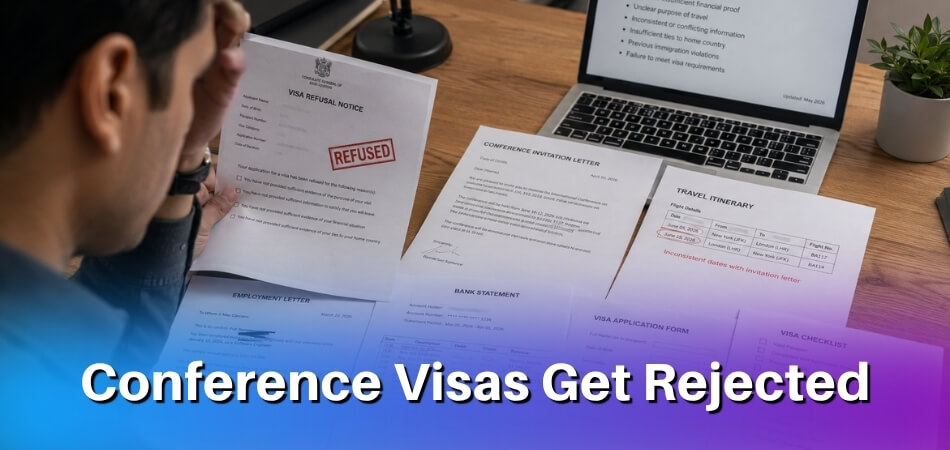
Your conference is just 6 weeks away — and you still haven’t applied for your visa. Is there still time? Maybe. But the honest answer depends on which country you’re traveling to, where you’re applying from, and whether you even know what documents you need yet. Every year, professionals miss international conferences — panels they were invited to speak at, networking events they spent months preparing for — simply because they underestimated how long the visa process would take.
A conference visa (such as the US B-1 Visa, UK Standard Visitor Visa, or Canada Temporary Resident Visa) typically takes 3–8 weeks to process, depending on the destination country, the applicant’s nationality, and the time of year. Applicants should ideally apply at least 6–8 weeks before the event date. Some countries offer expedited processing for urgent conference attendance, though these options come with extra fees and no guarantees.
The tricky part is that “3–8 weeks” is a range, not a promise. A traveler from Germany applying for a UK Standard Visitor Visa faces a very different timeline than someone applying from Nigeria or Pakistan. Nationality-based processing time variation is real, significant, and rarely talked about clearly in one place. Appointment slots at VFS Global can dry up weeks before you even get to submit your paperwork. And if your application comes back with a request for additional documents, the clock doesn’t pause.
This guide covers everything you need in one place — processing times, application fees, expedited options, common rejection reasons and how to fix them, and tracking tools for all major destinations: the USA, UK, Canada, and Schengen countries. Whether you’re navigating the DS-160 form for the first time, trying to understand the difference between UK Priority Visa Service and UK Super Priority Visa Service, or figuring out what a conference invitation letter actually needs to say, you’ll find clear, practical answers here.
Conference Visa Processing Time — Quick Answer
Processing time for a conference visa depends heavily on where you’re going, your nationality, and how you apply. There’s no single answer. But here are the realistic ranges for the most common destinations.

United States (B-1 Visa): Anywhere from 2 weeks to several months. The US Embassy at your location sets interview wait times, and those vary wildly. Check the CEAC dashboard after submitting your DS-160 form — it’ll show your specific consulate’s current wait. Some posts in Europe or East Asia are running 2–3 weeks. Others in South Asia or West Africa are pushing 3–6 months right now.
United Kingdom (UK Standard Visitor Visa): UKVI quotes up to 3 weeks for a standard application. In practice, most applicants who apply through VFS Global with a complete file see a decision in 10–15 working days. Need it faster? The UK Priority Visa Service bumps you to roughly 5 working days. The UK Super Priority Visa Service can get you a decision the next working day — but it costs significantly more.
Canada (Temporary Resident Visa / TRV): IRCC’s own website shows current processing times per country. Realistically, 4–8 weeks is common, though some nationalities see decisions in under 2 weeks through the IRCC application portal if biometrics are already on file.
Schengen Visa: 15 calendar days is the standard. That’s the legal minimum processing period for the consulate. You can apply up to 6 months before your trip, and you should — some consulates are booked out weeks just for a biometric appointment.
A few things that affect every single application:
- Nationality-based processing time variation is real and significant. A German passport holder applying for a US B-1 visa may qualify for a visa interview waiver. A Bangladeshi national applying for the same visa waits months for an interview slot.
- Incomplete documents — missing a conference invitation letter, no proof of accommodation, or a vague sponsorship letter — are the fastest way to trigger delays or a flat refusal.
- Peak conference seasons (spring and autumn) clog consulate queues. Apply early.
If your conference is in under 6 weeks, check expedite request options immediately for US visas, and look at Priority or Super Priority services for the UK. Don’t assume standard processing will get you there in time.
Conference Visa Processing Time by Country
Processing times vary wildly depending on where you’re applying, your nationality, the time of year, and whether you’re applying at a busy consulate or a quieter one. The numbers below reflect typical ranges — not guarantees. Always check the official source for your specific consulate before you book anything.
USA (B-1 Visa) — Processing Time
The B-1 Visa is what most international attendees use for business-purpose travel to the US, including conference attendance. It falls under the nonimmigrant visitor category, and the processing time is honestly one of the most unpredictable of any major destination.
Here’s the reality: wait times for a visa interview appointment at the US Embassy can range from a few days to over 500 days, depending on the consulate location and your nationality. India, Mexico, and Brazil have historically faced the longest waits. Some European applicants can get an appointment within a week.
You start the process on the CEAC (Consular Electronic Application Center) platform, where you fill out the DS-160 form and pay the MRV fee (currently $185 for B-1/B-2 applicants). After that, you schedule your biometric appointment and interview.
Once you’ve attended your interview, actual visa issuance typically takes 3–5 business days if approved, sometimes less. The bottleneck is almost always the interview appointment, not the adjudication itself.
Check the US Embassy website for your country’s current wait times — they publish appointment availability publicly. If your conference is in 60–90 days, you may already be cutting it close in high-demand locations.
There’s also the expedite request option. You can request an expedited appointment through the US Embassy scheduling system if you have urgent travel. You’ll need to demonstrate urgency — a conference invitation letter or sponsorship letter from the organizer helps, but approval isn’t guaranteed.
If you’ve previously held a valid US visa and meet certain criteria, you may qualify for a visa interview waiver (also called the Interview Waiver Program). This can cut processing time significantly.
UK (Standard Visitor Visa) — Processing Time
The UK Standard Visitor Visa handles conference and business-related visits. You apply through the UKVI online application portal, pay the application fee (currently £115 for a standard visitor visa), and also pay the IHS (Immigration Health Surcharge) — though for short visits under 6 months, the IHS is typically waived.
Standard processing takes about 3 weeks. That’s the baseline. UK Visas and Immigration (UKVI) officially states 15 working days for most applications from outside the UK.
If 3 weeks doesn’t work for your schedule, there are faster options.
The UK Priority Visa Service gets you a decision within 5 working days. It costs an additional £250 on top of the standard fee. The UK Super Priority Visa Service promises a decision by the end of the next working day after your biometric appointment — that one costs an extra £1,000. Not cheap, but it exists and it works if you’re in a genuine time crunch.
Biometric enrollment is mandatory. You book a biometric appointment through VFS Global (or an approved application center depending on your country), and that appointment slot availability can itself add days to your timeline. In some cities, slots fill up quickly.
Nationality matters here too. Some nationalities face additional administrative processing, which can push timelines beyond the stated 3-week window without warning.
A standard application gives you a single-entry or multiple-entry visa valid up to 6 months. For regular conference travelers, applying for a multiple-entry visa makes more sense if you plan to attend UK events more than once.
Canada (TRV / Visitor Visa) — Processing Time
Canada uses the Temporary Resident Visa (TRV) for conference visitors who aren’t from visa-exempt countries. Applications go through the IRCC application portal (Immigration, Refugees and Citizenship Canada), and most people apply online.
Current processing times sit around 27–44 days on average, but IRCC’s own website shows live estimates that fluctuate. Check it before planning anything. The number on their site reflects recent actual processing, not an optimistic target.
Biometrics are required for most applicants. If you’ve already given biometrics to Canada within the last 10 years, you may not need to give them again — that can speed things up.
The application fee is CAD $100, with an additional CAD $85 for biometrics if required.
Canada doesn’t currently offer a formal fast-track service for visitor visa applications the way the UK does. If you need a faster decision, the practical options are limited — submit as early as possible, make sure your documents are complete (bank statement, conference invitation letter, travel itinerary, proof of accommodation), and check if your nationality qualifies for any processing priority.
Even after IRCC approves your visa, the physical stamp or document has to be processed at a visa application center, often through VFS Global. That step adds time. Factor it in.
Schengen Countries — Processing Time
The Schengen Visa covers 27 European countries under a single short-stay visa framework. For conference travel, this is the visa you’ll be applying for if your event is in Germany, France, Italy, Netherlands, Spain, or most of the EU.
Official processing time is up to 15 calendar days from the date your application is lodged. In practice, most applications are decided within that window. Some applicants get a decision in 5–7 days.
The tricky part with Schengen is figuring out where to apply. You apply at the consulate of the country where your conference is being held — or, if you’re visiting multiple Schengen countries, at the consulate of the country where you’ll spend the most days. Get this wrong and your application gets rejected on procedural grounds.
Fees are standardized at €90 for adults (€45 for children aged 6–11). Some nationalities have fee waivers based on bilateral agreements.
Biometric enrollment is required if this is your first Schengen application, or if your stored biometrics have expired. VFS Global handles enrollment for many countries, though this varies by applicant location.
Appointment availability is a real constraint at busy consulates — particularly in South Asia, West Africa, and parts of Southeast Asia. In some cities, Schengen appointment slots book out 4–6 weeks in advance during peak conference season (spring and autumn). Submit early.
Processing times also vary by member state. France and Germany tend to be efficient. Some smaller Schengen consulates in specific countries have slower turnaround due to volume and staffing.
Travel insurance is mandatory for a Schengen Visa — minimum €30,000 coverage. Don’t forget it. Missing this document is one of the most common reasons for rejection.
Other Countries — A Brief Comparison
Beyond the big four, here’s a quick breakdown of common conference destinations:
- Australia — Visitor visa (subclass 600) for conference attendance typically takes 20–30 days, though many nationalities receive decisions within a week. Online applications are processed faster than paper ones.
- Japan — Processing is usually 5 business days once the consulate receives your application. Some nationalities can get a visa on arrival or through simplified procedures. Documentation requirements are strict — a detailed conference invitation letter is essential.
- UAE (Dubai) — Visa-on-arrival for many nationalities. For those who need a visa in advance, processing typically takes 3–5 working days. It’s one of the faster processes among major conference hubs.
- China — Standard processing is 4 business days; express service is 2–3 days; rush service is 1 day, at higher cost. Requirements vary significantly by nationality, and the documentation checklist is detailed.
- Singapore — Many nationalities don’t need a visa at all. For those who do, e-visa applications are typically processed within 3 business days.
Nationality-based processing time variation is real and significant. Two attendees from different countries applying for the exact same conference visa at the same consulate can face completely different timelines. Always check your specific consulate’s current estimates — not just general country averages.
How Far in Advance Should You Apply for a Conference Visa?
The honest answer: earlier than you think. Most people underestimate this.

A standard processing time from an embassy or consulate is only part of the equation. Before you even submit your application, you need to book a biometric appointment — and in busy cities or peak seasons, those slots can be 3–6 weeks out on their own. That’s before anyone’s even looked at your paperwork.
The Minimum You Should Work Backwards From
Start with your conference date. Then work backwards like this:
- Conference date → subtract at least 2 weeks of buffer for unexpected delays
- That buffer date → subtract the standard visa processing time for your target country
- That date → subtract the time needed to gather documents (conference invitation letter, sponsorship letter, bank statements, travel insurance, proof of accommodation)
- That date → subtract the wait for a biometric appointment
Do this math honestly and you’ll often land on a start date that’s 8–12 weeks before your conference.
Country-Specific Lead Times You Should Actually Use
United States (B-1 Visa) If you need an in-person interview at the US Embassy — which most first-time applicants do — check the wait time on CEAC before anything else. In 2024, interview wait times at some US Embassy locations exceeded 400 days. Yes, really. If your conference is in the US and you’ve never held a US visa, apply as soon as you get your conference invitation letter, even if that’s six months out. Complete your DS-160 form, pay the MRV fee, and get on the calendar immediately. For returning applicants who qualify for the visa interview waiver program, you have more flexibility — but don’t assume you’ll qualify until you’ve confirmed it.
United Kingdom (UK Standard Visitor Visa) Standard processing through UKVI runs about 3 weeks, but that’s not guaranteed. Apply at least 6–8 weeks out. If you can justify the cost, the UK Priority Visa Service brings it down to 5 working days, and the UK Super Priority Visa Service targets the next working day — useful if your conference date crept up on you. Book your biometric appointment through VFS Global as soon as you’ve completed the UKVI online application portal submission, because slots disappear fast in London, Manchester, and other major UK visa application centres globally.
Canada (Temporary Resident Visa / TRV) IRCC processing times fluctuate significantly. Check the IRCC application portal’s current processing time estimate the day you’re planning to apply — it changes week to week. Right now it can range from 2 weeks to over 2 months depending on your nationality. Nationality-based processing time variation is very real here; applicants from certain countries face longer scrutiny timelines. Apply at minimum 10 weeks before your conference.
Schengen Visa You can apply no earlier than 6 months before travel and no later than 15 calendar days before. The practical sweet spot is 8–10 weeks out. Biometric appointments at VFS Global or the relevant consulate can book out 3–4 weeks on their own in some cities, so don’t leave it to 6 weeks and expect everything to fall into place.
One Rule That Applies to Every Country
Get your conference invitation letter the moment your registration is confirmed. Don’t wait until the organiser sends it automatically — email them and ask. This single document drives your entire application timeline. No letter, no application.
Same goes for your sponsorship letter if your employer or an organisation is covering costs. Finance and HR departments move slowly. Chase them early.
What “Processing Time” Actually Means
The official processing time starts when your application is complete and accepted — not when you submit it. If your documents are missing something (a missing bank statement date range, unsigned travel insurance policy, incomplete travel itinerary), the clock can pause or your application gets rejected outright. That’s weeks gone.
Build in time for document corrections. Don’t submit the night before a courier deadline.
If You’re Cutting It Close
Some embassies allow an expedite request based on urgent travel — a conference invitation letter with a firm date is usually considered valid grounds. For the US, you submit an expedite request through the CEAC system after booking your interview, and you’ll need to justify why you can’t attend a regularly scheduled appointment. Approval isn’t guaranteed.
For the UK, the Super Priority Visa Service is the practical fast-track. It costs significantly more than standard processing, but it exists precisely for situations like this.
8–12 weeks is a safe window for most countries. If you’re applying to the US without a prior visa history, double that.
How to Speed Up Processing (Expedited Processing Options)
Standard processing times work fine if you’ve planned months ahead. Most people haven’t. If your conference is six weeks out and you’re still waiting on a visa, here’s what you can actually do about it.
How to Submit a USA Expedite Request
The US doesn’t have a paid fast-track tier the way the UK does. What it has is an expedite request — and getting one approved is less straightforward than embassy websites make it sound.
You apply for a B-1 Visa the normal way: complete the DS-160 form, pay the MRV fee, and schedule your biometric appointment through the CEAC portal. Once your appointment is booked, you can submit a separate expedite request through the US Embassy scheduling system before your interview date.
Your reason needs to be documentable. “Attending a conference” alone won’t cut it. You need to show that the event is within a tight timeframe, that your attendance is tied to a professional or organizational obligation, and ideally that you have a conference invitation letter or sponsorship letter confirming your role — whether you’re presenting, chairing a session, or representing an institution.
Upload everything that backs up your case. Travel itinerary, proof of accommodation, the conference agenda with your name on it. The stronger the paper trail, the better.
Approval isn’t guaranteed. US Embassy consular officers make the final call, and decisions vary by post. Some applicants get expedited within days. Others get rejected for an expedite and have to wait in the standard queue. Apply as early as you possibly can — waiting until two weeks before your flight is too late in most cases.
If you’ve previously attended the US and your last visa was issued within the past 48 months, check whether you qualify for a visa interview waiver. That alone can shave weeks off the process.
UK Priority and Super Priority Service
The UK system is more predictable here. UKVI offers two paid fast-track options on top of the standard UK Standard Visitor Visa application.
UK Priority Visa Service gives you a decision within five working days. It costs £250 on top of the standard application fee. If your conference is four to six weeks out and you applied on time but want certainty, this is the sensible choice.
UK Super Priority Visa Service targets a next working day decision — sometimes literally the next day after your biometric appointment. That costs £1,000 extra. It’s expensive, but if your event is two or three weeks away and you need a confirmed outcome fast, it’s the only option UKVI offers at that speed.
Both services are added during the application process through the UKVI online application portal. You can’t bolt them on after you’ve submitted.
A few things that trip people up: Priority and Super Priority don’t guarantee approval, only speed. If your application has gaps — missing bank statements, no travel insurance, unclear purpose of visit — paying for faster processing just means getting a faster refusal. Sort your documents first. Also, note that the IHS (Immigration Health Surcharge) is not required for Standard Visitor Visa applicants, so don’t let that confuse the fee total.
Biometric appointments for priority applicants are booked through VFS Global in most countries. Availability varies by location, so check the VFS Global calendar in your country early — the appointment slot itself can create a bottleneck even when you’ve paid for fast-track.
Canada Urgent Processing
Canada’s standard processing through the IRCC application portal can range from a few weeks to several months depending on your nationality and application volume at the time. For conference travelers, that uncertainty is a real problem.
IRCC does allow urgent Temporary Resident Visa (TRV) requests, but the process is manual and the bar is clear: you need to show that travel is urgent and time-sensitive due to an unforeseen circumstance, or that you have a confirmed travel date within the next 10 business days.
To request urgent processing, you don’t go through a separate portal — you submit a web form to IRCC directly after submitting your application, explaining the urgency and providing evidence. That means a conference invitation letter, your flight booking, and anything else that confirms the date is fixed and immovable.
Processing under urgent requests isn’t guaranteed to hit any specific timeline. IRCC processes these case by case. What helps: applying online rather than on paper (online applications are generally faster), having a complete application with no missing documents, and submitting the urgent request the same day you submit your main application rather than waiting.
Nationality matters a lot here. Some nationalities face longer baseline processing times, and urgent requests don’t always override those timelines. If you’re from a country with historically longer Canadian visa processing, factor that in. Multiple-entry visa holders who already have valid status don’t need to reapply — that’s worth checking before you go through the whole process unnecessarily.
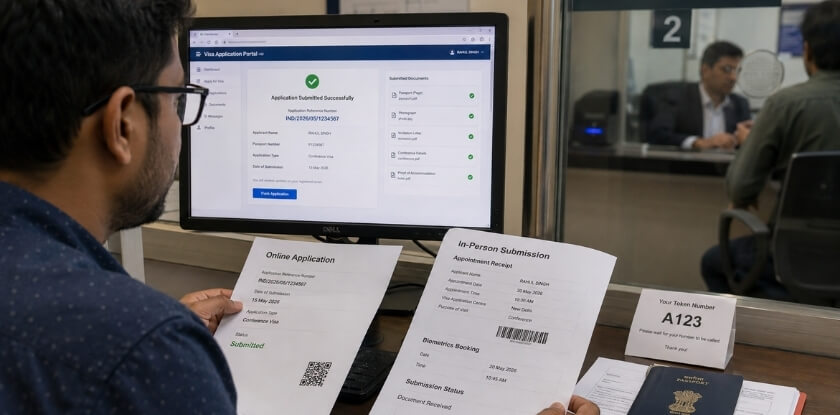
Online vs In-Person Application — Differences and Impact on Processing Time
The method you use to apply isn’t just a matter of convenience — it can directly affect how fast your visa gets processed, and in some cases, whether it gets processed at all before your conference date.

United States (B-1 Visa)
There’s no fully online application for a US conference visa. You fill out the DS-160 form on the CEAC portal, pay the MRV fee, and then you still need an in-person interview at a US Embassy or consulate. The online portion just gets you to the door.
That said, the DS-160 submission does create your case file, and a complete, consistent DS-160 can reduce interview time significantly. Errors or inconsistencies between your DS-160 and what you say in the interview are a common reason for administrative processing delays — sometimes adding weeks.
Some applicants qualify for a visa interview waiver under the Interview Waiver Program, which applies in certain renewal scenarios. If you’re eligible, this cuts out the appointment entirely and moves things faster. Check your consulate’s specific eligibility criteria — not every location offers it.
United Kingdom (UK Standard Visitor Visa)
The UK has moved almost entirely online. You apply through the UKVI online application portal, upload your documents digitally, and then attend a biometric appointment at a VFS Global centre. The document upload is the key difference from older paper-based systems — UKVI caseworkers review your uploaded files directly, which means you don’t have to mail originals unless specifically requested.
This matters for processing time. A complete digital submission with clearly labelled documents (conference invitation letter, bank statements, proof of accommodation, travel itinerary) tends to move faster than a poorly organised one. UKVI caseworkers aren’t hunting through a folder — they’re scanning a file list.
If you use the UK Priority Visa Service or UK Super Priority Visa Service, those are only available through the online pathway. You can’t get priority processing on a paper application. Priority costs around £250 on top of the standard fee; Super Priority (next working day decision) runs around £1,000. Neither guarantees approval — just speed of decision.
One thing people miss: paying the IHS (Immigration Health Surcharge) is done as part of the online application before you even book your biometrics appointment. If you skip or underpay this, your application gets rejected before it’s even assessed.
Canada (TRV — Temporary Resident Visa)
Canada’s setup through the IRCC application portal is probably the most purely online of the three. Most applicants submit everything digitally — no in-person interview required, no biometrics appointment in many cases (though if you haven’t given biometrics in the past 10 years, you will need to).
The trade-off is transparency. IRCC’s processing time estimates are notoriously variable, and online applications don’t come with a fixed timeline the way a scheduled interview does. You can check your application status through the portal, but “in progress” can mean almost anything.
Uploading supporting documents correctly is critical here. The IRCC system requires specific file formats and size limits. A sponsorship letter that’s too large to upload, or a bank statement in the wrong format, can stall your application without you realising it. Check the technical specs before you upload anything.
Schengen Visa
This one’s the outlier. Despite being 2024, most Schengen countries still require in-person applications — either at the consulate directly or through an outsourcing partner like VFS Global. The level of digital integration varies by country. France and Germany have online appointment booking and form submission, but you’re still physically submitting your passport and documents at a visa application centre.
The processing time is officially 15 calendar days, but that clock starts when your complete application is received — not when you book your appointment. During peak summer and conference season (especially around major European events), appointment slots at VFS Global centres in high-demand cities can be booked out weeks in advance. That’s a scheduling bottleneck, not a processing one, but the effect on your travel date is the same.
Travel insurance is mandatory for a Schengen Visa and needs to cover at least €30,000 in medical expenses across the entire Schengen Zone. Missing this is an immediate rejection. Get this sorted before you start the application, not after.
The Bottom Line on Online vs In-Person
Online applications tend to process faster when the system works correctly and your documents are in order. The risk is that errors in an online system are less visible — there’s no consular officer in front of you to ask a clarifying question. In-person applications add a scheduling delay upfront, but the interview itself is a chance to address concerns directly.
Whichever route your destination country uses, document quality matters more than the submission method. A clean, complete file — with a credible conference invitation letter, matching travel itinerary, and sufficient bank statements — moves through both online and in-person systems faster than an incomplete one ever will.
How to Track Your Conference Visa Application Status
Once your application is submitted, the waiting is the hardest part. Knowing where to look — and what the status messages actually mean — saves you a lot of unnecessary panic.
Tracking a US B-1 Visa Application
After your visa interview at the US Embassy, you track your application through the CEAC (Consular Electronic Application Center) at ceac.state.gov. You’ll need your passport number and the case number from your DS-160 confirmation page.
Status messages you’ll see:
- Ready — Application received, not yet reviewed
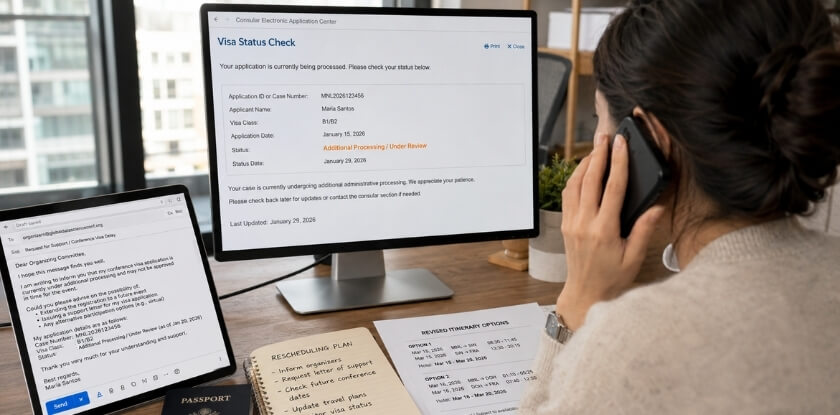
- Administrative Processing — Under additional review. This can add days or weeks. No action needed unless they contact you.
- Issued — Visa approved and being printed
- Refused — Self-explanatory. Check your refusal letter carefully.
“Administrative Processing” trips people up. It doesn’t mean you’re rejected. It means someone needs to look more closely — sometimes for security checks, sometimes because your supporting documents raised a question. Don’t call the embassy repeatedly. It won’t speed anything up.
If your passport has been at the embassy for more than 10 business days post-interview with no update, you can submit an inquiry through the embassy’s contact form.
Tracking a UK Standard Visitor Visa
UKVI sends tracking updates via email if you applied through the UKVI online application portal. You can also track through the VFS Global portal if VFS handled your biometric appointment — which it does in most countries outside the UK.
Log into your VFS account, go to “Track Application,” and enter your reference number. Status updates here are sometimes delayed by 24–48 hours compared to what UKVI actually has on file. If you paid for the UK Priority Visa Service or UK Super Priority Visa Service, you’ll typically get a decision email directly without needing to check VFS obsessively.
One thing to know: UKVI doesn’t do phone status updates. Email is your only channel, and response times vary. If your application is approaching the 15-working-day standard processing mark with no word, you can submit a complaint through the UKVI contact page — that sometimes prompts a review.
Tracking a Canadian TRV Application
IRCC has a dedicated status checker at ircc.canada.ca. You log in with the same GCKey or Sign-In Canada account you used for your IRCC application portal submission. The tracker shows whether your application is received, in process, or decided.
Biometric requests show up here too. If IRCC needs your fingerprints and photos, you’ll get a Biometric Instruction Letter (BIL) through your IRCC account, and you’ll need to book a biometric appointment at a VFS Global location or an Application Support Center.
Processing times on the IRCC website are updated weekly. Bookmark the IRCC processing time tool and check it against your submission date — it tells you what percentage of applications submitted on your date have been completed, which gives you a realistic sense of where you stand.
Tracking a Schengen Visa
This one’s more fragmented. There’s no central EU tracking system. Each member state runs its own process, and tracking options depend on which country’s consulate you applied through.
Many Schengen countries route applications through VFS Global or TLScontact. If yours did, log into whichever platform handled your submission and use their reference number tracker. Some consulates — French, German, Italian — have their own online status portals. Others send SMS updates once a decision is made.
If you applied directly at a consulate without a third-party intermediary, you may have no online tracking at all. In that case, email the consulate directly with your application reference number and expected travel dates. Keep the email short and professional.
What to Do If Your Status Hasn’t Updated
Give it the standard processing window before worrying. If you’re clearly past the normal timeframe — and especially if your conference date is approaching — here’s the order of steps:
- Check the tracking portal one more time with a cleared browser cache
- Email the relevant embassy, consulate, or IRCC/UKVI contact address with your full name, date of birth, application reference number, and travel dates
- If you submitted an expedite request earlier and haven’t heard back, reference that in your follow-up
- For US applications, contact your nearest US Embassy or consulate’s non-immigrant visa unit directly — many have inquiry forms on their individual websites
Don’t submit a new application thinking the first one got lost. That creates duplicate records and can cause both applications to be put on hold.
Nationality-based processing time variation is real — applicants from certain countries face longer timelines as a baseline, not because anything is wrong with their file. Factor that in before escalating.
Conference Visa Fees and Payment Process
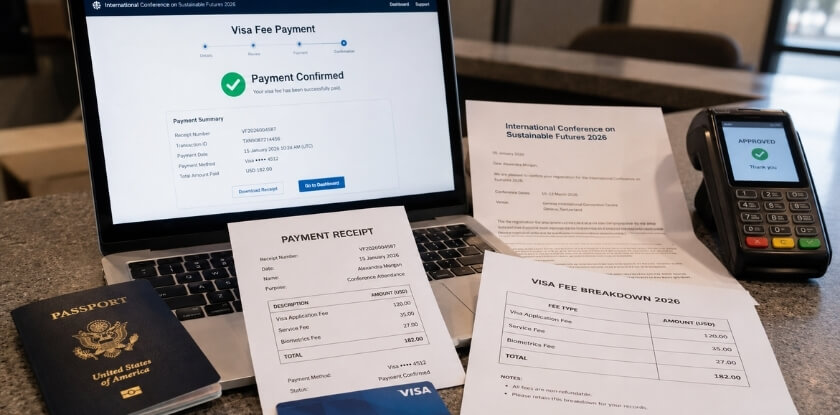
Visa fees are non-refundable. That’s the most important thing to know before you pay anything. Whether your application gets approved, rejected, or you change your mind halfway through — the money’s gone. So get the paperwork right before you touch the payment step..

USA B-1 Visa Fee
The standard MRV fee for a B-1 visa (Business Visitor) is $185 USD. This covers the visa application itself — not the biometric appointment, not any courier service, just the application processing fee.
You pay this through the CEAC portal before you can schedule your interview at a US Embassy or consulate. The payment methods vary by country — some locations accept bank transfers, others accept cash at designated banks, and some accept credit cards directly through the portal. Check your specific country’s US Embassy payment instructions because they genuinely differ.
One thing that trips people up: the MRV fee receipt has an expiration. If you pay but don’t schedule your appointment within a year (in most cases), the fee may expire and you’ll pay again. Don’t pay months before you’re ready to move forward.
There’s no separate government fee for expedited processing on a B-1. If you submit an expedite request, there’s no extra charge — but approval isn’t guaranteed. Some third-party visa agencies charge their own service fees on top of the MRV fee, which can run anywhere from $50 to a few hundred dollars depending on who you use.
UK Visitor Visa Fee
The standard UK Standard Visitor Visa costs £115 for a short stay (up to 6 months). That’s the base fee for a single or multiple-entry visa valid up to 6 months.
If you need longer validity — 2 years, 5 years, or 10 years — the fees go up considerably. A 2-year multiple-entry visa is £400, a 5-year is £771, and a 10-year multiple-entry visa runs £963. For a single conference, the 6-month visa is almost always sufficient, but if you travel to the UK regularly, applying for a longer-validity visa at the same time can save money over multiple applications.
On top of the visa fee, most applicants also pay the IHS (Immigration Health Surcharge). As a visitor applying for 6 months or less, you’re actually exempt from IHS — so don’t let any agent tell you otherwise.
The UK Priority Visa Service costs an additional £250 on top of the standard fee, and the UK Super Priority Visa Service runs an extra £1,000. Both are paid during the application through the UKVI online application portal or at a VFS Global centre, depending on where you’re applying from.
Payment is typically made online by card through the UKVI portal when you submit your application. Some countries process payments through VFS Global service centres.
Canada TRV Fee
The government fee for a Canada Temporary Resident Visa (TRV) is CAD $100 per person. If you’re applying for a multiple-entry visa — which IRCC often issues by default if you qualify — it’s the same fee.
You pay this through the IRCC application portal when submitting online. IRCC accepts credit cards and debit cards. If you’re applying through a Visa Application Centre (VAC, often operated by VFS Global in many countries), there may be an additional service fee — typically around CAD $30 to $55 depending on location.
Biometric fees are separate. If you haven’t given biometrics to Canada within the last 10 years, you’ll pay CAD $85 for the biometric collection appointment. Families applying together pay a maximum of CAD $170 regardless of how many people are in the group.
There’s no government-level fee for expedited processing in Canada — IRCC doesn’t offer a paid fast-track option the way the UK does. Processing times are what they are, and you can’t pay to jump the queue. If your conference date is tight, the only real option is applying as early as possible and ensuring your application is complete and clean the first time — missing bank statements or a vague conference invitation letter are common reasons for delays or requests for additional documents.
Conference Visa Validity and Conditions
Getting the visa approved is only half the story. What the visa actually lets you do — and for how long — matters just as much, especially if your conference schedule is tight or involves multiple countries.
How Long Is a Conference Visa Valid?
Validity depends heavily on the country and your nationality. These two factors often matter more than the purpose of travel.
A B-1 Visa for the US is almost always issued as a multiple-entry visa with a 10-year validity — but that doesn’t mean you can stay 10 years. The border officer at entry sets your actual authorized period of stay, typically 6 months. For a conference, you’ll realistically be in and out within a week or two, so this rarely causes problems. What trips people up is confusing the visa expiry date with the authorized stay date. They’re not the same thing.
The UK Standard Visitor Visa is usually granted for 6 months. Some nationalities get a 2-year or 10-year multiple-entry version, particularly if they’ve got a strong travel history and clean immigration record. You’re allowed to stay up to 6 months per visit, but UKVI expects you to leave and not treat this as a semi-permanent arrangement.
Schengen Visas for conferences are typically single-entry or double-entry with a validity window tied closely to your travel dates — often 15 to 30 days beyond the conference itself. If your conference runs 3 days in Berlin but you want to visit Paris afterward, you’ll need to declare that itinerary upfront. A Schengen visa issued for Germany technically allows travel across the entire zone, but the issuing country should be your primary destination. Getting a German Schengen visa and then flying directly to France as your first entry point is a known way to cause problems.
Canada’s Temporary Resident Visa (TRV), issued through IRCC, is often valid for up to 10 years or until your passport expires — whichever comes first. Like the US B-1, the actual duration of each stay is determined at the port of entry, usually up to 6 months.
Single-Entry vs. Multiple-Entry
Always check which type you’ve been issued. A single-entry visa is spent the moment you enter — even if it’s still technically “valid” by date. This becomes relevant if your conference involves crossing borders. Say you’re attending an event in Switzerland but flying in via France. If your Schengen visa is single-entry and you enter in Paris, you can’t re-enter after leaving the zone.
Multiple-entry visas give you flexibility, but they’re not always granted on the first application. A strong travel history helps. If you’ve held previous US, UK, or Schengen visas without overstaying, consulates tend to issue the more generous version.
What You Can and Can’t Do on a Conference Visa
This is where people get into trouble.
A conference visa — whether it’s a B-1, Standard Visitor Visa, or Schengen — is issued for a specific purpose. Attending a conference, presenting a paper, participating in a workshop: all fine. Getting paid by a local employer, doing business development work that generates direct income, or signing contracts on behalf of a company: not fine.
The UK is particularly strict on this. UKVI distinguishes between “permitted activities” under the Standard Visitor Visa — which includes attending conferences and meetings — and activities that require a work visa. You cannot be paid by a UK source for your time there. If your company is covering your travel expenses, that’s generally acceptable. But if you’re delivering paid consulting sessions during or after the conference, that’s a different category.
US rules under B-1 are similar. You can attend, present, network, and negotiate. You can’t receive a salary or payment from a US company for work performed on US soil.
Conditions Tied to Your Entry
When you arrive, especially in the US and Canada, border officers can ask why you’re there. Have your conference invitation letter accessible — not buried in a checked bag. If you’ve been asked for a sponsorship letter or proof of accommodation during the application, carrying copies with you isn’t paranoid; it’s practical.
Some countries stamp specific conditions directly into your passport or on a separate entry document. Read those. A “no study, no work” condition on a Schengen entry stamp is literally printed there, and “I didn’t know” won’t help you at customs.
Overstaying: Don’t Do It
Even a short overstay can follow you for years. The US tracks overstays electronically — the moment your authorized stay period ends, CEAC systems have a record. A previous overstay, even a minor one, will surface on any future DS-160 form application. Canada and the UK are similarly thorough.
If your conference runs over and you need more time in the country, the right move is to apply for an extension before your authorized stay expires — not after.
Common Reasons for Visa Rejection and How to Fix Them
Getting rejected is more common than most applicants expect — and the frustrating part is that many rejections happen for completely avoidable reasons. Here’s what actually goes wrong, and what you can do about it.

Incomplete or Inconsistent Documentation
This is the number one reason applications get refused. A missing bank statement, a sponsorship letter that doesn’t match the conference dates, or an employer letter that contradicts your travel itinerary — consular officers notice these gaps immediately.
Fix it by treating your document checklist as a legal brief. Every date, name, and amount should line up across your conference invitation letter, travel itinerary, proof of accommodation, and bank statement. If your employer is sponsoring you, the sponsorship letter needs to explicitly state that, with figures.
For US B-1 Visa applications, the DS-160 form itself has to match everything else you submit. Any discrepancy between what you typed on the CEAC portal and what your supporting documents say is a red flag.
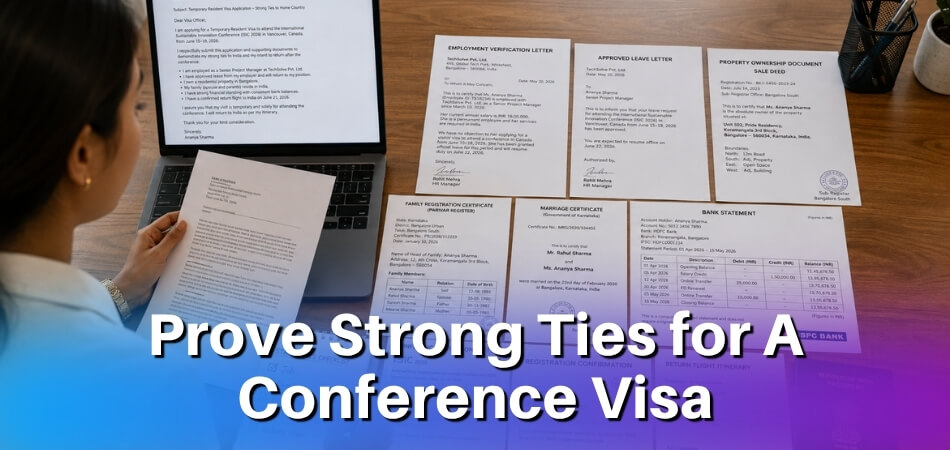
Weak Ties to Your Home Country
Consular officers want to see that you’ll go home. If your application doesn’t demonstrate that — through employment, property, family, or financial commitments — they’ll question your intent.
This hits harder for applicants from certain countries. Nationality-based processing time variation exists partly because some nationalities face higher scrutiny by default. That’s the reality.
Include an employment letter that confirms your leave of absence and return date. Bank statements help too, but they need to show consistent activity — not a sudden large deposit right before you applied.
Applying Too Late
Submitting your application two weeks before the conference and then being shocked by a refusal isn’t a visa rejection problem — it’s a planning problem. Schengen Visa applications at many VFS Global centres are running four to six weeks in standard processing. UK Standard Visitor Visa decisions average around three weeks. Neither of those fits a two-week window.
Apply early. Eight to twelve weeks out is the standard recommendation for good reason.
Biometric Appointment Issues
Missing your biometric appointment — or not scheduling one at all — stops the application dead. This catches people out, especially first-time applicants who assume submitting the online form is enough.
Both the UKVI online application portal and the IRCC application portal require a separate biometric step for most nationalities. Book that appointment the same day you submit your application form.
Insufficient Funds or Suspicious Bank Statements
You don’t need to be wealthy, but you do need to demonstrate you can cover your costs. For a five-day conference, that means showing enough for flights, accommodation, meals, and incidentals — plus a buffer.
Sudden large deposits look suspicious. Consular officers can spot a “loan from a friend” scenario quickly. Your bank statement should reflect normal, organic account activity over at least three months.
Missing or Inadequate Travel Insurance
For Schengen Visa applications, travel insurance isn’t optional — it’s a hard requirement. Minimum coverage of €30,000, valid for the entire Schengen Area, for the full duration of your trip. Getting this wrong is an instant refusal.
Even for non-Schengen destinations, including travel insurance in your application package strengthens it. It signals you’ve planned properly.
Errors on the Application Form Itself
A wrong passport number. A misspelled name. A travel history section left incomplete. These sound minor, but they trigger delays or outright refusals.
For US visa applications specifically, any error on the DS-160 form requires you to start a new application — the MRV fee you already paid doesn’t transfer automatically. Double-check everything before you submit.
Prior Visa Refusals Left Undisclosed
Most visa applications ask directly whether you’ve been refused a visa before. Answering no when the answer is yes — even for a different country years ago — is grounds for refusal on its own.
Declare it, explain it briefly, and provide any context that shows the situation has changed. Hiding it is always worse than disclosing it.
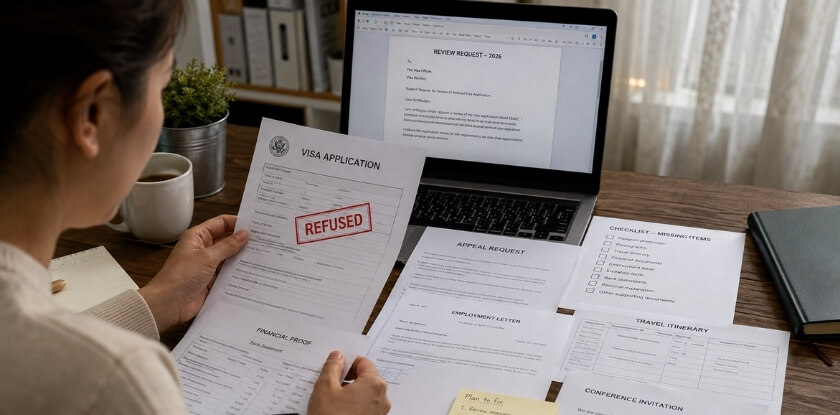
What to Do If You’re Refused
Read the refusal letter carefully. UK Visas and Immigration (UKVI) refusals include specific reasons. So do Schengen refusals. The US Embassy typically gives less detail, but the refusal notice will indicate whether it was under a particular section of immigration law.
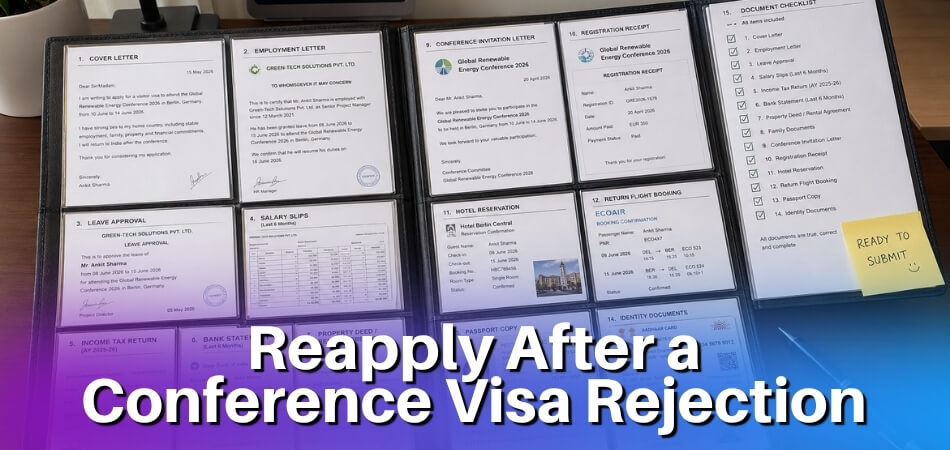
If the refusal is based on missing documents or a misunderstanding, you can reapply immediately with a corrected and stronger package. There’s no mandatory waiting period for most conference visa categories. Some applicants do this successfully within weeks.
If it’s a more substantive concern — like a credibility issue or prior immigration violation — consider consulting an immigration lawyer before reapplying. Submitting the same weak application twice rarely works.
What to Do If Your Visa Is Delayed
Your conference starts in five days and your passport is still sitting at a visa application center. It happens more often than consulates like to admit. Here’s what you can actually do.

Step 1: Confirm What “Delayed” Actually Means
First, check the official processing time for your specific nationality and visa category. The US Embassy publishes wait times by post on travel.state.gov — a delay at one consulate doesn’t mean the same at another. UKVI posts standard processing benchmarks for the UK Standard Visitor Visa (usually 15 working days). IRCC publishes current processing times on the IRCC application portal, and those numbers shift constantly.
If your application is still within the posted window, it’s not delayed. It just feels that way.
If you’re genuinely past the stated timeframe, move to the next step.
Step 2: Check Your Application Status
Log into the relevant portal. For US visas, that’s CEAC (Consular Electronic Application Center) using your DS-160 form confirmation number. For UK applications, use the UKVI online application portal. IRCC has its own tracker too.
Look for any action items. Sometimes a visa is held simply because they’ve requested additional documents and the notification went to your spam folder.
Step 3: Contact the Right People
For a US B-1 Visa: Call or email the specific US Embassy or consulate where you applied. Be concise — give your full name, date of birth, DS-160 barcode number, and interview date. Explain the conference date clearly. US embassies do sometimes escalate urgent cases, but “urgent” needs to be documented, not just stated.
For a UK Standard Visitor Visa: Contact UKVI directly. If you paid for UK Priority Visa Service or UK Super Priority Visa Service and didn’t receive a decision within the guaranteed window, you’re entitled to a refund of the priority fee. That’s worth knowing before you call.
For a Schengen Visa: Contact the embassy or the VFS Global center that holds your application. VFS Global acts as the intermediary for many Schengen countries — they can’t make visa decisions, but they can confirm your file’s status and whether anything is missing.
For a Canadian TRV: Check the IRCC application portal first. If there’s a biometric appointment outstanding or additional documents requested, that’s usually why things are stuck.
Step 4: Submit a Formal Inquiry or Expedite Request
If contacting the consulate doesn’t move things, submit a written expedite request. This is a formal ask — not just a follow-up email.
Your expedite request should include:
- Your full legal name and date of birth
- Application or case reference number
- The conference name, dates, and location
- Your conference invitation letter and any sponsorship letter
- Proof of registration or travel itinerary
- Your departure date and flight booking (if you have one)
- A brief, factual explanation of why the delay causes specific harm
Keep it factual. Emotional appeals don’t carry weight. Documented conference obligations do.
For US visas specifically, expedite requests are submitted through the US Embassy appointment scheduling system, and they require evidence — not just a request.
Step 5: Know When to Escalate Beyond the Consulate
If you’ve exhausted standard channels, a few other options exist:
Contact your institution or conference organizer. Many large international conferences have experience writing emergency support letters. Some have formal relationships with local embassies, particularly for recurring events.
Your country’s foreign ministry or equivalent. In some cases, a formal inquiry through diplomatic channels can accelerate things. This works better for government-affiliated attendees than private individuals, but it’s worth knowing the option exists.
Your employer or sponsoring organization. If a company is covering your conference costs, a letter on official letterhead confirming your role and the business purpose of attendance can sometimes help move a stuck file.
What Not to Do
Don’t submit a second application while the first is still pending — this creates confusion and can get both applications rejected. Don’t misrepresent your departure date to appear more urgent than you are; consulates notice inconsistencies between your travel itinerary, bank statement, and the story you’re telling them.
And if the visa genuinely doesn’t arrive in time? Some conferences offer remote attendance options now. It’s not ideal. But missing a session beats getting a visa refusal on your record, which affects your processing time variation on every future application.
FAQ — Common Questions About Conference Visa Processing Time
How long does a conference visa typically take to process?
It depends entirely on the country. The US B-1 Visa can take anywhere from a few days to several months depending on your nationality and the specific US Embassy you apply through. The UK Standard Visitor Visa processed through standard service takes about 3 weeks. Schengen visas are supposed to be decided within 15 calendar days, though that stretches to 45 days in complex cases. Canada’s Temporary Resident Visa (TRV) through IRCC currently averages 4 to 8 weeks for most nationalities.
The short answer: apply at least 8 to 12 weeks before your conference date. Don’t cut it close.
Can I apply specifically for a “conference visa” as a separate visa category?
No — this isn’t a distinct visa type in most countries. You’re applying for a standard business or visitor visa and explaining that the purpose of your trip is attending a conference. For the US, that’s the B-1 Visa. For the UK, it’s the Standard Visitor Visa. For Schengen countries, it’s a Type C short-stay visa. Your conference invitation letter and sponsorship letter are what establish the purpose — the visa category itself doesn’t change.
Does a conference invitation letter speed up processing?
Not automatically, no. It doesn’t bump you up a queue. What it does is reduce back-and-forth questions from the visa officer, which can prevent delays. A strong invitation letter — on official letterhead, signed, with conference dates and your full name — makes your application cleaner and easier to approve. Missing or vague letters are a common reason for requests for additional documents, which add days or weeks.
What’s the fastest way to get a US conference visa?
Request an expedite through CEAC after submitting your DS-160 form and paying the MRV fee. You’ll need to document the urgent need — an official conference invitation letter showing the event date typically qualifies. Expedited appointments aren’t guaranteed, but documented emergencies and legitimate event attendance requests are regularly approved. Once you get an expedited appointment, the visa itself often arrives within 2 to 5 business days after the interview.
How fast is the UK Super Priority Visa Service?
If your biometric appointment goes ahead as scheduled, you get a decision the next working day. That’s genuinely fast. But it’s only available at certain UKVI-linked centres — not everywhere VFS Global operates. The cost is significantly higher than standard service. It’s worth it if you have less than two weeks before your conference and can get an available appointment slot.
Do I need a bank statement for a conference visa application?
Yes, for virtually every country. The bank statement supports your financial credibility — officers want to see that you can fund your trip and have reason to return home. Three to six months of statements is the standard expectation. Low balances, irregular large deposits right before the application, or statements that don’t match your stated income can all trigger extra scrutiny or rejection.
Does travel insurance affect processing time?
It won’t speed anything up, but for Schengen visas it’s a mandatory requirement — you won’t get approved without it. Coverage needs to be at least €30,000 and valid across all Schengen member states you’ll visit. For US, UK, and Canada applications it’s not mandatory, but including it in your document pack signals that you’re a well-prepared applicant. It won’t hurt.
Why is my processing time longer than someone else’s from a different country?
Nationality-based processing time variation is real and significant. Some nationalities face additional administrative processing — security checks, background verification, or reciprocity-based delays that have nothing to do with your individual application. An applicant from one country might get a US B-1 Visa in three days; another nationality waits four months for the same visa. Check your specific country’s wait times on the US Embassy website, UKVI’s published figures, or IRCC’s current processing time tool before planning your travel.
Can I get a multiple-entry visa for conferences?
Possibly. Whether you’re issued a single-entry visa or multiple-entry visa often depends on your travel history, nationality, and how you frame your application. If you attend conferences in the same country regularly, it’s worth explicitly noting that in your application — some officers will grant multiple-entry if the case is clear. For Schengen, prior clean travel history significantly increases your chances. Don’t assume you’ll get multiple-entry, but don’t assume you won’t either.
What happens if my visa hasn’t arrived and the conference starts in three days?
Contact the relevant embassy or VFS Global immediately. For the UK, check your application status through the UKVI online application portal. For the US, log into CEAC to check status and contact the specific embassy directly. For Canada, use the IRCC application portal. In genuine emergencies, some embassies will expedite a final decision or issue an emergency appointment — but this is not a reliable fallback. It’s a last resort. The only real answer to this scenario is to have applied earlier.
Conclusion — What to Remember to Secure Your Visa Before the Conference
Get your timing right. That’s honestly the single biggest factor in whether you make it to your conference or spend the week watching the livestream from home.
Every country covered in this guide has its own processing rhythm. The US B-1 Visa can stretch to weeks or months depending on your nationality and which US Embassy you’re applying through. The UK Standard Visitor Visa typically moves faster, but the UK Priority Visa Service and UK Super Priority Visa Service cost extra for a reason — and they’re genuinely worth it if you’re cutting it close. Schengen processing sits around 15 calendar days on paper, but member states vary considerably in practice. Canada’s IRCC can surprise you in either direction.
None of these timelines are guaranteed. That’s not pessimism — it’s just how visa processing works.
Here’s what actually moves the needle:
Apply early. Not two weeks out. Six to eight weeks minimum for most destinations, and three months isn’t overkill if you’re US-bound and your nationality triggers longer processing. Check the appointment availability at your nearest VFS Global centre or consulate before you book your conference ticket.
Get your documents right the first time. A weak conference invitation letter, a bank statement that doesn’t cover your trip comfortably, missing travel insurance, or a vague sponsorship letter — any one of these can stall or kill your application. Rejection means starting over. That takes time you likely don’t have.
Know your form. The DS-160 on CEAC for the US. The UKVI online application portal for the UK. The IRCC application portal for Canada. Small errors on these — wrong passport number, inconsistent travel dates, a skipped field — cause delays that feel completely avoidable in hindsight.
Pay attention to fees before you submit. The MRV fee for the US isn’t refundable if you get rejected. The UK charges an IHS (Immigration Health Surcharge) on top of the standard visa fee. These costs add up fast, especially if you need a biometric appointment at a separate centre.
Check whether you qualify for a visa interview waiver. Some nationalities applying for certain visa categories don’t need to appear in person. If that applies to you, it can cut your processing timeline significantly.
Multiple-entry vs single-entry matters. If you attend conferences regularly, push for multiple-entry where available. It saves you repeating this whole process every few months.
Track your application. Don’t just submit and wait passively. Use your reference number to monitor status through the relevant portal. If something changes — your passport gets flagged, biometrics weren’t received, additional documents are requested — you need to know immediately, not the day before your flight.
Your conference invitation letter and proof of accommodation aren’t just formalities. Visa officers use them to confirm the trip is real and the purpose is what you say it is. Make sure those documents are specific: event name, dates, venue, your role (speaker, attendee, organiser), and who’s covering costs if someone else is.
One last thing. Your nationality affects processing more than almost anything else in this process. Two attendees going to the same conference in the same city can face completely different timelines based purely on their passport. That’s not a problem you can solve — but it is something you need to account for when you’re planning.
Start early. Document everything. Track your status. That’s it.