
A few minutes at the consular window can feel bigger than months of preparation. Even people with perfect paperwork worry about what the officer will ask and how to say it. Knowing the shape of the questions takes much of that pressure away.
Quick answer: Expect questions on four things: why you are going (conference name, dates and your role), who is paying, what ties you to your home country, and the documents you carry. Answer each in one or two plain sentences that match your paperwork exactly. Many visitor visas are decided without any interview, so this guide covers the cases where an officer does ask.
Fact-checked by the MS International Editorial Team. Last verified against official sources: October 2026.
Picture the scene. You have collected the invitation letter, sponsor letter, bank statements, agenda and hotel booking. You practised in the mirror. Then the officer looks up and asks, “How can we be sure you’ll return home after the conference?” and your mind goes blank. It happens to well-prepared people more often than they admit.
The good news is that the questions follow a pattern. The officer is checking your travel purpose, your money, your ties to home and your plan to return. This guide gives you sample answers for each area, for any destination country, in person or online. Country-specific question lists live in our separate guides on common questions in a USA conference visa interview and on likely questions for a B-1 conference visa interview, so here we stay general.
What Questions Are Asked in a Conference Visa Interview?
Officers ask about four areas: your travel purpose, your ties to home, who pays, and your documents. The interview is usually short, and the officer is trying to decide one thing quickly: is this person really going to a conference, and will they go home afterwards?
Before you prepare, check whether you need an interview at all. Many visitor applications, including most Canadian ones, are decided on documents and biometrics. IRCC says an officer reviews your file and then decides whether an interview is needed, and some files are also picked at random for a quality check. The US is stricter: since 1 October 2025 most nonimmigrant applicants must interview in person, and the State Department says to apply in your country of nationality or residence. A narrow waiver remains for renewing a B-1/B-2 visa within 12 months of the old one expiring, if you were never refused a visa and apply in your country of nationality or usual residence, and officers can still ask you to attend. If IRCC wants an interview, it tells you when and where.
| Area | Typical question | What the officer checks |
|---|---|---|
| Travel purpose | “What is the conference about, and what is your role?” | The event is real and relevant to your work |
| Home ties | “What do you do back home?” | You have reasons to return |
| Funding | “Who is paying for this trip?” | The answer matches your documents |
| Documents | “Can I see your invitation letter?” | Dates, names and venue are consistent |
A few less common questions still catch people out:
- “Have you visited this country before?”
- “Why do you need a multiple entry visa?”
- “Have you ever been refused a visa?”
If you were refused before, say so. The officer can see your history. Explain what has changed since then, such as stronger ties, better financial records or a clearer purpose.
Conference-Specific Questions and Ideal Answers
Name the conference, the dates, the city and your role, then link it to your work in one sentence. Conference questions show whether you know what you are attending or whether the event is just a convenient reason to travel.
How to Answer ‘Which Conference Are You Attending and Why?’
Give the actual name, not “an international conference on technology”. A weak answer sounds like this: “It’s a big conference in my field and I want to learn new things.” A stronger one: “I am attending [Conference Name] in [City] from [start date] to [end date]. I am a signal processing engineer, and two sessions cover my current research on error-correcting codes.” (Replace the brackets with your own event and dates.)
The officer wants a specific, believable purpose, not enthusiasm. Naming a keynote speaker or a panel you registered for adds credibility quickly. Expect a follow-up such as “Why this conference and not one at home?” Have a straight answer: international speakers, a topic not covered locally, or your organisation chose it.
Questions About the Conference Agenda, Schedule, and Your Role
Bring a printed agenda and know what is on it. Likely questions are how long the event runs, which sessions you plan to attend, whether you are presenting, and what you do afterwards.
If you are presenting, say so and bring the acceptance email from the organisers. If you are a delegate, that is perfectly valid. Do not inflate your role.
Your travel dates should fit the programme. A day or two on either side is normal. If you are attending a three-day event but asking for twelve days, expect questions and have a short reason ready, such as a pre-conference workshop or a required visit to your institution. Otherwise shorten the trip.
Questions About How You Found the Event and Whether You Are Paid
Officers often ask how you heard about the conference, whether you have attended it or a similar event before, and how the topic connects to your work. Give a real answer: a colleague’s recommendation, a call for papers, an earlier edition you read about. Do not invent a history with the event.
Be equally clear about money from the host country. For the US, the State Department says a B-1 conference attendee receives no salary or income from a US-based company or entity. If anyone in the destination country will pay you anything beyond your costs, such as an honorarium, check the rules for your visa category first and say so openly if you are asked.
Questions About Home Country Ties and Proving Your Intent to Return
Give concrete reasons why returning home is the obvious choice for someone in your position. Every question about your job, family or salary feeds one concern: will you come back?
How to Convince the Officer That You Will Return Home
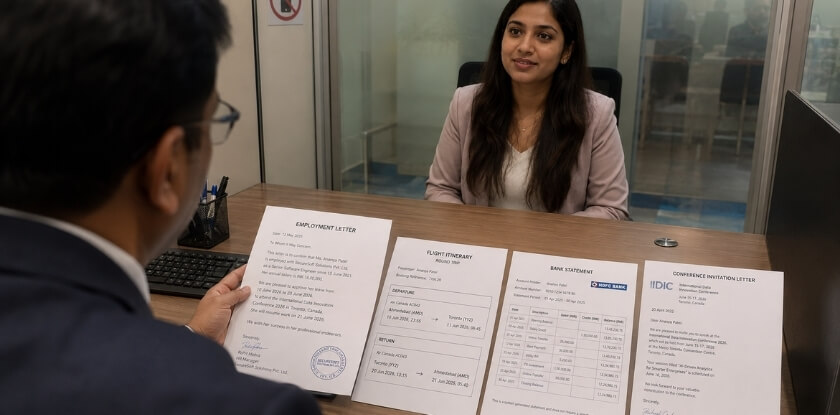
“I will return” proves nothing, because anyone can say it. Name what you would be walking away from: a permanent job, a business, dependants, property in your name, an ongoing degree. Be ready to talk about two or three of these without hesitation.
When asked what you will do after the conference, avoid “I’ll go back to my country.” Try something grounded: “My team expects me back in the office on Monday, and I have a project deadline the week after.” Specific details sound credible.
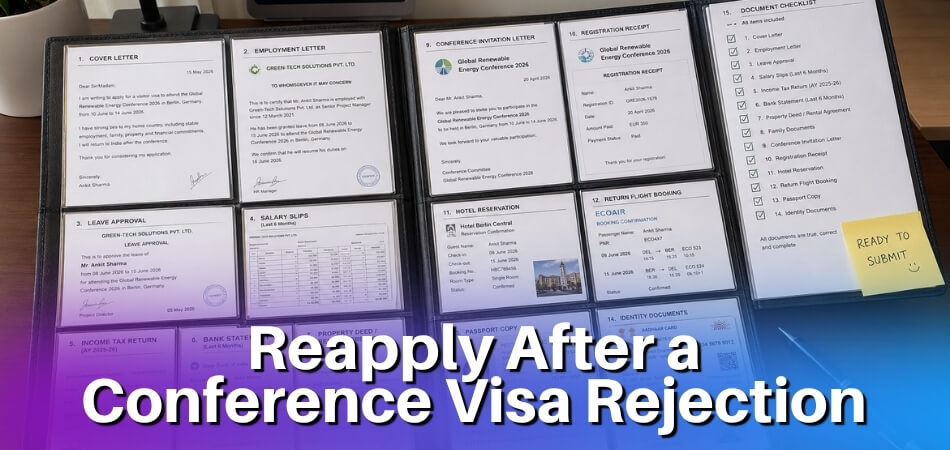
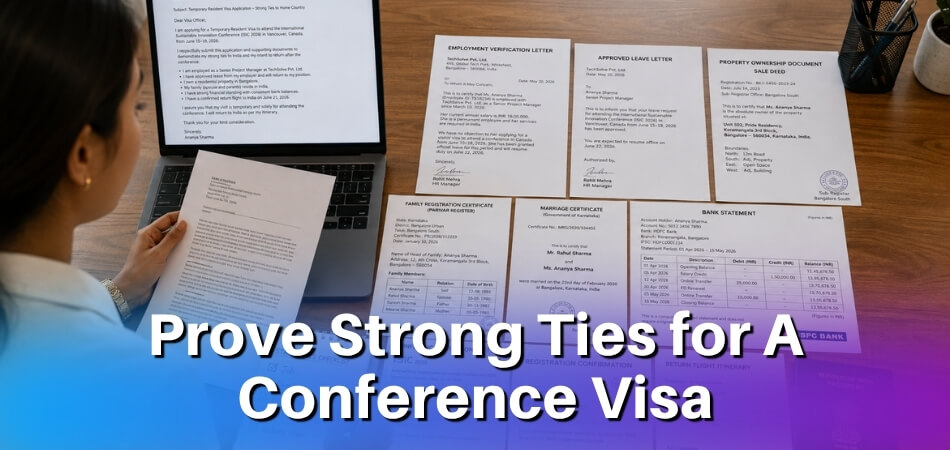
Bring documents that back this up: an employment letter with approved leave and return date, a property deed or lease, proof of dependants. You need not hand them over unasked, but having them shows you came prepared.
Strong finances do not hurt your case. A steady income and savings suggest you have something worth going back to. A clean travel history helps even more: if you have visited the US, Schengen area or UK before and left on time, mention it and carry the old visas.
How to Answer Questions About Your Job, Family, and Financial Assets
These feel personal, but they are standard in both in-person and online interviews.
On your job: State your role, your employer and how long you have worked there. If you run a business, say briefly what happens to it while you are away. If asked “Did your employer agree to this trip?”, have the approval or sponsor letter ready.
On your family: Mention spouse, children or elderly parents naturally: “My wife and two children are at home. My younger one is in school.” If family travels with you, say so honestly.
On financial assets: Be direct. A clean answer sounds like this: “My monthly salary is X, I have saved for this trip over three months, and my employer covered the registration.” Do not exaggerate, and do not be vague either.
If you worry about money questions, remember that documents beat talking points. Bank statements showing regular deposits carry more weight than anything you say.
Questions About Funding and Financial Capability
Say who pays, show a document that proves it, and know your approximate costs. The officer wants a simple picture of who funds the trip and whether they can afford it.
“Who is sponsoring your trip?”
Answer directly: you, your employer, the organisers, or a mix. Do not say “my company is supporting me” and then show only personal bank statements. If self-funded, show a balance that covers flights, accommodation, registration and daily costs, and be ready to say roughly what you earn and how you saved for the trip. “I have savings” is too vague.
An employer sponsor letter should be on company letterhead and say which costs are covered: flights, accommodation, registration or all three. If the organisers sponsor you, bring their official letter with your name, the event, the dates and the support provided.
Common follow-ups:
- “What is your relationship to the sponsoring organisation?”
- “Has your employer paid for international trips before?”
- “Who is your contact at the conference?”
Answer from memory first, then point to the document. Fumbling through papers to name your own sponsor looks bad. Know your manager’s name and the coordinator who sent your invitation.
One common mistake is treating the invitation letter as proof of everything. It only confirms you were invited. The sponsor letter shows who pays, and the agenda shows the programme exists. Missing one leaves a gap, and gaps invite hard questions.
No official body publishes a standard minimum balance for conference visitors, and the right amount depends on the destination and trip length. Check the embassy’s own guidance, and do not rely on rules of thumb from forums.
“Can you show proof of your funding?”
Have it organised before you sit down: recent bank statements, the sponsor letter, proof of hotel payment. The sponsor letter should also state the purpose of the trip and confirm your employment and return to work. A vague line such as “we support his attendance” is weak.
“What is the approximate cost of your trip, and can you cover it?”
Know your own numbers. You need not give a breakdown to the dollar, but an answer like this works: “Flights are about $900 return, the hotel is $120 a night for six nights, registration is $400. My company covers registration and hotel, and I cover personal expenses.” These figures are only an example, so use your own.
If you pay for everything, make your finances visible. A sudden large deposit just before the interview raises a flag, because officers are trained to spot accounts that were topped up for the application.
“Does your employer know you’re attending this conference?”
Answer with a document: the invitation plus your employer’s sponsor letter or at least a leave approval. If you attend independently, say so openly, say you cover your own costs, and mention your manager approved the leave.
“Have you attended international conferences before?”
It is not strictly a funding question, but it often comes up here. Earlier trips that ended on time work in your favour. If this is your first, do not apologise. Make your professional and financial case calmly.
A few things that can hurt you here
Refusals in funding cases often come from a mismatch between the story and the papers, not from a lack of money. Keep answers short and consistent. If you request a multiple entry visa, your funding documents must cover every planned trip.
How to Present Your Conference Invitation Letter During the Interview
Keep the letter at the top of your stack, know what it says, and make sure everything you say matches it. The officer will use it to cross-check almost every answer.
Check first whether your destination asks for one. The US says a letter of invitation is not needed to apply for a visitor visa, but a conference letter still answers the officer’s first question, what the trip is for. IRCC says a letter can confirm that your purpose for visiting Canada is valid, and to bring it with you in case a border officer asks.
Have It Ready Before You Sit Down
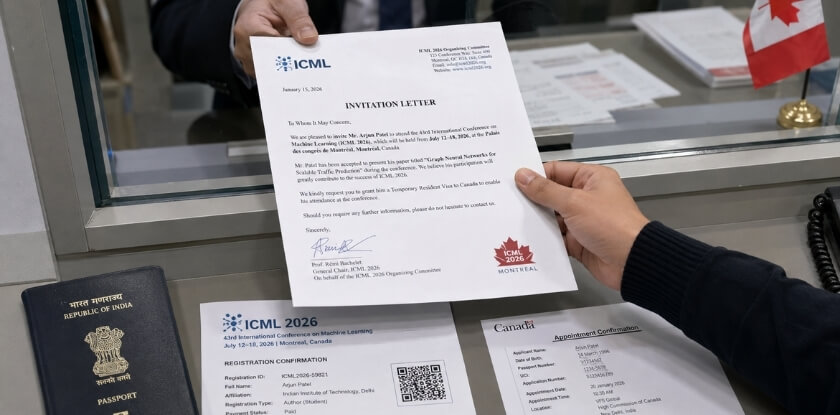
Bring a clean, unfolded paper copy. For an online interview, keep the PDF open and ready to share. Do not search through a folder while the officer waits.
Know the Letter Inside Out
The officer may read a line and look up: “This says the conference runs 14 to 17 March. Is that right?” Answer without looking down. Know the dates, venue, organiser’s name and your role. If you are a speaker, know your session title, and carry the acceptance email if the letter does not mention it. If the letter says the conference ends on the 18th but your flight home is on the 25th, the officer will ask, so have a clear reason. Your spoken answers and your papers must tell one story.
What the Letter Should Contain and What to Verify Before the Interview
Check that it includes:
- Full name of the conference and the organising body
- Your name and professional title
- Conference dates and physical location
- A statement that your registration or participation is confirmed
- Organiser contact details
If anything is missing, ask the organiser for a corrected letter before the interview.
How to Reference It During Answers
When asked about your purpose, point to it naturally: “The agenda is on page two, with the sessions I’m attending.” Keep the sponsor letter directly behind it, since funding is a common next question.
The Organizer’s Credibility Matters
For a smaller or newer conference, expect the officer to look it up, sometimes during the interview. That is normal. Know the website address and be ready to confirm there is a real programme.
Body Language When Presenting Documents
Hand documents over facing the officer and do not pull them back. Look at the officer while you answer, not while you dig through papers. Stay calm and open, with no crossed arms.
Online vs In-Person Interview: Key Differences and How to Prepare
The questions are the same, but the pressure points differ. Online, the risk is technical failure. In person, it is how you carry yourself and hand over documents.
| Point | Online interview | In-person interview |
|---|---|---|
| Main risk | Dropped call, poor audio | Nerves, disorganised papers |
| Documents | Scanned copies to share, plus paper at hand | Folder with originals and one photocopy |
| Setup | Test camera, mic and internet the day before | Arrive at the time your appointment notice gives |
| Eye contact | Look at the camera, not your own face | Natural, not staring |
What to Keep in Mind Specifically for an Online Visa Interview
Test your setup well before the call. Check microphone, camera, lighting and connection the day before, and log in again a few minutes early. Put the camera at eye level and choose a plain, quiet background with light facing you. Turn off notifications.
Keep your invitation letter, sponsor letter, agenda, bank statements and passport within arm’s reach, in order. Ask beforehand whether the platform allows file sharing, since some do not and you may have to hold papers up to the camera.
Speak a little slower than usual, because video compresses audio. If lag causes a misunderstanding, repeat calmly. Look at the camera when you answer, and dress as you would for the consulate.
Document Presentation and Body Language for an In-Person Interview
Arrive at the time your appointment notice gives, because late arrivals may lose their slot. Put your papers in a folder with labelled dividers. When the officer asks for something, hand it over calmly. Sit upright with your hands visible and still. Keep your answers short and direct. If you do not understand a question, say “Could you please repeat that?” Guessing is worse. Bring two copies of every key document, the original and one photocopy. Some officers keep a copy and some do not.
Effective Tips for Speaking Confidently During Your Visa Interview
Confidence comes from knowing your own story, not from memorising a script. Officers can tell the difference.
Slow Down More Than You Think You Need To
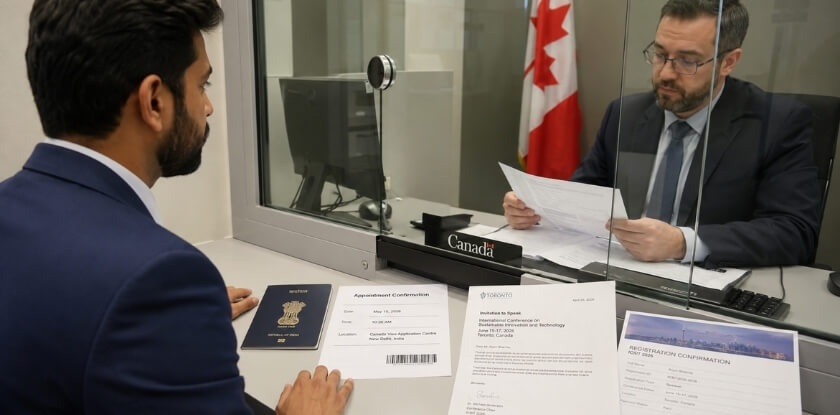
Nervous people speak fast, and fast speech sounds anxious. A full second of pause before answering shows you are thinking, not panicking. Funding, agenda and return plans are where people stumble most.
Answer What Was Actually Asked
If asked how long the conference is, say “three days, the 14th to the 16th”, and stop. Oversharing looks like you are trying to convince them of something. A simple pattern keeps answers short: answer the question in your first clause, add one detail the officer can check, name the paper that backs it up, and stop. For “Who is paying?” that sounds like: “My employer pays for the flight and hotel. The approval letter is in this folder.”
Know Your Documents Before You Walk In
Put the documents most likely to be requested on top. Do a dry run at home where someone asks for a specific paper and you find it in seconds. Also read your own application form, all of it, because being asked about something you wrote and not recognising it is a bad moment.
Don’t Memorize, Internalize
Memorised answers sound rehearsed. If you know your schedule, ties and finances well enough to explain them in your own words, that is the goal.
If You Don’t Understand a Question, Say So
Ask once: “Could you clarify what you mean?” It costs nothing. A confident answer to the wrong question looks evasive.
Prepare a 30-Second Summary of Why You’re Going
Why this conference, why now, why you. Include your role and your plan to return, and practise saying it out loud until it sounds like normal conversation. Everything else branches from it.
What Should You Never Say in a Conference Visa Interview?
Do not lie, guess, overshare or contradict yourself. Some mistakes are obvious. Others are small enough that applicants do not notice them.
Saying You Want to “Explore” or “See the Country”
Sightseeing is not a ground for refusal, but making it a goal tells the officer the conference is secondary. Keep your stated reason professional. Extra days are fine, just do not lead with them.
Vague Answers About Your Job or Employer
“I work in IT” and “I run a business” are not answers. Give your job title, what the company does and why this conference matters to your work.
Being Inconsistent With Your Documents
If the invitation says 12 to 15 October, your return flight is 10 October and your hotel starts 11 October, that is a problem. Before the interview, check every date, name and venue across all documents.
Claiming You’ll Pay for Everything Without Proof
Saying “money is not an issue” while your statements show three months of low balances is a quick route to refusal. Match the claim to the paperwork.
Saying Anything That Implies You Might Not Return
This is the big one. Examples: “My contract ends next month.” “My family has mostly moved abroad.” “I’ve been thinking about opportunities overseas.” “I applied for immigration before but it didn’t work out.” None of these is automatically disqualifying, but volunteering them gives the officer a reason to doubt you. Answer what is asked, and never lie if you are asked directly.
Contradicting Yourself Between Questions
An officer may ask about your employer early and return to it later from a different angle. If the answers differ, it reads as deception even when it is only a memory slip. Know your letters, schedule and dates well.
Asking About Multiple Entry Visa Options Unprompted
If you applied for a single entry visa, asking mid-interview for multiple entries suggests you are thinking beyond this one trip. If you really need it, the application should show that from the start.
Showing Nervousness That Looks Like Deception
Nerves are normal. Avoiding eye contact, giving very long answers to simple questions or hesitating over your employer’s name can read as evasion, though. Breathe, pause and speak slowly. Online, the same applies, and your spoken answers carry even more weight.
Interview Strategy for a Multiple Entry Conference Visa
For multiple entries, show a pattern of legitimate professional travel, not one event. The officer’s question shifts from “why this trip?” to “why come back repeatedly, and will you leave each time?”
In Canada you do not choose. IRCC says applicants who are eligible for a multiple entry visa are issued one, the officer decides, and a one-time special event is a typical single entry case. Where an application does ask you to choose the number of entries, expect the questions below.
Why Officers Ask More Questions for Multiple Entry
Repeated access is a bigger request. The expectation is several real reasons: different events, an annual conference, or a role with recurring travel. Vague answers will not work.
Make the Case Before They Ask
Put it in your first answer: “I’m attending the annual conference in March, and my organisation also sends me to the regional session in September. Both are in this country, so multiple entries make sense.”
Document Both Events Separately
Bring two invitation letters, two agendas and two hotel bookings, labelled by trip. A sponsor letter may cover both visits, but it must state the dates and purpose of each. Also bring bank statements that cover the whole travel period and proof of ties that lasts across the visa validity period.
The “Return Intent” Question Gets Harder
Past entry and exit stamps help most. If your passport shows you visited a country for a conference and left on schedule, point to the stamps. With no travel history, be honest and be more specific about your job, property, family and commitments.
Funding Questions Are More Detailed
You must show you can fund two or more trips. If the employer pays for both, the letter should say so, with approximate budgets or per diems. If one trip is self-funded and the other employer-funded, explain the split.
Anticipated Interview Questions Specific to Multiple Entry
“Why do you need multiple entries instead of applying each time?” Answer practically: both events are confirmed and your organisation planned both trips at the start of the year.
“Have you traveled to this country before?” If yes, say when, why, and that you returned as planned. If no, say so and explain what ensures your return.
“Who approved this travel, and is it documented?” Have the authorisation letter, registration confirmations and any internal travel approval ready.
“What happens if one of the conferences is canceled?” It is a hypothetical. Say you would return home as planned and not use the remaining entry for unrelated travel.
The Most Common Reasons for Visa Denial and How to Avoid Them
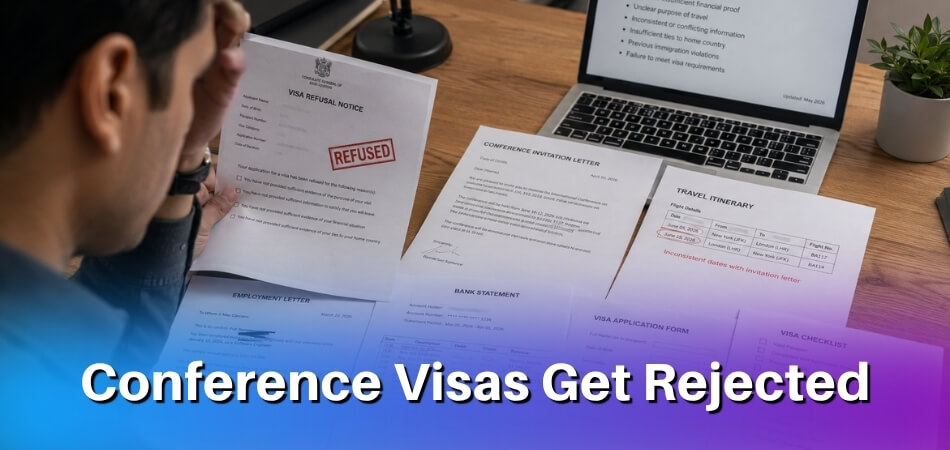
Most refusals trace back to weak home ties, inconsistent answers or missing money proof. For US visitor visas, the usual legal basis is section 214(b) of the Immigration and Nationality Act, which means the officer was not satisfied that you will return home, one of the most common reasons why conference visas are rejected. The mistakes are covered in the sections above, so here is a quick summary.
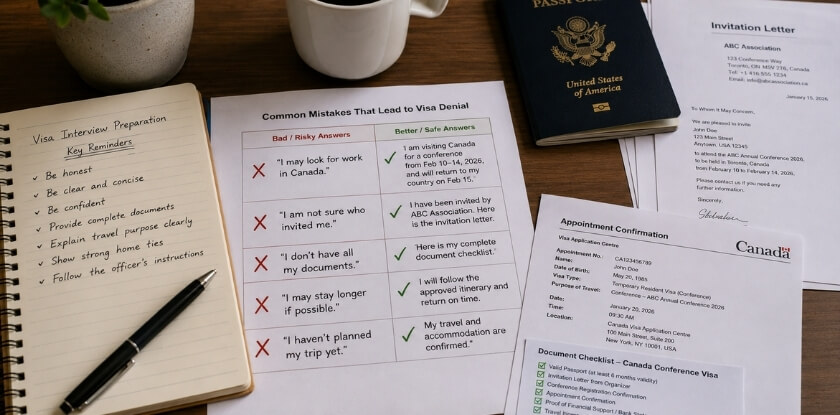
| Problem | How to avoid it |
|---|---|
| Weak proof of home ties | Bring an employment letter, payslip, property or business papers, and an enrolment letter if you study |
| Inconsistent answers | Know the dates, venue and your role, and match the invitation letter |
| Weak funding proof | Sponsor letter on letterhead or stable bank statements in your own name, with no last-minute deposits |
| Poor invitation letter | It must come from the organisers and state the name, dates and your participation. Ask for a corrected one if it reads like a generic template |
| Wrong visa type | Choose the category and entry type that match the real trip before booking the appointment |
| Disorganised documents | Passport, form, invitation, sponsor letter, financial proof, ties, itinerary, in that order |
| Late application | Start at least a month ahead and leave time for a resubmission |
Two points worth adding. First, bank statements must carry the same name as your passport. Second, if you do not know a figure, say “I’d need to check the exact amount” instead of guessing. Nervousness is expected. Evasion is the problem.
From our experience at MS International: our invitation letter is issued within 3 to 5 business days after payment clears, and a US$50 fee applies to corrections after it is issued. Settle your arrival and departure dates first and check the details you send, so the letter, your bookings and your interview answers all match. The letter supports a visa application but does not guarantee a visa.
Final Checklist Before Your Conference Visa Interview
Print everything, check the dates against each other, and arrive early. Tick each item deliberately.
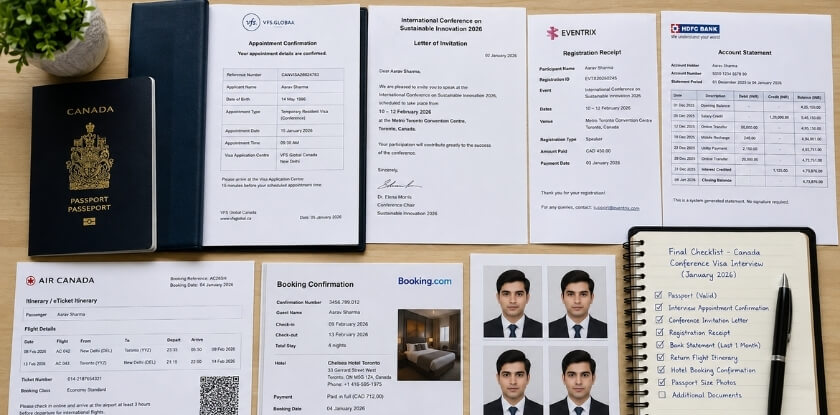
Documents to Have Ready
Print everything unless the embassy allows digital copies for an online interview, and even then keep paper within reach.
- Passport: check the validity rule for your destination. Schengen countries require it to extend at least three months beyond your planned departure. Some other countries require six months.
- Invitation letter: from the organiser, with your name, event name, dates and venue.
- Sponsor letter: if someone else pays, with the relationship, amount covered and contact details.
- Conference agenda: printed, showing session dates and your role.
- Flight and hotel bookings: confirmed reservations, not search screenshots.
- Funding proof: recent bank statements showing the money was there before you applied.
- Employment or business proof: office letter, payslips, registration or tax returns.
- Home country ties: property papers, family records, employment contract.
- Previous travel history: old passports or copies of past visas and stamps.
- Appointment papers: for the US, the appointment instruction page and the DS-160 confirmation page, with a barcode that matches the one used to book. Rules on phones and other electronics differ by embassy, so check before you go.
- Application form: signed, dated and matching your supporting documents.
For a multiple entry visa, add a documented reason, such as confirmed satellite events or a workshop in another city.
The Night Before
Do not cram new information. Organise your folder in the order you are likely to need it, and confirm your slot, location or video link and ID requirements. Write your purpose in one sentence: “I’m attending [Conference Name] in [City] as a [speaker/attendee] from [date] to [date].” Then sleep. A tired applicant stumbles over simple questions.
After the Interview
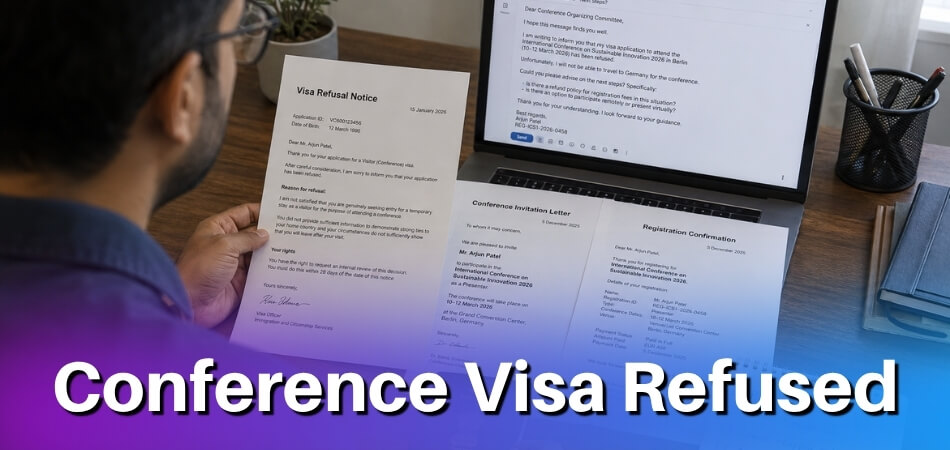
If the officer says your case needs further processing, ask what else is needed and note any reference number. For US cases, the State Department gives no fixed timeline for this. If you are refused, ask for the reason. Many applicants reapply successfully after fixing the specific gap, often home-ties evidence or financial proof.
Check country-specific rules before you go. Rules differ by nationality and change often. For example, the US applies a partial suspension of B-1/B-2 visas for nationals of certain countries since 1 January 2026, and a visa bond programme for some others, made permanent on 3 August 2026. If your country is on the bond list and you are otherwise eligible, the officer sets a bond of US$10,000, US$15,000 or US$20,000 at the interview, and the rule describes it as refundable on departure from the US. Canada also has temporary measures until 27 November 2026 for applicants whose last country of residence is affected by the Ebola outbreak: IRCC keeps processing their applications but does not finalize them. Check your own country’s status on the embassy or IRCC website.
Disclaimer: This article is general information, not legal or immigration advice. Visa rules, fees, and processing times change. Confirm the current requirements on the official website of the embassy or visa authority of the country you are visiting before you apply.
Frequently Asked Questions (FAQ)
Nerves before a consular interview usually centre on memorizing answers, freezing on a question, body language and how a past denial will come up, plus what to bring to an online interview.
Will I be interviewed at all for a conference visa?
Not always. Many Canadian visitor files are decided on documents, and IRCC tells you if it wants an interview. The US requires most applicants to interview in person, with a narrow waiver for some B-1/B-2 renewals.
Do I need to memorize my answers before the conference visa interview?
No. Officers spot scripted answers and ask follow-ups. Know the facts instead: the conference name, dates, venue, who pays and your job title. The words will come naturally from that.
What if I can’t answer a question during the consular interview?
Ask for clarification or say you do not know. “Could you rephrase that?” is acceptable. Guessing and being caught out is worse than admitting you do not have a figure memorised.
Is a sponsor letter mandatory if I’m self-funded?
No. If you pay yourself, show your own bank statements covering flights, accommodation and daily costs for the whole stay. For Canada, IRCC says at least six months of account details helps. Some visa offices ask for other letters, so check their checklist.
Can my employer’s invitation letter replace a conference invitation letter?
No, they do different jobs. The conference letter confirms your registration or speaker status. The employer letter supports your purpose and often your funding. Some officers want both.
How early should I arrive for an in-person visa interview?
Follow the arrival time on your appointment letter. Late arrivals may lose their slot, and security checks take time, so allow for them rather than turning up at the last minute.
What happens if my conference visa interview is rescheduled or canceled by the consulate?
Rebook as soon as a slot opens. Keep your documents unchanged, but check that your dates still fit the conference. Cancellations are usually administrative and rarely about your application.
Does body language actually matter to a visa officer?
It does not decide the outcome, but it shapes how credible you seem. Steady eye contact and a calm pace help. Fidgeting while discussing ties can create doubt.
Should I bring physical copies of my documents to an online visa interview?
Yes. Have them in front of you, because the officer may ask you to hold something up or give details immediately. Also keep scanned copies ready to share if the platform allows.
Can I apply for a multiple entry visa for a single conference?
Yes, but the officer decides. In Canada you do not choose: IRCC issues multiple entry to eligible applicants, and a one-time event is a typical single entry case. Elsewhere, give a reason such as related events within the validity period.
What’s the most common reason applicants fail the conference visa interview?
Weak home ties. For US visitor visas the usual refusal basis is section 214(b), meaning the officer was not convinced you will return. If you are young, unmarried or unemployed, document your job, property and family commitments carefully.
Is there a standard interview preparation checklist I should follow?
There is no single official checklist. A practical one: confirm your conference registration, have the invitation and funding documents ready, know the dates and sessions, be able to explain your job, and practise your answers out loud once.
What if I’ve had a visa denial before?
Be honest if asked. Concealing a previous refusal can seriously damage your application. Explain what has changed, such as stronger ties or better documentation. A past refusal is not automatically disqualifying.
Conclusion: Are You Ready for Your Visa Interview?
Keep three things straight in your head: why you are attending, who is paying and why you are coming back. If those are clear and match your documents, you can handle most variations.
Now practise out loud. Record yourself answering the common questions and listen back for filler words and vague answers. If you are refused, ask for the specific reason where possible, because many applicants succeed the second time once they know what was missing.