
Planning a trip to a conference in Canada starts with a question many people get wrong: what do you actually need before you board? A wrong guess can cost you weeks and a lot of stress. This page sorts out the paperwork so you can plan with a clear head.
Quick answer: Your passport decides which Canada conference visa document you need, not the event. Citizens of visa-exempt countries who fly in need an eTA (CAD $7, usually approved within minutes). Most other travellers need a visitor visa (TRV): CAD $100 plus CAD $85 for biometrics, with processing times that vary by country, so apply at least 8 weeks ahead. US citizens, Canadian citizens and permanent residents need neither.
Fact-checked by the MS International Editorial Team. Last verified against official sources: October 2026.
Conference attendees do not get a special visa. You enter Canada as a business visitor, using either an eTA or a visitor visa (also called a Temporary Resident Visa, or TRV), depending on your nationality. The questions that actually cause delays come after that: which documents IRCC expects, what your invitation letter should say, what an event code is, and how much time to allow.
This guide answers those questions for international attendees. MS International Conferences organizes in-person conferences in the Greater Toronto Area and issues invitation letters for them, and the document advice below focuses on what a conference visa file needs.
TRV or eTA: Which Do You Need for a Conference in Canada?
Check this before you register or book flights. Applying for the wrong document can cost you weeks.
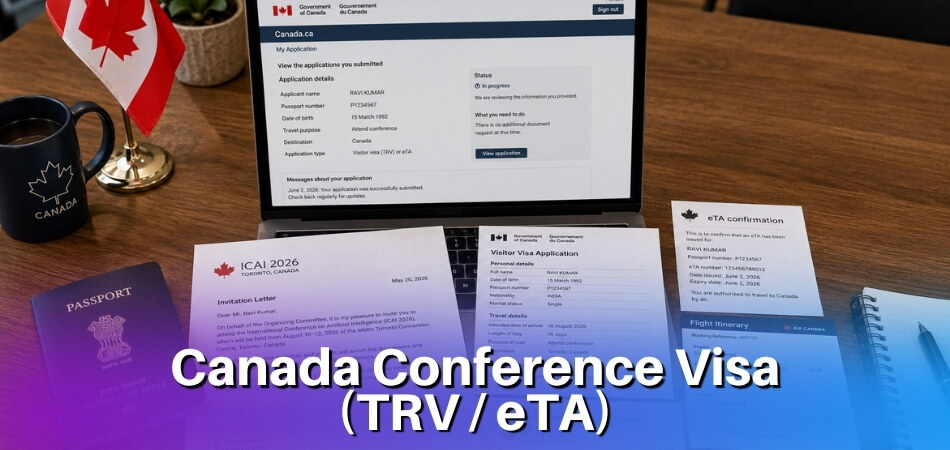
The short version: your passport decides everything. The purpose of your trip (attending a conference) only affects which supporting documents you carry.
| Your situation | What you need | Official fee | Typical timing |
|---|---|---|---|
| Citizen of a visa-exempt country (e.g. UK, France, Germany, Australia, Japan, South Korea), flying in | eTA | CAD $7 | Usually minutes; sometimes several days |
| Visa-exempt citizen arriving by car, bus, train or boat | Valid passport only | None | n/a |
| Citizen of certain visa-required countries (e.g. Brazil, Mexico, Philippines, Thailand) who held a Canadian visitor visa in the last 10 years or holds a valid US nonimmigrant visa, flying in | eTA (air only); a visitor visa if arriving by car, bus, train or boat | CAD $7 | Usually minutes |
| Most other nationalities (e.g. India, China, Pakistan, Nigeria, Vietnam) | Visitor visa (TRV) + biometrics | CAD $100 + CAD $85 biometrics | Varies by country; allow 8+ weeks |
| US citizens, US lawful permanent residents | No eTA or visa (carry passport; green card for US LPRs) | None | n/a |
| Canadian citizens and Canadian permanent residents | Neither (Canadian passport, or PR card + passport) | None | n/a |
Lists change, so confirm your own case with IRCC’s official “Find out if you need a visa” tool before you apply.
Which Nationalities Need Which: A Complete Nationality Breakdown
Here is how each group works in practice.
Nationalities That Require a TRV
If your country is not on Canada’s visa-exempt list, you need a visitor visa. Examples include India, China, Pakistan, Nigeria, Vietnam and much of South Asia, Africa and the Middle East. The visa is a sticker (counterfoil) placed in your passport after approval.
You apply online through the IRCC Portal. If you have not given biometrics (fingerprints and a photo) in the last 10 years, you will also need an appointment at a Visa Application Centre (VAC). Depending on where you live, that may mean travel to another city, so build it into your plan.
IRCC says your passport should be valid for at least 6 months from the date you plan to travel, and a visa is never issued past your passport’s expiry date. If your passport is close to expiring, renew it before you apply.
Nationalities That Can Use an eTA
Citizens of visa-exempt countries, such as the UK, France, Germany, Australia, Japan and South Korea, need an Electronic Travel Authorization (eTA) to fly to or through Canada. It costs CAD $7, you apply online, and most approvals arrive within minutes. Some take several days if IRCC asks for documents. An eTA is valid for up to 5 years or until your passport expires, whichever comes first. The eTA is only for air travel. Visa-exempt travellers arriving by land or sea show their passport at the border instead.
Citizens of some visa-required countries, including Brazil, Mexico, the Philippines, Thailand, Indonesia and Malaysia, can also use an eTA instead of a visa. You must meet all three conditions: you held a Canadian visitor visa in the past 10 years or currently hold a valid US nonimmigrant visa, your stay is temporary (normally up to 6 months), and you fly to or through a Canadian airport on a passport from an eligible country. The US visa must be valid when you apply, though not necessarily when you travel.
If you arrive by car, bus, train or boat, you need a visitor visa even if you are eligible for an eTA. If you do not meet the conditions, apply for a visa. IRCC lists the eligible countries on its eTA page for citizens of visa-required countries, and the list has changed recently, so check it rather than relying on an older article.
Who Needs Neither
US citizens need neither an eTA nor a visa; a valid US passport is enough. US lawful permanent residents have been exempt from the eTA since April 26, 2022, but must carry their green card and a valid passport from their country of nationality.
Canadian citizens, including dual citizens, enter on a Canadian passport. Canadian permanent residents use their PR card plus passport. If a PR card has expired or been lost, a Permanent Resident Travel Document (PRTD) is needed before boarding a flight to Canada.
Business Visitor or Tourist: Which Category Fits a Conference Attendee?
If you are attending a professional or academic conference, you are a business visitor. There is no separate “conference visa” and no separate business visitor application: you use the normal visitor visa or eTA and state that the purpose of your trip is business.

IRCC’s business visitor guidance for events and conferences sets out the test. You qualify if you are staying for up to 6 months, you will not enter the Canadian labour market, and your main place of business and source of income are outside Canada. Attending meetings, conferences, conventions and trade fairs all fit, which is why attending a conference usually counts as business travel.
At the border you should be able to say:
- The name, city and dates of the conference
- Who is paying for the trip (you, your employer or a non-Canadian sponsor)
- That you will not be working for a Canadian employer
When the Tourist Category Applies
Tourism fits informal events with no professional purpose, such as a fan convention or hobby meetup. If your employer is sending you, or the event is professional development, use business. Picking “tourism” for a clearly professional conference creates an inconsistency between your application, your invitation letter and what you tell the border officer.
What About Speakers Who Are Paid?
Presenting a paper or speaking on a panel without Canadian payment is normal business visitor activity. Payment does not automatically mean you need a work permit either. Under the public speakers exemption, guest speakers can work without a permit if the seminar or conference lasts no more than 5 days per trip. Commercial speakers hired by a Canadian organization to deliver training are not covered. If you are being paid and are unsure, check with a licensed immigration consultant before you apply.
What Documents You Will Need for Your Application
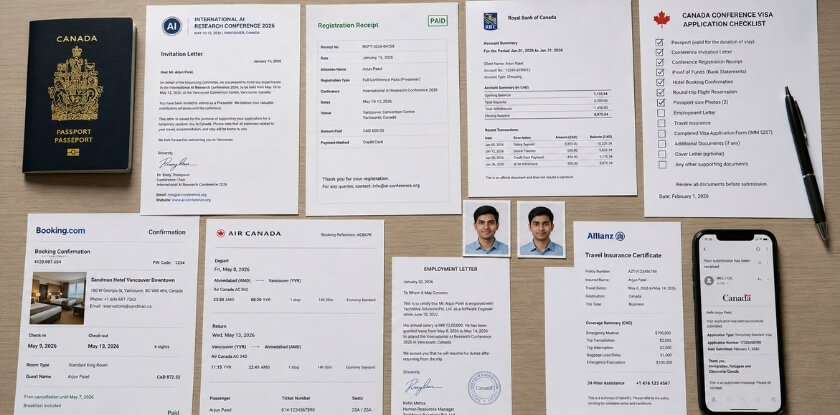
Documents Required for a TRV Application
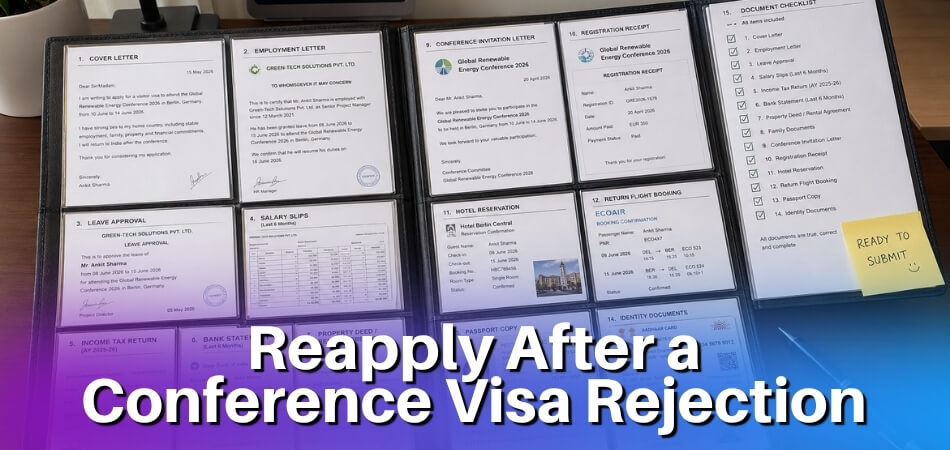
Gather everything before you open the IRCC Portal. The core package is:
Identity and travel
- A digital copy of your valid passport: the bio page plus any pages with stamps or visas. Previous passports that show travel to the US, UK or Schengen countries help.
- Biometrics, if required. Most applicants aged 14 to 79 give fingerprints and a photo at a VAC. If you give biometrics, you do not need to submit paper photos.
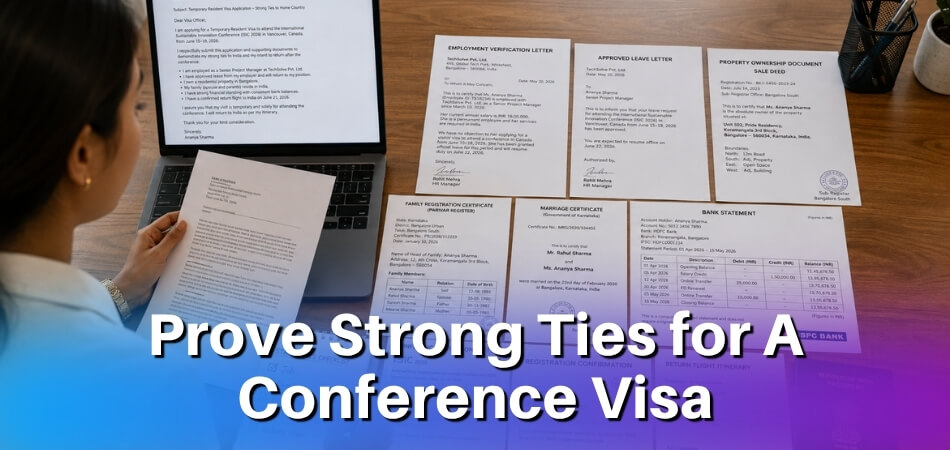
Money and ties to home
- Bank statements. IRCC says at least 6 months of account details, including balances, help it understand your finances.
- An employer or sponsor letter on letterhead stating your position, approved leave, that your job continues after the trip, and who is paying.
- Pay slips, an employment letter, or proof of self-employment. Property, family dependants and a return booking also show you will go home.
Purpose of travel
- Your conference registration confirmation (name, event, dates, venue).
- The conference invitation letter (details below).
- Your event code, if the organizer gave you one (details below).
Our conference visa document checklist has a printable version of this list.
Documents Required for an eTA Application
An eTA needs only a valid passport from an eligible country, a credit or debit card for the CAD $7 fee, and an email address. You do not upload financial documents or letters. Carry your conference documents anyway, because the border officer decides whether you enter.
Conference-Specific Documents: Your Invitation Letter and Event Code
The invitation letter
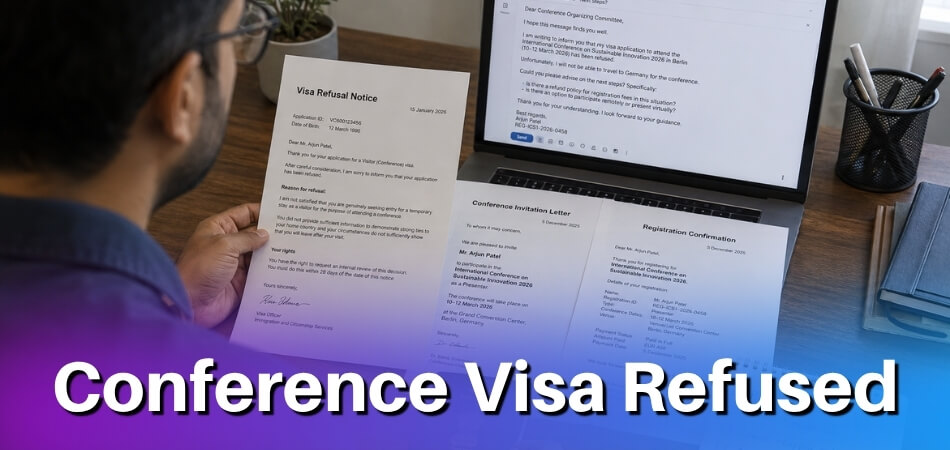
A registration email is not an invitation letter. Based on IRCC’s guidance on letters of invitation for business visitors, a useful conference letter includes:
- Your full name as in your passport, date of birth, employer and position
- The purpose of the trip, your length of stay and your intended departure date, if known
- The conference name, dates and full venue address, and your role (delegate, speaker, presenter, exhibitor)
- Who pays for registration, travel and accommodation
- The organizer’s legal name, address, website and a short description of the organization
- The signer’s name, title, Canadian address, phone and work email, plus 24-hour contact details
- The event code, where one has been issued
IRCC says the host should give each visitor two originals: one for the visa application and one to show at the border. IRCC also states that a letter of invitation does not guarantee that a visa will be issued, because officers assess each applicant. Ask for the letter as soon as you register, so it is ready before you start the visa application. Some visa offices or applicants also ask for a notarized invitation letter.
The event code
Organizers can register larger international events with IRCC’s Special Events Unit and receive an event code. If your event has one, IRCC asks participants to enter it in the visa application itself so the application is identified as part of that event. It does not guarantee approval. Some organizers share the code only inside the invitation letter they send after registration. Many conferences, especially smaller ones, do not have a code, and that does not affect your eligibility. Ask the organizer: “Is this event registered with IRCC, and what is the event code?”
How to Apply: Step-by-Step
TRV Application Process (IRCC Online Portal)
Answer every question truthfully, including any earlier refusals. IRCC treats false or withheld information as misrepresentation, which can make you inadmissible to Canada for five years. Paper applications are only allowed in limited cases, such as a disability that prevents online applying, so plan to apply online.
- Create an IRCC account. Use the IRCC Portal (first-time adult applicants applying alone may be offered the new version of the portal).
- Complete the visitor visa application. Choose business as the purpose of your visit. The application includes the visitor visa form (IMM 5257) and, for applicants 18 and over, a family information form (IMM 5645 or IMM 5707, depending on your country). Enter the event code where the organizer’s instructions tell you to.
- Upload your documents as clear scans: passport pages, invitation letter, registration confirmation, employer or sponsor letter, and proof of funds.
- Pay and submit. The visitor visa fee is CAD $100. First-time applicants also pay the CAD $85 biometrics fee at the same time (CAD $170 maximum for a family applying together). Biometrics are valid for 10 years.
- Give biometrics. After you submit, IRCC sends a biometric instruction letter to your account. You generally have 30 days to give biometrics at a VAC. Book as soon as the letter arrives.
- Track and respond. Watch your account for requests for more documents and answer within the deadline given.
- Passport request. If approved, you send your passport to the VAC so the visa can be placed in it. Allow time for this step.
eTA Application Process
Apply only on the official Government of Canada eTA page. Third-party sites often charge far more than the official CAD $7 fee and add nothing.
The form asks for your passport details, contact information and a few background questions. Most approvals come by email within minutes. If IRCC needs documents, it emails instructions within 72 hours. Use the same passport for the eTA and the flight, because the eTA is linked to it electronically.
You do not have to describe the conference in the eTA form. Your purpose is checked at the port of entry, so bring your invitation letter, registration confirmation and employer letter to the airport.
If you hold two foreign passports, one visa-exempt and one not, applying for an eTA on the visa-exempt passport and travelling on it is usually the simpler route. If you travel on the visa-required passport, you need a visa for it.
Processing Times and How to Plan Your 8-Week Timeline
IRCC does not guarantee processing times. Visitor visa times vary by country and change weekly, so check IRCC’s official processing times tool on the day you apply. IRCC calls the posted time an estimate, not a maximum or a guarantee, so your own case may take longer. For visitor visas the estimate includes the time to give biometrics, and the clock starts once IRCC has your complete application.

The plan below assumes a visa application and treats 8 weeks as the minimum. If the official time for your country is longer, start earlier by that amount. eTA travellers only need to apply before booking flights.
The 8-Week Application Timeline
Week 1: Registration and invitation letter. Register for the conference and request your invitation letter on letterhead. Check your passport validity (at least 6 months from your travel date) and renew if needed.
Week 2: Supporting documents. Collect your employer or sponsor letter, bank statements, proof of ties to home and travel history. Work on several documents at once.
Week 3: Submit online. Complete the application, check every field (name, passport number and travel history errors cause delays), upload documents, and pay the visa and biometrics fees.
Week 4: Biometrics. When the biometric instruction letter arrives, book the VAC appointment straight away. Slots fill up in busy cities.
Weeks 5 to 7: Wait and monitor. Check your IRCC account for document requests and reply quickly. Keep flights and hotels refundable or changeable until you have a decision. If you pass the posted processing time for your country, you can send an enquiry through IRCC’s web form with your application number and conference dates. If your event date is close, an expedite request letter from the organizer can support a request for faster processing, although IRCC decides whether to act on it.
Week 8: Passport and travel prep. Send your passport for the visa if requested, then print your conference documents for the trip.
A Note on Cutting It Close
If the conference is 6 weeks away and you have not applied, apply immediately and avoid non-refundable bookings. Some applications are decided within a few weeks; many are not. eTA travellers face little timing risk, but an eTA still does not guarantee entry if you cannot explain your visit.
What Happens at the Port of Entry: What to Say as a Conference Attendee
A visa or eTA lets you travel to Canada; the Canada Border Services Agency (CBSA) officer at the port of entry decides whether you enter. Most problems at this stage come from vague or inconsistent answers.
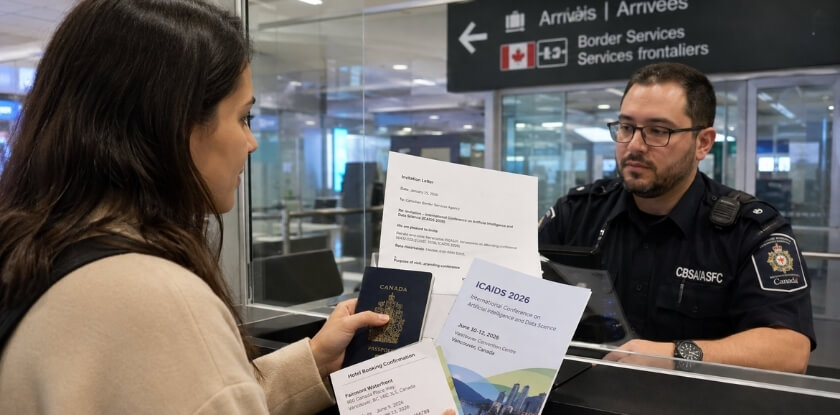
What the CBSA Officer Will Actually Ask You
Expect short questions:
- “What is the purpose of your visit?”
- “Who is paying for your trip?”
- “How long are you staying, and where?”
- “Are you presenting or attending?”
Answer directly: “I’m attending [conference name] in [city] from [date] to [date], and I fly home on [date].” Say “conference”, not “business meetings” or “tourism”.
Have Your Documents Ready at the Booth
Keep these in your hand luggage, printed if possible:
- Conference registration confirmation
- Invitation letter, including the organizer’s 24-hour contact details
- Employer or sponsor letter
- Hotel booking and return flight
- Proof that you can pay for your stay
The officer may ask for none of them or all of them.
Presenting Is Not “Working”
If no Canadian organization is paying you, say clearly that your income comes from your home employer. If you are being paid by a Canadian organization and did not check the work permit rules before travelling, speak to an immigration lawyer or licensed consultant before the trip rather than trying to explain it at the booth.
Secondary Inspection
Being sent to secondary inspection is not an accusation; officers refer travellers for many reasons. Give the same short, consistent answers and show your documents when asked. An event code on your invitation letter helps the officer check the event quickly.
After You’re Admitted
Visitors are usually admitted for up to 6 months, but the officer can set a shorter period. If your passport is stamped or you receive a document with a date, check that it covers your full stay, including any travel after the conference. It is far easier to fix at the border than later.
Common Mistakes and How to Avoid Them
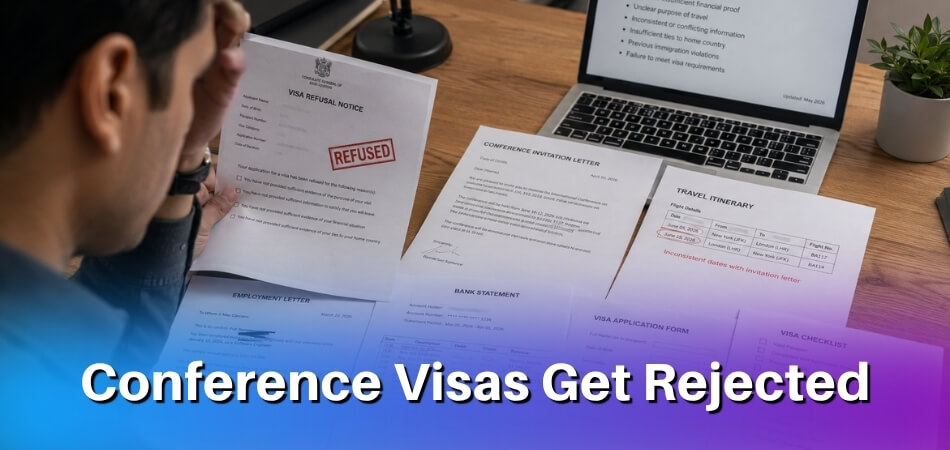
Most conference visa problems come from preventable errors rather than eligibility.
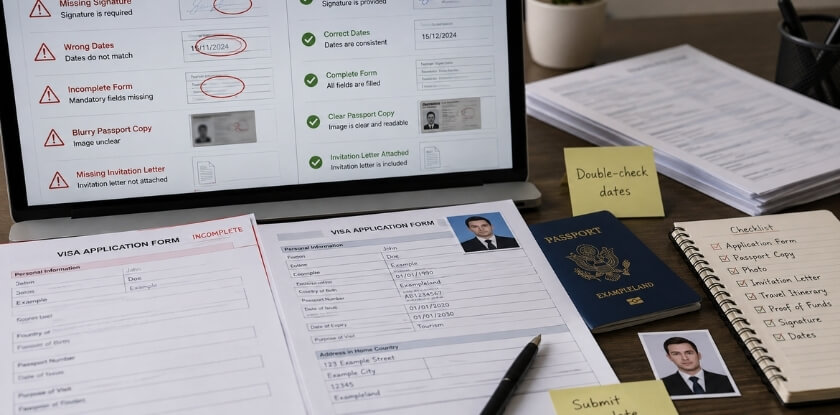
- Choosing tourism for a professional conference. Your stated purpose should match your invitation letter.
- A vague invitation letter. “We confirm John Smith is registered” is not enough. Use the checklist in the documents section above.
- Submitting only one of the two conference documents. The invitation letter and the registration confirmation are different documents, and you need both.
- No employer or sponsor letter. Without it, the application has no clear explanation of who is funding the trip. Self-employed applicants can write their own letter on business letterhead with registration details.
- Using an unofficial eTA website. Copycat sites charge CAD $50 to $100 for a CAD $7 government form.
- Assuming visa-exempt means no paperwork. Without an eTA linked to your passport, airlines will not board you.
- Not carrying copies. A folder of printed documents is quicker than searching your email at the booth.
From our experience at MS International: Request your invitation letter right after you register and pay, so it is ready before you start the visa application. Our letter is issued within 3 to 5 business days after payment clears, and a US$50 fee may apply to corrections requested after it is issued, so check your name and passport details before you submit your request. The letter supports a visa application but does not guarantee a visa or entry into Canada.
Frequently Asked Questions (FAQ)
TRV or eTA is the first fork when attending an event in Canada, followed by Tourist versus Business Visitor, what the invitation letter should say and what a CBSA officer wants to hear at the border.
Do I need a TRV or an eTA for a conference in Canada?
Your passport decides, not the conference. Visa-exempt citizens flying in need an eTA (CAD $7); most others need a visitor visa (CAD $100) unless they qualify for the air-only eTA. US citizens need neither. Check IRCC’s tool, because the lists change.
Can I use the Tourist category instead of Business Visitor for a conference?
For a professional or academic conference, choose business. It matches your invitation letter and what you will tell the border officer. Tourism is only a fit for informal, non-professional events.
What exactly should the conference invitation letter say?
It should state your full name, the conference name, dates and venue, your role, who is paying, the organizer’s details and signature, 24-hour contact details, and the event code if there is one. Ask for two originals and submit one with your registration confirmation.
My passport expires in 8 months. Is that a problem?
Possibly. With 8 months left you have only a small margin over the 6-month guidance, which counts from your travel date, and a visa or eTA cannot outlast the passport. If your trip is more than 2 months away, renew first.
I already have a Canadian Permanent Resident card. Do I still need an eTA or TRV?
No. Permanent residents travel with a valid PR card (or a PR travel document) and passport. Canadian citizens use a Canadian passport.
How long does TRV processing actually take?
No fixed time applies, because it depends on your country and changes weekly. IRCC’s estimate is not a guarantee. Check its processing times tool, allow at least 8 weeks and do not book non-refundable flights before approval.
Do I need to submit biometrics for a conference TRV?
Yes, if you are aged 14 to 79 and have not given biometrics in the last 10 years. Pay the CAD $85 fee when you submit; IRCC then sends an instruction letter, and you generally have 30 days to attend a VAC.
Does a conference invitation letter guarantee a visa?
No. IRCC states that a letter of invitation does not guarantee a visa, and the officer decides each case. The letter supports your purpose of travel, so submit it with your registration confirmation, funds and ties documents.
My employer won’t give me a sponsor letter. Can I still apply?
Yes. The letter strengthens your application but is not mandatory. Explain your employment situation, provide your own financial documents, and rely on your invitation letter and registration confirmation.
What does the CBSA officer actually want to hear at the border?
A short, consistent answer: the conference name, dates, where you are staying, and when you fly home. Have your invitation letter and registration confirmation with you.
Can I extend my stay in Canada after the conference for some tourism?
Yes, if you say so in your application and give your real departure date. A week of travel after an event is normal. Staying beyond what you stated causes problems on future applications.
Conclusion: Choose the Right Visa and Do Not Miss Your Conference
Check your passport against IRCC’s list first: eTA if you are visa-exempt and flying, visitor visa if not. Apply as a business visitor, with an invitation letter, registration confirmation, employer or sponsor letter and a passport valid for at least 6 months. Start at least 8 weeks out, longer if your country’s posted processing time is longer, and give short, consistent answers at the border.
If you are looking for an event, browse our conferences in Canada. MS International has listed 864+ conferences, holds its in-person events in the Greater Toronto Area, and provides invitation letters, notarized invitation letters and visa expedite request letters for registered attendees.
Disclaimer: This article is general information, not legal or immigration advice. Visa rules, fees, and processing times change. Confirm the current requirements on the official Government of Canada (IRCC) website before you apply.