
Ask a handful of speakers whether keynotes pay and you will hear very different stories. Some describe generous fees, others describe unpaid stages that still led somewhere. That gap is confusing when you are deciding whether an invitation is worth your time.
Quick answer: Yes, many keynote speakers are paid, but not all of them. Fees run from nothing at community events and TEDx to five or six figures for famous names, depending on reputation, topic, event budget and format. Whatever is offered, get the fee, any travel cover and any free registration confirmed in writing.
Last verified against official sources: October 2026.
Keynote speakers are sometimes paid very well and sometimes not paid at all. Two people can both be called “keynote speaker” and walk away with completely different results: one with a fee that takes a corporate budget line of its own, the other with a free lunch and a certificate. What decides it is who the speaker is, who is in the room, and what the organizer has budgeted.
This article covers what shapes a fee, rough ranges and how reliable they are, how academic and corporate events differ, when to say yes to an unpaid slot, what belongs in a contract, how to negotiate, and how speaking income is taxed.
Do Keynote Speakers Get Paid?
Often yes, but never automatically. A paid keynote is a business agreement between a speaker and an organizer, and the amount depends entirely on the market position of the speaker and the money behind the event.
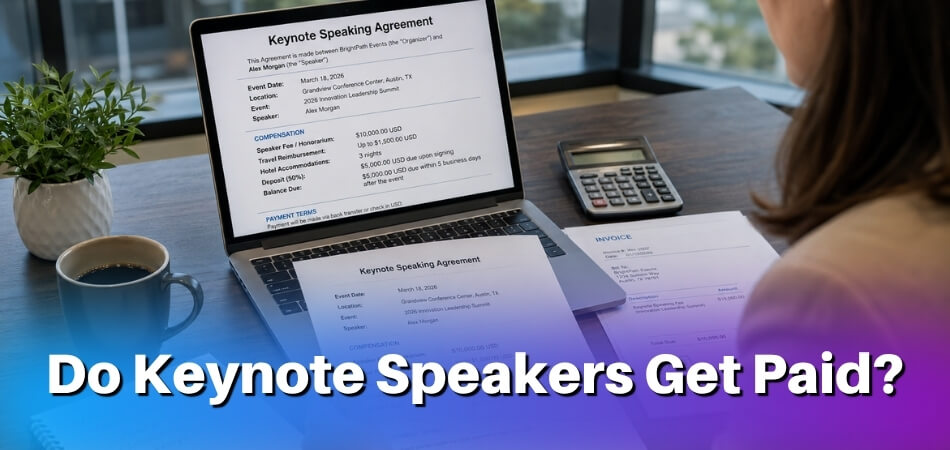
At the top, famous authors and executives are booked through speaker bureaus and agencies, and their fees are negotiated case by case. Most bureaus quote on request, so the loud numbers you see online are usually secondhand reports. Treat any single figure for a named celebrity as an unconfirmed estimate. At the other end, a first-time speaker at a local business event may be offered a few hundred dollars, a meal, or nothing.
Not every speaking gig pays cash
Some speakers trade their time for exposure, testimonials or back-of-room sales (BOR), which means selling books, courses or programs to the audience after the talk. If you have a product and the audience is the right buyer, that can outperform a flat fee. It is covered in more detail in the section on back-of-room sales below.
TED works on a firm no-pay rule. TED’s own TEDx guidance says that speakers never pay to speak at a TEDx event and that no TEDx speaker receives payment, although some events may cover travel costs or offer networking access as their own budget allows. TED also calls services that charge a fee to land you a TEDx talk illegitimate. TED’s main conference is the same on pay: TED describes itself as a nonprofit that does not pay speakers, but it covers a full pass, travel and accommodation at the conference and offers a small stipend for any financial impact. The trade-off is the platform: a strong talk can lift a speaker’s booking rate later. For some people that math works, for others it does not.
Commencement speaking is its own odd category, discussed in the academic section further down. Some universities offer an honorary degree and little else, while others pay a real fee.
What decides whether you get paid
Name recognition, event type, topic, representation and format all matter. They are explained one by one in the section on fee factors, so the short version is this: unknown speakers at community events are often unpaid, and well-known speakers at corporate events are often paid. Employer policy can decide it as well: an independent speaker’s blog (The Architect Elevator) notes that employed speakers often go unpaid because of their employer’s policy.
Keynote Speaker Fee Ranges by Experience Level
Published guides put most professional keynotes between $5,000 and $50,000, with celebrities above that and emerging speakers below. The numbers below come from speaker bureau and speaker-marketing guides, named in the table. Those sources sell speakers and they disagree with each other, so use the table as a map of the market, not a price list. An independent speaker’s blog (The Architect Elevator) puts pay at $0 to $25,000 per talk, a lower ceiling than the bureau guides.
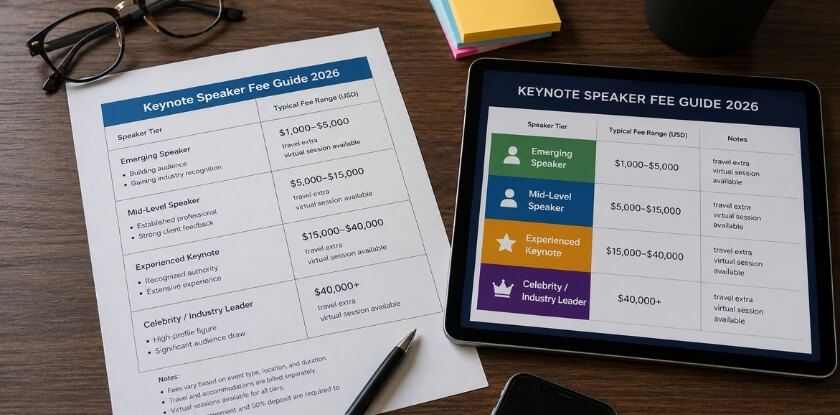
| Level | Range in published guides (USD) | How bookings usually arrive | What supports the fee |
|---|---|---|---|
| Beginner or emerging | Some speak free; under $15,000 (BigSpeak, October 2023); under $10,000 (Executive Speakers, April 2026); $1,500 to $5,000 (National Speakers Bureau, 2026 guide) | Local events, regional conferences, nonprofits, TEDx (unpaid) | Video footage, testimonials, a clean one sheet |
| Mid-level professional | About $5,000 to $25,000 across the guides, from National Speakers Bureau at the low end to BigSpeak at the high end of this band | Referrals, speaker platforms, sometimes a regional agency | A defined niche and repeat bookings |
| Established thought leader | About $15,000 to $50,000: BigSpeak and Executive Speakers list $25,000 to $50,000, National Speakers Bureau $15,000 to $30,000 | Bureaus and agencies, direct inquiries | Major-imprint book, strong media presence, viral talk |
| Top-tier and celebrity | $50,000 and above (BigSpeak); $100,000 to $400,000+ (Executive Speakers); $30,000 to $100,000+ (National Speakers Bureau); negotiated individually | Dedicated agencies and talent representatives | The name itself sells tickets |
The guides name their tiers differently, so the rows are matched by position and the tier boundaries do not line up exactly.
Beginner and emerging speakers
Most speakers start here, and there is no shame in it. You are presenting at local business events, regional conferences, nonprofit fundraisers or small industry meetups, and the fee reflects a name that is not yet recognized. Some beginners do not charge at all at first. They speak to build a reel, collect testimonials and get comfortable on stage, and Toastmasters is a common training ground before anyone quotes a fee.
Once you do charge, the figure depends on the audience and the event, and one 2026 guide starts entry-level speakers at $1,500. Travel and accommodation may not be covered at this level, so ask before you accept. What you gain is experience, footage and a name on a speaker bio page. A clean one-page speaker sheet with your topic, bio and headshot signals that you take this seriously, even now.
Mid-level professional speakers
This is where speaking starts to work as an income stream. Speakers here usually own a defined niche, such as leadership development, cybersecurity awareness or sales training, and have delivered it often enough that planners feel safe booking them. Bookings can come through speaker platforms, referrals from past clients or a regional agency pitching you to corporate and association events.
Some mid-tier speakers accept a lower base fee in exchange for the right to sell products after the talk, which can add real money if the audience is warm.
Established thought leaders
Speakers here usually have a bestselling book, regular major-media appearances or a serious following. Think of someone featured in Harvard Business Review, with a popular talk online or a consulting firm that clients recognize. Contracts get more detailed at this point. An intellectual property clause protects content from being recorded and redistributed, an exclusivity clause may stop the event from booking a competing speaker on the same topic, and a kill fee clause pays a share of the fee if the client cancels late. These clauses are explained in the contract section below.
Top-tier and celebrity speakers
At this level the speaker’s name is the marketing. Events build their promotion around the headliner, because registrations go up and press coverage grows. Celebrity speakers often skip traditional speaker associations and work through dedicated talent agencies.
Logistics get complicated too. A rider is a list of requirements attached to the contract, and it can include first-class travel, specific hotel arrangements, a green room and a dedicated audio-visual setup. These are paid on top of the speaking fee. Virtual and hybrid pricing at this tier is discussed in the virtual versus in-person section.
What Factors Determine a Keynote Speaker’s Fee?
Reputation is the biggest factor, followed by event budget, topic demand, the speaker’s own business model and the scope of the job. None of these is secret. Organizers and speakers both understand them, even if they rarely say so openly.
Name recognition and credibility
A speaker with a bestselling book, a widely watched talk or a recognizable media profile can command far more than someone with the same expertise and no public profile. Famous speakers are not paid more because their ideas are necessarily better. They are paid more because their names fill seats and justify a marketing budget.
Credibility markers that move the needle:
- A book from a major publisher rather than a self-published one
- A talk or TEDx video with real view counts
- Regular appearances in major media and podcasts
- Industry awards or a recognizable title, such as former CEO, Olympian or senator
- A place on the roster of a major bureau, which signals a fee bracket to buyers
Topic demand
Hot topics such as AI, cybersecurity, workplace mental health and healthcare can command premium fees because organizers are actively budgeting for them. If your topic is saturated or fading in corporate interest, you feel it in negotiation.
Niche works in the other direction too. A speaker who addresses only one sector, for example pharmaceutical sales teams, may earn more per engagement than a general motivational speaker, because fewer qualified speakers exist and the audience’s budget is larger.
Event type, budget and audience size
Corporate events usually pay the most: annual meetings, sales kickoffs and industry summits. Association and nonprofit events tend to pay less, and community events pay least, if at all. Speakers know this and adjust their quotes.
Audience size matters, but not always in the way you would expect. A 5,000-person arena does not automatically beat a small executive retreat, because the budget and the stakes of a senior audience can be higher than the headcount suggests.
The speaker’s own business model
Some speakers keep fees lower because the real money comes from back-of-room sales. Others refuse those arrangements and set a higher base fee. These are different business models, not different quality levels. A speaker who relies on BOR may trade fee for exclusive access to sell to the room, and a contract with an exclusivity clause that blocks it will be priced differently.
Travel, duration and exclusivity
A 45-minute keynote in a nearby city prices differently from a full-day workshop that needs two travel days and international flights. Many speakers either charge travel separately or build it into an all-in fee. Neither is wrong, but the contract must say which one applies.
Restrictions have value as well. If an organizer wants you to be the only speaker on your topic for their event series, or wants to stop you speaking to competitors for 90 days, that restriction is worth money and the clause should reflect it.
Experience, results and a good one sheet
Years on stage matter, but documented results matter more. A line such as “attendee survey scores averaged 4.8 out of 5 across 30 events” (use only real numbers of your own) justifies a higher fee faster than a claim to be good. Your one sheet is often the first thing a booking coordinator reads, before the demo reel. A vague or poorly designed one implies a lower fee range. The National Speakers Association offers members business training on areas such as pricing and marketing.
Virtual vs. In-Person Keynote Speaker Pay
Virtual keynotes often pay less than in-person ones, but guides disagree on how much, and some speakers do not discount at all. Kaltura’s 2025 guide says to expect virtual speaker fees to be 50% to 70% less, while CAG Speakers says some speakers price virtual engagements lower because of less travel and prep time and others hold the same fee for both. The spread tells you there is no standard.
The case for a smaller discount
Planners argue that virtual means no travel, no hotel and less time away. That has some logic, but a virtual keynote still needs the same preparation, the same content and the same energy. Only the delivery channel changed, not the value of the material. Many established speakers hold firm at a smaller discount, and a few charge the full rate.
Whether the talk is live or pre-recorded also matters. A pre-recorded message takes less effort on the day, so a lower price can be reasonable, and a live, interactive session deserves more. Recording rights add value of their own, so a request to record and reuse a session should come with its own price.
Where virtual can win on net pay
Run the numbers for yourself. Here is an illustration with made-up round figures, not market data. An in-person keynote at $15,000 sounds strong until you subtract flights, hotel, ground transport, meals and a full day of travel in each direction with no earning time. A virtual keynote at $11,000 with no travel may leave you with a similar or larger net, and you are home for dinner. This is why busy speakers sometimes prefer a calendar of virtual bookings over constant travel.
Hybrid events
In a hybrid event you address a live room and a remote audience at once. You perform for a camera crew, manage two audience experiences and often attend technical rehearsals that a standard in-person gig would not need. Some speakers therefore quote their full in-person rate and add a negotiated premium for the extra production work, and hybrid is usually priced case by case. If your contract does not treat hybrid as a separate scenario, add it. A kill fee clause also protects your base fee if an in-person event converts to virtual after you have signed.
How agencies and organizers treat the discount
If you book through an agency, ask whether it sets a floor for virtual fees. If you negotiate directly, do not name a lower number first. Let the organizer make an offer. Many will open low and move up if you explain the value clearly. Rate-benchmarking information on speaker platforms can help support your position.
Virtual-only speakers
Some speakers built their business on virtual delivery and never had an in-person rate. For them the virtual fee is simply the fee. It is a legitimate path now, not a fallback.
Speaker Bureau vs. Direct Booking
Guides commonly cite a bureau commission of about 25 to 30%, but a bureau can bring you clients you would never reach alone. Whether that is worth it depends on where your bookings actually come from.
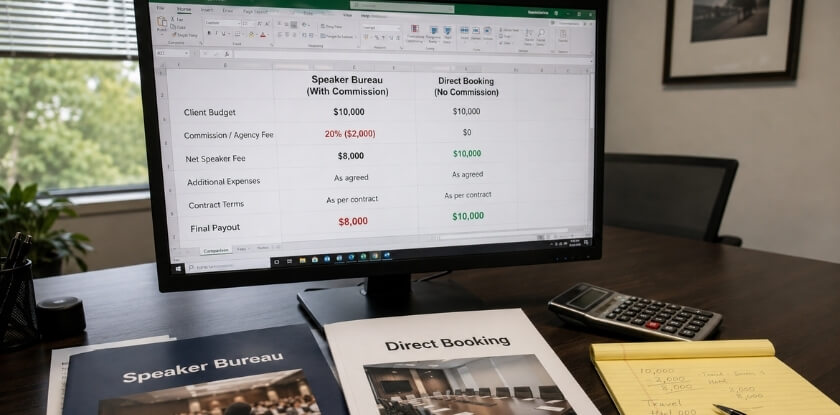
| Question | Through a bureau | Direct booking |
|---|---|---|
| Cost to the speaker | Commission, commonly cited at 25 to 30%; sometimes built into the quote the client sees | None, you keep the full fee |
| Who handles contract and logistics | The bureau negotiates and manages both | You do, so you need your own agreement ready |
| Access | Corporate meeting planners and buyers with large budgets | Whoever finds you through a profile, search or referral |
| Fee flexibility | Many bureaus expect one consistent fee wherever you are booked | Structure, BOR rights and workshop bundles are yours to set |
| Who can get in | Mostly speakers with existing visibility | Anyone |
How speaker bureaus work
A bureau acts as the middleman between you and event organizers. A bureau is not a talent agency in the film sense. It keeps rosters of vetted speakers, pitch them to meeting planners and handle negotiation, contracts and logistics.
Commission figures differ by source. One speaker-booking guide quotes a Skift Meetings report saying bureaus typically take 25% to 30% per booking. Sometimes the commission is built into what the client pays, and sometimes it comes out of the speaker’s side. Ask before you sign, because the structure varies.
Some bureaus expect you to keep the same fee whichever way you are booked, often called fee integrity in the trade. If a bureau books you at one price and later learns you quoted a lower price direct for the same kind of talk, that can end the relationship. Your official fee has to hold everywhere.
The case for direct booking
When an organizer finds you through a speaker platform such as SpeakerHub or eSpeakers, a LinkedIn search or a referral and no bureau is involved, that is a direct booking. You keep everything, you negotiate directly and you build the relationship. You can be flexible on structure, add BOR rights or bundle a workshop.
The trade-off is that you handle the contract. Have a solid keynote agreement ready, and do not rely only on the organizer’s paperwork, because their version protects them, not you.
Bureaus are not always available to you
The major bureaus recruit speakers who already have significant visibility: authors, executives, people with a widely watched talk. If you are building a career, you are in direct-booking territory for a while, and that is fine. Once you earn consistently in the mid range, smaller boutique agencies may approach you.
Working with several bureaus
Some speakers work with more than one bureau. That is allowed in many cases, but read every agreement for an exclusivity clause, because some bureaus want exclusive rights in certain industries or regions, and conflicting terms are a mess. If a bureau brings you a lead and you then book that client directly to avoid commission, that is a serious breach. Bureau contracts often include a tail period during which the commission is still owed on a client the bureau introduced, so check how long it runs.
Which route fits your stage
If you are early-stage, go direct: list yourself on speaker platforms, keep your one sheet sharp and set a fee you can defend. If you are established and want volume, especially corporate work you would never find alone, a bureau can make sense even with the commission. One placement through a bureau relationship may be worth more than many direct bookings you sourced yourself.
Honorarium vs. Speaker Fee
No, they are not the same thing, though in practice the line has blurred. A speaker fee is a negotiated rate set out in a contract. An honorarium is traditionally a voluntary payment offered as thanks.
| Speaker fee | Honorarium | |
|---|---|---|
| Nature | Negotiated business rate | Token payment, often set by the host |
| Negotiable? | Usually yes | Often fixed by the institution |
| Where you see it | Corporate events, bureau bookings | Universities, medical associations, nonprofits, community panels |
| Paperwork | Signed keynote agreement | Sometimes only a cheque and a thank-you note |
A speaker fee is agreed on a number, written into a signed agreement and treated as a business transaction. Historically, honorariums came up where openly charging a fee seemed inappropriate: academic lectures, nonprofit events and community panels. The organization offers what it can and the speaker accepts it as goodwill.
Today the distinction has mostly collapsed. An “honorarium” is often still payment for professional time, and the word simply sounds more dignified in some circles. Universities, medical associations and some government bodies like the term. In the United States, either label is generally taxable income either way, as the tax section below explains.
Why the label still matters
Even with the same tax treatment, the word tells you something about the budget. When an organization offers an honorarium, it is usually telling you indirectly that the number is what it has and may not move. A speaker fee implies a real budget and a real conversation.
Read an “honorarium opportunity” as a soft warning. The amount could be $200 or $2,000, and you will rarely know until you ask. Ask early, before you invest time in discussions:
Hello [Organizer Name], thank you for the invitation to speak at [Event Name]. Before we go further, could you tell me what honorarium or fee you have budgeted for this session, and whether travel and accommodation are included?
Commencement speakers and the honorarium gray zone
Commencement arrangements show the ambiguity well. Some universities pay nothing and frame it as an honor, and others offer an honorarium. Schools rarely publish what they pay, and the honorarium label gives them room to offer whatever fits the budget, or nothing.
Back-of-room sales as an informal substitute
Sometimes an organization cannot pay a proper fee or a meaningful honorarium, so it offers the right to sell products after the talk. A speaker might accept a small honorarium and negotiate BOR rights to sell books, courses or coaching packages. For the right audience that can beat a standard fee, though it is not guaranteed income.
Putting it on paper
A speaker fee belongs in a signed agreement. Honorariums are often paid with just a cheque and a thank-you note. That may be fine for a small amount, but if real money is involved, get it in writing. At minimum, confirm the amount by email. Better, use a simple independent contractor agreement covering payment terms, cancellation and who owns the recorded content. Even a one-page document protects you if the organization suddenly has “budget issues” after the event.
How Much Do Speakers Earn at Commencement and Academic Events?
Academic events usually pay less than corporate ones, and many pay nothing beyond costs. Commencement speeches have large audiences and real visibility, but their pay structure looks little like a corporate keynote.
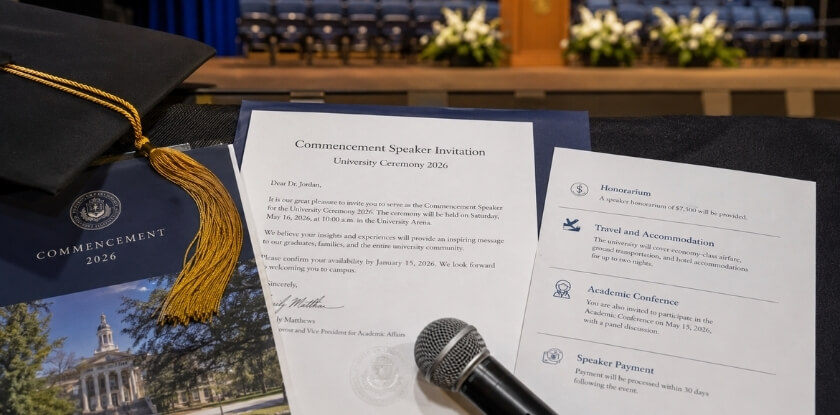
What universities publish about honoraria
Universities rarely publish what they pay commencement speakers, so most numbers you see are reports, not policy. Written honorarium policies for ordinary guest speakers are easier to find, and they show how modest academic budgets can be:
- SUNY Broome Community College allows an honorarium of up to $45 for classroom guest speakers (procedure revised March 2024).
- Kennesaw State University’s 2024 guidelines say honorarium payments may not be greater than $2,500, excluding travel.
- The Iowa State University College of Design guidelines (updated September 2024) say honoraria typically range from $250 to $2,000, depending on the speaker’s prominence, expertise and budget.
These are individual institutions, not an industry standard, and policies change. Always ask the host for its current figure.
Prestige does not always mean better pay
Being invited to a prestigious university does not mean the payment reflects it. Some institutions treat their brand as part of the compensation, on the logic that the association adds credibility to your career. Maybe it does, but credibility does not cover airfare.
If you are approached for a commencement address, treat it like any other engagement. Ask for a written agreement, confirm the fee in writing, and have travel and accommodation itemized separately. Institutions often pay through procurement systems with their own paperwork and slower payment timelines, so plan your cash flow.
Department lectures, guest speakers and academic conferences
Department-level invitations such as guest lectures and visiting speaker series are usually modest, as the policies above show. Academic conferences differ: some offer an honorarium, some waive registration, some cover only travel or hotel, and some offer nothing, so ask which package applies. A registration waiver and hotel help as the whole package makes sense if you are an academic building a research profile, and much less if speaking is your main income. Event industry groups describe academic and association events as generally sitting below corporate ones, which reflects nonprofit and educational budgets, not a lack of respect.
Professional associations often cover costs instead of paying fees. For example, ACM’s Distinguished Speakers Program states that it will cover the cost of transportation for the speaker, with priority going to ACM-affiliated events. Expense cover of that kind is a different thing from a fee.
Contract points that matter in academic settings
Some university contracts include an exclusivity clause that stops you speaking at a competing institution within a set area or period. If you are building a regional academic circuit, that clause could cost more than the fee is worth. Check the intellectual property clause too, because some universities claim partial rights to recordings of events they livestream or archive. If you want to reuse the talk on your website, in a course or on social media, make sure the contract does not block you.
Is academic speaking worth pursuing?
It depends on your goals. Early in a career, a speaking credit from a recognized university carries weight on a one sheet and signals credibility to corporate planners who might not otherwise take a chance on you. Later, with a competitive calendar, academic events can become low-return bookings: fees are lower, contracts can be slow, and back-of-room sales are rarely permitted, so that income stream disappears. Know what you need from the engagement before saying yes.
From our experience at MS International: For most applicants, the route to our in-person conferences in the Greater Toronto Area is the presenting-author track: choose a conference, submit work for review, receive a decision, and register as an author if accepted. Keynote and invited roles follow a different route. Our speaker agreement says participation does not create an entitlement to an honorarium, fee, travel reimbursement or accommodation unless we have agreed it in writing, so the sensible step for any speaker is to ask early and get any promise confirmed in writing.
When Is It Worth Accepting an Unpaid Speaking Engagement?
Early in your career, sometimes. Mid-career or later, almost never. Every speaker meets an organizer whose offer sounds interesting but carries a fee of zero. A clear framework helps you decide instead of saying yes out of guilt.
You are still building proof
If you have never spoken beyond a Toastmasters meeting or a local club, you do not have a sheet worth much, no video and no testimonials from planners. You are asking people to pay for something they cannot verify. Speaking free at a well-attended industry conference, a regional association event or a TEDx stage gives you footage, and a clean, professionally filmed talk can do more than cold outreach. TEDx is unpaid, but the credential is real and the video compounds over time.
That said, TEDx is about the ceiling for free work. If someone runs a ticketed corporate event with hundreds of paying attendees and wants a full keynote for nothing, that is not a career-building opportunity. It is unpaid labor dressed up as exposure.
The back-of-room exception
Some speakers accept a reduced or zero fee in exchange for BOR access. If you sell books, courses, coaching or physical products and the audience matches your buyer, you can earn more than a typical fee. This works best when:
- The organizer confirms a real selling window, not a table in a hallway
- You have a proven product with a clear price
- The audience is large enough for the conversion math to work (a small share of the room buying is a typical hope, not a guarantee)
- The arrangement is in writing, ideally in the keynote agreement
Do not take BOR as a consolation prize from a disorganized event. It is only valuable if the audience is buying.
Relationship and pipeline value
Sometimes the person inviting you does not pay this time but will matter later: a marketing chief who books speakers for several industry conferences a year, or a corporate event manager with a real speaking budget. Speaking once for free to reach that decision-maker is a business choice. Be honest with yourself about whether that is what is happening, or whether you are rationalizing the thrill of the stage.
Cause-driven and community work
If a nonprofit, school or community group shares your values and genuinely has no budget, some speakers simply choose to contribute. That is a personal call. Just do not let guilt drive it. If an organizer says “we’d love to have you, we just don’t have the budget”, it is fair to ask what the event does pay for, such as the venue, the audio-visual team and catering, and whether a small honorarium or travel cover is possible.
When to decline
Free speaking is almost never worth it in these cases:
- Paid-ticket conferences that say exposure covers your fee. If tickets are being sold, someone is being paid, and it should not be everyone except you.
- Last-minute unpaid asks. If your time is not worth planning around, the audience will not value it either.
- Events where you cannot film or reuse the content. With nothing reusable, the appearance has no lasting value.
- Anything with a vague exclusivity clause. Some “free” gigs restrict you from speaking to competitors for months. Read everything before signing.
Set a personal policy
Decide your criteria in advance so you are not negotiating against yourself every time. Some speakers allow one free event a quarter, and others take unpaid work only for TEDx or a cause they have already committed to publicly. Write the policy down. It is easier to say “that falls outside what I take on unpaid this year” than to improvise a refusal each time.
Once you are established enough to get inbound interest, the picture changes. Speaking free all the time then signals that your fee is not real, and it teaches the market to expect discounts. Protect your rate.
Do Keynote Speakers Get Paid Per Hour or Per Word?
Neither. The usual arrangement is a flat fee per engagement. You agree on a number before the event, you speak, and that is what you are paid. That is simple, and it trips up a lot of beginners.

Why the flat fee exists
A 45-minute talk may be the only visible part, but behind it sits preparation: customizing slides, researching the client’s industry, calls with the organizer, travel and follow-up questions. Many speakers spend many hours on this. An hourly speaker would have to track and invoice all of it, and no planner wants to receive that bill. The flat fee covers the speech, the prep, the travel time and the follow-up.
What “per engagement” covers
One engagement typically means:
- One keynote address, often 45 to 90 minutes
- Any pre-event calls the client requests
- Travel to and from the venue, or a setup call for a virtual keynote
- Sometimes a meet-and-greet, book signing or breakout session, though these often cost extra
A full-day workshop plus a keynote is two engagements, not one, and experienced speakers structure their contracts to say so clearly.
Does speaking longer mean more money?
Not automatically. A 90-minute talk does not always pay double a 45-minute one, because the fee reflects demand, credibility and the value the speaker brings, not the clock. If you are a mid-tier speaker asked to speak for 90 minutes instead of 30, it is fair to negotiate more, since you are doing more work. Frame it as your fee for the scope described, not as a rate per hour.
The per-word myth
Now and then a beginner asks in a speaker forum whether speakers are paid per word, as some copywriters are. They are not. There is no per-word pricing for live speaking, and you would not see it in a legitimate speaking agreement. Per-word pricing does appear when someone ghostwrites a keynote script for another person to deliver, which is a different service priced separately.
What the contract says about payment
A standard independent contractor agreement for speaking names a flat fee and a payment schedule, often a deposit up front with the balance on the day or within a set number of days after, plus cancellation terms. None of it is tied to minutes spoken or words delivered. Quote flat fees, get them in writing, and do not let anyone steer you into hourly billing, which undervalues the prep and leaves ambiguity that rarely resolves cleanly.
How Event Organizers Budget for a Keynote Speaker
Plan the speaker line from the start, not from what is left. Some event budgets are built backwards: venue first, catering next, and then someone realizes a speaker is needed and uses whatever remains. That is how an event can end up with a weak keynote or an awkward negotiation just before the contract.
There is no standard percentage
Some planners use a rule of thumb that gives the headline speaker a share of the total event budget, but no body sets a universal figure and the share varies widely by event type. Use any rule of thumb as a starting reference only. A large multi-day summit with sponsors covering overhead can put far more into one keynote than a small association meeting could.
What eats into the budget
The fee is only one piece. Travel, hotel and ground transport are often covered by the organizer on top of the fee, and they can add a large amount, especially for a long-haul speaker. Some speakers also bring an assistant or a technical rider, and audio-visual requirements such as specific microphones or custom staging can add production costs you did not expect. Budget for the full cost of the speaker, not just the number on the quote.
How sponsors change the equation
Sponsor funding can change what you can afford. Many conferences approach industry sponsors to underwrite the keynote, offering logo placement on the stage backdrop and in the program. If a sponsor covers most of a speaker fee, your own outlay shrinks. Sponsors value being associated with a speaker attendees will recognize, so a recognizable name makes those conversations easier.
Rough guide by event size
| Event budget | Typical speaker | Booking route |
|---|---|---|
| Small | Local speaker, early-career professional or subject expert from your own industry | Browse speaker platforms; often direct |
| Mid-size | Regional speaker with real credentials | Often direct, without an agency |
| Large | Nationally known professional | Bureaus often involved |
| Very large | Celebrity speaker, major author or public figure | Often a bureau or talent agency |
Exact dollar thresholds between these bands are not standardized, so check the fee ranges earlier in this article and ask for quotes.
Virtual and hybrid in the budget
Organizers of hybrid events sometimes argue for a lower fee because the speaker is not traveling. That sometimes works and sometimes does not. If the event is recorded and the footage will be reused, the speaker may ask for more, not less, because the intellectual property terms affect their future licensing. Budget the virtual option near full rate. If you win a discount, good, but do not plan around one.
The cancellation problem organizers underestimate
A kill fee clause protects the speaker if you cancel, and the organizer stays liable even when sponsorship falls through. If your event depends on sponsor money to cover the fee and that money disappears late, you can still owe the agreed percentage. The standard terms are in the contract section below. Some organizers take out event cancellation insurance for this, and it is worth asking a broker if the speaker fee is large.
Checklist before you finalize
- Put the speaker fee and estimated expenses in as separate line items
- Confirm audio-visual requirements before finalizing production costs
- Check whether the speaker plans back-of-room sales, which can offset your cost but needs table space and coordination
- If you use a bureau, ask whether its commission is already in the quoted fee
- Consider a professional review of the independent contractor agreement for a large fee, because misclassification problems are real
Budgeting for a keynote is not complicated. It just means treating the speaker as a real cost from day one.
Keynote Speaker Contract Basics
A handshake is not a contract, and every paid speaking engagement needs a signed agreement before you book travel or prepare a slide. This is not about distrust. It is about clarity on both sides.
Core elements of a keynote agreement
Event details. Date, time, venue and session length. Be specific: “approximately 45 minutes” invites arguments later, so write “45 minutes, not to exceed 60 minutes.” For a virtual or hybrid session, name the platform and who handles technical setup.
Fee and payment terms. State the exact amount, any deposit, the balance due date and accepted payment methods. Many professional speakers ask for a deposit before doing preparation work. That is common practice, not arrogance.
Expenses. Travel, hotel, ground transport and meals should be spelled out, either itemized for reimbursement or as a flat per diem. Do not leave this vague.
Cancellation and the kill fee clause. This is the clause organizers sometimes resist and speakers cannot skip. It says what happens if the event cancels after signing. One commonly negotiated structure is a large share of the fee owed for a late cancellation, a smaller share for earlier cancellation, and a non-refundable deposit beyond that. There is no fixed standard for the percentages, so settle them in writing. Speakers lose other bookings while holding a date, and the kill fee compensates for that.
Clauses that protect both sides
Intellectual property clause. The speaker created the content and keeps ownership by default, but organizers sometimes ask for recording rights. Filming, livestreaming or distributing the session is a separate negotiation and often a separate fee. The clause should cover recording permissions, distribution rights and how long the organizer can use captured footage. Never sign away your core content. A limited license for internal use is different from handing over rights permanently.
Exclusivity clause. An organizer, or the sponsor paying your fee, may want assurance that you will not speak for a direct competitor within a window before the event. That is reasonable if it is narrow and time-limited, and it should come with extra pay if it is unusually restrictive. Large corporate clients sometimes push restrictions that last months or a year. That is a real income limit, so price it or push back.
Back-of-room rights. If you sell anything at the event, agree it in writing. Some organizers prohibit it, some take a share and some encourage it.
Independent contractor language. You are not an employee. The agreement should confirm your status as an independent contractor, which matters for tax paperwork. It does not change your tax obligations, but it clarifies the relationship.
Practical details people forget
Audio-visual needs, such as a confidence monitor, a wireless clicker or screen resolution, go into the contract or an attached technical rider. Do not assume the venue has them. Your one sheet sets initial expectations, but the contract makes them binding. Special requests such as a private green room, dietary needs for a pre-event dinner or a dedicated sound check also belong in writing, because verbal agreements are forgotten and written addendums are not.
Lawyer or template?
Templates from speaker associations or speaker platforms are a reasonable starting point and cover most standard cases. For a large deal, an attorney’s review is worth the cost. Agencies and major bureaus usually have their own standard agreements, which already include these provisions. Read them anyway, because a standard contract protects the agency’s interests and an addendum can protect yours. Sign because you trust the organizer, not instead of trusting them.
How to Negotiate Your Speaking Fee
Negotiate every time: organizers expect it, budgets usually have some room, and the worst realistic outcome is a no. Many speakers feel uncomfortable about it, and they should not.

Know your value and research
Before you name a number, learn what the market pays. Some speakers list fee ranges on speaker platforms, and trade publications such as MeetingsNet write about event budgets. Compare yourself with speakers in your niche with similar credentials, not with the most famous names. Look two or three steps ahead of yourself.
Research the event too. A regional HR conference has a different budget from a national summit. Past speaker lineups on the event’s site often show whether it books speakers at the lower or higher end. Know your floor, the minimum you will accept, and your ask, what you want. Negotiation lives in the gap.
Build a package, not just a speech
Selling “a speech” invites a price comparison. A package shows value. A solid package might include:
- The keynote itself
- A pre-event 30-minute strategy call with leadership
- A workshop or breakout session after the main talk
- A signed copy of your book for each attendee
- A version of your one sheet adapted to their industry
BOR can be part of the conversation too. Be upfront about it, since many organizers see it as added value for attendees. A $7,500 package is an easier sell than a $7,500 fee.
Keep travel and expenses separate
Do not bundle travel into your speaking fee. Keep it a separate line on every quote and invoice. That protects the fee from being diluted by flights, and it gives you a clear paper trail for tax. A typical expense add-on is economy airfare, with business class specified in writing for very long flights, a hotel night before and sometimes after, ground transport and a per diem for meals whose level varies by city. Ask for reimbursement with receipts, or have the organizer book and pay directly. If an organizer will not cover travel at all, weigh that against the fee.
Make a counter-offer without losing the booking
Most organizers open below your ask. Do not panic and do not accept at once. A short reply that works:
Thank you for the offer. My standard fee for this type of engagement is [Fee]. I would like to find a way to make this work, so could you share a little about the full budget and where there is flexibility?
That opens a conversation instead of making a demand. If they genuinely cannot meet your fee, you have three real options:
- Reduce the deliverables. One session instead of two, no pre-event call, no custom materials.
- Negotiate non-monetary value. Professional video of your talk, a testimonial, introductions to other organizers or a prominent feature in their post-event content.
- Accept with conditions. Take the lower fee this time in return for a written commitment to a future engagement at your full rate.
If they will not move and the event serves none of your goals, it is fine to walk away. That is not burning a bridge. That is running a business. Add a kill fee clause to any booking before you lock it in, even a direct one handled through an independent contractor agreement, and agencies include it as standard.
Tax and Legal Considerations for Paid Keynote Speakers
In the United States, speaking fees are taxable self-employment income, and a client must report payments of $2,000 or more made in 2026 on Form 1099-NEC. Most paid speakers are independent contractors, so no employer withholds tax for them. This section describes US rules, because most of the fee guides cited here are American. In Canada, the Canada Revenue Agency encourages Form T2125 for reporting business or professional income and expenses. Speakers there or elsewhere should ask an accountant about local rules.
The 1099 and self-employment tax
The IRS says to report Form 1099-NEC payments totaling $600, or $2,000 for payments made after December 31, 2025, during the calendar year. Some clients will ask for your W-9 before they confirm the booking, so keep it ready.
What surprises new speakers is self-employment tax. The IRS lists the rate as 15.3%, made up of 12.4% for Social Security and 2.9% for Medicare, which an employee would normally split with an employer. You pay both halves. Set aside a share of every fee for tax from day one. The right share depends on your total income, so ask an accountant.
Your speaking income and expenses go on Schedule C. Business costs that can be listed there include mileage, travel, home office, professional development such as association membership or Toastmasters dues, one sheet design, speaker platform subscriptions and part of a phone bill. Keep receipts for everything. The IRS does not accept “I was too busy during conference season.”
Honorariums and fees are treated alike
Whether a payment is called an honorarium or a speaker fee, it is generally reported as income. The label does not change the tax treatment, so do not let it change your bookkeeping.
Contract language that affects tax and income
Almost every speaking engagement runs through an independent contractor agreement, which is standard. Read it in full before you sign, and watch for exclusivity and intellectual property terms that go beyond the engagement itself, as covered in the contract section above. A contract without a cancellation clause should have one added.
Back-of-room sales are taxable too
Revenue from products you sell at the event is taxable income and should be tracked separately. Physical products may carry sales tax obligations depending on where the event is held, which gets complicated if you speak across several states. Some venues take a share of BOR sales. Treat that share as a cost that reduces your net revenue and track it carefully.
Virtual keynotes are not simpler
A virtual keynote from your home office means no travel deductions, but also no travel costs to offset. The self-employment tax still applies and the 1099 still arrives. If an international client books you, you may also face foreign income reporting rules. For tax strategy specific to speakers, see a CPA or accountant who works with self-employed creative professionals, not just any preparer.
Payment timing
University and large-corporation payments can come through procurement systems with slower timelines. Payment terms vary, so check the payment schedule in the contract and build any delay into your cash flow before you depend on the income.
Association membership
The National Speakers Association lists contract templates, training videos and pricing webinars among its member benefits. If you speak at serious volume, membership may be worth the cost.
Back-of-Room Sales and Other Income Streams for Speakers
The speaking fee is not always the biggest payment from an event. For many working speakers, products and follow-up work earn more.
Back-of-room sales cover anything you sell to attendees after your talk: books, online courses, coaching packages, memberships, signed prints or drives with training content. You set up a table near the exit, and people who just spent 45 minutes listening to you walk past it. That is a warm audience.
How BOR works
Some events welcome it and others ban it outright. Always confirm before arriving with a folding table and a card reader. When BOR is allowed, organizers sometimes take a share of gross sales. Some events waive their speaking fee entirely in exchange for you keeping all BOR revenue. That deal makes sense with strong products and a large, engaged room, and little sense if you are selling a low-priced book to a few dozen people. Get the share and the arrangement in writing before agreeing to speak.
Online courses and digital products
Your talk plants a seed. Many attendees will not buy at the event but will search for you on the way home, so a ready website captures revenue weeks later. A course hosted on a course platform works well as the follow-up, because the talk was a live preview and credibility is already built.
Licensing and intellectual property
Your frameworks, method and slides can be licensed to companies for internal use. An HR team that loved your talk on psychological safety might want to train its managers with your material. That is a licensing deal, not a speaking gig. The intellectual property clause should state what you grant and what you do not, and if you do not own the video of your own talk, you cannot reuse it.
Coaching, consulting and retainers
A keynote can turn into a longer consulting relationship, because senior decision-makers sit in conference audiences. Offer something low-pressure, such as a short discovery call, on your slides, handout or website. Some speakers also offer a half-day or full-day workshop as the natural next step: the keynote opens the door and the workshop is where the deeper work and larger invoice happen.
Virtual summits and recorded libraries
Speakers at virtual summits often negotiate affiliate arrangements instead of, or alongside, a flat fee: you share your link and earn commission on sales from your promotion. Hybrid events have added another option. A session may be recorded for an on-demand library the organizer sells later, and that is a separate licensing fee to negotiate upfront, not afterward.
Sponsorships and partnerships
Once you have a real audience, such as an email list, social following or podcast, brands may pay to be associated with it. That is separate from event organizers, and you are paid for what you built. It takes time to build an audience that brands care about.
The bigger picture
The stage fee is one line item. BOR, courses, licensing, consulting, workshops and affiliate deals all trace back to credibility built in front of an audience. The speakers who earn the most are not necessarily those with the highest day rate. They have worked out how to turn one hour on stage into several streams of income that keep paying for months.
Is Professional Speaking a Viable Career or Side Hustle?
It depends on where you start and what you are willing to build. For many people speaking begins as a side hustle: a few local talks, perhaps a corporate gig through a contact, a few hundred dollars here and there. That is how many working speakers operate. They are consultants, coaches, authors or executives who speak as a revenue extension rather than their whole business.
A full-time speaking career is possible but not passive. The famous names built recognizable brands, wrote books and produced content, and many top speakers worked for years before agencies came calling.
What makes it sustainable
Speakers who earn a living from this tend to do a few things consistently:
- They do not rely on stage fees alone. BOR, courses, consulting retainers, books and licensing fill the gaps between bookings.
- They treat it like a business. That means tracking income, filing the right forms and paying self-employment tax correctly. Speakers who ignore the business side get burned.
- They invest in basics early. A solid one sheet, a profile on speaker platforms and a clear niche make a difference when organizers search.
- They stay connected. Speaker associations exist for this, and the referrals from their networks beat cold pitches.
Income is lumpy
You might earn a lot in one quarter and little the next. Corporate budgets shift and events get cancelled. A kill fee clause protects you from the worst cases but does not replace a cancelled booking. Virtual keynotes can help stabilize income in leaner periods, and hybrid events keep that door open. Rates are lower, but so is overhead.
Who should take this seriously
If you have genuine expertise, can tell a story and are already being asked to speak, take that as a signal. Toastmasters can sharpen delivery, and PCMA and MeetingsNet are where many buyers gather. TED and most TEDx events do not pay, but a strong TEDx talk can lift your fee when you pitch corporate clients, so think of it as marketing, not income.
The floor is accessible. As simple arithmetic, 20 talks a year at $5,000 add up to $100,000 before expenses and tax, with no publisher deal or TV appearance. That is a math problem, not a fantasy, and math problems have solutions.
Frequently Asked Questions (FAQ)
Fees are only part of the money side of keynoting; speaker bureaus, kill fee and exclusivity clauses, taxes and virtual versus in-person rates shape what a speaker actually takes home.
Do keynote speakers always get paid?
No. Many speaking gigs, especially early in a career, carry no fee: community events, TEDx, many nonprofit conferences and some industry panels. Unpaid slots still build a reel, a network and credibility, but the title “keynote speaker” does not guarantee a cheque.
What is a typical keynote speaker fee?
There is no single typical fee, but BigSpeak’s 2023 guide puts a typical professional keynote at $5,000 to $50,000. Newer speakers are quoted lower and celebrities far higher. Bureaus sell speakers, so treat their figures as rough.
How do speaker bureaus work?
They act as middlemen: they list you, pitch you to organizers and take a commission when a booking happens, commonly cited at 25 to 30% of the fee. The upside is access to clients you could not reach alone. The downside is that the commission adds up on large deals.
Is a TED Talk paid?
No. TED says no TEDx speaker receives payment and that speakers never pay to speak. Some events may cover travel costs, and TED’s main conference offers a pass, travel, accommodation and a small stipend. The benefit is exposure, not income.
What is a kill fee clause in a speaker contract?
It protects the speaker if the organizer cancels after commitment, by entitling them to a share of the fee, with the share depending on how close to the event the cancellation falls. Without one, a late cancellation can leave you with a blocked date and no income.
Do speakers have to pay taxes on their fees?
Yes, in the United States a speaking fee is taxable income. Clients issue Form 1099-NEC when payments reach the threshold, which is $2,000 for payments made in 2026. You report on Schedule C and owe self-employment tax on top of income tax. Keep receipts for deductible costs.
Can you make a living as a keynote speaker?
Some people do, but it usually takes years of consistent work, a clear niche, a strong one sheet, and either bureau relationships or serious direct marketing. Back-of-room sales and other income streams add to the fee. It is a real career, but it is not a fast one.
Do virtual keynotes pay less than in-person?
Often, but not always. Guides range from 50% to 70% lower (Kaltura, 2025) to no discount at all for some speakers (CAG Speakers). The preparation and content are the same, so do not accept a steep discount automatically.
What is an exclusivity clause and should I worry about it?
It restricts you from speaking at competing events for a set period around the contracted date. For one event that restriction has real cost to your business. Read it carefully, and if it is broad, negotiate it down or ask for extra pay to offset it.
Where can I learn more about speaker fees?
Start with the National Speakers Association, whose member benefits include business training, and with trade publications such as MeetingsNet. Toastmasters is a good place to build foundational skills before you charge anything.
Do academic conference keynote speakers get paid?
Sometimes, depending on the conference: an honorarium, a registration waiver, travel cover only, or nothing. University honorarium limits cited above run from $45 to $2,500, so ask for the full package in writing.
Does MS International pay keynote speakers?
Not automatically. Our speaker agreement says participation does not create an entitlement to an honorarium, speaker fee or travel reimbursement unless it is confirmed in a separate written agreement. Keynote and invited roles are handled outside the author route.