
You have been accepted to a conference in Canada, and now every site seems to offer an invitation letter with a different promise attached. Some of those offers are worth taking up and some are not.
Quick answer: To get a conference in Canada with a free invitation letter, pick an in-person event whose registration includes the letter and register with your exact passport name. At MS International Conferences Inc. the standard letter is free for registered participants, starts automatically once payment clears, and is emailed within 3 to 5 business days after payment clears. It supports a visa application but never guarantees approval.
Fact-checked by the MS International Editorial Team. Last verified against official sources: October 2026.
Who sends the invitation letter: the organizer, the venue, or Canada’s immigration authority? What does it need to say, and what if it never arrives?
A conference invitation letter does not guarantee entry into Canada, and no organizer has the authority to approve your travel. You attach the letter to your Canada Visitor Visa application (formally a Temporary Resident Visa) to help Immigration, Refugees and Citizenship Canada (IRCC) see why you are visiting, for how long, and that the trip has a verifiable purpose. Treating the letter as an approval is a common mistake and leads to weak applications and avoidable refusals.
This guide covers how to find a conference that includes the letter, how to request it, what it must say, and what to do if it is late or your visa is refused.
What Is a Canada Conference Invitation Letter and Why Do You Need One
A conference invitation letter is a formal document from the organizer confirming that you are invited to attend, present at, or take part in an event in Canada. It is not a visa and it does not guarantee entry, but without it a visa application for a professional or academic event looks thin. IRCC expects applicants to prove the purpose of their visit, and a letter tied to a specific conference is one of the clearest ways to do that.
Who Typically Needs This Letter
If you are applying for a Canada Visitor Visa, which applies to passport holders from countries that are not visa-exempt, this letter becomes a core part of your application package. Citizens of visa-exempt countries usually only need an Electronic Travel Authorization (eTA) to fly to Canada. For them the letter is still worth carrying, but it is not submitted to IRCC as a formal supporting document.
What Role It Plays in Your Visa Application
Think of the letter as corroborating evidence. A registration confirmation alone only shows that you paid a fee. A proper letter, issued on official letterhead and signed by the organizer or institution, tells the visa officer:
- The event is real and takes place in Canada on specific dates
- You have a legitimate reason to be there (presenting a paper, attending as a delegate, delivering a keynote)
- Someone in Canada is accountable for your visit
Refusal letters often cite weak documentation or an unclear purpose of travel, and a strong invitation letter addresses both. The officer reviews your whole package, including application form IMM 5257, passport, biometrics and supporting documents, so a vague letter can quietly work against you.
The Difference Between an Invitation Letter and an Abstract Acceptance Email
An abstract acceptance email only confirms that your work was selected. The invitation letter is a separate document from an authorized representative of the conference, such as the organizing committee chair or event director. It is addressed to you by name and refers to your passport details and the purpose of your visit. Even if your abstract was accepted automatically, you will usually need to request the letter separately, because many organizers will not send it unless you ask.
How to Find a Canadian Conference That Includes the Invitation Letter

A letter is “free” when the conference includes it in your registration, so the real task is choosing an event that issues one. Check these points on the conference website before you pay:
- A visa or travel page. Large conferences usually explain the letter process on the event page, often under a heading such as “Visa & Travel Information”. Each conference has its own organizing committee, so use that event’s site, not the parent organization’s homepage.
- A clear trigger. Good organizers say when the letter is issued, for example automatically after payment clears or after a request form. Some large events let you download it from your attendee account, and some use a conference management company or a secretariat to issue it.
- Who qualifies, and when. Many organizers issue the letter only after full registration payment or, for speakers, a signed speaker agreement. Some also charge a processing fee for it. Read the event’s visa page for both points before you pay, because a registration ticket is usually non-refundable.
- A named organizer. The site should show a legal name, a physical address, a phone number and an email on a domain the organizer controls.
- An in-person event in Canada. A virtual or hybrid-only ticket will not support a visa application.
- Recognition. A letter from an accredited or well-known body carries more weight than one from a loosely organized meetup, which matters most if your visa history is thin or you were refused before. IRCC also lets organizers register an event with its Special Events Unit, and participants then quote the event code. Ask the organizer if one exists.
Request the letter as soon as registration opens, and remember that appointment lead times at a Canada Visa Application Centre (CVAC) or VFS Global add to IRCC’s own processing time.
From our experience at MS International: Our standard letter is created automatically once an eligible registration is complete and payment is confirmed, and it arrives by email as a PDF. It is built from your registration and passport details, so a name that does not match your passport means the letter has to be redone. We may contact you if details are missing, names do not match, passport details appear incomplete or payment is unconfirmed, and replying promptly helps prevent delays. A US$50 administrative fee may apply to corrections requested after issue, so check your name and passport number before you submit them.
| Letter type | Cost | Timing | Good to know |
|---|---|---|---|
| Standard invitation letter (MS International) | Free for registered participants (the registration fee is separate) | Within 3 to 5 business days after payment clears | A US$50 fee may apply to corrections after issue |
| Notarized invitation letter (MS International) | US$100 per request | Up to 10 business days, longer if couriered | Optional, not required for conference participation. Non-refundable once submitted, even if the visa is denied |
| Employer or host letter | Set by the writer | Set by the writer | Supports funding and return, does not replace the organizer’s letter |
IRCC’s guidance for Canadian hosts says some visa offices may ask for a notarized invitation letter, so ask your visa office before you pay to have the letter notarized.
Red Flags of Fake “Free Invitation Letter” Offers
Free should mean included with a real registration, not a letter handed to anyone who asks. Treat an offer as risky if you see any of these:
- The seller offers a letter with no registration, or for a conference you never signed up for. A letter must match a real event and a real participant.
- There is no event website, no dates, no venue address or no named organizer you can contact.
- It promises or implies visa approval. No organizer can promise that.
- The sample shows a generic letter with no passport number, dates or venue.
- Contact is only through a free webmail address or a messaging app.
- The offer pushes you to pay quickly and refuses to confirm details by email.
A forged or misleading letter can lead to a refusal and can create bigger problems for later applications. Misrepresenting the purpose of your travel is a serious matter, so use only letters tied to your own registration.
How to Get an Invitation Letter: Step-by-Step Process
Step 1: Confirm Your Acceptance to the Conference
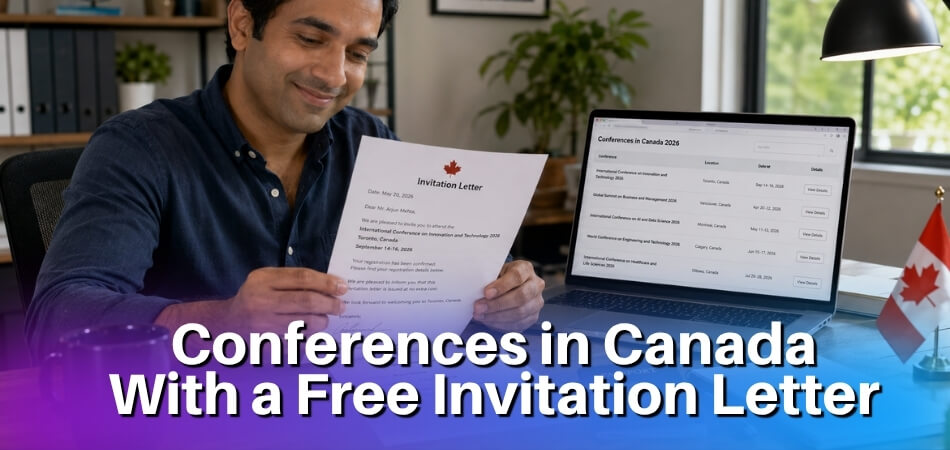
Get something in writing first: an abstract acceptance email, a speaker confirmation, a registration confirmation, or a combination. Organizers will ask for proof of registration anyway, so asking too early only wastes time. Keep the payment receipt and save everything as PDF, because you will cite these documents in your request and attach them to your visa application. For presenters, the acceptance email is usually enough to start the request. For professional conferences, registration confirmation plus any speaker agreement works.
Step 2: Send a Formal Request to the Conference Organizer
Email a named contact, such as the event coordinator, program chair or visa support contact, rather than a general form when you can. Keep it short and include:
- Your full name as it appears on your passport
- Your nationality and current country of residence
- Your role at the conference (attendee, speaker, session chair, keynote speaker)
- The conference name and dates
- The visa type (Temporary Resident Visa via IMM 5257, or an eTA if you are from a visa-exempt country)
- A request for the letter on official letterhead
- A specific deadline, not “as soon as possible”
Attach your registration confirmation and abstract acceptance if relevant, and ask the organizer how long a reply takes. Where the letter is issued automatically after payment, as at MS International, you may not need to send a request at all. If you are close to a CVAC or VFS Global appointment, say so up front.
Step 3: Tell the Organizer What the Letter Must Include
Many letters fail because they are too vague, and the organizer cannot guess what you need. Send the list from the checklist section below as a reference, not a demand. Some coordinators have never written one of these letters, so be helpful. If the organizer is linked to a Canadian university, government body or recognized professional association, ask them to say so, because it adds credibility.
Step 4: Review and Verify the Letter Once You Receive It
Read the letter against the checklist before you attach it to anything. Is your name spelled exactly as in your passport? Is there a physical address, not just a website? Is it signed, with the signatory’s name and title printed below? Are the dates right? A date typo can raise questions about authenticity. Is it on letterhead with branding? If anything is off, ask for a corrected version straight away. Keep the original PDF and do not compress or convert it in a way that degrades quality.
Step 5: Submit the Letter as a Supporting Document in Your Visa Application
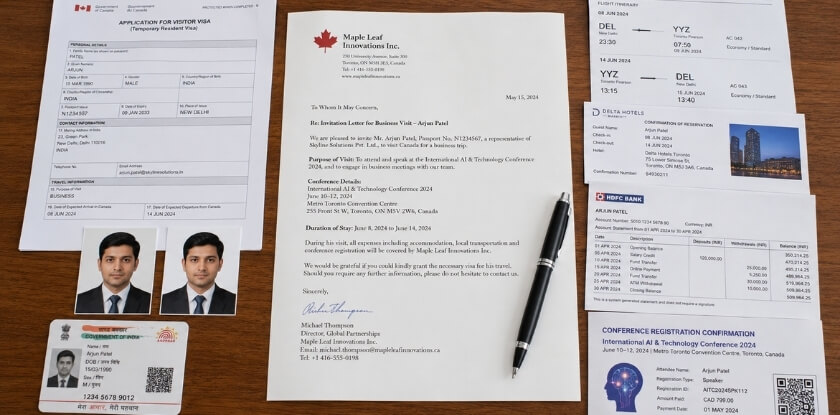
The letter goes alongside your IMM 5257 application, passport, financial documents, travel itinerary and anything else IRCC or your CVAC requires. When uploading through the IRCC online portal, name the file clearly, for example “Conference_Invitation_Letter_YourName.pdf”, and do not bundle it with unrelated documents. Include your abstract acceptance or registration confirmation too, because they back up the letter.
Keep a printed copy as well. IRCC’s guidance for event organizers and Canadian businesses tells hosts to give each business guest 2 copies of the letter of invitation.
Biometrics may be required depending on your nationality, so check IRCC’s current requirements and book your appointment as soon as you get the biometrics instruction letter. If you were refused before, address that refusal directly in the new application, as explained in the refusal section below.
What a Canada Conference Invitation Letter Must Include: Complete Checklist
A weak or incomplete letter is one of the fastest ways to a refusal. IRCC does not publish a template, so the organizer writes the letter in its own format, and the details below make it useful.
Your Identification
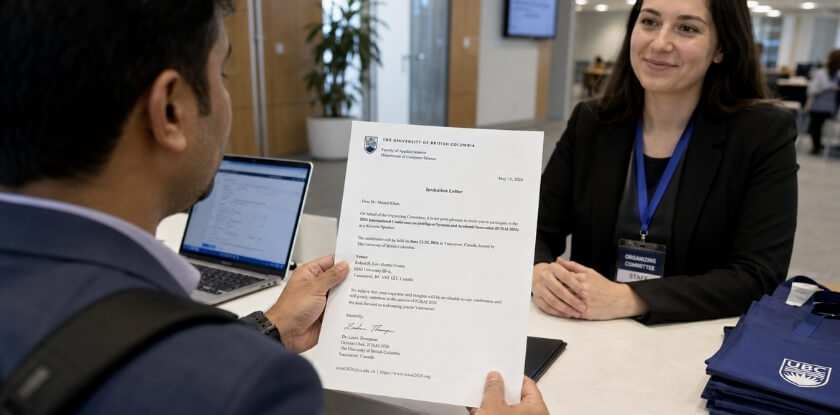
Your full legal name as in your passport, date of birth, nationality and country of residence, and passport number. Some organizers skip the passport number, so ask for it, because it ties the letter to you. Any mismatch with IMM 5257, even a minor spelling difference, creates a red flag and can slow processing.
Conference Details
- The official name of the conference (the full official title, not “our annual event”)
- The venue with full address, including city and province
- Exact dates, including setup days if you arrive early
- The nature of the conference (academic, professional, industry, government-sponsored) and the hosting institution or recognized body, if any
Registration Confirmation
The letter should include or reference your registration confirmation. Some organizers attach it separately and others fold it into the letter. Either works, but it must exist somewhere in your package, because it proves you completed the sign-up and that someone does not merely say they want you there.
Financial Responsibility
The letter must say who pays for what. If the organizer covers travel or accommodation, state it directly and expect to need a separate financial guarantee letter. If you fund your own trip, the letter should confirm that the organizer is not sponsoring you, so your bank statements carry the weight. Ambiguity here causes problems.
Organizer’s Contact Information and Signature
Required at minimum: the signatory’s name and title, the organization name and letterhead, a phone number and email, a mailing address, and a wet or digital signature. A typed name alone often does not cut it. If an officer wants to verify the letter, they need someone to call, and a webmail address with no phone number or letterhead raises doubts at once.
The Dates You’ll Be in Canada
State your expected arrival and departure dates, aligned with your itinerary and the conference dates. If the conference runs June 10 to 13 but you enter June 8 and leave June 16, the letter or a note from you should explain why, such as pre-conference workshops or a travel buffer.
A Quick Reference Checklist
Go through this with the actual letter in hand before you attach it to your application. One missing item can mean a refusal.
| Item | Included? |
|---|---|
| Your full name as on passport | ✓ |
| Your passport number | ✓ |
| Conference name, venue, and dates | ✓ |
| Your specific role (speaker, attendee, etc.) | ✓ |
| Abstract acceptance reference (if presenting) | ✓ |
| Registration confirmation | ✓ |
| Financial responsibility statement | ✓ |
| Organizer’s name, title, signature | ✓ |
| Official letterhead | ✓ |
| Organizer’s phone and email | ✓ |
| Your intended entry and exit dates | ✓ |
Conference Speaker vs Participant: How the Invitation Letter Differs
A speaker’s letter needs more detail than an attendee’s, and the visa officer will notice the difference.
If You’re a Speaker or Presenter
Vague letters that only say “we invite you to attend” will not work if you are presenting. The letter should state the title of your presentation or paper, whether you are a keynote speaker, panelist or paper presenter, the session date and time if confirmed, and whether the organizer covers any costs. If a university or another body funds your trip, say so, because it explains your finances. Attach your abstract acceptance email as well, so the officer sees a paper trail showing you were invited to present, not just to attend.
If You’re an Attendee or Participant
Your letter can be shorter. It needs to confirm that the event is real, the dates, the venue, and that you are registered. Your registration confirmation is your main proof of attendance. Some large academic and professional conferences issue letters by default through their registration system. If yours does not, email the organizing committee and ask for one on official letterhead, which most will do.
Where It Gets Complicated
Problems come up when your role is unclear, for example a session chair or workshop facilitator. Ask the organizer to describe it precisely. Also make sure the purpose on IMM 5257, your letter and your supporting documents tell the same story, because a speaker’s letter next to a form that says only “conference” can raise flags.
Speakers often receive fee waivers or honoraria. If money changes hands, even a waived registration fee, mention it in the letter. Hiding financial arrangements is not something you want the visa office to discover later.
eTA vs Visa: Which One Do You Need Based on Your Country
Having an invitation letter does not automatically mean you need a full visa. Canada has two entry systems, depending on your passport.
| Your passport | What you need | Official fee (CAD) | Letter role |
|---|---|---|---|
| Visa-exempt country (flying) | eTA | 7 | Carry it for the border officer |
| Visa-required country | Visitor visa (TRV) | 100, plus 85 for biometrics | Core supporting document |
| US citizen | No visa or eTA | None | Helpful to carry |
If You’re from a Visa-Exempt Country
Citizens of countries such as the UK, Australia, Germany, France, Japan and many other European countries do not need a visitor visa. They need an eTA, applied for online through IRCC. Most applications are approved within minutes, though some take a few days, and IRCC advises applying for the eTA before you book your flight. It is linked electronically to your passport, so there is no sticker or stamp.
Your letter still matters. A border services officer can ask why you are visiting, and “I’m attending a conference” is stronger when you can show your letter, registration confirmation and itinerary. The eTA does not guarantee entry, and the officer at the border makes the final call.
If You’re from a Visa-Required Country
Citizens of India, Nigeria, Pakistan, Bangladesh, the Philippines, China and many other countries need a visitor visa before they fly. You apply online through the IRCC portal (paper only if you qualify for an exception), and the invitation letter goes in that package. Biometrics are given at a visa application centre. If you have not given biometrics to Canada recently, you must do so too, which adds a step to your timeline. Apply early and do not wait until the conference is six weeks away.
How to Check Which Category You Fall Under
Use the “Find out if you need a visa” tool on the IRCC website. Enter your nationality, country of residence and travel document type, and you get an answer in under a minute. Do not rely on what a colleague told you or on last year’s rules, because visa-exempt status can change.
US Citizens and Dual Citizens
US citizens need neither a visa nor an eTA to enter Canada, whether by land or air, though they must carry valid identification such as a passport. Carrying your letter, registration confirmation and itinerary is still smart. If you hold both a visa-exempt and a visa-required citizenship, you can fly on the visa-exempt passport with an eTA, but make sure the eTA is linked to the passport you actually travel with.
Online vs In-Person Conference: Does the Invitation Letter Play the Same Role
No, they do not work the same way. For an in-person conference in Canada, the letter is a core part of your visa application, alongside IMM 5257, passport, itinerary and registration confirmation. The officer wants to know why you are entering Canada, for how long, and who invited you, and the letter answers all three.
For an online conference you need no Canadian visa, no eTA, no biometrics and no CVAC appointment, because you do not cross a border. The letter is then only an administrative document, perhaps useful to your employer or university.
Hybrid Conferences
Many events now run in hybrid format. If you present on site, your situation matches a fully in-person event and you need the full package. If you present virtually but your institution wants you to travel anyway, the letter must clearly state your in-person role, and one that says “virtual presenter” will not support a physical entry visa.
When an Online Conference Converts to In-Person
If organizers switch to in-person weeks before the event, check your processing window immediately. Get an updated letter the same day the change is announced, reflecting the physical venue, exact dates and your role. If your application was filed for an online event, you may need to contact IRCC or submit a new application, which is often cleaner than amending a pending file.
What Changes in the Letter Itself
For in-person attendance the letter must include a physical venue address in Canada, a detail that gets missed when organizers copy a template from an online edition. It should also say you are expected on site, with a line such as “We request that you attend in person at [venue], [city], Canada”. Using a virtual-event letter to support a Canadian trip you also plan as tourism means you must be honest about your main purpose. Misrepresentation is a fast route to a refusal.
Sample Canada Conference Invitation Letter Template
Share this template with your organizer, or use it to check whether the letter you received covers what IRCC expects to see.
For Conference Organizers Issuing the Letter
[Organization Letterhead: Name, Address, Phone, Email, Website]
Date: [Full date, e.g., 14 July 2026]
To: Immigration, Refugees and Citizenship Canada / Canadian High Commission
Subject: Letter of Invitation for [Full Name of Invitee] to Attend [Conference Name]
Dear Visa Officer,
We are writing to formally invite [Full Name], a [profession/title] from [Country of Residence], to attend the [Full Conference Name], to be held at [Venue Name and Full Address], [City, Province], Canada, from [Start Date] to [End Date].
Details of the Invitee:
- Full Name: [As on passport]
- Date of Birth: [DD/MM/YYYY]
- Passport Number: [XXXXXXXX]
- Nationality: [Country]
- Current Position: [Job Title, Employer Name]
Details of the Conference:
- Conference Name: [Full official name]
- Organized by: [Organization name]
- Official Website: [URL]
- Dates: [Start Date] to [End Date]
- Location: [Full venue address]
- Expected Attendance: Approximately [number] delegates from [number] countries
Purpose of Invitation:
[Full Name] has been invited to attend as a [select one: registered participant / presenting author / keynote speaker / session chair].
If presenting: Their abstract, titled “[Abstract Title]”, was accepted through our peer-review process on [acceptance date]. They are scheduled to present in the [Session Name] on [date] at [time].
If attending as a participant: They registered for the conference on [registration date], and their registration has been confirmed under reference number [XXXX].
We confirm that [Full Name] will bear all costs related to travel and accommodation personally / [or: costs will be covered by our organization, specifically: return airfare, hotel accommodation at [Hotel Name] from [date] to [date], and conference registration fee].
The conference schedule requires their presence in Canada from [arrival date] to [departure date]. We respectfully request that the visa be issued to cover this period.
Should you require any additional information, please contact the undersigned directly.
Yours sincerely,
[Signatory Full Name]
[Title, e.g., Conference Chair / Event Coordinator / Program Director]
[Organization Name]
[Phone Number] [Email Address]
[Official Stamp if applicable]
A Few Things to Watch For
Do not accept a generic letter. “We invite you to attend our event” with no dates, venue or passport details gets flagged immediately, and a plain Word file with no branding looks unprepared. Match the form. Name, date of birth and passport number must be identical to IMM 5257, since a missing middle name or a transposed digit can trigger a request for clarification. Do not mix up documents. Your abstract acceptance from the conference or any other body is a supporting document, not an invitation letter. Submit both.
Large, well-known conferences usually have a standard template ready, so ask their registrations or delegate support team. Most will process it within a few business days once your registration is confirmed.
What to Do If Your Invitation Letter Is Delayed
Organizers get busy and requests get buried. If the conference is three weeks away and you have no letter, do not wait quietly.
Follow Up Directly and Set a Deadline
Write to the organizing committee or the contact on the registration portal, and ask for exactly what you need: a formal letter on letterhead, addressed to IRCC, with your name, passport number, conference dates and venue. Add a date: “My visa application needs to be submitted by [date]. I need the letter no later than [specific date].” Large events usually have a contact for international attendees or visa support, so look for it.
Check If a Digital Version Works for Now
A digitally signed PDF on letterhead, emailed straight away, may be enough to get your application moving while you wait for a paper copy. Confirm that this is acceptable before you assume it is.
Escalate if Needed
If the team is slow, email the conference chair or the senior point of contact. Be polite but firm, and mention that a missed application window will prevent your participation. Escalation is easier for invited keynote speakers, who usually have a direct relationship with someone senior. General participants may need to be more persistent.
Use Your Other Documents as a Bridge
If the organizer will not or cannot issue a letter, your other documents can partly do its job:
- Your conference registration confirmation with your name, dates and event details, plus the payment receipt
- Your abstract acceptance email, if you are presenting
- A published schedule or program that includes your name
- Your travel itinerary with dates that align with the event
These are gap-fillers, not substitutes, and the officer will piece them together. Add a short cover note saying the formal letter is pending. It adds uncertainty, so keep pushing for the letter.
Do Not Hold the Application Back
Do not wait for the perfect file. Processing can take weeks to months depending on your country, and biometrics add time. Ask your CVAC or VFS Global office whether a supplementary document can be added later, since the answer depends on the visa office. If the letter arrives after you apply, log into your IRCC account, add it through the document upload option and include a short note explaining what it is.
Can You Attend Without an Invitation Letter?
Technically yes, depending on your nationality. US citizens can show up at the border with a passport and explain they are attending a conference, and an eTA traveller does not submit a letter with the eTA form. For a visitor visa, IRCC’s guidance for business visitors asks for a letter of invitation from the Canadian host, and you still need to show your purpose of travel, your ties to your home country and your plan to leave Canada. Without the letter, the officer has to take your word for it, and a refusal followed by a new application costs far more time than a letter would have. The letter is the clearest answer to the question every officer is asking: why are you coming to Canada, and why should we believe you?
What to Do If Your Canada Visa Application Is Rejected
A refusal is frustrating, especially after you have registered or been confirmed as a speaker, but it is not necessarily the end. Start by reading the refusal letter, which lists the reasons the officer was not convinced.

Understand Why You Were Refused
Common reasons for a visitor visa refusal include:
- The officer was not satisfied you would return home after the conference
- Financial documents were weak or incomplete
- The invitation letter was vague or looked unofficial
- Too few supporting documents alongside IMM 5257
- Biometrics were missing or not yet processed
Do not assume the letter alone was the problem. Look at the full picture.
Option 1: Reapply With a Stronger Application
There is no formal appeal for a refused visitor visa, but IRCC says you can reapply if you have new information or documents that address the reasons in your refusal letter. Fix what was actually wrong rather than resubmitting the same documents, because that rarely changes the result. For ties to home, add an employment letter, property documents or evidence of family responsibilities. If the issue was the invitation letter, ask the organizer for a revised one with your name, the conference dates, your role and the organizer’s full contact details, ideally on institutional letterhead with a phone number the visa office can verify. Attach your registration confirmation and abstract acceptance as well.
Option 2: Submit a Reconsideration Request
A reconsideration request is not an appeal. It is an informal request asking the visa office to look at the decision again, and it makes sense mainly if there was a procedural or clerical error or you hold genuinely new evidence. Write a short, factual letter that answers the refusal reasons point by point and attach the new documents. Processing time is not guaranteed, so if the conference is close this route may not be practical. IRCC’s help centre says that if you believe the process was unfair you may request a judicial review through the Federal Court of Canada, which is a legal route with strict time limits, so get qualified legal advice quickly.
Option 3: Add a Letter of Support
When you reapply, a letter of support from your employer, university or a professional body in your home country can address the purpose-of-visit concern directly. For an academic conference, ask your department head or supervisor to confirm that the event is part of your research or professional development.
Practical Things to Check Before Reapplying
- IRCC says your passport should be valid for at least 6 months from the date you plan to travel, and a Canadian visa cannot be issued beyond the passport’s expiry date
- Confirm that your biometrics are still valid; they last 10 years for most applicants
- Book biometrics at the visa application centre that serves your country
- If you use a paper form such as IMM 5257, check that it is the current version, because IRCC updates forms
- Apply online, which IRCC requires unless you qualify for an exception such as a disability
Be Realistic About Timing
If your conference is four weeks away, reapplying may not be realistic. Contact the organizer immediately and share the refusal letter. Many legitimate conferences will move your registration to the next edition or consider a refund on a case-by-case basis, so check the refund terms before you pay. Repeated refusals without new evidence raise red flags, so apply again when you have something stronger to show.
Visa Processing Time: How Much Lead Time You Should Plan For
Plan at least 12 weeks before the conference, and more for countries with heavy application volumes. That is a planning buffer, not an IRCC figure, because actual processing varies by country, season and IRCC volumes, and IRCC may ask for more documents.
Check IRCC’s Processing Time Tool
Before you set your timeline, use the processing times tool on the IRCC website. Select the visitor visa, your country of residence and whether you apply online or on paper. It is more accurate than any static figure, including ours. IRCC says its estimates are not a maximum or a guarantee, and the clock starts only when a complete application is received.
The Biometrics Factor
If you have not given biometrics to Canada before, add time. First-time applicants must give fingerprints and a photo. IRCC’s processing estimate already includes the time it takes to give your biometrics, so do not add that window on top of it. Instead, book your appointment as soon as you receive the instruction letter, because appointment availability depends on your location and a late booking delays the decision.
Special Measures That Can Delay a Decision
If your last country of residence on the application is the Democratic Republic of the Congo, South Sudan or Uganda, IRCC has temporarily suspended immigration documents, including visitor visas and eTAs. It keeps processing new and existing applications but is not finalizing any until the measures end at 23:59:59 ET on 27 November 2026. Check IRCC’s Ebola temporary measures page before you plan a conference trip, because the date can change.
Working Back From Your Conference Date
| Step | Suggested timing before the conference |
|---|---|
| Confirm whether you need a visa | Immediately |
| Register and request the invitation letter | 14 weeks or earlier |
| Receive letter and registration confirmation | 13 weeks |
| Submit the visa application with full documents | 12 weeks or earlier |
| Biometrics completed | As soon as you get the biometrics instruction letter |
| Decision | Check IRCC’s tool for your country |
If you are from a country with long visa queues, start at least 16 weeks out. If you also expect a possible refusal and reapplication, build that time in.
If the Conference Is Only 6 Weeks Away
Be honest about the risk. A short window is genuinely risky for applicants from countries with long processing times. IRCC does not guarantee faster handling, so check its site for any urgent processing option that applies to you. Apply immediately: a complete application submitted now beats a polished one submitted in two weeks.
Frequently Asked Questions (FAQ)
Counting on a free letter for a Canadian conference? Points worth checking include using one letter for several events, physical versus email signatures, a reconsideration after refusal and whether an employer can write it.
Does every conference attendee from every country need an invitation letter?
No. Visa-exempt travellers apply for an eTA without a letter, and US citizens need neither. If you need a Temporary Resident Visa, include the letter, because IRCC’s guidance for business visitors asks for one from the Canadian host.
Can I use one invitation letter for multiple conferences in Canada?
No. A letter names one participant, one conference and one set of dates and venue. For back-to-back events, ask each organizer for a separate letter and submit both with your application.
What if the conference organizer refuses to issue an invitation letter?
Ask for a registration confirmation email and a payment receipt, which can partly substitute, but keep pushing for a formal letter. Explain that you need it for a visa application. Established conferences that regularly host international attendees usually agree.
Is an invitation letter a visa guarantee?
No. IRCC decides on the full picture: your finances, travel history, ties to your home country and the letter together. A strong letter from a well-known conference helps, but it does not override a weak application.
How long before the conference should I submit my visa application?
Plan at least 12 weeks before the conference, and more if your country has long queues. That is a planning buffer, not an IRCC figure, so check IRCC’s processing times tool for your country, and avoid non-refundable flights until you have a decision.
Is a Canada conference invitation letter really free?
It depends on the organizer. At MS International Conferences Inc. the standard letter is free for registered participants, though the registration fee applies and a US$50 fee may apply to corrections after issue. Other events may charge for the letter, so check the event page.
My visa was refused. Can the invitation letter help with a reconsideration request?
Yes, if the refusal was partly because your purpose of travel was unclear. Attach the letter, or a stronger and more detailed one, along with the refusal letter, and explain your role. Vague requests almost always fail.
Does the invitation letter need to be signed physically or is an email acceptable?
A signed PDF on official letterhead works, and wet ink is not required. It should come from an official organizational email address and show the organizer’s contact details. A plain email body with no letterhead will not do.
Can my employer write the invitation letter instead of the conference organizer?
No. The invitation should come from the organizer hosting the event in Canada. Your employer can add a separate support letter confirming your position, that they fund your trip and that you will return to work. Submit both.
What if the conference is virtual, should I still apply for a Canadian visa?
No. A fully online conference needs no Canadian visa because you do not travel. For hybrid events, apply only if you attend the in-person part, and use the letter for that session.
Is there a standard government form for an invitation letter?
No. IRCC has no official template for a conference letter. The organizer writes it on its own letterhead, as long as it covers your full name, passport number, conference dates, venue and the organizer’s contact details.
Conclusion: Where to Start Right Now
The biggest mistake is waiting too long. Choose a conference that clearly includes the letter, register with your exact passport name, request the letter with your passport details and purpose, and check every field against the checklist. Then build your package: IMM 5257, the letter, itinerary, registration confirmation, financial documents and your biometrics appointment. If you are from a visa-exempt country, sort out your eTA first, which takes minutes. Get the letter, build the file and submit on time.
Disclaimer: This article is general information, not legal or immigration advice. Fees, forms and rules change, so check IRCC (canada.ca) for the current requirements before you apply. Final decisions on visas and entry are made by the Canadian authorities.