
Few papers in a US visa file cause as much worry as the bank statement. Applicants wonder whether anyone really reads it, and whether a few odd lines will count against them. Those fears are common, and they ease once you know how the statement is used.
Quick answer: Yes, a U.S. consular officer can review, question and, if worried, verify the bank statement you submit for a conference visa. Most statements are simply read at the interview and compared with the rest of your application. There is no official minimum balance. Bring complete, recent statements that match your income and trip cost, and never submit an edited document.
Fact-checked by the MS International Editorial Team. Last verified against official sources: October 2026.
For conference travel, a bank statement is not about showing a big balance. It helps the officer judge whether you can pay for the trip, whether the money has a clear source, and whether your finances support your plan to go home afterwards. This guide covers what officers look at, what raises questions, and what to prepare. If you are applying to Canada instead, the Canadian embassy does not access your bank account directly, but it can check that your statement is real.
Can the U.S. Embassy Check Your Bank Statement?
Yes, an officer can review, question and, if there are doubts, try to confirm the statement you submit. In practice, many statements are not confirmed with the bank. The officer reads them during the interview and decides whether the numbers look believable. The State Department narrowed its interview-waiver rules from 1 October 2025, so more applicants now sit an in-person interview, where the statement can be discussed. The final decision is always the officer’s, based on your application, your interview and U.S. immigration law.
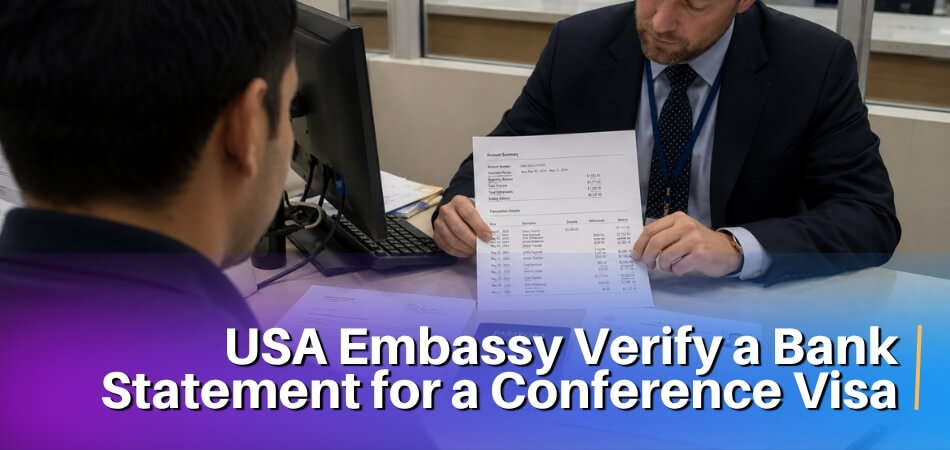
USCIS lists enough money to cover the trip among the B-1 conditions, along with a limited stay and a residence abroad you do not plan to give up. The State Department says officers may ask for proof that you can pay for the trip, such as bank statements or certified tax returns. That is why a statement is read together with your other documents. An officer may use it to check that:
- You can afford the trip, and your travel plan matches your means.
- Your account activity looks normal and your income source is believable.
- The figures agree with your DS-160 and your interview answers.
- The money is not temporary “show money” added only for the interview.
“Verification” can mean a quick read, detailed questions, a comparison with other papers, or direct confirmation when the officer has doubts. The clearer and more consistent your papers are, the less likely it is to go beyond a quick read.
Which U.S. Visa Is Usually Used for Conference Travel?
Most conference visitors use the B-1 business visitor visa, often issued as a combined B-1/B-2. The State Department lists attending a scientific, educational, professional or business convention or conference as a permitted visitor activity. Citizens of Visa Waiver Program countries can instead travel on an approved ESTA for stays of 90 days or less, and conference attendance is also a permitted activity under that program.
Paid work is different. Neither B-1 nor ESTA allows a U.S. job. A speaker honorarium is allowed on B-1 only under the narrow academic exception in INA 212(q): no more than nine days at one institution, a qualifying paying organisation, and payment from no more than five institutions in the previous six months. If your plan does not fit, a different visa category may be needed. Treat that as a question for the embassy or an immigration lawyer.
Why Consular Officers Review Bank Statements
An officer has to decide whether your whole application makes sense, not only whether the conference is real. The statement helps answer: can this applicant pay for the trip and return home as planned?
Proving You Can Afford the Trip
A conference trip means airfare, hotel, meals, local transport, registration, insurance and emergency money. If your records cannot support that cost, the officer may doubt the plan, or suspect you will rely on unauthorised work.
Showing Financial Ties to Your Home Country
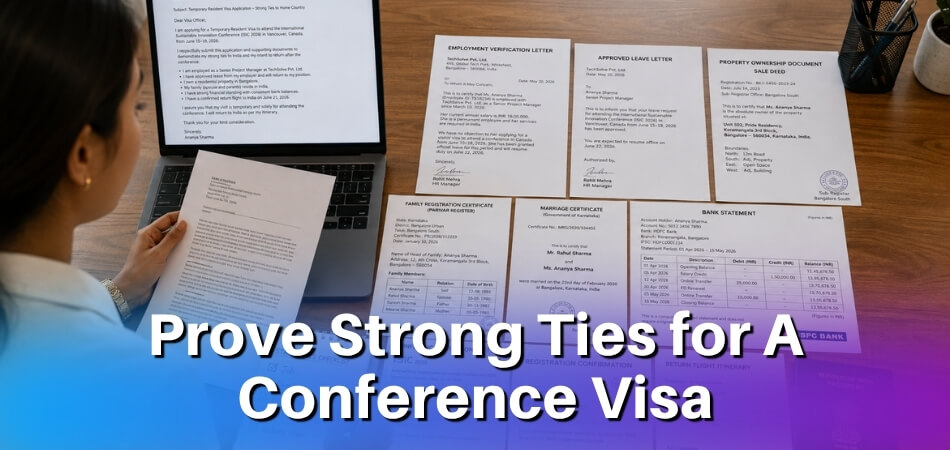
Regular salary, business income, rent or loan payments and savings can support your claim to have ongoing responsibilities at home. The State Department says visitor applicants must show ties to their home country. A bank statement helps, but alone it does not prove ties. It works alongside an employment letter, business registration, property or family records, or school enrolment.
Checking Consistency Across Your Application
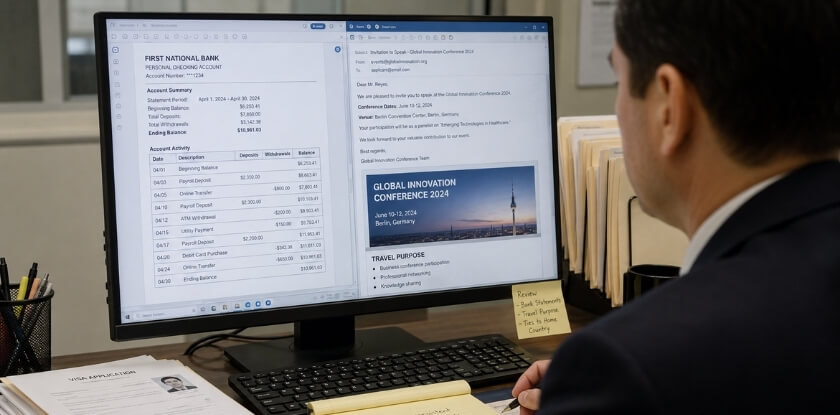
Officers may compare the statement with your DS-160 income, employer letter, payslips, tax records, business documents, sponsor letter, conference registration, itinerary and interview answers. If your DS-160 shows a monthly income that your account never receives, expect questions. A sponsor who promises to pay but gives weak financial proof carries little weight.
Detecting Fake or Misleading Documents
Never submit an edited, borrowed or invented statement, even one that looks convincing. A willful misrepresentation of a material fact can make you inadmissible under INA 212(a)(6)(C)(i), and that bar generally lasts until a waiver is granted. It can follow you into every later visa application.
How U.S. Visa Officers Evaluate a Bank Statement
No single formula guarantees approval. Officers look at the whole financial picture: whether the statement looks genuine, whether the funds are enough, and whether the activity fits your situation.
Account Holder Details and Authenticity
The statement should show the bank name, your name, the account number or part of it, the statement period, the transactions and the current balance. Avoid cropped screenshots, blurry phone photos, missing pages, undated statements and edited PDFs. A printed online statement can be fine if complete. A stamped or bank-issued copy removes doubt where you can get one.
Balance, Income, and Trip Cost
Officers do not only ask how much is in the account. They ask whether the amount makes sense for this trip. A three-day event in a cheaper city needs less than a week in an expensive one. A high balance with an unclear source helps less than a moderate balance with stable income and a short, partly sponsored trip.
Transaction History and Account Activity
Officers prefer months of normal activity to a sudden jump just before the interview.
| Good signs | Risky signs |
| Salary or business deposits that repeat | Sudden unexplained deposits |
| Regular savings and normal spending | Very little transaction history |
| Traceable transfers | Heavy cash deposits without proof |
| Payments linked to real obligations | A balance that appears only before the interview |
| Consistent use over several months | Money moved out right after it arrives, or income that does not fit your job |
Liquid Funds and Clean Presentation
Liquid funds are money you can actually use for travel. Savings and current accounts are usually stronger than funds that are locked, unstable or hard to verify. Keep the file easy to read: complete pages, the same name as on your passport and DS-160, and a short note of the sources behind any large balance. Stable income, a clear source and consistency with your other documents matter more than the size of the balance.
Source of Funds
Funds from a job need payslips or an employer letter. Business funds need invoices, tax records or trade documents plus business statements. Sponsored funds need a sponsor letter, the sponsor’s statement and proof of relationship. The officer wants funds that are genuine, legal, and available for the trip.
Is There a Minimum Bank Balance for a U.S. Conference Visa?
No. The State Department does not set a fixed minimum bank balance for a U.S. conference visa. Fixed dollar figures you see on agency and consultancy sites are their own advice, not a government rule. Officers assess your circumstances, travel purpose, length of stay, funding source and home ties. A better question than “how much?” is: does my financial record support my travel plan?
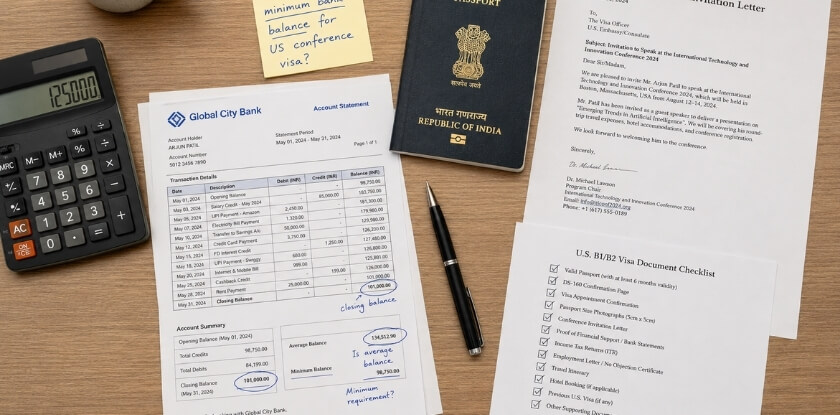
The amount you need to show depends on how long you stay, which city you visit, whether the hotel, flights and registration are already paid, whether an employer or organiser is sponsoring you, and whether you travel alone. Someone attending a three-day conference on employer sponsorship shows a different picture from a self-funded applicant staying ten days.
A practical way to prepare is to write a simple budget: airfare, hotel, food, transport, registration and extra funds. Then check that your statements and papers explain how each cost is covered. For airfare, note that a ticket from Nigeria to the USA costs more in peak season and close to departure.
Is a Visa Bond the Same as Proof of Funds?
No. A visa bond is a separate condition, and a strong bank statement does not remove it. Since 3 August 2026 the State Department runs a permanent visa bond program. An officer can require B-1/B-2 applicants from countries on its published list to post a bond of $10,000, $15,000 or $20,000 before the visa is issued, unless the requirement is waived. The statement shows you can fund the trip; the bond is a guarantee tied to your nationality and your circumstances.
Two more current rules sit outside the statement. The country list for bonds changes, so check travel.state.gov for your nationality before you pay any fee. Separately, Proclamation 10998 has partially suspended B-1/B-2 visas for nationals of 19 countries since 1 January 2026, and finances do not change that.
How Many Months of Bank Statements Should You Bring?
Three to six months of recent statements is the usual practice, but it is not an official rule. Embassy instructions, your profile and the officer can change what is useful.
| Three months is often enough when | Six months or more helps when |
| You have stable salary deposits and a clear account history | You are self-employed, run a business or have irregular income |
| The trip is short and your employer pays most costs | You rely on a sponsor or have several accounts |
| Your documents are simple | You recently received a large payment or opened the account |
A statement is a snapshot of a past date, so bring the most recent one you can get, and be ready to explain if the balance has dropped since, for example after paying for flights or registration. A new account is not automatically a problem, but it needs explaining. If money came from an older account, business earnings, salary savings, a property sale or family support, bring papers that show it.
Common Bank Statement Red Flags That Can Hurt a Visa Application
A red flag does not always mean refusal, but it invites more questions. Prepare honest explanations before the interview.
- Sudden large deposits shortly before the interview can look like money added to impress the officer.
- A low balance compared with the trip matters most when flights, hotel and fees are not prepaid.
- Income that does not match your occupation, such as no salary deposits for a salaried applicant.
- Frequent cash deposits are hard to verify unless you can show business records, receipts or tax filings.
- Missing, cropped or edited pages create serious trust issues. Never edit a statement to hide transactions or improve the balance.
- Weak sponsor evidence: a sponsor letter without bank records, income proof or proof of relationship is rarely persuasive.
Can Local-Currency Bank Statements Be Used?
Yes, local-currency bank statements are generally acceptable for U.S. visa applications. You do not need to convert the account into U.S. dollars first.
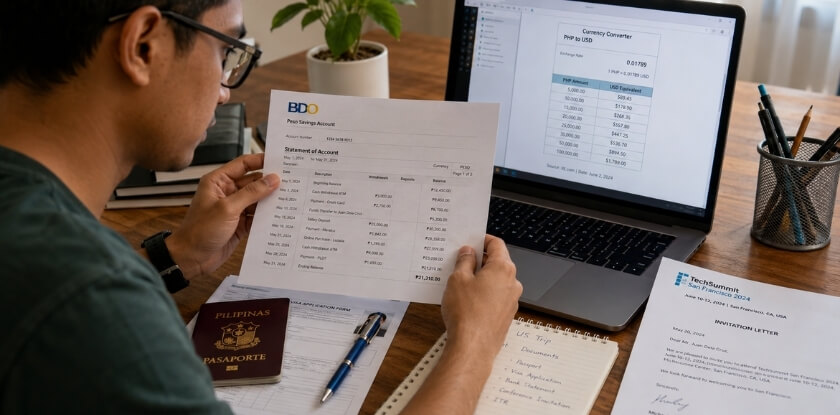
The officer must still understand the value. If the statement is not in English, include an English translation. Add a separate, simple note with the approximate U.S. dollar equivalent. Never rewrite the statement itself: the conversion should be clearly an explanation, not part of the bank document.
Do PayPal, Fintech, Crypto, or Digital Wallet Balances Count?
Digital balances can support your profile but should not replace a normal bank statement. Values can change quickly, ownership is harder to confirm, funds may not be available at once, and records are often less formal.
Include online funds as extra evidence, with a regular bank statement as the main proof. Crypto needs most care: wallet screenshots are weaker than bank records. If you converted crypto to cash, show the transfer trail into your bank account and be ready to explain the source.
What If Someone Else Is Paying for the Conference Trip?
Sponsorship is acceptable when it is documented clearly. Fully self-funded travel is not required.
Employer-Sponsored Conference Travel
Bring a sponsorship letter on company letterhead. It should state your name and position, the conference name and location, the purpose, travel dates, the expenses covered, confirmation that you are expected back at work, and the name, designation and signature of the authorised person. Add proof such as a registration receipt, hotel or flight booking if you have it.
Family-Sponsored Travel
Bring a sponsor letter explaining why they are paying, their bank statement and income proof, and proof of relationship. The sponsor’s finances must be realistic. If their account cannot cover the promised costs, the officer may doubt the arrangement.
Organizer-Funded Conference Attendance
Some conferences give grants, fee waivers, hotel cover or travel support. Bring official confirmation that states exactly what is covered. If only part of the trip is funded, show how you will pay the rest.
Special Applicant Scenarios
The right documents depend on your situation.
| Applicant | Bring with your statements |
| Salaried employee | Employer letter, payslips, tax documents if available, leave approval. Salary deposits should match the letter. |
| Freelancer or self-employed | Client payments, contracts, invoices, tax records, and statements that show your income pattern. |
| Business owner | Business registration, tax records, trade license, company bank statement, invoices, and proof the business runs while you travel. |
| Student | Enrolment proof, invitation or registration, sponsor documents if parents or the university pay, paper acceptance if presenting. |
| Joint or family account | Proof you can access the funds. If the account is mainly a relative’s, add a support letter and relationship proof. |
| Irregular income or new account | Invoices, contracts, tax filings, older statements and transfer records that show where the money came from. |
How to Explain Weak or Irregular Bank Statements
A weak statement does not always sink an application. The usual problem is a lack of explanation.
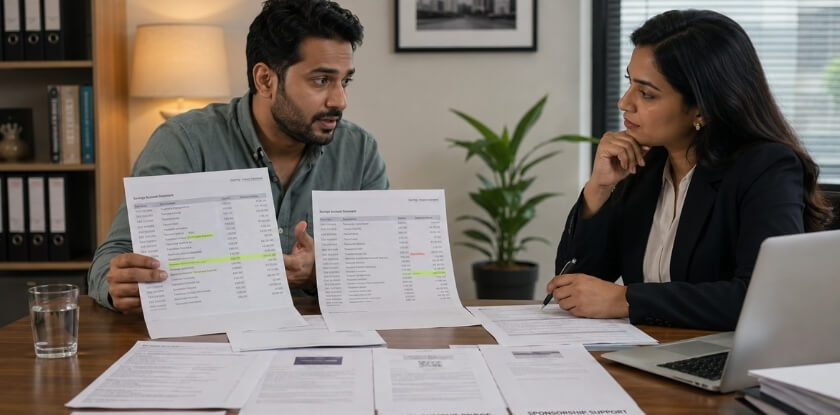
If your balance is low, show which costs are already paid or covered by a sponsor, and bring the hotel, registration or flight receipts. If you received a large recent deposit, explain it honestly and bring proof. Typical genuine reasons are:
- Salary arrears or an annual bonus
- A property sale or fixed deposit maturity
- A business payment, with the invoice
- Family support, a scholarship or grant
- A loan disbursement, with the loan record
A short written note can help organise the facts, but it does not replace official proof. If your income is irregular, show a longer history. Avoid artificial “show money”: borrowing to inflate your account creates more risk than benefit, and officers look at patterns, not only balances.
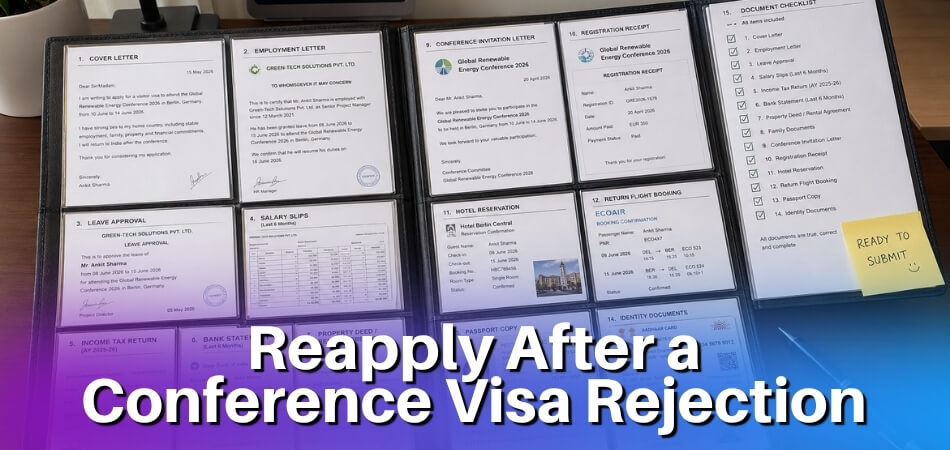
Documents to Bring With Your Bank Statement
The State Department says visitor applicants must complete the DS-160 and bring the confirmation page to the interview. An invitation letter is not required for a visitor visa, but conference registration or paper acceptance explains your purpose. Supporting documents vary by case, so check your embassy’s instructions.
| Group | Examples |
| Required at the interview | Valid passport, DS-160 confirmation page, appointment confirmation |
| Purpose of travel | Conference invitation or registration proof, abstract or paper acceptance, agenda, itinerary, hotel and flight details |
| Your finances | Bank statements, employment letter, payslips, tax returns, business registration and business bank statement |
| Sponsor, if any | Sponsor letter, sponsor bank statement, proof of relationship |
| Home ties | Proof of property, family, education or other responsibilities |
Do not overload the officer with unnecessary papers, but keep originals ready in case you are asked.
From our experience at MS International: the invitation letter we issue after payment clears confirms your registration and the event details. It supports a visa application but does not guarantee a visa, and it says nothing about your finances, so it cannot replace your bank statements or income proof. Before your appointment, check that the income on your DS-160 matches the deposits in your account.
Sample Interview Questions About Bank Statements
Officers usually ask direct questions. Keep your answers short, honest and consistent with your documents. Replace the examples with your own facts.
| Question | Example answer |
| Who is paying for your trip? | “My employer covers registration, airfare, hotel and a daily allowance. I have the sponsorship letter and payment proof.” |
| Why was this amount deposited recently? | “It was a business invoice paid by my client. I have the invoice and payment confirmation.” |
| How much will the trip cost? | “About the budget I prepared, covering airfare, hotel, meals, local transport and registration. Some costs are paid and the rest comes from my savings.” |
| What is your monthly income? | “It is in my employment letter and payslips, and the deposits appear in my statement.” |
| How will you support yourself in the United States? | “I will use my savings for personal costs, and my employer covers the listed conference costs.” |
FAQs About U.S. Embassy Bank Statement Verification for Conference Visas
Financial proof for a US conference trip raises doubts about online statements, more than one account, fixed deposits or credit cards, a minimum balance and whether travel history offsets thin funds.
Does the embassy contact banks directly?
Sometimes, but not for every statement. An officer may try to confirm a statement when something looks wrong. Most are only read at the interview and compared with your other documents.
Can a visa be refused because of a bank statement?
Yes. A weak or inconsistent statement can feed a refusal under INA 214(b), where the officer is not satisfied you will return home. A fake one can lead to a misrepresentation bar. Officers weigh the full application, including purpose, income, ties and answers.
Are online bank statements accepted?
Yes, usually, if they are complete and clearly show the bank, account holder, dates, balances and transactions. A bank-stamped copy is stronger, and if your embassy asks for one, follow its instruction.
Can I show more than one bank account?
Yes, if the accounts hold genuine funds. Be ready to explain transfers between accounts and say which funds are available for the trip.
Do fixed deposits or credit cards replace bank statements?
Usually not. They can support your file, but statements show regular activity and accessible funds better. A credit limit is not savings, and at least one U.S. embassy says it does not treat credit cards as financial assets. If a fixed deposit can be liquidated, bring proof.
Does a conference invitation reduce the need for financial proof?
No. The State Department says a letter of invitation is not needed for a visitor visa and is not one of the factors used to decide it. Registration or invitation shows your purpose only; you still show how the trip is paid for.
How many months of bank statements do I need?
No official rule sets the number, and most applicants bring three to six months. Choose the longer period if you are self-employed, have irregular income, rely on a sponsor or opened the account recently. Check your embassy’s instructions.
Is there a minimum bank balance for a US conference visa?
No. The State Department does not publish a minimum bank balance for visitor visas. Officers judge whether your funds fit your trip cost, income and funding source, so build a simple budget and match your documents to it.
Can strong travel history make up for weak financial documents?
It helps, but it does not replace current financial credibility. Good travel history shows past compliance with visa rules. Officers may also consider earlier applications, so keep your answers consistent.
Conclusion
The U.S. Embassy can verify a bank statement for a conference visa, but the real question is whether your financial story is believable. You do not need unrealistic savings. You need records that fit your income, trip cost, sponsorship and home situation, plus honest explanations for anything unusual. Before the interview, make sure you can say in a sentence or two who pays for each cost, what the whole trip will cost and where any recent deposit came from. Keep answers short and truthful, and bring originals where possible.
Disclaimer: This article is general information, not legal or immigration advice. Visa rules, fees and processing times change. Confirm current requirements on the official U.S. Department of State (travel.state.gov) site and your local U.S. Embassy or Consulate website before you apply.