
Few things make a conference trip feel as uncertain as the visa interview. It lasts only a few minutes, so knowing what the officer is likely to ask, and what the B1/C2 label really means, helps you prepare calmly.
Quick answer: Officers at a B-1 conference visa interview mostly ask why you are travelling, which conference you will attend, who pays, where you will stay, and why you will go home. “B1/C2” is not a standard conference category: B-1 covers conference attendance, while C-type visas are for transit only. Answer briefly and bring documents that match.
Fact-checked by the MS International Editorial Team. Last verified against official sources: October 2026.
A conference interview usually comes down to one point: is the trip genuine, temporary, affordable, and tied to a clear professional reason? Most people who search “B1/C2” are attending an event in the United States, so this article explains what the two labels mean and then covers the questions you should expect.
What Do Visa Officers Usually Ask Conference Travelers?
Officers usually ask about the purpose of the visit, the conference details, your job, your funding, the trip length, your accommodation and your plan to return. Each question tests whether you will attend a real event and then leave on time.
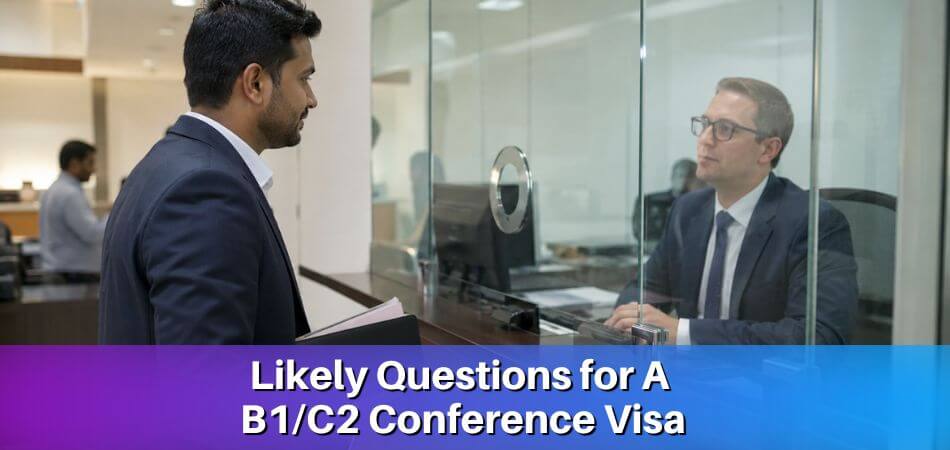
Main Interview Question Areas
| Question Area | What the Officer Wants to Confirm |
| Purpose of visit | You are attending a real conference or professional event |
| Conference details | You know the name, dates, venue, and topic |
| Work or business background | The event is relevant to your current role or field |
| Financial support | You can afford the trip or have valid sponsorship |
| Travel plan and accommodation | Your stay is temporary and you know where you will sleep |
| Return intent | You have real reasons to go back home |
What the Officer Is Trying to Decide
The officer decides whether your visit fits a temporary business purpose. Your answers should show that the event is genuine, your background supports the trip, your finances are clear, and your return plan is believable. If you are going to a U.S. conference, do not make the trip sound like tourism, job hunting, or immigration.
Is B1/C2 a Real Conference Visa? What B-1 and C-1 Mean
No standard “B1/C2 conference visa” exists. B-1 is the business visitor category that covers conference attendance. C-type visas are for travellers passing through the U.S. on the way to another country.
What a B-1 Visa Allows for Conference Attendees
The State Department lists taking part in a scientific, educational, professional or business convention, conference or seminar among the permitted B-1 activities. You may attend sessions, workshops and meetings, meet industry contacts, or represent your employer. The stay must remain temporary and cannot turn into work for a U.S. employer or long-term study, and you should not receive a salary or income from a U.S. source for attending. Travellers from Visa Waiver Program countries can attend such events without a visa for stays of 90 days or less (with ESTA approval), under the same rule against U.S.-sourced pay. If you would rather hold a visa, you may still apply for a B visa.
In the interview, be ready to name the conference, city, venue, dates, organizer, your role at the event, and how it connects to your background.
What a C-1 Transit Visa Is Used For
A C transit visa is for “immediate and continuous” travel through the United States to another country. If you want a layover for another purpose, such as visiting friends or a conference, you need a different visa. So a transit visa is not the right category for a conference inside the U.S.
Transit questions focus on your final destination, your connecting flight and your right to enter that destination. A Canadian conference with a route through a U.S. airport is one case where transit can matter.
Why the Right Category Matters
The officer compares your stated purpose with the visa type. A U.S. conference described as transit looks unclear, and a business visit described like employment invites doubt. Whichever applies, be ready to explain purpose, duration, funding, return plan and documents.
Common B1/C2 Conference Visa Interview Questions and How to Prepare
Most conference visa interview questions are short and direct. Preparing by topic helps you stay calm and consistent.
Questions About the Purpose of Your Trip
The first question is often why you are travelling. Expect: Why are you going to the United States? What will you do there? Why does this event matter to you?
Sample answer:
I am attending [conference name] in [city]. It relates to my work in [field], and I will return after the conference.Avoid vague lines such as “I want to visit the U.S.” They make the purpose sound wider than a conference.
Questions About the Conference
The officer may ask the name, location, dates, organizer, whether you registered, whether you attend, present or exhibit, and which topics are covered. Know these details without searching through papers.
Sample answer:
The conference is [conference name], from [start date] to [end date] in [city]. It focuses on [main topic], and I have registered as an attendee.
Questions About Dates, Stay and Accommodation
Your stay should match the event. Expect: When will you travel? How long will you stay? Why arrive early or stay after? Where will you sleep? Who booked it?
Sample answer:
I arrive on [date], attend the conference from [start date] to [end date], and fly back on [return date]. I booked [hotel name], close to the venue.A short buffer before or after the event is easy to explain. A long extra stay is not.
Questions About Your Job or Business
Your background explains why the event matters. Expect: What is your job? What are your duties? How long have you worked there? How does the conference relate to your work? If your employer approved the trip, you may also be asked who pays and whether you return to the same job.
Employee:
I work as a [job title] at [company]. My role involves [brief duties], and the conference topics relate to those responsibilities. My employer approved the leave.Business owner:
I own a [type of business] in [country]. The conference covers [topic], which connects to my business.
Questions About Who Is Paying
Financial questions test whether you can afford the trip. Expect: Who pays? What is your income? How much will the trip cost? Is anyone sponsoring you?
If self-funded: I am paying from my savings and regular income, and I have recent bank statements.
If employer-funded: My employer covers registration, flights and hotel, and I have an official letter.
If sponsored: My [relationship] covers part of the cost, and I also have personal funds. I have the sponsorship letter and relationship proof.
Funding should look stable and realistic. Sudden large deposits with no explanation raise questions.
Questions About Ties to Your Home Country
Return intent carries a lot of weight. Expect: Why will you come back? Do you have a job, family, property or a business there?
Sample answer:
My job is based in [country], and my leave is approved only for this trip. I am expected back at work on [date].Real ties include employment, a business, family duties, property, studies, a professional licence or contracts that start after the trip.
Questions About Plans After the Conference
Expect: What will you do afterwards? Will you visit relatives? Do you plan to work or extend your stay?
Sample answer:
After the conference I return home and resume work. I do not plan to work, study or stay beyond the purpose of my visit.
Questions About Previous Travel and Refusals
Expect: Which countries have you visited? Have you been to the U.S.? Have you ever overstayed or been refused a visa? Answer honestly. If you were refused before, say so.
Sample answer:
Yes, I was refused in 2026. Since then, I have updated my documents and fixed the earlier problems.
How Should You Answer Conference Visa Questions?
Give a short, specific, truthful answer and name the document that supports it. You do not need long explanations unless the officer asks for more.

Keep Answers Short and Credible
A good answer has a direct response, one relevant detail and, if needed, a document.
Question: Why are you going to the United States?
Answer: I am going to [conference name] for its sessions on [topic], and I have already registered.
Connect the Conference to Your Work
Use one formula: “My role is [role]. The conference covers [topic]. This is useful because [professional reason].” Employees link it to current duties, business owners to knowledge or networking, researchers to their paper or research area, students to academic development, and speakers to their session topic. A logical link beats an overdone explanation.
Explain Funding and Return Plans
Avoid “someone will help me later” or “I will arrange money after approval,” and for return, real commitments are stronger than “I promise to return.”
What Not to Say During the Interview
| Avoid Saying | Why It Can Be Risky | Better Approach |
| I want to explore opportunities. | May sound like job hunting | I am attending sessions related to my work. |
| I may stay longer if I like it. | Weakens return intent | I will return on [date]. |
| I do not know much about the event. | Makes the purpose look weak | Reread the programme and your registration page the night before. |
| My friend arranged everything. | Shows poor personal preparation | Explain your own registration and plan. |
| I will work if I get a chance. | Conflicts with visitor purpose | State that you will not work in the U.S. |
| I am not sure when I will return. | Creates uncertainty | Give a clear return timeline. |
U.S. Conference Visa vs. Canada Conference Entry Requirements
A U.S. conference usually needs a B-1 visa (or visa-free entry if your country qualifies), and a Canadian conference needs a visitor visa (TRV) or an eTA, depending on your nationality. Do not assume one document works for both countries. Under the rules for Canadians attending a U.S. conference, Canadian citizens need no visa or ESTA for a short trip.
When Canada Requires a TRV or eTA
For a conference in Canada you need a Temporary Resident Visa or an Electronic Travel Authorization, depending on your passport and how you travel. Check IRCC for your nationality. Carry event proof, funds, itinerary, accommodation and return evidence.
Key Differences to Check
| Issue | United States | Canada |
| Common conference route | B-1 business visitor purpose | Visitor/business visitor entry, TRV, or eTA |
| Transit | Separate C transit rules | Depends on nationality and route |
| Main focus | Temporary purpose and return intent | Temporary purpose, funds, and return intent |
| Interview | Required for most visa applicants | Depends on the case |
What Changed for U.S. Conference Applicants in 2026?
Three recent U.S. rules can affect a conference trip: narrower interview waivers, a visa bond for some countries, and a partial suspension of B-1/B-2 issuance for nationals of certain countries. Check your own country before you pay anything.
Interview Waivers Are Narrower
Since October 1, 2025, most applicants must attend an in-person interview, including many renewals. A narrow exception remains for B-1/B-2 renewals filed within 12 months of the old visa’s expiry, when that visa was issued for full validity and you have no past refusal. A first-time applicant has no waiver route, and an officer can still ask any applicant to attend. Applicants also generally apply in their country of nationality or residence.
Visa Bonds
Under a permanent visa bond program that took effect on August 3, 2026, officers may require some B-1/B-2 applicants from listed countries, Nigeria among them, to post a bond of $10,000, $15,000 or $20,000 (Form I-352, paid through Pay.gov). The amount is set case by case. The bond is refunded after you depart as required. The country list can change, with additions taking effect 15 days after they are announced, so confirm your country’s status on travel.state.gov.
Partial Suspension of B-1/B-2 Issuance
Presidential Proclamation 10998 partially suspends B-1/B-2 visa issuance for nationals of 19 countries, Nigeria included, from January 1, 2026. You can still submit an application and book an interview, but you may be ineligible for a visa. Exceptions include dual nationals applying with a passport from an unaffected country and some case-by-case national-interest travel. The State Department reviews the list every 180 days, so check its page before booking flights or paying conference fees.
Fees
The standard B-1/B-2 application (MRV) fee is $185 and is not refunded if you are refused. A separate $250 visa integrity fee was legislated in 2025 and is charged when a visa is issued, not when you apply, so it does not apply if you are refused. Check travel.state.gov and your embassy’s fee page for its start date.
Documents to Carry for a B1 Conference Visa Interview
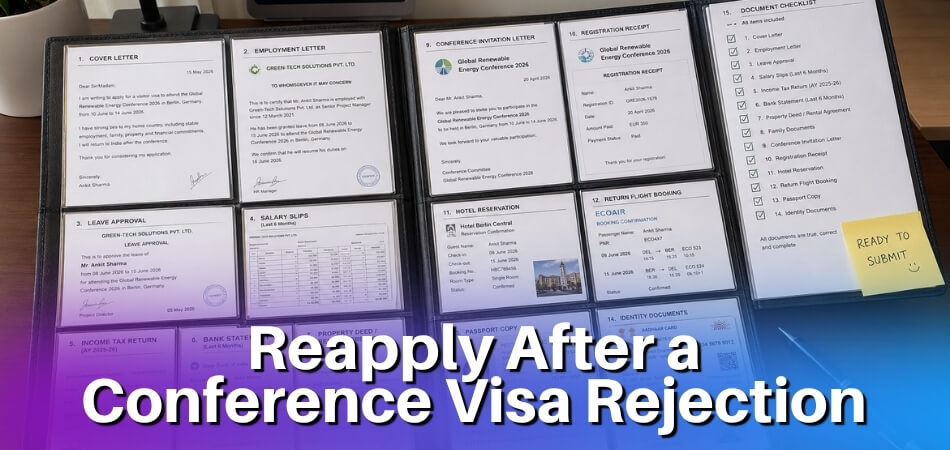
Carry documents that prove your identity, the conference purpose, your job, your funds, your travel plan and your reasons to return. The officer may not check every paper, but you should have them.
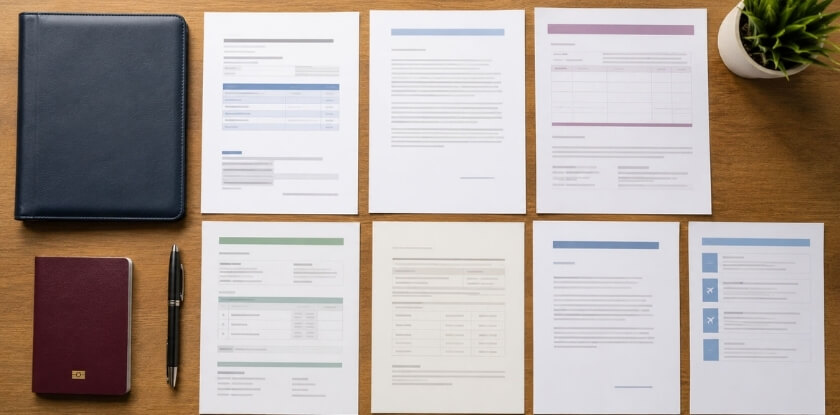
Passport and Application Documents
Bring your current passport, old passports, previous visa pages, DS-160 confirmation page, appointment confirmation, fee receipt and a photo if required. Check that your name, date of birth and passport number match everywhere.
Conference Documents
- Invitation letter
- Registration confirmation and payment receipt
- Event schedule and venue details
- Organizer contact information
- Speaker or exhibitor confirmation, if applicable
The invitation or registration should show your name, event name, dates, location and how you take part. An invitation letter supports your application but does not guarantee a visa.
Employer, Business, or Academic Proof
If employed, bring a letter confirming your job title, approved leave, conference purpose, who pays, and your expected return to work. If self-employed, bring business registration, tax records and business bank statements. Students and researchers need a letter from their institution.
Financial and Travel Documents
Useful proof includes recent bank statements, salary slips, tax or business income records and, if someone sponsors you, their letter, bank statements and proof of your relationship. Your documents should match your explanation: if your employer pays, the employer letter says so.
Carry an itinerary with arrival date, conference dates, hotel booking, venue address and return date. A confirmed flight ticket is not always necessary before approval, but your dates should be realistic.
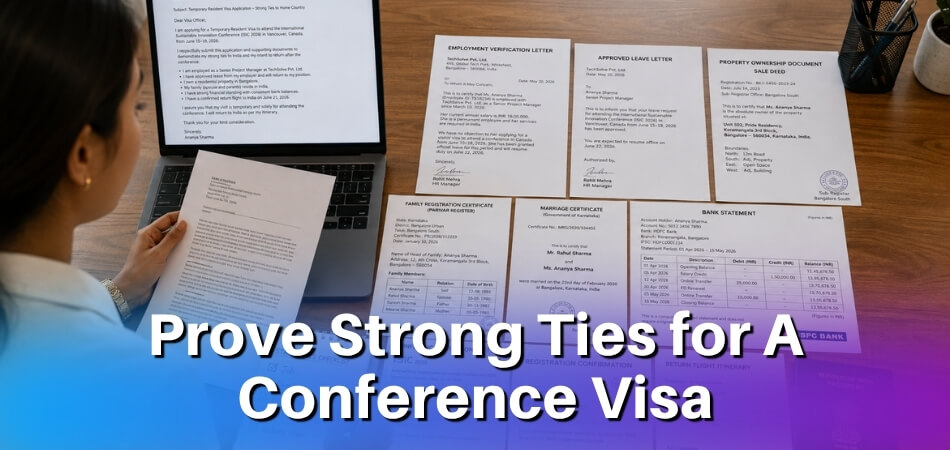
Evidence of Home-Country Ties
Depending on your case, bring employment proof, leave approval, business records, property or lease documents, family documents, student enrollment, professional licences or upcoming work commitments.
How to Organize Documents
Sort them into six folders: passport and application, conference, work or study proof, finances, travel and accommodation, and home ties. Do not hand over everything at once. Give only what the officer asks for.
How to Schedule a U.S. Conference Visa Interview
You complete the DS-160, create a profile on the appointment platform for your country, pay the fee, and book the appointment. Start early, because wait times vary by embassy.
Complete the DS-160 Form
The DS-160 asks for personal details, passport information, travel purpose, employment history and previous travel. Your stated purpose must match your event documents and your interview answers. Print the confirmation page and save a copy.
Create a Profile and Pay the Fee
Use the official appointment platform for your country, with the same passport details and DS-160 confirmation number. Pay the application fee by the method offered there and keep the receipt, because you may need it to book or to enter the appointment centre.
Book Biometric and Interview Appointments
Depending on the country, you may need a biometric appointment and a separate consulate interview. The State Department’s visa appointment wait times page shows an estimate for each post. Choose dates that leave time before the conference, because appointment availability and passport return times differ.
Can You Get an Earlier Appointment for a Conference?
Usually not for the conference alone. The State Department says travel to an annual business, academic or professional conference does not qualify for an expedited appointment, and tells such applicants to book a regular appointment well in advance. Urgent, unforeseen situations such as a funeral or medical emergency can qualify, with proof.
A limited pilot also lets B-visa applicants at selected posts pay $750 for an earlier interview, on top of the $185 application fee; the pilot runs to 31 December 2026. It is voluntary, non-refundable, runs only where the booking site shows the “Paid Expedite” option, and gives an earlier appointment only, not a faster decision or a guaranteed visa.
Common Mistakes That Can Weaken a Conference Visa Application
Most problems come from vague answers, weak proof, unrealistic plans or inconsistent information. These are the mistakes that most often weaken an application.
Giving Unclear Answers About the Purpose
“I just want to attend an event” is too vague. Name the conference, location, topic and your professional reason.
Showing Insufficient Financial Proof
Low balances, unexplained deposits, missing salary proof and unclear sponsorship weaken a case. Show stable income, savings, business records or sponsor documents that cover the cost.
Mixing Conference Travel With Tourism or Family Travel
Limited personal activity can be acceptable, but the conference must stay the main purpose.
Applying From a Country Where You Do Not Live
Booking in a third country raises extra questions about your ties, so schedule the appointment where you live, work or study.
Tips for a Successful Embassy or Consulate Interview
Preparation, consistency and calm communication matter most. Officers see many applicants a day, so a clear, short answer helps you.

Dress Neatly and Stay Polite
Wear neat, professional clothes. Greet the officer, listen to the whole question, do not interrupt, and stay calm even if questions repeat.
Answer Honestly and Directly
Do not add details nobody asked for. Follow-up questions do not always mean a problem; ask politely for clarification if needed. Before you apply, write two sentences on why this event matters to your job and say them aloud once.
From our experience at MS International: Our invitation letter is issued within 3 to 5 business days after payment clears, so register early enough to have it before you book your interview. It confirms your registration and the event details, but it supports your application and does not guarantee a visa. Our conferences are held in person in the Greater Toronto Area.
Frequently Asked Questions About B1/C2 Conference Visa Interviews
Whether a visa called B1/C2 exists is often the first doubt, followed by an earlier or rescheduled interview date, originals or copies, English fluency, family on the same visa and two conferences in one trip.
Is there a visa called B1/C2?
No. B-1 is the visa most conference attendees need, and C-type visas are transit visas. If an invitation or form uses “B1/C2,” ask the embassy which category fits your trip.
Do I need an interview for a conference visa?
Usually yes. Most U.S. visa applicants now need an in-person interview, and only some B-1/B-2 renewals filed within 12 months of expiry can skip it. First-time applicants cannot.
Can I get an earlier interview date because my conference is soon?
Usually not. A conference, even a yearly one, is not a qualifying reason for an emergency appointment, so book a regular slot well in advance. Some posts offer a paid $750 option in a limited pilot.
Can I reschedule my visa interview?
Usually yes, through the same appointment portal where you booked it. Your confirmation shows a deadline for changes, and the number of changes allowed depends on the embassy. Reschedule early and pick a date that leaves time before your conference.
Should I bring original documents or copies?
Bring originals with photocopies where possible. Originals prove authenticity and copies make review easier. Keep everything in one organized folder.
Does English fluency affect the decision?
Not by itself. Officers look at purpose, documents, finances and return plans. If you do not understand a question, politely ask the officer to repeat it.
Can I arrive before the conference starts?
Yes, if the timing is reasonable. Arriving one or two days early for check-in and rest is common. Keep your dates closely tied to the event schedule.
Can my family travel on my conference visa?
No. Each person needs their own visa or entry permission based on their own reason for travel. Your conference invitation supports your trip only.
Do I need confirmed flight tickets before the interview?
Not always, and many applicants avoid non-refundable tickets before approval. Still, know your intended arrival date, return date, hotel and conference schedule.
Can I attend more than one conference on the same trip?
Yes, if every event fits the business visitor purpose and your dates. Bring the invitation, registration proof and schedule for each event so the itinerary looks realistic and connected.
Is travel insurance required for a B-1 visa?
It is not normally the main requirement for the interview. It can help with medical or cancellation problems, so keep the proof with your travel documents if you have it.
What should I do if my visa is refused?
You can usually reapply, but only after something real has changed. Read the refusal letter for the section cited, strengthen the evidence the officer doubted, often home ties or trip purpose, and disclose the refusal on your next DS-160.
Final Preparation Checklist Before the Interview
Check that your answers, documents and travel plan tell one story.
Final Checks
Do not memorize robotic answers; know your facts and speak naturally. Check your passport validity, DS-160 confirmation, appointment time, fee receipt, security rules at the embassy, and that names, dates and funding details match across every document. If something changed, explain it and carry updated proof.
Conclusion
Good preparation for a B1/C2 conference visa interview is not a long script. It is knowing your conference and role, organized documents, direct answers and honesty. When your purpose is clear and your papers support it, the interview is much easier.
Disclaimer: This article is general information, not legal or immigration advice. Visa rules, fees, and processing times change. Confirm the current requirements on the official U.S. Department of State (travel.state.gov) website before you apply.