
Many researchers, PhD students especially, are unsure whether a review paper belongs at a conference at all. The honest answer is that it depends on the call, and finding that out early saves a wasted submission.
Quick answer: Yes, you can present a review paper at a conference, but only where the call accepts review papers. Some conferences list them as a submission type and some exclude them. Read the call for papers, match your review type to it, state your method and contribution in the abstract, and confirm that prior publication is allowed.
Last verified against official sources: October 2026.
Can You Present a Review Paper at a Conference?
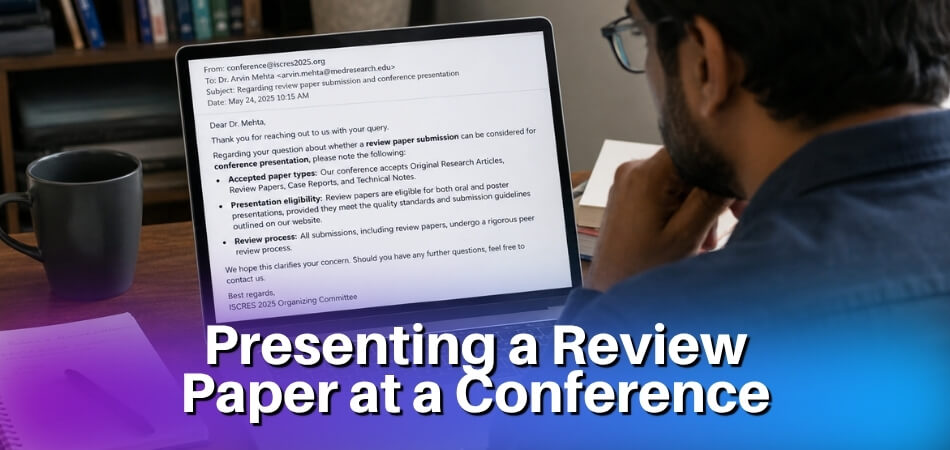
Yes, if the conference accepts them. Review papers (systematic, narrative or scoping) are a listed submission type at some conferences and are excluded at others, so each conference’s own rules decide.
Most conferences judge a submission on its scholarly contribution rather than its study design. A well-executed review that pulls together a fragmented body of literature, identifies gaps or challenges an existing consensus can carry as much intellectual weight as an empirical study. Acceptance is still not automatic, and a few factors shape your chances.
What Conferences Are Looking For
The bar is whether your review advances the conversation in a field. Reviewers want a sound methodology, a clearly defined scope and a synthesis that offers more than a reading list. Showing that is the core of a strong abstract.
Discipline-specific conferences tend to have clearer norms. In medicine, public health and the social sciences, systematic reviews are an established paper type, though a given conference may still limit them to certain tracks. Interdisciplinary conferences can be more flexible, though the expectation that you frame your contribution clearly can be higher.
What Different Review Types Usually Offer a Conference
| Review type | What reviewers can check | Typical fit |
|---|---|---|
| Systematic review | Protocol, search, inclusion criteria, screening numbers | Health, psychology, evidence synthesis tracks |
| Scoping review | Search strategy and the map of evidence | Health, education, policy venues |
| Narrative review | Quality of the argument and the stated logic of source selection | Interdisciplinary, humanities, social science venues |
| Critical or methods review | How a construct or method has been used across studies | Methodology-focused conferences |
Which Types of Conferences Accept Review Papers
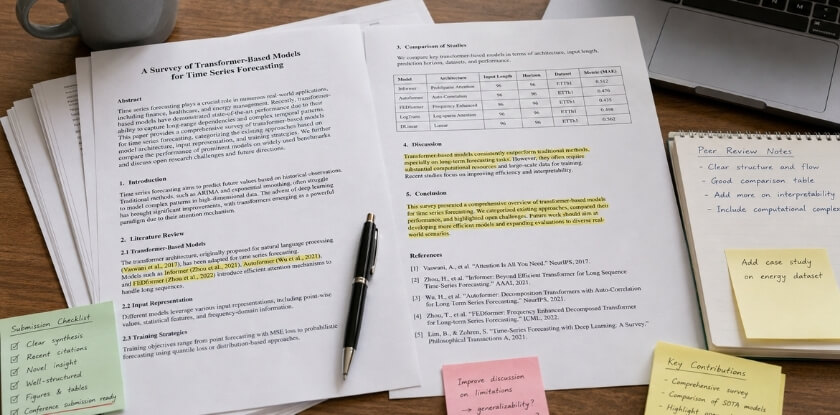
Not every conference has the same appetite for review papers. Some encourage them, others consider them only in specific tracks. Knowing where yours fits saves you from wasting submissions on venues that will not take them.
What Published Calls Actually Say
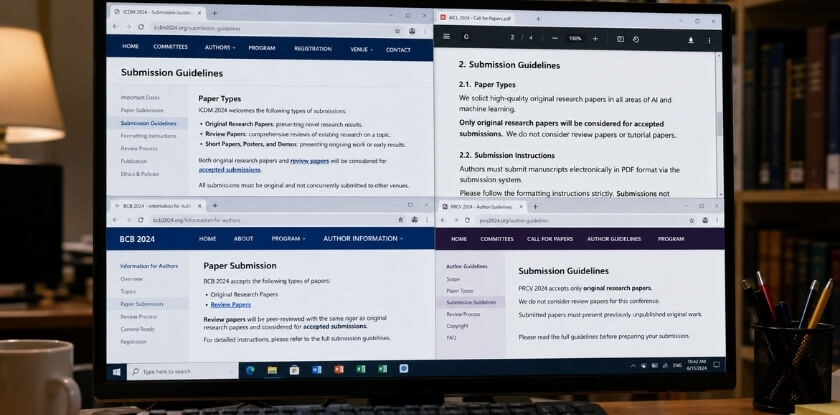
Published rules differ, which is why the call matters more than general advice. The examples below restate what each source says on its own page.
| Source | What it says about review papers |
|---|---|
| GPEBT 2026 (Global Perspectives on Education, Business and Technology) | Has a review paper category, recommended at 8 to 12 pages, for systematic, scoping, narrative or critical literature reviews. Submissions must be original, unpublished and not under review elsewhere. |
| CHI 2026 | Its contributions page lists eight contribution types, and a literature review is not one of them. |
| IEEE Sensors Council journal-to-conference initiative | For journal papers invited to be presented at its conferences. The page says the paper has to be new and should not be a review paper. |
| MS International | Lists review papers as a submission type: a paper that reviews previous studies, compares findings, identifies research gaps and discusses future directions. |
The same review can therefore fit one call and be out of scope for another. One editing-service Q&A (Editage, 2018) goes further and says conferences usually do not accept literature reviews for their proceedings, though some allow them as posters, and it advises asking the organizers when the call is silent.
Discipline-Specific Conferences vs. Interdisciplinary Venues
Discipline-specific conferences tend to be more conservative. In fields like medicine, psychology and the natural sciences, the default expectation is original data, methods and results. A systematic review can still find a home, especially if it addresses a question the field is debating, but a narrative review without a defined methodology often struggles. These venues are also more likely to judge a review against the methodological standards of that discipline.
Interdisciplinary conferences can be more receptive. They bring researchers from different fields together and often value synthesis over novelty. A literature review that maps a topic across disciplines, or a review that identifies gaps in fragmented research, tends to land well. Education research, public health and policy-oriented venues can be open to review work.
For PhD students, interdisciplinary venues can be a practical first step, because feedback is often more varied and the audience is less likely to question the format itself. Some smaller regional conferences and graduate research symposiums may also welcome review papers, since many exist to help early-career researchers gain presentation experience.
How to Check a Conference’s Submission Guidelines for Review Papers
Conferences are not always explicit about review papers, so read the guidelines instead of assuming.
- Start with the call for papers. Look for tracks or paper types such as “literature reviews,” “theoretical contributions” or “synthesis papers.” If the call mentions only “original research” or “empirical studies,” look closer or ask the organizers.
- Check the abstract template. If it demands sections like “Hypothesis,” “Data Collection” and “Results” with no alternative format, the conference is probably built around empirical work. A required “Results” section does not automatically rule out a review, but it tells you what the committee expects.
- Browse previous proceedings. Two or three years of accepted papers show whether reviews have been accepted before and in what form. A handful of systematic reviews in the archive means yours has a reasonable shot. If the last three years contain none, that is a useful signal about the committee’s preferences.
- Look for the right track. Larger conferences often have tracks for methodology, theory or literature-based work. Submitting to the correct track puts your paper in front of reviewers equipped to evaluate it.
- Email the program committee when in doubt. Ask whether review papers or systematic reviews are eligible and name the track you are considering. Organizers respond to these questions regularly, and getting a direct answer before you submit is far better than a desk rejection afterwards.
- Confirm author rules early. Some conferences limit the number of authors for certain submission types, and a large author team can run into formatting or registration requirements that are not obvious at first.
Systematic Review vs. Narrative Review: Which Has a Better Chance at a Conference?
A systematic review usually has the easier path, because reviewers can assess its method quickly. A narrative review can still succeed, especially at interdisciplinary venues, but it depends much more on the strength of the argument.
Why Systematic Reviews Tend to Fare Better
A systematic review follows a defined protocol, a reproducible search and stated inclusion and exclusion criteria. That transparency gives peer reviewers something concrete to evaluate. The PRISMA 2020 reporting guideline, with its checklist and flow diagram, is the standard way to report this, and reviewers trained in health and social science fields recognize it immediately. At discipline-specific conferences in medicine, public health or clinical psychology, a systematic review can be competitive with an original empirical study.
For PhD students, a systematic review also signals independent scholarly work: you can define a question, design a search strategy and synthesize a literature base with discipline.
Where Narrative Reviews Still Win
A narrative review is not a lesser product. It serves a different purpose, and some conferences prefer it. Interdisciplinary programs often want a broad conceptual synthesis that cuts across sub-fields, such as a review that maps competing frameworks or traces how a concept has evolved over decades.
The catch is that acceptance depends heavily on the quality of your argument. Without a traceable methodology, reviewers judge whether your synthesis is insightful and well reasoned, which is a more subjective bar that varies across conferences.
Practical Implications for Your Submission
- Match the review type to the call. Some conferences, especially in STEM and health sciences, expect a systematic or scoping methodology. Submitting a narrative review to a call that implies otherwise can sharply reduce your chances.
- Name your approach in the abstract. For a systematic review, state the databases searched, the number of studies screened and the inclusion criteria. PRISMA 2020 includes a 12-item checklist for abstracts, which its authors describe as a framework for a journal or conference abstract, and scoping reviews have their own PRISMA-ScR checklist (20 essential items and 2 optional). A short word limit may not fit every item, so follow the call first. For a narrative review, frame the conceptual work your synthesis does that a primary study could not.
- Match format to review type. Systematic reviews often translate well into posters, where tables and flow diagrams display clearly. Narrative reviews frequently work better as oral presentations, where you can walk the audience through your interpretive argument.
How the Conference Paper Review Process Works for Review Submissions
A review paper goes through essentially the same peer review process as any other submission, but reviewers apply different criteria. Knowing them gives you a real advantage.
What Reviewers Are Actually Assessing
Conference review is often shorter than journal review, but it is still substantive. For a review paper, reviewers usually work from three questions.
- Does the review have a clear methodology? They want to see that your literature search was not arbitrary: you defined the scope, searched systematically and made transparent inclusion decisions. A systematic review satisfies this naturally. A narrative review needs to describe its guiding logic.
- Does it contribute something beyond summary? Cataloguing studies will not pass. The paper must synthesize, identify gaps, resolve contradictions or point the field in a new direction. Reviewers expect analysis, not an annotated bibliography.
- Is it appropriate for this venue? A review of machine learning in clinical diagnostics might do well at an interdisciplinary health informatics conference and be rejected at a narrow conference focused on original clinical trials.
How Conference Timelines Affect Your Submission
Conference review cycles are usually shorter than journal cycles, and the number of revision rounds varies, so check the call.
If a reviewer has a question about your scope or methodology, you may get no chance to respond before a decision, so your abstract and full paper must be self-contained. Some conferences use a two-stage process: a structured abstract is screened first, and only shortlisted submissions go to full-paper review. For a review paper, that abstract should name the review type, summarize the search strategy and state the key finding, all within the word limit.
How Acceptance Rates Factor In
A lower acceptance rate does not mean review papers are unwelcome. It means your abstract has to show the fit and the contribution more sharply.
Acceptance rates vary enormously between conferences, and highly competitive venues accept only a fraction of submissions, so look for the published rate in the call or in past proceedings instead of assuming. At conferences that actively seek review papers the fit works in your favor, and at venues that treat them as peripheral it works against you.
A co-authored review does not carry less weight because a student is not the sole author. Reviewers focus on the quality of the work, and what matters is that the author order reflects real intellectual input and that the submitting author can speak to the methodology if questions arise.
What Gets a Review Paper Rejected
It helps to know the failure points before you write the abstract, because they can be fixed in advance.
Problems that can lead to rejection:
- The scope is too broad to say anything specific.
- The methodology is vague or undescribed.
- The paper duplicates an existing review without new analysis.
- The submission ignores the conference’s stated focus areas.
From our experience at MS International: review papers are one of the submission types we accept, alongside abstracts, full papers, case studies and professional presentations. Submissions go through double-blind review and follow APA format, and full papers normally run between four and twelve pages including tables, figures, references and appendices.
Oral Presentation vs. Poster Presentation for Review Papers
When you submit, you are usually asked to indicate a preferred format, or the committee assigns one based on how your submission fits the program. Choose an oral presentation when your review makes a clear directional argument that benefits from spoken explanation and Q&A. Choose a poster when the review is broad, taxonomic or exploratory and viewers can engage with it at their own pace. Some conferences specify format by paper type, so check the guidelines before you decide.
| Format | Best for | Main risk |
|---|---|---|
| Oral presentation | A clear argument or resolved debate; Q&A with the room | Spending the slot listing sources instead of findings |
| Poster | Broad or exploratory reviews; one-on-one feedback before a journal submission | Too much detail (flow diagrams, tables) making it unreadable |
Oral Presentations
An oral slot is usually short, and its length depends on the conference. It puts you in front of an audience expecting a clear argument, not a bibliography walk-through. A common trap is spending half the time listing papers instead of presenting what those papers collectively show.
Build the talk around the findings. You covered the methodology in the paper, so in the talk get to the synthesis quickly: what patterns emerged, what is contested and where the field is moving.
- Lead with a clear gap or question. Say what problem in the literature your review addresses.
- Use figures that show synthesis. A comparison of findings across studies, a trend chart or a conceptual framework diagram communicates more than a slide of citation counts.
- Adjust context to the room. Discipline-specific audiences know the literature. Interdisciplinary audiences may not.
- Be ready to defend your inclusion criteria. Someone will ask why you excluded certain studies.
Poster Presentations
Posters have a reputation as the less prestigious format, but for a review paper a poster session can be more productive than a short oral slot, because it allows sustained one-on-one conversation with people interested in your topic.
The challenge is density. Systematic reviews generate PRISMA flow diagrams, inclusion tables and quality scores, and cramming them all on a poster makes it unreadable. Pick two or three key findings and show them visually, include a simplified version of the search and selection process, and let a handout or QR code linking to the full paper do the rest.
Also check the proceedings policy. Some conferences publish poster abstracts in their proceedings, while others publish only oral-session papers. If publication credit matters for this work, find out before you accept a poster assignment. If you present for a team, know the full contribution breakdown, because it will come up in conversation.
Which Format Is Better for a Review Paper?
An oral slot signals most clearly that the committee saw your review as a standalone argument. If it advances a specific position or resolves a genuine debate, ask for an oral slot in your abstract.
A poster fits if your review is broad and exploratory, or if you mainly want feedback before journal submission. The informal back-and-forth generates detailed input that a short Q&A rarely provides. Some larger, empirically focused conferences assign review papers to posters by default. Treat that as a real opportunity, since the people who seek out your poster are often the most relevant to your work.
Co-Authorship and Attribution in Review Papers
Review papers are rarely solo efforts, so settle authorship before you submit. Doing so early prevents awkward conversations later, especially after acceptance.
Who Counts as an Author?
The usual benchmark is the ICMJE guidance, which many journals and conferences follow. An author needs all four of: a substantial contribution to the conception or design of the work or to acquiring, analyzing or interpreting data; drafting the work or revising it critically; final approval of the version to be published; and agreement to be accountable for the work. Someone who only collected a few references or formatted citations does not qualify and would normally be acknowledged instead. Some fields use other conventions, so check your own.
This matters because many submission portals ask for the full author list upfront, and changes after acceptance can be complicated or disallowed. Some proceedings lock the list once a paper is accepted.
How PhD Students Should Think About This
If you led the review as a PhD student, your supervisor will probably be on the paper, as is standard in most disciplines. The practical question is order.
First authorship signals that you drove the intellectual work: the search strategy, the synthesis and the framing. If that is true, you should be listed first.
Corresponding authorship is a separate decision. Some students take it, others leave it with a supervisor. The presenting author and the corresponding author do not have to be the same person, though it is cleaner if they are.
With co-authors at other institutions, agree on attribution before writing starts. A shared document with a one-paragraph authorship agreement is informal but effective, and this step is easy to skip.
Review Methodology and Who Did What
Systematic reviews often divide the labor, and a review with several contributors is common: one person designs the search, others screen titles and abstracts, someone extracts data and someone runs quality assessment. Each of these can count toward authorship if the other criteria are met. You probably will not need to document roles for a conference, but a clear record of who did what protects everyone if a co-author asks to be removed or a collaborator claims they should have been included.
Attribution in Conference Proceedings vs. Journal Publication
If a review first appears in proceedings and is later expanded into a journal article, authorship should stay consistent unless there is a documented reason to change it, such as a contributor who worked only on the journal version. Changing authors is not a problem in itself, but be transparent. Some journals ask whether the work was presented at a conference, and an unexplained author-list difference can raise questions. If a supervisor restructures the paper for journal submission, discuss attribution before submitting, not after.
Who Presents a Co-Authored Review?
For example, a review may have four co-authors with only the lead PhD student presenting. All four are listed in the submission with the presenting author flagged, and the proceedings list every co-author regardless of who stood at the podium. Before you submit independently, for example as a poster, make sure all listed authors know about and agree to the submission. A short email takes five minutes and removes any ambiguity.
Tips to Get Your Review Paper Accepted at a Conference
Some conference reviewers expect original data, so make the contribution of your review unmistakable from the first line of the abstract. The tips below address points where review submissions can fall short.
Frame the Contribution Before Anything Else
- Lead with the gap, not the method. Open by identifying what the literature has not yet synthesized and why that matters to this audience. The insight earns the acceptance, not the fact that you did a review.
- Name your review methodology explicitly. Say early whether you followed a systematic protocol or a structured narrative approach. Vague phrases like “we examined the literature” invite rejection.
- Quantify the scope. “We screened 1,400 studies and synthesized 62 that met the inclusion criteria” tells the reviewer you did serious work. “We reviewed relevant literature” does not. (The numbers here are only an example of the style.)
Match the Paper to the Right Conference
Submitting a systematic review to a conference that only processes empirical research wastes a submission cycle, so confirm the fit first, using the checks listed under the submission guidelines section above. Interdisciplinary conferences can be more flexible, and some actively seek synthesis papers that can bridge fields.
Tailor the Abstract for the Peer Review Process
- Write for the reviewer. Do not just summarize what you did. Every sentence should help answer “Why should this be at our conference?”
- State a concrete finding. Do not end with a vague line about implications. Say what the review actually established.
- Keep the methods part tight. One or two sentences are enough. Spending half the abstract on search strings leaves too little room for findings.
- Include the core items. A good review abstract covers the review question, methodology (search strategy, inclusion criteria), scope of literature and main conclusions. Requirements vary, so follow the conference’s instructions.
- Test it on an outsider. Have a colleague outside your subfield read it. If they cannot say in one sentence what the review contributes, revise it. This matters most at interdisciplinary conferences.
Anticipate Reviewer Objections
Most objections concern currency, an unclear contribution or an informal-looking methodology, and you can address all three in advance.
- Show currency. If your search cut-off is a few years old, reviewers may question relevance. Update the search before submitting and state the date range.
- Say what is new. If similar reviews exist, explain briefly why yours differs: a different population, discipline, time window or inclusion process.
- Show methodological transparency. Even a narrative review benefits from a consistent, stated approach to source selection and synthesis.
- Prepare for either format. Some conferences ask your preferred format at submission, others assign it after acceptance. Indicating flexibility can help, and a well-made poster can reach as many people as a short oral slot.
Practical Submission Habits That Actually Help
- Settle authorship before the abstract goes in. Attribution disputes after acceptance are a serious problem, and some committees do not allow changes to a proceedings entry once submitted.
- Read two or three papers from earlier editions. They tell you more about tone, depth and format expectations than the guidelines alone.
- Plan your talk length. If the slot is 15 to 20 minutes and you read from a script, a common rule of thumb is about two minutes per double-spaced page, so roughly 7 to 10 pages. Check whether Q&A is included in the slot. Rehearse the talk against a timer as you prepare the conference presentation.
Is It Okay to Present a Published Review Paper at a Conference?
Sometimes. It depends on the conference’s prior-publication policy, which varies widely. Some conferences treat any earlier journal publication as grounds for rejection, while others only ask that the presentation adds something for that audience. Read the call, and ask the committee if it is unclear.

When a Published Review Can Still Be Presented
Some conferences, particularly interdisciplinary ones, welcome work that has appeared in print, as long as you frame the conference contribution correctly. In fields where journal timelines run well ahead of conference cycles, proceedings are sometimes used to share published findings with a live audience.
- Posters may have more flexibility. Some conferences apply looser originality rules to posters, so check whether the call says so before proposing a published review as a poster.
- Proceedings change the picture. If your paper would appear in published proceedings, you are asking for a second formal publication. Check the copyright agreement of the journal that published the original review, as some restrict republication in any form.
- Updated work can qualify. A scoping review published in a journal and presented months later with updated implications, based on literature that appeared after publication, can work at conferences that allow previously published work. Look for guideline wording that says whether previously published work is accepted and what the presentation must add.
What You Should Disclose
Tell the organizers. Mention the earlier publication in your cover letter or submission notes and explain what the conference version adds, such as updated literature or a focus on implications for a specific audience. Some conferences see a published peer-reviewed paper as a quality signal. Disclosure also protects you: if a reviewer finds the prior publication on their own and you did not mention it, the submission looks problematic even if it was not.
When It Becomes a Problem
The real issue is submitting the paper as if it were entirely new, or having a proceedings version that is substantially identical to the journal article. The ICMJE defines duplicate publication as publication of a paper that overlaps substantially with one already published, and that can cause problems with both the journal and the conference.
Illustrative Examples of Review Papers Presented at Conferences
The scenarios below are illustrative patterns, not a survey of any conference. They are composites, not named real cases, but they show the range of situations where review papers are presented, including by early-career researchers.
A Systematic Review Presented as an Oral at a Health Sciences Conference
At a conference run by a professional association in public health or nursing, a systematic review can be accepted for an oral session. A PhD student reviewing community-based mental health interventions submits a structured abstract to a track for evidence synthesis, stating the methodology, inclusion criteria, number of studies and key findings. It is accepted as a 15-minute talk with a short Q&A, using a PRISMA flow diagram, a risk-of-bias summary table and the main outcomes. It works because the findings are immediately useful to practitioners in the room.
A Narrative Review as a Poster at an Interdisciplinary Conference
A researcher synthesizing twenty years of literature on teacher burnout across national contexts submits a narrative review as a poster to an education research conference. The structured abstract, kept within the word limit, frames the contribution as filling a gap in cross-cultural comparison. At the session, psychologists and education policy researchers both engage, which is the kind of exchange interdisciplinary conferences are built for. A poster also suits a review that is not yet published, as a way to collect feedback before journal submission.
A Scoping Review Published First, Then Presented
A researcher publishes a scoping review in an open-access journal and submits it to a conference eight months later. The conference treats it as a new submission, and the talk covers what the field has learned since publication, which generates more discussion than a first-time presentation would.
A Co-Authored Review Presented by a Single PhD Student
Co-authorship is routine in review papers, especially when several lab members share the search, screening and data extraction. The lead PhD student presents, the abstract lists all authors with clear attribution, and the institution recognizes the presentation as the student’s own even though the work was collaborative.
An Empirical-Adjacent Review at a Methods-Focused Conference
Some conferences on research methodology welcome review papers. A critical review of how organizational psychology has measured a construct fits a psychometrics conference, because it evaluates measurement validity across dozens of studies and is scored on rigor and contribution to measurement practice, not on whether it contains new data collection. Matching a review’s focus to the community’s debates matters as much as the paper type.
FAQ
Pitching a review paper to conference organizers means facing doubts about empirical work being preferred, PhD students’ chances, poster versus oral slots, narrative versus systematic reviews and who should present.
Can a review paper be submitted to a conference if it’s already published in a journal?
Only if the conference’s prior-publication policy allows it. Some accept it when you add new insights and some prohibit previously published material, so check the call and disclose the earlier publication. MS International does not take work that is already published or under review elsewhere.
Do PhD students have a realistic chance of getting a review paper accepted?
Yes, where the conference accepts review papers. A review is judged on its method, scope and contribution, so a clear methodology and a stated gap matter more than career stage.
Is a poster presentation a lesser outcome than an oral presentation for a review paper?
Not necessarily. Posters often produce more direct conversation with interested researchers, which suits a review that covers a broad field. The quality of engagement matters more than the format.
Do conferences prefer empirical research over review papers?
Some do, and some exclude review papers outright, while others list them as a submission type. The call decides, so pick a conference whose call or earlier programmes show that review papers are taken.
Does presenting a review paper at a conference count toward academic publishing credit?
It depends. Papers published in proceedings are often counted as publications, but the weight compared with a journal article depends on your department’s criteria. Check with your supervisor or institution.
Can a narrative review be accepted, or do conferences only want systematic reviews?
Yes, at conferences whose call accepts review papers without requiring a systematic method. Systematic reviews are easier to assess, but a narrative review with a clear scope, a stated logic for choosing sources and a strong synthesis can still be accepted.
What should a review paper abstract include for conference submission?
Include the review question, the methodology (search strategy and inclusion criteria), the scope of literature reviewed and the main findings. For a systematic review, PRISMA 2020 for Abstracts gives a 12-item checklist. Requirements vary, so follow the conference’s instructions.
If a review paper has multiple authors, who should present it?
Any listed author can present, but the presenter should have been substantively involved. Some conferences require the presenting author to be named on the submission form, so confirm this before registering.
Final Thoughts
Presenting a review paper is achievable at a conference that accepts one, and for PhD students it can be a useful way to build a track record before an empirical study is finished. Choose the right venue, be honest about your methodology, state your contribution in the first line of the abstract and read the guidelines for the format you are assigned.