
Anyone applying for a Canadian conference visa soon starts wondering how closely the embassy looks at their money. Bank statements feel personal, and it is easy to imagine an officer going through every transaction. Here is what actually happens with your financial records.
Quick answer: No. The Canadian Embassy and IRCC do not log into, monitor, or pull data from your bank account. Officers review the bank statements and financial documents you upload with your visitor visa application. Your information is subject to verification, and some visa offices ask you to sign a consent form so they can confirm documents with the issuing bank. There is no fixed minimum balance; your funds must fit your trip.
Fact-checked by the MS International Editorial Team. Last verified against official sources: October 2026.
Attending a conference in Canada counts as a business visitor activity. If you are from a visa-required country, you apply for a visitor visa (Temporary Resident Visa); if you are from a visa-exempt country, you usually need only an eTA. Either way, IRCC must be satisfied that you have enough money for your stay and to return home.
Can IRCC Access Your Bank Account Directly?
No, the Canadian Embassy or IRCC does not directly access your personal bank account when you apply for a conference visa. Visa officers cannot log in to your online banking, watch your transactions in real time, or ask for your banking password, PIN, OTP, or login details. Anyone who asks you for these is not an IRCC officer.

What officers review is the financial evidence you submit: bank statements, salary slips, employment letters, business documents, tax records, fixed deposit certificates, or sponsorship letters.
That does not mean your documents are taken on trust. So the honest answer is: IRCC does not look inside your account, but it can check whether the statement you sent is real. The verification section below explains how.
What Financial Information Does IRCC Actually Review?
IRCC reviews your financial documents to decide whether your trip is affordable, whether the money is really yours to use, and whether your finances tie you to your home country. The official requirement is simple: you must have enough money for your stay, and the amount depends on how long you will stay and where you will stay. Officers look at the full picture, not just the closing balance.
Bank Statements
Statements show your balance, deposits, withdrawals, and savings pattern over time. Regular income and normal spending look stronger than a balance that jumped just before you applied.
Income Proof
Income proof shows where your money comes from. Salary slips show what you earn, and officers compare them with your deposits, as the verification section explains. Self-employed applicants can use invoices, business records, tax documents, and client payment records.
Employment or Business Documents
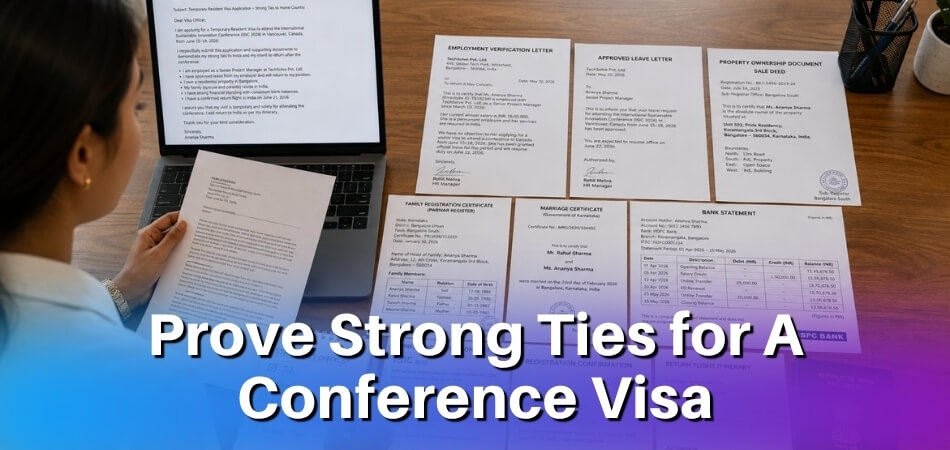
These documents prove both income and home ties. An employment letter or business registration shows you have responsibilities to return to after the conference.
Sponsor or Funding Letters
If someone else is paying, the officer needs to see who is paying, which costs they cover, and proof that they can afford it. A letter alone is weak without the sponsor’s own financial documents.
Tax and Asset Records
Tax returns, property documents, fixed deposits, investments, or pension statements fill gaps that a bank statement alone cannot explain. A retired applicant, for example, may have no salary deposits but can show pension income, savings, and property.
How Visa Officers Verify Financial Documents
Officers check whether your documents are complete, consistent with each other, realistic for your profile, and genuine. Most of this happens by reading what you submitted; if something looks wrong, they can verify it further.

Document Authenticity Review
Officers look at the bank name and logo, layout, account details, branch information, page order, and transaction format.
Cross-Checking Income With Bank Activity
If your salary slip shows a certain monthly income, your statement should show matching deposits. When declared income, deposits, and employment records do not line up, the officer may doubt all of them. If there is a valid reason (commission, cash salary, delayed pay, several income sources), explain it and attach proof.
Bank or Institution Confirmation When Needed
IRCC’s visitor visa guide states that the information you provide is subject to verification, and IRCC can confirm a document with the institution that issued it. Some visa offices go further. The Lagos and Colombo visa office checklists, for example, require a signed “Consent to Verification of Documents” form, which allows the issuing authorities (such as your bank) to release information to IRCC and CBSA to confirm that your documents are genuine. This is document verification, not access to your account.
Why a Large Balance Alone Is Not Enough
IRCC’s guidance says officers assess whether your financial resources are adequate, not just how big the closing balance is. A full transaction history shows where the money came from and that it is available to you. Submit every page and every supporting document with the application, because an officer is not required to ask you for something that is missing.
How Much Money Should You Show for a Canada Conference Trip?
IRCC does not publish a fixed minimum bank balance for visitors, including conference attendees. The right amount depends on your trip length, the city, where you stay, the conference fee, and who is paying.

Why IRCC Does Not Set a Fixed Minimum Amount
Situations differ too much. One person attends a three-day conference with a prepaid hotel and employer support; another stays a week and pays for everything. The officer checks whether your available funds match your own travel plan.
Common Conference Trip Expenses to Calculate
Estimate the full cost of the trip before you apply, so the funds you show are clearly enough.
| Expense Type | What to Consider |
| Airfare | Round-trip travel from your country to Canada |
| Accommodation | Hotel or other stay for the full visit |
| Conference Fee | Registration, workshop, or event charges |
| Meals | Daily food expenses |
| Local Transport | Airport transfer, public transit, taxi, or rideshare |
| Insurance | Travel or medical insurance, if included |
| Emergency Fund | Extra money for unexpected costs |
If you have already paid the conference fee, hotel, or flight, include the receipts. Prepaid costs reduce what you still need to show.
How to Work Out Your Own Number
Add up the table above for the exact number of days you will be in Canada. A 3 to 4 day trip needs less than a 5 to 7 day stay. If an employer or sponsor pays the main costs, your personal balance can be lower, but the sponsorship documents must be strong. If you pay for everything yourself, your own statements must cover the total.
Why You Should Keep a Currency Buffer
If your savings are in another currency, exchange rates can move while your application is processed. Show somewhat more than your estimate, and add a short note with the approximate value in Canadian dollars.
Financial Documents Required for a Conference Visa Application
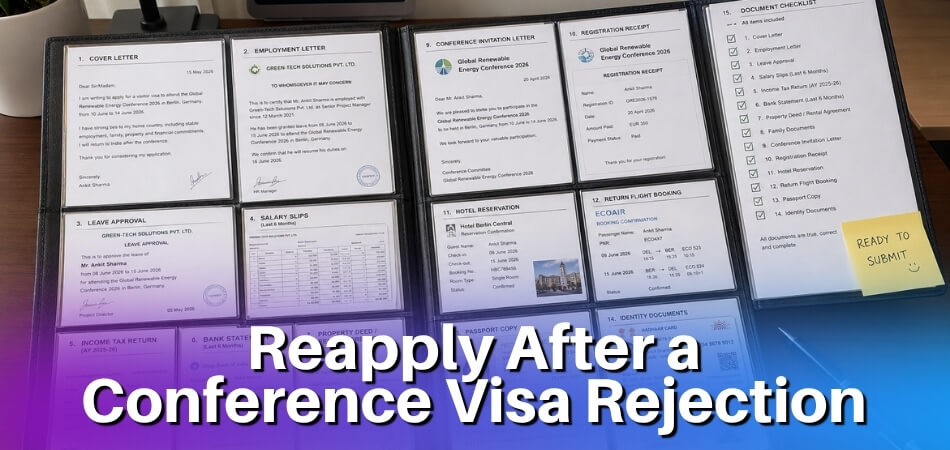
The documents depend on your job, income type, and who is paying. Start with IRCC’s Document Checklist (IMM 5484), which requires proof of financial support, then follow the additional checklist for the visa office that serves your country. Our conference visa document checklist covers the non-financial documents.
Documents for Salaried Applicants
- Recent bank statements
- Salary slips
- Employment confirmation letter
- Approved leave letter
- Income tax return or tax certificate
- Conference invitation letter or registration proof
- Travel plan and estimated budget
The employment letter should state your job title, salary, start date, approved leave dates, and expected return to work.
Documents for Self-Employed or Business Applicants
- Personal bank statements
- Business bank statements
- Business registration certificate
- Trade license or professional license
- Tax returns
- Client contracts or invoices
- Proof of business payments
- Conference invitation related to your field
Income that varies month to month is acceptable if it is documented. If the conference relates to your business, say so in your purpose-of-travel letter.
Documents for Students or Unemployed Applicants
Without regular income, sponsorship documents carry most of the weight. Students can add enrollment proof, student ID, and academic leave approval. Unemployed applicants can add personal savings, asset records, and a short explanation of their situation, alongside the sponsor’s documents.
Documents for Retired Applicants
- Pension statements
- Savings account statements
- Fixed deposit certificates
- Property documents
- Tax records, if available
- Retirement proof
- Sponsor documents, if applicable
- Conference invitation or registration proof
If the conference connects to your former profession or research interest, mention that.
Documents for Sponsored Applicants
- Sponsor letter
- Sponsor bank statements
- Sponsor income or business proof
- Sponsor ID or registration documents
- Proof of relationship or connection
- Clear list of covered expenses
- Applicant’s own bank statement, if available
- Conference invitation or event proof
What the sponsor letter must contain is covered in the employer and organizer section below.
Other Forms of Funds IRCC Lists
IRCC’s operational guidance lists bank statements and deposit books, and also cash, a certified cheque, a bank draft, or a money order large enough to cover all reasonable expenses for the stay. It says the list is not exhaustive. For most conference travelers a bank statement is still the clearest proof, so use these only as extra evidence.
Bank Statement Requirements for a Strong Application
A strong bank statement is official, complete, readable, and consistent with your income and travel budget.

How Many Months of Statements to Provide
It depends on your visa office. The Colombo office checklist asks for bank statements covering the past three months, while the Lagos and Manila checklists ask for six months. Check the checklist for your country and give at least what it asks. If your income is irregular or your balance changed recently, a longer history can help.
What Details Must Appear on the Statement
- Your full name
- Account number or partial account number
- Bank name
- Branch name or address
- Statement period
- Opening and closing balance
- Transaction history
- Bank logo or official format
- Page numbers, if available
The officer should be able to link the account to you without any doubt.
If Your Statement Is Not in English or French
Include an English or French translation with every document in another language. If the translator is not certified, add an affidavit from the translator. You or your family members cannot translate your own documents.
Common Statement Formatting Mistakes to Avoid
- Missing pages
- Blurry scans
- Cropped account details
- Screenshots instead of official PDF statements
- Statement dates that do not match the application
- Different names across documents without explanation
What If Your Employer or Conference Organizer Pays for the Trip?
You still need to prove that the funding is real and documented. Whoever pays (you, your employer, a family member, or the organizer), the officer must be able to see who covers each cost.

Sponsor Letter Requirements
A sponsor letter should be formal, specific, and on letterhead when possible. It should include:
- Sponsor name or organization name
- Applicant’s full name
- Conference name, date, and location
- Reason for sponsorship
- Relationship between sponsor and applicant
- Exact expenses covered
- Sponsor contact details
- Signature and official designation
A vague line such as “all expenses will be covered” is weaker than a letter that names each cost.
Proof of Sponsor’s Financial Capacity
The sponsor must show they can afford what they promise: recent bank statements, income or business proof, company registration, tax records, or an official funding approval. Visa office checklists commonly ask for the sponsor’s signed letter, a copy of their photo ID, proof of their funds, and a description of how they are related to you.
When a Family Member Sponsors You
A relative provides the same documents as any sponsor (see the list for sponsored applicants above). Their documents should show they can support your trip and still meet their own obligations.
When the Conference Organizer Provides Funding
Some organizers offer a travel grant, fee waiver, accommodation, or invited-speaker funding. Include the official confirmation that states exactly what is covered. Keep in mind that an invitation letter and a sponsorship letter are different documents; see the difference between an invitation letter and a letter of sponsorship.
Expense Breakdown for Flights, Hotel, Fees, and Meals
A clear split avoids confusion. For example, the sponsor may cover flights and hotel while you cover meals and local transport.
| Expense | Covered by Sponsor? | Notes |
| Airfare | Yes | Round-trip ticket |
| Hotel | Yes | During conference dates |
| Conference Fee | Yes | Registration or fee waiver |
| Meals | Partial | Event days only |
| Local Transport | No | The applicant will pay personally |
Any cost the sponsor does not cover must be covered by your own funds, so your statement still matters.
Employer Leave and Return Confirmation
For employer-paid travel, the letter should also confirm the conference’s link to your job and what the employer pays for. The application is strongest when funding, job role, leave approval, and conference purpose all match.
Can a US Visa Help Reduce Financial Document Requirements?
Sometimes. Your application may be processed faster under CAN+ if you held a Canadian visa in the last 10 years or hold a valid U.S. non-immigrant visa. Eligible applications are placed in CAN+ automatically; you need to include a copy of your U.S. visa if you have one.
What CAN+ Means for Eligible Applicants
Some visa offices relax financial documents for these applicants. The Manila visa office checklist, for example, says no proof of funds is needed if you (and everyone travelling with you) travelled to Canada in the last 10 years or hold a valid U.S. non-immigrant visa and can prove it. Other offices do not say this, so follow your own office’s checklist. The officer can still ask for more documents.
When Bank Statements May Still Be Helpful
Even with a valid U.S. visa, statements help if you pay for the trip yourself, the trip is expensive, your stay is longer than the conference, or your employment needs support. A U.S. visa helps your profile but does not replace a complete Canadian application.
Documents Usually Needed With a Valid US Visa
- Valid passport and copy of your U.S. visa
- Proof of previous Canada travel, if applicable
- Conference invitation or registration
- Employment or study proof
- Basic financial proof, if your visa office asks for it
Red Flags That Can Weaken Your Financial Proof
Officers question proof of funds when the source, stability, or authenticity of the money is unclear. The common red flags are:
- Large deposits shortly before applying, with no explanation
- A low balance, or one that often drops near zero. Your funds should cover the trip and still leave enough for normal expenses after you return home
- Salary slips that do not match bank deposits
- Borrowed money that appears suddenly
A red flag does not always lead to refusal if you explain it with proof (see the next section). Fake or altered documents are different. Under IRCC’s rules on consequences of fraud, if you submit false documents or information, your application will be refused, you could be banned from Canada for at least 5 years, and you could have a permanent record of fraud with IRCC.
How to Explain Unusual Financial Situations
Explain anything unusual before the officer has to guess. A short letter of explanation with supporting proof is usually enough.

Sudden Deposits
State the source and attach the proof: a bonus letter, business invoice, property or vehicle sale agreement, gift letter, refund, fixed deposit maturity, or transfer from your own account. The deposit is rarely the problem; an unknown source is.
Borrowed Funds or Temporary Support
Say whether the money is a gift, a loan, or sponsorship, and include proof from the person or organization that provided it.
New Bank Accounts
Include older statements from your previous account if you have them, plus transfer records, and explain why you opened the new one (new job, salary account, business need).
Joint Bank Accounts
Show that you can use the funds: a consent letter from the other holder, their ID copy, and proof of relationship. The letter should say you may use the money for your Canada conference trip.
Multiple Accounts or Fixed Deposits
List your accounts in a short summary, and note which one pays for the trip and which is backup. For fixed deposits, explain whether the money can be withdrawn if needed.
Freelance or Irregular Income
Irregular income is fine if documented. Use contracts, invoices, payment receipts, tax returns, and statements showing client payments.
Sample Financial Scenarios for Conference Visa Applicants
These examples show how different applicants can present a consistent financial story.

| Applicant | Main documents | What makes it credible |
| Self-funded, stable savings, 4-day conference | Bank statements for the period your office asks, salary slips, employment letter, registration, hotel booking, budget | Deposits match salary slips and the balance covers the full trip |
| Employer-sponsored employee | Employer letter (role, purpose, leave, costs paid), registration, own statement | The conference clearly relates to the job and the company covers the main costs |
| Applicant with a large recent deposit | Statement plus proof of source (car sale, bonus, business payment) | The money has a documented origin, not arranged only for the visa |
| Student or junior employee with a sponsor | Sponsor letter, sponsor statements and income proof, ID, proof of relationship | Sponsor can clearly afford the trip and the conference purpose is clear |
Frequently Asked Questions
Proof of funds for a conference trip to Canada gets complicated with two relatives sponsoring, fixed deposits, foreign currency accounts, long gaps in bank activity, translations and retired applicants.
Can IRCC contact my bank to verify my statement?
IRCC can verify the documents you submit, and some visa offices require a signed consent form that lets your bank release information to confirm them. This checks that the statement is genuine; it does not give IRCC access to your account.
What happens if I submit a fake bank statement?
Your application will be refused, and you could be banned from Canada for at least 5 years and have a permanent fraud record with IRCC.
Can IRCC refuse my visa if my funds look inconsistent?
Yes. Refusal can happen when your balance changes suddenly, your income does not match your deposits, or the source of funds is not explained. A large balance with no history does not fix this.
Can I use fixed deposits as proof of funds?
Yes, if the money is accessible or can be withdrawn when needed. IRCC’s list of proof of funds is not exhaustive, so include the certificate showing the bank, amount, and maturity date, plus the account history.
Can two relatives sponsor my Canada conference trip?
Possibly. IRCC accepts support from family if it can be confirmed, so each relative should provide a support letter, bank statement, income proof, ID copy, and proof of relationship, with the letters stating who pays for what. The officer decides.
Are credit card limits accepted as financial proof?
They can show extra capacity, but they should not replace savings, income, or sponsor support. Use them only as secondary evidence.
Can I show money in a foreign currency account?
Yes. Submit the official statement in its original currency and add a short note with the approximate value in Canadian dollars.
Does a long gap in bank activity affect approval?
It can raise questions if the account suddenly becomes active before you apply. Explain the reason and attach supporting documents.
Should I include prepaid hotel or flight bookings?
Yes, if they match your travel plan. You still need funds for daily costs, local transport, and emergencies.
Do I need to translate my bank statement?
Yes, if it is not in English or French. Attach a translation, and an affidavit from the translator if they are not certified. You and your family cannot translate it yourself.
Can retired applicants qualify for a conference visa?
Yes, with enough funds and a clear reason to attend. Pension records, savings, fixed deposits, property papers, and family ties help.
Do family responsibilities help prove home ties?
Yes. Caring for children or parents, or managing a household, can help show that your visit is temporary.
Can I combine personal savings with sponsor support?
Yes. Submit both sets of documents and make clear who pays for which expenses.
Conclusion: What Applicants Should Remember Before Applying
IRCC judges your finances from the documents you send, and it can verify them. Your bank statements, income proof, employment records, sponsor letters, and budget should tell one consistent story: who pays, where the money came from, and why it is enough for this trip. Explain anything unusual, and never submit altered documents.
MS International Conferences Inc. runs in-person conferences in cities across the Greater Toronto Area and has listed 864+ events on its conferences in Canada page. Registered participants can request a conference invitation letter, a notarized invitation letter, or a visa expedite request letter to include with their visa application. Strong documents do not guarantee approval, but they make your application easier for an officer to assess.
Disclaimer: This article is general information, not legal or immigration advice. Visa rules, fees, and processing times change. Confirm the current requirements on the official Government of Canada (IRCC) website before you apply.