
People often mix up an invitation letter, a registration confirmation and an acceptance letter, and the mix-up usually shows up at a bad moment: a visa officer, an employer or a university office asks for one document and you send another. All three come from official sources, use formal language and tend to land in the same inbox within days of each other, so the confusion is easy to understand. They are three different documents with three different jobs.
Quick answer: An invitation letter invites you to a conference and supports a visa or travel request. A registration confirmation only proves you registered and paid. An acceptance letter confirms your abstract or paper passed peer review. They are not interchangeable: a visa file usually carries the invitation letter, employers often want the confirmation, and academic offices want the acceptance.
Fact-checked by the MS International Editorial Team. Last verified against official sources: October 2026.
Key Differences Between All Three: At a Glance
The simplest way to separate them is to ask what each one proves. The invitation letter proves a host wants you at the event. The registration confirmation proves you paid and hold a place. The acceptance letter proves your work was judged good enough to present.
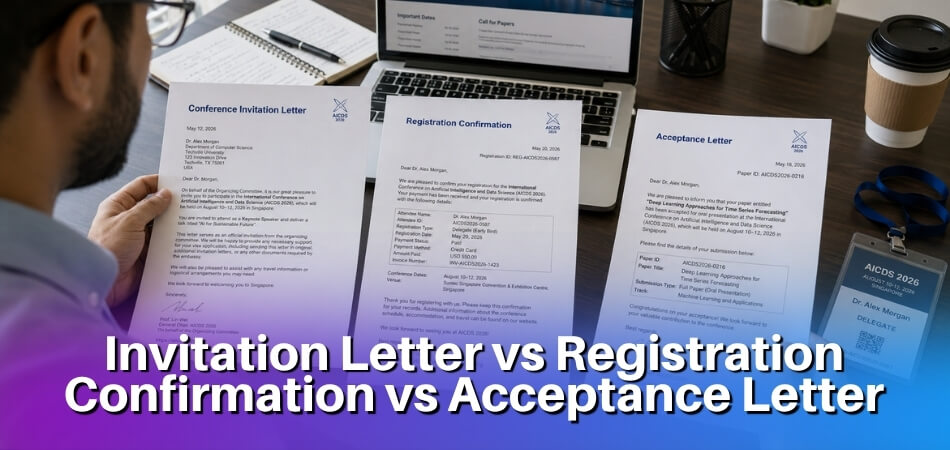
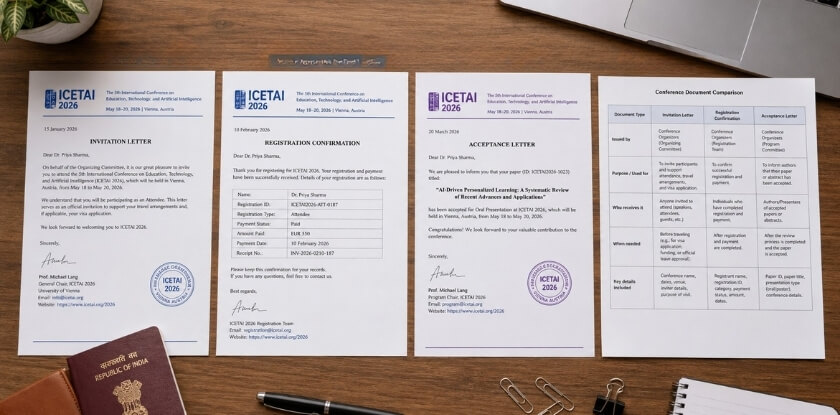
| Feature | Invitation Letter | Registration Confirmation | Acceptance Letter |
| Issued by | Conference organizer or host institution | Registration system or organizer’s admin team | Program committee or admissions body |
| What triggers it | Organizer invites you, or you request it after registering | You complete payment or the registration form | Your abstract or paper passes peer review |
| What it confirms | You are invited to attend or present | Your registration is recorded and fees are paid | Your paper, abstract or application was approved |
| Main use | Visa application, employer approval, funding requests | Proof of booking for travel or expense reimbursement | Academic CV, research office, grant or admission files |
| Format | Formal signed letter on letterhead with event details | Automated email or PDF receipt with a reference number | Formal letter or email naming the accepted paper |
| Linked to peer review | No | No | Yes |
| Helps with a visa | Yes, often the main supporting document where a letter is asked for | Supporting only | Supporting, strong for presenters |
| Replaces the others | No | No | No |
Some conferences bundle the invitation and the acceptance into one letter, which happens more at smaller academic events. When they are separate, treat them as separate: the visa file needs the invitation letter, addressed to you, while your institution’s research office usually wants the acceptance as proof that the work went through a credible review.
Definitions and Purpose of All Three Documents
Each document comes from a different party and carries different weight, so it helps to see what each one contains and what it leaves out.
What Is an Invitation Letter
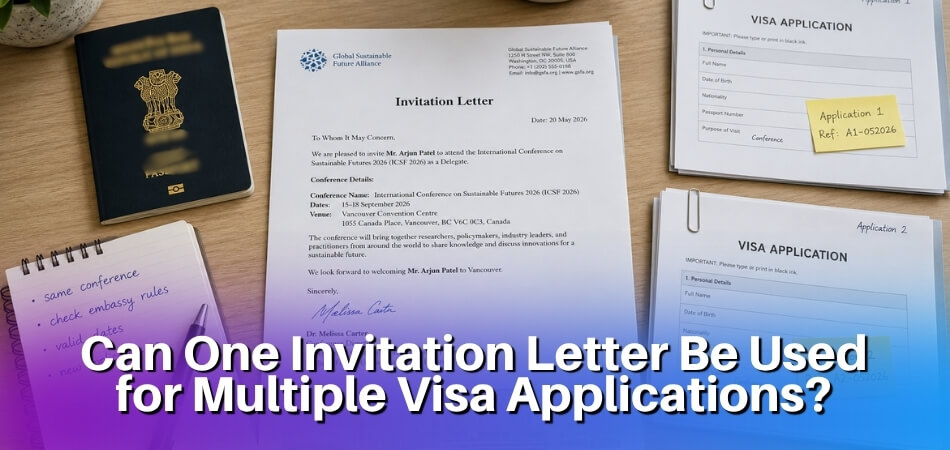
An invitation letter is issued by a hosting organization, usually the conference organizer or a university department, to formally invite a named person to attend or take part in an event. For a visa application it is often the most important supporting document, because it shows the embassy there is a real reason for the trip.
It normally appears on official letterhead and includes the event name, dates, location and the invitee’s full name. It does not confirm that you registered or paid. It also says nothing about whether your paper passed review, and it can be issued to someone who has not submitted any work. It signals intent and official recognition, nothing more administrative than that. Some organizers also state the payment status in it, so check that the wording matches what you actually paid.
What Is a Registration Confirmation
A registration confirmation is what you receive after the formal sign-up. It confirms that your participation is logged, required fees are processed and you are on the attendee list.
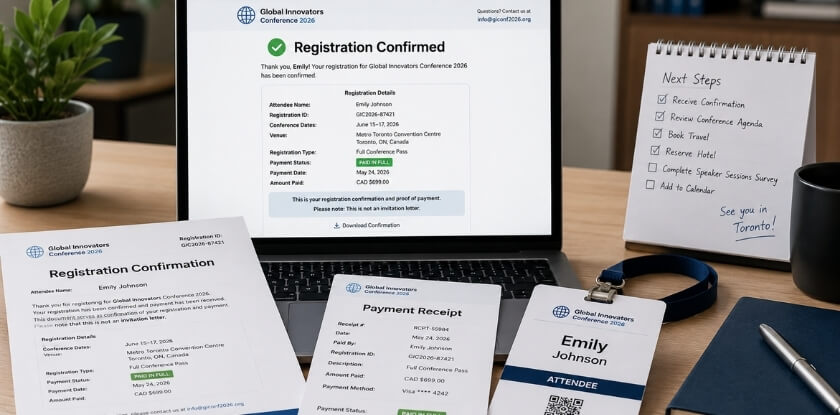
It usually comes from the conference management platform and carries a registration number, the event name and dates, and sometimes a list of what is included, such as sessions, workshops or meals. It is the operational record of your booking.
Timing differs between organizers. Some will issue an invitation letter before you register, and the confirmation then comes later. Others, including MS International, issue the letter only once payment has cleared. Some visa applications ask for both: the letter to show you were invited and the confirmation to show you acted on it.
What Is an Acceptance Letter
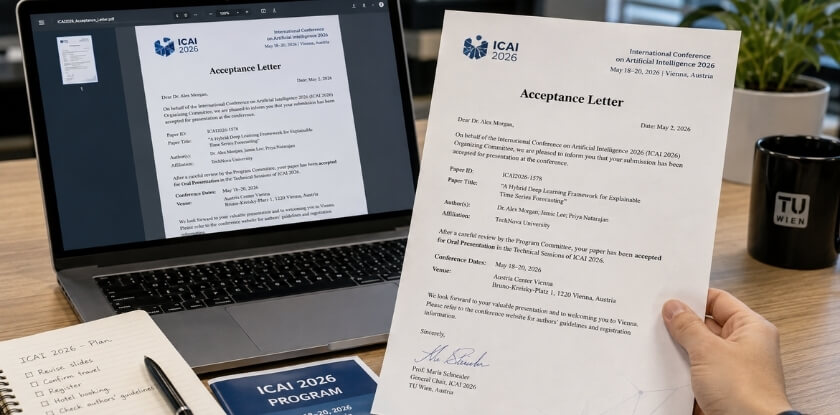
An acceptance letter is issued at the end of a formal review. In the conference setting it is the outcome of peer review after an abstract submission: the program committee evaluated your abstract and decided it meets the standard for presentation. In a university setting it means an admissions office offered you a place.
It carries different weight from the other two because it follows scrutiny, not just an administrative step. A confirmation is triggered by payment, an acceptance by merit.
Practical Use of All Three Documents at a Conference
You may collect all three between submitting an abstract and walking into the conference hall. Which one to hand over depends on who is asking.
Typical Order of Documents
| Stage | Document you usually receive |
| After abstract review | Acceptance Letter |
| After payment clears | Registration Confirmation |
| After payment, or on request (organizer dependent) | Invitation Letter |
| Before the visa appointment or travel approval | All three, checked against the requesting office’s list |
Which Document Is Required for a Visa Application
Where a destination asks for a letter, it should be on the conference’s letterhead, name you, state the dates and venue, and say you were invited to attend or present. For Canada, IRCC says a letter of invitation is something an officer may ask for, that it can help, and that it does not guarantee a visa. If the event is registered with IRCC, the organizer gives an event code to enter on the visa application. Some IRCC visa-office checklists also ask conference visitors for a letter from the organizer confirming registration, plus a letter from the employer. The New Delhi checklist is one example.
The United States works differently. The State Department says a letter of invitation is not needed to apply for a visitor visa, and that if you bring one, it is not one of the factors used to decide the visa. Officers look at your ties to your home country instead.
A registration confirmation alone is a booking record, so it may not be what the office asked for. An acceptance letter is useful supporting evidence if you are presenting, because it ties your trip to a professional purpose. Always check the embassy’s own list, because requirements vary by country, visa office and visa category.
Which Document Works for University or Employer Approval
The right document depends on what the approver is asking for. Universities and academic departments mostly want the acceptance letter, because it shows the trip has a scholarly output and justifies funding or academic leave.
Employers approving travel budgets often want the registration confirmation, since it shows a confirmed booking with a date, a cost and an event that HR or finance can process. The invitation letter helps most when you were invited to speak, chair a session or join the program committee. If your institution asks for several documents, send all three: the acceptance justifies the purpose, the invitation confirms your role and the confirmation documents the booking.
Does an Acceptance Letter Count as Proof of Enrollment or Conference Participation
Not by itself in either case, and the answer depends on the setting.
For University Admissions
A university acceptance letter says you were offered a place. Proof of enrollment is a separate document issued by the registrar after you accept the offer, pay any deposit and register for courses. Many universities also provide an enrollment certificate through the student portal. A student visa may ask for this later document, because immigration authorities want evidence that enrollment is confirmed and active.
If you only hold an acceptance letter, check what the consulate handling your case requires. Some accept a conditional offer with financial documents, others want the full enrollment record. An acceptance letter from a conference can add weight to a research profile, but it is not the university’s own admission letter.
For Conference Participation
A conference acceptance letter is meaningful, but it is not proof that you registered or attended. For visa purposes it carries real weight when it is on letterhead with the dates, venue and your name, and some consulates ask for it next to your registration receipt.
What Document to Use and When
| Situation | Document Needed |
| Visa application for a student visa | Proof of Enrollment (issued after registration) |
| Visa application for an academic conference | Invitation letter, plus registration confirmation, plus acceptance letter if presenting |
| Employer approval for conference travel | Registration confirmation, often with the acceptance letter |
| University funding or academic leave | Acceptance Letter |
| Proving active student status | Proof of Enrollment |
| Confirming conference registration is paid | Registration Confirmation |
If an organizer or institution issues only one document, ask whether it covers more than one function. A combined letter stating both acceptance and registration exists, but it is the exception.
Registration Confirmation vs Acceptance Letter: Are They the Same
No. These two cause the most mix-ups because their names sound interchangeable, but they sit on two separate tracks. A registration confirmation comes from a payment process. An acceptance letter comes from a selection process. If someone calls a confirmation an acceptance letter, that is an error.
What Each Document Actually Confirms
A confirmation says your seat is booked and your name is on the attendee list. It says nothing about your research. An acceptance letter is an editorial decision by the program committee, not an administrative one.
You can receive an acceptance before you register, and you can register and attend as a non-presenting delegate without ever receiving one. Many conferences also require a separate registration step with payment after acceptance, and a paper can be removed from the program if you skip it.
When They Are Used Together
A presenting author will usually hold both. A non-presenting attendee will usually hold only the confirmation, which is perfectly normal for general participation. For a visa, the acceptance shows you have a defined role, while the confirmation works as supporting documentation. Some consulates want both, some accept one, depending on whether you present or only attend.
Common Misconceptions About These Three Documents
Most misconceptions come from assuming the documents are interchangeable.
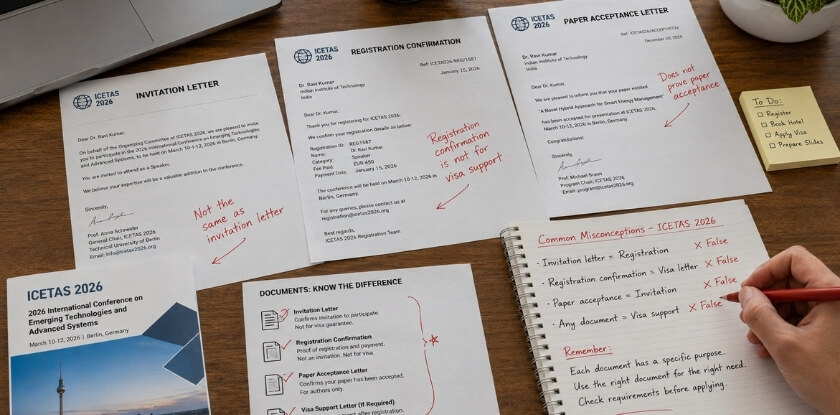
“My Registration Confirmation proves I was invited”
It shows you paid and signed up. It does not show the organizer extended a formal invitation. Many visa applications need a document on the conference letterhead that explicitly invites you, so ask for a formal invitation letter instead of assuming the registration email doubles as one.
“These documents all work the same way for visa applications”
They do not. Requirements differ by country and visa office, and some countries do not ask for any of them. Check the official embassy or immigration site for your destination and send the document it names.
“A university Acceptance Letter works as Proof of Enrollment”
Employers, scholarship committees and government agencies that ask for proof of enrollment will not accept an offer letter instead. If you need proof of enrollment for tuition reimbursement or a student visa extension, contact the registrar, not the admissions office that sent the offer.
“The conference will send an Invitation Letter automatically”
Many conferences do not send one unless you ask. The default flow gives you an abstract confirmation, a peer review outcome and a registration confirmation after payment. A letter for visa or employer purposes is often a separate request, so make it early. At MS International the process starts on its own once payment clears.
Sample Formats: Examples of All Three Documents
Seeing the structure makes the differences concrete. These are generic templates: replace the bracketed fields with real details.
Invitation Letter Sample
An invitation letter comes on official letterhead and is signed by someone with authority, such as the program committee chair or a conference director. It is addressed to you personally and names the event.
Sample:
[Conference Name]: Official Invitation Letter
[Conference Letterhead: Organization Name, Address, Website]
Date: [DD Month YYYY]
To Whom It May Concern / To the Visa Officer:
We are pleased to invite [Full Name of Attendee], [Designation], [Institution/Organization], to participate in the [Full Conference Name], to be held from [Start Date] to [End Date] at [Venue Name], [City, Country].
[Full Name] has been selected to [present a paper / attend as a delegate / chair a session] at this conference. The conference is an international academic gathering focused on [brief subject area], organized by [Organizing Institution/Body].
This letter is issued to support [his/her/their] visa application to the [Country] authorities. The conference registration fee has been [paid / waived], and [his/her/their] participation is confirmed.
For any verification, please contact us at [official email address].
Sincerely,
[Name of Signatory]
[Title, e.g., Chair, Program Committee]
[Organization Name]
[Official Contact Information]
Registration Confirmation Sample
A registration confirmation is typically system-generated and sent once payment clears or a free registration is processed. It is transactional, not personalized.
Sample:
Subject: Registration Confirmed: [Conference Name] [Year]
Dear [Full Name],
Thank you for registering for [Full Conference Name].
Your registration has been successfully processed. Please keep this email for your records.
Registration Details:
- Registration ID: [CONF-XXXX-XXXX]
- Attendee Name: [Full Name]
- Registration Category: [Early Bird / Standard / Student]
- Conference Dates: [Start Date] – [End Date]
- Venue: [Conference Venue], [City, Country]
- Payment Status: Confirmed / Paid
- Amount Paid: [Amount + Currency]
Access to conference materials, the program schedule, and session links (if applicable) will be sent to this email address closer to the event date.
If you have questions, contact the organizing team at [support email].
[Conference Name] Organizing Committee [Website]
Acceptance Letter Sample
An acceptance letter follows peer review and confirms your abstract or paper was evaluated and approved. It comes from the program committee and includes details about your presentation.
Sample:
Subject: Abstract Acceptance: [Conference Name] [Year]
Dear [Author’s Full Name],
We are pleased to inform you that your abstract submission to [Full Conference Name] has been accepted for [oral presentation / poster presentation / workshop session].
Submission Details:
- Submission ID: [ABST-XXXX]
- Title: “[Full Title of Your Paper/Abstract]”
- Presentation Type: Oral Presentation / Poster
- Session: [Session Name or Track]
- Scheduled Date/Time: [Date, Time, if confirmed]
Your abstract was evaluated by members of the Program Committee through a blind review process. The reviewers’ comments, where applicable, are attached to this email.
To confirm your participation, please complete your conference registration by [Registration Deadline] at [registration link]. Please note that acceptance of your abstract does not automatically complete your registration.
We look forward to your contribution to the conference.
Regards,
[Name]
[Title, e.g., Program Chair / Abstract Review Coordinator]
[Conference Name] Program Committee
[Email] | [Website]
How MS International Handles These Documents
At MS International Conferences Inc., registered authors, presenters and listeners who have completed full payment can receive an invitation letter. It starts automatically once payment clears and is issued within 3 to 5 business days, as a PDF sent to your registered email. You provide your full legal name exactly as on your passport, passport details and contact information.
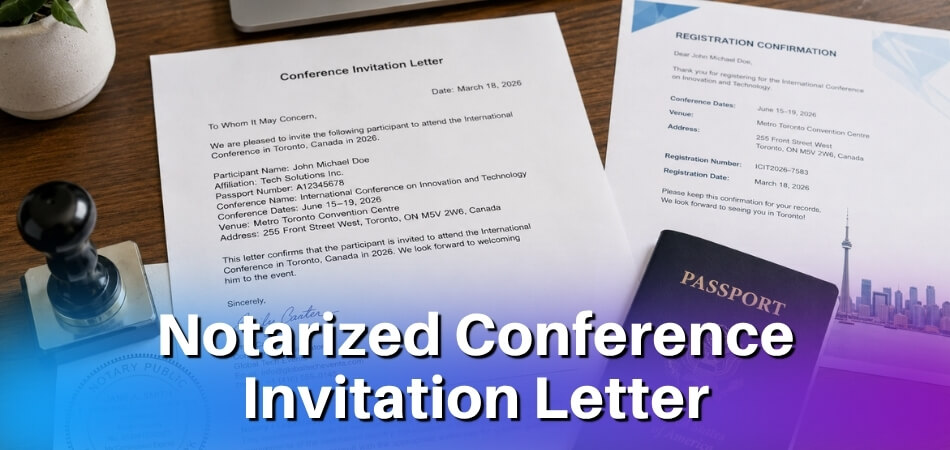
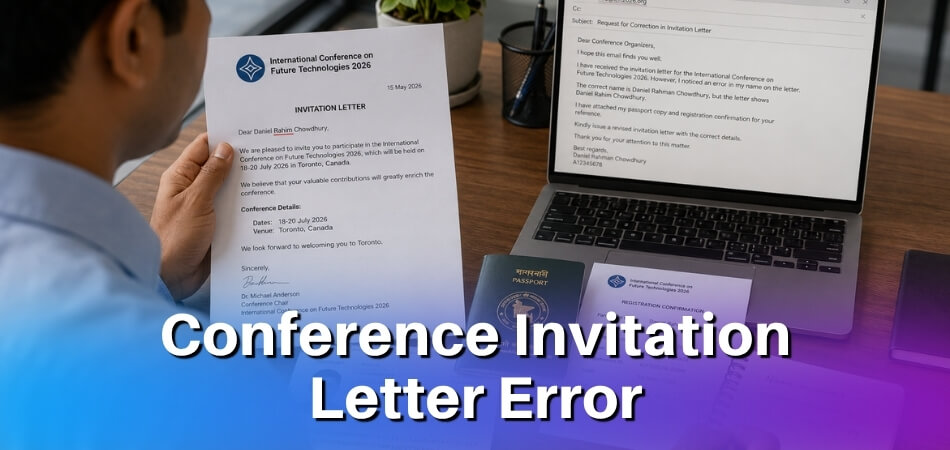
If something needs changing after the letter is issued, a US$50 administrative fee may apply to modifications or corrections. A notarized version is available on request for US$100, typically takes up to 10 business days and is non-refundable. The letter supports your application but does not guarantee a visa or entry into Canada. Registration fees are non-refundable once paid, and the refund policy lists visa refusal or delay among the reasons a refund is not provided, so check your visa timeline before you register.
From our experience at MS International: the letter is prepared from the name and passport details you submit, which must match your passport exactly. Our team may contact you if details are missing or names do not match, so check the spelling against your passport before you submit.
FAQ
Juggling three conference documents on a tight visa timeline? Here the focus is which one a visa officer needs, what an employer wants to see, and the case where only a registration confirmation arrives.
Is an invitation letter enough to apply for a conference visa?
No. Visa offices decide on the whole file, and the letter is one piece of it. Embassies often also look at registration proof, funds and ties to your home country, and the United States does not require a letter at all for a visitor visa. Check the embassy’s own list.
Who issues the invitation letter for an academic conference?
The conference organizer or a program committee member, on official letterhead. A host university may issue it on the conference’s behalf. It should name you and reference the event details.
Can I use my acceptance letter as proof of conference participation?
Only partly. It proves your abstract passed peer review, not that you registered or paid. For a visa, add the invitation letter and the registration confirmation if the embassy asks for them.
What if the conference only sends a registration confirmation and no invitation letter?
Ask the organizer whether a formal letter is available, and first check whether your destination asks for one. Some organizers issue letters only on request. At MS International it is prepared automatically after payment clears and sent within 3 to 5 business days.
Does my employer need to see all three documents?
Not always. Employers often ask for the registration confirmation because it shows the booking and cost. Some also want the acceptance letter to show the purpose. Ask your HR or finance team which one they require.
Is a Proof of Enrollment the same as an acceptance letter for university admission?
No. An acceptance letter is issued before enrollment and offers you a place. Proof of enrollment comes after you register as a student. For a student visa, some embassies want one, some the other, some both.
Can I attend a conference without going through abstract submission and peer review?
Yes. Many conferences allow general attendees to register without submitting research. You get a registration confirmation but no acceptance letter, because nothing was submitted for review. An invitation letter can still be issued to a registered attendee.
What is the fastest way to get these documents on a short visa timeline?
Register early and ask the organizer for the letter as a PDF on letterhead. Many letters follow payment, so a late payment means a late letter. Registration confirmations normally arrive automatically; if yours did not, check spam, then ask for a resend.
Conclusion
A visa officer expecting an invitation letter on official letterhead may not accept a registration email in its place, and a research office asking for an acceptance letter does not want a payment receipt. Before you send anything, confirm which document is requested and who must issue it. When in doubt, ask the requesting authority to name the exact document.
Disclaimer: This article is general information about conference documents and is not legal or immigration advice. Visa rules change and differ by country, so always confirm requirements with the official embassy, consulate or immigration authority.