
A student invited to a conference often finds that a university office, a supervisor or a funder wants proof in writing. The letter sounds simple until you have to work out who issues it and what it must say.
Quick answer: A conference invitation letter for students is an official letter from the conference organizer, or from the student’s university, confirming that the student is invited to attend, present or take part in a conference. To be accepted, it needs the student’s full name, the conference name and dates, the venue or online platform, the student’s role, and an authorized signature on letterhead. It supports a visa, leave or funding request but does not guarantee approval.
Fact-checked by the MS International Editorial Team. Last verified against official sources: October 2026.
This guide is built around the student’s situation: what the letter must say about enrollment and funding, how a student visa differs from a visitor visa for a conference trip, four ready samples, and what to do when a letter is rejected.
What Is a Conference Invitation Letter for Students?
It is a formal document that invites a student to a conference as an attendee, student presenter or speaker, and it proves the student has a real academic reason to be at the event.
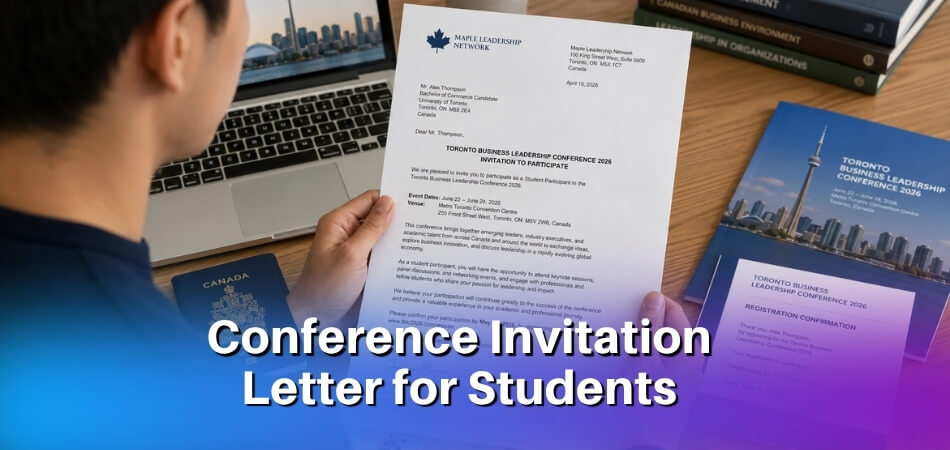
Students usually need it for three things: approved leave from their institution, funding, and a visa application when the conference is abroad. For international conferences the letter often doubles as a visa support letter, so it has to be more detailed than a plain attendance confirmation. A plain confirmation may not be enough where an embassy asks for a letter.
The main types students encounter
| Type | Who issues it | What it is for |
| Standard conference invitation letter | Conference organizer | Confirms participation; usually enough for internal approvals or travel grants |
| Student visa invitation letter | Conference organizer, signed by an authorized representative | Supports a visa application; embassies want official letterhead, the event schedule and the student’s role |
| University invitation letter | The student’s own institution | Confirms current enrollment and good academic standing, which some international conferences require |
| Virtual conference invitation letter | Conference organizer | Same structure for online events; some institutions ask for it for reimbursement or academic credit |
What the letter typically covers
Most letters carry the same core details whatever the format: the student’s name, the conference name and dates, the student’s role (attendee, presenter or delegate) and the hosting organization’s contact information on letterhead. Students who attend without presenting can often get one too: letters for listeners and general attendees confirm registration for the event, not an invitation to speak. A visa version adds accommodation arrangements, registration status and sometimes the funding source.
Who issues it and who needs it
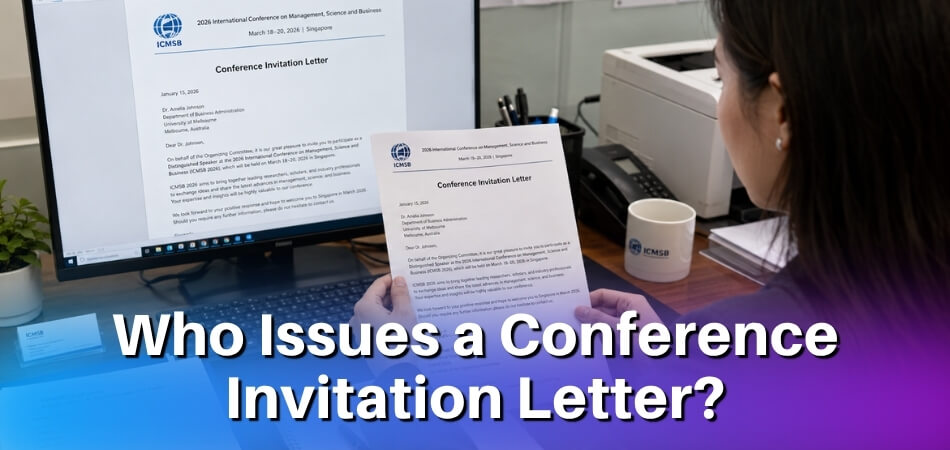
The conference organizer issues the primary invitation. If the student needs more for a visa or travel approval, the university’s international office or department head usually issues a supporting student participation letter.
The students who need it most are those attending conferences abroad, applying for travel grants, or seeking academic credit. For a local conference with no funding request, a registration confirmation email is often enough.
What Should a Student Conference Invitation Letter Include?
A student letter must name the student, the institution, the conference, the student’s role and who pays for what, and it must be signed by someone with a stated title.
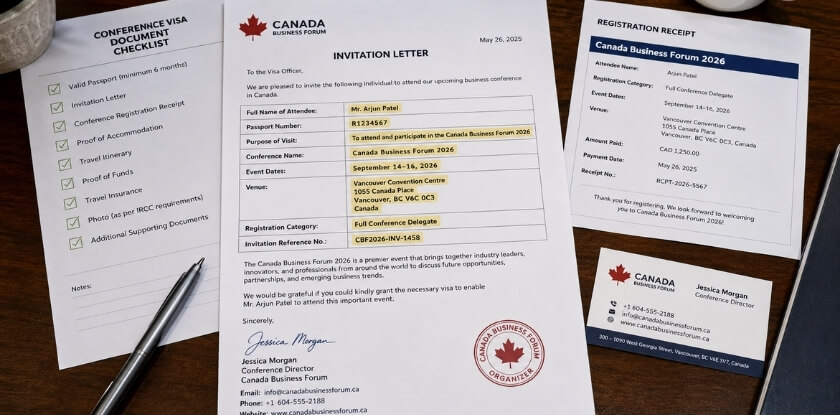
| Element | What to state |
| Sender | Organizer or hosting institution on official letterhead, with full name, address, official email and a direct phone number |
| Student | Full legal name exactly as on the passport or enrollment documents, plus home institution and current enrollment status |
| Conference | Official name, exact dates (including setup or networking days the student must attend), venue and address, or the online platform and time zones |
| Role | Student presenter, student delegate or attendee, and why the student is invited (paper, workshop, panel) |
| Money | Whether the registration fee is waived, whether there is a stipend or travel grant, and who covers accommodation and travel |
| Signature | Name, title and signature of the organizer, department head or academic coordinator |
Why letterhead and the signatory matter
A visa office has to be able to tell who issued the letter and how to reach them, so letterhead, contact details and the signatory’s title matter. A letter with only a generic email address and no institutional identity is easy to question. Vague wording such as “the bearer of this letter” will not hold up, and an unsigned letter or one signed by an unidentified “admin team” carries little weight.
A conference invitation letter that does not state the student’s role is incomplete. If the student needs the letter urgently, a direct contact line and an offer to answer the embassy’s questions can speed things up.
Money and logistics
Visa officers and university administrators often ask who pays, so say it in the letter. If the institution covers accommodation or travel, state that. If the student pays, one line confirming the student has been told the arrangements is still useful.
Student Invitation Letter vs. Professional Invitation Letter: Key Differences
A student letter has to explain more than a professional one, because nobody assumes the student has institutional backing, a travel budget or established standing.
| Point | Student letter | Professional letter |
| Focus | Who the student is, which institution, what role | Credentials, affiliation, contribution to the event |
| Tone | Formal and explanatory; confirms enrollment, names the supervising institution, states the student was selected | Collegial, assumes peer standing (“we would be honored to have your expertise”) |
| Institutional backing | Almost always references the university, in a separate letter or inside the organizer’s letter | Rarely mentions the employer as a requirement |
| Purpose | States clearly whether presenting, attending sessions or joining a workshop; “participation in the conference” is often not enough | Usually less specific |
| Money statements | Frequently says who covers fees, accommodation and travel | Rarely included unless the organizer pays everything |
| Schedule | Often needs exact dates and a program reference for embassy checks | Usually omitted |
| Letterhead | Proper institution or organizer letterhead; without it the letter is often flagged by visa offices or the university finance office | Plain company stationery often passes |
If you are the one receiving the letter
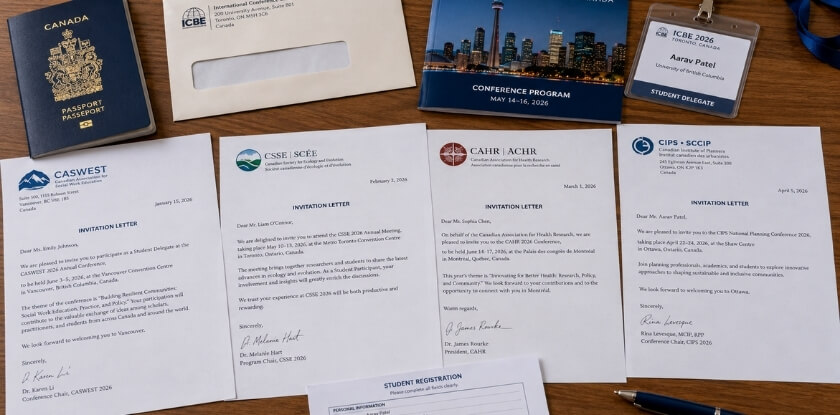
For international events the letter often has to double as visa support, so consulates scrutinize it in ways they would not scrutinize a corporate letter. The organizer should print it on official letterhead, include contact details and sign it with a full name and title. If the version you receive lacks these elements, ask for a reissue before you submit anything to an embassy, a university finance office or a grants committee.
Virtual events
For an online conference the travel and visa language drops away. The letter confirms the platform, access arrangements and the student’s role, and it is shorter. Students still benefit from a formal letter on letterhead, because grant applications and university reporting often ask for proof of participation even when no travel was involved.
Student Visa or Visitor Visa for a Conference?
A student who travels abroad for a conference is normally a short-term visitor there, not a student, so the conference trip is judged as a visit and not as a study application.
The student visa or study permit belongs to the country where the student studies. It does not cover a trip to a conference elsewhere. Canada’s immigration department states that a study permit lets you study in Canada but is not a travel document, so a student still needs a visitor visa or an eTA to enter.
| Situation | What the invitation letter supports |
| Student studying at home, conference abroad | A visitor or business visitor visa application for the conference country |
| Student already studying abroad, conference in a third country | A visitor application for that country, with proof of enrollment alongside the invitation |
| Student on a study permit returning to the study country after the conference | Re-entry rules of the study country apply; the letter does not replace them |
Depending on your nationality, a short visit to Canada may need a visitor visa or only an electronic travel authorization (eTA), so check which one applies to your passport before you book flights or pay for registration. The same principle holds for the United States, where the State Department lists attending a professional or educational conference as an activity a visitor visa covers. Interview waits differ by embassy, so book your appointment well ahead of the event. In every case the letter is supporting evidence only. Canada’s immigration department says a letter of invitation does not guarantee a visa, and the visa officer decides.
Event code and copies for Canada
IRCC’s guidance for event organizers says that if the event is registered with IRCC, the organizer puts the event code in the letter of invitation, and participants should include the code in their visa application. Ask your organizer whether your conference has one. For business guests, IRCC tells organizers to give each guest 2 copies of the letter, so keep a spare copy with your papers.
Current rules a letter cannot change
Some rules apply whatever the letter says. Check where your passport and your last country of residence stand before you pay for registration.
| Rule | Who it affects | What it means |
| US B-1/B-2 visa bond | Visitor visa applicants from designated countries | The program became permanent on 3 August 2026; an officer can ask for a bond of $10,000, $15,000 or $20,000 |
| US Proclamation 10998 | Nationals of 19 countries, including Nigeria | Partly suspends visa issuance, including B-1/B-2 visitor visas, from 1 January 2026 |
| US interview waivers | Visitor visa applicants | Narrowed from 1 October 2025, so plan for an in-person interview |
| Canada Ebola measures | People whose last country of residence is the Democratic Republic of the Congo, South Sudan or Uganda | Applications are processed but not finalized, and existing visas and eTAs cannot be used to travel, until 27 November 2026 unless extended |
An invitation letter does not change any of these, so confirm the current position with the embassy or IRCC before you book.
Supervisor, University and Funding Letters
Students often need a second letter from their own side, because the organizer’s invitation does not prove enrollment or who is paying.
Ask your academic supervisor, department head or international office for a short, factual letter confirming your student status, your academic purpose for attending and your intention to return after the conference. Departments often want the organizer’s letter before they approve travel expenses, so the two letters work as a pair. This matters most for international students, whose visa application letter is tied to a specific academic event.
Keep digital and printed copies of every letter, because requirements for originals and PDFs differ by office, so check the checklist. Use the same name spelling on all of them.
What to send when you ask for the letters
Give the organizer your full legal name as on the passport, your university and department, your enrollment level, your role at the conference, your registration confirmation and the date you need the letter by. Give your supervisor the conference name and dates, your abstract or paper title, and a note on how the trip is funded. Both can then write without back-and-forth. Most organizers issue the letter only after registration and payment are complete, so register first. Some ask students to name a faculty advisor and copy them on the request, so follow the organizer’s instructions.
Sample supervisor support letter
This short letter comes from your side and complements the organizer’s invitation. Keep it factual.
[Department Letterhead]
Date: [Insert Date]
To Whom It May Concern,
I confirm that [Student Full Name] is currently enrolled in the [program name] at [University Name] and is in good academic standing. I supervise [his/her/their] work in [field].
[Student Name] has been accepted to [attend/present at] the [Full Conference Name] in [City, Country] from [Start Date] to [End Date]. Attendance supports [his/her/their] research on [topic], and the department approves the trip. [Funding statement, e.g., “The cost is covered by a departmental travel grant” or “The student is funding the trip personally.”]
[Student Name] is expected to return to complete the program, with classes resuming on [Date]. Please contact me at the details below if you need to verify this letter.
Sincerely,
[Supervisor Name]
[Title, Department]
[Email Address] [Phone Number]
Why Conferences Matter for Students
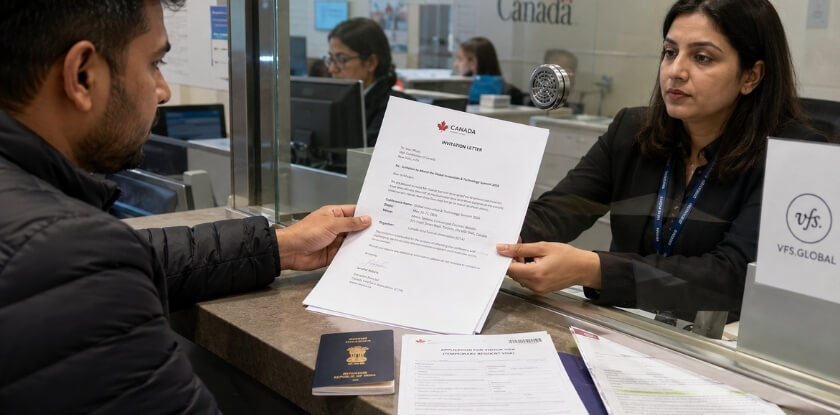
Attending or presenting at a conference can do more for a student’s academic path than a lot of coursework, and the invitation letter is often what turns interest into actual participation.
Real exposure to active research
Most programs teach what is already known. Conferences show you what is being figured out right now, with researchers talking through problems they have not solved yet. For student presenters, putting a paper or project in front of people outside your institution forces you to defend your methodology and answer questions you did not expect. That pressure is genuinely useful.
Building a network before you need one
Students often wait until they are job hunting or applying for doctoral programs to think about professional relationships. A student delegate who introduces themselves to three or four faculty members over a two-day conference has done more than many students manage in a semester. These contacts become the start of a professional record other people can speak to.
Without the letter, some students cannot go
Without the right documentation, students who qualify for registration can find themselves unable to attend, because departments want the letter before approving travel expenses and embassies want it before a visa. Online conferences have widened access for students who cannot fund travel, and a virtual conference invitation letter or a speaker invitation letter for an online session is taken seriously by most departments, particularly from an established organizer on letterhead. A well-regarded online conference still adds to a CV. Judge an event by its academic standing and the quality of your participation, not by its format.
Sample Conference Invitation Letters for Students
The four samples below cover a university letter, an organizer’s visa letter, a presenter invitation and an online event. Adapt the bracketed fields to your conference details.
Sample 1: University or Institution Inviting a Student (General Participation)
This is the standard university invitation letter. It is issued on institution letterhead and confirms the student has been selected or accepted to take part.
[University Letterhead: include university name, address, logo, and contact details]
Date: [Insert Date]
To Whom It May Concern,
This letter is to confirm that [Student Full Name], currently enrolled as a [undergraduate/postgraduate/doctoral] student at [University Name], Department of [Department Name], has been formally invited to attend the [Full Conference Name] to be held on [Date(s)] at [Venue Name, City, Country].
The conference brings together students and scholars from across [region/the world] to exchange research, attend academic sessions, and engage with leading voices in [field of study]. [Student Name]’s participation has been approved by the organizing committee following a review of their academic background and submitted application.
The university fully supports [Student Name]’s attendance and considers this conference a valuable component of their academic development. All conference registration formalities have been completed. Should you require any further documentation or verification, please contact the undersigned directly.
Sincerely,
[Name of Authorized Signatory]
[Title/Designation]
[Department Name]
[University Name]
[Email Address]
[Phone Number]
Sample 2: Conference Organizer Inviting a Student (Visa Purpose)
When a student applies for a visa, the organizer’s letter must be precise. Consular officers look for specific details, and vague language does not help.
[Conference Organizer Letterhead: include organization name, address, official website, and contact information]
Date: [Insert Date]
To: The Visa Officer [Name of Embassy/Consulate] [Country]
Subject: Invitation Letter in Support of Visa Application, [Student Full Name]
Dear Visa Officer,
We are writing on behalf of the organizing committee of the [Full Conference Name], scheduled to take place from [Start Date] to [End Date] at [Venue Name, City, Country].
We are pleased to confirm that [Student Full Name], holding passport number [Passport Number], has been selected as a student delegate and is formally invited to participate in this event. The conference is an international conference for students and early-career researchers working in [field], and [Student Name]’s participation contributes directly to the program.
The student is expected to arrive on [Arrival Date] and depart on [Departure Date]. Accommodation arrangements have been confirmed at [Hotel/Venue Name]. [State whether the organizer or the student is covering costs, e.g., “All conference-related costs, including registration fees, are the responsibility of the attendee” or “Conference registration and accommodation have been covered by the organizing body.”]
We respectfully request that the relevant authorities facilitate the visa application process for [Student Full Name]. Please direct any queries regarding this invitation to the contact details below.
Yours faithfully,
[Name of Conference Director or Authorized Representative]
[Title] [Organization Name]
[Email Address] [Phone Number]
[Conference Official Website]
Sample 3: Inviting a Student as a Speaker or Presenter
A speaker invitation letter has a different tone. The student was selected to contribute to the program, and the letter should say so.
[Conference Organizer or University Letterhead]
Date: [Insert Date]
Dear [Student Full Name],
We are delighted to invite you to present at the [Full Conference Name], to be held on [Date(s)] at [Venue, City, Country]. Your abstract, titled “[Paper/Abstract Title],” was reviewed by our academic committee and has been accepted for presentation in the [Session Name or Track].
Your presentation is currently scheduled for [Date and Time], and you will have [X minutes] for your talk, followed by [X minutes] for questions. Full details about the session format and technical requirements will be sent separately closer to the event date.
As a student presenter at this conference, you will have access to all plenary sessions, networking events, and workshops included in the program. [If applicable: A partial/full registration fee waiver has been granted in recognition of your contribution.]
Please confirm your participation by [Confirmation Deadline] by responding to this email or completing the form at [Registration/Confirmation Link].
We look forward to your contribution to the conference.
Warm regards,
[Name of Program Chair or Conference Coordinator]
[Title] [Organization/Institution Name]
[Email Address]
[Conference Website]
Sample 4: Online or Virtual Conference Invitation Letter
There is no travel or venue to reference here, so access instructions take their place. If a student needs to document participation for a university or professional record, the letter still has to be formal.
[Conference Organizer or Institution Letterhead]
Date: [Insert Date]
Dear [Student Full Name],
We are pleased to invite you to participate in the [Full Conference Name], which will be held online via [Platform Name, e.g., Zoom / Microsoft Teams / a dedicated conference portal] on [Date(s)].
This online conference brings together student researchers and academics from [number] countries to share work and attend sessions in [field]. You have been accepted as a [student participant / student presenter / student delegate] for the [specific session or track, if applicable].
The conference will run from [Start Time] to [End Time] [Time Zone] on each day. Access credentials and session links will be sent to your registered email address no later than [Date]. Please ensure your registration is complete at [Registration Portal Link] before [Registration Deadline].
A digital certificate of participation will be issued to all confirmed attendees upon completion of the event. This letter may be used as supporting documentation for any institutional approval or student participation letter you may need to submit to your university.
For any queries, contact us at [Email Address].
Sincerely,
[Name of Organizer or Program Chair]
[Title] [Organization Name]
[Email Address]
[Conference Website]
What to Do If Your Invitation Letter Is Rejected or Insufficient
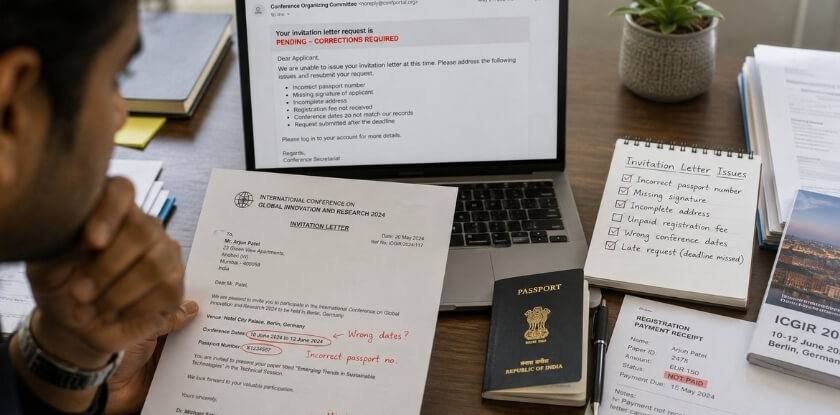
Ask the embassy or office exactly what was missing, then get a corrected letter from the organizer before you reapply. Most problems are fixable if you act quickly.
Find the exact reason
Visa offices usually give a reason, even if brief. Common ones are a missing official signature, no organizer contact details, no mention of the student’s role, or no institution letterhead. If the embassy gave no written reason, ask for clarification. If the conference registration office flagged your student participation letter, ask what information was missing.
Go back to the organizer
Explain which embassy flagged the issue, what it cited, and what the corrected letter must contain. Ask for a revised letter on letterhead, signed by an authorized representative, stating:
- The full name and title of the person invited
- The student’s role (presenter, delegate, attendee)
- Dates and location of the academic conference
- That accommodation and/or funding arrangements are the student’s responsibility (unless covered)
- The organizer’s official contact information for embassy verification
Ask whether the organizer has a standard version for visa use. Some organizers charge for changes after issue. At MS International, a US$50 administrative fee may apply to corrections requested after the letter has been issued, so check your details before you ask for the first copy.
Add a university letter
If the first letter came only from the organizer, a supporting letter from your department (see the supervisor section above) can strengthen a reapplication, because embassies want institutional backing as well as the organizer’s confirmation.
Reapply with a consistent package
Treat the letter as one part of a full package. The dates on your registration confirmation should match the invitation letter, which should match your travel bookings. Embassies notice inconsistencies, and a corrected letter loses credibility if the documents around it do not line up.
If you can only join online
If the conference has a virtual option and the in-person visa was refused, a virtual conference invitation letter confirms your online registration. It will not undo a refusal, but it keeps your participation on record and may support a later application.
If the conference has already passed
There is no clean fix. Ask the organizer for a formal letter confirming your accepted participation and the circumstances that stopped you attending, and keep the original invitation, the refusal notice and all correspondence. Some universities also let students present the work at a departmental seminar instead.
From our experience at MS International: Our letter process starts automatically once payment clears, and the letter is issued within 3 to 5 business days after payment clears. Enter your legal name exactly as on the passport when you register, because our team may contact you if details are missing or names do not match. Registered listeners are eligible too, not only authors and presenters. The letter supports an application but does not guarantee a visa, and registration fees are non-refundable, so check the visa rules for your passport before you pay.
FAQ
As a student heading to a conference abroad, you may wonder who should sign your letter, whether you can draft it yourself, and how it compares with a student visa invitation letter.
Do I need a conference invitation letter to attend a virtual conference?
Usually not. Virtual conferences rarely need one because no visa is involved. The exception is when your university wants written proof of acceptance before approving funding or academic leave.
Can I write my own conference invitation letter?
Not for a visa. The letter must come from the organizer, your university or another recognized institution. Some organizers give a template you fill in yourself, so ask yours. Otherwise, draft a version and ask them to review it and issue it on official letterhead.
What’s the difference between a conference invitation letter and a student visa invitation letter?
A student visa invitation letter is built for a visa file. It adds conference dates, financial arrangements and a statement that the event needs your presence. A standard letter only confirms your role. Some letters serve both purposes.
Who should sign the invitation letter?
A person with a stated title: a department head, dean or supervisor for a university letter, and a program chair or committee representative for the organizer. A letter signed by a peer or an assistant with no stated authority will likely be questioned.
How far in advance should I request the letter?
As soon as your registration and payment are complete, because many organizers issue letters only then. MS International issues the letter within 3 to 5 business days after payment clears. The visa itself takes longer, so ask before you book anything else.
Does the letter need to be on official letterhead?
Yes for a visa or any formal academic process. Letterhead shows who issued the letter and how to contact them. For a virtual event or an internal approval, ask your institution what it accepts.
What if the conference doesn’t provide an invitation letter automatically?
Ask the registration team directly. Give your full name, registration confirmation and the details the letter must include, such as your role as a student presenter or speaker.
Can one letter cover multiple requirements?
Sometimes. If the organizer’s letter already has your dates, purpose and accommodation details, your university may not need a separate one. Check the visa office’s checklist to see whether one letter or two is required.
Is a student participation letter the same as a speaker invitation letter?
No. A student participation letter confirms you are attending as a registered delegate or audience member. A speaker invitation letter is for someone presenting a paper or talk, and it usually carries more weight because it shows a concrete reason for travel.
Do students need a student visa to attend a conference abroad?
Usually not. A student visa belongs to the country where you study, and a conference trip is normally a visit. Apply as a visitor or business visitor, or use a visa waiver or eTA if your passport qualifies. Canada states that a study permit is not a travel document.
Is an invitation letter required for a visa?
Not always. It is a supporting document, and each embassy sets its own list, so check its official checklist. Canada says it may ask for a letter of invitation with a visitor visa application, and that the letter does not guarantee a visa.
Final Thoughts
A conference invitation letter for a student has to prove who you are, where you study, why you are invited and who pays. Get it from the organizer on letterhead, add a short supervisor or university letter if the visa office or funder asks, and make sure every date and name matches your other documents. If something is rejected, ask what was missing and fix that one point.
Disclaimer: This article is general information, not legal or immigration advice. A letter of invitation does not guarantee a visa, and requirements vary by country and change over time. Confirm the current rules with the official embassy, IRCC (canada.ca) or travel.state.gov pages for your destination before you apply.