
Most people know they need an invitation letter, but sitting down to write one is another matter. Copying a generic template often produces something that sounds like it belongs to a different event.
Quick answer: A good conference invitation letter names the event, dates, venue, the person’s role, who pays for what, and one reply deadline. This page has ready organiser templates for attendees, speakers, researchers, students, groups, visa support, virtual and hybrid events, sponsors, press and follow-ups. Copy one, replace the brackets, and send it as a PDF.
Fact-checked by the MS International Editorial Team. Last verified against official sources: October 2026.
These templates are written for the organiser side: the committee, department or company that sends the invitation. They are samples to adapt, not legal documents, and every bracket needs your own real details before the letter goes out.
What Is a Conference Invitation Letter and When Do You Need One
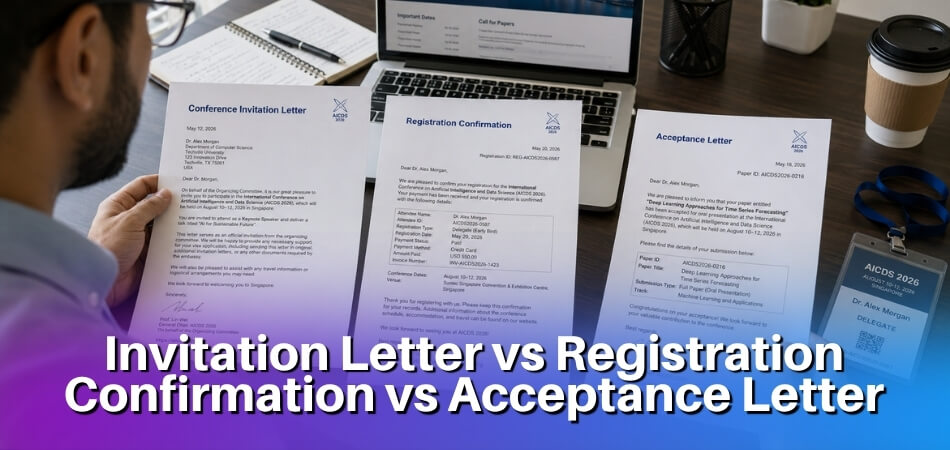
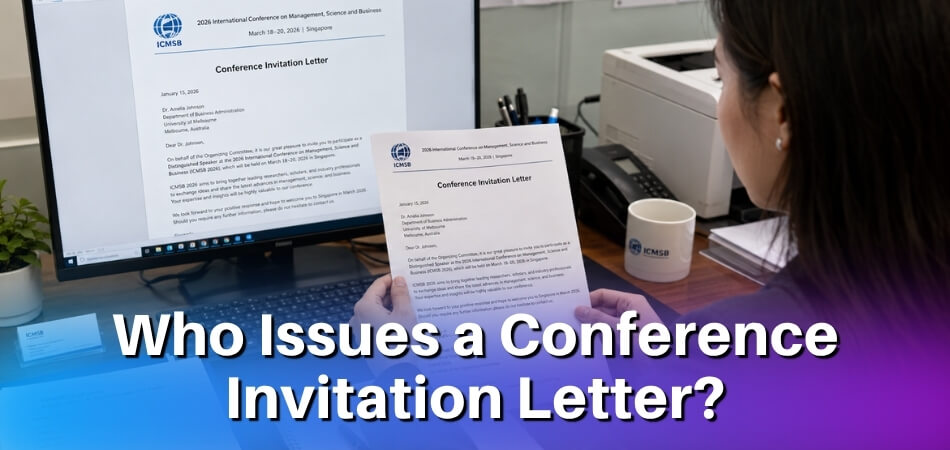
A conference invitation letter is a written invitation from the organiser to a named person: a speaker, attendee, researcher, student, sponsor or journalist. It confirms the event is real, gives the person enough detail to decide, and can double as supporting paperwork for a visa, travel funding or leave from work.
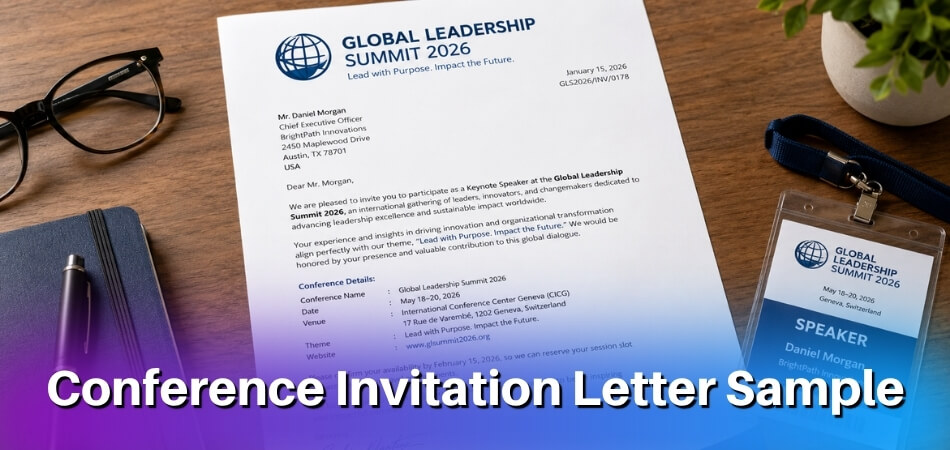
Use the table to pick the sample that fits your situation, then jump to that section.
| Who you are writing to | What the letter must do | Sample below |
|---|---|---|
| Colleagues, clients, partners | Give the date, place, format and one RSVP action | General / Corporate |
| Researchers, faculty, postdocs | State the session, time slot and what you expect them to do | Academic and Research |
| Students | Confirm the role, the supervisor’s support and funding position | Student delegate letter |
| Keynote or guest speakers | Name the role, length, audience and what you cover (fee, travel, hotel) | Speaker and Guest Speaker |
| Visa applicants | Give an embassy the dates, venue, role, costs and organiser details | International (With Visa Support) |
| A delegation from one institution | Cover several named people in one letter | Group letter |
| Online or mixed audiences | Add platform, time zone and the choice of format | Virtual and Hybrid |
| Companies you want as sponsors | Make the case, show tiers and set a deadline | Sponsorship |
| Journalists | Lead with the news, time and place | Press Conference |
| Anyone who has not replied | Remind without pressure | Follow-Up and Reminder |
Even a fully virtual event benefits from a proper letter, because high-profile speakers and international participants often need something for their records or their employer. A vague or late letter makes people write back for basics, and some simply decline because the event does not look organised.
How to Write a Conference Invitation Letter: Key Elements and Structure
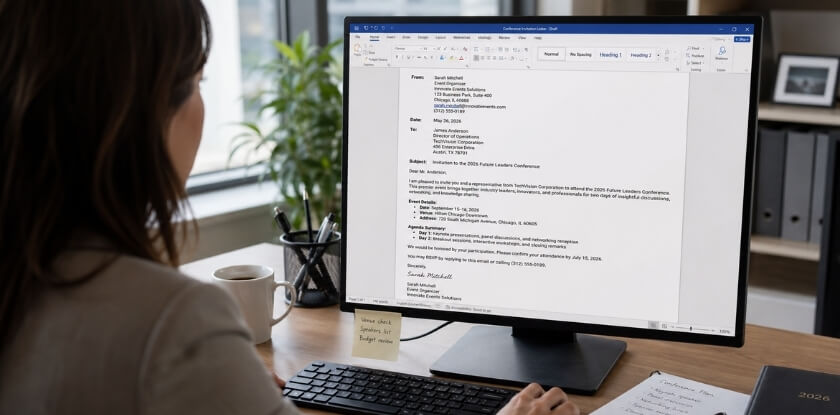
Every sample on this page follows the same skeleton, so check these items before you send any version of it.
| Element | What to put | Common slip |
|---|---|---|
| Opening | Who you are, the event name, date and place, and the role you offer, in two or three sentences | A long backstory before the event is named |
| Two dates | Conference dates and a reply deadline, placed where they are easy to see | Burying the RSVP date at the bottom |
| Venue or platform | Full venue, city and country; for online events the platform and how login details arrive; for hybrid, both | Leaving people to guess the format |
| Agenda | The main blocks (keynotes, workshops, panels, networking); attach the full agenda instead of pasting it | Pasting the whole schedule into the letter |
| What you ask of them | Role, session length, materials due, and what you cover (fee, travel, hotel) | Saying nothing about costs |
| One call to action | One thing to do by one date, such as reply or register at a link | Three ways to respond, or only “we hope to see you” |
| Contact and sign-off | A direct email or phone number, full name, title and organisation | A generic mailbox with no named person |
Give international invitees a longer reply window than local ones, because their travel plans and any visa application may depend on your letter. Match the tone to the reader. A letter to a senior academic or a government office should follow the formal invitation letter format; a note to a colleague you know can be warmer. If you are unsure, start formal. If you produce several versions, keep the event details identical across them and change only the opening, the ask and the speaker section. Beyond the core facts a conference invitation letter must include (who is inviting, the event, the invitee’s role, the costs and how to reply), each letter type needs extra fields, such as passport details for a visa letter.
General / Corporate Conference Invitation Letter Sample
This is the all-purpose letter for inviting colleagues, clients, partners or industry peers to a corporate conference. Copy it into Word or Google Docs, replace the brackets, and keep the tone professional but personal.
Sample: General Corporate Conference Invitation Letter
[Your Company Letterhead / Logo]
Date: [Insert Date]
To: [Recipient’s Full Name] [Job Title] [Company Name] [Address]
Subject: Invitation to [Conference Name]: [Date], [City/Platform]
Dear [Mr./Ms./Dr. Last Name],
On behalf of [Your Organization], I am pleased to invite you to [Conference Name], scheduled for [Date] at [Venue Name and Address] / via [Virtual Platform, if applicable].
This year’s conference focuses on [brief theme or topic, e.g., “emerging trends in supply chain management and cross-border logistics”]. We’ve brought together [number] speakers across [number] sessions, and the conference agenda includes panel discussions, workshops, and a networking reception on the evening of [date].
Your expertise in [specific field or role] makes you exactly the kind of participant who contributes to a genuinely useful conversation, not just an audience member. We’d value your presence.
Conference Details:
- Date: [Day, Month, Year]
- Time: [Start Time] – [End Time] ([Time Zone])
- Location: [Venue Name], [Full Address], or [Virtual Platform Link]
- Format: [In-person / Virtual / Hybrid]
- Registration Deadline: [Date]
Attendance is [complimentary / $X per delegate]. A full conference agenda will be sent upon confirmation of your attendance.
To confirm your seat, please RSVP by [RSVP Deadline Date] by replying to this letter or emailing [Contact Email]. You can also register directly at [Registration URL].
We look forward to having you with us.
Warm regards,
[Your Full Name] [Your Job Title] [Organization Name] [Phone Number] [Email Address] [Website]
Notes on Using This Sample
- Personalise one line. Add why this person is invited, for example “your recent work on [topic]”. It shows the letter is not a bulk mail-out.
- Keep one RSVP action. Reply, click a link or call, never all three. A single action gets more replies.
- Check the file before sending. If the letterhead breaks onto page two or the layout shifts on another computer, fix it first. Sending as a PDF avoids most of this.
Academic and Research Conference Invitation Letter Sample
Academic letters go to researchers, faculty, postdoctoral fellows and students, so the tone is scholarly but still warm. State the role (present a paper, chair a session, attend as a guest), the theme and the dates.
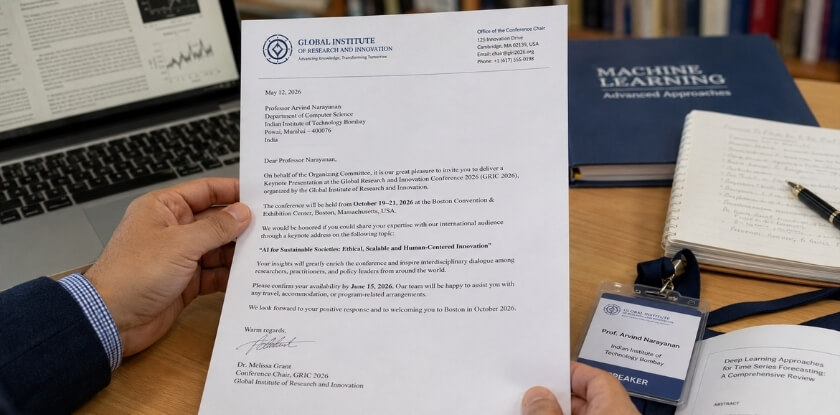
Academic Conference (University / College)
University conferences usually carry a department theme or an annual event. The sample below names the conference and institution in the subject line, asks for one specific contribution and sets a clear reply date.
Subject: Invitation to the 12th Annual Symposium on Environmental Sciences: [University Name]
Dear Dr. [Last Name],
On behalf of the Department of Environmental Sciences at [University Name], I am pleased to invite you to our 12th Annual Symposium on Environmental Sciences, scheduled for March 14–16, 2027, at the [Campus/Building Name], [City, Country].
This year’s theme is “Climate Resilience and Urban Ecosystems,” and we are bringing together researchers, faculty, and graduate students from across the region to present and discuss current work in this space.
We would like to invite you to present your research during the session on urban biodiversity, which is scheduled for the afternoon of March 15. Your recent work on green infrastructure in metropolitan areas fits directly with our conference agenda for that session.
The symposium will include three days of presentations, panel discussions, and a poster session. Full event details, including the conference program and submission guidelines, are available at [conference website].
Please confirm your participation by February 1, 2027. You can RSVP by replying to this email or by completing the registration form on our website.
We would be honored to have you join us. Travel support and accommodation assistance may be available for select speakers, please reach out if this applies to you.
Warm regards,
[Your Full Name] [Title / Position] Department of Environmental Sciences [University Name] [Email] | [Phone]
If your university conference has an international audience, add one line offering a formal visa support letter on request. Do not wait for people to ask.
Invitation Letter for Postdoctoral Fellows and Researchers
Researchers and postdoctoral fellows often need a letter they can show to an institution, funding body or embassy, so use official letterhead. Treat them as peers, say why their work fits, and be exact about the time slot.
Subject: Invitation to Present at [Conference Name]: [Institution Name]
Dear Dr. [Last Name],
I am writing on behalf of the organizing committee of the [Conference Name] ([ACRONYM] 2027), hosted by [Institution Name] and scheduled to take place on September 8–10, 2027 in [City, Country].
We would like to formally invite you to participate as a guest speaker in the session on Synaptic Plasticity and Cognitive Decline. Your postdoctoral research at [Current Institution], particularly your recent publications on hippocampal function, directly aligns with the focus of this session, and we believe your contributions would add significant value to the conversation.
Your participation would include a 30-minute research presentation followed by a 10-minute Q&A. If you are interested, we are also open to discussing a keynote speaker slot, depending on your availability and interest.
The conference will bring together over [number] researchers from [number] countries. The full conference agenda will be circulated in July 2027.
Should you require an official invitation letter for institutional or visa purposes, we are happy to provide one on university letterhead. Please let us know your requirements.
We ask that you confirm your participation by June 15, 2027, by replying to this letter or emailing [conference email address] directly.
We hope you will join us for what promises to be a substantive three days of research exchange.
Sincerely,
[Your Full Name] [Title] | [ACRONYM] 2027 Organizing Committee [Institution Name] [Email] | [Phone] | [Website]
This letter works because it gives the session topic, the time allocation and the Q&A format. Researchers need to know what they are committing to. If you cite a specific piece of their work as the reason for the invitation, name it briefly; it shows you read it.
Student Delegate Invitation Letter
Students need a letter that confirms their role and shows their supervisor or university is behind the trip. Say clearly whether the invitation covers registration or travel, because a student’s funding position drives both the university’s approval and any visa application.
Subject: Invitation to Present at [Conference Name] as a Student Delegate
Dear [Student’s Full Name],
On behalf of the organizing committee of [Conference Name], I am pleased to invite you to take part as a student delegate at the conference, to be held on [Dates] at [Venue, City, Country].
We have reviewed your abstract, “[Abstract Title]”, and would like you to present it as a [poster / 15-minute oral presentation] in the student session on [date]. Your supervisor, [Supervisor’s Name] at [University Name], is welcome to attend as well.
Please note that this letter confirms your role at the conference. [Registration fees and travel costs are the responsibility of the participant / The organizing committee will cover: ______.] We recommend that you share this letter with your supervisor or department to request leave and funding support.
If you need a version of this letter for a visa application, reply with your full name exactly as it appears in your passport, your university and program, and your travel dates, and we will prepare it.
Please confirm your participation by [RSVP date] by replying to this email.
Sincerely,
[Your Full Name]
[Title], Organizing Committee, [Conference Name]
[Email] | [Phone] | [Website]
Make sure the student’s enrolment details and the supervisor’s name in the letter match their university documents. Whether a student applies for a student visa or a visitor visa is the embassy’s call; the letter only describes the event and the student’s role.
Speaker and Guest Speaker Conference Invitation Letter Sample
A speaker letter must be specific about what you are asking for, because speakers give time, expertise and often travel. Vague invitations such as “we would love you to speak” tend to be ignored.
What to Include in a Speaker Invitation Letter
- The role. Keynote, panelist or workshop facilitator, stated exactly.
- Topic. A suggested angle based on their work; it need not be fixed.
- Length and format. For example 30 or 60 minutes, in person or virtual.
- Audience. Who will be in the room and roughly how many.
- Compensation and logistics. Honorarium, travel and hotel, whichever you offer. If you offer none, say so.
- A reply date. Speakers juggle several invitations.
Sample: Keynote Speaker Invitation Letter
[Your Name / Title] [Organization Name] [Address] [Date]
[Speaker’s Full Name] [Speaker’s Title and Affiliation] [Address]
Dear [Dr./Mr./Ms. Last Name],
On behalf of [Organization Name], I am pleased to invite you to serve as the keynote speaker at the [Conference Name], scheduled for [Date] at [Venue], [City].
This year’s conference will bring together approximately [number] professionals from [industry/field] to discuss [main theme or challenge]. Based on your work in [specific area, e.g., “machine learning applications in healthcare”], we believe your perspective would set a strong tone for the event and speak directly to our audience.
We are inviting you to deliver a keynote address of approximately 45 to 60 minutes, followed by a short Q&A session. The conference agenda also includes panel discussions, breakout sessions, and a networking reception, full details are attached for your reference.
We are pleased to offer:
- An honorarium of [amount or “to be discussed”]
- Round-trip travel reimbursement
- Hotel accommodation for [X nights]
- A formal speaker acknowledgment in all conference materials
We recognize this is a significant commitment of your time, and we genuinely value what your contribution would bring to the event. We would be honored to have you involved.
Could you please confirm your availability and interest by [RSVP date]? If you have questions about the format, topic expectations, or logistics, I’m happy to get on a call at your convenience.
Warm regards,
[Your Full Name] [Title] [Organization Name] [Phone Number] | [Email Address] [Website]
Enclosures: Conference agenda, speaker profile form, event brochure
Sample: Guest Speaker Invitation Letter (Shorter, Semi-Formal)
Use this version for smaller conferences, internal events or speakers you already know.
Dear [First Name],
I’m writing to invite you to speak at [Conference Name], taking place on [Date] at [Venue / Virtual Platform].
We’re organizing a half-day session focused on [topic], and we’d love for you to lead a 30-minute presentation on [specific subject area]. Our audience will be [brief description, e.g., “around 80 mid-level marketing professionals”].
This is an in-person event, though we’ll also be live-streaming to a virtual audience. We can cover your travel and accommodation, and we’re happy to discuss a speaker fee if that’s relevant.
Please let me know by [date] if this works for you. If you’d prefer a quick call to talk through the details, just say the word.
Looking forward to hearing from you.
Best,
[Your Name] [Title, Organization] [Contact Details]
Practical Notes
- State the ask first. Put the role in the first paragraph, not after three paragraphs about the event.
- Use PDF for a formal first approach. A short email is fine for follow-ups or people you know.
- Raise visa support early. If the speaker travels from abroad, offer a visa support letter in the first message, since embassy appointments can take time.
- Follow up once. If there is no reply in 10 to 14 days, send one short reminder.
International Conference Invitation Letter Sample (With Visa Support)
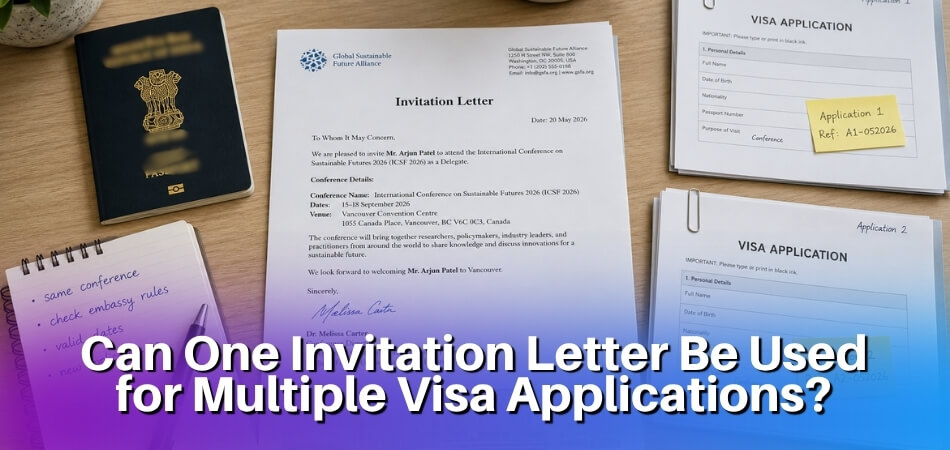
A visa-support version of the invitation is a letter addressed to the visa officer that confirms the person is genuinely invited and gives the facts an officer needs to assess the trip. For many invitees the plain invitation and this letter can be one document if it contains these details.
[Your Organization Letterhead]
Date: [Full Date]
To Whom It May Concern / Visa Officer [Name of Embassy or Consulate] [Country]
Subject: Invitation Letter and Visa Support for [Attendee’s Full Name]
Dear Sir/Madam,
We are writing to formally invite [Attendee’s Full Name], [Designation], from [Institution/Organization Name], [Country], to attend the [Full Conference Name], to be held on [Dates] at [Venue, City, Country].
[Attendee’s Name] has been invited to [present a paper / deliver a keynote address / participate as a delegate] at this conference. The conference focuses on [brief description of the field, e.g., advances in climate science, emerging infectious diseases, international trade policy], and their participation is an important part of the program.
The conference is organized by [Organizing Institution/Body], and is expected to bring together approximately [number] participants from [number] countries.
Conference Details:
- Conference Name: [Full Name]
- Dates: [Start Date] to [End Date]
- Venue: [Full Address]
- Conference Website: [URL]
[Choose what applies: The participant has completed registration for the conference. / Registration fees are covered by the organizing committee.] [Accommodation at [Hotel Name] has been arranged for the duration of the event. / The participant is responsible for their own accommodation and travel costs.]
We respectfully request that the relevant visa authorities give favorable consideration to this application. The participant is expected to return to their home country immediately following the conclusion of the conference.
Should you require any additional documentation or clarification, please contact us directly at the details below.
Yours sincerely,
[Your Full Name]
[Title / Position]
[Department / Faculty / Division] [Institution / Organization Name]
[Address]
[Phone Number]
[Official Email Address]
[Website]
Making the Letter Useful for a Visa Application
- Address the right authority. If the invitee knows which embassy they will apply through, address the visa officer there instead of a bare “To Whom It May Concern”.
- Show the organiser’s real details. Full name, address, website and a working organisational email, ideally on letterhead. A free webmail address weakens it.
- Match the dates exactly. Write “November 12 to 14”, not “mid-November”. The visa application uses specific travel dates.
- State who pays what. Say whether registration, accommodation and travel are covered or self-funded. Unclear funding causes questions.
- Collect the details first. Ask the invitee for the name exactly as in the passport, affiliation, role, paper title if presenting, proof of registration and travel dates before you draft the letter.
- Mention the return. One line that the participant is expected to return home after the conference.
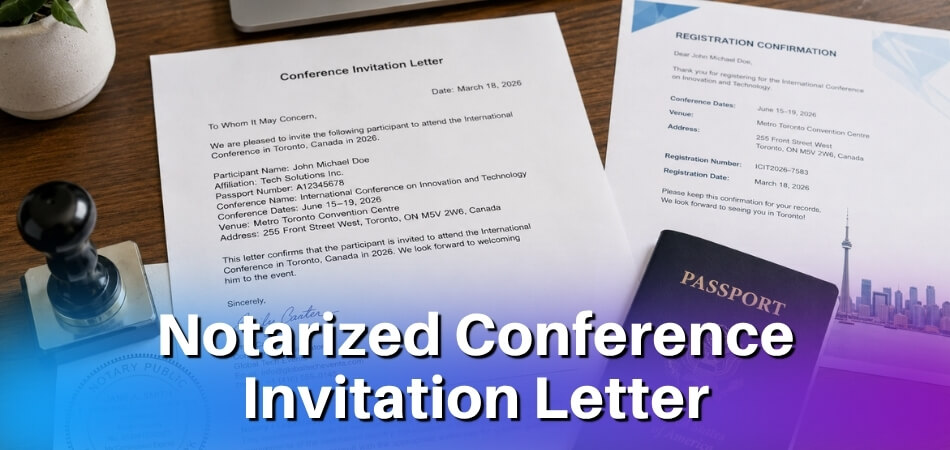
- Ask about extra formalities. Some visa offices may ask for a notarized letter, so check with the office the invitee will apply through.
- Use a formal tone and a senior signature. A conference chair, dean or director carries more weight than a junior coordinator. For an early-career researcher, a co-signature from a senior faculty member or the international office can help.
Two official points are worth knowing before you promise anything. The US State Department’s visitor visa page says an invitation letter is not needed to apply for a B-1 visa and is not a factor in the officer’s decision, though attending a business or professional conference is a permitted activity. Canada’s IRCC page on letters of invitation (written by a person in Canada) says a letter is only sometimes requested and does not guarantee a visa. So a letter supports an application; it never replaces the applicant’s own documents or promises an outcome. Embassy processing times vary by country, so send the letter as early as you can.
A letter also cannot change rules that depend on the invitee’s nationality or residence. For the United States, these include the visa bond for B-1/B-2 applicants from listed countries and the partial B-1/B-2 suspension that has applied to nationals of some countries since 1 January 2026. For Canada, IRCC is currently processing but not finalizing applications from people whose last country of residence is the Democratic Republic of the Congo, South Sudan or Uganda, until 27 November 2026 unless it extends the measures. Tell invitees from those places to check the official page for their situation before they rely on your letter.
If Your Event Is in Canada
IRCC’s page for event organizers tells a Canadian host to give each business guest 2 copies of the letter of invitation and 24-hour contact details for a representative of the business. If the event is registered with IRCC, put the event code in the letter; guests then enter that code on their visa application so they are identified as event participants.
Registration is voluntary and handled by IRCC’s Special Events Liaison Unit. IRCC says an event must take place in Canada, include at least 10 delegates from visa-required countries, and pass a review of the event details. The notice must be sent at least 6 months before the event starts, and the unit aims to reply within 10 business days. IRCC also says the unit cannot speed up visa applications or guarantee entry for participants.
Group Letter for a Delegation
When several people from one university or company are attending, one letter can name all of them. Keep a numbered list so each name, role and passport-matching detail is clear, and have each person receive a copy for their own application.
[Your Organization Letterhead]
Date: [Full Date]
Subject: Invitation Letter for Delegation from [Institution Name] to [Conference Name]
Dear [Name of Delegation Leader / Visa Officer],
We are pleased to confirm that the following members of [Institution Name], [Country], have been invited to attend the [Full Conference Name] on [Dates] at [Venue, City, Country]:
- [Full Name 1], [Title], invited as [role]
- [Full Name 2], [Title], invited as [role]
- [Full Name 3], [Title], invited as [role]
Each person is invited to [present a paper / attend sessions / take part in the workshop] and has been registered under the name shown above. Please use the names exactly as they appear in each person’s passport.
[State who covers registration, accommodation and travel for the group.]
Individual letters with passport details can be issued to each delegate on request. For any questions, please contact [Name] at [Email] or [Phone].
Yours sincerely,
[Your Full Name]
[Title / Position]
[Organization Name]
[Address] | [Website]
Virtual and Hybrid Conference Invitation Letter Sample
Online and hybrid letters need three extra details that in-person letters do not: platform access, time zone and, for hybrid, a clear choice of format. Without them, people miss the start or spend the first minutes confused about how to join.
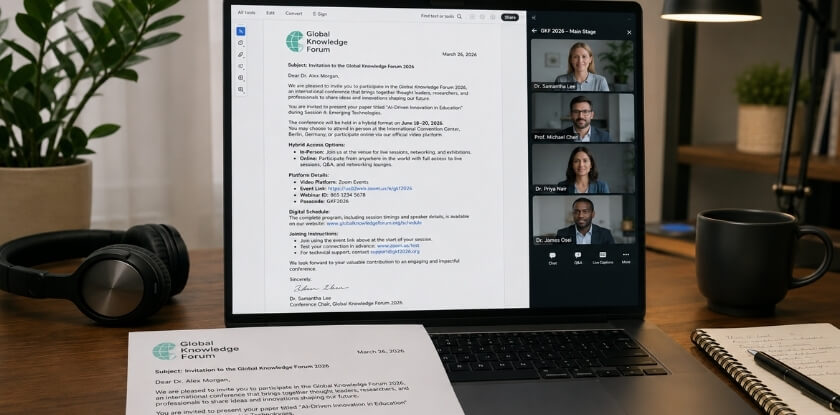
Virtual Conference Invitation Letter Sample
This version states the time zone with both a UTC offset and a city, names the platform so attendees can check requirements, and ties the reply date to limited seats.
Subject: Invitation to the [Conference Name]: [Date] | Virtual Event
Dear [Recipient’s Name],
We are pleased to invite you to [Conference Name], a fully virtual conference organized by [Organization Name]. The event will take place on [Date] from [Start Time] to [End Time] (UTC+[X] / [City Time Zone]).
This year’s conference focuses on [brief topic description, e.g., “emerging trends in sustainable supply chain management”]. We have confirmed [number] speakers across [number] sessions, including keynote presentations, panel discussions, and interactive Q&A segments.
Event Details:
- Date: [Day, Month, Year]
- Time: [Start Time] to [End Time] | [Time Zone, e.g., 9:00 AM – 5:00 PM EST]
- Platform: [Zoom / Microsoft Teams / other platform]
- Registration Link: [URL]
- Access Instructions: A unique join link will be emailed to you upon confirmed registration.
Registration is free for [eligible group, e.g., academic researchers, members of the association]. Non-member registration is $[amount].
Please confirm your attendance by [RSVP deadline] using the registration link above. Seats are limited to [number] attendees to keep the sessions interactive.
If you have any questions about the conference agenda, session access, or technical requirements, contact us at [email address] or [phone number].
We look forward to your participation.
Sincerely,
[Your Full Name]
[Title / Role]
[Organization Name]
[Email Address]
[Phone Number]
[Website URL]
Keep the tone professional for academics and speakers. For a casual corporate event you can soften the language slightly.
Hybrid Conference Invitation Letter Sample
A hybrid event is really two events, so the letter must label each option and say what differs. Here networking and workshops are in-person only, and saying so up front prevents complaints later.
Subject: Invitation to [Conference Name]: In-Person & Virtual Attendance Options Available
Dear [Recipient’s Name],
On behalf of [Organization Name], it is our pleasure to invite you to [Conference Name], scheduled for [Date(s)]. This year’s event will run as a hybrid conference, offering both in-person attendance at [Venue Name, City] and live virtual participation for those joining remotely.
The conference will cover [topic area], bringing together [describe attendees, e.g., industry professionals, researchers, and policy makers] from [regions/countries]. Our confirmed speakers include [Speaker Name, Title] and [Speaker Name, Title], among others. A full conference agenda will be shared with all registered attendees by [date].
Attendance Options:
Option 1, In-Person Attendance
- Venue: [Venue Name], [Full Address]
- Date: [Date(s)]
- Time: [Start Time] – [End Time]
- Capacity: Limited to [number] in-person seats
Option 2, Virtual Attendance
- Platform: [Platform Name, e.g., Zoom Webinar / Microsoft Teams Live]
- Date: [Date(s)]
- Time: [Start Time] – [End Time] [Time Zone]
- Access: Join link provided upon registration
Both attendance formats will have access to all main stage sessions. Networking sessions and workshops are available to in-person attendees only.
Registration and RSVP: Please indicate your preferred attendance format and complete your registration at [Registration URL] by [RSVP Deadline].
In-person registration: $[amount] | Virtual registration: $[amount] (or Free for [eligible group])
For any questions regarding event details, accessibility requirements, or technical support, please reach out to [Name] at [email] or [phone].
We hope to welcome you, whether in the room or on screen.
Warm regards,
[Your Full Name]
[Title / Role]
[Organization Name]
[Email Address]
[Phone Number]
[Website]
Conference Invitation Letter With Sponsorship Sample
A sponsorship letter invites and persuades at once, so put the opportunity in the first paragraph. Sponsors are busy and need to see the value quickly.
What to Include in a Sponsorship Invitation Letter
- Event details: name, date, location and format.
- Audience: who attends, how many, and their industry or academic background.
- Tiers or opportunities: what the sponsor gets for what they give.
- Direct benefit: logo placement, speaking slot, booth space.
- A call to action: a deadline, a contact and a link to a prospectus.
Put full tiers in a separate prospectus and attach it rather than cramming everything into the letter.
Sample: Conference Sponsorship Invitation Letter
[Your Organization Letterhead]
Date: [Insert Date]
To: [Sponsor Contact Name] [Title] [Company Name] [Address]
Subject: Sponsorship Opportunity: [Conference Name], [Year]
Dear [Mr./Ms./Dr. Last Name],
We are writing to invite [Company Name] to become a sponsor of the [Full Conference Name], scheduled for [Date] at [Venue/Platform Name] in [City, Country].
This is the [Xth] annual edition of our conference. Last year, we welcomed over [number] attendees from [number] countries, including industry professionals, researchers, policymakers, and executives from organizations such as [two or three relevant examples if possible].
This year’s theme is “[Conference Theme]”, with sessions covering [list two or three key topic areas]. Our keynote speakers include [Name, Title] and [Name, Title], both recognized figures in [relevant field].
Why Sponsor This Event?
Your brand will be seen by a highly targeted audience that matches your customer and partner profile. Sponsorship packages range from [Bronze/Silver/Gold] tiers, offering benefits that include:
- Logo placement on all conference materials, including the conference agenda, website, and registration portal
- Acknowledgment in our opening and closing sessions
- Exhibition space (Gold and Platinum sponsors)
- A complimentary speaking or panel slot (Platinum sponsors)
- Access to the full attendee list post-event (subject to consent)
Full details are outlined in the attached [Conference Name] Sponsorship Prospectus.
Sponsorship packages start at [amount/currency], and spaces are limited. We are accepting sponsorship commitments until [Deadline Date].
To confirm your interest or discuss a custom arrangement, please contact [Name] at [email address] or [phone number]. We’re also happy to schedule a call at your convenience.
We hope to welcome [Company Name] as a valued partner at this year’s event and look forward to building a relationship that goes well beyond this conference.
Yours sincerely,
[Your Full Name]
[Title] [Organization Name]
[Phone Number]
[Email Address]
[Conference Website URL]
Notes on Sponsorship Letters
- Find the decision-maker. “Dear Sir/Madam” rarely gets read; look for someone in marketing, partnerships or communications.
- Show a starting price. It filters out poor fits and saves time on both sides.
- Give a real cutoff date. “Spaces are limited” means little without one.
- Follow up once, one to two weeks before the deadline. Attach a PDF, not a Word file.
Press Conference Invitation Letter Sample
A press invitation asks journalists to cover an announcement, so lead with the news and put the time and place near the top. Reporters receive many of these and decide in seconds.
- Lead with the news. A launch, a statement or a finding, stated plainly.
- Make time and place unmissable.
- Set a firm RSVP date. Media outlets must assign staff and equipment.
- Keep it to one page.
Sample: Press Conference Invitation Letter
[Your Organization’s Letterhead]
Date: [Insert Date]
To: [Journalist/Editor Name] [Media Outlet Name] [Address / Email]
Subject: Media Invitation: Press Conference on [Topic/Announcement]
Dear [Name / “Members of the Press”],
You are invited to attend a press conference hosted by [Organization Name], scheduled for:
Date: [Day, Month, Year] Time: [Start Time] to [End Time] Venue: [Full Address or Virtual Link]
We will be announcing [brief description of the announcement, e.g., “the findings of our two-year national climate research study” or “the launch of our new community housing initiative”]. Representatives available for comment and interview will include [Name, Title] and [Name, Title].
A full media kit, including statement documents and high-resolution images, will be distributed on-site and emailed to registered attendees following the event.
To confirm your attendance, please RSVP by [Date] to [Contact Name] at [Email Address] or [Phone Number].
We look forward to your coverage.
Sincerely,
[Your Full Name]
[Title] [Organization Name]
[Phone Number]
[Email Address]
[Website]
Adapting the Press Letter
- Virtual press conference: replace the venue with the video link and say whether it will be recorded and when.
- Specific beat reporters: one sentence referencing their coverage, for example “Given your coverage of urban development policy, we believe this announcement will interest your readers.”
- High-profile news: send a short save-the-date a week earlier and the full letter 3 to 5 days before the event.
- Attachments: a one-page fact sheet, not a ten-page document.
- Delivery: many PR teams paste the invitation as plain text in the email body, which reads better on mobile than a download.
Follow-Up and Reminder Letter After Sending a Conference Invitation
Send one follow-up 5 to 7 business days after the first invitation, and another 3 to 4 days before the reply deadline if needed. A well-timed reminder often decides whether a room is full.

| Recipient | When to follow up | Why |
|---|---|---|
| General invitee | 5 to 7 business days after the invitation | People are busy and emails get buried |
| Keynote or guest speaker | Within 3 to 4 days | Packed calendars; they need lead time for travel and preparation |
| International invitee needing visa support | As soon as possible | They may be waiting on your confirmation before they can apply |
| Anyone close to the deadline | 3 to 4 days before the reply date | A last nudge with the deadline in view |
A good follow-up restates the key details, mentions the deadline, offers one clear way to respond and keeps the same tone as the original. Refer to the first message rather than rewriting it. Send it in the same format as the original, and stop after two reminders; a third rarely converts and can sound pushy. Avoid wording such as “As we have not yet received your reply”, which sounds like a complaint, and give people an easy way out if the timing does not suit them.
Sample 1: General Conference Follow-Up Letter
Subject: Reminder: RSVP Requested by [Date] | [Conference Name]
Dear [Recipient’s Name],
I’m following up on the invitation I sent on [original date] regarding the [Conference Name], scheduled for [Date] at [Venue/Platform].
We haven’t yet received your RSVP, and we’d love to confirm your participation. Spots are limited, and we want to make sure we have accurate numbers for [specific session/workshop/dinner].
Could you please respond by [RSVP Deadline]? You can confirm by replying to this email or completing the registration form at [link].
If you have any questions about the event details or need any additional information, feel free to reach out.
We hope to see you there.
Warm regards,
[Your Full Name]
[Title]
[Organization]
[Contact Information]
Sample 2: Reminder Letter to a Speaker
Subject: Quick Follow-Up: Speaker Confirmation for [Conference Name]
Dear [Speaker’s Name],
I wanted to follow up on my earlier email regarding your participation as a [keynote speaker / guest speaker] at [Conference Name] on [Date].
We’re finalizing the conference agenda and would greatly appreciate your confirmation this week. Your session on [topic] is one our attendees are particularly looking forward to.
If there’s anything you need from us, travel arrangements, AV requirements, or a visa support letter, please let us know and we’ll handle it promptly.
Please reply at your earliest convenience to confirm your availability.
Best regards,
[Your Full Name]
[Title]
[Organization]
[Phone / Email]
Sample 3: Academic or Research Conference Reminder
Subject: Reminder: Abstract Submission & RSVP Deadline: [Conference Name]
Dear [Recipient’s Name],
This is a friendly reminder that the RSVP and abstract submission deadline for the [Conference Name] is [Date]. We previously sent an invitation on [original date] and wanted to ensure you received it.
The conference will bring together researchers and postdoctoral fellows working in [field], and your contribution would genuinely strengthen the program.
If you’ve already submitted, thank you, and please disregard this message.
For those still considering, you can register and submit your abstract at [link].
We look forward to hearing from you.
Sincerely,
[Your Full Name]
[Department / Institution]
[Contact Details]
How MS International Conferences Issues Its Own Letter
At MS International Conferences Inc., the conference invitation letter is issued automatically after an eligible registration is paid, within 3 to 5 business days after payment clears. It is prepared on the organiser’s letterhead and sent as a PDF to the email on the registration. MS International conferences are held in person in the Greater Toronto Area.
| Question | Answer |
|---|---|
| Who gets a letter? | Eligible registered authors, presenters and listeners who have completed full payment |
| How fast? | The process starts automatically once payment clears; the letter is issued within 3 to 5 business days after payment clears |
| What does it cost? | The standard letter is free for registered participants |
| What do we need from you? | Full legal name exactly as in the passport, passport details, and an active email and phone number |
| Correction after the letter is issued | A US$50 administrative fee may apply |
| Notarized letter | Optional, on request: US$100 per request, typically up to 10 business days, non-refundable once submitted |
A letter supports an application but does not guarantee a visa or entry to Canada.
From our experience at MS International: Our letter is prepared only after an eligible registration is paid, using the full legal name and passport details exactly as you give them. We may contact you if details are missing or names do not match, and a US$50 fee may apply to a correction after the letter is issued. Registration and document fees are non-refundable, and the letter supports an application but does not guarantee a visa.
Conference Invitation Letter Format: Word, PDF, and Other Tools
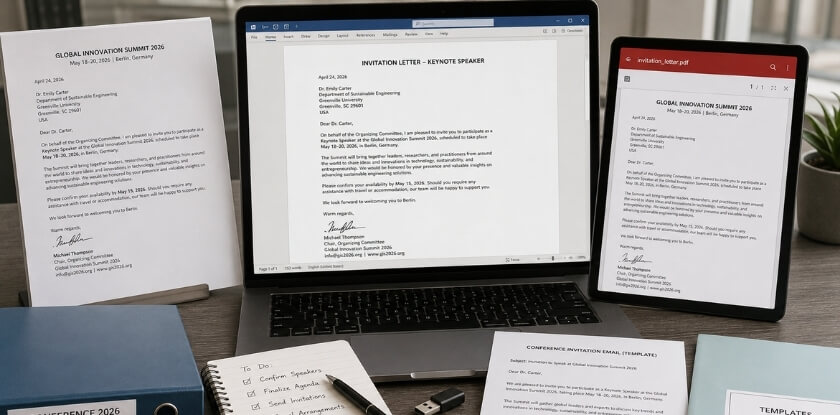
Send the final letter as a PDF; use Word or Google Docs only to draft it. PDF keeps your layout exactly as written on any device.
| Tool | Best for | Watch out for |
|---|---|---|
| Microsoft Word | Reusable templates; keep letterhead in the header and save as a .dotx file with bracketed placeholders | Formatting can shift on another machine, so convert to PDF before sending |
| The version you send; export from Word, print to PDF or download from Google Docs | If a wet signature or stamp is needed, sign the printed copy, then scan it | |
| Google Docs | Drafts that several people review and comment on | Do not send a Docs link as the official letter; outsiders may lack access or see it as informal |
Formatting and Final Checks
- Font and margins: Times New Roman, Calibri or Arial at 11 to 12 pt, with 1-inch margins and single spacing.
- Letterhead: organisation name, address and contact details at the top; add the department and logo for a university conference.
- Dates: write them out, “July 14, 2027”, because international readers read numeric dates differently.
- File name: something like
Conference_Invitation_[RecipientName]_2027.pdf, not “document1.pdf”. - Proofread: a typo in the conference name, a wrong date or a broken RSVP link undermines the letter, especially a sponsorship request. Read it yourself, then have someone else read it.
- Personalise: use the person’s real name and title, never “Dear Guest”.
If you run recurring events, keep separate base templates for general invitations, speakers, sponsors, press, visa support and follow-ups. Each needs different information, and mixing them causes errors.
FAQ
Adapting a sample template to your own event brings up tone, length, whether to add the agenda or an RSVP line, and fixing an error spotted after sending.
Does a conference invitation letter need to be formal?
Yes for academic, corporate and visa letters. Use a proper salutation and full sentences. A small internal workshop can be warmer. If unsure, start formal, since it is easier to loosen a formal letter than to repair a careless one.
What’s the difference between an invitation letter and a visa support letter?
They can be the same document. An invitation tells someone they are invited; a visa version is addressed to an embassy or consulate and adds dates, venue, role and who pays. Some organisers only issue a visa support letter, so ask for the document by the name your organiser uses.
How long should a conference invitation letter be?
One page is standard. Two pages is acceptable for a keynote speaker when you must explain the honorarium, travel and session details. Anything longer is rarely read in full.
Should I include the conference agenda in the letter?
No, attach it or point to the website. Mention the main blocks in the letter, but pasting the full schedule makes it cluttered and harder to read.
Can I use the same letter template for a virtual conference?
Yes, with changes. Replace venue and accommodation details with the platform, how login details arrive, the time zone and any technical requirements. Lines such as “the conference hall” make a virtual invitation look careless.
Is RSVP required in a conference invitation letter?
You need a clear call to action with a date, whether that is an RSVP, a registration link or a confirmation deadline. Without one, many people do nothing. A date matters most when seats or catering are limited.
Does Canada require an invitation letter for a conference visitor?
Not always. IRCC’s letter of invitation page says it only sometimes asks for one, and a letter never guarantees a visa. Business visitors to a conference in Canada are told to carry a letter of invitation from the host to the border.
Do I need to send a follow-up if someone doesn’t respond?
Yes, send one short reminder 5 to 7 business days after the invitation. Refer to the original message and ask if they have questions. Stop after two reminders.
What should I do if there is an error in the invitation letter after sending it?
Send a corrected letter promptly and name the error. Treat wrong dates, venue or names as urgent because they affect travel and visas. At MS International, a correction after issue may carry a US$50 administrative fee.
Can a postdoctoral fellow or graduate student use these templates?
Yes, adapt any academic template. If the letter must support a visa or a formal speaking invitation, have it signed by someone with institutional authority such as a department head or conference chair.
When does MS International Conferences issue the invitation letter?
Within 3 to 5 business days after payment clears for an eligible registration. The PDF goes to the email on your registration. A notarized letter is separate: US$100 per request, typically up to 10 business days, non-refundable.
Does a US visitor visa application need an invitation letter?
No. The US State Department says a letter of invitation is not needed to apply for a visitor visa and is not one of the factors in the decision. Your ties to your home country count instead. A letter can still explain the trip to your employer.
Conclusion: A Strong Invitation Letter Is Where a Successful Conference Begins
Pick the template that matches the reader, fill in real details, add one clear action with a date, and send it as a PDF. For visa-related letters, match the dates and costs to the invitee’s application and send early. Follow up once, and then once more at most.
Disclaimer: This page gives sample letters and general information, not legal or immigration advice. A letter does not guarantee a visa or entry. Always check the requirements of the embassy or immigration authority involved.