
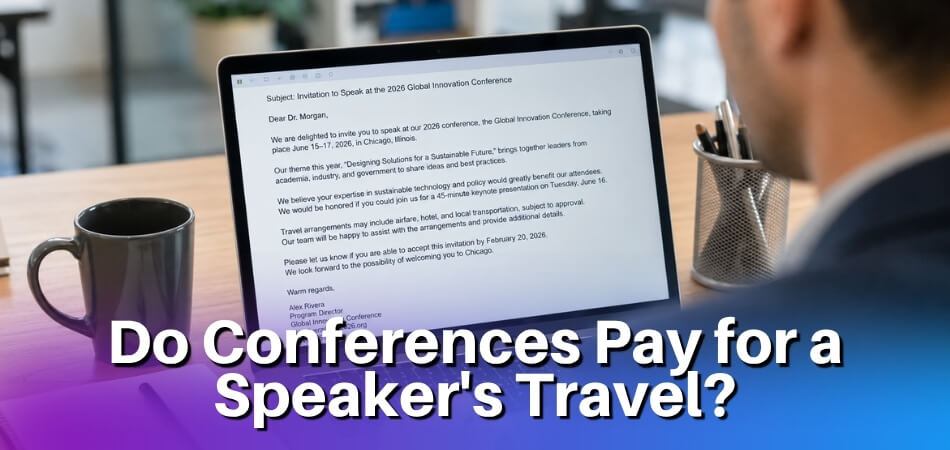
An invitation to speak often arrives with warm words and very few details about money. It is easy to say yes first and find out later that the flight and the hotel are your problem.
Quick answer: Sometimes. Conferences usually pay travel for keynote and invited speakers, while regular paper presenters, panelists and poster presenters typically cover their own flights and hotel, and often pay registration too. Support varies by role, budget and event type, so never assume it. Ask before accepting, and get the covered costs, caps and payment timing in writing.
Last verified against official sources: October 2026.
Being invited to speak is exciting, but one practical question comes right after the thank-you email: who pays for the trip? Flights, hotel, meals, local transport, visa costs and registration add up fast, especially when you travel across borders.
Coverage depends on the speaker’s role, the conference budget, the event type and whether you are local, domestic or international. A keynote at a large business event may get a full package. A panelist may get only a free pass. An academic presenter often relies on university money, a research grant or personal funds. Some organizers book travel directly, others reimburse after the event.
This guide covers who gets support, what can be covered, how reimbursement works, what to ask before you accept, and how to avoid surprise bills.
When Conferences Cover Speaker Travel
Conferences pay for speaker travel mainly when the speaker is invited, featured or central to the event’s success. That means keynote speakers, invited experts, workshop leaders and high-profile guests.
There is no universal rule. Some events offer full coverage, some partial support, and many expect speakers to self-fund. A few societies and meetings publish their approach, with real limits, and the examples further down show how different they can be. Read the policy of the specific event before you assume anything.
Common arrangements include:
- Full coverage: flights, hotel, meals, local transport and registration are covered.
- Partial coverage: the conference pays selected costs, such as the hotel or capped airfare.
- Reimbursement: the speaker pays first and submits receipts later.
- Direct booking: the organizer books flights or hotel.
- No coverage: the speaker, employer, university or sponsor pays.
The safest rule is simple: never assume travel is covered just because you were invited to speak.
Who Is Most Likely to Get Travel Paid For?
Speakers are more likely to receive support when their presence attracts attendees, strengthens the program or adds major value. Travel budgets are usually kept for people central to the agenda.
| Speaker type | Travel usually covered? | Often offered instead |
| Keynote or headline guest | Most likely, in full or part | Hotel, transfers, sometimes a fee |
| Invited expert or workshop leader | Possible, often in the agreement | Fee, honorarium or combined package |
| Panelist or moderator | Less likely | Free event pass, speaker badge |
| Academic or paper presenter | Usually not | Possible student or early-career grant |
| Company representative | The employer usually pays | Free registration |
Keynote speakers and headline guests
Keynote speakers are the most likely to receive full travel coverage. Conferences use them to build credibility, promote the event and increase attendance.
A keynote package may include round-trip airfare, hotel, airport transfers, meals, registration and sometimes a separate speaking fee. Even so, confirm limits, booking rules and reimbursement timelines before agreeing.
Invited experts and workshop leaders
Invited experts, trainers and workshop leaders may receive travel support when their session needs specialized knowledge. This is common for technical training, executive workshops and paid learning sessions.
Travel may be paid separately or folded into a speaker agreement. Ask whether the payment is a speaker fee, honorarium, travel reimbursement or a combined package.
Panelists, moderators and session speakers
Panelists and moderators often receive less than keynote speakers. Many conferences offer a free event pass, speaker badge or limited access instead of flights and hotels.
A featured panelist, such as an executive, public figure or recognized subject expert, may get partial support. Other panel participants should ask directly whether airfare, accommodation or local transport is included.
Academic presenters and research speakers
Academic presenters usually pay their own travel or rely on institutional funding. At research conferences, speakers attend because a paper, abstract or poster was accepted, and acceptance does not mean the conference will fund the trip. Many events also ask accepted presenters to pay a registration fee.
Typical sources are university travel funds, department budgets, research grants, student awards and association support. Keynote speakers at academic events may be covered, but regular presenters should plan their own funding.
Company representatives
When a speaker represents a company, the employer often pays the travel costs. This is common when the talk supports brand visibility, client relationships, recruitment or thought leadership.
The conference may waive registration while the company pays for flights, hotel, meals and other expenses.
How Speaker Travel Policies Differ by Conference Type
Policies vary by conference type because each event has different funding, goals and audiences.
| Conference type | Common travel practice |
| Corporate, business and tech events | More likely to cover keynote and expert travel |
| Academic conferences | Often expect presenters to self-fund, except keynotes |
| Nonprofit and association events | May offer limited stipends, grants or free registration |
| Trade shows and expos | Depends on whether the speaker is invited, sponsored or vendor-linked |
| Virtual conferences | Usually no travel support, but may offer fees or technical stipends |
Corporate, business and tech conferences
Corporate and technology conferences are more likely to pay speaker travel, because ticket sales, sponsorships and exhibitor fees fund larger budgets. Support still is not equal. A headline speaker may get full coverage while a breakout speaker gets free entry.
Academic and research conferences
Academic conferences usually put their money into the program, publication process and venue rather than presenter travel. Researchers, students and paper presenters often need outside funding.
Some events cover keynote speakers, plenary speakers, invited chairs or distinguished guests, and some offer travel grants for students or early-career researchers.
Nonprofit, association and community events
Nonprofit and association conferences often have limited speaker travel budgets. They might offer free registration, a small stipend, shared accommodation, local mileage or partial reimbursement.
Support may be need-based, aimed at students, underrepresented speakers, international participants or speakers with little institutional backing.
Trade shows and industry expos
Trade shows may cover travel when the speaker adds strong audience or industry value. A featured expert may be supported, while a sponsor or vendor speaker is usually paid for by their own company.
Clarify whether your session is an invited talk, sponsored session, exhibitor presentation, panel appearance or paid workshop, because session type often decides coverage.
Virtual and hybrid conferences
Virtual conferences usually do not pay travel because none is needed. Speakers may instead be offered payment, a technical stipend, or access to sessions and recordings.
Hybrid events depend on format. If you must attend in person, travel support may apply. If you join online, support shifts toward payment, technology or event access.
What Speaker Travel Costs Conferences May Cover
Support may include transportation, accommodation, meals, local travel, visa help and registration, but it depends on the speaker agreement, not assumptions.
| Cost | Often covered? | Notes |
| Flights or trains | Sometimes | Usually economy class with a cap |
| Hotel accommodation | Often for invited speakers | Usually approved nights only |
| Local transport | Sometimes | Airport transfers, taxis, shuttle, mileage |
| Meals or per diem | Sometimes | May be replaced by event-provided meals |
| Visa fees | Sometimes | More common for invited international speakers |
| Registration fee | Often | Free registration is not the same as travel coverage |
| Travel insurance | Rarely | Usually the speaker’s responsibility |
Flights, trains and long-distance travel
Flights or train travel are often the largest approved expense. When covered, most conferences pay for standard or economy travel. Premium seats, extra stops, upgrades and personal route changes usually need written approval.
Confirm the travel cap, approved route, baggage rules, booking deadline and who books the ticket.
Hotel accommodation
Hotel coverage usually applies only to the nights needed for the speaking commitment. That may be the night before the talk, the night of the talk, or the full event if you must attend several days.
Standard rooms are usually covered. Upgrades, minibar charges, guest expenses, early arrivals, late departures and vacation extensions are often excluded. If you extend the trip for personal reasons, assume the extra nights are yours.
Local transportation
Local transportation may be covered when it is directly tied to the event. That can mean airport transfers, taxis, rideshares, shuttles, public transport, parking or mileage.
Rental cars usually need advance approval. Sightseeing, unrelated meetings and extra stops are normally not reimbursed.
Meals, per diem and allowances
Some conferences provide meals, reimburse them or offer a fixed daily allowance. If meals are already part of the program, outside meal reimbursement may not apply. Ask whether tips, room service, alcohol, snacks and meals outside approved dates are covered.
Visa fees and documentation
International speakers may receive visa support, but visa fee coverage is not automatic. A conference may provide an invitation letter without paying application fees, courier fees or appointment costs. Ask what happens if a visa is delayed or denied after plans are made.
Registration and event access
Many conferences waive the registration fee for invited speakers. This may include sessions, networking areas, exhibitions or recordings.
However, free registration is not travel coverage. You can hold a complimentary pass and still owe for flights, hotel, meals and transport.
Full Coverage vs Partial Coverage vs No Coverage
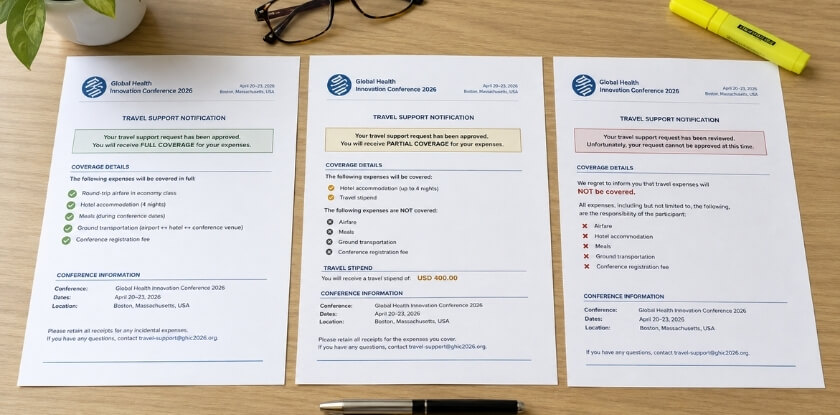
Support usually falls into three categories: full, partial or none. Make the organizer define these terms before you accept.
Full travel coverage
Full coverage means the conference pays the main costs needed for you to attend and deliver the session. That may include airfare, hotel, local transport, meals, registration and visa-related support.
Even full coverage may have limits, such as economy flights only, standard rooms only, set travel dates or a fixed meal allowance.
Partial travel support
Partial support means the conference pays only selected expenses. This is common when budgets are tight or several speakers share the funds. Examples:
- Hotel covered, flights paid by the speaker
- Airfare reimbursed up to a fixed amount
- Free registration and meals only
- One hotel night instead of the full stay
- A flat travel stipend
- Airport pickup but no airfare support
Partial support still helps, but work out the remaining cost before you accept.
No travel coverage
No coverage means the speaker pays personally or finds outside funding. This is common for academic presenters, poster presenters, panel applicants, early-career speakers and open-call participants.
Self-funding can be worthwhile when the event offers real professional value, networking, publication opportunities or business leads. Be careful if an event asks for high fees without clear value or credible details.
Travel Reimbursement vs Direct Booking
Conferences usually manage travel through reimbursement or direct booking, and each puts different duties on you.
Direct booking
Direct booking means the conference arranges and pays for approved travel before the event. That may cover flights, hotel rooms, airport transfers or shuttles.
You avoid upfront costs and the organizer controls pricing and logistics. Still check names, dates, routes, arrival times, hotel details and baggage rules carefully.
Reimbursement
Reimbursement means the speaker pays first and is repaid after submitting documents. It is common when speakers manage their own travel.
You usually need receipts, proof of payment, travel dates, bank details and a completed form. If you book outside the approved policy, the conference may refuse full payment. Reimbursement is rarely immediate, so ask about timelines before accepting.
Records to keep
Keep copies of:
- Flight or train tickets
- Hotel invoices
- Taxi, rideshare or transit receipts
- Meal receipts, if approved
- Visa payment proof, if approved
- Currency conversion records
- Reimbursement forms
- Written approval emails
Speaker Fees, Honorariums, and Travel Support: What’s the Difference?
Speaker fees, honorariums and travel support are separate items, and a conference may offer one, several or none. Fees are a topic of their own, so this section stays short.

Travel reimbursement
Travel reimbursement pays back approved event-related expenses. It is not payment for your time. It covers costs such as flights, hotel, transport, meals or visa fees.
Speaker honorarium
An honorarium is a modest payment that recognizes the speaker’s contribution. It is common at academic, nonprofit, association and community events, and may come with or without travel coverage.
Speaking fee
A speaking fee is professional compensation for a keynote, workshop, talk or training session. It is more common for professional speakers, consultants, authors, trainers and recognized experts. Some quote an all-inclusive fee with travel built in. Others charge a fee plus expenses. The agreement should say which.
How Much Do Conferences Usually Pay Toward Speaker Travel?
There is no fixed amount, because support depends on distance, location, event size, speaker role, accommodation costs and funding. Rather than trust averages, focus on the written travel limit in your invitation or agreement.
Domestic travel support
Domestic support may include airfare, train fare, mileage, hotel nights or a flat stipend. A local speaker may need only parking or mileage, while someone crossing the country needs flights and a room.
The conference may set a cap, such as a maximum airfare or a limited number of hotel nights. Anything above it is yours.
International travel support
International support is usually more selective because costs are higher. Conferences often reserve it for keynote speakers, featured experts or speakers with unique value to the program.
International speakers should confirm airfare limits, visa support, hotel nights, local transport, payment currency and the reimbursement method before booking.
Examples from published speaker policies
Published policies show real limits, and they differ from one event to the next. Two examples, both read on the organisers’ own pages:
- SCNP annual meeting, 2024: registration was waived for invited speakers, and tourist-class travel was refunded up to EUR 600 (EUR 1000 for non-European speakers), including local transport. Hotel nights were limited to two days for European speakers and three for US speakers. No honorarium was offered.
- ACS Division of Organic Chemistry symposium guidelines: for academic, government and non-profit speakers, economy airfare, two hotel nights and airport ground transport, with $4,000 available per half-day session. The guidelines say industrial speakers are typically not eligible.
Treat these as examples of how caps work, not as averages. Your own invitation or agreement is the only figure that counts.
Hotel and meal support
Hotel and meal support usually applies only to approved conference dates. If a speaker extends the trip for personal reasons, the extra cost is usually not covered. Meal support may come through event meals, reimbursement, vouchers or a per diem, so ask what is included and what is excluded.
How to Ask a Conference About Travel Support
The best time to ask is before you formally accept the invitation. Asking early is professional and prevents confusion on both sides.
What to ask
Useful questions include:
- Does the conference cover speaker travel?
- Are flights or train tickets included?
- Is hotel accommodation provided, and for how many nights?
- Are meals or a per diem included?
- Is local transportation covered?
- Are visa costs covered for international speakers?
- Does the organizer book travel, or do I pay first?
- Is there a reimbursement cap?
- What receipts are required, and when will reimbursement be processed?
- Is there a speaker fee or honorarium?
Professional wording
You can ask politely without sounding demanding. Two short options:
Thank you for the invitation. Before I confirm my participation, is travel or accommodation support available for speakers?
I would be glad to discuss the session. Could you let me know what speaker expenses are covered and how the booking or reimbursement process works?
Sample email requesting speaker travel support
Subject: Question About Speaker Travel Support
Hello [Name],
Thank you for inviting me to speak at [Conference Name]. I appreciate the opportunity and would be happy to learn more about the session.
Before I confirm, could you please let me know whether the conference provides travel and accommodation support for speakers? I would also appreciate details about covered expenses, booking arrangements, reimbursement limits and payment timelines.
Thank you again for considering me.
Best regards,
[Your Name]
How to Negotiate Speaker Travel Support Without Sounding Demanding
Negotiating means discussing practical costs clearly, not making demands. Be polite, specific and flexible.

Instead of saying “I need everything covered,” try:
To plan properly, could you let me know what travel support is available for invited speakers?
If full coverage is not possible, ask about partial options:
- Hotel accommodation
- Airfare reimbursement up to a set limit
- Airport transfer
- Meal allowance
- Free registration
- A small travel stipend
- Virtual participation, where the event offers it
A useful follow-up is:
If full travel coverage is not available, would partial support for hotel accommodation or airfare be possible?
You can also offer alternatives, such as joining virtually, shortening the stay, choosing a lower-cost route, or taking hotel support instead of airfare. Once anything is approved, get written confirmation before you book.
Travel Grants and Alternative Funding Options for Speakers
If the conference cannot pay, outside funding can still make the trip possible. This is common for researchers, students, early-career professionals, nonprofit speakers and international presenters.
- University travel funds: for research presentations, academic networking or department representation.
- Employer funding: for business development, brand visibility, training or professional growth.
- Professional association grants: for members, students, early-career professionals or field representatives.
- Conference travel grants: for speakers with financial need, accepted papers or underrepresented participation.
- Research grants and bursaries: for project-related conference travel.
- Sponsors or partners: for speakers representing a project, organization or professional community.
Check eligibility, deadlines, required documents and reimbursement rules before relying on any of them.
What Conferences Expect When They Pay for Speaker Travel
When a conference pays, it expects you to follow the approved policy and keep your commitments. Common expectations:
- Booking within approved limits, dates and routes
- Staying at the approved hotel
- Submitting receipts on time
- Attending the scheduled session
- Joining required rehearsals or briefings
- Following event rules and professional standards
Do not book upgrades, extra nights, rental cars or personal extensions unless the organizer approves them in writing.
If flight delays, illness, visa problems or emergencies change your plans, contact the organizer quickly. Early communication protects the schedule, the budget and your reimbursement.
Red Flags Before Paying to Speak or Accepting an Invitation
Be cautious when a conference asks for money, avoids clear details or cannot verify its claims. A legitimate event is open about its organizers, venue, schedule, speaker expectations, fees and policies.
Warning signs include:
- High fees required before clear details are shared
- Generic invitation emails with excessive praise
- Pressure to accept immediately or pay quickly
- Very broad or unrelated conference topics
- Unclear organizer identity
- Missing venue or schedule details
- Speaker names or sponsors that cannot be verified
- Poor communication about refunds or travel support
- Only a free pass or discount offered, with no clear answer when you ask about travel
- Use of your name before you confirm participation
Organizers should also verify speakers. Warning signs include unverifiable credentials, vague job titles, unrelated expertise, unsupported award claims, incomplete proposals or unusual payment requests.
Before accepting, check the organizer, venue, past events, sponsor claims, agenda, refund policy and speaker agreement. If the event still feels unclear or risky, decline or offer a virtual session instead.
Are Speaker Travel Expenses Tax Deductible?
They may be, when the trip is directly connected to professional, academic or business activity, but the rules depend on your country, employment status, income type and reimbursement.
Self-funded expenses can include flights, hotel, local transport, meals, registration, visa costs or presentation materials. If the trip mixes business and personal travel, you may need to separate the two. Fees and travel can also be treated differently: one US university tax guide (Vanderbilt) says travel expenses for conference speakers and panelists are non-taxable business expenses, while honoraria and speaker fees are taxable income. Other countries and situations differ.
Keep receipts and invoices, proof of payment, your invitation or acceptance email, the agenda showing your session, the speaker agreement, travel dates, reimbursement records and a note explaining the professional purpose. This section is not tax advice. Consult a qualified tax professional before claiming conference travel expenses.
Quick Checklist Before Accepting a Speaking Invitation
Before accepting, confirm travel terms, payment details, session expectations and cancellation rules in writing. The travel questions are listed earlier, so these cover the rest.

Payment and reimbursement
- Is travel reimbursement separate from any fee?
- Which expenses are capped?
- What payment method and currency will be used?
- Who handles travel questions?
Session and schedule
- What is the confirmed session date and time?
- What is the session format and how long is the talk?
- Who is the audience?
- Are slides required in advance?
- Is a rehearsal or briefing required?
- Is full conference attendance expected?
Contract and cancellation
- Is there a written agreement?
- What happens if the event is postponed or moves online?
- Who pays for non-refundable costs if the event cancels?
- What happens if the speaker must cancel?
- Can the conference record or reuse the session?
From our experience at MS International: For most applicants, the route to the programme is the presenting-author track: submit your work, receive a decision, and register as an author if accepted. Keynote and invited roles are arranged separately with our team and are not obtained by buying an author ticket. Speakers cover their own travel, accommodation, visa and personal costs unless we have agreed otherwise in writing, and participation creates no entitlement to an honorarium or reimbursement without written confirmation. All our conferences are held in person in the Greater Toronto Area, so raise any travel concern before you submit.
FAQs About Conference Speaker Travel Payment
Whether a conference pays your fare depends on details like being a panelist or keynote, an academic setting, bringing a guest and booking before written approval arrives.
Do conferences always pay for keynote speaker travel?
No, but keynote speakers are the most likely to receive support. Large conferences may cover flights, hotels, meals and local transport, often within a cap. Smaller events may offer only partial support, so get the terms in writing.
Can a speaker ask for travel support after being invited?
Yes, you can ask after receiving an invitation. The best time is before accepting, signing an agreement or booking travel. Asking early is normal and professional.
Do conferences pay travel for panelists?
Some do, but many do not. Panelists often get free registration or limited access instead. Featured panelists or invited experts may receive more.
Do academic conferences pay speaker travel?
Usually not for regular presenters; invited and keynote speakers are the most likely to be supported. Regular presenters use university funds, grants or personal budgets. Where support exists it often has a cap, so check the event’s speaker policy.
Are international speakers more likely to receive travel support?
Only when their presence is important to the program; it is never automatic. International travel is expensive, so organizers often save funding for keynotes or high-value sessions. Some policies set a higher cap for long-distance speakers, but a cap is still a limit, not full cost.
Can speakers bring a guest if the hotel is covered?
Usually the conference does not pay for a speaker’s guest. Extra guest charges, room upgrades, meals and companion travel are normally yours unless approved in writing.
What happens if a speaker cancels after travel is booked?
It depends on the agreement. If the conference booked the travel, it may cover, cancel or transfer the booking. If you paid first, reimbursement depends on the policy and the reason for cancelling.
Do virtual speakers receive payment instead of travel support?
Often yes, in the form of a fee, honorarium or technical stipend, or just free event access. With no travel, some events direct support toward payment or online presentation needs.
Should speakers book travel before receiving written approval?
No, wait for written approval first. It should state covered costs, spending caps, approved dates, receipt rules and reimbursement deadlines.
Is free registration the same as travel coverage?
No, free registration only removes the entry fee. Travel coverage pays for flights, hotels, meals, transport or visa costs.
Conclusion
Conferences do pay for speaker travel in some cases, but coverage depends on your role, the event budget, the conference type and what was agreed before acceptance. Keynote speakers, invited experts and workshop leaders are most likely to get full or partial support. Regular presenters, panelists and academic speakers often receive a free pass or nothing.
Ask early and get the details in writing. A speaking invitation is valuable, but it should not create an unexpected bill.