
An invitation letter sounds simple until you try to get one. Who should write it, what should it say, and does the host need to prove anything? Many applicants lose time on these small questions, so this page sorts them out in order.
Quick answer: To get an invitation letter for Canada, ask your host (a citizen, permanent resident, permit holder, company, conference organizer or university) to write and sign a letter with your details, the purpose of the trip, travel dates, where you will stay, who pays, and when you will leave. Attach proof of the host’s status. IRCC does not always require the letter, and it never guarantees a visa.
Fact-checked by the MS International Editorial Team. Last verified against official sources: October 2026.
An invitation letter is only one supporting document. Your application must still show a genuine temporary purpose, enough funds, clear travel plans, and good reasons to return home. Conference organizers write these letters often, and the problems are usually the same: a name that differs from the passport, dates that do not match the registration, or an unclear payer.
What Is a Canadian Invitation Letter?
A Canadian invitation letter is a signed statement from a person or organization in Canada inviting a foreign visitor for a temporary stay. It helps the visa officer understand why you are travelling and who you are connected to in Canada.
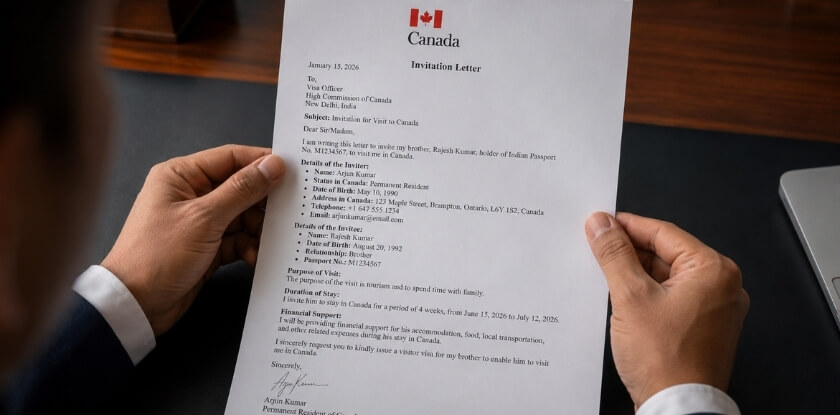
The letter can explain your reason for travel, the host’s role and your stay plan. It cannot replace proof of funds, home-country ties, travel history or employment documents. Officers review the full file.
Who Can Write an Invitation Letter for Canada?
The host needs a clear legal presence in Canada and a real connection to your purpose of travel. The right host makes the letter credible.
Canadian Citizens and Permanent Residents
A citizen or permanent resident can invite relatives, friends or personal visitors. IRCC asks the host to include a photocopy of their proof of status. The accepted examples are in the table in the documents section below. The letter should not suggest that the visitor plans to settle in Canada through a visitor visa.
Work Permit or Study Permit Holders
Someone with a valid work or study permit can invite a spouse, parent, sibling or friend for a short visit. They should attach a copy of their permit and passport, address proof and employment or enrollment confirmation. Your stay should be reasonable compared with their own authorized stay.
Canadian Companies and Employers
A company can invite business visitors for meetings, training, site visits, trade shows or contract talks. Use company letterhead and include the visitor’s name and job title, meeting dates, who pays, and confirmation that the visitor will not take employment in Canada. IRCC also asks for the company’s headquarters address, the addresses of the places the visitor will go, its website if it has one, and a short description of the business and its relationship with the visitor. The company should send each visitor two originals: one for the visa application and one to show when entering Canada.
Conference and Event Organizers
An organizer can invite registered attendees, speakers, presenters, panelists, exhibitors or delegates. The letter names the event, dates, venue, participant role, registration status and any financial support, and says the visitor comes for the event only. Organizers who write a conference visa invitation letter put it on official letterhead and have it signed by someone authorized to confirm the invitation.
Universities and Research Institutions
An academic institution can invite researchers, guest speakers, visiting scholars and seminar participants. The letter gives the institution and department, the visitor’s role, activity dates, a contact person and any funding.
How to Get an Invitation Letter from Canada: Step-by-Step Process
You get the letter by choosing the right host, giving them accurate details, and checking the finished letter against your application.
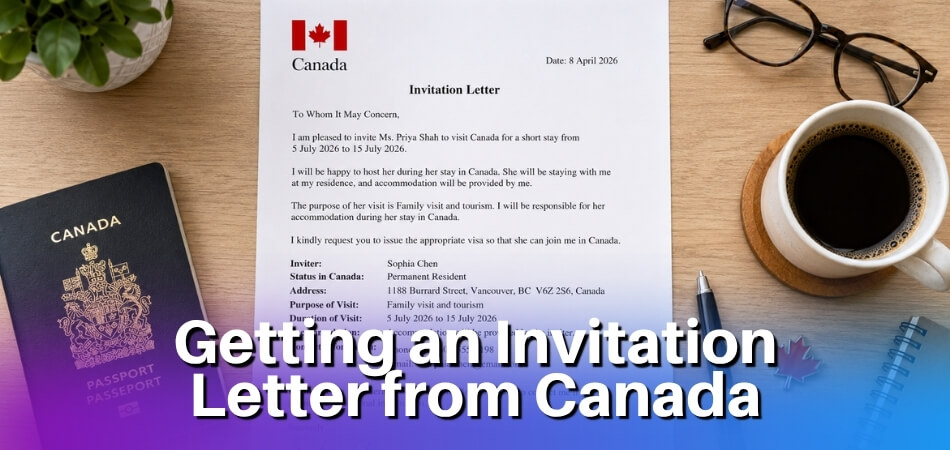
Step 1: Identify the Right Canadian Host
Choose the host from the list above whose role matches your purpose. For a Super Visa, that is your child or grandchild in Canada. A letter from someone unrelated to your trip adds little value.
Step 2: Confirm a Specific Purpose
Avoid broad wording such as “personal visit”. Write “visiting my brother in Toronto for three weeks”, “attending a healthcare conference in Vancouver” or “presenting a paper at an academic event”. The same purpose must appear in your forms, itinerary and supporting documents.
Step 3: Send the Host Accurate Information
Give the host your full name exactly as on your passport, date of birth, passport number, nationality, address, phone and email, relationship to the host, travel dates, length of stay, purpose, accommodation plan and expense arrangement. For conference, business or academic travel, add your job title, organization, and registration or presentation confirmation.
Step 4: Ask the Host to Write and Sign the Letter
The letter should be formal, simple and easy to verify. IRCC’s guidance is written for the person doing the inviting, so the host writes and signs the letter and you only supply the facts. Companies, universities and organizers should use official letterhead. The next section lists what to include.
Step 5: Attach Proof of Host Status and Purpose
The host attaches proof of status, and you add documents that match the purpose of the trip. The full lists are in the documents section below.
Step 6: Check and Upload
Make sure names, dates, addresses, passport numbers and financial details match your application forms. Save the letter and attachments as clear PDF files and upload them in the supporting documents section of your application.
Information That Must Be Included in a Canada Invitation Letter
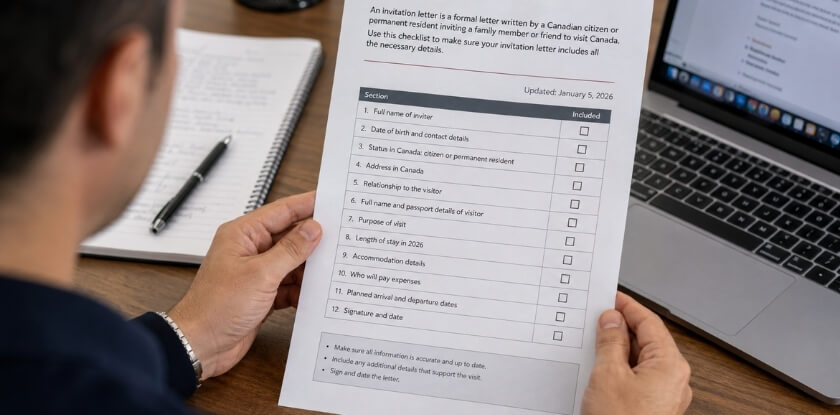
The letter must identify the visitor, confirm the host, explain the reason for travel, describe the stay, and say who pays. IRCC’s letter of invitation page lists these items for a family or friend invitation. Missing details weaken the letter.
Visitor and Host Details
- Visitor: full name, date of birth, passport number, nationality, address, phone, email, relationship to the host
- Individual host: full name, date of birth, Canadian address, phone, email, job title or study status, legal status in Canada, and the names and dates of birth of any spouse and dependants
- Organization: legal name, Canadian address, contact person and title, and official role in the invitation
For professional or academic travel, add the visitor’s job title, organization, event role or registration status.
Travel Dates and Length of Stay
State the arrival date, departure date and total duration. Avoid open-ended phrases like “as long as needed”. Good examples: “from June 5, 2027, to June 18, 2027” or “for the conference period from July 10 to July 12, 2027”.
Accommodation Details
Say where the visitor will stay: the host’s home (full address), a hotel (confirmed details), university housing or company lodging.
Financial Responsibility
Explain who pays for travel, accommodation, meals, local transport, insurance and daily costs. Typical arrangements are visitor pays everything, host provides accommodation only, host covers all costs, employer pays, organizer covers selected costs, or costs are shared. If the host pays, attach their financial proof. If the visitor pays, the visitor shows proof of funds.
Temporary Visit Statement
State that the visitor is expected to leave Canada after the visit. Keep it natural and consistent with the rest of the application.
Canada Invitation Letter Requirements by Travel Purpose
Each type of trip needs different details, so match the letter to the real purpose.
Family or Friend Visit
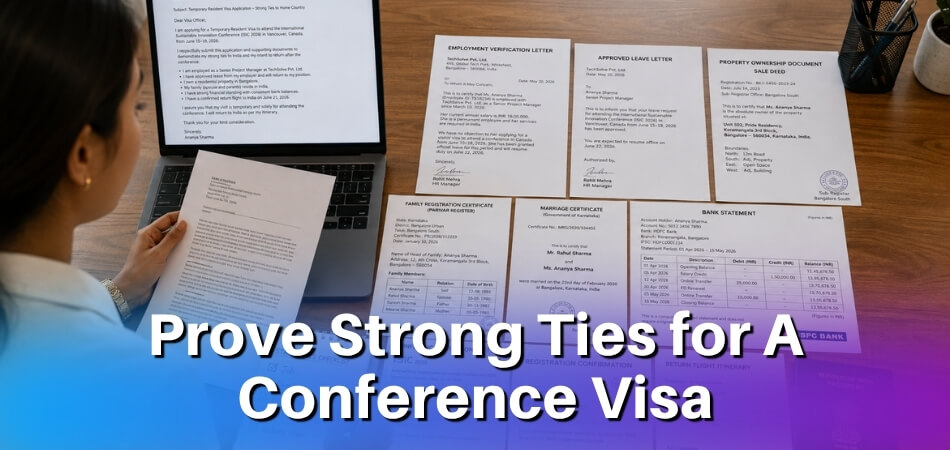
Explain the relationship, purpose, stay address, dates and who pays. Add proof of the relationship when available, such as birth or marriage certificates or communication history.
Tourism
A letter helps only if you meet or stay with someone in Canada. If you are sightseeing and staying in hotels, a clear itinerary matters more.
Business Visit
Add the meeting schedule and the visitor’s role to the company letter, and make clear that the visitor is not coming to work in Canada.
Academic or Research Visit
The letter can also come from a supervisor or event organizer, and should state the academic purpose, location and funding.
Super Visa for Parents and Grandparents
See the Super Visa section below. The requirements are stricter than for a regular visit.
Super Visa Invitation Letter Requirements
A Super Visa letter must come from your child or grandchild and promise financial support for the whole visit. IRCC also requires a list and the number of people counted in the host’s family size. A Super Visa can allow a stay of up to 5 years at a time.
Host Eligibility and Income
The host must be a Canadian citizen, permanent resident or registered Indian, at least 18, and living in Canada. You must prove the host is your biological or adopted child or grandchild. The host must also meet IRCC’s minimum necessary income for their family size, shown with documents such as tax records, employment letters, pay slips or bank statements. The income figures change, so check the current table on the IRCC website.
Medical Insurance
You, the applicant, must have medical insurance valid for at least one year from the date of entry, from a Canadian insurance company or a company approved by the minister. The letter can say that insurance is arranged or will be submitted. You must also complete an immigration medical exam.
Documents the Host Should Include
- Proof of citizenship or permanent residence
- Proof of relationship
- Income documents
- Signed support statement
- Proof of address and household details
Household details in the letter must match the income proof and the application.
Documents to Attach With a Canadian Invitation Letter
Attach only documents that confirm what the letter says. The exact set depends on the host’s status and the purpose of the trip.
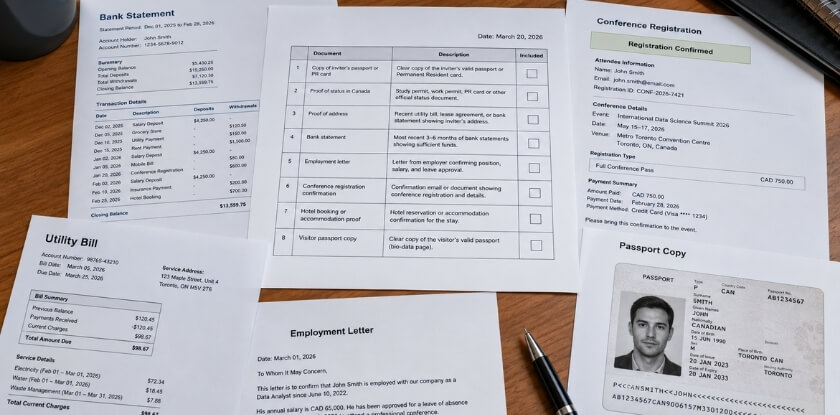
From the Host
Which proof the host attaches depends on their status.
| Host | Proof to attach | Also attach |
|---|---|---|
| Canadian citizen or permanent resident | Photocopy of one status document IRCC lists: Canadian birth certificate, citizenship card, PR card, IMM 1000 proof of landing, or Certificate of Indian Status | Proof of address. Employment letter, pay slips, bank statements or tax documents if the host pays |
| Work or study permit holder | Copy of the permit and passport, valid for your whole visit | Proof of address, and employment or enrollment confirmation |
| Company, university or organizer | Letter on official letterhead, signed by an authorized representative | Business records or financial proof if the organization pays |
From the Visitor
- Valid passport and application forms
- Proof of funds
- Employment, business or student documents
- Travel history and itinerary
- Relationship proof, if relevant
Extra Documents for Business, Academic or Conference Travel
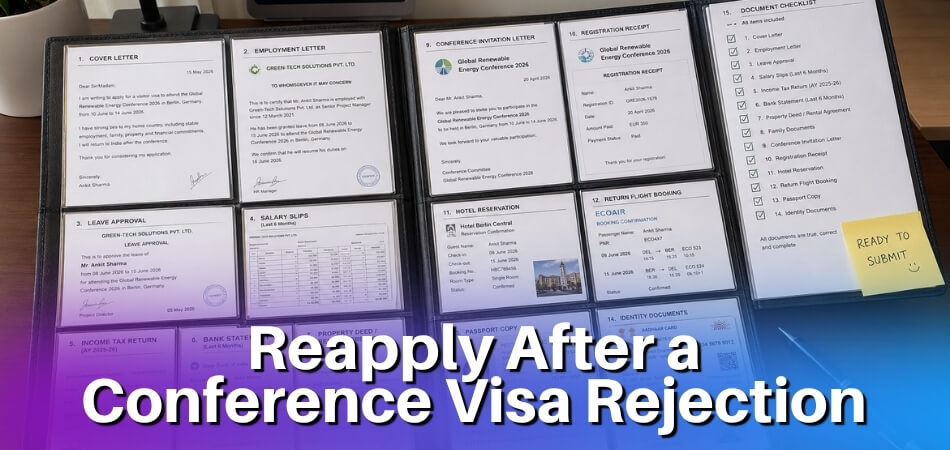
Business: meeting agendas, company documents and an employer support letter. Academic: institutional invitation, seminar details or research schedule. Conference: registration confirmation, payment receipt, agenda, speaker acceptance and organizer contact details.
Canada Invitation Letter Format
Keep the format simple: one clear page in a logical order, signed by the host.
Recommended Structure
- Host name, address, phone and email
- Date of writing
- Greeting to the visa officer
- Visitor’s full details
- Purpose of invitation
- Travel dates and stay plan
- Accommodation details
- Financial responsibility
- Host’s legal status and attached proof
- Temporary visit statement
- Signature and contact details
Length, Tone, Letterhead and Notarization
Most letters fit on one page. Super Visa and complex business letters may run longer. Use a formal, direct and honest tone, without emotional requests or exaggeration. Organizations use official letterhead, and the signatory adds their title and authority, while a signed personal letter is usually enough for family or friends. IRCC says some visa offices may require a notarized letter, so ask the visa office that handles your application. Notarization does not guarantee approval.
Invitation Letter Templates for Canada
Use these as starting points and replace every bracket with real, verifiable details. Do not copy a template blindly.
Conference Invitation Letter Template
[Organizer Name]
[Address]
[Phone | Email]
Date: [DD Month YYYY]Dear Visa Officer,
This letter confirms that [Participant Full Name], passport number [Passport Number], has been invited to attend [Event Name] in [City, Province], Canada, from [Start Date] to [End Date].
The participant’s role is [attendee/speaker/presenter/delegate]. Registration status is [registered/confirmed/paid], with confirmation ID [ID], if applicable.
The event will take place at [Venue Name and Address]. The purpose of the visit is to participate in event-related activities only.
Expenses will be covered by [participant/employer/organizer]. This invitation does not authorize employment in Canada. The participant is expected to leave Canada after the event.
Sincerely,
[Name]
[Title]
[Organization]
[Signature]
Family or Friend Visit Invitation Letter Template
[Host Full Name]
[Canadian Address]
[Phone | Email]
Date: [DD Month YYYY]Dear Visa Officer,
I, [Host Full Name], born on [Date of Birth], invite [Visitor Full Name], passport number [Passport Number], to visit me in Canada from [Start Date] to [End Date].
The visitor is my [relationship]. The purpose of the visit is [family visit/friend visit/holiday]. During the visit, the visitor will stay at [address or hotel].
Expenses will be covered by [visitor/host/both]. I am legally residing in Canada as a [citizen/permanent resident/work permit holder/study permit holder] and have attached proof of my status.
[Visitor Full Name] will return to [Home Country] when the visit ends.
Sincerely,
[Host Name]
[Signature]
Business Invitation Letter Template
[Company Letterhead]
Date: [DD Month YYYY]Dear Visa Officer,
This letter confirms that [Company Name] invites [Visitor Full Name], passport number [Passport Number], employed as [Job Title] at [Visitor Company], to visit Canada from [Start Date] to [End Date].
The purpose of the visit is [meetings/training/site visit/contract discussion] at [location]. The visitor will attend scheduled business activities only and will not take employment in Canada.
Expenses will be covered by [visitor/visitor’s employer/inviting company].
Sincerely,
[Authorized Name]
[Title]
[Company Name]
[Signature]
Super Visa Invitation Letter Template
[Host Full Name]
[Canadian Address]
[Phone | Email]
Date: [DD Month YYYY]Dear Visa Officer,
I, [Host Full Name], invite my [parent/grandparent], [Visitor Full Name], passport number [Passport Number], to visit me in Canada under the Super Visa program.
I am a [Canadian citizen/permanent resident] living at [address]. I promise to provide financial support for the whole visit, including [accommodation/food/living expenses].
My household size is [number], made up of [names of household members]. I have attached income documents, proof of relationship, proof of Canadian status and other supporting documents. The visitor will provide proof of medical insurance.
Sincerely,
[Host Name]
[Signature]
Common Mistakes to Avoid
Check the letter against your forms, passport, itinerary and financial documents before you submit. These errors cause most problems:
- Mismatched dates: the letter, forms, itinerary, hotel booking and event schedule must agree.
- Wrong identity details: use the name, date of birth and passport number exactly as printed, with no nicknames.
- No proof of host status: a letter without status proof looks incomplete.
- Vague purpose: write “attending a conference in Toronto”, not “visiting Canada”.
- Unsupported sponsorship: if the host pays, show their finances. If you pay, say so.
- Wording that suggests a long stay: avoid any hint of moving, working or settling.
- Missing Super Visa items: income proof, insurance, relationship proof, household details and a support statement.
Is an Invitation Letter Mandatory for a Canadian Visa?
No. IRCC does not require one for every application, but it may ask for one, and it can be very helpful when a host, company, event or institution is connected to the trip. For a Super Visa, the host’s signed letter is part of the application.
It is strongly recommended for family and friend visits, host accommodation, business meetings, conferences, academic visits and speaker roles. It may be optional for tourism when you have hotel bookings, a clear itinerary, strong funds and travel history. It can also help when your travel history is limited or the purpose needs explanation. Travellers from visa-exempt countries need an eTA (CAD 7) to fly to Canada. The eTA application asks for a passport, an email address and a payment method, not a letter, and a letter does not replace the eTA.
Does an Invitation Letter Guarantee Visa Approval?
No. IRCC states that a letter of invitation does not guarantee a visa. Officers assess the whole application: travel purpose, funds, employment or studies, family ties, business ownership, travel history, past visa compliance, host credibility and length of stay.
Proof of funds shows you can afford the trip. Travel history shows past compliance. Home ties such as a job, studies, a business, property or family responsibilities show why you will return. The letter must tell the same story as the rest of your file. If it says conference, include registration proof. If the host pays, include host financial documents. If the stay is two weeks, every document should support that timeline.
Writing the letter does not make the host legally responsible for the visitor in Canada, but the host should tell the truth and plan to keep the promises in it.
How Conference Attendees Can Strengthen Their Invitation Letter
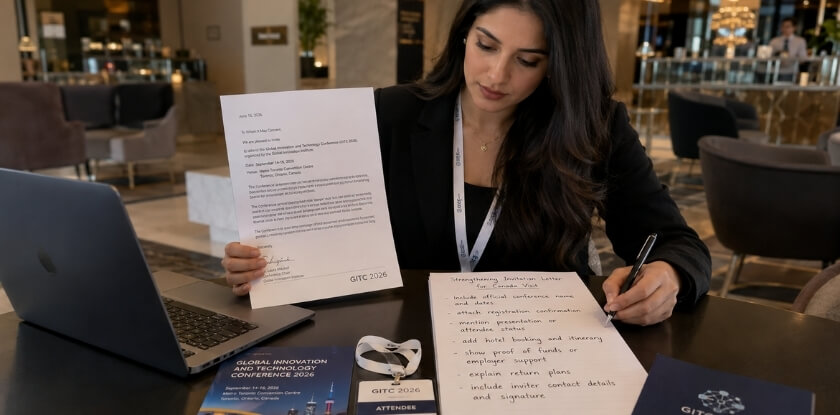
Make the letter specific to the event and your role. Confirm the event name, dates, venue, organizer and registration status.
Include Event and Participation Details
Add the full conference name, city, province, organizer contact details and website. State whether you are registered, paid, accepted or invited, with a confirmation ID where available.
State Your Role Accurately
Do not call an attendee a speaker unless the speaking role is confirmed. For presenters, add the presentation title, session date or acceptance confirmation. Explain any honorarium, travel support or accommodation the organizer provides.
Attach Event Documents and Avoid Work Language
Useful attachments are the registration confirmation, payment receipt, agenda, brochure, speaker acceptance and presenter schedule. Use event words such as attend, present, speak, exhibit or participate, and avoid anything that suggests you will work in Canada.
From our experience at MS International: when we issue a conference invitation letter, we check that the name matches the passport exactly and that the letter states the event dates, the venue and the attendee’s role. Ask the organiser to correct any mismatch before you submit your visa application, because it is easy to fix early and hard to explain later.
FAQ About Getting an Invitation Letter from Canada
Hosts writing a letter for a Canada visit run into questions about who can invite, such as a friend or work permit holder, plus notarization, PDF copies, length, covering several family members and fixing a mistake.
Can a friend invite me to Canada?
Yes. A friend who legally lives in Canada can write the letter. They need to include proof of status, your relationship, visit dates, where you will stay and who pays.
Can someone on a work permit invite a visitor?
Yes, for a reasonable short stay. They should attach their permit, passport copy, address details and employment proof if available, and check that the permit is still valid on your visit dates.
Does the invitation letter need to be notarized?
Not always. IRCC says some visa offices may require a notarized letter, so ask the visa office for your country. A signed letter with correct details and proof of host status is the base.
Can the letter be emailed or uploaded as a PDF?
Yes. The host can send a scanned signed copy, and you upload it as a clear PDF with your application.
How long should the letter be?
One page is usually enough. If a second page is needed, use it for the itinerary and who pays for what, not for repeating the request.
Can one letter cover several family members?
It can, but separate letters are clearer when applicants have different passport details, finances or travel plans.
What if the host is not paying?
That is fine. The letter should say you will cover your own expenses, and you should provide proof of funds.
Can a conference organizer issue an invitation letter?
Yes. An organizer can invite attendees, speakers, presenters, delegates, exhibitors or panelists. Many organizers issue the letter only after registration and payment, so register first and ask early.
Does an invitation letter guarantee a Canada visa?
No. IRCC says a letter of invitation does not guarantee a visa. The writer is not legally responsible for the visitor in Canada, but should tell the truth and plan to keep the promises in the letter.
What should I do if the letter has a mistake?
Have the host correct it before you submit. Do not upload a letter with wrong names, passport numbers, dates, addresses or financial details.
Final Thoughts
A strong invitation letter is short, accurate and specific, and it is backed by documents that match the full application. It helps an officer understand a genuine temporary visit but does not guarantee approval. Before you submit, ask your host or organizer to check every name, date and payer detail against your passport and forms.
Disclaimer: This article is general information, not legal or immigration advice. Visa rules, fees, and processing times change. Confirm the current requirements on the official Immigration, Refugees and Citizenship Canada (IRCC) website before you apply.