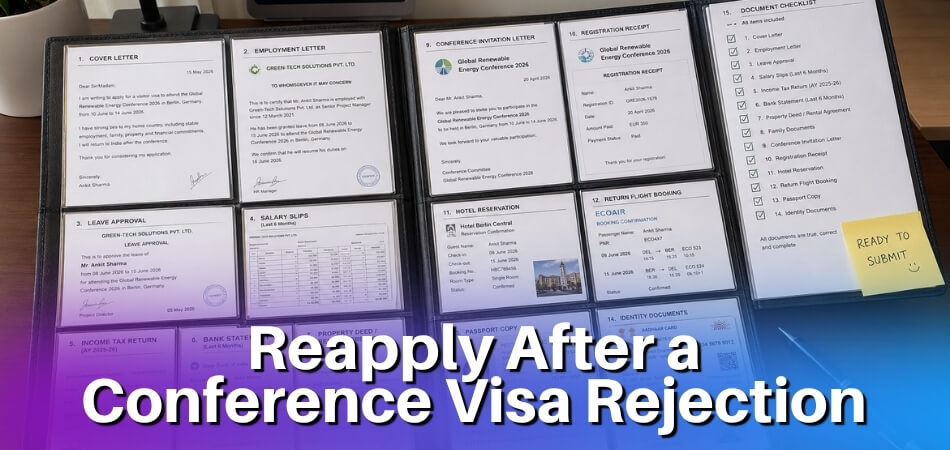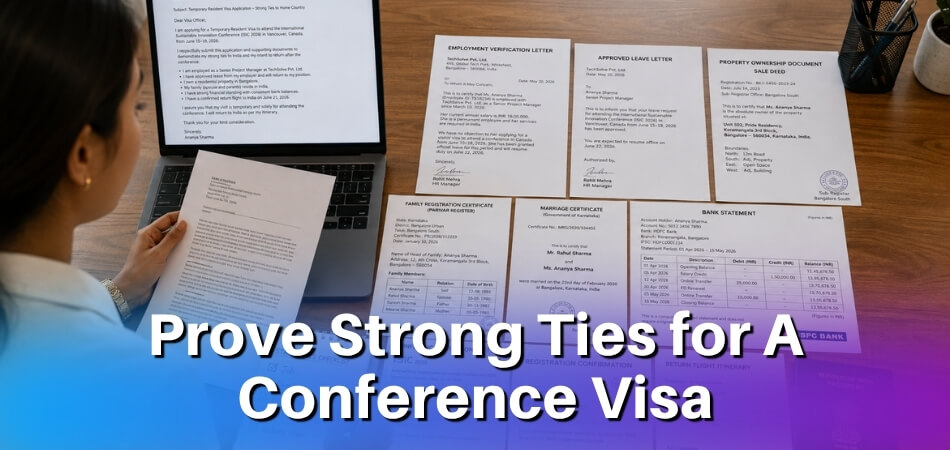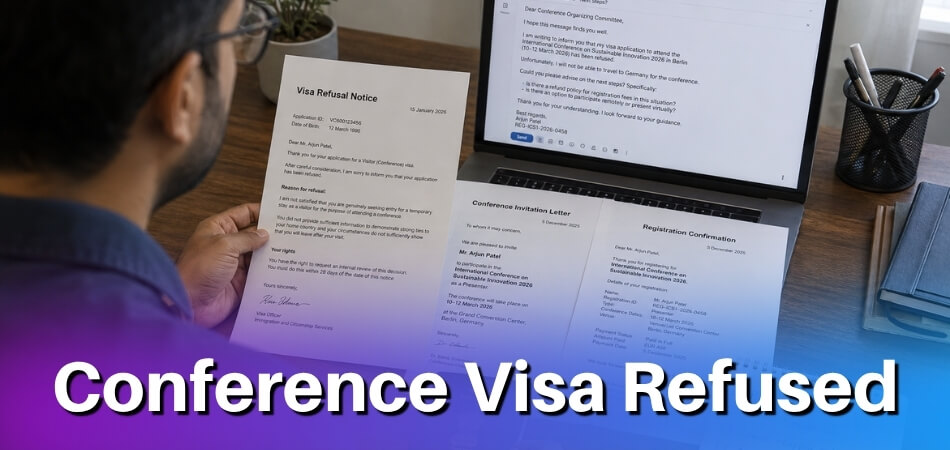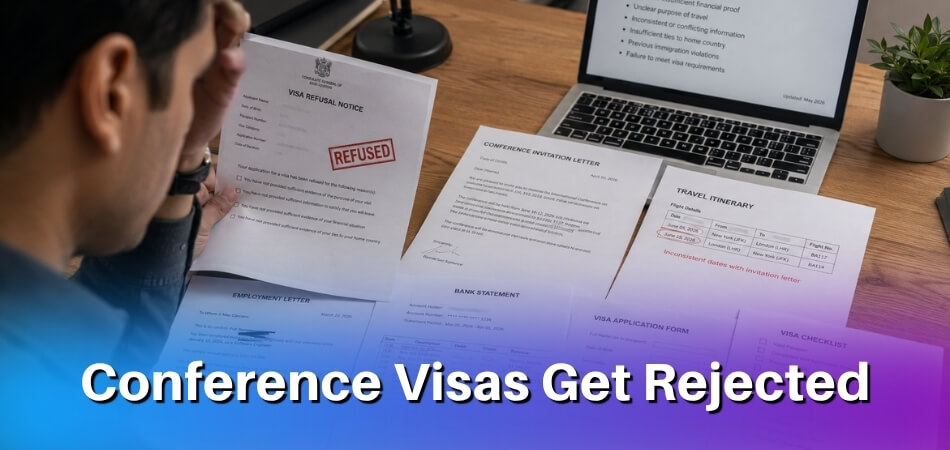

An embassy wants proof that your trip has a real purpose, and for conference travel that proof often starts with a single letter from the organizer. Writing it badly, or asking for it the wrong way, can slow everything down. Here is how to get it right.
Quick answer: A conference visa invitation letter is issued by the organizer on official letterhead. It names the attendee exactly as in the passport, gives the conference name, dates and venue, states the person’s role and who pays the expenses, lists a contact for verification, and carries an authorized signature. It supports a visa application but never guarantees approval.
Fact-checked by the MS International Editorial Team. Last verified against official sources: October 2026.
Most visa offices want proof that your trip is tied to a real event, and the organizer’s letter is the usual way to show it. This guide covers what the letter must contain, how to write it step by step, two ready templates, how an attendee should request one, and the mistakes that cause trouble at the embassy.
What Is a Conference Visa Invitation Letter?
A conference visa invitation letter is an official document from the conference organizer, host institution, association or university. It confirms that a named person is invited to attend, speak, present or take part in a specific conference.
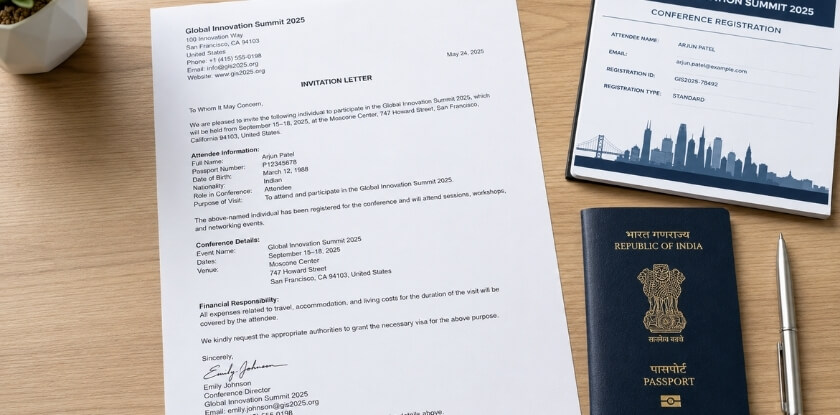
The letter links the applicant’s reason for travel to a real event. It does not replace the visa form, passport, financial proof, itinerary or any other document the embassy asks for.
Who Issues It?
The organization responsible for the conference issues it: the conference committee, host university, professional association or registered event organizer. It should be on official letterhead and signed by someone authorized to confirm the invitation.
When Do You Need a Conference Visa Invitation Letter?
You need it when the visa office asks for proof that your trip is connected to a real conference, which is most common for professional, academic, research and business travel. Request it after your registration is confirmed. Some organizers also wait for payment confirmation, speaker approval or abstract acceptance. The letter applies to attendees, keynote and session speakers, panelists, authors, poster presenters, workshop participants and sponsored delegates who must apply for a visa before travel, and even where it is not mandatory it makes the visa file more complete.
A letter is not required for every application, because embassies differ on whether they ask for one. Check the document list of your own embassy or visa center before you request it.
Attendees Applying for a Visa
General attendees use the letter to show they are traveling for a scheduled conference and nothing else. It should confirm the registration status, conference name, dates, venue and purpose of visit.
Speakers, Presenters, and Researchers
Speakers, authors and researchers need a more specific letter because their role is part of the program. It should state the official role (speaker, panelist, paper presenter, poster presenter) and, when available, the session title, paper title or academic affiliation.
Visa-Exempt Travelers Who Need Proof of Visit
A visa-exempt traveler may still be asked about the purpose of the trip by an airline, a border officer, an employer, a university or a funding body. Canada’s immigration department (IRCC), for example, tells visitors who were invited to bring the letter with them, because a border services officer may ask to see it. Here the letter confirms the event, the traveler’s role and the planned dates.
How to Write a Letter for Conference Visa Invitation Step by Step
Start with the organizer’s details, identify the attendee, confirm the conference, explain the purpose of travel and close with a signature the embassy can verify. The details must match the applicant’s passport and registration record. The finished letter should be short, formal and easy to scan, with one clear subject line such as Subject: Conference Visa Invitation Letter for [Full Name].
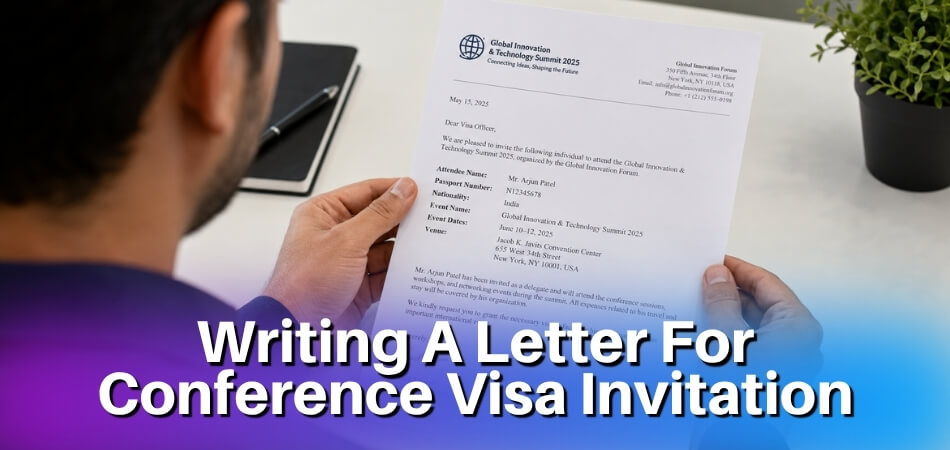
Step 1: Use Official Conference Letterhead
Show the organization name, address, phone, email and website. If there is no letterhead, put these details clearly at the top. Add the issue date.
Step 2: Address the Visa Officer or Embassy
If the exact officer is unknown, use “Dear Visa Officer,” “To the Consular Officer,” or “To Whom It May Concern,”. Keep the greeting formal.
Step 3: Introduce the Organizer and Event
Name the host organization, the conference, its city and country, the dates and the type of event (academic, medical, technology, business and so on). Skip the promotional description. The embassy only needs facts.
Step 4: Identify the Invited Participant
Give the full name as printed in the passport, nationality, passport number if appropriate, date of birth if the embassy asks for it, affiliation, and the registration ID if there is one.
Step 5: Confirm Registration or Participation Status
Say what the person is: registered attendee, invited speaker, accepted research presenter, confirmed delegate or workshop participant. For academic contributors, add the accepted paper, session, panel or presentation topic.
Step 6: Explain the Purpose of Travel
State plainly that the purpose is to attend or take part in the conference, for example to attend sessions, present research, speak, join workshops or meet peers. The purpose should match the visa type the applicant is requesting.
Step 7: Mention Travel, Stay, and Expense Details
Add expected arrival and departure dates if known, and say who pays: the attendee, employer, institution, sponsor or organizer. Mention accommodation only when it is confirmed. Do not promise financial support that is not confirmed, and if the organizer covers only some costs, list exactly which.
Step 8: Add Verification Contact Information
Give an email and phone number the conference office actually monitors, with the contact person’s name and position. A direct conference office email is better than a generic contact form.
Step 9: Close With an Authorized Signature
Close with the signature, full name, position, organization, contact details and date, plus an official stamp if the organization uses one. The signatory must have authority to issue visa support documents. Some visa offices accept a digital signature and others ask for a printed original, so the applicant should check the embassy’s rules.
Conference Visa Invitation Letter Format
A good format is simple, formal and focused on confirming facts. It should not read like a brochure.

Formal Tone and Wording Guidelines
Use short paragraphs and factual phrases such as “We confirm that…”, “This letter is issued to support…”, “The participant is registered for…” and “Please contact us for verification…”.
Never write “guaranteed entry,” “approved visa” or “fully authorized by the embassy.” The organizer cannot promise visa approval. Also avoid long paragraphs, informal greetings, unverified sponsorship claims, wrong travel dates and old conference information.
Conference Visa Invitation Letter Template
Below are two templates organizers can adapt. Replace every bracketed field with accurate event and attendee information before sending.
Standard Attendee Template
Subject: Conference Visa Invitation Letter for [Full Name]
Dear Visa Officer,
On behalf of [Organizer Name], we confirm that [Full Name], passport number [Passport Number], nationality [Nationality], is registered to attend [Conference Name].
The conference will be held from [Start Date] to [End Date] at [Venue Name], [City, Country]. The purpose of the visit is to attend conference sessions, professional discussions, and related event activities.
This letter is issued to support the participant’s visa application for the conference visit. [Full Name] will be responsible for travel, accommodation, meals, insurance, and personal expenses unless otherwise stated.
For verification, please contact [Contact Person], [Position], at [Email Address] or [Phone Number].
Sincerely,
[Authorized Signatory Name]
[Position]
[Organizer Name]
[Signature/Stamp]
Speaker or Research Presenter Template
Subject: Conference Visa Invitation Letter for [Full Name]
Dear Visa Officer,
We confirm that [Full Name], passport number [Passport Number], nationality [Nationality], has been invited to participate in [Conference Name], taking place from [Start Date] to [End Date] at [Venue Name], [City, Country].
The participant will join the official program as a [Speaker/Presenter/Author/Panelist] and will present [Session Title/Paper Title/Presentation Topic]. This letter confirms their role and supports their visa application for travel related to the conference.
Expenses for the trip will be covered by [Self/Employer/Institution/Organizer]. For verification, please contact [Contact Person], [Position], at [Email Address] or [Phone Number].
Sincerely,
[Authorized Signatory Name]
[Position]
[Organizer Name]
[Signature/Stamp]
How to Request a Conference Visa Invitation Letter From the Organizer
Most attendees do not write their own letter. They request it from the organizer after registering. A clear request saves back-and-forth, and at MS International we treat the letter as a verification document first: an embassy should be able to check every line with one email or call.
When to Request It
Ask as soon as your registration, payment, speaker approval or paper acceptance is confirmed. Do not wait until the visa appointment is close, because the organizer needs time to check your details and issue the document. Turnaround differs: some organizers issue the letter within days, others ask for about two weeks or more, so look for the time the organizer states. Some also charge for the service or for mailing a printed original, so ask before you pay.
What Details to Send
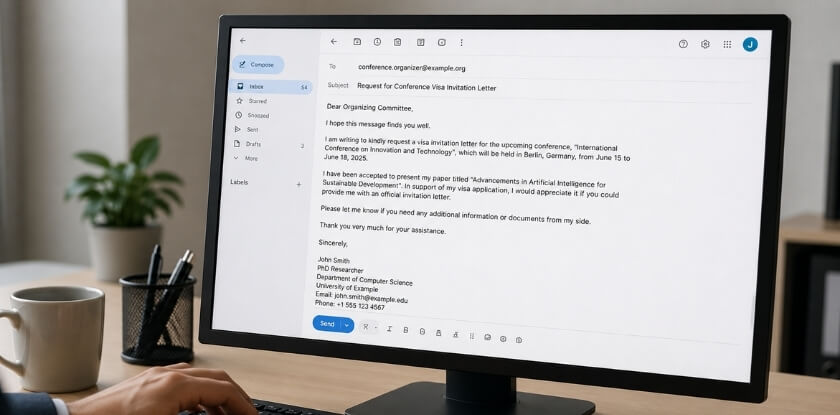
Give the organizer everything it needs to match the letter to your passport and registration. The sample email below shows each field. Speakers and researchers should also name their session, paper or abstract title and presentation date, and attach their acceptance confirmation.
Sample Request Email
Subject: Request for Conference Visa Invitation Letter
Dear [Organizer Name/Conference Team],
I have completed my registration for [Conference Name], scheduled from [Start Date] to [End Date] in [City, Country]. I am requesting an official conference visa invitation letter to support my visa application.
My details are as follows: [Full Name], [Passport Number], [Nationality], [Date of Birth], [Affiliation/Organization], [Registration ID], [Role at the Conference], [Paper or Session Title, if applicable], and [Expected Travel Dates].
Please let me know if any other information is needed.
Sincerely,
[Your Name]
If you hear nothing after the organizer’s stated turnaround time, send a short follow-up with your registration ID instead of repeating the whole request.
Invitation Letter vs Cover Letter vs Registration Confirmation
These are three different documents. They can support the same visa application, but each has its own purpose.
| Document | Issued By | Main Purpose |
| Conference visa invitation letter | Conference organizer | Confirms the applicant is invited or registered for the event |
| Visa cover letter | Visa applicant | Explains the applicant’s travel purpose, itinerary, funding and document package |
| Registration confirmation | Conference system or organizer | Shows that the applicant completed registration |
The invitation letter proves the host side of the visit: the event exists and the applicant has a reason to attend. The registration confirmation (an email, receipt or portal page) shows the attendee is recorded in the conference system.
Check that the conference name, dates, location and attendee details match across all three. If the invitation letter gives one start date and the registration confirmation another, the visa officer may question both.
Embassy Expectations for Conference Visa Invitation Letters
Embassies expect the letter to be official, accurate and verifiable, with the details listed in the steps above. Some will ask for more depending on the destination country, visa category and the applicant’s nationality.
Printed Original vs Scanned PDF vs Digital Copy
Format rules vary, so check the exact requirement of the embassy or visa center.
| Format | When It May Be Used |
| Scanned PDF | Often used for online or email-based visa applications |
| Printed copy | Common for in-person visa appointments |
| Original signed letter | Sometimes requested by specific embassies or visa centers |
| Digitally signed letter | Accepted in some cases, depending on embassy rules |
If an original is required, request it early enough to allow for delivery, and check whether a printed copy of an emailed PDF is enough. Canada’s IRCC, for example, tells hosts of business visitors to send each guest two originals: one for the visa application and one to show when entering Canada. To get an invitation letter from Canada, ask a host with a clear legal presence in Canada and a real connection to your purpose of travel.
Why Accurate Passport Details Matter
The letter must clearly belong to the applicant. A wrong name, passport number, nationality or date of birth makes the visa officer question the document. Take extra care with multiple given names, middle names, name order and passport number formatting. If the passport is renewed after the letter is issued, ask for an updated letter with the new number.
How Embassies May Verify the Letter
An embassy may contact the organizer to confirm that the event is real, the attendee is registered, the role is correct, the dates and location match, and the organizer actually issued the letter. That is why contact details must be active and accurate.
Why an Invitation Letter Does Not Guarantee Visa Approval
The letter supports the application, but the decision belongs to the embassy or visa authority. Officers also review financial proof, travel history, employment or study status, accommodation, return travel plans, ties to the home country and previous visa compliance. The invitation letter is one part of the file, not the whole case. It also does not mean the organizer pays any costs unless the letter says so.
Country-Specific Requirements to Check Before Submission
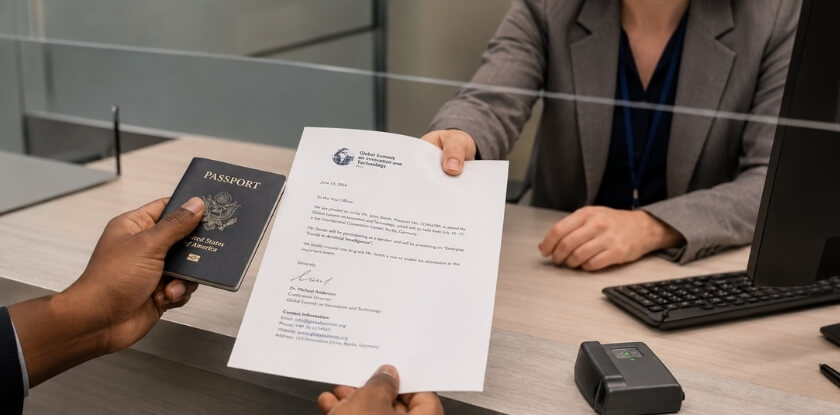
Requirements differ by destination country, embassy, visa center and applicant nationality. Two people attending the same conference may face different document rules if they apply from different countries, so follow the instructions for your own location. For an Australian visa with a conference invitation letter, for example, the letter should state that the visit is for short-term conference participation only.
Embassy or Visa Center Formatting Rules
Check whether the letter must include the passport number, date of birth, full venue address, registration number, the organizer’s tax or registration details, a named host contact, exact travel dates or an original signature.
Extra Documents That May Be Requested
Visa offices may also ask for the registration confirmation, payment receipt, event agenda, hotel booking, flight reservation, employer letter, bank statement, travel insurance, and proof of an accepted paper or speaker role. The invitation letter should match these documents and never conflict with them.
Common Mistakes to Avoid
A letter loses value when it is incomplete, unclear or inaccurate. Check for these before issuing or submitting it:
- Name or passport details do not match. Use the exact passport spelling, never nicknames, initials or informal spelling.
- Unclear attendee role. “Invited” is not enough. Say whether the person is attending, speaking, presenting, exhibiting or representing an organization.
- Missing expense statement. If the attendee is self-funded, say so. If the employer or organizer covers some costs, list what is covered, and avoid broad statements that are not accurate.
- Reusing an old template without updating it. Prepare each letter for the specific attendee and conference, and recheck the event year, edition, venue, name, passport details, role, contact person and signature date.
Checklist Before Sending or Submitting the Letter
Organizer Checklist
Before issuing the letter, confirm that the attendee is registered or approved, the name matches the passport, the conference details and role are correct, the expense statement is accurate, the letter is on official letterhead, the signatory is authorized, the contact details are active and the document is dated and signed.
Attendee Checklist
Before submitting it, confirm that your personal details and passport number are correct, the dates and venue match your registration, your role is right, your travel dates are reasonable, financial responsibility is clear, the organizer’s contact details are included and the embassy accepts the document format. If anything is wrong in the letter, ask the organizer for a corrected version before you submit the visa application.
Final Accuracy Review
Compare the letter with the visa form, passport, registration confirmation, accommodation document and travel plan. If any detail does not match, fix it before submission.
From our experience at MS International: Our invitation letter is issued automatically once payment clears, within 3 to 5 business days. Before issuing it we check the registration against the details you give, and we may contact you if names do not match or passport details look incomplete. A US$50 administrative fee applies to corrections after the letter is issued, so check your passport details at registration. The letter supports a visa application but never guarantees one, and fees are non-refundable if a visa is refused. Our events are held in person in the Greater Toronto Area.
Frequently Asked Questions
Before requesting or drafting the letter, attendees tend to ask about writing it themselves, notarization, getting it before paying the registration fee and using one letter for more than one visa application.
Can I Write My Own Conference Visa Invitation Letter?
Usually the organizer should issue it. You may prepare a draft only if the organizer asks you to, and an authorized representative must review, sign and send the final version. A self-written letter without organizer confirmation may carry little weight.
Does the Letter Need to Be Notarized?
Often not. A signed letter on official letterhead is usually enough, but IRCC notes that some visa offices may require notarization for business guest letters. Check your visa office’s rules, and ask the organizer whether it offers a notarized copy.
Can I Request the Letter Before Paying the Registration Fee?
Usually not. Most organizers issue the letter only after registration is confirmed and paid, and some also wait for abstract acceptance or speaker confirmation. Check the conference’s visa support policy before you register.
Can One Letter Be Used for Multiple Visa Applications?
Normally a letter matches one event, one destination and one application. If your dates, passport number, visa type or conference details change, request an updated letter.
Do All Conferences Provide Visa Invitation Letters?
No. Many do, but some issue only a visa support letter or a registration confirmation instead of a formal invitation. Some send it automatically after registration, others need a request. Confirm this before you register or book travel.
Will My Embassy Ask for an Invitation Letter?
Not always. IRCC says it only sometimes asks for a letter of invitation, and the U.S. Department of State says one is not needed to apply for a visitor visa. Follow your embassy’s document list; the letter still helps show the purpose of your trip.
How Long Does an Organizer Take to Issue the Letter?
It varies by organizer, from a few days to about two weeks or more. At MS International the letter is issued within 3 to 5 business days after payment clears, so request it as soon as your registration is confirmed.
Can a Conference Invitation Letter Guarantee Visa Approval?
No. The letter confirms the purpose of your trip, but the embassy decides after reviewing the full application, including financial proof, travel history and identity documents.
Conclusion
Request the letter early, send passport-matching details and check the result before you submit the visa application. Organizers should put accuracy, official formatting and easy verification first, because an embassy must be able to check every line. The letter does not guarantee approval, but when it matches the applicant’s other documents it makes the application much easier to understand.
Disclaimer: This article is general information, not legal or immigration advice. Visa rules, fees, and processing times change. Confirm the current requirements on the official website of the embassy, consulate, or immigration authority of the country you are visiting (for example IRCC for Canada or the U.S. Department of State for the United States) before you apply.