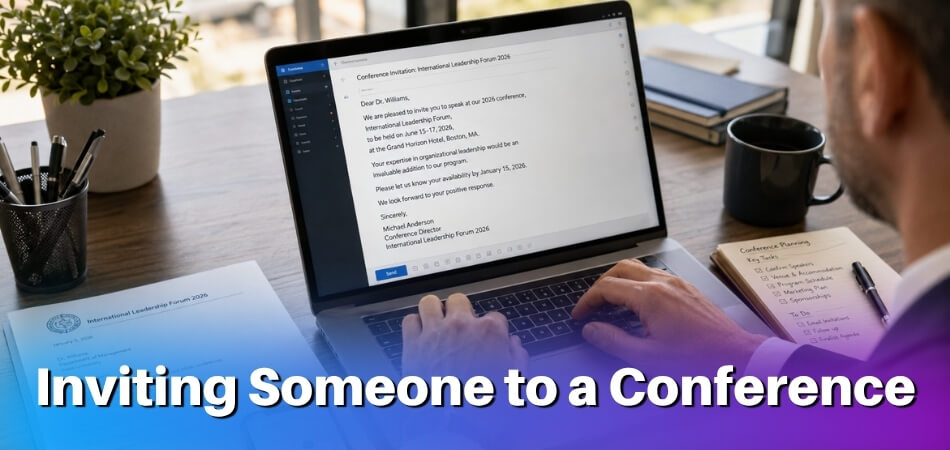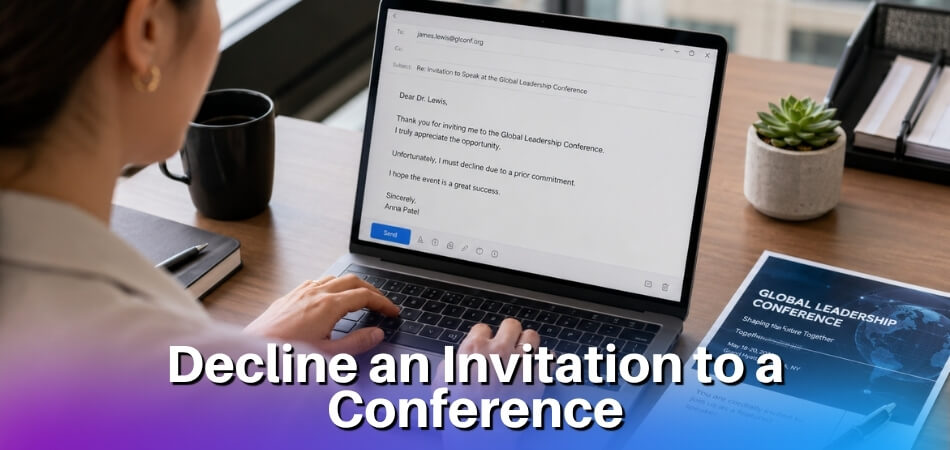

Being invited to speak at a conference is a professional compliment. It means an organizer sees value in your knowledge, experience, reputation, or point of view. Still, you cannot accept every request. You may have a schedule conflict, too little preparation time, travel barriers, personal responsibilities, or a topic that is not your strongest area.
Quick answer: To decline an invitation to speak at a conference, reply promptly, thank the organizer, say clearly that you cannot speak, give a brief reason if you wish, and close with good wishes for the event. If it helps them, suggest a colleague who has agreed to be named, or ask to be considered for a future edition.
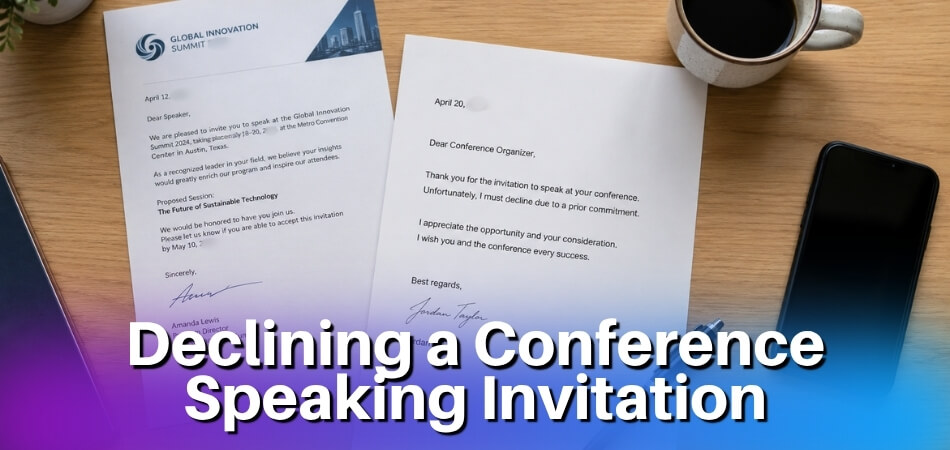
The best approach is to decline clearly, politely, and early. A thoughtful answer lets the organizer keep building the program, protects your professional image, and keeps the relationship open. Most organizers only need enough information to update the speaker list, so a long story is not necessary. A complete answer in one message also saves both sides a round of back-and-forth.
This guide is about declining a speaking invitation (keynote, panel, workshop or talk). It covers how to decide, what to write, ready-to-use templates, and what to do if the organizer keeps asking.
When It Is Acceptable to Decline a Speaking Invitation
It is acceptable to decline when you cannot give the audience, the organizer, or the topic the attention it deserves. Saying no is not rude when your reason is real and your reply is respectful.
| Reason | Example | How to word it |
| Schedule conflict | A meeting, business trip, client deadline, academic obligation or personal event | I have a prior commitment during the conference dates. |
| Limited preparation time | The invitation arrived too close to the event for a strong presentation | The timeline does not leave me enough time to prepare properly. |
| Travel or budget issues | The location, travel time, visa process, or cost does not work | I’m unable to travel on the event dates. |
| Health or personal responsibilities | You need to put health, family or private commitments first | Due to personal commitments, I’m unable to take part. |
| Topic mismatch | The subject is outside your strongest area of expertise | I do not think I’m the strongest fit for this session. |
| Workload or capacity | Current responsibilities leave too little time or energy | My workload will not allow me to give this the attention it needs. |
| Another engagement | You already confirmed another speaking event | I have already committed to another event on those dates. |
Declining for any of these reasons is professional when you tell the organizer early. If you know you would be rushed, distracted, or underprepared, saying no is more responsible than accepting for the sake of appearance. A strong speaker protects the audience experience by being honest about availability and expertise before the event, not after problems appear.
What to Consider Before You Say No
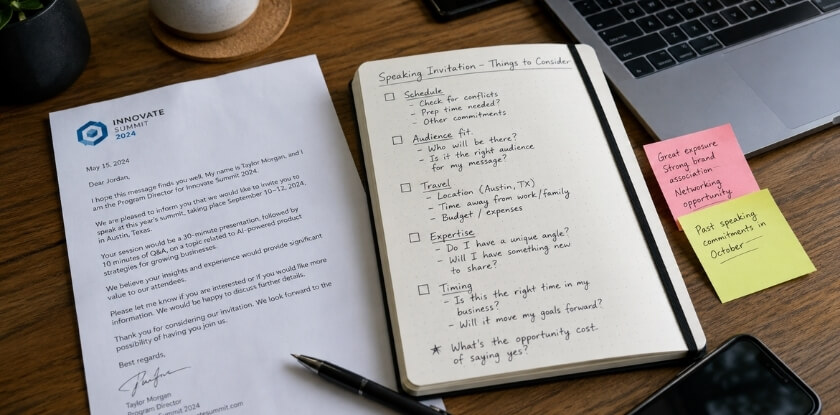
Before declining, review the opportunity carefully so your decision is thoughtful and accurate. A fast reply matters, but it should still be based on the event details and your real ability to contribute.
Review the Event Details
Check the conference date, location, audience, topic, session length, format, preparation requirements, travel expectations, and any speaker deadlines. If key information is missing, ask for clarification before deciding, especially when the opportunity looks valuable.
Also look for hidden expectations. Some invitations include more than a speech. The organizer may expect a speaker bio, headshot, promotional post, networking dinner, panel rehearsal, or media interview. These tasks can be reasonable, but they still take time.
Check Your Calendar and Workload
A speaking role usually takes more time than the session itself. You may need to prepare slides, research the audience, join planning calls, travel, rehearse, and follow up afterwards. If accepting would create pressure or lower the quality of your talk, declining may be the better choice.
Consider the Audience and Topic Fit
A good speaking engagement matches your expertise and the audience’s needs. If you cannot offer useful examples, practical insight, or confident guidance on the requested topic, the audience may be better served by someone else.
See Whether an Alternative Could Work
Before saying no completely, ask whether another format would solve the problem. You might join virtually, take part in a panel, record a short message, send a short written piece for the programme, suggest a shorter session, or speak at a future edition. Check the event format first: some conferences are in person only, so a virtual option is not always available. Only offer an alternative you can realistically honor. If the organizer agrees, confirm it in a short letter accepting the invitation to speak.
If You Need More Time to Decide
If you are interested but cannot answer yet, do not go silent. Within a few business days, send a short note that thanks the organizer, says you are interested, names the date you will confirm by, and asks any open questions about the date, session format, travel and costs. Then keep that date. Do not mention other invitations in the note.
Separate Interest From Availability
If you are unsure whether to decline or negotiate, split the decision in two: your interest and your availability. You can respect the event and still be unavailable, or like the topic and still lack preparation time. This avoids guilt-based decisions. Also think about the long-term relationship: a respectful decline today can lead to a better invitation later, and many event teams remember speakers who communicate clearly.
How to Decline an Invitation to Speak at a Conference Professionally
To decline professionally, make your response appreciative, direct, brief, and respectful. The goal is not to defend your decision. It is to give the organizer a clear answer while keeping goodwill.
Reply Promptly
Send your answer as soon as you know you cannot accept. Organizers work with speaker lists, schedules, websites, promotional materials and program deadlines, so an early no gives them time to invite someone else.
Thank the Organizer
Start with sincere appreciation. An invitation means someone considered your experience valuable. Useful openings include:
- Thank you for inviting me to speak at the conference.
- I appreciate you considering me for this session.
- I’m grateful for the opportunity to contribute to your event.
State Your Decision Clearly
Do not make the organizer guess. Instead of a vague line such as “I’m not sure this will work,” write: “Unfortunately, I’m unable to accept the invitation this time.” A clear sentence prevents confusion and extra follow-up.
Give a Brief Reason
You do not need to share every detail. A short explanation is enough, such as a prior commitment, schedule conflict, limited availability, travel issue, workload concern, or topic-fit concern. For example: “Unfortunately, I have a prior commitment during the conference dates and won’t be able to participate.”
Express Regret Without Overexplaining
One short line adds warmth: “I’m sorry I won’t be able to take part this time.” Avoid long apologies unless you are declining after already accepting, or making a last-minute change.
Offer Support and Keep the Door Open
If you can help, offer one useful option: recommend another speaker, share the event with your network, suggest a later date, or discuss a virtual format. If you want future invitations, say so: “Please keep me in mind for future opportunities where the timing may be a better fit.” If you do not, simply wish them well. This small difference tells the organizer whether to contact you again.
What a Decline Message Contains
A strong message has appreciation, a clear answer, a short reason, and a positive closing, plus an optional referral and future note.
| Message Element | Purpose | Example Phrase |
| Appreciation | Shows respect for the invitation | Thank you for considering me. |
| Clear decline | Removes uncertainty | I’m unable to participate this time. |
| Brief reason | Gives helpful context | I have a prior commitment. |
| Good wishes | Ends on a positive note | I wish you a successful event. |
| Optional referral | Supports the organizer | I may be able to suggest another speaker. |
| Future interest | Keeps the relationship open | Please keep me in mind for future events. |
What Not to Say When Declining a Conference Speaking Invitation
When declining, avoid wording that is unclear, negative, too personal, or unreliable. Your message should be polite, complete, and easy for the organizer to act on.
Avoid Vague Answers
Do not write “maybe,” “I’ll try,” or “let me see” if you already know the answer is no. A soft answer creates planning delays. Be kind, but clear.
Avoid Criticizing the Event
Even if the conference is not right for you, do not criticize the topic, audience, location, format, or organizer. Instead of saying the event is not useful to you, say “I do not think I’m the strongest fit for this session.”
Avoid Excessive Personal Details
You can keep private matters private. A phrase such as “due to personal commitments” gives enough context without oversharing.
Avoid Promises You Cannot Keep
Do not promise to speak next year, promote the event, or recommend several people unless you will follow through. Use flexible language such as “I’d be happy to stay in touch.”
Best Communication Channels for Declining a Speaking Invitation
Email is the best choice for most professional conference invitations, because it gives you time to choose your words and leaves a written record. Match the channel to the formality of the event, your relationship with the organizer, and how the invitation arrived.
| Channel | Best for | Tip |
| Invitations from an organization, committee, university, business or formal event team | Keeps a written record | |
| Phone call | A close contact, mentor, partner or colleague | Send a short written confirmation afterwards |
| Text or direct message | Informal invitations, small community events, or contacts who reached out that way | Stay respectful and complete even when casual |
| Formal letter | Institutional, academic, government-related or highly formal invitations | Greeting, thanks, decision, brief reason, good wishes |
| In person | An organizer you see regularly | Follow up with a short note for professional events |
Conference Speaking Invitation Decline Templates
Use these templates as starting points. Replace the bracketed text with your own details and delete any sentence that does not apply. The strongest messages sound personal, not copied, and are short enough to read quickly but complete enough to answer the request.
Standard Professional Email Template
Use this for a schedule conflict, a travel limitation or a general decline. Swap in one reason from the list below the template.
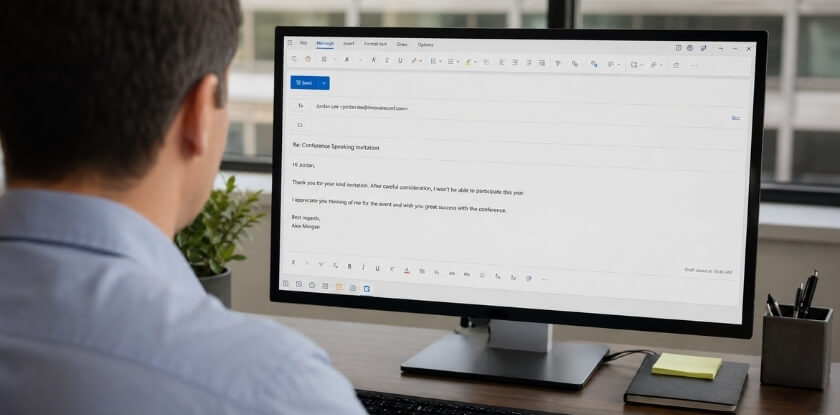
Subject: Thank You for the Invitation
Dear [Organizer’s Name],
Thank you for inviting me to speak at [Conference Name]. I appreciate your consideration and the opportunity to contribute.
Unfortunately, I’m unable to participate this time due to [brief reason]. I wish you and your team a successful conference. [Optional: Please keep me in mind for future conferences where the timing may be a better fit.]
Best regards,
[Your Name]
Keep the subject line plain and include the conference name, or reply in the same email thread so the organizer finds your answer at once. Reason options: “a schedule conflict during the conference dates”, “my travel plans, so I’m unable to travel on the event dates”, “a prior commitment”.
Topic Fit Template
Subject: Your Speaking Invitation
Dear [Organizer’s Name],
Thank you for thinking of me for this session. After reviewing the topic, I do not think I’m the best fit for what your audience needs.
I appreciate the invitation and hope the conference is a success.
Best regards,
[Your Name]
Referral Template
Subject: A Colleague Who Could Speak
Dear [Organizer’s Name],
I was glad to be thought of for [Conference Name], but I’m afraid I cannot take part this time because of [brief reason].
If helpful, I may be able to recommend someone whose experience aligns well with the session topic. I can share their details after confirming their availability.
Best regards,
[Your Name]
Alternative Format Template
Subject: Re: Speaking Invitation for [Conference Name]
Dear [Organizer’s Name],
Your invitation to [Conference Name] means a lot. I cannot travel on the event dates, but I could join virtually or record a short video message if that would be useful. If neither option works for your program, I understand completely.
Kind regards,
[Your Name]
Informal Message Template
Hi [Name], thank you for thinking of me for [Conference Name]. I appreciate the invitation, but I’m not available on the event date and will need to decline this time. I hope the conference goes well.
Phone Call Script
Thank you again for inviting me to speak at [Conference Name]. I really appreciate being considered. Unfortunately, I can’t take part this time, as [brief reason] is in the way. I wanted to let you know early so you have time to adjust the program. I hope the event goes very well.
How to Recommend Another Speaker Professionally
Recommend a speaker only when they are a strong fit and have agreed to be named. A good referral shows that you still care about the event’s success even though you are unavailable.

Ask the person for permission first, so they are not surprised by an unexpected request. Once they agree, explain why they fit by mentioning their expertise, experience, audience relevance, or connection to the session topic.
Share only appropriate professional details, such as name, title, organization, email, website, or LinkedIn profile. Do not share private contact information without permission.
Avoid recommending someone just to soften your decline. A weak referral creates extra work for the organizer. If you do not know a suitable person, it is completely acceptable to decline without suggesting anyone.
How to Decline After Already Showing Interest or Accepting
If you showed interest but can no longer take part, tell the organizer as soon as your situation changes. This needs extra care because the organizer may already be planning around your possible involvement.
Start by acknowledging the change: “Thank you again for discussing the speaking opportunity with me. After reviewing my availability, I’m no longer able to participate in the conference.”
Then add a brief apology if your change affects their planning: “I’m sorry for any inconvenience this may cause as you finalize the program.”
Give a short reason if appropriate, such as a new professional commitment, workload change, travel limitation, or personal responsibility. If you can reduce the organizer’s burden, offer a limited and realistic option, such as recommending another speaker or staying available for a future event.
If you had already accepted and your name is on the programme, the same rule applies with more urgency: write the day you know, say plainly that you must withdraw, and ask what the organizer needs from you, for example a replacement name. Announcements already published may stay online for a while, so ask how they would like to handle that.
How to Handle Pressure After You Decline
If the organizer keeps asking, stay polite, repeat your decision, and avoid a long debate. You can appreciate their interest while protecting your schedule and boundaries. If they reply with another option, answer briefly, restate your decision and thank them for understanding.
A firm response can be simple: “Thank you for following up. I appreciate your interest, but I’m still unable to participate in the conference this time.”
Do not overexplain your calendar or give details that invite negotiation. If you want to keep the relationship open, steer the conversation toward a future opportunity.
If the pressure continues, set a respectful boundary: “I appreciate the invitation and your understanding. My decision is final for this event, but I wish you a successful conference.” This is clear without sounding harsh.
What to Do With an Unsolicited or Suspicious Invitation
You do not have to answer an invitation that looks suspicious. Ignoring it is fine, and a one-line neutral decline is also fine, as long as you do not engage with the pitch. Replying with questions or a sarcastic note can invite more messages.
Treat an invitation with caution when several of these apply:
- You have never dealt with the sender and cannot tell who is organizing the event.
- The praise is over the top, or the topic is far outside your field.
- You are pushed to confirm or pay within a day or two.
- Basic questions about the organizing body, programme committee, dates and costs get vague answers.
Before replying, check the event with your professional society or colleagues. Until you are sure, keep your documents and payment details to yourself.
What Happens If You Do Not Respond to a Speaking Invitation
If you do not respond to a genuine invitation, the organizer may assume you are not interested, offer the spot to another speaker, or hesitate to contact you again.
Silence can create several problems:
- The organizer may delay the speaker lineup while waiting for your answer.
- The agenda, website, promotional materials, or session schedule may be affected.
- You may appear unorganized, uninterested, or disrespectful.
- Future invitations from the same organizer may decrease.
Even a one-line answer protects your reputation. “Thank you for the invitation, but I’m unable to participate this time” is far better than no answer.
How to Maintain a Professional Relationship After Declining
After declining, stay courteous, supportive, and easy to contact. A well-handled decline can strengthen the relationship because it shows reliability and respect.
You can keep the connection by:
- Sending a supportive note wishing the event success
- Sharing the event with relevant contacts, if appropriate
- Engaging with public event posts that match your professional interests
- Congratulating the organizer after the conference
- Recommending a suitable speaker later if you know one
Small gestures matter. A short message after the event, such as “Congratulations on completing the conference; I hope it went well,” leaves a positive impression.
From our experience at MS International: our conferences are held in person at venues in the Greater Toronto Area, so if you cannot travel on the event dates, say so before you submit or pay rather than assuming a virtual option. Our Speaker Agreement asks a confirmed speaker who cannot take part to tell us as soon as possible, so the schedule, programme, website and promotional materials can be updated where reasonably possible. Keynote and invited roles are arranged separately with the organizing team, and any terms for travel or fees need to be confirmed in writing.
How to Increase Future Invitations to Relevant Conferences
To receive more relevant speaking invitations, build visibility around your expertise and make it easy for organizers to see what you can speak about.

Keep your professional presence updated: LinkedIn profile, personal website, company bio, speaker page, association profile, or published work. Use specific topic areas instead of broad labels. “Digital marketing strategies for international audiences” is stronger than “marketing.”
Share insights through posts, articles, case studies, event reflections, research summaries, or answers to common industry questions. Organizers look for people who communicate clearly and add useful ideas.
Attend conferences, webinars, workshops, networking sessions, academic seminars, and association events. Many speaking opportunities begin with a conversation. Ask thoughtful questions, introduce yourself clearly, and follow up with people you meet. Join associations, subscribe to conference updates, respond to calls for speakers, and send topic ideas when submissions open.
Smaller opportunities help too. Local events, webinars, internal sessions, community workshops, podcasts, and panel discussions build confidence and show that you can communicate well.
Keep your speaker materials ready:
- Short professional bio
- Headshot
- Speaking topics
- Past speaking experience
- Audience types you serve
- Relevant links or recordings
- Contact information
- Preferred formats, such as keynote, panel, workshop, or webinar
Consistency matters. When you communicate well, meet deadlines, support others, and stay active in your field, organizers are more likely to trust you with future speaking roles.
Frequently Asked Questions (FAQ) About Declining a Speaking Invitation
Turning down a speaking slot gets trickier when the organizer is a friend, the request is last-minute or unsolicited, or you hope to be asked again next year.
How Quickly Should I Respond to a Speaking Invitation?
Reply within a few business days, and sooner if the event is near, so the organizer can adjust the lineup. If you need longer, send a short note saying the date you will confirm by.
Can I Decline Without Giving a Reason?
Yes, you can decline without a specific reason. A general line such as prior commitments or limited availability is enough. You do not need to share personal, medical, family, or business details.
Should I Apologize When Declining?
Only briefly. A short apology helps if your decline may inconvenience the organizer, for example when replying late or after showing interest. For a normal decline, appreciation and a clear answer matter more.
Can I Say No and Ask to Be Considered Next Year?
Yes, if you are genuinely interested. Asking to be considered for a future conference shows that your no is about timing, availability or fit, not a lack of respect for the event.
Do I Have to Reply to an Unsolicited Speaking Invitation?
No. If an invitation looks suspicious, you can ignore it or send a one-line neutral decline. Do not send a CV, abstract or payment details until you are sure the organizer is genuine.
Can I Ask for More Time Before Deciding?
Yes. Within a few business days, thank the organizer, say you are interested and give the date you will confirm by. Ask any open questions about dates, format and costs in the same note.
What Should I Do If I Change My Mind After Declining?
Contact the organizer quickly and ask whether the slot is still open. Be respectful, because the spot may already be filled or the agenda finalized.
Should I Suggest Another Speaker?
Only if they are a strong fit and have agreed to be contacted. A thoughtful referral helps the organizer, but sharing a name without permission can cause confusion or discomfort.
How Do I Decline a Last-Minute Speaking Invitation?
Decline quickly, politely and clearly. It is fine to explain that the short timeline does not allow enough preparation for a session that would properly serve the audience.
Is It Unprofessional to Decline a Conference Invitation?
No. Declining is not unprofessional when your response is timely, polite and clear. It is better to say no early than to accept a speaking role you cannot prepare for or deliver properly.
What Is the Most Polite Sentence to Decline a Speaking Invitation?
Thank the organizer and refuse in the same breath, for example: “Thank you for the invitation, but I’m unable to participate this time.” Keep the tone respectful, brief and professional.
How Do I Decline If the Organizer Is a Friend or Colleague?
Use a warmer tone but keep the decision direct. A personal conversation is fine, so long as the organizer understands you cannot take on the speaking commitment.
Final Takeaway: Decline Clearly, Kindly, and Early
The best way to decline a speaking invitation is to respond early, express appreciation, give a clear answer, and keep the tone respectful. You do not need a long explanation or a detailed excuse.
When you decline properly, the organizer can keep planning without confusion, and you protect your schedule and credibility. If the timing, topic, or format is not right, decline with care and leave room for a better opportunity later.