
A conference in Australia is a good reason to travel, but the event registration is only the first step. Before you spend money on flights or hotels, you need to know which permission applies to you and how to get it.
Quick answer: To attend a conference in Australia, check whether your passport qualifies for an ETA (subclass 601) or an eVisitor (subclass 651). If it does not, apply for a Visitor visa (subclass 600), Business Visitor stream, through ImmiAccount. Submit your passport, invitation letter, registration proof, funds and home-ties evidence, then wait for the electronic decision. Attending is allowed; paid work is not, and the organisers cannot pay you to take part.
Fact-checked by the MS International Editorial Team. Last verified against official sources: October 2026.
Planning to attend a conference in Australia means sorting out the visa before you book flights or pay non-refundable fees. Registration for the event does not give you permission to enter the country, so the visa question comes first.
Who Needs a Visa to Attend a Conference in Australia?
Most international visitors need a visa or travel authority before entering Australia for a conference. This applies to business, academic, medical, technology and trade events, as well as workshops and summits.
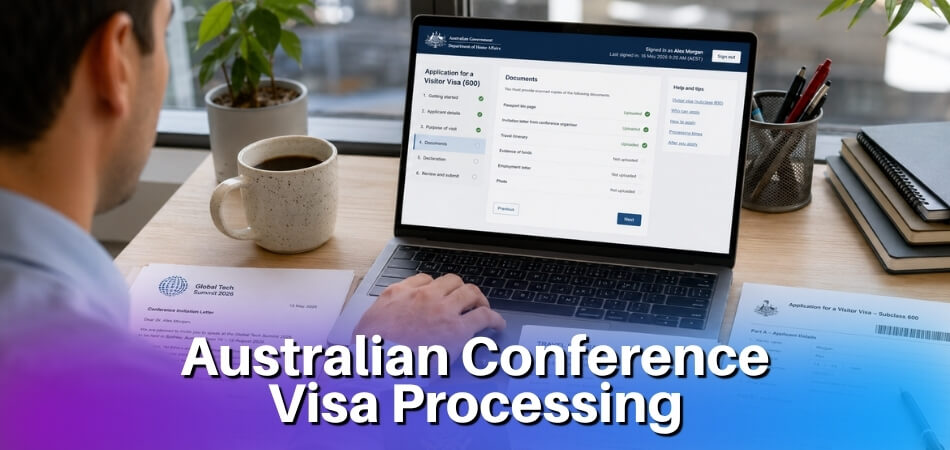
What you need depends mainly on your passport country, the length of your stay, and what you will do at the event. If you are unsure, check the eligibility rules on the Department of Home Affairs website before you apply. Choosing the wrong visa can cost you time and weaken your application.
Which Australian Visa Is Suitable for Conference Attendance?
The right visa depends on your passport and your activities. Three options cover most conference trips: subclass 600, subclass 601 and subclass 651. None of them is called a conference visa, and very few countries issue a conference visa under that name; India is the clearest example.
Visitor Visa Subclass 600, Business Visitor Stream
This is the usual choice if your passport is not eligible for an ETA or eVisitor. It covers short business activities such as attending a conference or meetings, and it does not allow paid work in Australia.
You apply online through ImmiAccount, and you must be outside Australia when you apply and when Home Affairs decides. The stay period is set in your grant: generally 3 months, and up to 12 months in certain circumstances. The visa can be single or multiple entry. Expect to upload more documents than for the electronic options, because the officer decides on your evidence alone.
Electronic Travel Authority Subclass 601
The ETA is open only to passport holders from certain countries. Eligible passports include, for example, Canada, Japan, Singapore, South Korea and the United States. Eligible travelers can use it for tourism or approved business visitor activities, which include attending a conference. You apply through the Australian ETA app, and in most cases the result comes immediately, although a quick decision is not guaranteed. An ETA is valid for 12 months or until your passport expires, whichever is shorter, with multiple entries and up to 3 months’ stay after each entry.
If you have a criminal conviction in any country, Home Affairs says to apply for the subclass 600 visa and give evidence about it instead. Even with a simple process, carry proof of your conference purpose. Border officers may ask about your plans.
eVisitor Visa Subclass 651
The eVisitor is for holders of an eligible European passport. It covers short visits for tourism or business, including conferences and seminars, and has no application charge. It is valid for 12 months from the grant, with multiple entries and up to 3 months’ stay after each entry. Do not arrange travel until Home Affairs tells you in writing that the visa is granted. Passport matters more than residence. Living in Europe does not qualify you unless your passport is on the eligible list.
Quick Visa Comparison
| Visa type | Best for | Application route | Main point |
| Visitor visa subclass 600, Business Visitor stream | Travelers who do not qualify for ETA or eVisitor | ImmiAccount | Needs stronger supporting documents; stay set in the grant, generally 3 months |
| ETA subclass 601 | Eligible passport holders | Australian ETA app | Electronic option; up to 3 months per entry |
| eVisitor subclass 651 | Eligible European passport holders | Online application | No application charge; up to 3 months per entry |
Step-by-Step Visa Process for Attending a Conference in Australia
Prepare your documents before you open the form. Every step should support the same story: a temporary visit for a legitimate conference.
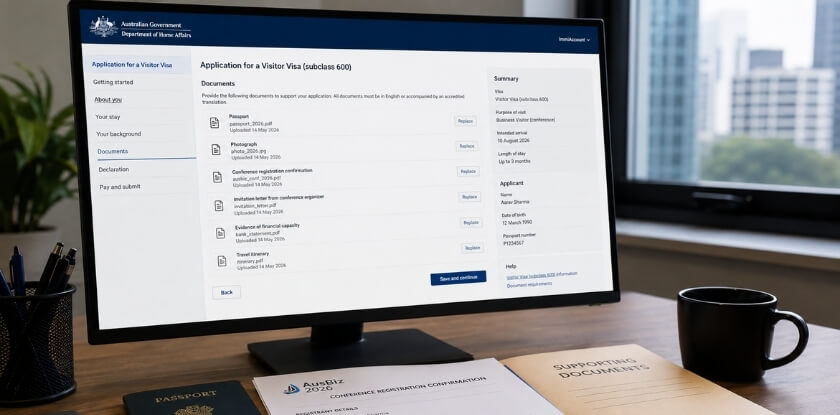
Step 1: Confirm Your Conference Purpose
Attending sessions, speaking, networking and professional discussions can fit a business visitor purpose if you take no paid employment in Australia. Be specific: name the conference, dates, city, organizer and your role, instead of calling it a general business visit.
Step 2: Choose the Correct Visa Type
Pick the type that fits your passport, as explained above. Your visa type, form answers and documents must agree. If the form says tourism but your documents show a conference, you invite questions.
Step 3: Use the Correct Application Platform
In ImmiAccount (subclass 600) you fill in the form, upload documents, pay, and receive requests. Enter your name, date of birth and passport number exactly as printed in the passport.
Step 4: Complete the Application Form
Expect questions on identity, passport, travel plans, health, character, work or study, and the reason for the visit. Have these ready:
- Conference name, dates, venue and organizer
- Your role at the event
- Arrival and departure dates, and where you will stay
- Who is paying for the trip
- Your job, business or study in your home country
Check every answer before you submit. A wrong digit in a passport number can delay the whole application.
Step 5: Pay the Required Charge
Depending on the visa, you may pay a visa application charge or an app service charge. The Department of Home Affairs says the fee that applies is the one in force when it receives your application, so check its Visa Pricing Estimator on the day you lodge. Save the receipt. If the payment page freezes, check your application status before paying again.
Step 6: Upload Supporting Documents
Documents carry the application. The next section lists what to include. Upload clear files with readable names, and avoid blurry photos, cropped screenshots and missing pages.
Step 7: Biometrics or Health Checks, If Requested
Not everyone needs these. Health checks, police certificates or biometrics may be requested, and instructions arrive after you apply. Complete them quickly, because delay here delays the decision.
Step 8: Track the Application
Check your email and account regularly. A request may ask for updated bank statements, clearer scans, proof of employment or more conference details. Answer before the deadline and send exactly what was asked.
Step 9: Review the Visa Grant Notice
An approval arrives electronically. Check your full name, passport number, visa subclass, validity, permitted stay, number of entries and conditions. Keep a digital and printed copy. Your visa is linked digitally to your passport, and you can check its conditions and entries in VEVO.
Required Documents for an Australian Conference Visa Application
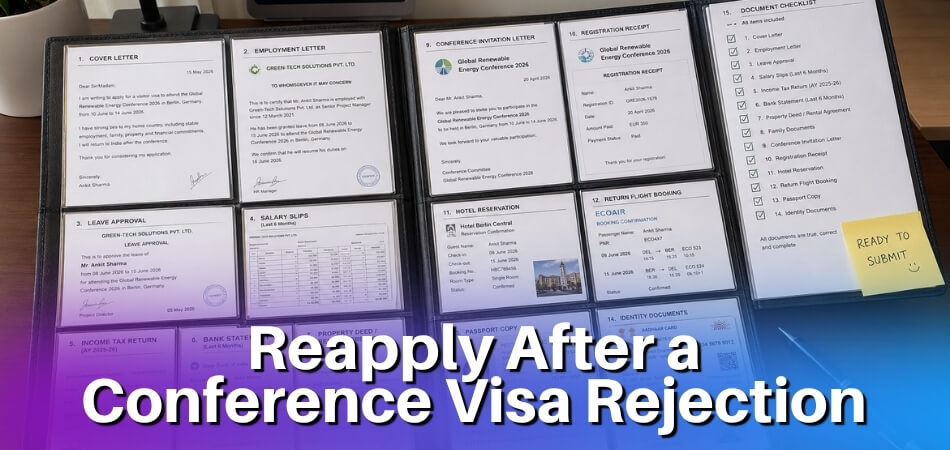
Your documents should prove five things: who you are, why you are going, how you will pay, where you will stay, and why you will return home.
| Document | What it proves |
| Passport information page | Identity. Use your legal name exactly as printed. |
| Invitation letter, registration proof, agenda | The event is real and you are taking part in it |
| Bank statements, salary slips, sponsor letter | You can pay for the trip without working in Australia |
| Hotel booking and itinerary | A realistic plan that matches the conference dates |
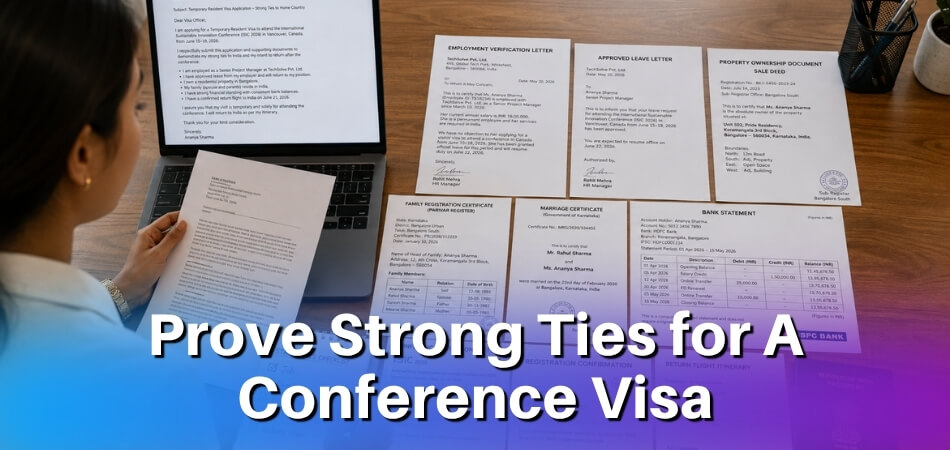
| Employer leave letter, business or study records, family and property ties | You have reasons to return home |
Invitation Letter and Registration Proof
The invitation letter should come from the organizer and state your full name, the conference title, dates, venue, your role (attendee, speaker, exhibitor or panelist) and the organizer’s contact details. Add your passport number if the organizer can include it, and the position of the person who signs. It helps to state that the invitation is for participation only and does not involve paid work in Australia. Registration proof can be a confirmation email, receipt, ticket, or abstract acceptance letter. For a free or sponsored event, ask the organizer for written confirmation, because a conference invitation letter for an Australian visa should say exactly which costs the organizer covers.
From our experience at MS International: the invitation letter we issue supports a visa application but does not guarantee a visa. It is issued within 3 to 5 business days after payment clears, and corrections after issue cost US$50, so check your name, role and dates before you pay. Our registration fees are non-refundable, and our conferences are held in person in the Greater Toronto Area. With any organiser, the avoidable problem is a mismatch: if the letter says one set of dates or one role and your registration or itinerary says another, fix it before you apply.
Financial Evidence
Home Affairs requires that you have, or have access to, enough money to support yourself in Australia. Recent bank statements, salary slips, business records or tax documents work. If an employer, university or sponsor pays, include a letter saying which costs they cover. If a person sponsors you, explain the relationship and show that they can afford it.
Accommodation, Travel Plan and Return Evidence
A hotel booking or host letter plus a simple itinerary is enough. A confirmed return ticket is not always required before applying, but a refundable booking or planned departure date strengthens the case. Avoid non-refundable bookings until the visa is granted, unless you accept the risk.
Proof of Ties to Your Home Country
Employment, business ownership, study, family responsibilities, property and future professional commitments all show a temporary visit. An employee’s letter should state job title, approved leave and return date. A business owner can add registration and income records.
What Activities Are Allowed on an Australian Conference Visitor Visa?
A conference visitor visa allows short professional activities such as attending sessions, meetings and networking. It does not allow regular employment or ongoing services in Australia.

Permitted Activities
- Attend sessions, seminars and workshops
- Take part in networking events and meet professional contacts
- Present at the event
- Join short business discussions, make general business enquiries, and negotiate or review a business contract
- Visit tourist attractions during the same trip
Always check the conditions in your own grant notice.
Restricted Activities
- Taking paid employment, or working for or providing services to a business or organisation based in Australia
- Being paid by the organisers to take part in the conference
- Selling goods or services directly to the public
- Staying longer than permitted
Paid consulting, installation, training delivery, or a role that replaces a local worker may need a different visa.
Australia Conference Visa Cost and Processing Time
Costs and timing depend on the visa type, your passport, and how complete your application is. Check the current figures on the Department of Home Affairs website before you apply, because charges change.
| Visa | Charge | Decision time |
| Subclass 600, Business Visitor | Visa application charge. Use the Home Affairs Visa Pricing Estimator. | No fixed time. The Home Affairs processing time guide shows how long recent applications took; it is a guide only. |
| ETA 601 | No visa application charge. A service charge of AUD 20 applies to use the Australian ETA app. | In most cases the result is immediate; it can take longer if answers are wrong or more information is needed |
| eVisitor 651 | No application charge. The eVisitor is free. | Home Affairs publishes how long recent applications took; not guaranteed |
From 1 July 2026, citizens of listed Pacific Island countries and Timor-Leste who apply with a valid passport from one of them pay a lower subclass 600 charge, which ImmiAccount applies automatically. Other costs can include a health examination, police certificates, biometrics, certified translations, passport photos, travel insurance, and card or currency conversion charges. Delays usually come from missing documents, unclear scans, weak funds evidence or a request for more information. Apply early. The last week before the conference is a bad time to find a problem.
How to Improve Your Chances and Avoid Refusal
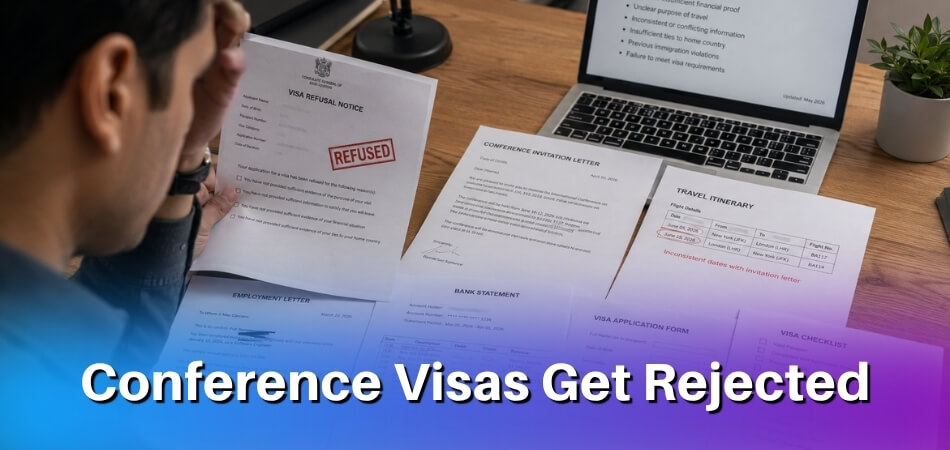
A strong application lets the officer see quickly that you attend a genuine conference, have enough funds, and will leave Australia afterward. Refusals usually trace back to one of a few gaps.
Common reasons applications fail:
- Missing invitation or registration proof
- Weak financial evidence or unexplained bank deposits
- Unclear conference purpose or conflicting travel dates
- Limited proof of ties to your home country
- Wrong passport details
- Not declaring a previous visa refusal
Most of these gaps close when names, dates and passport numbers are identical across every document and the documents listed above are all included. Re-read the full application before you submit.
What to Do If Your Australian Conference Visa Is Refused
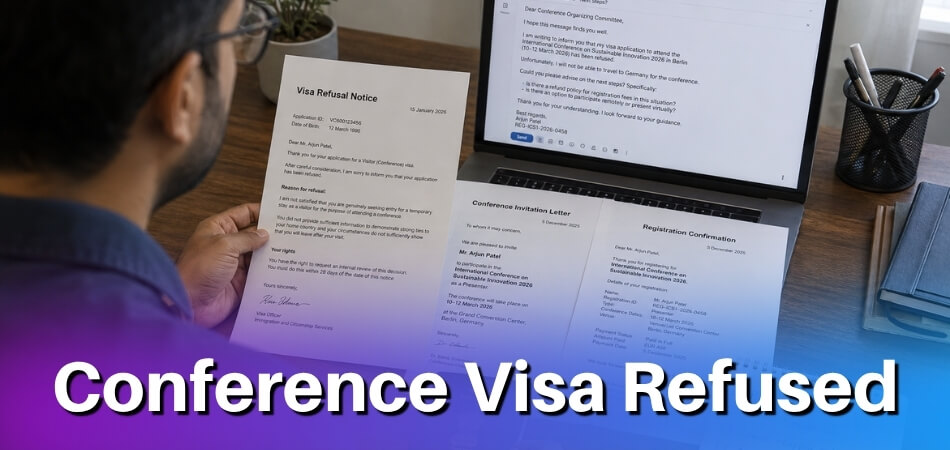
Read the refusal notice first. It gives the reason and may say whether review rights are available.
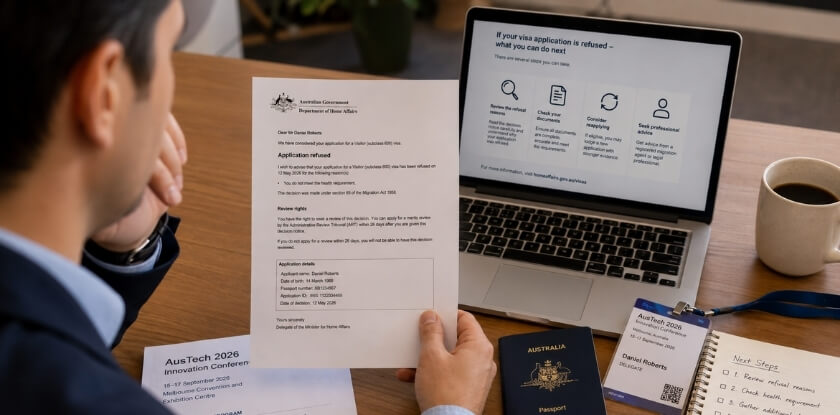
A refusal does not mean you can never travel to Australia. It means the application did not meet the requirements at that time. Find the exact weakness, such as funds, conference evidence or return ties, and do not reapply with the same documents unless the cause was a simple mistake you have fixed. If you reapply, mention the earlier refusal in a short cover letter and say what has changed. If the notice raises credibility concerns, a past overstay or unclear review rights, consider advice from a registered migration agent.
Should You Include a Cover Letter?
A cover letter is optional, but it helps when your documents need context. That includes an employer paying for the trip, extra tourism days, or a role beyond simple attendance.
Keep it short and factual: the conference name, dates and city, your role, why the event matters to your work, who pays, where you will stay, when you return, and what ties you have outside Australia. An employee can say the employer approved leave for set dates. A researcher can mention the accepted paper. The letter supports the evidence and does not replace it. If you say your employer approved the trip, attach the employer’s letter.
Special Notes for Speakers, Presenters, and Exhibitors
Speaking or exhibiting can fit a visitor visa, but only if the organisers do not pay you to take part and your documents do not make the trip look like local employment.
Speakers and presenters should include the abstract acceptance letter or speaker invitation, the program schedule, the session title with date and time, and organizer confirmation. Exhibitors should explain what they will do at the booth. Sharing product information and holding business discussions differ from selling directly to the public or delivering services in Australia.
Home Affairs says participants who are not paid, other than having reasonable expenses such as accommodation and meals reimbursed, may be eligible for a Visitor visa. Invited participants and speakers whose main aim is to pass on information might be eligible for a Temporary Activity visa (subclass 408) as an invited participant, and event workers such as exhibit installers or stand constructors might need a Temporary Work (Short Stay Specialist) visa (subclass 400). If an honorarium or speaker fee is on offer, settle it with the organiser first, because it decides which visa fits. When the role is complicated, ask a registered migration agent before applying.
Practical Tips Before Traveling to Australia for a Conference
Your visa is held electronically against your passport, but keep a copy of the grant notice anyway.
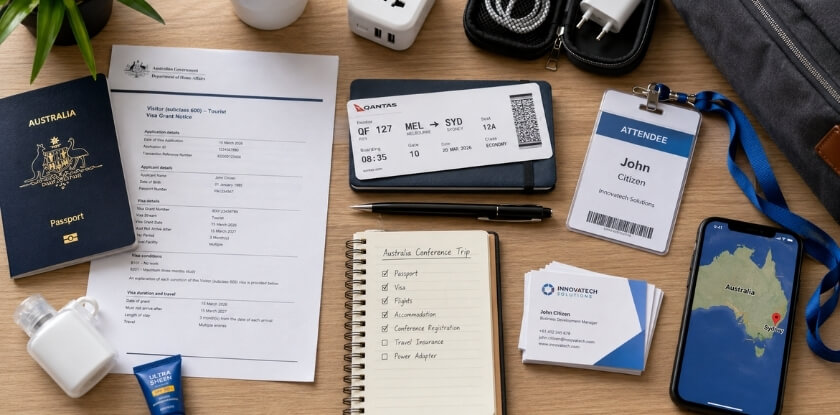
Carry digital and printed copies of:
- Visa grant notice and passport information page
- Invitation letter and registration confirmation
- Hotel booking and return ticket or itinerary
- Travel insurance and employer leave letter, if relevant
Home Affairs says you are liable for all your healthcare costs in Australia and strongly recommends adequate health insurance.
Mistakes to avoid after approval: traveling on a new passport without checking your visa (an ETA ends when you get a new passport, so you need a new one), staying past the permitted period, assuming multiple entries without checking, accepting paid local work, and changing your main purpose without reviewing the conditions. If something on the grant notice looks wrong, fix it before departure, not at the border.
At the airport or border, answer questions clearly and honestly. If you are attending a conference, say so and be ready to show proof.
Frequently Asked Questions About Australia Conference Visas
Once the visa is lodged, plans can still shift: travel details change, family wants to come, a second conference appears or you need to withdraw, and paid speaking or switching visas while in Australia need checking.
How early should I apply for an Australian conference visa?
Apply as soon as your conference documents and travel plan are ready. Home Affairs gives no fixed time for subclass 600 and shows recent decision times in its processing time guide, so allow several weeks. An ETA result usually comes immediately.
How long can I stay?
Usually up to 3 months. For subclass 600, Home Affairs sets the period case by case and can grant up to 12 months in certain circumstances. An ETA or eVisitor allows up to 3 months after each entry. Your grant notice states the exact period.
Can I attend multiple conferences on the same visa?
Yes, if every event is a permitted business visitor activity and your stay, entries and validity allow it. Check in VEVO or your grant notice whether the visa is single or multiple entry. Keep proof for each event.
Do I need a return ticket before applying?
Not always, but return evidence helps. A refundable booking, a travel plan or an employer-approved leave letter shows that you intend to leave.
Can family members travel with me?
Yes, but each person needs a separate application, including children listed in your passport. You cannot add family members to yours, and each application depends on that person’s own purpose.
Do I need a conference agenda?
Not always, but it helps. An agenda shows the event is real and that your travel dates match the program. Speakers and presenters should include their program details if available.
What if my travel details change after applying?
Update important changes through the correct channel. That includes a new passport, new dates or a changed venue.
Can I withdraw my visa application?
You may be able to withdraw before a decision, but charges are often not refunded simply because plans changed. Weigh that before you withdraw.
Can I be paid to speak on a visitor visa?
No. A business visitor cannot be paid by the organisers to take part in a conference. Invited speakers who will be paid might be eligible for a subclass 408 invited participant visa instead. Check with the organiser and Home Affairs first.
Can I switch to another visa while in Australia?
Not by extending: visitor visas cannot be extended. You can apply for another visa only if yours has no condition, such as 8503 (no further stay), that blocks it. If you plan to work, study or stay longer, check the pathway before you travel.
Conclusion
Choose the right visa first: ETA 601 or eVisitor 651 if your passport qualifies, otherwise the subclass 600 Business Visitor stream. Then use the correct platform, keep every document consistent, answer requests quickly, and read your grant notice before you fly.
Disclaimer: This article is general information, not legal or immigration advice. Visa rules, fees, and processing times change. Confirm the current requirements on the official Australian Department of Home Affairs website before you apply.