
Sponsors rarely start by asking for a price list. They ask what they actually get for their money, and tiers are the way organizers answer that question. This guide covers the usual levels, how benefits grow from one to the next, and how to choose one.
Quick answer: Conference sponsorship tiers are ranked sponsorship levels, usually named Platinum, Gold, Silver, and Bronze, that link what a sponsor pays to the benefits it receives. Higher tiers add visibility, better booth placement, speaking slots, and networking access, while lower tiers cover basic recognition. Each organizer sets its own prices and benefits.
Conference Sponsorship Tiers Explained
Conference sponsorship tiers are ranked sponsorship packages that connect a sponsor’s level of support with specific event benefits. Each tier gives sponsors a different level of recognition, visibility, and access.
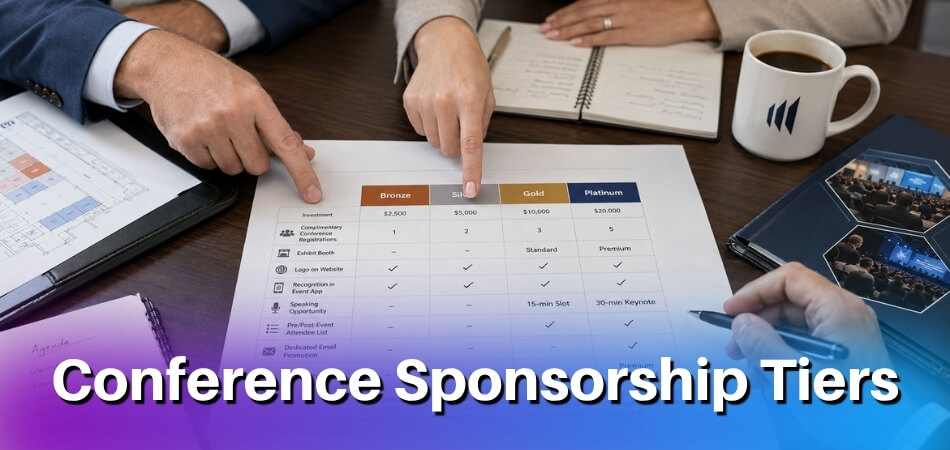
Instead of one general sponsorship option, conferences usually divide sponsorship into several levels. A business that wants basic brand recognition may choose an entry-level tier, while a company looking for premium exposure may select a higher-tier package with stronger promotional benefits.
Simple Definition of Sponsorship Tiers
Tiers run from basic to premium, and the benefits increase as the sponsorship value rises. Each level defines what the sponsor contributes and what it receives in return.
For example, a basic tier may include a logo on the conference website and a mention in event materials. A mid-level tier may add booth space, email promotion, and social media visibility. A premium tier may include a speaking opportunity, prime exhibit placement, branded sessions, or recognition during key parts of the event.
How Sponsorship Tiers Help Organizers and Sponsors
Tiers give organizers clear partnership options and give sponsors a way to pick the right level of involvement. Without a tiered structure, sponsorship conversations can become unclear, inconsistent, or hard to compare.
For conference organizers, tiers help with:
- Creating professional sponsorship packages
- Attracting sponsors with different budgets
- Setting clear expectations from the beginning
- Organizing visibility, booth space, and promotional placements
- Managing event funding more effectively
For sponsors, tiers help with:
- Comparing available options
- Choosing a package that matches the budget
- Aligning benefits with marketing objectives
- Reaching a relevant conference audience
- Planning how to measure value after the event
This is especially useful for conferences with a broad or international audience, where sponsors may want to meet attendees from different industries, regions, or professional backgrounds.
Common Benefits Included in Sponsorship Packages
Most packages mix branding, promotional visibility, attendee engagement, and event recognition. Higher tiers usually provide more of these, while lower tiers focus on basic exposure.
Common benefits may include:
- Logo placement on the conference website
- Brand mention in email campaigns
- Recognition in conference programs or digital materials
- Social media promotion
- Exhibition booth or display space
- Branded banners, signs, or digital screen placement
- Sponsored sessions, workshops, or networking breaks
- Speaking, panel, or moderator opportunities
- Recognition during opening or closing remarks
- Access to VIP networking sessions
- Product demonstrations or promotional material distribution
The right tier depends on the sponsor’s goals, target audience, available budget, and expected return from the event.
Why Conferences Use Sponsorship Tier Systems
Conferences use tiers to organize sponsor opportunities by budget, value, and visibility. A tiered structure gives sponsors clear choices and helps organizers manage funding, promotional benefits, and sponsor expectations.
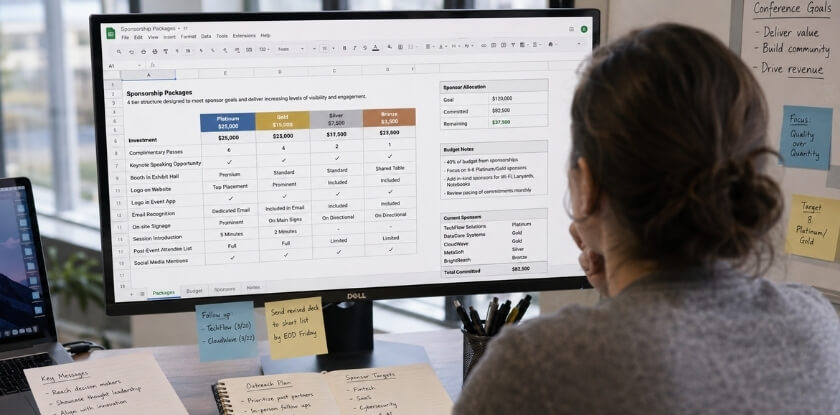
Without tiers, every sponsor conversation may turn into a custom negotiation. That can lead to confusion, inconsistent pricing, and unclear deliverables. A tier system gives each package a defined price range, set of benefits, and level of exposure.
Clear Sponsorship Options for Different Budgets
A tiered system lets businesses with different budgets take part in the same conference. Not every sponsor has the same financial capacity or marketing goal, so several tiers make the opportunity more accessible.
A startup or small business may choose a lower tier to gain visibility without a large commitment. A larger company may invest in a higher tier to increase exposure, meet attendees directly, and strengthen its position in the industry.
Common budget-based levels include:
- Entry-level tiers for basic brand recognition
- Mid-level tiers for stronger visibility and attendee engagement
- Premium tiers for maximum exposure and exclusive opportunities
- Custom tiers for sponsors with specific goals
Structured Value for Brand Exposure and Engagement
Each tier should state what kind of exposure the sponsor gets and how it can engage with the audience. Exposure means logo placement, signage, mentions, and website visibility. Engagement means booth space, networking access, sponsored sessions, product demonstrations, or speaking roles.
Easier Comparison Between Sponsorship Packages
Tiers let sponsors compare packages side by side. When benefits are grouped into clear levels, sponsors can quickly see what changes from one tier to the next.
A clear comparison helps sponsors answer questions such as:
- Will we receive booth space or only logo placement?
- Are speaking opportunities included?
- Will our company be promoted before the conference?
- Can we interact directly with attendees?
- Is the higher tier worth the added cost?
This saves time for both sponsors and organizers.
Better Planning for Event Revenue and Sponsor ROI
Because each tier has a defined value, organizers can forecast revenue and sponsors can plan their return on investment. Organizers can estimate how many sponsors they need to cover the conference budget. Sponsors can judge expected outcomes such as audience reach, lead opportunities, brand impressions, or direct conversations with attendees.
Main Types of Conference Sponsorship Tiers
The usual tier names are Platinum, Gold, Silver, and Bronze, sometimes joined by supporting, in-kind, and custom levels. They help sponsors choose how much visibility, access, and involvement they want. Some events add a level above Platinum, such as Diamond, and the names do not have to be metals at all.
Platinum Sponsorship Tier
Platinum is usually the highest level and offers the most prominent visibility at a conference. It is designed for sponsors that want a leading presence throughout the event.
A Platinum sponsor may receive top logo placement, premium booth space, speaking opportunities, major event signage, recognition during opening or closing sessions, VIP networking access, and stronger digital promotion.
This tier suits companies that want to position themselves as major industry supporters. Because it usually carries the highest cost, sponsors should choose it when the audience closely matches their target market and they have a clear plan to use the visibility.
Gold Sponsorship Tier
Gold is a high-value tier that offers strong visibility, usually at a lower price than the top package. It is a practical option for sponsors that want meaningful exposure but may not need every premium benefit.
Gold sponsors may receive strong website placement, recognition in event materials, good booth placement, social media and email promotion, selected session mentions, and access to networking opportunities.
Silver Sponsorship Tier
Silver is a mid-level option that balances promotional visibility with cost control. It works well for companies that want an active conference presence without committing to a premium package.
A Silver sponsor may receive logo placement, recognition in event programs, standard booth space, limited social media promotion, a sponsor listing, and the ability to distribute promotional materials, such as a sponsor insert in the conference kit.
Bronze Sponsorship Tier
Bronze is commonly the entry-level tier and gives basic visibility at a lower cost. It suits small businesses, first-time sponsors, startups, academic groups, and local service providers, or companies testing whether the event is a good fit, that want to support the conference without a large financial commitment.
A Bronze sponsor may receive a basic website listing, a mention in event materials, limited signage, and general acknowledgment as an event sponsor.
Bronze can also be a starting point for companies that may move up a tier at a future event after seeing the audience quality and sponsorship value.
Supporting, In-Kind, and Custom Levels
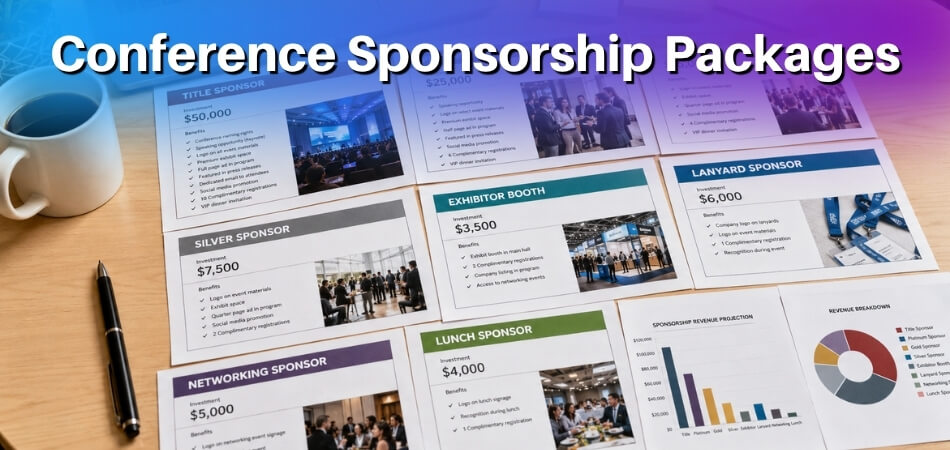
Beyond the four named levels, organizers often add supporting, in-kind, and custom options. A supporting sponsor pays for one feature, such as a networking session, coffee break, lunch session, workshop, panel discussion, registration desk, conference badge, or digital resource. This lets organizers package smaller but valuable event assets. An in-kind sponsor contributes products, services, or resources instead of money, which can reduce event costs. Examples are printing, event technology, catering support, branded merchandise, photography, software access, transportation assistance, or media support. In return the sponsor receives recognition that matches the value of the contribution, such as logo placement, booth space, or acknowledgment during a session.
A custom package is built around one sponsor’s goals, budget, or preferred benefits. It may mix branding, sponsored content, networking access, co-branded materials, digital promotion, and product displays. A custom tier is useful when the standard Bronze, Silver, Gold, or Platinum options do not match what the sponsor wants to achieve. Custom tiers work best when both sides define expectations, deliverables, timeline, and success goals in writing.
What Sponsors Typically Receive at Each Tier
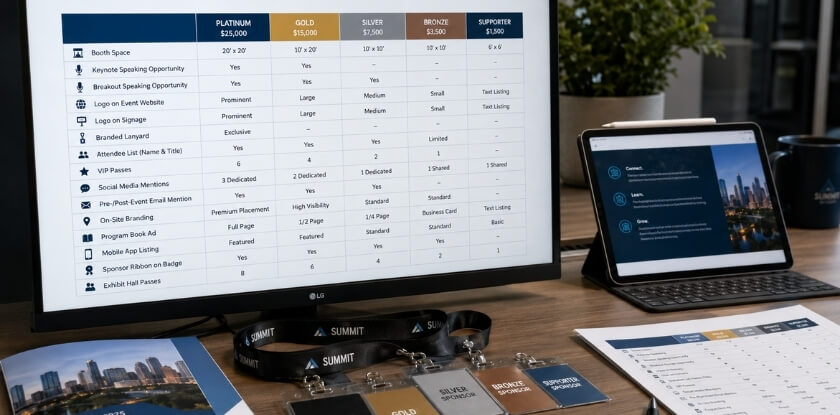
Sponsors typically receive brand visibility, event recognition, booth access, digital promotion, networking opportunities, and sometimes speaking roles. The exact benefits depend on the sponsorship level, event format, audience size, and available sponsor assets.
Brand Visibility Benefits
Brand visibility puts a sponsor’s name, logo, or message in front of attendees before, during, and after the event. Common forms include website placement, sponsor listings, event signage, presentation slides, registration-area branding, email mentions, event app visibility, and sponsor directories.
Higher-tier sponsors usually get more prominent placement. For example, a Platinum sponsor may appear at the top of the event website, while a Bronze sponsor is listed in a general sponsor section.
Speaking and Thought Leadership Opportunities
Speaking opportunities let sponsors share expertise and build trust, and they are often reserved for higher tiers or custom packages. They may include keynote introductions, panel participation, workshop hosting, sponsored educational sessions, moderator roles, short presentations, or product demonstrations.
Exhibition and Booth Placement
Exhibition space gives sponsors a place to meet attendees, answer questions, demonstrate products, and collect leads. It is one of the most practical benefits for sponsors that want direct engagement.
Higher tiers often include better placement, such as near entrances, session halls, registration desks, or networking areas. These spots can increase foot traffic and create more conversations.
A booth is not always part of a tier. The Society for Neuroscience lists no exhibit space in any of its four Neuroscience 2024 tiers; its tiers earn priority points toward future exhibit space instead. PRICAI 2023 includes a single-wide exhibit space only for its Diamond, Platinum, and Gold levels. Check whether the booth is included or sold separately.
Complimentary Registrations and Attendee Lists
Higher tiers can include free registrations, and some events also offer higher-tier sponsors a participant list. Neuroscience 2024 gives 1 complimentary registration at Bronze, 2 at Silver, 5 at Gold, and 10 at Platinum. PRICAI 2023 gives 1 at Bronze up to 5 at Diamond, and lists a participant list for its Diamond and Platinum levels only.
A participant list is personal information, so a sponsor should not assume it comes with a tier. In Canada, the Office of the Privacy Commissioner states that PIPEDA applies to private-sector organizations that collect, use, or disclose personal information in the course of commercial activity. Ask the organizer exactly what is shared and under what conditions.
Digital Promotion Before, During, and After the Event
Digital promotion helps sponsors reach the audience beyond the venue. It can include online visibility before the conference, engagement during the event, and recognition after it ends.
Digital benefits may include landing page placement, email newsletter mentions, social media posts, event app visibility, virtual platform banners, push notifications, and post-event recap mentions. They matter most for hybrid or virtual conferences, where online engagement plays a larger role.
Networking Access and VIP Opportunities
Networking access helps sponsors build relationships with attendees, speakers, organizers, and other partners. For many sponsors, these connections are worth more than passive exposure.
Networking benefits may include VIP receptions, sponsor-attendee meetups, speaker networking, business matchmaking, roundtables, hosted meals, or invitation-only events. Premium tiers often include stronger privileges, but organizers should define exactly what access is included.
Recognition in Event Materials and Announcements
Sponsor recognition publicly acknowledges the businesses that support the conference. It can appear in printed programs, digital materials, session slides, stage remarks, sponsor walls, registration materials, and post-event thank-you content. This helps sponsors build credibility by showing their connection to the event and its professional community.
Example Conference Sponsorship Tier Comparison
A tier comparison shows what each level may include and how benefits grow from one package to the next. Every conference structures its packages differently, but a clear comparison makes the decision easier.
| Sponsorship Level | Typical Purpose | Common Benefits |
| Bronze | Basic visibility | Website listing, sponsor mention, logo in event materials |
| Silver | Moderate exposure | Bronze benefits plus booth space, social media mention, and stronger recognition |
| Gold | High visibility | Silver benefits plus better booth placement, email promotion, and session options |
| Platinum | Maximum exposure | Gold benefits plus top logo placement, speaking opportunities, VIP access, and major branding |
| Custom | Specific goals | Selected benefits based on sponsor needs, budget, and event availability |
How Benefits Scale From One Tier to the Next
Benefits usually grow in both quantity and quality as you move up, with the best spots going to the top tier. The table below shows a typical pattern. It is an illustration, not a standard, and each organizer decides what goes where.
| Benefit | Bronze | Silver | Gold | Platinum |
| Website logo | Listed in sponsor section | Logo listed | Prominent placement | Top placement |
| Booth or display | Usually none | Standard space | Better location | Prime location |
| Email and social media | None | Limited mention | Included | Featured |
| Speaking or session role | None | None | Session mention or option | Speaking slot |
| VIP networking | None | General activities | Selected events | Full access |
Published Tiers From Two Real Conferences
Real tier lists differ in the number of levels, the prices, and what each level includes. The table below comes from each event’s own sponsorship page, read in October 2026.
| Event | Levels and listed prices | Complimentary registrations | Exhibit space |
| Society for Neuroscience, Neuroscience 2024 | Platinum $50,000, Gold $25,000, Silver $15,000, Bronze $7,500 | 10, 5, 2, and 1 | Not included in any tier |
| PRICAI 2023 | Diamond US$10,000, Platinum US$8,000, Gold US$5,000, Silver US$4,000, Bronze US$3,000, plus a separate Keynote Speaker sponsorship at US$5,000 | 5, 4, 3, 2, and 1 (Keynote Speaker: 3) | Single-wide space for Diamond, Platinum, and Gold; none listed for the others |
The two lists share the metal names but little else, which is why a sponsor should read each organizer’s own page and not assume a tier means the same thing everywhere.
Who Each Level Suits
Entry-level tiers fit small businesses and first-time sponsors, mid-level tiers fit companies that want some attendee contact, and premium tiers fit sponsors that want the strongest presence. Entry-level packages focus on a website logo, a program mention, and basic digital recognition. Mid-level packages add better website placement, email recognition, standard booth space, attendee material inclusion, and general networking access. Premium packages add prime booth location, speaking opportunities, branded signage, sponsored sessions, product demonstrations, and strong post-event recognition.
Custom Add-On Sponsorship Opportunities
Add-ons let sponsors support one specific event feature, either on their own or on top of an existing tier. Examples include coffee break, lunch, conference badge, Wi-Fi, mobile app, registration desk, workshop, student participation, award ceremony, or branded attendee gift sponsorship.
How to Create Conference Sponsorship Tiers
To create tiers, organizers should identify valuable event assets, group benefits into clear levels, price each package fairly, and leave room for customization. The goal is a set of options that is easy to understand, attractive to sponsors, and practical for the event team to deliver.
Identify Valuable Event Assets
Event assets are the things sponsors may find valuable. These include website visibility, email promotion, social media exposure, signage, booth space, speaking opportunities, networking sessions, sponsored meals, event app placement, registration desk branding, and post-event content.
Not every asset has the same value. A speaking slot in a high-attendance session may be worth more than a small logo placement, and a booth near registration may beat one in a quiet corner.
Define Clear Sponsorship Levels
Most conferences use Bronze, Silver, Gold, and Platinum because the names are instantly recognizable. Each level should feel meaningfully different from the one below it. If the benefits are too similar, sponsors may pick the lowest option because the higher tiers do not show enough added value.
How Many Tiers to Offer
Offer as many levels as you can clearly tell apart, and no more. Three or four named levels with optional add-ons are easy to explain. More levels mean more benefits to track and deliver, and they make it harder for sponsors to see the real difference between neighbouring packages. A smaller event may do well with two or three levels, and a large event with many exhibitors may need more. Neuroscience 2024 uses four levels, and PRICAI 2023 uses five plus a keynote sponsorship.
Match Benefits to Sponsor Goals
Each tier should be built around the goals sponsors are likely to have. These include brand awareness, lead generation, product promotion, thought leadership, community support, recruitment, and partnerships.
A sponsor focused on awareness may value logo placement and digital promotion. One focused on leads may care more about booth traffic and networking access. One focused on authority may prefer speaking opportunities.
Price Each Tier Based on Value
Sponsorship pricing should reflect the value of the benefits, the audience size, the event’s credibility, and the visibility the sponsor expects. Do not copy prices from another event without considering context.
Review audience size, attendee relevance, promotional touchpoints, booth placement quality, exclusivity, event production costs, and previous sponsor demand. Price usually steps up with visibility and scarcity: a single top-sponsor slot or a prime booth justifies a bigger gap than a general website listing. Keep the gap between tiers large enough that each upgrade clearly adds something.
Build Easy-to-Review Sponsorship Packages
A sponsorship package should be clear, scannable, and easy to compare. It should include a short event introduction, audience details, tier names, pricing, benefits, add-ons, custom options, deadlines, and contact information. A comparison table helps sponsors see what changes from one level to another.
Leave Room for Custom Sponsorship Requests
Custom options let organizers serve sponsors whose goals do not fit a standard tier. Some sponsors want to support a specific session, branded resource, niche audience segment, or networking activity. Document custom packages clearly so both sides understand the value, deliverables, timeline, and responsibilities.
Review and Update Tiers Regularly
Review tiers after each event to improve value, pricing, and sponsor satisfaction. Look at which tiers sold, which benefits sponsors used, which were hard to deliver, and what feedback sponsors gave. Regular updates keep tiers competitive and easier to sell.
Why Sponsorship Tiers Matter for Sponsors
Tiers matter because they show what each level of investment buys. Instead of choosing a package blindly, businesses can compare tiers and select the option that best supports their goals.
They Clarify Value and Support Marketing Goals
Each level connects a specific investment with specific benefits, which makes sponsorship a measurable marketing decision and not just event support. A company seeking awareness may choose a lower tier with brand recognition. One focused on lead generation may choose a tier with booth space or networking access. One aiming for thought leadership may prefer speaking or workshop opportunities.
They Increase Brand Recognition
Tiers help sponsors put their name in front of a relevant audience. Repeated visibility across websites, emails, signage, social media, and session materials helps attendees become familiar with the sponsor. Higher tiers usually give more frequent and prominent exposure.
They Help Build Long-Term Event Partnerships
A sponsor that takes part consistently becomes familiar to organizers, attendees, speakers, and industry partners. Over time this can lead to stronger recognition, better future opportunities, and more meaningful professional connections.
They Make Sponsorship ROI Easier to Measure
Each package has defined benefits and expected outcomes, so results are easier to track. Sponsors may track booth visits, scanned leads, QR code traffic, website visits, social media engagement, session attendance, meetings booked, and post-event conversions. The most useful metric depends on the sponsor’s goal.
How to Choose the Right Sponsorship Tier
Compare your budget, marketing goals, audience fit, engagement needs, and expected return. The best tier is not always the highest-priced one. It is the one that gives the sponsor the most relevant value.
Set a Realistic Sponsorship Budget
A realistic budget includes the sponsorship fee and the extra costs of using the sponsorship properly. These may include booth design, travel, printed materials, staff time, branded items, lead capture tools, and follow-up campaigns. A package with a speaking slot needs preparation, and a booth needs staffing, materials, and follow-up.
A smaller tier with strong activation can perform better than a larger tier with poor preparation. Choose a tier you can fully use, not just one you can afford on paper.
Define Your Marketing Objectives
Clear objectives let you choose a tier based on purpose instead of price alone. Decide whether you want awareness, leads, partnerships, product visibility, recruitment, authority, or community support. Once the goal is clear, it is easier to match package benefits to it.
Review the Conference Audience
Audience fit is one of the most important factors in choosing a tier. Review attendee industries, job roles, professional levels, location, company types, decision-making influence, and session themes.
A smaller conference with highly relevant attendees may create stronger value than a larger event with a broad but less relevant audience.
Compare Visibility and Engagement Opportunities
Visibility shows that a brand is present, while engagement lets the sponsor talk to attendees directly. Visibility benefits include logo placement, signage, program recognition, and email promotion. Engagement benefits include booth space, networking access, sponsored sessions, roundtables, and direct conversations. Sponsors that want leads or partnerships should prioritize engagement, not just exposure.
Align the Tier With Long-Term Brand Strategy
The right tier supports both immediate event goals and long-term brand positioning. Consider whether the event fits your brand direction, audience priorities, credibility goals, and future partnership plans. A consistent sponsorship strategy builds stronger recognition over time.
Check What Is Exclusive
Exclusive means only one sponsor can hold a benefit, and non-exclusive means several can. At Neuroscience 2024, the exclusive eblast is listed under Platinum only. Ask whether a tier or an add-on has a cap, because that affects both price and availability.
Check What Sponsorship Does Not Buy
At an academic conference, sponsorship should not give a sponsor control over the scientific programme. PRICAI 2023’s page states that sponsors have no say over paper selection, tutorial selection, programme committee composition, or best paper awards. Look for a similar statement on any academic event you consider.
Common Mistakes to Avoid When Selecting a Sponsorship Tier
Most mistakes come from choosing a package without checking audience fit, total cost, activation needs, or a measurement plan. A tier may look attractive on paper, but it only creates value when it supports real goals.

Choosing Based Only on Price
Choosing only on price can lead to poor results. A low-cost package may not give enough visibility, while a high-cost package is not worth it if the sponsor cannot use the benefits. Compare benefits, audience fit, engagement opportunities, and activation requirements first.
Ignoring Audience Fit
Ignoring audience fit is one of the biggest mistakes a sponsor can make. Sponsorship works best when the audience matches the sponsor’s ideal customers, partners, clients, students, members, or professional community. A large audience does not mean strong value if the attendees are not relevant.
Overlooking Activation Costs
Activation costs are the extra expenses needed to make a package work, and they are easy to forget. Besides the booth and travel costs listed in the budget section above, remember staff training, presentation preparation, branded merchandise, and post-event follow-up.
Failing to Track Leads and Engagement
Without tracking, you cannot tell whether the sponsorship worked. Decide how you will measure performance before the conference begins. Useful methods include contact forms, QR code scans, meeting requests, and post-event sales conversations, along with the metrics listed earlier.
Waiting Too Long to Secure a Tier
Waiting too long can limit your options. Premium packages, booth spaces, speaking opportunities, and exclusive add-ons may sell early. Early commitment also gives you more time to prepare and gives organizers more time to include you in pre-event promotion.
From our experience at MS International: We organize in-person conferences in the Greater Toronto Area, and the tiers in this guide describe general industry practice, not an MS International price list. At our conferences, the moderator introduces each presenter before the presentation.
FAQ: Conference Sponsorship Tiers
Sponsors comparing tiers want to know what higher levels include, whether exhibit space is part of the deal, if prices are fixed and when to commit or change level.
What Are the Most Common Conference Sponsorship Tiers?
The most common conference sponsorship tiers are Bronze, Silver, Gold, and Platinum. They usually move from basic to premium, with each level offering more visibility, recognition, and engagement than the one below.
What Is Usually Included in a Higher Sponsorship Tier?
Higher tiers usually include stronger brand visibility, better placement, and more attendee access. Common benefits are prominent logo placement, more complimentary registrations, speaking opportunities, sponsored sessions, email promotion, VIP networking, and post-event recognition. Booth space is included only at some events.
What Is the Right Number of Tiers for a Conference?
Three or four levels are easy to explain, though no rule fixes the number. A smaller event can manage with two or three, as long as each level adds clearly different benefits.
Do Sponsorship Tiers Have Fixed Prices?
No, each organizer sets and publishes its own prices. Neuroscience 2024 lists $7,500 to $50,000 across four levels, and PRICAI 2023 lists US$3,000 to US$10,000 across five. Ask the organizer for its current package details.
How Do I Know Which Sponsorship Tier Fits My Budget?
The right tier fits both your budget and your marketing goals. Compare the sponsorship fee, activation costs, audience relevance, visibility benefits, and the internal resources you need to use the package.
Is Exhibit Space Included in a Sponsorship Tier?
Not always. Neuroscience 2024 includes no exhibit space in any tier, while PRICAI 2023 includes a single-wide space for its top three levels. Read the package page before assuming a booth comes with a tier.
Do Sponsors Get a Say in the Conference Programme?
It depends on the organizer, and some academic events rule it out in writing. PRICAI 2023 states that sponsors have no say over paper selection. Look for a similar statement before you commit.
Can Sponsorship Tiers Be Customized?
Yes, tiers can often be customized if the organizer allows flexible packages. Sponsors may request session sponsorships, branded resources, networking opportunities, product demonstrations, or in-kind contributions.
Can a Sponsor Upgrade or Downgrade Their Tier?
Possibly, depending on event rules, deadlines, and availability. Changes are easier before booth assignments, promotional materials, and program listings are finalized.
When Should Sponsors Confirm Their Sponsorship Tier?
As early as possible, especially for premium benefits. Early confirmation helps secure better booth placement, speaking opportunities, and pre-event promotion, and leaves time to prepare.
Final Thoughts on Conference Sponsorship Tiers
Tiers give sponsors and organizers a clear way to structure event partnerships. The best tier is not always the largest package. It is the one that matches the sponsor’s budget, audience priorities, and engagement needs, so review the audience, compare benefits, and count the full cost of using the package before deciding.
For organizers, tiers should stay clear, realistic, and easy to compare, and every promised benefit should be practical to deliver.