
Is the abstract you send to a conference really the same thing as the abstract on a journal paper? They look alike, since both are a short block of text summarizing research. But they are written at different stages, for different readers, and treating them as interchangeable causes real problems.
Quick answer: No. A conference abstract is a standalone submission, often written before the study is finished, that a committee uses to decide whether to give you a presentation slot. A paper abstract summarizes a completed paper for readers deciding whether to read it. They differ in purpose, stage, length, tense and what the abstract has to prove.
Last verified against official sources: October 2026.
Conference Abstract vs Paper Abstract: Key Differences at a Glance
They share a name and a rough format, but the rules around them differ. The table maps the core differences, and the sections below explain what each one means for your work.
| Dimension | Conference Abstract | Paper Abstract |
| Purpose | Secure a presentation slot | Summarize a published or submitted paper |
| Writing stage | Often written before the research is complete | Written after the full paper exists |
| Audience | Program committee, then conference attendees | Journal editors, peer reviewers, database readers |
| Typical length | Set by the call for papers; commonly 150 to 300 words, longer for extended abstracts | Set by the journal; commonly 150 to 300 words (APA caps professional paper abstracts at 250) |
| Tense | Present or future for planned work (“This study examines…”), past for finished parts | Mostly past for what was done and found, present for conclusions |
| Results | Preliminary or expected; some fields accept none | Final results are expected |
| Citations | Rarely, only a key source if the call allows it | Rarely; the reference list belongs to the paper |
| Review | Selective review of the abstract alone; the process depends on the organizer | Full peer review of the complete manuscript |
| Publication status | Usually a program book or proceedings entry, not a journal article | Published with the article and indexed in academic databases |
| Keywords | Sometimes required; used to route reviewers and schedule sessions | Required by many journals; drive database discoverability |
| Reuse | Can seed a paper but must be rewritten | Check the conference rules before reusing it as a submission |
| Stands alone? | Yes, the abstract is the entire submission | No, it accompanies and represents a full paper |
Purpose and Writing Stage
The most practical difference is when you write them. A conference abstract is usually submitted months before the event, often before data collection is finished or conclusions are firm. Many researchers in STEM submit with preliminary results; those in the humanities may submit with a theoretical argument still taking shape. You are pitching what the work will do.
A paper abstract, whether for a journal article or a thesis chapter, gets written last. The research is done, the argument is settled, and the abstract exists to represent something that already exists in full.
Audience
A conference abstract goes to a selection committee first, then works as a preview for attendees browsing the program. Those readers want to know whether your work fits the event’s themes and is worth attending.
A journal abstract reaches a wider audience: editors making desk-reject decisions, peer reviewers, and researchers scanning databases who may never open the full paper. For that last group the abstract is the paper, practically speaking.
Peer Review and Acceptance
Conference abstracts are reviewed for fit and quality, but the bar and the process differ from journal peer review. Acceptance rates vary widely between events, and the decision rests entirely on the abstract. Selection criteria often include relevance to the theme, methodological clarity and the potential for useful discussion, not the rigor standards applied to a finished manuscript. In some fields, computer science for example, conferences ask for full papers instead of abstracts and review the whole paper, which makes their review much closer to journal peer review.
Journal peer review evaluates the full paper. The abstract matters at the desk review stage, but reviewers read everything behind it. Standards are higher, the timeline is longer, and the outcome affects your publication record more permanently.
Length and Format
Conference word limits vary more than most researchers expect, from about 150 words for a short summary to 500 or more for an extended abstract that outlines methods, findings and implications. Some conferences, particularly in the humanities, publish extended abstracts as proceedings that work almost like standalone documents.
Journal abstracts follow tighter conventions. Many journals fix a word count, often between 150 and 300, and many require labeled sections such as Background, Methods, Results and Conclusion. APA 7 sets a 250-word maximum for abstracts in professional papers and places the abstract on the second page as a single paragraph, while for student papers an abstract is usually optional and the instructor sets any limit.
Full Paper Conversion
A conference abstract does not automatically become a paper abstract, even if the same research leads to a journal submission. Scope, framing and detail usually have to change. The conference version was written to get you a room; the journal version represents a completed, peer-reviewed argument. Treating one as a draft of the other tends to produce something that fits neither purpose.
Same Study, Two Abstracts
A made-up example shows the shift. The first version is written mid-project for a conference; the second after the paper is finished.
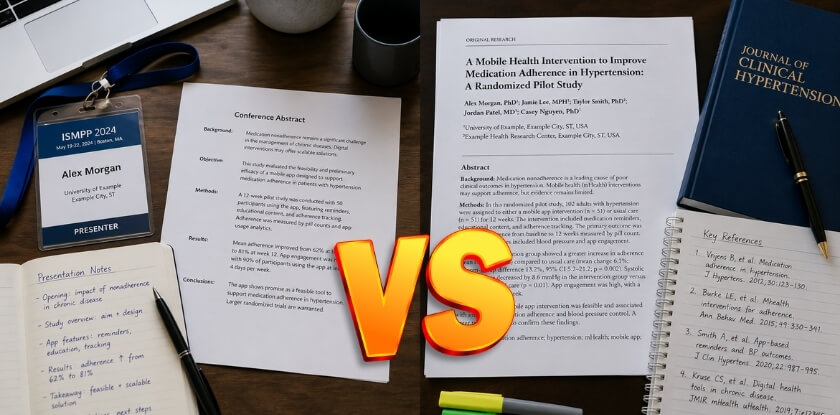
Conference version (data still being collected): This study asks whether brief weekly feedback helps first-year students write better lab reports. Forty students are being tracked across one term, and early scores suggest a modest gain. We will present the method, the interim results and the questions we still need to answer.
Paper version (study complete): Report scores for forty first-year students were compared before and after a term of short weekly feedback sessions. Scores rose in the feedback group, and the effect held after controlling for prior grades. We discuss limits of the small sample and suggest a larger follow-up.
Notice the tense, the status of the results and the closing line. The conference version promises; the paper version reports.
What Is a Conference Abstract and Why Is It Written?
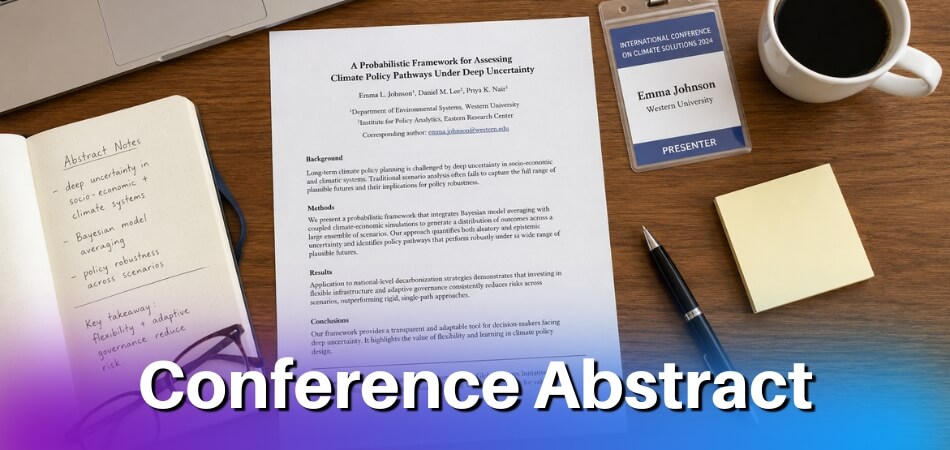
A conference abstract is a short document you submit to an organizing committee before the event so they can decide whether to include your work in the program.
The Purpose Behind the Submission
The committee is reviewing many submissions against a defined set of criteria. They are asking a practical question: does this proposed talk or poster fit the theme, and is the research substantial enough to deserve a slot? Your abstract has to answer that clearly, often in 150 to 300 words.
This is a gatekeeping document. It goes in before the full paper exists in many cases, and in some fields, especially the humanities and social sciences, before a manuscript has even been drafted. That makes it a forward-looking pitch in a way a journal abstract never is.
When It Gets Written
The writing stage is one of the clearest differences from a paper abstract. You often write a conference abstract early, sometimes when only preliminary results exist. In STEM, researchers sometimes submit on data that is still being collected or analyzed, and the full paper, if one emerges at all, comes later.
What Happens After Acceptance
Acceptance means a presentation slot, a poster, or a place in a workshop session, not an automatic publication. The abstract may appear in a program or proceedings volume, which has its own status, but that is different from a peer-reviewed journal article.
Many researchers list accepted conference abstracts on an academic CV to show active participation in a field, particularly early in a career. Competitive conferences can be genuinely selective, so acceptance carries professional weight even without a full paper behind it. Turning the presentation into a journal article is a common path in many disciplines, but it is a separate step.
What Is a Paper Abstract and How Is It Different?
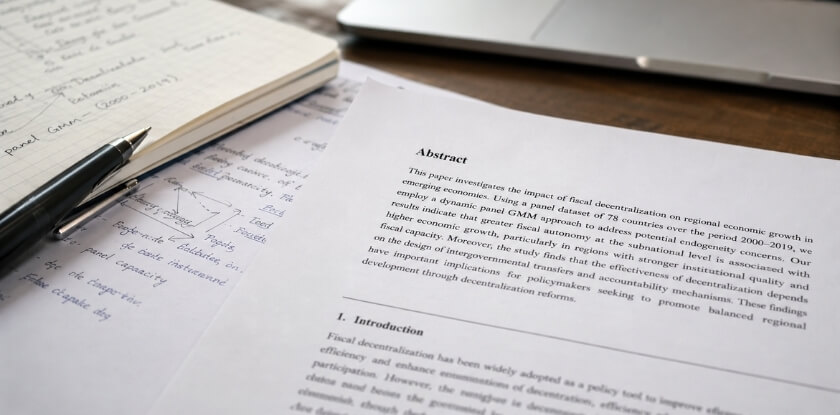
A paper abstract is written after the research is complete. That is the most fundamental distinction from a conference abstract, and everything else flows from it.
It Summarizes a Finished Study
By the time you write a journal abstract you have results. You know what you found, what your analysis showed and what you conclude. The abstract is a compressed version of that complete work, not a pitch for what you plan to do.
Journal abstracts commonly run between 150 and 300 words, though each journal sets its own limit. Some require a structured format with labeled sections, while others expect one flowing paragraph. STEM and biomedical journals lean toward the structured version; many humanities journals do not use it.
The abstract travels with the paper permanently. It appears on the journal’s website, in databases such as PubMed, Scopus or Google Scholar, and in citation records. Readers use it to decide whether to read the full paper, and it can influence whether your work gets cited. A conference abstract, by contrast, may never appear in a publicly indexed document.
Audience and Purpose Are More Specific
A paper abstract is addressed to researchers already working in or near your field, so you can assume more baseline knowledge than at a general conference. Its job is to convey the study’s contribution accurately so the reader can judge whether the full paper is worth their time.
It is also part of the peer review package and is scrutinized by reviewers evaluating validity, not just interest. Conference reviewers often make a quick selection call on fit and relevance; journal reviewers go deeper.
Keywords and Discoverability
Paper abstracts usually come with a keyword list, and those keywords do real indexing work: when someone searches a database, they determine whether your paper surfaces. Choose terms your target audience actually searches with, not just the terms you prefer. Conference abstracts sometimes include keywords too, but the stakes are lower, since few people search a conference proceedings database the way they search PubMed or Web of Science.
How It Fits Your Academic CV
A conference abstract signals active engagement with a field; a published journal abstract signals a completed, peer-reviewed contribution. Both belong on a CV, in different categories, and grant committees, hiring panels and tenure reviewers read them differently.
Where the Two Overlap: Similarities Between Conference and Paper Abstracts
Despite the differences, the two share common ground, which is why skills built on one transfer to the other.
They Both Compress Complex Work Into a Small Space
Both formats ask you to reduce a body of research, sometimes years of work, to a few hundred words without losing the essential meaning. You still need to convey what you studied, why it matters and what you found. The order and emphasis shift, but the discipline of concise, accurate representation is the same.
Both Have to Stand Alone
A conference abstract is read without any accompanying paper. A journal abstract is read before the full paper, and often instead of it. Either way it has to work as a self-contained unit, because readers make quick judgments from those few sentences alone.
Keywords Matter in Both
In both cases keywords drive discoverability. A poorly chosen keyword in a conference abstract reduces your visibility in the program; the same mistake in a journal abstract affects how your published work surfaces in search results.
Structure Follows Similar Conventions
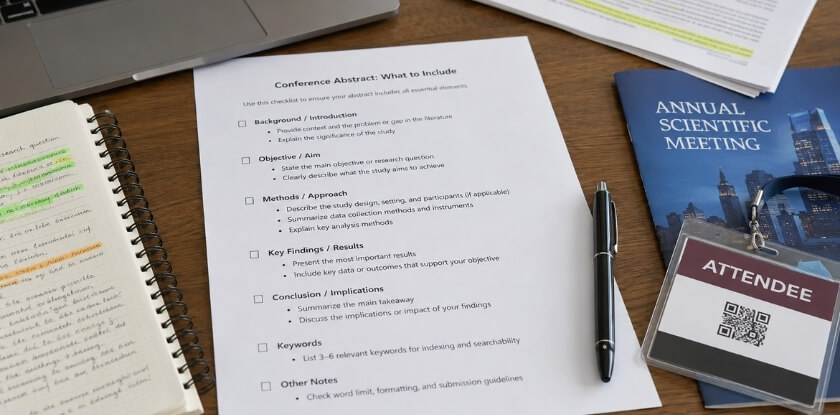
Both generally follow the same arc: background, objective, method, results and significance. A conference abstract may lean harder on the question and approach when results are not final. In the humanities both sometimes shift toward a descriptive style that signals the argument and scope rather than reporting outcomes.
Both Are Gatekeeping Documents
A conference abstract decides whether you get a presentation slot. A paper abstract shapes whether a reader, reviewer or editor invests time in the manuscript. Different gatekeepers, similar function: each opens or closes a door before anything else is read.
Descriptive vs Informative Abstract: Two Types Explained
A descriptive abstract says what the work covers without giving results; an informative abstract reports the problem, method, results and meaning. Knowing which one a venue expects decides how you structure your writing.
Descriptive Abstract
A descriptive abstract tells the reader what the paper or presentation covers without summarizing findings or conclusions. Think of an outline in sentence form: topic, scope and general approach, but no results.
These are typically short, often under 100 words. They are common in humanities disciplines, where the argument unfolds through the paper itself. A humanities conference abstract often leans descriptive for this reason, since the committee is judging whether the topic fits the program. Descriptive abstracts also suit exploratory work where no definitive outcome exists yet.
Informative Abstract
An informative abstract covers the full picture: the problem, the method, the results and what they mean. It is a compressed version of the paper, not a pointer to it. This is the standard in STEM and in most peer-reviewed journals, and if you submit to a journal you should assume it is wanted unless the guidelines say otherwise.
For a STEM conference, reviewers expect to see results even in draft form, because the abstract has to show evaluable work. Confirm the expected type before you write. A journal’s author guidelines will say; a call for papers usually signals it through the word limit and template. A 250-word limit with named fields for methodology and results is telling you to go informative.
Does a Conference Abstract Count as a Publication?
Generally no. A conference abstract is not considered a peer-reviewed publication in the same sense as a journal article, though the full answer depends on context.
What “Publication” Actually Means in Academia
Most disciplines use the term for work that has undergone rigorous peer review and appears in a citable, indexed outlet, typically a journal. A paper abstract, as the front matter of a published article, inherits that status. It appears in databases alongside the full paper and counts toward your publication record.
A conference abstract sits in different territory. It does go through a selection process, but selectivity and criteria vary enormously. Some conferences use structured peer review and accept few submissions; others accept nearly everything. That inconsistency is why the academic community does not treat conference abstracts as equivalent to journal publications. The CASRAI research dictionary describes a conference abstract as a short summary of findings or planned work submitted for selection as an oral or poster presentation. Once it is printed in an abstract book or supplement it is citable as a publication, but it typically lacks full peer review of the underlying research.
Does the Abstract Get Published Separately?
Sometimes. Many conferences publish accepted abstracts in a journal supplement, a printed program book or an online proceedings repository. The abstract then has a record of its own and can be cited as a conference proceeding. If the volume has an ISSN or ISBN you can cite it, and some STEM proceedings are indexed or carry a DOI, which gives them a quasi-publication status. In the humanities this is far less common.
Even so, a proceedings abstract has gone through lighter vetting, carries less weight in most tenure and promotion reviews, and does not substitute for a journal article. Whether it belongs in a “Publications” list or a “Conference Activity” list is a judgment call, so check your institution’s guidelines and your discipline’s norms.
The Conversion Question
A conference abstract is often a stepping stone. Many researchers present, collect feedback and then develop the work into a journal paper. The paper abstract written at that later stage is what enters the formal publication record. The conference abstract got you in the room and helped you refine the work, but the publication credit belongs to the journal article.
Can You Add a Conference Abstract to Your Academic CV?
Yes, and most academics do. The question is where it goes and how to present it accurately.
Where It Sits on Your CV
Conference abstracts do not belong in the list of peer-reviewed journal articles. Put them in a separate section such as “Conference Presentations,” “Conference Papers” or “Abstracts Presented.” Reviewers and hiring committees know the difference, and mixing the two raises eyebrows. Misrepresenting an abstract as a publication is a credibility risk, while listing it accurately still shows scholarly activity.
Within that section, note whether it led to an oral presentation or a poster, the conference name, the year and the location. Some researchers also note whether the selection was peer-reviewed, since some conferences use a formal process and others accept nearly everything.
What It Actually Signals
An entry shows your work was active and in circulation before a full paper reached a journal. Early in a career this matters: it shows you are presenting, your research agenda is moving and colleagues have encountered your work. In many STEM fields conference presentations can carry more weight than in the humanities, where the journal article tends to dominate the CV.
Converting a Conference Abstract into a Full Paper
Present first, then write the paper: this is common in STEM especially, but the abstract you submitted was a pitch, never a blueprint. The paper is the real work.

The Gap Between Abstract and Article
The conference abstract describes what you expected to find, not necessarily what you found once you were deep in the data. The journal abstract must reflect the completed study: confirmed methods, real results and a conclusion grounded in evidence. Treat the conference abstract as a reminder of what you promised, not as a draft.
What Changes During Full Paper Conversion
Scope and depth. A conference abstract gestures at findings; a full paper proves them. Methods, data, analysis and limitations all have to be present and defensible.
The abstract itself. Journal abstracts are informative; conference abstracts are often more descriptive. Write the journal abstract last, as a precise compression of the finished article.
Audience expectations. At a conference you can explain and answer questions in the room. A journal reader has only the page, so the writing has to carry more weight.
Keywords. Your conference form may not have required formal keywords. A journal almost always does, and they affect how the paper performs in searches.
When to Decide Whether to Convert
Not every presentation becomes a paper, and that is fine. Ask whether the work is genuinely novel, whether the results are strong enough to survive peer review, and whether the target journal is realistic for where the research stands. If the conference version rested on preliminary data, wait until the study is complete. Submitting a half-finished study dressed up as a complete one is one of the fastest routes to rejection.
Practical Steps for Making the Transition
Revisit the conference abstract alongside your actual data and conclusions; where they diverge, the paper wins. Outline the full paper from scratch rather than expanding the abstract paragraph by paragraph, because the structures differ enough that expansion produces awkward writing.
Check whether the conference proceedings were published. If your abstract or a short proceedings paper appears in a citable venue, disclose that when you submit to a journal. The ICMJE Recommendations list an abstract or poster shown at a scientific meeting as a preliminary report, and say a journal may still consider the complete report that follows. They also say that when a submission is closely related to earlier material, the letter of submission should clearly say so, with copies for the editor. Each journal has its own policy as well, so read it before you submit. The rule also runs the other way: many conferences, including MS International, require that submitted work is not already published or under review elsewhere.
Humanities vs STEM: How Abstract Writing Differs Across Disciplines
STEM abstracts follow a structured problem, method, result, significance pattern, while humanities abstracts are argument-led. What reads as strong in one field can look underdeveloped in another, so match the template to the field.
STEM Abstracts
In STEM, conference and journal abstracts both tend to follow a tight pattern: problem, method, key results, significance. Reviewers use the abstract as a rapid-signal document, and if the results are not visible some treat the submission as incomplete.
Word counts are strict, usually 150 to 250 words, and numbers matter. “Results showed improvement” will not hold up; reviewers want to see what the improvement was, even at an order-of-magnitude level. Labeled structured formats (Background, Methods, Results, Conclusion) are common in biomedical and clinical research, less so in physics or computer science, but the expectation of quantified outcomes applies broadly.
Humanities Abstracts
Humanities abstracts tolerate an argument-driven structure because many papers have no discrete experimental results. You signal a scholarly position, a theoretical lens or an interpretive claim.
A history or literary studies abstract might spend two thirds of its words framing the argument within existing debate, with a brief note on the primary sources involved. That would look inadequate in a chemistry submission but is appropriate here. Dense theoretical jargon without a clear claim can lead to rejection, since committees still want to understand what you are arguing.
What This Means for Your Abstract
For interdisciplinary conferences, read the guidelines more carefully than you would for a field-specific event, because different subcommittees may apply different criteria. Match your structure to what reviewers in that field are trained to evaluate: methodological transparency in medicine, argumentative clarity in comparative literature. Neither is easier; they reward different things.
Using Keywords in Abstracts and Their Role in Peer Review
Conference abstract keywords mainly route and schedule your submission, while journal abstract keywords serve long-term indexing and discoverability. Both influence review quality, through different mechanisms.

Keywords in a Conference Abstract
Many submission systems ask for a short keyword list. Organizers use it to assign reviewers with relevant expertise and to slot presentations into tracks or panels. If your keywords are too broad (“education,” “technology,” “health”), your abstract may reach reviewers who do not specialize in your area, which can hurt your chances. Describing your work accurately makes the selection criteria work in your favor. Conference abstracts are rarely indexed in searchable databases, so keywords here are mostly administrative and help organizers more than future readers.
Keywords in a Paper Abstract
For a journal abstract, keywords are part of the published record, picked up by databases such as PubMed, Scopus or Google Scholar and used by researchers searching the literature. A weak list means your paper is found less often, however good the work is. Some journals ask for controlled vocabulary, with MeSH headings in biomedicine the best-known example. STEM readers search with precise standard terms; the humanities allow more flexibility, but specificity still helps. For professional papers, APA Style asks for three to five keywords placed below the abstract after the italic label “Keywords:”.
The abstract text itself is also parsed by search engines and databases, so the language inside the abstract shapes discoverability, not just the keyword field below it.
How Keywords Affect Peer Review
In both contexts keywords influence who reads your work. For conferences they route your submission to suitable committee members; for journals they help editors pick reviewers. Precise, field-standard terminology attracts reviewers who can evaluate it accurately, while vague framing can cause reviewer mismatches and feedback that misses the point.
If your work sits between two fields, your keywords signal which community you are writing for. A paper on computational methods applied to historical texts could pull toward computer science reviewers or humanities scholars, and that choice shapes the review you receive and where the paper lands.
From our experience at MS International: Our submission guidelines say an abstract should explain the work’s purpose, method, key findings, significance and relevance to the selected conference. Submissions are reviewed double-blind, with most decisions returned within about 10 working days (an acceptance, a revision request or a rejection), and papers must follow APA format and must not be published or under review elsewhere. Accepted papers presented in person may be considered for conference proceedings where applicable. Read the specific conference page before you write.
FAQ
Conference abstracts and paper abstracts part ways on length, peer review, keywords, descriptive versus informative style and whether one text can serve a journal and a conference alike.
Is a conference abstract the same as a paper abstract?
No. A conference abstract is a standalone submission used for selection, often written before the research is complete. A paper abstract summarizes a finished work and appears with the journal article itself.
Can I submit the same abstract to a conference and a journal?
Usually yes, but not unchanged. ICMJE treats a conference abstract as a preliminary report, so a journal may still consider the full paper that follows. Rewrite the abstract for the finished study, follow the journal’s structure, and tell the editor about the earlier version.
Which is longer, a conference abstract or a paper abstract?
It depends on the venue. Journal abstracts are commonly 150 to 300 words, and APA caps professional paper abstracts at 250. Conference limits are set by each call, from about 150 words to 500 or more for extended abstracts.
Does submitting a conference abstract count as publishing?
Usually not. A conference abstract is not a peer-reviewed journal article, even when it is printed in an abstract book and can be cited. List it on your CV in a separate section, not under journal articles.
Is the acceptance rate for conference abstracts different from journals?
It varies widely. Conference acceptance rates range from highly selective to near-universal depending on the event, and journal rates depend on the title. The criteria differ too: conferences weigh fit and originality of the proposed work, journals judge the completed study’s rigor.
Do conference abstracts go through peer review?
Often, but the level varies. Many conferences use committee review of abstracts that is lighter than journal peer review, and in some fields full papers are reviewed instead. Some use blind review; MS International reviews submissions double-blind, but the process still differs from journal peer review.
Should I write a descriptive or informative abstract for a conference?
Check the call first. For most STEM conferences an informative abstract works better because reviewers want methods and results, even briefly. In the humanities a descriptive abstract outlining your argument and approach is more common.
Do keywords matter in a conference abstract?
Yes, mainly for routing. Good keywords help organizers assign reviewers and sessions, and help your work be found if the proceedings are published online. For a journal abstract they matter even more because they affect discoverability in databases.
At what writing stage should I write each type of abstract?
A conference abstract is written early, often before data collection ends, as part of the proposal. A paper abstract is written last, once the full paper exists, so that it represents the completed work accurately.
Can a conference abstract become a full paper?
Yes, and it is a common path. You expand methodology, results and discussion into a full manuscript and submit that to a journal. The conference abstract itself is not submitted; it only informed the work.
Final Thoughts
A conference abstract gets you a podium; a paper abstract anchors a published record. Treating them as interchangeable is a mistake, because the stage, audience and stakes differ. Read the call or author guidelines first, then write each one for its own reader.