
You can spend weeks on your slides and still lose the room with a rushed hello. A greeting is small, but it shows the audience whether you are in control of what comes next.
Quick answer: To greet everyone in a conference presentation, pause for a moment, say a short greeting such as “Good morning, everyone,” introduce yourself, thank the audience and the chair or moderator, and give a one-sentence preview of your topic. Keep the whole opening to roughly 30 to 60 seconds and match the formality to the event.
Last verified against official sources: October 2026.
Best Way to Greet Everyone in a Conference Presentation
The best way to greet everyone in a conference presentation is to welcome the audience, introduce yourself, show appreciation, and lead directly into your topic. A good greeting should feel warm, clear, and professional without becoming too long.
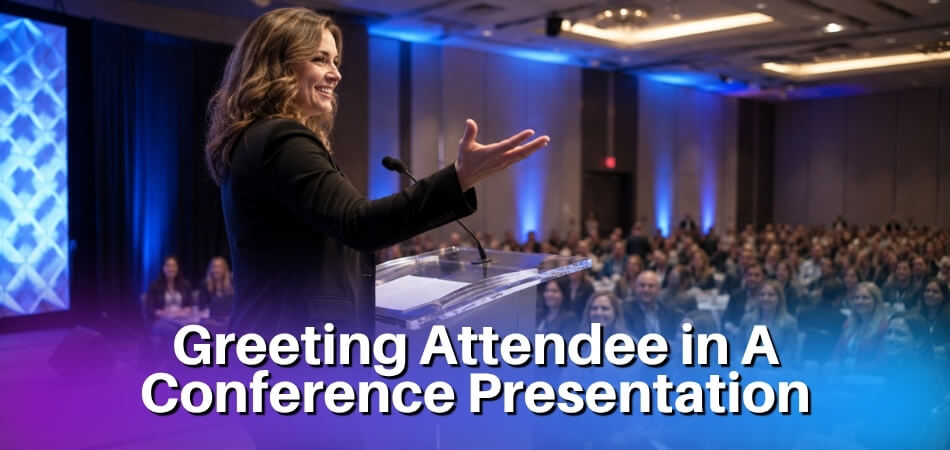
Start with a calm pause and confident presence
Before saying your first words, take a brief pause. Look at the audience, stand upright, and allow the room to settle. This small pause helps you appear prepared and tells attendees the session is about to begin.
Avoid walking to the front and speaking immediately while people are still moving, chatting, or checking their phones. A few quiet seconds make your opening feel more controlled, and they give you time to breathe and steady your voice.
Use a clear opening greeting
Begin with a simple greeting that matches the setting. For a typical session, a short line works best:
- Good morning, everyone.
- Good afternoon, and welcome.
- Hello everyone, it is a pleasure to be here.
- Good evening, distinguished guests and participants.
For formal events, use a polished tone. For smaller sessions, a more conversational greeting can feel more natural. Do not overload the first sentence with detail: the audience may still be shifting their attention toward you.
Acknowledge the chair or moderator
If a chair or moderator has just introduced you, thank them by name before you greet the room. It takes five seconds and shows the audience that you respect the program.
Thank you, [Chair’s Name]. Good morning, everyone.
Use the chair’s name and title as the programme lists them. Then give your own name and topic in a sentence rather than repeating the full introduction you were just given, and leave out any title or affiliation the chair has already read aloud.
Introduce yourself with relevant context
After greeting the room, introduce yourself briefly. Mention your name, role, organization, or connection to the topic, and keep it focused on why you are speaking.
My name is [Your Name], and I am [Your Role] at [Organization]. Today, I will be speaking about [Topic].
If your experience adds credibility, include one short detail, such as the number of years you have worked on the topic. Avoid a long personal history. Your introduction should support the presentation, not delay it. If nobody introduces you, thank the audience first and then give your name and one line of credentials yourself.
Thank the audience and acknowledge the event
A short thank-you shows professionalism. Attendees may have traveled, adjusted their schedules, or chosen your session from several options. You can say:
- Thank you for joining this session today.
- I appreciate you taking the time to be here.
- Thank you to the organizers for bringing us together.
- It is a privilege to be part of this conference.
When appropriate, mention the conference name, theme, host organization, or location, and thank sponsors or fellow speakers. This makes your greeting feel specific instead of generic.
Preview your topic in one sentence
After the greeting and introduction, give the audience a quick reason to listen. Explain what you will cover and why it matters.
Instead of saying:
Today, I will talk about communication.
Say:
Today, I will share practical ways to make your conference presentation opening clearer, more confident, and more engaging.
Transition smoothly into your first point
End the greeting with a direct transition, so the opening does not feel separate from the rest of the talk. Useful lines include:
- Let’s begin with the first step.
- To start, let’s look at why the opening matters.
- I’ll begin with a common challenge many speakers face.
- First, let’s define what a strong greeting should accomplish.
Simple Conference Presentation Greeting Formula
A strong conference greeting follows a simple formula: greeting + introduction + appreciation + topic preview + benefit + transition. This structure covers everything the audience needs without wasting time.
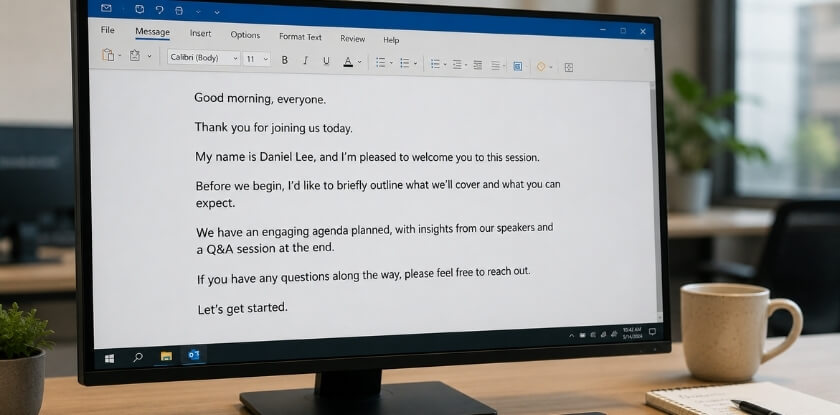
| Element | What to do | Suggested time |
| Greeting | Address the audience directly in one short sentence | 5–10 seconds |
| Name and role | Give only what matters for this session | 10–15 seconds |
| Appreciation | Thank the audience, the host, or the organizing committee | 10 seconds |
| Topic preview and benefit | Say what you will cover and what listeners will gain | 10–15 seconds |
| Transition | Move straight into the first section | 5 seconds |
For an academic event, name your institution or research area in the second step. For a business conference, name your company or professional role.
The audience benefit should be realistic and tied to your content:
By the end of this session, you will have a simple structure you can use to open your next presentation with confidence.
Then bridge with one line, such as “Let’s begin with what makes a greeting effective.” Together the five rows add up to about 40 to 55 seconds, which fits the 30 to 60 second target below.
Ready-to-Use Conference Presentation Greeting Examples
The right greeting depends on the audience, event type, and speaking format. These scripts are samples, so replace the placeholders and adjust the wording to your own voice.
Formal conference greeting example
Good morning, respected guests, organizers, speakers, and participants. My name is [Your Name], and I am honored to be part of this conference. Thank you for joining today’s session. I will be speaking about [Topic] and sharing ideas that can support our discussion on [Conference Theme]. Let’s begin by looking at why this topic matters.
Use this type of greeting for professional conferences, opening sessions, academic programs, and events with senior guests.
Informal conference greeting example
Hi everyone, welcome. I’m [Your Name], and I’m glad to be here with you today. Thanks for taking the time to join this session. We’ll be talking about [Topic], and I’ll share a few practical points you can use right away. Let’s get started.
This works best for smaller events, creative sessions, networking groups, and workshops where the mood is relaxed.
Academic conference greeting example
Good morning, colleagues, researchers, and distinguished guests. I am [Your Name] from [Institution]. Thank you for attending this session. Today, I will present on [Research Topic], with a focus on [Specific Area]. I will begin with the background of the study before moving into the key findings.
This greeting is suitable for research presentations, symposiums, and university-based conferences.
Business conference greeting example
Good afternoon, everyone. My name is [Your Name], and I work with [Company/Organization]. Thank you for being part of this session. Today, I will discuss [Business Topic] and how it connects to current challenges in [Industry/Field]. Let’s begin with the main issue many organizations are facing.
This style is useful for corporate events, leadership conferences, industry panels, and professional seminars.
Virtual conference greeting example
Hello everyone, and welcome. I’m [Your Name], joining you from [Location if relevant]. Thank you for logging in and being part of this online session. Today, we will discuss [Topic]. Before we begin, please feel free to use the chat or Q&A box for questions during the session. Let’s start with a quick overview.
For virtual presentations, mention the online format early so remote attendees know how to take part.
Workshop or small-group greeting example
Hi everyone, thank you for being here. I’m [Your Name], and I’ll be guiding today’s workshop on [Topic]. This session is designed to be interactive, so I encourage you to ask questions and share your thoughts as we go. Let’s start with a quick introduction to the main goal of the workshop.
This greeting works well when participation is expected.
International audience greeting example
Good morning, everyone, and welcome to today’s session. I’m [Your Name], and it is a pleasure to speak with participants joining from different countries and professional backgrounds. Thank you for being here. Today, I will discuss [Topic] and connect it to challenges that many global audiences can relate to. Let’s begin.
This approach recognizes diversity without making the greeting too long.
Panel or session moderator greeting example
Good afternoon, everyone, and welcome to this panel discussion on [Topic]. My name is [Your Name], and I will be moderating today’s session. We are joined by speakers from [Brief Context]. Thank you for being here. I will begin by introducing our panelists before we move into the discussion.
Moderators should clearly explain their role and the session flow.
How Long Should a Conference Greeting Be?
A conference greeting should usually take 30 to 60 seconds. That is enough to welcome the audience, introduce yourself, thank them, and preview the topic without slowing down the session. The timing table in the formula section above shows how the seconds split, so use it as a guide rather than a rule.
The clock may already be running. The 2026 Vision Sciences Society moderator instructions tell the moderator to start the talk timer immediately after introducing the speaker, so at that meeting the greeting comes out of the speaker’s own time. Other conferences set this differently, so ask the session coordinator when your timer starts.
When to keep the greeting very short
Use a shorter greeting when:
- The session is already running late.
- You are one speaker in a long program.
- The host has already introduced you.
- The audience already knows your background.
- Your presentation time is limited.
In these cases, a direct greeting is enough:
Good afternoon, everyone. Thank you for being here. My topic today is [Topic]. Let’s begin.
When a longer opening is appropriate
A slightly longer greeting may be acceptable when:
- You are opening a major event.
- You are the keynote speaker.
- The audience includes special guests.
- The session requires formal acknowledgments.
- The topic needs careful context before the main discussion.
Even then, avoid turning the greeting into a speech. The audience should feel welcomed, not delayed.
How to avoid overexplaining before the main topic
Prepare your greeting in advance and remove anything that does not serve a clear purpose. Skip long comments about your travel, nervousness, schedule problems, or personal background unless they connect directly to the talk. The audience came for your presentation, so move toward the content quickly.
Formal vs Informal Conference Greetings
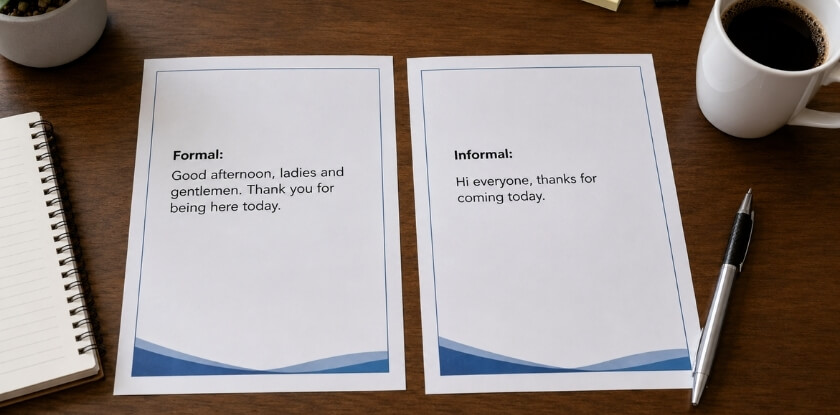
The difference between formal and informal greetings comes down to tone, word choice, body language, and audience expectations. Both work well when used in the right setting.
When to use a formal greeting
Use a formal greeting for:
- Academic conferences
- Government or policy events
- Corporate summits
- International conferences
- Ceremonial openings
- Events with senior officials or distinguished guests
Formal greetings should sound respectful and structured. Use titles when needed, speak clearly, and avoid slang or overly casual humor. A typical line is “Good afternoon, respected guests and colleagues. Thank you for attending this important session.”
When to use an informal greeting
Use an informal greeting for:
- Small workshops
- Training sessions
- Startup events
- Creative meetups
- Internal company sessions
- Community events
Informal greetings can sound more conversational, with warmer phrases and a lighter tone. A typical line is “Hi everyone, thanks for being here. I’m excited to get started.”
Differences in tone, wording, and body language
| Aspect | Formal Greeting | Informal Greeting |
| Tone | Polished and respectful | Friendly and conversational |
| Wording | Complete, professional phrases | Simple everyday language |
| Body language | Controlled and composed | Relaxed and open |
| Humor | Limited and careful | Light humor may fit |
| Best setting | Official or high-level event | Smaller or casual session |
If you are unsure which one the event expects, look at how the earlier speakers opened and match that level.
Body Language Tips for Greeting a Conference Audience
Your body language should support your words. A confident greeting includes eye contact, posture, facial expression, voice control, and clear movement.
Smile naturally without forcing it
A natural smile helps you appear comfortable and welcoming, and it can reduce tension in the room. Do not hold a fixed smile for too long. Let your expression match your message so you look present and approachable, not staged.
Make balanced eye contact
Look across different parts of the room as you greet the audience, so people feel included. Avoid staring at one person, reading only from your notes, or looking at the screen the entire time. In a large room, divide the audience into sections and briefly look toward each area.
Stand where the audience can see you clearly
Position yourself where you are visible. Avoid hiding behind a podium unless the event setup requires it, and if you use notes, keep them low enough that your face remains visible.
In a virtual presentation, place your camera at eye level and look into it when greeting the audience. This creates the feeling of direct eye contact online.
Use open posture and controlled gestures
Stand with your feet steady and your posture open. Keep your arms relaxed and use small gestures when needed. Avoid fidgeting, crossing your arms, shifting constantly, or touching your face repeatedly, since these movements distract from your words.
Check your microphone and speaking volume before starting
Before your formal greeting, confirm that your microphone works. If you are unsure, ask briefly:
Can everyone hear me clearly?
Once confirmed, begin your greeting at a volume that carries to the back of the room.
What to Say After Greeting the Audience
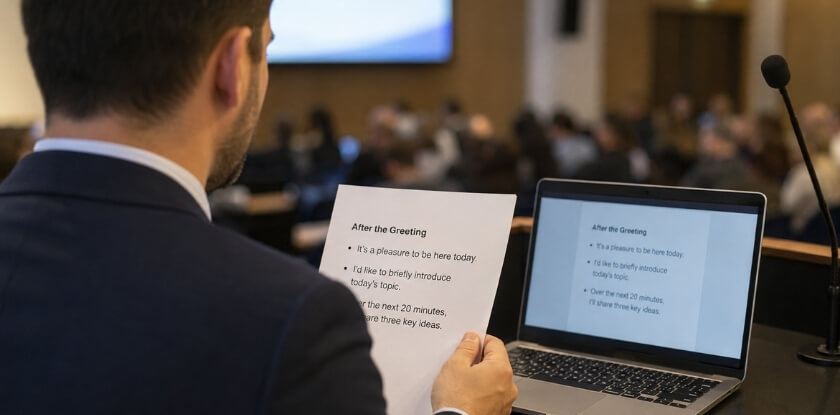
After greeting the audience, connect the opening to the purpose of the presentation. This is where you move from welcome to engagement.
Mention the conference theme or purpose
If the conference has a theme, connect your topic to it. This shows that your presentation fits into the larger event.
This year’s theme focuses on innovation, and my session looks at how communication supports that goal.
Connect your topic to the audience’s needs
People listen more closely when they understand why the topic matters to them.
If you present research, pitch an idea, or lead a workshop, your first words influence how the audience receives your message.
Use a short story or observation when relevant
A brief personal observation can work well after the greeting, but keep it concise and do not begin with a long unrelated anecdote. Use a statistic only if you can name its source.
I spent weeks on my slides and ten minutes on my opening. Today I want to show you how to fix that balance.
This is a sample, so use a line that is true for you.
Move from greeting to agenda without sounding abrupt
Your transition should be clear but smooth, and it gives the audience a structure to follow.
Today I’ll cover how to open confidently, how to match your greeting to the event, and how to recover if the first few seconds feel awkward.
Questions You Can Ask Right After Greeting the Audience
The best opening questions are simple, relevant, and easy to answer. They make the audience active right away without embarrassing anyone or slowing the session, and they work best when they relate to your topic. One example is “How many of you have faced this challenge in your own work?”
Show-of-hands questions
These are quick and visual, so use them when you want instant engagement.
- How many of you have presented at a conference before?
- How many of you feel confident starting a presentation?
- How many of you have attended this conference in previous years?
One-word response questions
One-word questions suit workshops and smaller groups, and the answers can reveal the audience mood.
- In one word, how do you feel before giving a presentation?
- What word comes to mind when you think of public speaking?
- What is one quality you value in a speaker?
Experience-based questions
These connect your topic to the audience’s real life and make the session feel practical.
- Who has ever forgotten their first line during a presentation?
- Who has spoken to an audience from different countries?
- Who has had to present online with technical issues?
Prediction or curiosity-building questions
Prediction questions create interest before you reveal an idea or finding.
- What do you think audiences notice first: your words, your voice, or your posture?
- How long do you think a conference greeting should be?
- What do you think is the most common opening mistake speakers make?
Light icebreaker questions
Use light questions only when the setting allows it, and keep the humor safe, inclusive, and relevant.
- If you could describe this conference in one word, what would it be?
- Who here has already had their second coffee today?
- Who traveled the farthest to be here?
Questions to avoid at the start of a presentation
Avoid questions that are too personal, too difficult, or likely to create silence, and do not ask for long answers unless the session is built for discussion. Skip:
- Controversial questions
- Embarrassing questions
- Questions unrelated to the topic
- Questions that challenge the audience too aggressively
- Questions that require private information
The purpose is to build comfort, not pressure.
Common Mistakes to Avoid When Greeting a Conference Audience
Three mistakes are worth watching most: starting too early, rushing, and running long. Avoid these to keep your opening professional.
Starting before the room is ready
Do not begin while people are still settling down. Pause, smile, and wait until attention shifts toward you. If needed, say “We’ll begin in just a moment.”
Speaking too fast or too softly
When nervous, speakers can rush, which makes the greeting hard to understand. Slow down for the first few sentences, because clear pacing gives your voice authority. Speaking too softly has the same effect: the audience may disengage before you have said anything useful.
Reading the greeting word for word
A fully scripted greeting can sound stiff. Remember the structure instead of memorizing every word, using these cue points: greeting, name, thank-you, topic, transition.
Using jokes that do not match the setting
Humor can work, but only when it fits the audience and event. Avoid jokes about sensitive issues, personal identity, politics, religion, or groups of people. When in doubt, choose warmth over comedy.
Forgetting to introduce yourself
Even if the host introduced you, repeat your name briefly. Some attendees may have missed the introduction or joined late.
Making the greeting too long
A long greeting can reduce attention before your main content starts. Avoid thanking too many people individually unless the setting requires it.
Apologizing repeatedly
Apologizing for nerves, slides, or the time slot can reduce confidence. One short acknowledgment is enough if something really is wrong.
Ignoring online attendees in hybrid or virtual sessions
If your session includes remote participants, acknowledge them in the first sentence, for example “Welcome to everyone in the room and to those joining us online.” It makes virtual attendees feel included.
How to Recover If Your Opening Greeting Goes Wrong
If your opening does not go perfectly, pause, correct it in one short sentence, and restart with confidence. Most mistakes pass quickly.
What to do if you forget your first line
Pause, breathe, and begin with a simpler sentence.
Thank you for being here. I’m [Your Name], and I’m pleased to begin this session on [Topic].
You do not need to apologize heavily. The audience usually cares more about how you continue than about a small pause.
What to do if the microphone or slides fail
Acknowledge the issue briefly and continue if possible.
It looks like we need a moment for the slides, so I’ll begin with a quick overview while that is being fixed.
This shows control and prevents the room from becoming uncomfortable.
What to do if you mispronounce a name or phrase
Correct yourself respectfully and move on.
Let me correct that pronunciation: [Correct Name]. Thank you.
Do not make the mistake the focus of the opening. A clean correction is enough.
What to do if the audience seems distracted
Use a brief engagement line to regain attention.
Before we begin, let me ask a quick question related to today’s topic.
A simple question or short pause can bring people back into the moment.
Simple restart script for a rough beginning
Use this backup script when your opening feels off:
Let me begin again clearly. Good morning, everyone. My name is [Your Name], and today I’ll be speaking about [Topic]. Thank you for being here. By the end of this session, you will understand [Main Benefit]. Let’s start with [First Point].
Having a restart line prepared can reduce anxiety before you present.
How to Greet Different Types of Conference Audiences
Match the greeting to the people in front of you: more structure for senior or large audiences, more warmth for students, and simpler language for international groups. The full scripts for formal, academic, business, and virtual audiences are in the examples section above, so this part covers what changes.
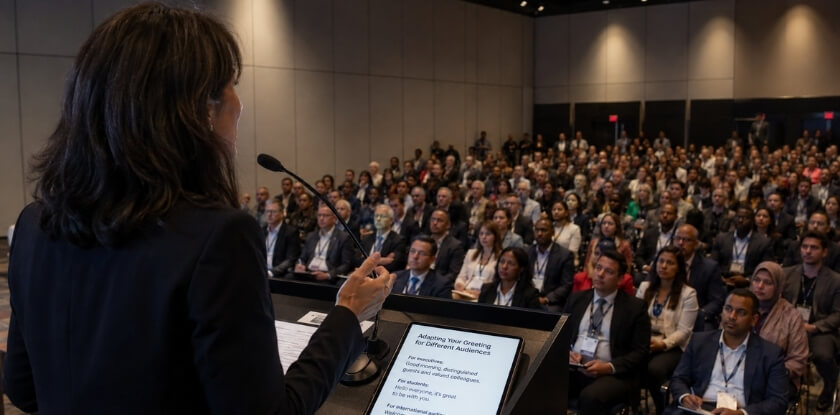
Large professional conference audience
Keep the greeting polished and structured. Speak clearly, use strong posture, and avoid overly casual language.
Academic researchers and scholars
Academic audiences expect precision and relevance, so mention your research context early.
Business leaders and executives
Business audiences value clarity and practical outcomes. Keep the greeting concise and outcome-oriented, for example by naming what the topic means for decisions, growth, or organizational performance.
Students or early-career attendees
Use an encouraging and accessible tone to create a friendly environment.
Hello everyone, I’m glad to be here with you today. We’ll keep this session practical, and I’ll share ideas you can apply in your next presentation or professional event.
Multicultural or international audiences
Use clear language and avoid idioms and slang that may not translate well. Speak at a steady pace, choose simple, inclusive wording, and welcome participants from different countries and backgrounds in one sentence.
If you add a greeting in another language, do it only when you can pronounce it well, and keep it to a few words. A mispronounced phrase draws more attention than a plain English welcome. For names that are hard to say, check the pronunciation with the organizers beforehand.
Online or hybrid conference participants
Welcome both groups, those in the room and those online, and explain how questions should be shared.
From our experience at MS International: Our conferences are held in person in the Greater Toronto Area, and the moderator will introduce you before your presentation. Presentation lengths may vary, so use the speaker confirmation and final programme as the official sources for your slot, and confirm your room, speaking time and question period with the session coordinator at check-in.
Do’s and Don’ts of Conference Presentation Greetings
A strong greeting is easier when you follow a few practical rules, and the two tables below show the habits to copy and the habits to drop.
Do’s for a strong first impression
| Do | Why It Helps |
| Start with a calm pause | Helps you gain attention |
| Introduce yourself briefly | Builds context and credibility |
| Thank the audience | Shows respect |
| Mention the topic early | Sets expectations |
| Speak slowly and make eye contact | Improves clarity and builds connection |
| Match the event tone | Shows awareness |
Don’ts that weaken the opening
| Don’t | Why to Avoid It |
| Start while people are distracted | Your first words may be missed |
| Read every word from notes | It may sound unnatural |
| Use risky humor | It can create discomfort |
| Make the greeting too long | It delays the main content |
| Speak too softly | The audience may disengage |
| Ignore virtual attendees | It makes the session feel less inclusive |
Quick checklist before you begin speaking
Before greeting the audience, check:
- Is the microphone working?
- Are the slides ready?
- Can the audience see you?
- Do you know your first sentence?
- Is your greeting suitable for the event?
- Can you explain your topic in one sentence?
- Do you have a backup line if you forget your opening?
FAQs About Greeting Everyone in a Conference Presentation
Your first sentence on stage sets the tone, so presenters weigh good morning against hello, thanking the chair, greeting an international audience and whether the greeting eats into speaking time.
What is the first thing to say in a conference presentation?
Start with a short greeting such as “Good morning, everyone” or “Hello, and welcome to today’s session.” If a chair introduced you, thank them first. Then give your name and a one-sentence preview of your topic.
How do you greet a formal audience?
Greet a formal audience with respectful language and a polished tone. You can say, “Good morning, distinguished guests, respected speakers, and participants.” Then thank them for attending and move into your introduction.
How do you greet an international audience?
Use simple, inclusive language and avoid idioms. Welcome everyone clearly and acknowledge the diversity of the audience without making the greeting too long. For example, “Good morning, everyone. It is a pleasure to welcome participants from different countries and backgrounds.”
Should you say good morning or hello?
Use “Good morning” or “Good afternoon” when the time of day is clear and the event is formal. Use “Hello everyone” when the setting is casual, virtual, or includes people from different time zones.
How do you introduce yourself after greeting the audience?
After greeting the audience, say your name, role, and connection to the topic. For example, “My name is [Your Name], and I am [Your Role] at [Organization]. Today, I will be speaking about [Topic].”
Should you thank the chair or moderator in your greeting?
Yes, thank the chair or moderator by name if they introduced you. Say it before you greet the room, for example “Thank you, [Chair’s Name]. Good morning, everyone.” Then give your own name and topic in one sentence.
Does the greeting count toward your speaking time?
It can. Some conferences start the talk timer as soon as the moderator finishes the introduction, so your greeting uses part of your slot. Keep it short and ask the session coordinator when your timer starts.
Is it okay to use humor in the opening greeting?
Yes, but only if the humor is light, respectful, and suitable for the event. Avoid jokes about sensitive topics or specific groups. If the setting is formal, it is safer to keep the greeting warm and professional.
How do you greet people in a virtual conference?
Welcome attendees, name the online format, and look into the camera as you speak. Say, “Hello everyone, and welcome. Thank you for joining us online today.” Then explain how to use chat, Q&A, or reaction features.
How do you keep a greeting short but professional?
Use a three-part structure: hello, introduction, and topic preview. For example, “Good morning, everyone. I’m [Your Name], and I’ll cover [Topic] today. Thank you for being here. Let’s begin.”
Conclusion
A strong conference greeting is clear, respectful, brief, and connected to the purpose of the presentation. Pause, greet the room, thank the chair, introduce yourself, preview your topic, and move into your first point.
The best greeting is the one that fits the audience and the event tone, not the longest or most dramatic one. Before your next talk, practice your first few lines and keep a backup restart sentence ready.