
The appointment is over, the staff have waved you out, and your phone stays quiet. It is natural to wonder if you missed a step, or if something has quietly gone wrong. Knowing what happens on the other side of that silence makes the wait easier to handle.
Quick answer: After you give biometrics, there is usually nothing more for you to do. IRCC checks your fingerprints and photo against security and immigration records while an officer reviews your file. You then wait for a decision, an Additional Document Request (ADR), or, occasionally, an interview notice, all sent to your IRCC account or email. Check the official processing times tool before you contact IRCC.
Fact-checked by the MS International Editorial Team. Last verified against official sources: October 2026.
You gave your fingerprints and photo, got a receipt, and now nothing happens. That silence is normal. This guide explains what IRCC does behind the scenes, what to expect for each type of application, when an interview is possible, and how to follow up without making things worse.
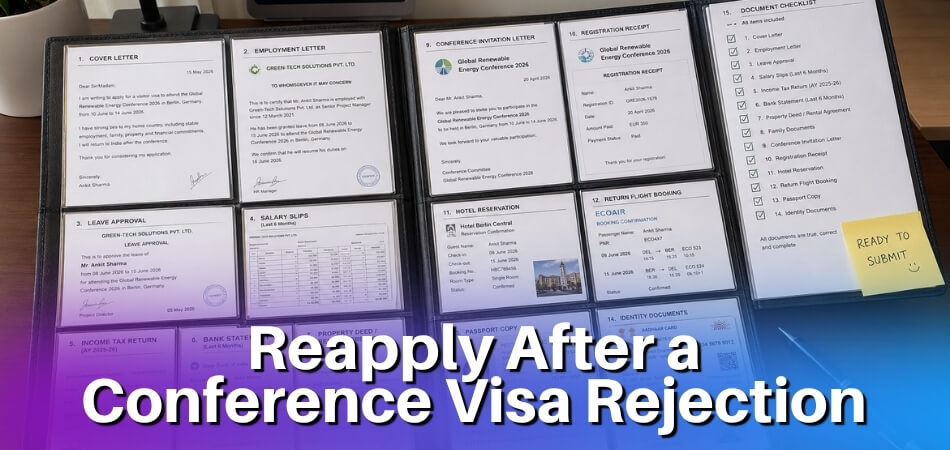
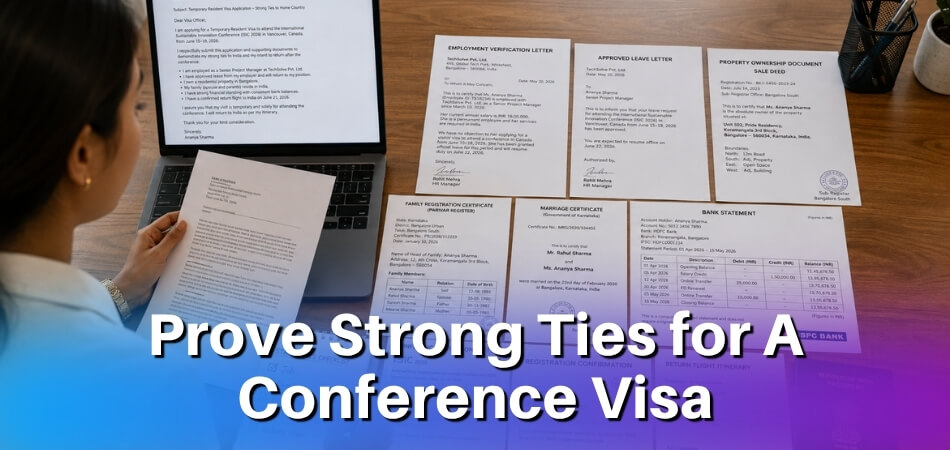
From our experience at MS International: we issue conference invitation letters, and a question worth settling early is whether giving biometrics means you are approved. It does not. If you are applying for a visitor visa to attend a conference, keep your invitation letter, registration confirmation and travel plan ready, because an officer may ask for them in an ADR. A letter from us cannot speed up processing or replace any step IRCC requires.
What Happens After Biometrics?
After biometrics, your file goes back to IRCC. Giving biometrics is not an approval, and a decision still follows. The checks and the officer’s review happen without any action from you, and the next message you receive is usually a decision or an ADR.
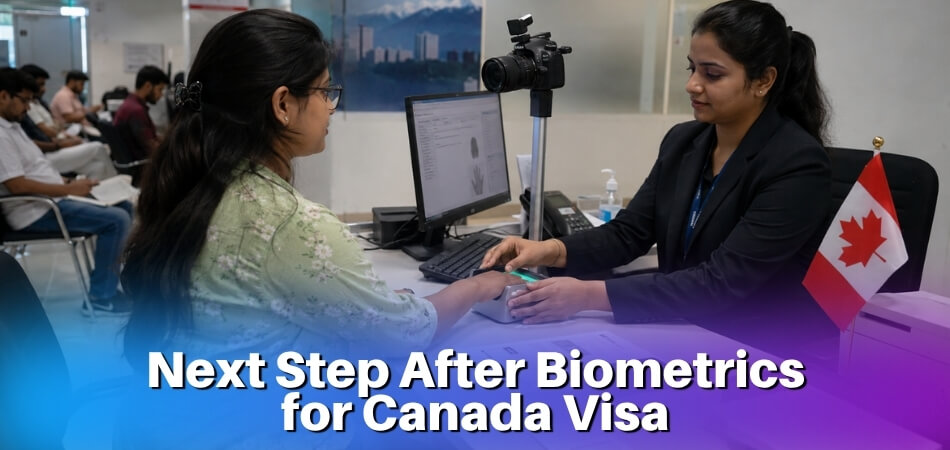
Here is the order of events in plain terms:
- Your biometrics are received and linked to your application. IRCC says it cannot process the application until it has them, so a late appointment holds everything up. The posted processing time already includes the time it takes you to give biometrics.
- Identity and security checks run in the background (covered in the next section).
- An officer reviews your documents and may send an Additional Document Request through your IRCC account.
- You receive a decision, or in rarer cases an interview notice.
For a visitor visa, study permit or work permit, many applicants hear nothing between biometrics and the decision. For permanent residence and family sponsorship, the review is longer and more detailed, and approval ends with a Confirmation of Permanent Residence (COPR) rather than a visa stamp.
What IRCC Does After You Submit Your Biometrics
IRCC stores your biometrics, checks them against security and immigration records, and reviews your file for completeness. Most of this is invisible to you, which is why the wait feels so quiet.
Fingerprint Encryption and Secure Database Submission
Your fingerprints and photo are captured digitally at the Visa Application Centre (VAC) and sent to IRCC through a secure channel. They are stored in a federal biometric database and tied to your application file. The collection site does not keep a copy, because IRCC deletes the data from the collection system once it is sent. IRCC generally keeps your fingerprints and photo for 15 years from your most recent biometrics, and longer in some situations, such as becoming a permanent resident.
Canada also shares immigration fingerprint data with close partners, as the sharing section below explains. This is routine, and it is one way IRCC confirms that you are who you say you are.
Background Check with RCMP and CBSA
The biometric match feeds into a wider admissibility check. IRCC says the Royal Canadian Mounted Police (RCMP) compare your fingerprints with records of criminals, refugee claimants, deportees and earlier temporary resident applicants, and the result supports the decision on your file. The Canada Border Services Agency (CBSA) receives your fingerprints and photo so it can confirm your identity when you arrive in Canada.
Most applicants never hear about these checks. If there is a name match or a mismatch between your forms and the records, the file is flagged for an officer. That can add weeks and sometimes leads to a request for police certificates or other documents. Family sponsorship and permanent residence files get a deeper review than a standard visitor visa.
Application Completeness Review and Document Requests
While the checks run, an officer looks at whether your documents match what was required for your category and whether anything is missing, outdated or inconsistent. If so, IRCC sends an Additional Document Request. It names what is needed and gives a deadline.
Missing that deadline is a common reason files are refused or returned, so check your account and email, including spam, during the wait. For study and work permits an ADR can arrive after weeks of silence. Silence does not mean the file is stuck. Many files are simply still in review.
How the Next Steps Differ by Visa Type
The first steps are the same for everyone, but what you receive at the end depends on the application type. This table shows the main differences, and the sections below explain each one.
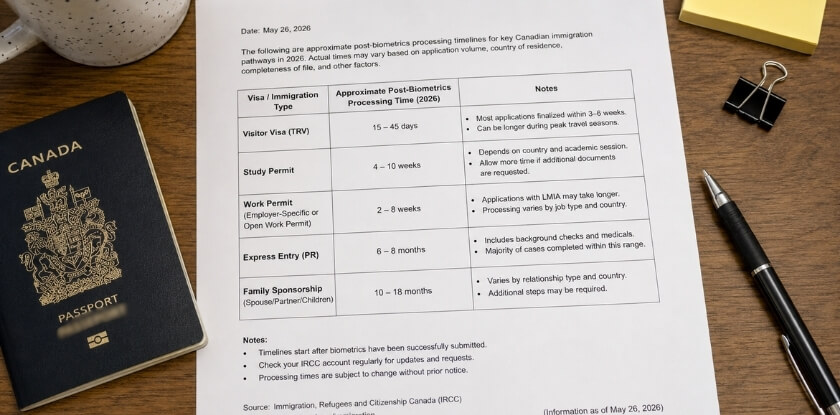
| Application | What the officer focuses on | What you receive if approved |
|---|---|---|
| Visitor visa (TRV) | Purpose of visit, ties to home country, funds, travel history | Visa counterfoil in your passport (or the format stated in your approval letter) |
| Study permit | Acceptance letter, proof of funds, study plan | Approval letter and a port of entry letter of introduction; permit issued at the border |
| Work permit | Job offer, employer details, LMIA if required, admissibility | Approval letter, or the permit itself if you apply from inside Canada |
| Permanent residence or sponsorship | Admissibility, medical and police checks, the relationship in sponsorship cases | COPR (plus a PR visa if you are outside Canada) |
| eTA | Eligibility for visa-exempt travellers | Email confirmation linked to your passport |
Tourist / Visitor Visa (TRV)
For a visitor visa, biometrics are usually the last active step before the decision. The officer assesses your travel history, ties to your home country, finances and the purpose of your trip. This includes attending a conference, where the invitation and registration are part of the evidence.
Processing times vary by country and by how busy IRCC is, so use the official processing times tool for your country instead of a forum figure. IRCC describes the posted time as how long it expects to take if it received your application today, not a maximum or a guarantee. If the officer needs more, an ADR arrives by email. If approved, you will be told how to get the visa into your passport, often by sending it to a VAC after a passport request letter. Follow that letter exactly.
Student Visa (Study Permit)
A study permit gets closer scrutiny. The officer reviews your acceptance letter, proof of funds, study plan and academic history, and wants to be sure you will leave Canada when the permit ends. Waiting times are longest around the main intakes in fall and January.
The Student Direct Stream (SDS) closed on 8 November 2024, so all study permit applications are now handled in the regular stream. If a medical exam applies to you, it is normally done alongside biometrics, not after the decision. What you receive on approval is covered in the final-stage section below.
Work Permit
Work permits fall into two groups: employer-specific permits, which usually need an LMIA or an employer compliance check, and open permits, which have less employer verification. Admissibility and background checks apply to both.
Closed permits that depend on an LMIA tend to take longer than simple open permits. As with a study permit, the permit is usually finalised at the border.
Permanent Residence or Sponsorship Application
Permanent residence is the longest path. For Express Entry, Provincial Nominee Program and family sponsorship cases alike, the review after biometrics has several layers and can take many months. In sponsorship cases both the sponsor and the applicant are assessed.
You may receive requests for updated police certificates, medical results or clarifications. The end result is a COPR. If you are outside Canada you also receive a PR visa, and you must land before the documents expire. Biometrics given for a PR application can also cover a visitor, study or work application you file during their validity, as long as IRCC has them on file.
Can You Be Called for an Interview After Biometrics?
Most applicants are not called for an interview. IRCC asks for one only when an officer needs information that the paper file does not give.
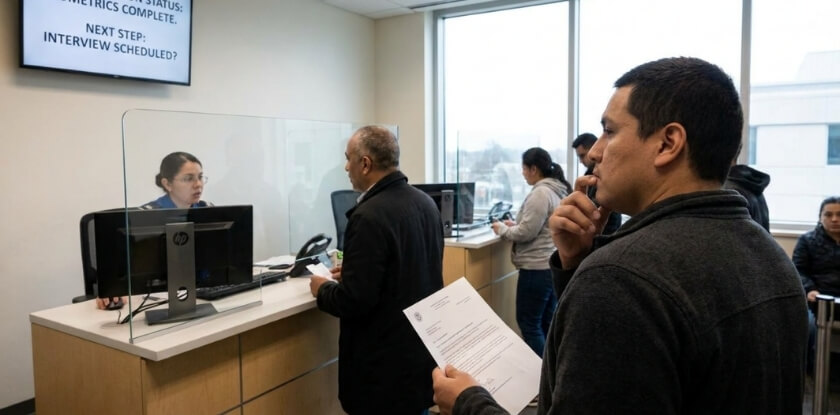
When IRCC Is Most Likely to Request an Interview
An interview can be requested at any point after biometrics, usually during the main review. The trigger is nearly always a question the documents do not answer. Typical reasons are:
- Inconsistent documents. Bank statements, an employment letter and your stated travel purpose that do not line up.
- Weak ties to your home country. If the officer doubts you will return, an interview may test your plans.
- Prior refusals or immigration problems. A refusal, overstay or removal in Canada or a partner country can lead to closer scrutiny.
- Sponsorship cases. Sponsor and applicant may be interviewed to confirm that the relationship is genuine.
- Study or work plans that do not fit your background. For example a course unrelated to your studies, or an unusual job offer.
What the Interview Actually Looks Like
Interviews are normally held by a visa officer at a Canadian visa office or a VAC, and sometimes in Canada for permanent residence cases. You are told the date, place and sometimes the documents to bring, through your IRCC account or by email. Missing the interview usually leads to a refusal.
Expect conversational questions about your travel purpose, finances, ties to home, relationship (in sponsorship cases) or study and work plans. Short, honest answers that match your documents work best.
Permanent Residence and COPR Cases
Interviews are more common for permanent residence, especially in the family class. If you get one, the officer usually wants to confirm identity, close a gap in the documents or assess the relationship.
How to Prepare
Review your full application as one package and look for anything that could seem inconsistent. Bring originals of employment letters, financial records, relationship evidence and travel history. Have a plain explanation ready for any gap, large deposit or earlier refusal.
A lawyer or consultant can help you prepare, but legal representatives are generally not in the interview room with you. If English or French is not your first language, ask in advance about interpretation.
Common Mistakes After Biometrics That Cause Processing Delays
Most avoidable delays come from the applicant’s side: missed emails, incomplete answers to an ADR or wrong assumptions about biometrics. These are the usual ones.
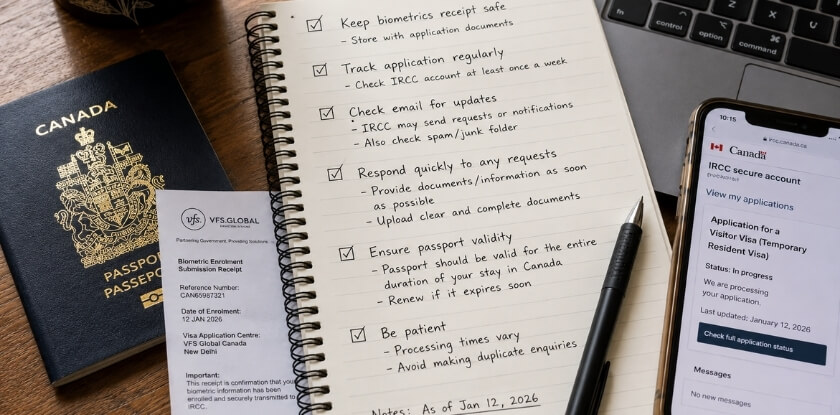
Not Checking Your Email (or Spam Folder) Regularly
IRCC sends follow-ups by email and posts them in your account. Missing an ADR by even a few days can lead to a refusal. Check the inbox and spam folder every day or two, and confirm that the address on file is one you still use.
Submitting Outdated or Incomplete Supporting Documents
An ADR asks for specific items. A bank statement that is months old, or an employment letter without salary and contract type, does not satisfy it. The officer will not chase you for a better version. Read the request twice before you answer. If something is unclear, ask through the official IRCC Webform, not through social media.
Assuming Biometrics Validity Automatically Covers a New Application
IRCC decides whether you need to give biometrics again, so do not assume. If you file a new application and receive a Biometric Instruction Letter (BIL), follow it. If you do not get one, you generally do not need to book. The validity section below explains how to check.
Waiting Too Long to Book a VAC Appointment After Receiving a BIL
You normally have 30 days from the date on the BIL to give your biometrics. Slots in big cities can fill quickly, so book within the first few days.
Not Updating a Change of Address or Contact Information
If you move or change your email or phone number after applying, IRCC still has the old details. Update them in your account straight away, because an ADR or passport request sent to a dead address will not reach you.
Expecting GCMS Notes to Be Current
GCMS Notes (Global Case Management System notes) are useful, but they show a past snapshot and can lag behind your file. Treat them as a reference, not a live tracker.
Sending Duplicate Applications or Unrequested Documents
Do not submit a second application or send extra papers that IRCC did not ask for. Both create confusion and can slow the file. If IRCC needs something, it will send an ADR.
Traveling Internationally While Your Application Is in Progress
Travel while an application is pending can cause complications depending on the application type and your status. If you must travel, ask a licensed immigration consultant or lawyer first instead of assuming it is fine.
Contacting IRCC Through Unofficial Channels
No Facebook group or third-party site can check your file or speak to IRCC for you. The official routes are the IRCC Webform, or a licensed consultant or lawyer. Sharing your application number and personal details with unofficial parties also puts your privacy at risk. CBSA and the RCMP do not handle individual application inquiries.
What Happens If You Miss or Reschedule Your Biometrics Appointment?
If you miss your appointment, book a new one as soon as possible. Your application cannot move forward without biometrics, and IRCC will not chase you.
If You Miss the Appointment
A no-show leaves your biometrics uncollected, so the security checks cannot be completed and the file stalls. Book another slot through the same VAC booking system. If your BIL has not expired, you can use it for the new appointment.
If the BIL has expired, write to IRCC through the Webform with your application number, the date the BIL expired and a request for a new one. There is no guaranteed timing, and it adds days or weeks.
Rescheduling Before the Appointment
If you know you cannot attend, change the booking before the date. Most VACs allow online rescheduling, and the BIL stays valid. Availability differs by city, so check for the earliest slot right away rather than assuming one will open later.
Special Circumstances: Travel, Medical Issues, or Being Outside the Country
If illness or travel made you miss the window, explain it in your Webform message and attach proof, such as a hospital note or travel records. Explained absences are treated better than unexplained ones. If you have moved to another country, IRCC must update the collection point on your file, which also goes through the Webform.
One Thing That Often Catches Applicants Off Guard
Sometimes a BIL arrives even though your biometrics are already on file. Before you book, use the IRCC tool that shows whether your biometrics are still valid. If you are unsure, follow what the BIL says.
What Not to Do
Do not wait for IRCC to ask why you did not show up. Do not assume that fees or documents can replace biometrics: an officer will not decide a visa, study permit, work permit or PR case without them when they are required. In a sponsorship case, missing biometrics for the sponsored person holds up the whole file. If an application was refused because biometrics were not given, do not try to give them afterwards: reapply, pay the fees and wait for a new BIL, because using the old one may cause delays or a refusal.
Biometrics Validity: How Long It Lasts and When You Need to Resubmit
Biometrics are valid for 10 years from the date you gave them. If you apply for another temporary resident visa, study permit or work permit within that time, you generally do not need to give them again.
If you came in on a visitor visa in 2022 and now apply for a study permit, IRCC can use the record already on file. The exceptions are described below. The official “check if your biometrics are still valid” tool on canada.ca gives the final answer for your case.
When You Need Fresh Biometrics
- Your 10 years have passed. The record has expired and a new BIL will be issued.
- You apply for permanent residence. PR applicants are generally asked to give biometrics for that application even if they gave them before.
- IRCC issues a new BIL. If one arrives, follow it, even if you believe yours are still valid.
Countries Where Validity Works Differently
Biometrics you gave to the UK, US or Australia do not count for Canada. Each country keeps its own enrolment and its own validity rules. Data sharing supports security screening, but it does not replace your obligation to enrol with Canada if IRCC asks.
How to Check Whether Your Biometrics Are Still Valid
Use the official biometrics validity check on canada.ca, and look at your IRCC account. If you file a new application and no BIL appears, IRCC is using your existing record. If a BIL is issued, fresh biometrics are required. GCMS Notes also record when biometrics were collected.
What Happens If You Resubmit When It Isn’t Required
It is not harmful, but it costs you time and the biometrics fee. The one good reason to give them early is a longer visa or permit: IRCC cannot issue one for more than 10 years from the last time you gave your biometrics, so you may give them again when you apply, using the BIL issued for that application. Biometrics you gave for an application that was refused stay valid for 10 years. The fee is CAD 85 per person, or CAD 170 for a family applying together. Check your status before booking.
Age-Based Exemptions to Keep in Mind
Children aged 13 and under and applicants aged 80 and over are exempt, according to the official IRCC page. Age is counted on the day the application was submitted. If a child who was exempt later applies again at 14 or older, expect to give biometrics. The eTA process does not involve biometrics for most travellers from visa-exempt countries.
Which Countries Does IRCC Share Biometric Data With?
IRCC can cross-check your fingerprints with partner countries, mainly the United States, the United Kingdom, Australia and New Zealand. Together with Canada, these are the Five Eyes countries, and they share immigration data to catch false identities, past deportations and criminal records.
What This Means Practically for Applicants
For most people the cross-check confirms a clean record and nothing changes. It matters when something is on record. A person deported from the US and now applying to Canada under a different passport should not assume that history is invisible. A biometric match can bring it up, and failing to disclose it creates a misrepresentation problem that is often worse than the original issue.
The same applies to a police caution in the UK, an arrest in Australia or an overstay in New Zealand. Disclose relevant history on your forms. Having it found is much worse than declaring it.
Does Biometric Sharing Affect Processing Time?
It can. A match in a partner database may put your application on hold while the issue is investigated. You will not always be told. You may simply see “in progress” for longer than the posted time, or receive an ADR asking for police certificates from specific countries.
Beyond Five Eyes: Other Information-Sharing Arrangements
IRCC says biometrics may also be shared with other Canadian law enforcement agencies and, in line with Canada’s privacy laws, with other Canadian institutions or foreign governments. Assume that background screening is not limited to the four partner countries.
How to Track Your Application Status: IRCC Portal and GCMS Notes
Your IRCC account is the main tracking tool, and GCMS Notes give a more detailed view. Neither is real time, so use them with the posted processing times.
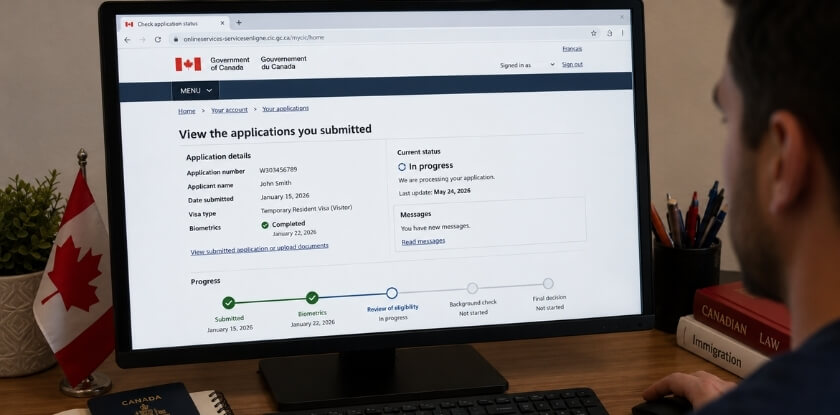
Tracking Your Application Through the IRCC Online Portal
If you applied online, log in to your IRCC account. If you applied on paper, link your file to an online account using your application number.
The overall status is Received (IRCC is checking that the application is complete), In progress (still under review) or Closed (approved, refused, withdrawn or abandoned). The tracker also shows four sections: Eligibility, Medical exam, Background verification and Biometrics. Each section reads Not started, Waiting on you, In progress, Completed or Exempted. If Biometrics says “Waiting on you”, look under “Your next steps”, which may ask you to give biometrics. None of this tells you whether the officer has opened your file. The portal can lag behind reality by several days, so check your email as well. IRCC’s posted processing times are estimates by application type and country, and an individual file can take longer.
How to Request GCMS Notes
GCMS Notes are the officer’s internal record of your file: comments, the status of checks and the actions taken. They are requested through IRCC’s Access to Information and Privacy (ATIP) process. Use the official IRCC ATIP page for the current form, any fee and who may apply from outside Canada, because the rules have changed over time.
You will need your name, date of birth and application number or Unique Client Identifier. The law sets a 30-day target for a reply, and in practice it can take longer. Because the notes can be dense, look for entries on biometrics, RCMP screening and any hold. If all checks look complete but no decision is entered, the file is probably waiting for an officer. If you use a paid service, confirm that it is legitimate before you share personal details.
When and How to Follow Up with IRCC
Wait until the posted processing time for your application type has passed. IRCC states that calling it will not get an application processed faster. It lists an incomplete application, a complex file and security checks among the reasons a file can take longer than the posted time. After that, use the IRCC Webform and include:
- full name, date of birth and application number;
- the date and the VAC where you gave biometrics;
- a clear question, such as whether anything else is needed.
Check for special measures too. IRCC is currently processing, but not finalizing, applications from people whose last country of residence is the Democratic Republic of the Congo, South Sudan or Uganda, and its processing times page warns that these applicants may wait longer. The measures run until 27 November 2026 and could be extended.
Replies can take from a few days to several weeks, and a written reply is easier to keep than a phone call. In rare cases of long unexplained delay, some applicants ask their Member of Parliament’s office to make an inquiry. Keep copies of every email, portal update and Webform message.
Approval or Refusal: What You Will Receive at the Final Stage
You receive either an approval or a refusal, and what an approval looks like depends on your category.
If Your Application Is Approved
For a visitor visa, IRCC may send a passport request letter through your account or by email. It has a deadline, so act on it quickly. After the visa is placed in your passport it shows the validity dates and the number of entries.
For a study or work permit applied for from outside Canada, you get an approval letter, and the permit is issued when a CBSA officer finishes the check at the port of entry. Keep the letter with your travel documents.
For permanent residence you receive a COPR, and a PR visa if you are outside Canada. Both have an expiry date, and you must land before it. Make several copies. For an eTA, approval usually comes by email within minutes, though it can take longer, and it is linked electronically to your passport.
If Your Application Is Refused
The refusal letter arrives through your IRCC account or by mail and gives written reasons. Read it carefully. Officers refer to sections of the Immigration and Refugee Protection Act (IRPA) or its Regulations (IRPR). Common grounds include weak ties to the home country, financial concerns, missing documents and credibility issues.
For most temporary resident applications, including visitor visas, study permits and work permits, IRCC also sends an officer decision note with the refusal letter (since 29 July 2025; eTAs are not covered). The officer who made the decision writes it to explain the refusal, although parts may be removed to protect sensitive information. Read it before you decide what to do next.
For a temporary visa you can usually reapply straight away, but sending the same package usually gets the same result. Change something that matters. IRCC says a visitor visa refusal has no formal appeal. If you believe the decision was unfair, the route is a judicial review at the Federal Court of Canada. The biometrics you already gave stay valid, so you should not need to give them again. For some permanent residence and sponsorship refusals, a right of appeal to the Immigration Appeal Division may exist, depending on the grounds. A lawyer or licensed consultant can tell you which options apply. If the decision note leaves questions, requesting your GCMS Notes can help you see what concerned the officer.
A Note on Passport Submission Timing
Never send your passport to a VAC until you receive a written passport request from IRCC. If an approved application has no passport request after an unusually long time, use the Webform and have your reference numbers ready.
FAQ
Once biometrics are done, the waiting stage brings doubts about confirmation from IRCC, Additional Document Requests, months without a status change, sharing of biometrics with other countries and stamp versus approval letter.
Does giving biometrics mean my visa is approved?
No. IRCC says biometrics are one step it needs before it can process your application. A decision still follows, and an officer may ask for more documents first.
Does my application keep moving while I wait after biometrics?
Yes. IRCC runs identity and security checks and an officer reviews the file without any action from you. Watch your account and email for requests.
How long does it take for IRCC to process an application after biometrics?
It depends on the application type and your country, and IRCC’s posted estimate already includes the time to give biometrics. Visitor visas are usually quicker than permanent residence. The estimate is not a guarantee, so check IRCC’s processing times tool.
Will I get a confirmation when IRCC receives my biometrics?
Check the Biometrics section of the application tracker in your IRCC account, which shows Not started, Waiting on you, In progress or Completed. Do not count on a separate email. If nothing changes after a few business days, ask through the Webform.
Do I need to resubmit biometrics for every Canadian visa application?
No. Biometrics are valid for 10 years, so a new temporary resident application in that period generally does not need them again. Permanent residence applicants are generally asked each time. Follow any BIL you receive.
Can IRCC share my biometrics with other countries?
Yes. Canada shares data with the US, UK, Australia and New Zealand to check identity and immigration history. A past refusal or deportation in those countries can appear during your review, so declare it on your forms.
What does an Additional Document Request mean after biometrics?
It means an officer needs more information before deciding, and it is not a refusal. Typical requests are for financial documents, travel history or police certificates. Send exactly what is asked before the deadline in the letter.
What should I do if my application status hasn’t changed in months?
Only write to IRCC once your wait is longer than the posted time. Then send a clear message through the IRCC Webform, and use GCMS Notes to see where the file stands.
Will I get a visa stamp in my passport, or just an approval letter?
It depends. A visitor visa is usually placed in your passport after a passport request. A study or work permit from outside Canada comes with a letter, and the permit is issued at the border. Permanent residence gives you a COPR, and an eTA is an email confirmation.
What happens if my visa application is refused after biometrics?
You get a refusal letter with reasons, and for most temporary resident applications an officer decision note too. You cannot formally appeal a visitor visa refusal, but you can reapply with new information that addresses the reasons or ask a lawyer about judicial review at the Federal Court.
Is there anything I need to do after approval to prepare for entry into Canada?
Check names, dates and permitted stay on every document. Carry your letter of introduction or visa and your supporting documents. A CBSA officer makes the final decision on entry at the border.
Final Thoughts: How to Make the Wait After Biometrics Easier
The wait after biometrics is uncomfortable because it is out of your hands, but “In progress” does not mean something is wrong. Check your IRCC account every few days, keep your email and address up to date, and answer any ADR before its deadline.
If the posted processing time passes, request your GCMS Notes or write to IRCC through the Webform. If you have a fixed start date for a course, a job or a conference, build in a buffer, because posted times are only estimates.
Disclaimer: This article is general information, not legal or immigration advice. Visa rules, fees, and processing times change. Confirm the current requirements on the official Immigration, Refugees and Citizenship Canada (IRCC) website before you apply.