
Committees, funders and managers often read many requests in one sitting. A short letter that names the event and gives one clear reason is far easier to approve than a general one.
Quick answer: To write a motivation letter for attending a conference, greet the committee, introduce yourself in two lines, name the conference, give one or two specific reasons, link them to your study, research or work goals, and close politely. Aim for 150 to 250 words, or 250 to 400 for funding and scholarship requests.
What Is a Motivation Letter for Attending a Conference?
A conference motivation letter is a short formal letter that explains why you want to attend one specific event. It may be asked for to approve a registration, support a travel grant or scholarship, select participants for a limited event, or get a manager’s approval to go.
Its job is to show a clear reason for attending. Reviewers do not want a line such as “I want to attend because it is a good event.” They want a real link between your background, the conference theme and your goals.
People who write this letter include:
- Students applying to academic or professional conferences
- Researchers presenting a paper, poster or abstract
- Professionals asking an employer to approve time and budget
- Applicants requesting funding or travel grants
- Participants of international conferences who need to explain their purpose to a sponsor, university or visa office
- Virtual attendees explaining why online access matters
A good letter shows purpose, relevance, readiness and professionalism. It makes the reader feel you understand the event and will use the chance well.
One point is easy to mix up. A motivation letter is written by you, to explain your reasons. An invitation letter is issued by the organizer, to confirm that you are registered. It is a different document with a different reader, and it does not replace your own explanation.
What Should a Conference Motivation Letter Include?
Six elements are enough. The letter should not repeat your full CV. It should explain why you are attending and how the conference fits your current direction.
| Element | What to Include |
| Introduction | Your name, role, institution, and field |
| Reason for attending | Why this specific conference matches your interests |
| Learning goals | What knowledge, skills, or insights you hope to gain |
| Future connection | How the event supports your study, research, or career |
| Contribution | How you will take part, share ideas, or apply what you learn |
| Closing | A polite thank-you and contact details |
How to Write a Motivation Letter for Attending a Conference Step by Step
Nine short steps take you from the conference instructions to a letter you can send. Each one helps the reader see who you are, why you chose this event and what your attendance adds.
Step 1: Read the Conference Requirements Carefully
Check the instructions before you write a word. Some events want a motivation letter for registration, others for scholarships, travel grants, abstract acceptance or invitation letter requests, and the purpose changes what you should say.
Look for details such as:
- Required length
- Submission format and subject line
- Funding or scholarship criteria
- Conference theme and session topics
- Required personal, academic, or professional details
- Deadline and supporting documents
This step stops you from writing a general letter that misses a rule.
Step 2: Start With a Professional Greeting
Use the recipient’s name if you know it. If not, choose a general but respectful greeting.
Suitable greetings include:
- Dear Conference Committee,
- Dear Selection Committee,
- Dear Organizing Committee,
- Dear Scholarship Review Committee,
- Dear Conference Coordinator,
Skip casual greetings unless the event clearly uses an informal style.
Step 3: Introduce Yourself Briefly
Your first paragraph says who you are and why you are writing. Keep it to two or three lines.
You can include:
- Your name
- Your current role
- Your institution or organization
- Your field of study or work
- The name of the conference
Leave out unrelated achievements and long personal history. They belong in your CV. The introduction gives context and nothing more.
Step 4: Explain Why You Want to Attend
Name the theme, subject area or session that connects to your current goals. Avoid lines such as “I want to attend because it will be helpful.” A direct link between the conference topic and your purpose is what makes the reason believable.
Step 5: Mention What You Hope to Learn
State what you expect to gain: new knowledge, practical methods, feedback on your research, professional insight or useful contacts. Two or three clear learning goals are enough, so the reader sees quickly what value you expect.
Step 6: Connect the Conference to Your Goals
Show how the event supports your next step. Tie it to a current project, study plan, research direction, job responsibility or longer-term interest. That link shows the conference is part of your development and not a random trip.
Step 7: Show How You Will Participate or Share the Learning
Say how you plan to take part: attending key sessions, joining discussions, asking questions, presenting work or sharing notes afterward. This shows you want to take part and not only attend, and it counts most when you apply for funding, selection or sponsored participation.
Step 8: End With Appreciation and Contact Details
Thank the reader for reviewing your request and restate your interest in one sentence. Add your full name and, if required, your email address or phone number. Do not add a long final argument. A calm, confident close reads better.
Step 9: Proofread Before Submitting
Spelling mistakes, unclear sentences or the wrong conference name can weaken a good application. Check these items:
- Correct conference name and recipient or committee name
- Short paragraphs and a clear purpose
- No wording copied from a template or sample
- Correct contact details
- Correct file name if you attach the letter
Reading the letter aloud helps you catch awkward wording. Then compare it with the conference instructions once more.
Motivation Letter Format for Conference Attendance
Most conference motivation letters follow one order: greeting, introduction, motivation, goals, contribution, closing.
Recommended Length and Structure
Four short paragraphs on one page are enough for most letters. Word counts for each situation are in the length table further down.
Paragraph-by-Paragraph Format
| Paragraph | What It Covers |
| Paragraph 1 | Introduce yourself and mention the conference |
| Paragraph 2 | Explain why the conference interests you and which topics connect to your goals |
| Paragraph 3 | Describe what you hope to learn, how you will take part and how the event supports your plans |
| Paragraph 4 | Thank the reader and close politely |
This keeps the letter organized without making it long.
Email Format vs. PDF or Document Format
Some conferences collect the letter through an online form. Others ask for an email or an uploaded file.
If you send it by email, use a clear subject line such as:
Subject: Motivation Letter for Attending [Conference Name]
If you upload it as a file, use a plain file name such as:
Motivation-Letter-[Your-Name]-[Conference-Name]
When no format is mentioned, a PDF is often a safe choice because the layout stays fixed. Still, follow the conference instructions first.
Sample Motivation Letter for Attending a Conference
Here is a general sample you can adapt. Replace every bracket with your own details and change the wording so it sounds like you.
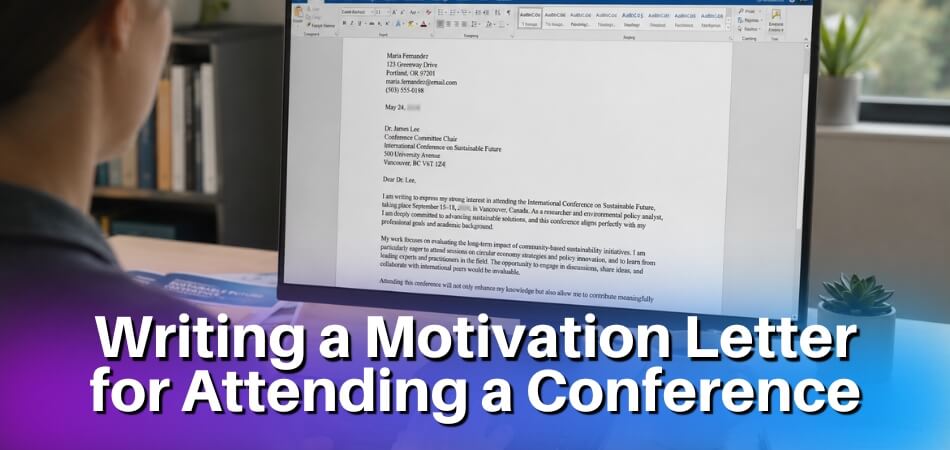
Dear Conference Committee,
My name is [Your Name], and I am currently [your role, program, or position] in the field of [your field]. I am writing to ask to attend [Conference Name], as its focus on [main topic or theme] closely matches my academic and professional interests.
I am especially interested in the sessions on [specific topic], because they relate to my current work on [study, project, research, or professional goal]. Attending would help me understand recent developments in this area and learn from experts, researchers and professionals who work on similar questions.
The conference would also support my plans by helping me build knowledge, exchange ideas and apply new insights in my [study, research, workplace, or community]. I hope to join the discussions and share what I learn with my peers or colleagues afterward.
Thank you for considering my application. I would be grateful for the chance to attend and contribute.
Sincerely,
[Your Name]
[Email Address]
Motivation Letter Examples for Different Applicants
Adjust the letter to your purpose. A student leads with academic growth, a researcher with presentation goals and feedback, and a professional, funding applicant or virtual attendee with their own situation. Each sample below is short on purpose, so add your own details.
Motivation Letter for Students Attending a Conference
A student letter should focus on academic interest, learning goals and how the event supports future study or research.
Dear Conference Committee,
I am a student of [Program Name] at [Institution Name], and I would like to attend [Conference Name]. Its focus on [Topic] connects directly with what I am studying this year.
The sessions on [Specific Topic] would deepen what I learn in class, and I hope to use the ideas in coming assignments, projects or research work.
I appreciate your time and consideration.
Sincerely,
[Your Name]
Motivation Letter for Researchers or Paper Presenters
A researcher letter should connect the conference to your research area, your presentation and the feedback you need.
Dear Organizing Committee,
I am a researcher in [Research Area], and I am applying to take part in [Conference Name]. Its theme overlaps closely with my current work on [Research Subject].
I plan to present my paper/poster titled [Title], which looks at [Brief Focus]. The conference would let me share my findings, collect feedback and meet others working in related areas.
Thank you for reviewing my request.
Sincerely,
[Your Name]
Adding a Plain-Language Summary When You Apply to Present
Many academic calls ask for the letter together with an abstract and a CV, and use it to choose who gets a talk or a poster slot. An INOMICS guide for economics conferences (2020) suggests describing your research in a few plain sentences for a reader outside your sub-field, leaving methods and results to the abstract. It also suggests linking your work to the conference theme and saying why it matters now. Spend most of the letter on the research, not on your career.
Motivation Letter for Working Professionals
A professional letter should focus on skill development, industry knowledge and practical use at work. If your employer must approve time off or budget, say what the organization gains and how you will report back. When no letter is required, a short email that expresses interest in attending does the same job for a manager.
Dear Selection Committee,
I work as a [Job Title] at [Organization Name], and I would like to attend [Conference Name]. The sessions on [Topic] relate directly to my current responsibilities.
I expect to learn updated methods, hear how others in the field handle similar problems and meet professionals in my area. After the event I will apply the useful ideas in my role and brief my team.
Thank you for your time.
Sincerely,
[Your Name]
Motivation Letter for Travel Grant or Funding Support
A travel grant letter should explain why the conference matters, why support is needed and what value the opportunity will create.
Dear Grant Committee,
I am writing to request funding to attend [Conference Name]. The event matters to my work in [Field/Topic], particularly the sessions on [Specific Topic].
Without support, the cost of attending would be a real barrier for me. With it, I could take full part in the conference and bring the knowledge back to my [classmates/research group/team/community].
I am grateful for your consideration.
Sincerely,
[Your Name]
Motivation Letter for Virtual or Hybrid Conference Participation
A virtual letter should focus on online learning value, remote participation and how you will engage with the sessions.
Dear Conference Team,
I would like to join [Conference Name] through its online option. The virtual sessions on [Topic] fit my current interest in [Field or Subject].
Although I would attend remotely, I plan to join the live sessions, ask questions when possible and use the digital materials. The online format lets me learn from experts while keeping up with my study or work.
With thanks for your consideration,
[Your Name]
How Long Should a Conference Motivation Letter Be?
A conference motivation letter should usually be one page or less. For most requests, 150 to 250 words is enough. Funding, scholarship and research-based applications can run to 250 to 400 words. These are common guides, not fixed rules, and a stated word limit always wins.
| Situation | Suggested Length | Best Use |
| Standard conference attendance | 150 to 250 words | General registration or application |
| Student application | 180 to 250 words | Academic interest and learning goals |
| Research presentation | 250 to 350 words | Paper, poster, or research explanation |
| Travel grant or scholarship | 250 to 400 words | Purpose, need, and expected impact |
| Working professional | 180 to 300 words | Skills, career growth, and workplace value |
| Virtual conference | 150 to 220 words | Online learning and participation |
Longer does not mean stronger. A short letter with clear details beats a long one that circles the same idea. Reviewers who read many applications remember direct writing, and a long letter can hide the main point. If a sentence does not tell the reader who you are, why you want to attend, what you will learn, how it fits your goals or how you will share it, remove it.
What Tone Should You Use in a Conference Motivation Letter?
Use a formal, respectful and natural tone. You should sound professional without sounding robotic, like a real person with a clear reason for attending.

Formal but Natural Language
Be polite, but avoid forced or dramatic phrases. You can show strong interest without exaggerating.
Good tone:
“I am interested in attending this conference because the sessions on public health policy match my current research focus.”
Weak tone:
“This life-changing conference is the only opportunity that can transform my entire future.”
A natural tone feels more honest and credible.
Simple and Clear Sentences
Clear writing works better than complex wording, and the letter should be easy to follow on the first read.
Instead of writing:
“I am deeply passionate about the extraordinary intellectual opportunities offered by your distinguished platform.”
Write:
“I am interested in the conference because it brings together experts working on topics related to my field.”
Simple does not mean weak. Plain sentences often sound more confident.
Words and Phrases to Avoid
Avoid language that is too casual, too vague or too dramatic. Try not to use:
- “I really, really want to attend”
- “This is my dream conference”
- “I will be the best participant”
- “I need this opportunity at any cost”
- “Your conference is the greatest event in the world”
- “I just want to learn many things”
- “Please choose me because I deserve it”
Calm, specific and respectful wording works better. This also covers slang, jokes and emotional pressure.
Should You Mention Previous Conference Experience?
Yes, mention previous conference experience when it supports your reason for attending, and keep it to one short sentence. For example, if a past seminar or workshop sparked your interest in a topic, say how this conference builds on it. You do not need to list every event you attended. The aim is continuity, not a second CV.
If you have no previous experience, focus on:
- Your interest in the subject
- Your current study or work
- Your learning goals
- Your willingness to participate
You can also say that this would be your first chance to engage with experts and participants in the field.
Can a Motivation Letter Help With Conference Funding or Scholarships?
Yes, a motivation letter can support a conference funding, scholarship or travel grant application when the event offers financial assistance. It tells the committee why you need support and how the opportunity will help your development. It does not guarantee an award.

Explain Your Need Clearly
Describe your need honestly and briefly. Unless the application asks for figures, you do not need every financial detail. You can say that travel, registration or accommodation costs are a barrier, then explain how support would let you attend and take part fully.
Keep the balance right. The letter should not be mostly about money. The main point is still the value of attending.
Connect the Funding Request to Learning or Research Value
A strong funding letter explains why the conference matters. You can say it will help you:
- Present research findings
- Learn from experts
- Improve a project
- Build professional connections
- Join a session or meeting aimed at early-career researchers, if the programme has one
- Gain knowledge not easily available elsewhere
Some funders publish questions for the letter, such as the value of the event for your project and how you will share it with your group. If yours does, answer those questions in the order given. Committees often prefer applicants with a clear purpose who will use the opportunity well.
Show How the Opportunity Benefits Others Too
Funding requests are stronger when they show wider value. You may plan to:
- Share notes with classmates
- Present key takeaways to your research group
- Apply new methods in your workplace
- Use the knowledge in a community project
- Improve an ongoing study or paper
- Support future collaboration
This shows the funding creates benefits beyond your own attendance.
Do Virtual Conferences Require a Motivation Letter?
Only sometimes. A virtual conference may ask for a letter when it uses an application, selection, funding or approval process. Many online events do not.
For online attendance you do not need to explain travel plans. Focus on why the online sessions matter and how you will take part remotely. A virtual letter can mention:
- Specific online sessions you want to attend
- Live Q&A participation and digital networking
- Access to international speakers
- Flexibility to join while studying or working
- How you will use live or recorded content
Keep it concise. With fewer logistical barriers, your motivation should rest on learning value and engagement.
Common Mistakes to Avoid in a Conference Motivation Letter
Most weak letters are too general, too long or too close to a template. Fixing these mistakes makes the letter more focused.

Writing Too Generally
A general letter could be sent to any event. It does not mention the theme, relevant topics or your own reason for attending. A line such as “I want to attend because this conference will help me grow” says nothing until you add which part of the conference supports your growth.
Copying a Template Without Personalizing It
Templates help with structure, but a letter that sounds copied feels careless. Always change:
- Conference name
- Topics of interest
- Your background
- Your learning goals and reason for attending
- Your future connection to the event
Repeating Your CV
Your CV lists education, work and achievements. Your letter explains purpose. Choose only the degrees, jobs or projects that support your reason for attending.
Using Overly Casual or Overly Formal Language
Slang and jokes look unprofessional, while stiff, complex wording sounds unnatural. Aim for a professional but human voice.
Making the Letter Too Long
Reviewers may not have time for a long letter, and extra sentences hide your main point. Stay inside the range in the length table above.
Forgetting to Proofread
Small errors make a letter look rushed. Apart from the Step 9 checks, pay special attention to dates, the organizer’s name, the subject line and attachments.
Quick Checklist Before Submitting Your Motivation Letter
Use this checklist for the content of the letter. Spelling, names and contact details are covered in Step 9.
| Checkpoint | What to Confirm |
| Clear purpose | The letter explains why you want to attend |
| Short introduction | Your background is clear but not too long |
| Specific interest | You mention relevant topics, sessions, or themes |
| Learning goals | The letter shows what you hope to gain |
| Future connection | The conference connects to your study, work, or research |
| Active participation | You explain how you will engage or share learning |
| Tone and length | Professional, simple, respectful, and within the required word count |
| Submission rules | File format, deadline, and instructions are followed |
From our experience at MS International: Our conferences are in person in the Greater Toronto Area, and you can register as an attendee (listener) without presenting a paper. If an employer, sponsor or scholarship body is paying, get their written approval before you pay, because registration fees are non-refundable and non-transferable. A motivation letter is for your funder or employer. It is not the invitation letter we issue after payment clears.
Motivation Letter FAQ
Starting the motivation letter is one hurdle; others include reusing it for another event, attaching a CV, the file format and how it differs from a cover or invitation letter.
How do I start a motivation letter for a conference?
Start with a professional greeting, then introduce yourself in a line or two and name the conference. The opening should show who you are and why you are writing, so the reader understands your purpose immediately.
What should I write in the first paragraph?
Include your name, role or study program, field of interest and the conference you want to attend. Add one short sentence on why the event is relevant to your academic or professional goals.
Can I reuse one motivation letter for more than one conference?
No, do not send the exact same letter twice. You can reuse the structure, but each letter needs the correct event name, topics, sessions and reasons for that specific conference.
Should I attach my CV with the motivation letter?
Attach your CV only if the conference asks for it or it supports your application. The letter explains your purpose, while the CV gives the detailed background, so do not repeat the full CV inside the letter.
What if I have no conference experience?
You can still write a strong letter. Focus on your interest in the topic, your current study or work, your learning goals and how attending will help your future development.
Should I mention speakers or sessions in the letter?
Yes, if they truly connect to your goals. Do not drop names at random. Use specific details only when they explain why the conference matters to you.
Is a motivation letter the same as a cover letter?
No, though they are similar. A cover letter is usually tied to a job and your fit for it, while a motivation letter explains why you want a place, grant or event. For conferences, the focus is purpose, learning and relevance.
How long should a motivation letter for a conference be?
One page or less. A word limit set by the conference or funder always comes first, so check the call before you write. The length table above gives working ranges for common situations.
What file format should I use when submitting the letter?
Use the format the conference requests. If none is given, PDF is usually a good option because it keeps the layout clean. For email applications, you can write the letter in the email body or attach a PDF.
Is a motivation letter the same as an invitation letter?
No. You write a motivation letter to explain why you want to attend. The organizer issues an invitation letter to confirm your registration. At MS International it is issued within 3 to 5 business days after payment clears, and it supports a visa application without guaranteeing it.
Can I attend a conference without presenting a paper?
Yes. Many conferences register attendees who are not presenting. In your letter, focus on what you will learn and how you will use it.
Conclusion
A strong motivation letter for attending a conference is clear, personal and focused. It says who you are, why this event matters to you, what you hope to learn and how it supports your goals.
The best letters are not the longest. They give specific reasons in plain language and show a real link between you and the conference. Before you submit, check the instructions, personalize the text and proofread.