
Budgeting for a trip to Canada from Kenya sounds easy until the figures stop agreeing. One site quotes dollars, another quotes shillings, and a half-remembered tip from a friend says something else again. Here is what the process really costs you, piece by piece.
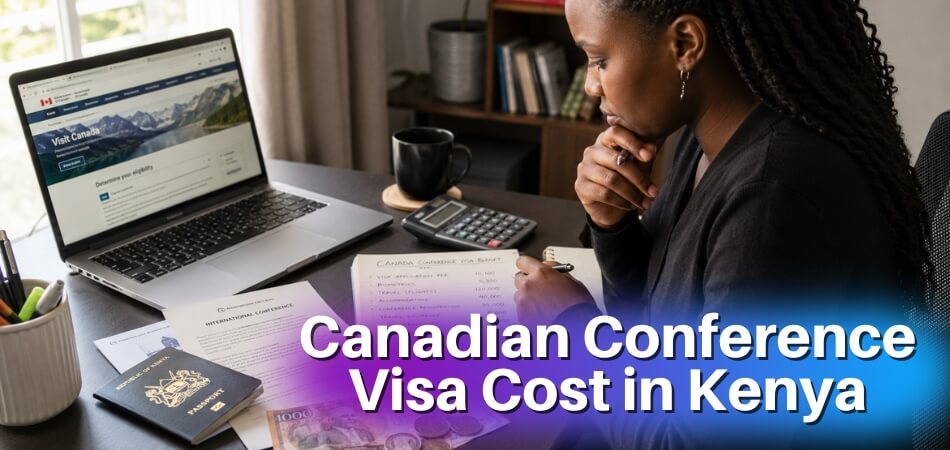
Quick answer: A Canadian conference visa costs CAD 185 per adult applicant from Kenya: CAD 100 for the visitor visa plus CAD 85 for biometrics. At an illustrative rate of about KES 95 per CAD, that is roughly KES 17,600. VFS Global Nairobi charges, travel insurance and document costs come on top. Canada has no separate conference visa; you apply for a Temporary Resident Visa.
Fact-checked by the MS International Editorial Team. Last verified against official sources: October 2026.
Many Kenyan applicants find conflicting figures, old forum posts and fee tables that mix currencies without saying so. This article separates what you pay IRCC from what you pay VFS Global and from what you pay for your own supporting documents.
One point to settle first: the “conference” part of the application is your supporting paperwork, mainly the conference invitation letter. The visa category and the government fees are exactly the same as for any other visitor visa. You apply through the IRCC online account, and Immigration, Refugees and Citizenship Canada (IRCC) makes the decision. VFS Global runs the Canada Visa Application Centre in Nairobi, which collects biometrics.
Canadian Conference Visa Cost from Kenya
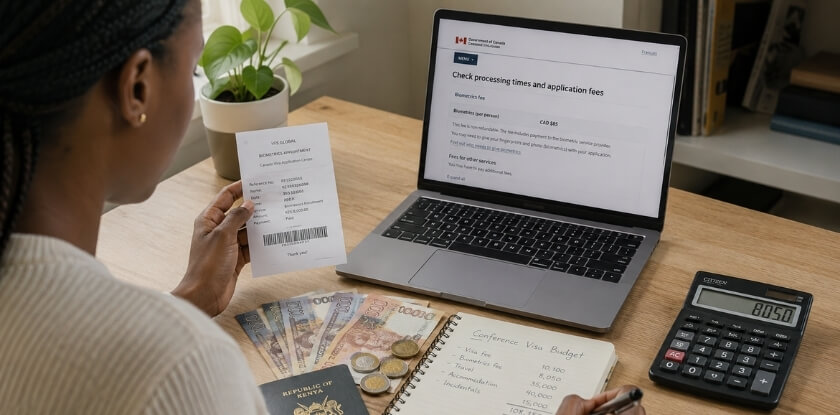
You pay IRCC CAD 100 for the visa and CAD 85 for biometrics, a total of CAD 185 per person. Both are paid in Canadian dollars by card when you submit the application online. The card does not need to be in your name, and IRCC accepts Visa, Mastercard, American Express, JCB and UnionPay for online applications, plus Visa Debit. If you use a prepaid card, keep it for at least 18 months so any refund is easier.
Here is how the main charges fit together:
| Charge | Who you pay | Amount | Notes |
|---|---|---|---|
| Visitor visa (TRV) processing fee | IRCC | CAD 100 per person | Family of 5 or more: CAD 500 in total |
| Biometrics fee | IRCC | CAD 85 per person | Family: up to CAD 170. Not charged again while your biometrics (valid 10 years) are still current |
| Total government fees | IRCC | CAD 185 for one adult | Depends on the day’s exchange rate (worked example below) |
| VFS Global service charges | VFS Global Kenya | In KES, see VFS site | Not an IRCC fee. Check the Canada page of the VFS Kenya website for the current schedule |
| Travel insurance, photos, bank documents | Third parties | Varies | Optional for the visa, but useful |
Where to Check the Current Fees
IRCC sets its fees in CAD and VFS Global Kenya quotes its own charges in KES. Both can change, so read the amounts on the IRCC fee pages on canada.ca and on the Canada page of the VFS Global Kenya site on the day you apply. Treat any number in an article, this one included, as a guide for budgeting.
Why the KES Amount Moves
Because IRCC fees are charged in CAD, the Kenya shilling amount depends on the exchange rate and on your card’s conversion margin on the day you pay. Check the live CAD to KES rate and add a small buffer. Applicants in Ghana and Nigeria pay the same CAD fees, so the Canadian conference visa cost in Ghana moves with the cedi and the conference visa cost from Nigeria to Canada moves with the naira.
Full Cost Breakdown in Kenya Shillings (KES)
Budget for four layers: IRCC fees in CAD, VFS Global charges in KES, travel insurance, and document costs. The IRCC layer is fixed, while the others depend on what you choose and where you live.
Government Fees (CAD to KES)
Take the CAD 185 total and multiply it by the live exchange rate. Each KES 1 change in the rate moves the total by about KES 185, so at KES 100 per CAD it would be KES 18,500. The IRCC payment page shows both fees as separate lines.
VFS Global Service Charges in Kenya
VFS Global is the official service partner for the Canada Visa Application Centre in Nairobi. Its charges are separate from IRCC’s, are paid in KES, and the VFS site says new service charges took effect on 1 May 2026, so use the current schedule. Optional extras such as courier return of documents, ICAO-compliant photographs and printing carry their own fees.
Other Costs to Budget For
- Travel insurance. Not a legal condition of the visa, but a policy covering your travel dates and medical emergencies supports the application. Get quotes early.
- Photographs and document preparation. Passport photos, translations, notarisation or certification all add up.
- Bank statement fees. Some Kenyan banks charge for stamped statements.
- Travel to Nairobi. If you live outside Nairobi, include transport and possibly one night’s accommodation for the biometrics visit.
Conference Visa vs Regular Visitor Visa: Is There a Difference?
No. Canada does not issue a separate conference visa. Conference attendees, tourists and family visitors all apply for the same Temporary Resident Visa and pay the same fees.

What changes is the story your documents tell. A conference gives the officer a fixed purpose, fixed dates, a named host and a clear end point to the trip.
What Makes a Conference Application Different
The conference invitation letter carries the most weight, and a general “you are welcome to attend” email does not do the same job. The documents section below lists what the letter should contain.
How Officers Read a Conference Application
A well-documented conference trip can help, but it does not replace the basics: your finances, your ties to Kenya, your travel history and the credibility of the invitation. If the invitation comes from a recognised institution, say so in your cover letter.
From our experience at MS International: attendees often ask whether the invitation letter alone is enough. Not on its own, because IRCC decides on the whole file. It works best when its dates, your name and your role match your passport, registration and cover letter exactly. We issue ours within 3 to 5 business days after payment clears, and a US$50 fee may apply to corrections after issue, so check your details before you submit them.
Bank Balance Requirement for Kenyan Applicants
IRCC does not publish one fixed minimum balance. You need to show enough money to pay for flights, accommodation and daily costs for the whole trip without working in Canada. If the host or your employer covers accommodation and registration, say so in writing. That lowers what you need to show yourself.
What Officers Look For
They look at whether your finances make sense for this trip. Your statements should cover about three to six months and show regular income, not a large deposit made days before applying. A sudden lump sum raises questions that steady activity avoids.
Documents to Prepare
Use statements issued by the bank on its letterhead. Add statements for savings, current and mobile money accounts if you use them, because together they show a fuller picture. Employees should add an employer letter with position, salary and approved leave; it helps if the letter also names the conference, even when you have already submitted a general employment letter. A bank reference letter confirming your account standing is optional but some applicants add one. Business owners should add registration documents and tax records.
Sponsored or Employer-Funded Attendance
If an organisation pays, include a signed sponsorship letter on letterhead that names what it covers: travel, accommodation and daily expenses. The sponsor’s own financial documents may also be needed. Keep a personal statement in the file too, since the officer wants to see your own financial footing.
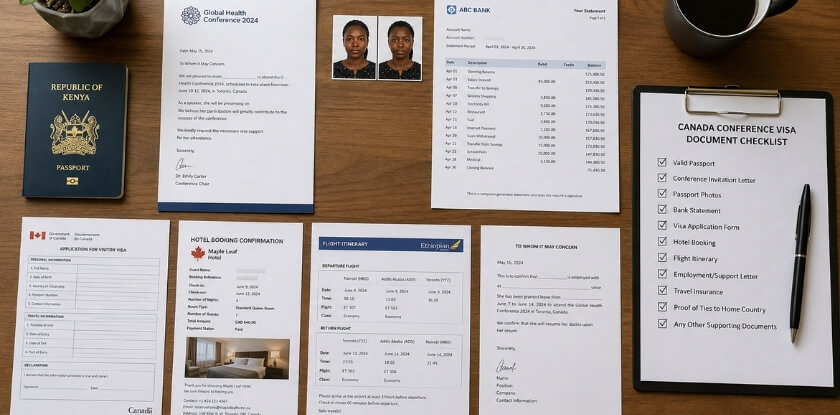
Required Documents, Including Conference-Specific Papers
You need the standard visitor visa documents plus a conference layer on top. IRCC officers review Kenyan files remotely, so the file must explain itself without follow-up.
Standard Visitor Visa Documents
- Valid passport. Upload the identity page, plus old passports that show your travel history.
- Photographs. They must meet IRCC photo specifications. The VFS centre in Nairobi offers an ICAO-compliant photo service for a fee.
- Application forms. The IRCC online account lists the forms that apply to you, such as the IMM 5257 application and the Family Information form IMM 5645.
- Proof of funds. Bank statements for the last three to six months.
- Employment or business proof. Employer letter, or business registration and tax returns.
- Proof of ties to Kenya. Property, a lease, dependants or a job to return to.
- Biometrics. Most Kenyan applicants give fingerprints and a photo at the VFS Canada centre in Nairobi. If you gave biometrics in the last 10 years, you may not need to again.
Conference-Specific Documents
- Conference invitation letter. Letterhead, your name, dates, location, your role (attendee, speaker, presenter) and the conference website or registration details.
- Registration confirmation and payment receipt. It shows the event is real and corroborates the letter.
- Programme or agenda. Sessions, venue and speakers give the officer something to check.
- Proof of accommodation. Hotel booking, or a letter from the host institution or colleagues.
- Cover letter. Short and factual: who you are, what the conference is, why you attend and when you return to Kenya.
- Sponsorship proof, if someone else pays. It must agree with your bank statements.
Upload clear, legible scans.
Where and How to Apply from Kenya
Apply online in an IRCC account. IRCC requires online applications, and paper is allowed only when you cannot apply online, for example because of a disability.
Online Through the IRCC Portal
Create your account, complete the forms, upload documents as PDF or JPEG files, and pay the CAD fees by card. After you submit and pay, IRCC sends a Biometric Instruction Letter (BIL). IRCC currently gives you 30 days from the date of the letter to give biometrics. You then book an appointment at the VFS Canada Visa Application Centre in Nairobi.
The centre is at Parkfield Building, 5th Floor, Muthangari Drive, off Waiyaki Way, according to the VFS site. Check the VFS Kenya Canada page for hours and booking rules before you travel.
Paper Application via VFS Global Kenya
Paper applications are the exception. If IRCC accepts that you cannot apply online, VFS Global can receive the paper package. Confirm the exact process and any VFS charge with IRCC and VFS before you go.
What the Canadian High Commission Nairobi Does
Visa decisions are made by IRCC officers, not by staff at the High Commission front desk, and the High Commission does not take walk-in visa applications, so turning up there will not speed anything up. For status questions, use your IRCC account or the IRCC web form.
Processing Time for a Conference Visa from Kenya
IRCC does not guarantee a processing time, and it changes by country and month. Use the IRCC processing times tool, select Kenya and “Visitor visa (from outside Canada)”, and read the current estimate before you plan.

Estimate Versus Real Experience
The published figure is an estimate, not a maximum or a guarantee. IRCC bases it on its current inventory, staffing and expected intake. Missing documents, inconsistent travel history or extra checks will make your file take longer.
Do IRCC’s Ebola Measures Affect Kenya?
Not if you live in Kenya. IRCC’s temporary measures, in force until 27 November 2026, apply to people whose last country of residence on the application is the Democratic Republic of the Congo, South Sudan or Uganda, whatever their citizenship. Those applications are processed but not finalized. IRCC’s page names no other country. A Kenyan citizen living in one of those three countries should expect a longer wait than the tool shows.
Planning Around a Conference Date
IRCC starts counting when it has your complete application, and its estimate includes the time it takes to give biometrics, so book the appointment as soon as the BIL arrives. Before that, count gathering documents, submitting and receiving the BIL. Then add the IRCC estimate and a buffer for document requests. We cannot give an official safe lead time, so apply as soon as you hold your invitation letter and registration.
No Paid Fast Track
You cannot pay to speed up a visitor visa, and if the event is within a few weeks there is no guaranteed official way to accelerate. IRCC can consider urgent cases, but an ordinary conference is not normally treated as an emergency, so be realistic about the date. The practical way to avoid delay is a complete, consistent file submitted early.
Checking Your Status
Track the application in your IRCC account. If the posted time has passed with no decision, use the IRCC web form. VFS handles logistics only and cannot tell you the decision status.
Health and Travel Insurance Requirement
Canada does not require travel insurance for a visitor visa, but a good policy supports your application by showing you have planned the trip properly: your invitation letter shows purpose, your bank statement shows funds, and insurance shows you have prepared for the unexpected. It also protects you, because Canadian hospital care is costly for visitors.
What Coverage to Look For
- Cover the full dates of travel, not only the conference days.
- Medical limits should suit Canadian hospital costs.
- Include medical evacuation, since the flight from Nairobi is long.
- Check pre-existing conditions if they apply to you.
Kenyan insurers and some banks offer short-term international cover. Keep the certificate in English, ready to upload.
The Cost Side
Premiums depend on age, trip length and coverage limit, so no single figure fits everyone. Compare at least two quotes by what they cover, not only by price. IRCC does not publish a minimum coverage amount.
Refund Policy If Your Visa Is Rejected
No. If your visa is refused, you do not get the IRCC fee, the biometrics fee or the VFS service charge back. A refund is possible only in narrow cases, such as withdrawing before IRCC starts processing.

The IRCC Application Fee
IRCC says that if you withdraw before it starts processing, you get a full refund. After processing starts, its refund page lists only a few other fees as refundable, such as the permanent residence and citizenship fees, and the visitor visa fee is not among them, so a refusal does not bring it back. Refunds on fees paid inside the online application are meant to be automatic. If nothing arrives after 8 weeks, request it through IRCC’s payment service using your receipt number.
The Biometrics Fee
IRCC refunds the biometrics fee only if you did not give your biometrics or gave them by mistake. After you give them at the Nairobi centre, the fee stays with IRCC even if the visa is refused.
The VFS Global Service Fee
VFS charges for its service once your documents are submitted at the centre, and this fee is separate from IRCC’s. Read the VFS terms for the current refund wording.
What You Cannot Recover
Insurance premiums, courier fees, translations and medical exam fees are third-party costs that IRCC cannot refund. There is no appeal-based refund through the High Commission.
When a Refund May Be Possible
If IRCC returns your application unprocessed, for example because it was incomplete, it may refund the fees. A refusal means a decision was made, while a returned application means none was made. Contact IRCC through your account to ask.
Approval Tips for Kenyan Applicants
Your file should show three things clearly: you are attending a real conference, you can pay for the trip, and you will return to Kenya. Every document should support those points without contradiction.
- Refer to the conference by name. Your cover letter should give the dates, your role and your return date, in your own words.
- Show concrete ties to Kenya. Employment, a business, property or dependants at home.
- Keep bank statements steady. Regular income and savings over several months read better than a recent spike.
- Do biometrics quickly. Slots can fill in busy seasons, and your file does not move until biometrics are done.
- Organise the upload. Use a logical order, clear names and check nothing is missing before you submit. A blurred bank statement or cropped invitation letter often leads to a request for more documents.
- Include insurance proof for the full travel dates.
- Apply early. Check the current IRCC estimate and leave room for biometrics.
- Cross-check every document. Dates, role and spellings in the cover letter, invitation, registration and tickets should match.
Disclaimer: This article is general information, not legal or immigration advice. Visa rules, fees, and processing times change. Confirm the current requirements on the official IRCC website (canada.ca) and the VFS Global Kenya website before you apply.
Frequently Asked Questions
Kenyan attendees pricing a Canadian trip ask whether fees are paid in KES or CAD, who issues the visa, how much to show in the bank and whether the Nairobi centre or the Ebola pause affects them.
How much does a Canadian conference visa cost from Kenya?
CAD 185 for one adult: CAD 100 for the visitor visa and CAD 85 for biometrics, paid to IRCC online. VFS Global charges its own service fees in KES on top. Confirm current amounts on IRCC and VFS before paying.
Is a conference visa a separate category from a visitor visa?
No. Canada has no standalone conference visa. You apply for a Temporary Resident Visa, and your conference invitation letter explains the purpose of the trip.
Does the fee change?
Yes. IRCC and VFS Global can update their fees at any time, and the KES amount also moves with the exchange rate. Check both official sites on the day you apply.
Do I pay IRCC fees in KES or CAD?
IRCC fees are paid online in CAD by credit or debit card, which need not be in your name. VFS Global Kenya charges its own service fees in Kenya shillings.
Will IRCC refund my fee if the visa is refused?
Generally no. The visa fee is not refunded after a refusal. A full refund is possible only if you withdraw before processing starts. Biometrics are refunded only when you never gave them or gave them in error.
Do I need a conference invitation letter?
Canada does not name it as a mandatory document, but in practice it is the key proof of purpose. It should name you, the dates, the venue and your role, on the organiser’s letterhead. It supports your application but does not guarantee a visa.
How long does processing take for Kenyan applicants?
IRCC shows a current estimate for Kenya in its processing times tool, and it is not a guarantee. The estimate includes the time to give biometrics. Apply well before the conference.
How much money must I show in my bank account?
IRCC sets no fixed amount. Show enough for flights, accommodation and daily costs, with three to six months of steady activity rather than a late deposit.
Does travel insurance affect approval?
It is not required, but it shows you planned the trip responsibly and protects you from high Canadian medical costs.
Do I have to visit the Nairobi centre if I apply online?
Usually yes, for biometrics, unless you gave them in the last 10 years. Your Biometric Instruction Letter states whether you must.
Does IRCC’s Ebola pause affect Kenyan applicants?
No, not if you live in Kenya. The pause covers only applicants whose last country of residence is the DRC, South Sudan or Uganda, and it runs to 27 November 2026.
Does VFS Global or IRCC issue the visa?
IRCC decides every application. VFS Global collects biometrics and provides services, and has no role in the decision.
Final Thoughts
Budget CAD 185 per adult for the government fees, then add VFS Global charges, insurance and document costs. Keep the invitation letter specific, the bank statements steady and every document consistent. Apply online through IRCC well before your conference, and confirm the current fees on the IRCC and VFS Global Kenya websites.