
Ask three people for the three types of conferences and you may hear three different lists. The word covers everything from a research meeting to a company announcement, so the answer depends on who is asking.
Quick answer: No official list of three types exists, so sources differ. This guide groups conferences by purpose into academic conferences, business or trade conferences, and press conferences. Academic events share research, business events serve companies, customers and shareholders, and press conferences hand news to journalists. Other sources group by format (in person, virtual, hybrid) or by scale.
Last verified against official sources: October 2026.
Is There an Official List of Conference Types?
No. No standards body defines “the three types of conferences.” The number and the categories change with the source. Pages read in October 2026 group conferences in quite different ways:
| Source | How it groups conferences |
| Orvium blog (December 2022) | Three types of academic conference by format: in person, hybrid and virtual |
| AiScholar (October 2025) | By scale (international, national, regional or local), by kind of meeting (conference, symposium, workshop, seminar, colloquium, congress) and by delivery (in person, virtual, hybrid) |
| Miller Tanner (event planning firm) | By audience and purpose: academic, business, trade and unconference (equally knowledgeable attendees hold open discussions without a featured speaker) |
Miller Tanner describes a conference as a structured meeting that brings people together to discuss a specific topic, share expertise and explore new ideas. That broad meaning is why one word stretches across so many event types, including a church conference that brings members together for worship, teaching and planning.
This guide follows the purpose-and-audience approach: academic, business or trade, and press. It is this guide’s own editorial grouping, not a rulebook, and Miller Tanner’s list is the closest of the three sources above, though it does not include press conferences. Format is covered separately further down.
The Three Types of Conferences: Academic, Business and Press
Each type is defined by what the event is for and who it is meant to reach. Academic events serve researchers, business events serve commercial or governance audiences, and press events serve the media.

| Type | Main Purpose | Main Audience | Typical Examples |
| Academic | Present and discuss research | Researchers, students, academics, practitioners | International conferences, symposia, workshops |
| Business or trade | Inform, sell, report or build industry relationships | Customers, partners, investors, shareholders, industry staff | Industry conferences, trade shows, annual general meetings, product launches |
| Press | Share official news with the public through the media | Journalists, media teams, public relations staff, stakeholders | Announcements, crisis updates, policy statements |
Although all three are called conferences, they are not used the same way. The right one depends on the goal of the event, the people you need to reach, and the action you want them to take afterward.
Academic Conferences: Sharing and Testing Research
An academic conference is a meeting where researchers, students and professionals present work and discuss it with peers. It is the type most people mean when a university, journal or professional society talks about “attending a conference.”
Typical features are:
- A call for papers or abstracts with a deadline
- Peer review before a paper is accepted for presentation
- Oral sessions, poster sessions and panels organized by theme
- Keynote talks from invited experts
- Time for questions, feedback and networking
Smaller formats sit under the same umbrella. A symposium goes deep on one narrow topic, a workshop teaches a skill, and a colloquium or seminar suits early-stage research that needs feedback. At the other end, AiScholar (2025) describes a congress as a very large, formal meeting, usually run by a major professional association. Small events go by several such names depending on their format.
Attendees generally take part in one of two ways: as presenting authors, who submit work for review, or as listeners, who register to attend sessions and network. Both are normal ways to take part.
Business and Trade Conferences: Industry Events and Corporate Meetings
A business conference brings a company’s customers, partners, investors or staff together for information, sales or reporting. The label covers several quite different events. Industry conferences gather professionals from one sector to hear speakers and discuss trends. Trade shows add exhibition floors where companies show products and services to buyers. They are less about publishing findings and more about contacts, deals and market awareness.
Two corporate events come up often enough to need their own sections: the annual general meeting, which serves shareholders, and the product launch, which serves the market.
Annual General Meetings: Purpose, Audience, and Use Cases
An annual general meeting, or AGM, is a formal yearly meeting where a company updates its shareholders and handles governance matters. It gives shareholders a chance to review performance, ask questions and vote on selected company decisions. In Canada, section 133 of the Canada Business Corporations Act (Justice Laws website, read October 2026) requires directors to call the first annual meeting within 18 months of incorporation, and later ones within 15 months of the previous one and no later than six months after the financial year ends. Notice must go to the voting shareholders, the directors and the auditor (section 135), and a company can ask a court to extend the deadline. Provincial rules differ, and a company’s own bylaws can add requirements.

AGMs are commonly used to discuss:
- Company performance from the past year
- Financial statements and annual reports
- Board updates or director appointments
- Dividend-related matters, where applicable
- Auditor appointments or approvals
- Future business plans and strategic priorities
- Shareholder questions and concerns
The main purpose is accountability: leaders explain results, share plans and stay transparent with shareholders.
Who Usually Attends an AGM?
An AGM is designed for people connected to the company’s ownership, leadership and compliance responsibilities.
- Shareholders who review updates and vote on key matters
- Board members who discuss leadership and governance issues
- Company executives who present performance and strategy
- Financial officers who explain financial results
- Legal or compliance advisors who help ensure proper procedure
- Investors who follow the company’s direction
Common Format of an AGM
Because AGMs deal with formal company matters, they follow a structured agenda.
- Opening of the meeting
- Review of the previous year’s performance
- Presentation of financial reports
- Discussion of company strategy
- Voting on resolutions
- Shareholder question-and-answer session
- Closing remarks
This keeps the meeting organized and makes sure governance items are handled properly.
Benefits and Limitations of AGMs
AGMs support transparency, shareholder participation and corporate accountability, and they let owners see how the company is doing and where leadership is heading. The limitation is reach. AGMs are not built for public promotion, the audience is specific, and the tone is formal. For public excitement or media buzz, a product launch or press conference fits better.
Product Launches: Purpose, Audience, and Use Cases
A product launch is a conference-style event that introduces a new product, service, feature or brand offering to the market. It is designed to create awareness, explain value and encourage early interest from customers, media, partners and industry audiences.
Companies organize launches when they want to:
- Announce a new product or service
- Demonstrate key features
- Explain customer benefits
- Build brand excitement
- Attract media coverage
- Support sales or pre-orders
- Connect with potential buyers, partners or influencers
The aim is to make the offering visible and memorable. A launch is not only about announcing availability. It shows why the product matters and what problem it solves for the target audience.
Who Usually Attends a Product Launch?
A launch brings together people who can build interest, visibility or sales momentum.
- Potential customers who want to understand the new product
- Media representatives who may cover the announcement
- Influencers or reviewers who can share early opinions
- Sales teams who use the event to build leads
- Marketing teams who manage promotion and messaging
- Business partners who may support distribution or collaboration
- Industry professionals interested in new trends or solutions
Common Format of a Product Launch
Launches are more promotional and experience-focused than other types. They may use presentations, demonstrations, videos, product trials, media briefings or networking sessions.
- Welcome and brand introduction
- Product announcement
- Feature or benefit presentation
- Live demonstration or product showcase
- Customer, expert or partner remarks
- Media or audience question session
- Networking, trials or sales conversations
This helps the audience understand both the product and the story behind it.
Benefits and Limitations of Product Launches
Launches create attention around a new offering and let people experience it directly. They can strengthen brand image, generate media interest and support early customer engagement. They need clear positioning, though. If the message is weak, the audience is poorly chosen, or the demonstration shows no real value, the event may create little lasting interest. A successful launch connects the product’s features with the audience’s needs.
Press Conferences: Making an Official Announcement
A press conference is a formal event where an organization gives important information to journalists and media representatives. It is held when a message needs public attention, quick distribution, or a direct explanation from official speakers.
Organizations use press conferences for:
- Major company announcements
- Government or public updates
- Crisis communication
- Policy and leadership changes
- Event announcements
- Responses to public concerns
The goal is clarity. Instead of letting information spread through rumors or unofficial sources, the organization presents the message itself.
Who Attends a Press Conference?
The event is built around the media, but other groups may attend depending on the topic.
- Journalists and media outlets who report the announcement
- Company or organizational leaders who deliver the message
- Public relations teams who manage communication
- Industry experts who provide context
- Stakeholders who observe the announcement
Common Format of a Press Conference
A typical press conference is short and simple. A prepared statement comes first, then remarks from key representatives, then questions from journalists.
- Opening remarks
- Main announcement
- Supporting explanation or data
- Media question-and-answer session
- Closing statement
The prepared message keeps the announcement focused, while the question period lets the media clarify points.
Benefits and Limitations of Press Conferences
They spread information quickly and reach a large audience through media coverage. They also require careful preparation. If speakers are unclear, dodge questions or give inconsistent answers, the event can damage trust instead of building it. Use one only when the message justifies public and media attention.
In Person, Virtual or Hybrid: The Other Common Way to Group Conferences
The other widely used split is by delivery format: in person, virtual or hybrid. It cuts across the three types above, because an academic meeting, a trade show or a press briefing can each run in any of these formats. ITHAKA S+R (July 2022) argues that the simple triad of virtual, in-person and hybrid is too coarse and describes several hybrid models, such as hub and spoke (regional mini-conferences meeting alongside a central in-person event) and parallel (separate in-person and virtual programming streams). Always check what an organizer actually offers.
| Format | What It Means | Best For |
| In person | Everyone meets at one venue | Networking and live demonstrations |
| Virtual | Sessions run entirely on a digital platform | Wider access and lower travel barriers |
| Hybrid | A live venue plus remote participation | A mix of audience reach and live engagement |
Timing also shapes the choice. A press conference may need to happen quickly if the issue is urgent. An AGM follows the company’s reporting cycle. A product launch should wait until the product, market and promotional materials are ready.
Key Differences Between Academic, Business and Press Conferences
The main difference is purpose, followed by audience and tone. An academic conference tests and shares knowledge, a business conference serves commercial or governance goals, and a press conference delivers news.
| Factor | Academic | Business or Trade | Press |
| Tone | Scholarly and discussion-based | Promotional (launches, trade shows) or formal (AGMs) | Formal, direct and news-focused |
| Common Format | Papers, posters, panels, keynotes | Presentations, demonstrations, reports, voting | Statement followed by media questions |
| Entry | Submission and registration | Invitation, ticket or shareholder status | Media accreditation or invitation |
| Expected Outcome | Feedback, contacts, a presentation record | Sales momentum, shareholder votes, accountability | Public awareness and media coverage |
Choosing the wrong format weakens the message. A product announcement may not work well in an AGM because shareholders are not always the buying audience, and a financial governance issue does not fit a promotional launch.
How to Choose the Right Type of Conference
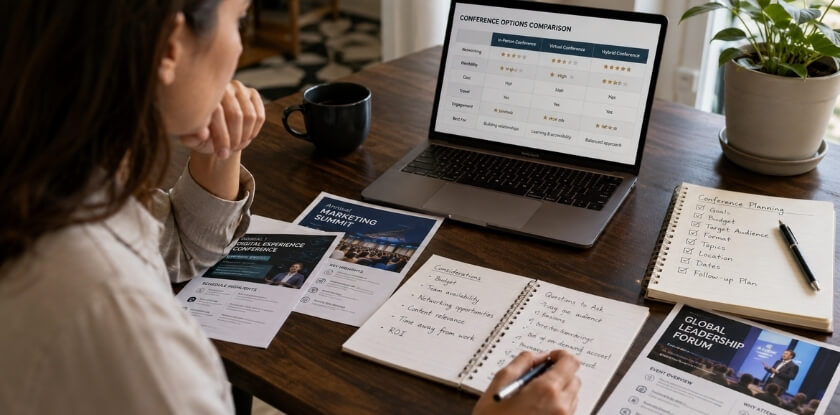
To choose the right type, start with the main goal of the event. What you want to say, who needs to hear it, and what you expect them to do afterward point to the format.
Define the Main Goal
Your goal should guide the type. For urgent public news, a press conference is usually the best choice. To report performance to shareholders, an AGM is more suitable. To introduce a new product or service, a product launch fits better. To present research, choose an academic conference.
Ask yourself:
- Do we need media coverage?
- Do shareholders need formal updates?
- Are we introducing something new to the market?
- Are we presenting research to peers?
- Is the event mainly for communication, governance, promotion or knowledge sharing?
Identify the Target Audience
The audience should match the format. A press conference is built for journalists, an AGM for shareholders, directors, investors and advisors, a product launch for customers, influencers, media, sales teams and partners, and an academic conference for researchers and practitioners. Even a well-planned conference may fail if the right people are not in the room.
Match the Format to the Message
A serious public update should be clear and controlled. A shareholder meeting should be structured and compliant. A product launch should be engaging and easy to understand. A research conference should give presenters enough time and room for questions.
Consider Timing, Location, and Delivery Mode
Timing, delivery and venue matter too, since convention hotels and conference centers suit different kinds of events. See the in-person, virtual and hybrid comparison above before you decide where the event runs.
Review the Expected Outcome
Define what success should look like before you finalize the type. It helps you plan the agenda, speakers, messaging and follow-up.
| Goal | Best Conference Type |
| Present and discuss new research | Academic conference |
| Gain media coverage for an announcement | Press conference |
| Answer questions about a public issue | Press conference |
| Present annual results to shareholders | AGM |
| Allow voting on company matters | AGM |
| Introduce a new product to the market | Product launch |
| Create customer interest and early demand | Product launch |
| Meet industry peers and buyers | Industry conference or trade show |
Benefits of Attending the Right Conference
Attending the right conference can improve your knowledge, network, visibility and understanding of your industry or organization. The value depends on how well the event matches your goals and role.

Better Knowledge and Industry Awareness
A relevant conference lets you learn from speakers, panels, reports, demonstrations and discussions. You hear about current trends, new challenges and market changes that may affect your work. A product launch helps customers understand a new solution, while an AGM helps shareholders understand company performance and direction.
Stronger Networking Opportunities
Conferences put people with shared interests in the same space, which makes it easier to meet professionals, investors, journalists, partners, customers or decision-makers. Good networking can lead to:
- New business conversations
- Professional relationships
- Media or partnership opportunities
- Career development
- Better understanding of stakeholder needs
Connections are more useful when the audience at the event matches your purpose.
Improved Professional Visibility
Asking thoughtful questions, joining discussions, speaking on a panel or representing your organization helps others recognize your expertise. Visibility matters most at industry events, product launches and public communication settings, where a clear message builds trust.
Access to Useful Resources and Insights
Many events give access to reports, presentations, tools, demonstrations or expert opinions. A launch may give a first look at a new tool, an AGM may provide detailed company reports, and a press conference may give media teams official statements.
Better Understanding of Direction and Priorities
The right event shows where an organization, industry or market is heading: future plans, public concerns, customer expectations or investment priorities. That makes conferences useful for planning as well as information.
Tips to Make the Most of Any Conference
To make the most of a conference, prepare before it, take part during it, and follow up afterward. Attend with a clear purpose instead of treating it as a passive event.
Set Clear Goals Before Attending
Decide what you want: to learn a topic, meet specific people, understand a company update or explore a product. Clear goals help you choose sessions, ask better questions and skip activities that do not match your purpose. If the main goal is one practical skill, training may suit you better than a conference.
Review the Agenda in Advance
Check the schedule, speakers and announcements so you know where to spend your time. For an AGM, read the reports or voting items beforehand. For a product launch, look at the product details or teasers. For a press conference, learn the background of the announcement so you can follow the message.
Take Part in Relevant Discussions
Ask thoughtful questions, join discussions when appropriate, and listen closely. Interaction is often built into the format, such as shareholder questions at an AGM, media questions at a press conference, or demonstrations at a launch.
Build Meaningful Connections
Do not try to meet as many people as possible. Connect with people relevant to your goals, such as journalists, shareholders, customers, partners or speakers. A short, focused conversation with the right person is worth more than many casual introductions.
Take Notes and Save Key Details
Write down key points, names, product details, decisions and follow-up tasks. Good notes help when you report to your team, compare event value or make decisions later.
Follow Up After the Event
The value of a conference often depends on what you do afterward. Send follow-up messages, review your notes, share insights with your team and act on the most important ideas. You may contact a new connection, review AGM decisions, test a launched product or plan your next business step.
Common Mistakes to Avoid When Choosing a Conference Type
The basic mistake is choosing a format before defining the goal, audience and expected outcome. Using the wrong one weakens the message and reduces the value of the event.
Choosing a Format Without a Clear Goal
Without a clear purpose, the event feels unfocused and attendees may leave without understanding the main message. Write the goal in one sentence first, then pick the type.
Inviting the Wrong Audience
Inviting journalists to a meeting meant only for shareholder voting creates confusion. Inviting only internal stakeholders to a product launch limits public reach. Before sending invitations, decide who needs the information and who can help achieve the goal.
Ignoring Timing and Event Context
A press conference should happen while the news is still relevant. An AGM should follow proper reporting and governance timelines. Poor timing can reduce attendance, media interest or audience response.
Skipping Follow-Up Communication
A conference should not end when the session closes. Depending on the type, follow-up may include:
- A media release after a press conference
- Meeting minutes or voting results after an AGM
- Product details, demos or purchase links after a launch
- Slides, a thank-you note or a contact list after an academic event
Treating All Types the Same
Each type needs its own tone, agenda and success measure. A press conference should focus on clarity and media questions, an AGM on formal reporting and shareholder participation, a product launch on product value and audience response, and an academic conference on the quality of the research and discussion.
From our experience at MS International: our conferences are in-person events in the Greater Toronto Area. Presenting authors submit their work, it goes through double-blind review, and they register after acceptance. Attendees who are not presenting can register as listeners. Accepted papers may be considered for conference proceedings where applicable.
FAQs About the Three Types of Conferences
Telling a press conference from an annual general meeting or a product launch matters when you need to announce news, report to shareholders or present something new.
What are the three types of conferences?
There is no fixed set, but a purpose-based answer is academic, business or trade, and press. Other sources use in-person, virtual and hybrid formats instead, so check which grouping a page or organizer means.
Is there an official list of the three types of conferences?
No. No standards body defines three official types. Guides group conferences by purpose, scale or format, so the label depends on the source and the field you are working in.
What is the main objective of a press conference?
The main objective of a press conference is to deliver one clear, official message to journalists and, through them, the public. A question period then lets reporters clarify it. Organizations use it for announcements, urgent updates and crisis responses.
Why are annual general meetings important?
AGMs give shareholders a formal way to hold company leaders accountable. Shareholders review performance, ask questions and vote on selected matters, and leaders explain future direction.
What makes a product launch useful?
A product launch introduces a new offering to the right audience. It helps a company explain value, attract media interest and create early market awareness.
Can a conference have more than one purpose?
Yes, but one goal should stay primary. A product launch may include media communication, yet its main purpose is still to promote a new offering.
Which type is best for public announcements?
A press conference is usually best for public announcements. It lets an organization deliver a clear message, answer media questions and reach a wider audience through news coverage.
Which type is best for shareholder communication?
An annual general meeting is best for shareholder communication. It covers company updates, financial reporting, governance matters, voting and direct interaction between leadership and shareholders.
Which type is best for introducing a new product?
A product launch is best for introducing a new product, service, feature or brand offering. It gives a company a focused setting to demonstrate value and support marketing or sales goals.
How do I decide which conference type to attend or organize?
Choose by goal: a press conference for public communication, an AGM for shareholder matters, a product launch for market introduction, an academic conference for research. Then weigh audience, message, timing, format and expected outcome.
Are in-person, virtual and hybrid also types of conferences?
Yes, some guides name them as the three main types. Orvium (2022) does so for academic conferences. They describe how an event is delivered, not its purpose, so any academic, business or press event can use any of them.
Conclusion
The label depends on who is using it, so check what an organizer means before you register or plan. Pick the purpose first, then the audience, then the format. If you are still unsure, start with the goal table above and match it to your own situation.
Disclaimer: This guide gives general information and is not legal advice. Company law and meeting rules vary by jurisdiction and by a company’s own bylaws.