
The refusal arrives after the fees are paid, the flight is booked and the organiser is expecting you. Panic is normal, but the order in which you act now decides how much you can save. This page walks through those first moves.
Quick answer: After a conference visa refusal, read the refusal letter first, because the stated reason decides every next step. Tell the conference organiser the same week and ask about online presentation and refunds. US 214(b) refusals and Canadian visitor visa refusals have no formal appeal, so reapply only with new evidence. Schengen refusals can be appealed, but the deadline is short and set by each country.
Fact-checked by the MS International Editorial Team. Last verified against official sources: October 2026.
A refusal feels final when you have already paid the registration fee, booked a flight and sent your abstract. It usually is not. It is a decision on one application, and much of the money and the chance to present can still be saved if you act in the right order.
This guide covers the first steps only: what the letter means, whether to appeal or reapply, how to recover costs, and how to stay on the programme. Why applications get refused, and how to build the second application in full, are separate topics with their own guides on this site.
First 5 Things to Do After a Conference Visa Refusal
Read the letter, write to the organiser, check your insurance, start the cancellations, and decide between appeal and reapplication. Do all five in the first few days, because refund windows and appeal deadlines run from the date of the refusal.
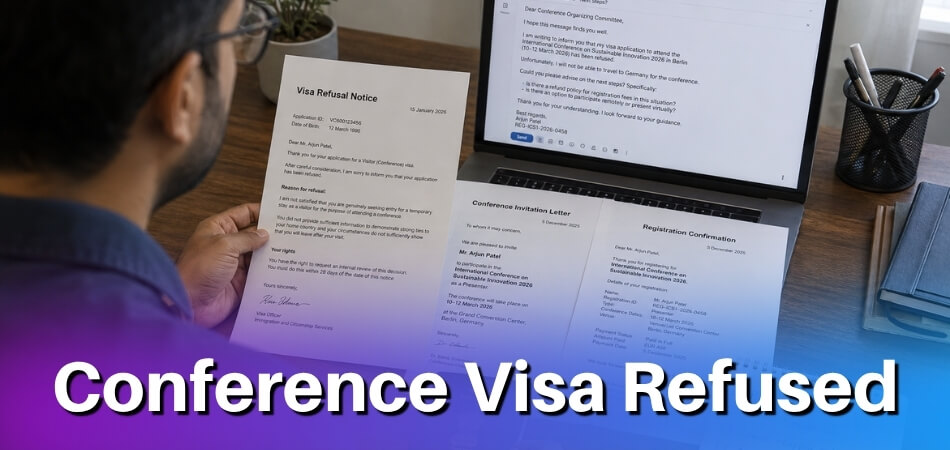
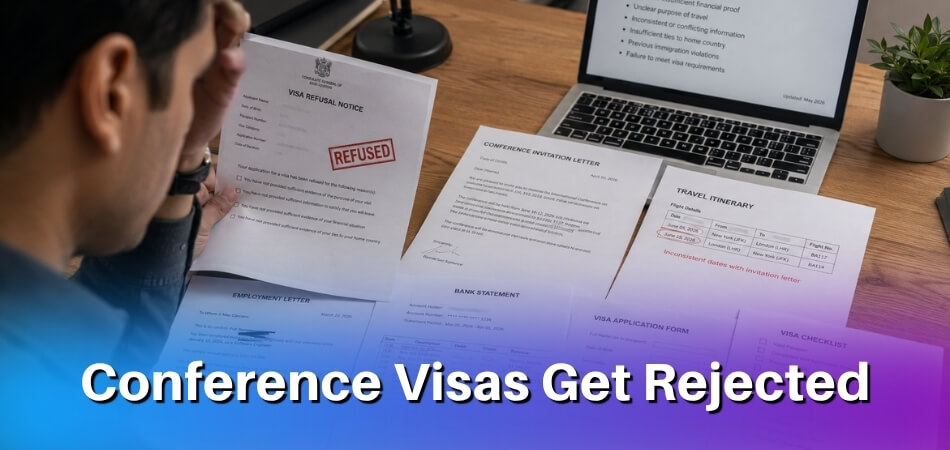
1. Read the Refusal Reason Word for Word
Do not skim it. A US refusal under section 214(b) of the Immigration and Nationality Act (INA) means the officer was not convinced that you would return home after the conference. A Schengen refusal comes on a standard form with ticked boxes, and each box is a separate reason. Letters from Immigration, Refugees and Citizenship Canada (IRCC) are shorter and usually say the officer was not satisfied that you would leave Canada at the end of your stay.
These need different fixes. A 214(b) refusal calls for proof of home ties, while a Schengen box about missing funds calls for better bank evidence. Find out which one you have before you do anything else.
2. Write to the Conference Organiser
Email the conference chair or organising committee the same day. Say the visa was refused and ask two things: can you present online or in a hybrid slot, and is there any flexibility on the registration fee. Attach the refusal letter if they ask for it. Keep the email short and professional, since they have almost certainly handled this before.
Many conferences now have virtual presentation tracks. Some convert your slot automatically, others need a request. Ask early, because after two weeks both answers get harder.
From our experience at MS International: Our registration fees are non-refundable, and our refund policy says a visa refusal does not create a right to a refund, so read the terms of any conference before you pay. A refusal also does not cancel a registration automatically. Our events are held in person in the Greater Toronto Area. An invitation letter supports an application, but it does not guarantee approval, and no organiser can change a consular decision.
3. Check Your Travel Insurance
Pull out the policy and read the trip cancellation section and the list of exclusions. Coverage varies a great deal. Some policies reimburse non-refundable costs when a visa is refused through no fault of your own, while others exclude visa refusal entirely or require that you bought the policy before applying.
If you bought the policy after you already suspected a problem, or after the refusal, expect it to be denied. File while everything is documented.
4. Start the Flight and Hotel Cancellations
Check the fare rules now. Most international fares have a narrow refund window, and a visa refusal does not guarantee a refund. Some airlines list it as a refund condition in their conditions of carriage, and many low-cost carriers do not.
Call the airline rather than cancelling online, explain the situation and ask for a refund, not only a credit. If you booked through a third-party site, contact them as well, because they sometimes have separate policies. Hotels are usually simpler but just as time-sensitive.
5. Decide Whether to Appeal or Reapply
That depends on the country and the reason, and the next sections set it out. In short, the US and Canada have no formal appeal for a visitor visa, and Schengen countries do.
If a US case is under administrative processing, it is not a final denial. Do not rebook travel yet, and ask the embassy for an update if you hear nothing for a long time. Act fast and keep copies of everything. Refund windows close, appeal deadlines pass and organisers fill empty slots.
How to Read Your Visa Refusal Letter and Understand the Reason
The letter tells you the legal ground for the refusal and, sometimes, what you can do next. Read it twice, because its exact wording decides whether you appeal, reapply or wait.
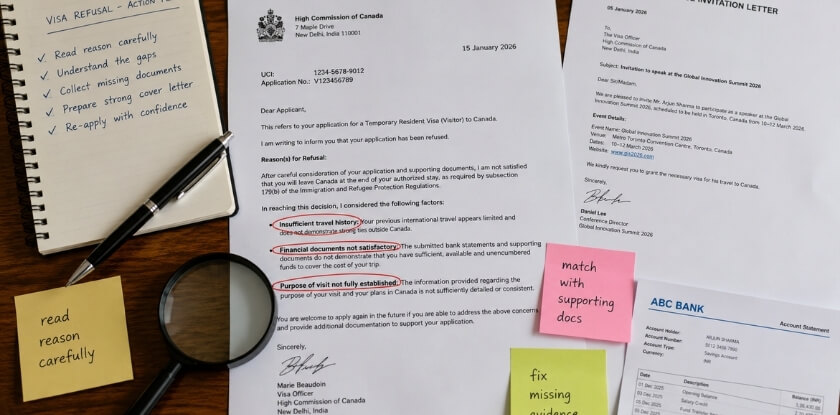
The Parts That Matter
The legal basis. US letters cite a section of the INA, often only “214(b)”. Schengen letters use the standard form based on the Visa Code (Regulation (EC) No 810/2009).
The ticked boxes. Several ticked boxes on a Schengen form mean the officer had several concerns, and your next application must answer all of them, not only the easiest one.
What is missing. US letters are deliberately brief, sometimes three lines. A short letter does not mean a weak refusal, and officers are not required to explain in detail. Do not read the brevity as encouragement.
Instructions for next steps. Look for any mention of appeal rights, deadlines or the authority to write to. For Schengen refusals the form must tell you this.
Keep the original letter safe. Future applications ask whether you have ever been refused, and you may be asked to show it. If you have lost a US refusal letter, you can still recover the refusal details.
Common Refusal Grounds and What They Point To
214(b) INA, the most common US refusal. Every nonimmigrant visa applicant is presumed to intend to stay until they show otherwise, and a 214(b) refusal means the officer was not persuaded. Typical triggers are thin employment or financial ties, a short work history, no dependants, or a prior overstay. For academics there is an irony: a strong international career can make an officer wonder about your plans. The fix is evidence of what is waiting for you at home, such as an employer letter, ongoing academic duties, a lease or mortgage and family documents.
Schengen refusal wording. These are the reasons that come up most often for conference travellers, paraphrased from the standard form:
- Purpose and conditions of the stay not provided. The invitation letter was missing or vague, or left out the dates, your role or the organiser’s contact details. A letter from the chair on letterhead is what is needed here, not a registration email.
- No proof of sufficient means of subsistence. Bank statements were missing or covered too short a period, or no funding letter covered the trip.
- Justification for the purpose of stay not reliable. The officer doubted the stated reason, often because conference documents looked informal or your role was unclear.
- Intention to leave before the visa expires could not be ascertained. Same concern as 214(b): home ties were not convincing.
Canadian refusals. Common grounds are insufficient funds, weak ties and doubts that the visit is temporary. The next section on Canada covers how to get the officer’s notes.
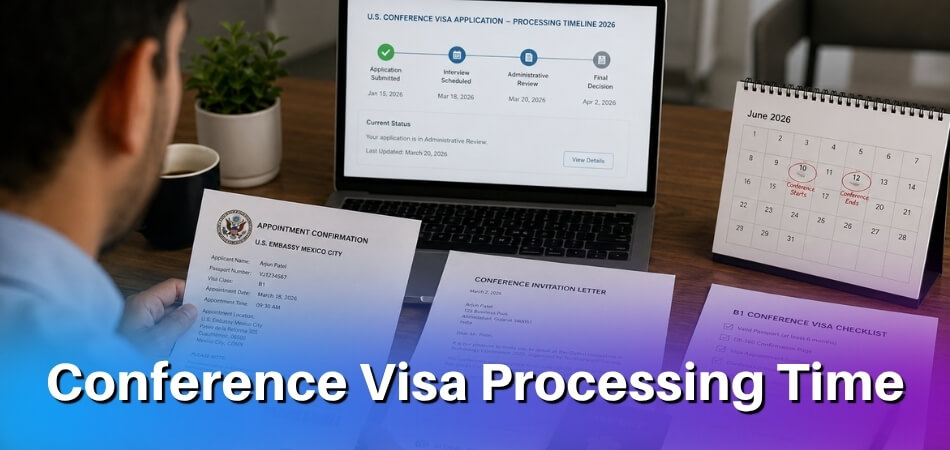
Administrative processing. If a US officer told you the case needs further review, that is usually a 221(g) outcome, which is not a final denial. It is often security-related. Wait for the result and check the status on the CEAC portal before taking other action.
Should You Appeal or Reapply After a Visa Refusal?
Your route depends on where you applied. The table below shows the realistic option for each destination, and the Schengen row matters most if you want to appeal, because the clock starts the day you receive the form.
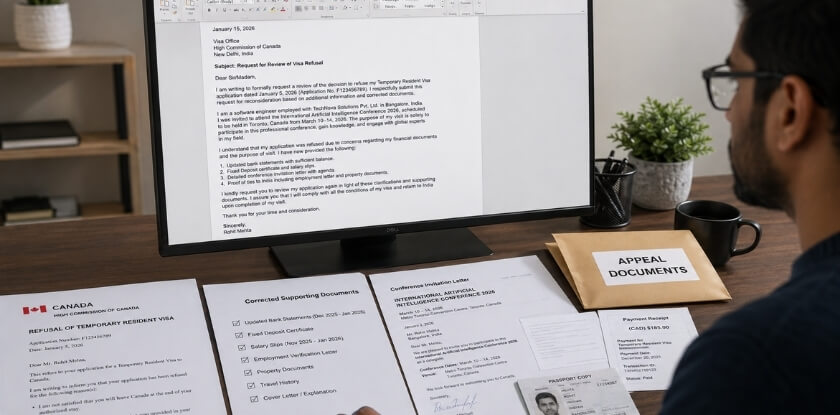
| Destination | Formal appeal? | Realistic route |
|---|---|---|
| United States (B-1/B-2, 214(b)) | No. A supervisor can only correct a clear error. | New application, new fee, new evidence or changed circumstances |
| Schengen countries | Yes. Authority and deadline are stated on the refusal form and differ by country. | Appeal only if there was a clear error; otherwise a stronger new application |
| Canada (visitor visa) | No appeal. Federal Court judicial review checks the process, not the merits. | New application when your situation has changed or you have new information |
When an Appeal Is Possible
United States. The State Department says a 214(b) refusal cannot be appealed. You can ask a supervisor to look at it, but that rarely changes anything unless there was a clear procedural error. You can reapply if there is new information or a significant change in your circumstances, and you pay the application fee again, except after a 221(g) refusal, where you send the documents the embassy asks for instead of applying again. Reapplying with the same papers rarely changes the result.
Schengen. The right to appeal comes from the Visa Code, but each member state sets the procedure and the time limit, and the refusal form must name the authority. Some limits are very short, for example 15 days in the Czech Republic, so do not assume 30 or 60 days. File the appeal with the authority named on the form, which may not be the country you wanted to visit if another state handled your application. The visa fee is not refunded after a refusal. An appeal must address the stated ground and cannot rely on documents you did not submit originally. For a conference that is weeks away, a corrected new application is usually faster than an appeal.
Canada. IRCC states that there is no formal appeal for temporary residence decisions. Judicial review at the Federal Court is for unfair or unreasonable decisions. It has short deadlines, it is slow and it is costly, so it rarely suits a conference trip. If you think the officer missed a document you submitted, you can write to the visa office with the evidence. Keep it short, stay factual and do not argue. IRCC also says that hiring a consultant or agent does not increase the chance of approval.
What to Fix Before Reapplying
Never resubmit the same file. IRCC itself warns that applying again with the same information will likely give the same result.
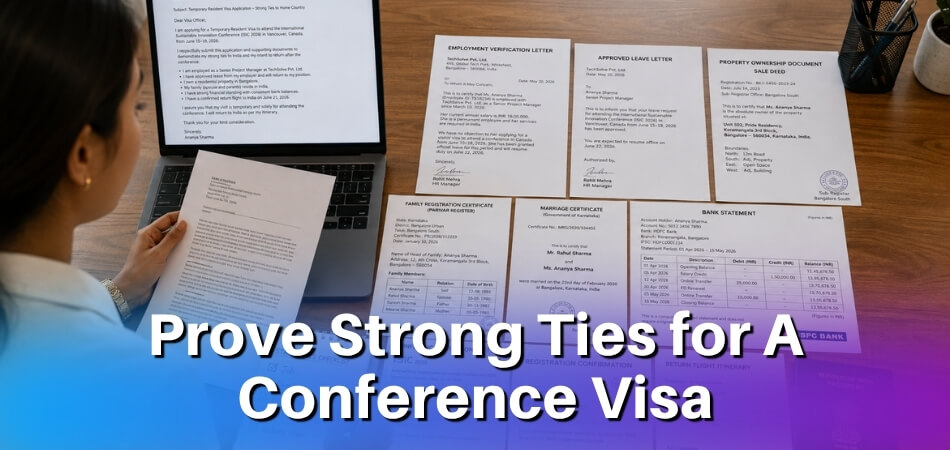
Match each fix to the stated reason. Weak ties need an employer letter confirming your return date, proof of ongoing duties, and property, family documents, funded projects or teaching duties after the conference. A weak invitation needs a reissued letter on letterhead with your role, paper title and the dates. Weak funds need three to six months of statements and a sponsor or institution letter. PhD students should add a supervisor letter confirming their status and expected return date. Do not reapply while a US case is in administrative processing. Wait for the formal outcome first.
How Long Should You Wait?
There is no single number, because it depends on what changed.
- US: wait until something real has changed, such as a new job, a finished degree, property or dependants. Without a change, a few weeks gives the same result. Three to six months is a common rule of thumb, not an official period.
- Schengen: you can reapply at once. Quick fixes like a missing insurance document justify a fast new application, while funding or purpose problems need more time to fix.
- Canada: there is no mandatory waiting period. A month or two to rebuild the file is realistic. Check IRCC’s current processing times before you plan the dates.
Compare all of this with the conference date and the embassy’s appointment wait. If the event is six weeks away and the appointment queue is five weeks, a reapplication will not arrive in time. Arrange an online presentation in parallel and aim the reapplication at a later event. Use the waiting time to chase the refund, the insurance claim and the airline as well.
Tips for Building a Stronger Second Application
A second application should answer the exact reason for the first refusal with dated, official documents, not general reassurance. This section gives the short version, and the dedicated guide on how to reapply after a conference visa rejection has the full process.
Match the fix to the real category in the letter, not to a general pile of extra paperwork. Mention the earlier refusal in your cover letter and say what has changed.
Documents Applicants Often Forget
- Bank statements for at least three months, not just a balance letter
- A letter from your institution confirming your post, your return date and that your salary continues during the trip
- Proof that your paper was accepted, which is different from a registration confirmation
- Return flight or firm travel plans, preferably refundable
- Travel history, especially stamps showing you returned from earlier trips
Early-career researchers without a permanent post should ask a supervisor or department head for a letter describing their role, their ongoing duties and when they are expected back. A bare statement like “I am a researcher” with no institutional backing is a red flag.
A Proper Invitation Letter
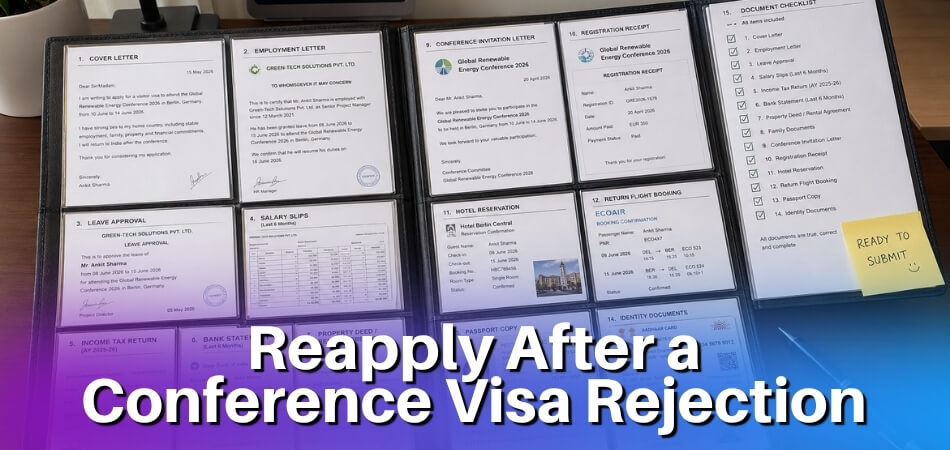
A registration email is not an invitation letter, and sending one can sink an otherwise decent file. A real letter comes from a named person, on letterhead and signed. It should show:
- Your full name as on your passport
- The conference name, dates and venue address
- A statement that you were accepted to present, with the paper title
- The signer’s name, title and contact details
- Whether the conference covers any of your costs, such as a fee waiver or accommodation
Officers sometimes check, so a letter signed by a named chair with an institutional email carries more weight than an automated PDF. The letter and your financial documents must tell the same story. If your funding comes from a grant or your institution, say so in the cover letter and attach the matching proof.
What to Ask the Organiser For
Be specific. Reasonable requests are a reissued invitation letter, a letter confirming your presentation slot and session, a letter confirming the fee you paid (useful for insurance and refunds), and an extension of the registration or abstract deadline if the visa delay pushes you past it. Organisers usually agree to the last one for visa delays.
If you are stuck in administrative processing, tell the chair. They may hold your slot, arrange a remote talk or move your paper to a later cycle. Get every agreement in writing and follow up verbally agreed holds with an email, since you may need the correspondence for the reapplication or an insurance claim.
What Are the Steps After a Canada Visa Refusal?
There is no appeal for a Canadian visitor visa refusal, so the steps are to learn the reason, fix it and apply again. A short refusal letter is normal, so the officer notes are often the most useful document you can get.
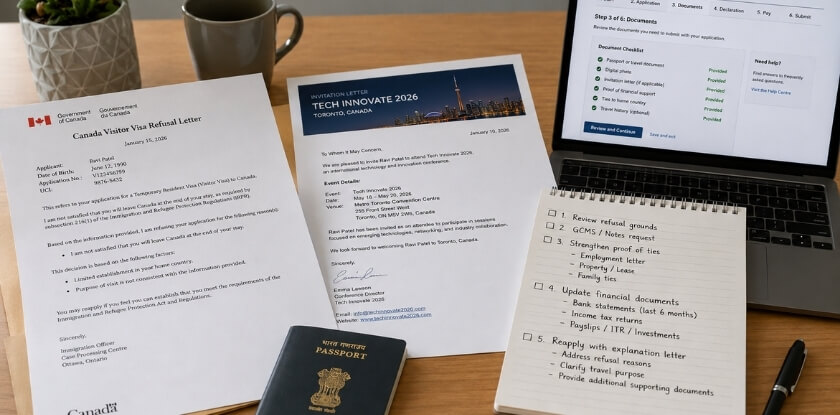
Get the Officer’s Notes
IRCC now includes officer decision notes with some refusals, so check your letter first. The full case notes (called GCMS notes) can be requested through IRCC’s access to information and privacy process. They can explain the refusal in far more detail than the letter does. Eligibility, fees and processing times depend on where you live and have changed over time, so read IRCC’s current instructions before filing. Do it early if you plan to apply for a later conference.
What Officers Look For
The officer decides whether you are a genuine temporary visitor. Researchers are often flagged for:
- No permanent employment contract, common for postdocs and visiting fellows
- A low or inconsistent bank balance
- Thin proof of the conference itself, since a registration email is not enough
- First travel to Canada with little international travel history
- Home ties that look weak on paper
The invitation letter should ideally say that in-person attendance is expected.
Rebuild the Application
Answer the officer’s concern directly, as set out under “What to Fix Before Reapplying” above. A cover letter is optional, but it is your one chance to explain in your own words. Keep it factual, mention the earlier refusal, and present the new evidence without arguing with the old decision. Check IRCC’s posted processing times before you submit, because they change. If your last country of residence is Uganda, the Democratic Republic of the Congo or South Sudan, IRCC is currently processing applications but not finalizing them under temporary measures set to run to 27 November 2026, so a long wait there is not a refusal.
How to Recover Registration Fees and Travel Costs After a Refusal
You can often recover part of your costs if you write quickly and give the organiser, airline and insurer a copy of the refusal letter. Check three sources in this order: the conference refund policy, your fare conditions, and your insurance.
Conference Registration Fee
Most conferences keep a refund policy in the registration terms. Windows vary: some give a full refund 60 or 90 days out, others a partial refund up to 30 days, and some small workshops allow none.
A refusal is a reasonable ground to ask for an exception even when the policy says no. Some policies refund visa refusals only if you applied for the visa before a set date, so keep the application receipt and the appointment confirmation. Write to the organiser and include:
- Your registration confirmation number
- The date of the refusal and the country that refused you
- A line saying you cannot attend in person
- A request for either a refund or a switch to online attendance
Many conferences offer a credit toward next year instead of cash, which is worth accepting if you plan to reapply, as long as you get it in writing. Conferences run by professional societies often have a written exception process for visa problems, so ask the organiser. If you paid by card, a chargeback is a last resort, because it can damage the relationship with the organiser.
Flights and Travel Insurance
Refundable ticket: cancel it now. Non-refundable ticket: call the airline directly and ask about a refund, a voucher or waived change fees.
Travel insurance can cover the most, but only if the policy lists visa denial or a similar term, such as travel document refusal, and you bought it before the problem arose. If it does not name visa denial, ask whether it covers unforeseen circumstances that prevent travel, because some adjusters accept a refusal under that heading. A claim normally needs:
- The original refusal letter
- Flight and hotel confirmations and receipts
- Your conference registration receipt
- Your invitation letter or acceptance email, as proof you were expected
- The insurer’s completed claim form
Submit everything at once, because incomplete claims are delayed or denied, and reply to follow-up requests within the insurer’s stated time. For future trips, buy insurance when you register, before you apply for the visa. If your university books travel centrally, tell the travel office, because it may have a group policy that already covers this.
Can You Still Get a Visa for Another Country After a Refusal?
Yes. A refusal from one country does not bar you from another, but you must declare it honestly wherever the form asks, and Schengen states can see each other’s refusals.
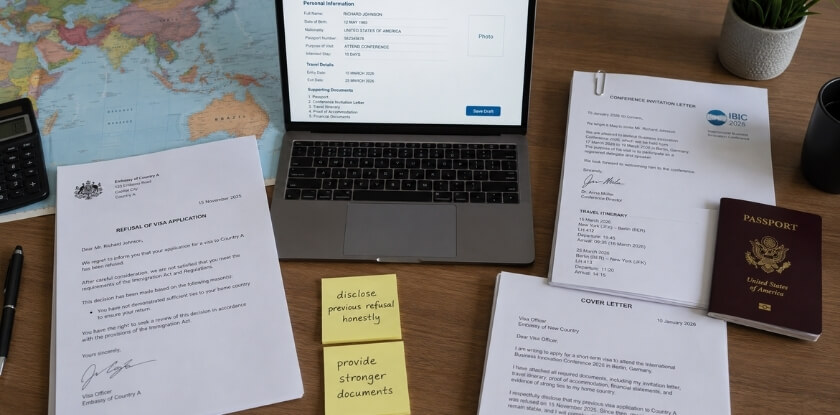
Does a Refusal Follow You?
Many visa forms ask whether you were ever refused a visa, including those for the US, Canada, the UK, Australia and Schengen states. Answer truthfully. A false answer can lead to rejection or a ban, which is far worse than the first refusal.
A truthful “yes” does not disqualify you, because each application is judged on its own merits. A 214(b) refusal does not blacklist you for Germany or France, and a Canadian refusal does not appear in the US system.
Schengen Refusals and Other Schengen Countries
Schengen refusals are recorded in the Visa Information System (VIS), which all Schengen consulates can access. If one state refused you, another will see it. Applying to a second state for the same trip and dates looks like an attempt to get around the first decision and usually fails.
If your documents are genuinely stronger, with better proof of funds and home ties, apply to the state that is your main destination and explain what has changed.
Another Country or Another Edition
If your US visa was refused, you cannot move a Chicago conference elsewhere. But if the event has a hybrid option or a satellite event in another country, that may work. Many large conferences rotate locations, and a refusal for this year’s US event does not affect next year’s event in, say, Amsterdam or Toronto. Apply early and disclose the earlier refusal.
Some researchers find a Canadian, Japanese, Korean or other European visa easier after a US or UK refusal, especially with a strong institutional link, a publication record and clear finances. The test is always the same: can you show that you will leave on time? An invitation from the organising institution and a letter from your department head count in any country.
What to Tell the New Consulate
State the refusal, give the reason as written in the letter, and say briefly what has changed. Do not argue that the earlier decision was unfair, because officers will not relitigate another country’s ruling. If an earlier US case was stuck in administrative processing, say so, since that is a pending status and most forms ask about refusals only.
One refusal is not a permanent mark. Plenty of researchers with a past Schengen or Canadian refusal later attend conferences in many countries. What matters is honest disclosure, better documents and enough lead time.
Can a Visa Be Refused for Political or Policy Reasons?
Yes. Some refusals have little to do with your documents, because nationality, country-level policy and extra security checks can all affect the outcome. Knowing this will not reverse the decision, but it tells you where to spend your effort.
Officers do not put policy reasons in a letter. The 214(b) presumption applies to everyone, and in practice it can be harder to overcome for nationals of some countries. A strong invitation letter, proof of affiliation and a return flight still may not be enough.
Rules also change. As of October 2026, two US measures affect some conference travellers:
- Visa bond: a permanent programme from 3 August 2026 for listed countries, including Nigeria, with bonds of $10,000, $15,000 or $20,000 paid through Pay.gov with Form I-352.
- Presidential Proclamation 10998: partly suspends B-1/B-2 issuance for nationals of 19 countries, including Nigeria, since 1 January 2026.
Interview waivers were also narrowed in 2025. Check the State Department’s current country list before you pay for anything.
Administrative Processing
Reasons for administrative processing include security checks, travel history, nationality or field of research, and researchers in sensitive technical fields are sometimes checked more closely. There is no document that speeds it up and no fixed time: it can take weeks or months. The State Department’s general guidance is to wait at least 180 days from the interview or your last document submission before asking for a status update, except in an emergency, and some embassy pages give a shorter period, so check yours. If the conference date passes first, the visa may be approved too late to use.
When Your Field or Institution Is Flagged
Where you work can matter. Applicants linked to institutions that destination countries treat as sensitive may get closer scrutiny, whatever their personal intent. You cannot change your employer, but you can describe your research, your department’s civilian academic focus and your paper’s subject clearly in the supporting documents. That reduces ambiguity, though it will not remove it.
What Helps in These Cases
When a refusal is policy-driven, better bank statements will not fix it. Talk to the chair, not only the organiser’s admin: chairs often have room for a remote talk, a co-presenter or a special session. If you got no written reason, ask for the formal decision, since Schengen refusals must come in writing and you need it for insurance.
Can You Still Present Online After a Visa Refusal?
Yes, you can usually still take part: most conferences will offer a live online talk, a pre-recorded video or a poster equivalent if you ask early. Do not go quiet after a refusal, because organisers can only help while your slot is open.

Ask What Is Possible
Keep the first email simple. Give your name, paper title and session reference, say that the visa was refused, and ask whether a live online, hybrid or pre-recorded slot is available. Add your availability across the conference dates and attach your acceptance letter. If the event is fully in-person, ask whether someone on site can play a video you record. Some conferences reduce or waive fees for remote presenters who could not travel for visa reasons, so ask about that too.
Not every conference allows a remote talk. Some ask for proof that you applied for the visa in good time, and some do not offer remote presentation at all, so keep your application receipt and appointment confirmation as proof that you tried to attend.
Live Hybrid Sessions
Hybrid formats vary. Some are interactive, with live questions and a chair managing the room, while others are only a video feed. Ask which model they use and whether you need an account on a special event platform, which sometimes requires registration days before the event.
Check the time zone. A 9am Eastern US slot is 7pm in Dhaka in October, and the gap can be far worse for other cities.
Pre-Recorded Talks
If the time difference or your connection is a problem, record in advance. Organisers commonly accept an MP4 of the standard slot length, often 15 to 20 minutes, but confirm the format and length with them. Use a quiet room, normal slides and your usual pace. Built-in tools such as Clipchamp on Windows or iMovie on Mac are enough. Send the file a few days early so the AV team can test it, and put an email address on the last slide for questions.
Networking and Your CV
Ask for access to the attendee app or chat channels, post your abstract and share your slides afterwards. If a co-author attends in person, brief them to speak for the paper in the breaks and pass on your contact details.
List the talk as “virtual” or “remote” on your CV. Reviewers rarely penalise it, and a mismatch with the printed programme looks worse. A visa refusal is a bureaucratic problem, not a judgement on your research.
FAQ
A refusal raises money and people questions as well as legal ones: getting the registration fee back, what happens to the flight booking, telling the conference chair and whether a Schengen appeal is worth it.
Will I be refused again if I reapply?
Not automatically, but officers can see the earlier refusal. Address the original reason with new evidence, such as employer letters, property or family documents. A reapplication that looks identical to the refused one will probably fail again.
How long should I wait before reapplying?
It depends on the reason. For the US, wait until something has actually changed. Schengen and Canada have no mandatory waiting period, but reapplying without fixing the problem wastes the fee.
Can I get my conference registration fee back after a visa refusal?
Sometimes, and it depends on the conference. Many give a refund, deferral or credit if you ask promptly with the refusal letter, but MS International registration fees are non-refundable. Read the cancellation policy first. Insurance may cover the rest if it includes visa denial.
What happens to my flight booking if I am refused?
A visa refusal is not a free cancellation reason on most standard fares. Check the fare conditions, call the airline, and ask for a refund, voucher or fee waiver. Insurance that covers visa denial is often the best route to recover the cost.
Should I tell the conference chair my visa was refused?
Yes, at once. It opens the door to an online presentation, a deferral or a reissued invitation letter for your next application. Most chairs would rather have a remote talk than lose your paper.
Does a US refusal affect a Schengen application?
Not legally, since each country decides for itself. Forms often ask about previous refusals, though, and you must answer honestly. Add a short, factual explanation of what has changed.
What is administrative processing, and how long does it take?
It is a temporary hold on a US application while extra checks are done, not a final denial. There is no fixed time. The State Department advises waiting at least 180 days before asking for an update, so ask the organiser about a remote talk early.
Is it worth appealing a Schengen visa refusal?
It is worth appealing when the officer clearly made an error, such as overlooking a document you submitted. Otherwise a stronger new application is usually faster. Read the form the day it arrives, because some appeal windows are only days long.
What if the refusal was for political or policy reasons?
Extra paperwork may not change it. Ask the chair about a remote talk, look for another edition or location, and check current rules such as the 2026 US visa bond and country restrictions on travel.state.gov.
Can my university help if my visa is refused?
Yes. International offices can advise on documents and write institutional support letters. A letter from your department head to the conference chair or the embassy can also help.
Conclusion: A Refusal Is a Setback, Not the End
A refusal is a decision about one application at one point in time. It is not a verdict on your career or your future travel.
Read the letter, tell the organiser the same week, and reapply only when you have new evidence that answers the stated reason. If the conference passes before you can travel, a well-prepared remote talk keeps your paper in the programme.
Disclaimer: This article is general information, not legal or immigration advice. Visa rules, fees, and processing times change. Confirm the current requirements on the official travel.state.gov, canada.ca (IRCC) or Schengen member state government website before you apply.