
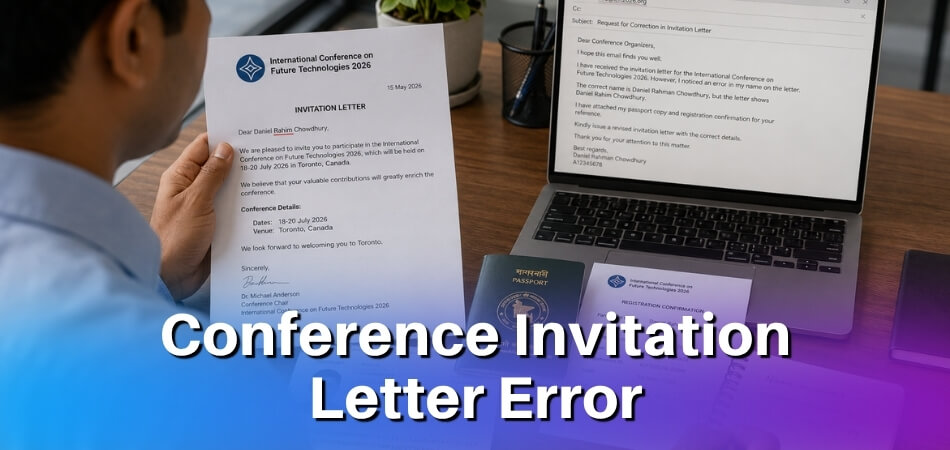
You just received your conference invitation letter, but the name is misspelled or the dates do not match your travel documents. If you plan to use that letter for a visa application, even a small discrepancy can give the embassy a reason to delay your request. Most errors are fixable, as long as you move quickly and know who to contact.
Quick answer: Contact the organizer as soon as you spot the error and ask for a corrected letter on official letterhead before you submit anything to the embassy. Name, date, venue, visa category and role errors matter most. Ask as early as you can, well before your visa appointment. If the corrected letter will be late, attach a short explanation letter instead of hoping nobody notices.
Fact-checked by the MS International Editorial Team. Last verified against official sources: October 2026.
This guide shows how to identify the type of error, which email to send, what to put in an explanation letter, and how to handle last-minute corrections without losing your visa appointment slot.
What Types of Errors Can Appear in a Conference Invitation Letter
The errors that matter most are the ones that touch your identity, the event details or your stated purpose of travel. Knowing what to look for helps you catch issues before they reach the embassy.
| Error type | Risk level | What to ask the organizer for |
|---|---|---|
| Name spelling | High | Name exactly as in your passport |
| Conference dates | High | Dates that match the official program and your bookings |
| Venue or city | Medium to high | Current venue and address |
| Visa category or purpose | High | Purpose stated as conference attendance, with your real role |
| Title, role or affiliation | Medium | Role and institution that match your other documents |
| Event code (only if the event is registered with IRCC) | Medium | The event code printed in the letter, which you also enter in your Canada visa application |
| Contact details | Medium | Working email and phone number for verification |
| Letterhead or signature | Low to medium | Current organization name and a signer who still holds the post |
Name Spelling Errors
This is the error an officer can check fastest, because the passport is right there. If your name in the letter differs from your passport, the embassy may notice, and even one transposed letter counts. The organizer may have copied your name from a registration form, an email signature or an abstract submission, and any of those can contain a variation.
Check every name field: your full legal name, any co-presenter names, and the name of the signing authority. Look beyond plain typos. Swapped given and family names, a missing middle name, dropped hyphens and accents, and a nickname used instead of your legal name are all common, and each can differ from the name printed in your passport.
Date Mismatches
The dates in the letter may not match the event website, or your intended travel dates may fall outside the window described. A visa officer comparing the letter with your flights and hotel will notice either way.
This matters most when the letter justifies your length of stay. A letter that says the conference runs three days while your application shows ten will need a clear explanation.
Venue or Location Errors
The wrong city, the wrong hotel or an outdated venue name can slip in, especially when an event moves after the first letters were drafted. If the address does not match what the embassy can verify independently, it raises unnecessary questions.
For a guest speaker, a venue error can also affect which visa category applies, since some countries distinguish event types by location or institution type.
Visa Category Errors
Some letters state the purpose of the visit and recommend a visa category. If the category is wrong, for example a tourist visa recommended when you should apply for a business or conference visa, the whole application may be built around the wrong criteria. This is less obvious than a typo but can do more damage. If you are unsure of the correct category, check with the embassy before submitting.
Here is how the wording typically needs to change:
| Wording in the letter | Better wording |
|---|---|
| Purpose: tourism | Purpose: to attend [Conference Name] as a delegate |
| Participant | Guest speaker presenting [session title] |
| Dates: 10 to 12 March | Dates exactly as in the official program, for example 12 to 14 March |
Title or Role Errors
The role matters because it tells the officer why you are travelling. If the letter calls you an “attendee” when you are a confirmed guest speaker, or lists the wrong institution, officers who cross-reference your role with your supporting documents will see a mismatch.
Missing or Incorrect Contact Information
A letter with no organizer contact details, or with an inactive phone number or email, is a problem if the embassy wants to verify the event. If nobody can be reached, it reflects poorly on the application whatever the conference’s legitimacy.
Outdated Letterhead or Signatures
Organizations rebrand, merge or change leadership. A letter on old letterhead, or signed by someone who no longer holds the stated position, can look irregular. It is a small detail, but confirm the letter reflects the organization’s current status.
First Steps to Take When You Spot an Error (Step-by-Step Action Plan)
Confirm the error against your passport, then write to the organizer the same day with the exact correction. A calm, specific response gets you a corrected letter faster than a panicked email chain.
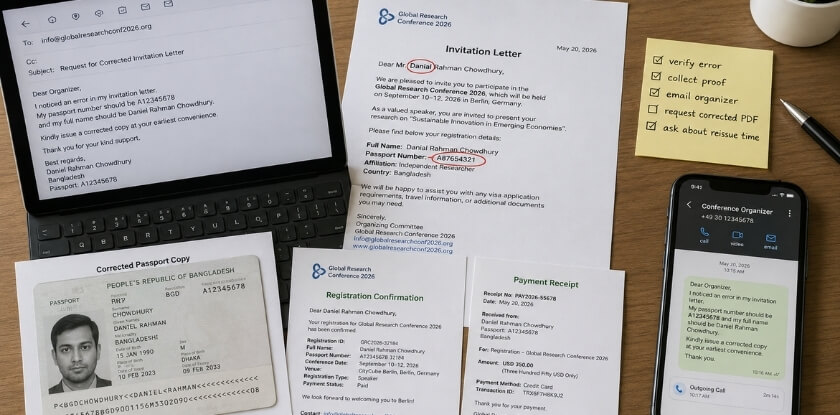
Step 1: Confirm the Error and Document It
Compare the letter directly against your passport, your visa application form and your conference registration confirmation. Check your full name, passport number (if included), the dates, the venue address and the visa category mentioned.
Keep the comparison simple: put the passport data page next to the letter and read the name, then the dates, then the venue, one field at a time. Then take a screenshot or scan of the original letter and save it. Note the exact field that is wrong and what it should say. You will need this for your request, and it removes any ambiguity.
Do not edit the PDF yourself. Only the organizer should issue a corrected letter. Altering a document, even to fix an obvious typo, can look like tampering. IRCC, for example, treats false or altered documents as misrepresentation, which is far more serious than the original typo.
Step 2: Notify the Organizer (When and How)
Contact the organizer as soon as you have confirmed the error. Do not wait to see whether the embassy notices.
For large conferences, write to the visa support coordinator or events manager rather than the general inbox. If you were invited as a guest speaker, go to whoever sent your original invitation. A short message naming the specific error is enough to start the process. Save the full details for your formal request.
Step 3: Send an Email Requesting a Corrected Letter
A formal written request creates a paper trail and gives the organizer everything in one place. Include:
- Your full name as it appears in your passport
- The error as it currently reads in the letter
- The correct information that should replace it
- Your visa application timeline or appointment date, if you have one
Attach proof so the organizer does not have to ask for it:
| Error | Attach |
|---|---|
| Name | Passport data page |
| Dates | Screenshot of the official program or event page |
| Venue | Official venue announcement or your registration confirmation |
| Role or visa purpose | Speaker confirmation, acceptance email or registration receipt |
Use the matching template in the next section. Keep the tone professional, and if the error is a visa category or venue mistake that changes how the embassy classifies your visit, say so briefly so the organizer understands the stakes.
For last-minute corrections, add “URGENT: Visa Appointment [Date]” to the subject line so the email does not sit unread in a busy inbox.
Email Template for Notifying the Organizer About an Error
Use the template that matches your error, and keep the same structure: state the problem, show the correct version, mention your visa deadline and ask for a corrected letter within a reasonable time. A vague message that something “seems off” slows everything down.
Name Spelling Error
Embassies match the name on your letter against your passport exactly, so this is the most urgent type to flag.
Subject: Request to Correct My Name in the Conference Invitation Letter
Dear [Organizer’s Name],
Thank you for sending through the invitation letter for [Conference Name]. I noticed that my name appears as “[Incorrect Spelling]” in the letter, but my passport reads “[Correct Spelling].” This discrepancy could create a complication with my visa application, so I wanted to flag it as soon as possible.
Could you issue a corrected letter with the accurate spelling at your earliest convenience? I am aiming to submit my visa documents by [your target submission date], so even a few days would make a difference.
Please let me know if you need any supporting documents from my end. I am happy to send a copy of my passport data page to confirm the correct spelling.
Thank you for your help.
[Your Full Name]
[Your Title / Institution]
[Your Contact Information]
Date Mismatch
Wrong dates can make the embassy question whether the invitation is genuine, so correct them before you submit any travel documents.
Subject: Date Correction Required: Conference Invitation Letter
Dear [Organizer’s Name],
I am writing about the invitation letter issued for [Conference Name]. The letter currently states the conference runs from [incorrect dates], but the official program shows [correct dates]. Since the visa application I am preparing will reference these dates, the wrong ones could create a conflict.
Would it be possible to send a corrected letter reflecting the accurate dates? I need to submit my application by [date], so a quick turnaround would be very helpful.
Thank you for sorting this out.
[Your Full Name]
[Your Title / Institution]
[Your Contact Information]
Venue Error
If the city or country in the letter is not where the conference is held, the embassy may question which country’s visa you need.
Subject: Venue Correction Needed: [Conference Name] Invitation Letter
Dear [Organizer’s Name],
The invitation letter I received for [Conference Name] lists the venue as [incorrect venue/city/country]. The correct location, as I understand it, is [correct venue/city/country]. Since I will be applying for a visa based on this letter, the venue detail needs to be accurate.
Could you reissue the letter with the correct venue information? I would appreciate receiving the corrected version by [date] if possible.
Thank you in advance.
[Your Full Name]
[Your Title / Institution]
[Your Contact Information]
Visa Category Error
If the letter lists the wrong purpose of travel, for example “tourism” instead of “conference attendance”, or the wrong designation for a guest speaker, this needs its own request. You may also need to attach a short explanation letter to your visa application.
Subject: Visa Category Error in Conference Invitation Letter: Correction Request
Dear [Organizer’s Name],
I wanted to bring to your attention an issue with the invitation letter for [Conference Name]. The letter currently describes my purpose of travel as [incorrect category/description], but based on my role as [your actual role, e.g., guest speaker, workshop facilitator, delegate], the correct designation should be [correct category/description].
Since visa applications are assessed partly on the stated purpose of travel, this needs to reflect the accurate information. Please could you issue a corrected letter, and if possible include a brief line confirming my specific role at the event?
I will also include an explanation letter with my visa application to note that the original version contained an error, which I hope will avoid any confusion at the embassy.
Please let me know if you need anything from my side to process this quickly.
[Your Full Name]
[Your Title / Institution]
[Your Contact Information]
Explanation Letter to the Embassy
Use this short letter when the corrected version is late or when you submit both versions. Ask the organizer to co-sign or confirm it by email if possible.
Subject: Explanation of Correction: Conference Invitation Letter for [Your Full Name]
To the Visa Officer,
My conference invitation letter for [Conference Name], dated [date], contained an error. It stated [incorrect information], but the correct information is [correct information], as shown in my passport and the official conference program.
[A corrected letter from the organizer is attached. / The organizer has been asked to issue a corrected letter, which I will provide as soon as I receive it.] All other details in my application are unchanged.
Please contact [organizer name and email] if you need to confirm this.
Sincerely,
[Your Full Name]
[Passport Number]
What to Do When There Is an Error in Your Invitation as a Guest Speaker
As a guest speaker, write to your speaker coordinator right away, because your letter usually states your role, session and sometimes honorarium, and an error in any of those can raise questions about your credibility or the event.
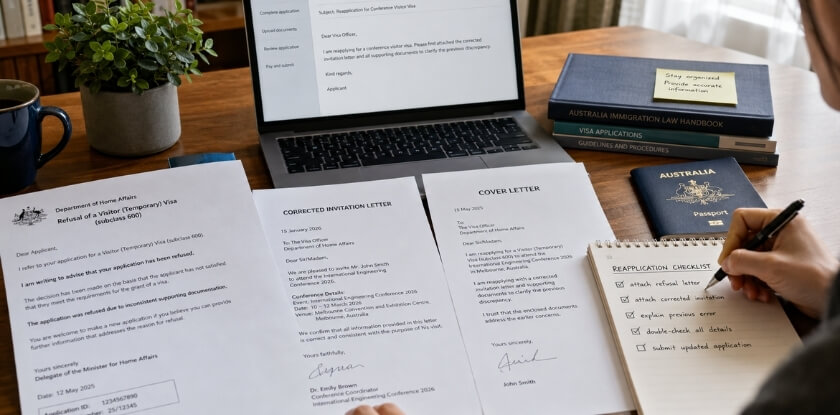
Your Role Changes the Urgency
If your visa application lists you as a guest speaker but the letter says general attendee, the embassy may see a mismatch between your stated purpose and your supporting documents. That can stall a category review or prompt a request for more evidence. Do not assume the officer will overlook it.
What to Check in Your Speaker Invitation Letter
Speaker letters include more fields than attendee letters, which means more places for errors.
- Your name and title. Your name must match your passport, visa application, program listing and other travel documents. Check all four.
- Your designated role. The letter should say “guest speaker,” “keynote speaker” or your actual role. If it only says “participant,” ask for a corrected letter.
- Your session details. Date, time and topic. Organizers sometimes use a draft schedule that later changed. If your session date does not align with your travel dates, fix it before submission.
- The venue. A wrong venue can look strange to an officer who checks the conference website.
- Fee or honorarium language. Some embassies scrutinize this closely, particularly for visa categories tied to paid work. Ask the organizer to correct how compensation or expenses are described, carefully and clearly.
How to Request the Corrected Letter
Write to your main contact on the organizing committee and be specific. “There is an issue with my letter” slows things down; “my name is spelled [X] but my passport reads [Y], and my session is listed as March 14 but should be March 15” gets resolved faster.
If time allows, also ask for a brief explanation letter on official letterhead acknowledging the change. Some embassies want to see that the organizer knew about the error and corrected it intentionally.
Can You Submit a Letter with Errors in a Visa Application
Nothing stops you from submitting a letter with a typo, but any discrepancy with your other documents becomes something you must explain, and you may not get the chance. If the error touches your name, passport number, dates, organization or purpose of visit, get a corrected letter first.
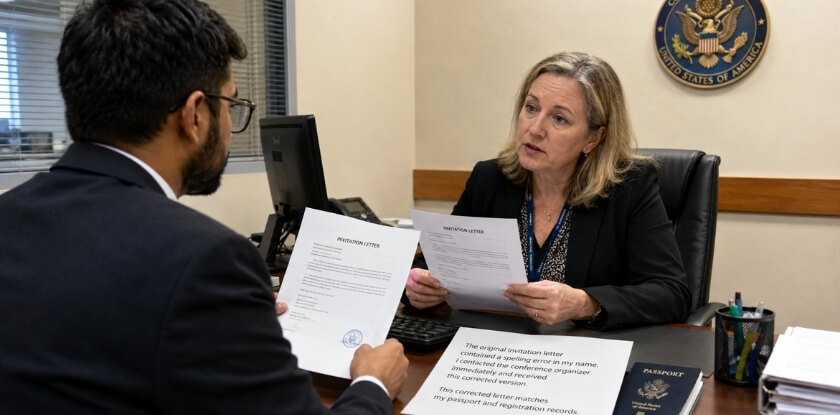
What Official Guidance Says
A letter of invitation is not always a mandatory document. IRCC says it only sometimes asks for one, that the letter does not guarantee a visa, and that officers assess you, not the letter. So a corrected letter helps your file but does not replace the rest of it. IRCC also says that fake or altered documents can lead to refusal and a ban from Canada of at least 5 years. An honest typo that the organizer corrects is a different matter, which is why you should never fix the letter yourself.
What Actually Happens at the Embassy
Visa officers cross-check documents against each other. A name that differs from your passport is a flag, and so are letter dates that do not match your flight or hotel bookings. Officers are not looking for perfection, but they do look for consistency. Depending on the case, the application may be delayed while the officer asks for clarification, or it may be refused for inconsistent supporting documents. Outcomes vary by embassy and officer.
When an Error Might Slide Through
Not every mistake carries the same weight. A wrong font or a missing comma in the address is unlikely to matter. A venue error in a secondary section probably will not sink an application either. What is risky is anything that affects your identity, the event details or your eligibility for the visa category, such as being listed as an attendee when you are a guest speaker.
Do not guess how a particular embassy will handle it. Some consulates are strict and others more flexible, and you will not know which until it is too late to fix.
What a Corrected Letter Should Cover
Make sure the new version explicitly fixes the error rather than reissuing the same text. Ask the organizer to confirm:
- The correct spelling of your name as it appears in your passport
- Accurate event dates and venue details
- Your correct role (attendee, presenter, guest speaker, panelist)
- The appropriate visa category language, if the letter mentions visa type at all
- The event code, if the conference is registered with IRCC and you are applying for a Canada visa
If your letter comes as two copies, one for the visa application and one to show on arrival, which is how IRCC describes letters for business guests, ask for the corrected version of both so the copy you carry matches the one you submitted.
Before you send the corrected letter anywhere, compare it once more against your passport and your booking confirmations. If the new version fixes one field but changes another, ask for a second correction immediately rather than submitting a letter you are not sure about. A correction that still contains the original mistake is worse than useless, because it creates two conflicting documents in your file.
If the Organizer Can’t Issue a New Letter in Time
If a corrected letter is simply not possible before your submission deadline, include an explanation letter alongside the flawed document, written by you or the organizer (ideally both). It will not undo the inconsistency, but it shows the officer you are aware of it and not hiding anything.
Be specific about what the error is, why it happened and what the accurate information is. Attach what you can: an email thread with the organizer confirming the correct details, your speaker confirmation or your registration record. The goal is for the error to read as an administrative oversight rather than a false document. Submitting without acknowledging the discrepancy and hoping the officer misses it is the worst option.
Last-Minute or Emergency Error Correction
If you find the error close to your appointment, phone the organizer first and email in the same hour. It is recoverable in most cases, but the timing of when you found it changes what you should do.
| When you find it | First action | What to carry or send |
|---|---|---|
| Within 48 hours of the appointment | Phone and email the organizer | Corrected PDF plus a short explanation letter |
| After you submitted the application | Write to the embassy or consulate | Corrected letter and an explanation letter, in the way they ask |
| On the day of travel | Call the organizer | Printed or phone copy of the corrected letter and your speaker confirmation |
When You Find the Error Within 48 Hours of a Visa Appointment
Phone the organizer if you have a number, then follow up by email. Explaining a mismatch verbally at the counter rarely goes well. Keep the email short: state the error, give the corrected information and ask for a revised PDF within a few hours. A short, specific request gives the organizer the best chance of turning it around quickly.
If the corrected letter arrives in time, bring both versions to the appointment with a one-paragraph explanation letter saying the original contained an error and has been corrected.
When the Error Is Discovered After You’ve Already Submitted a Visa Application
You generally cannot swap documents mid-application without telling the embassy. Contact the embassy or consulate as soon as you have the corrected letter and ask how they prefer to receive updated documents. Some missions accept supplementary submissions, while others require you to withdraw and resubmit. Do not assume an emailed letter will be attached to your file automatically.
For a Canada application, IRCC says to send an error correction or a new document through its web form, choosing the option to add documents to support or complete your application, explaining what you are sending and uploading it. It says to use email, mail or fax only if IRCC has told you that you can. Other countries have their own channels, so ask the embassy or visa centre.
Your explanation letter should say that a corrected letter is being provided, name the specific error and confirm that all other documents are unchanged. Keep it factual and brief.
When You’re a Guest Speaker with Same-Day Travel
If you are still at departure, call the organizer at once. A corrected letter emailed to you and printed at the airport may help alongside your existing documents, particularly for a minor error when the rest of the paperwork is consistent, but the officer decides.
If you have already arrived and the error only surfaced at the destination, an explanation letter from the organizer sent to your phone as a PDF, plus your event schedule or speaker confirmation, can help clarify the discrepancy for immigration officers.
What to Bring if Time Runs Out
If the corrected letter has not arrived by your appointment, bring a short folder: the original letter, your registration or speaker confirmation, the email thread showing you reported the error, a copy of the conference program with the correct dates and venue, and your explanation letter. The aim is to show that the mismatch is a documented clerical issue and that you acted on it promptly.
Preventing a Last-Minute Situation From Getting Worse
- Keep the organizer’s direct contact handy. A general inbox is useless at 6am. Get the name and mobile number of the person who issues letters before you need them.
- Prepare the explanation letter in parallel. Draft it when you email the organizer, so it is ready to customize.
- Tell the embassy before sending anything. A corrected letter without context can confuse a file. A brief note to the visa processing unit keeps the correction clean.
- Accept that some delays are unavoidable. If the application is deep in processing, a correction may push the timeline.
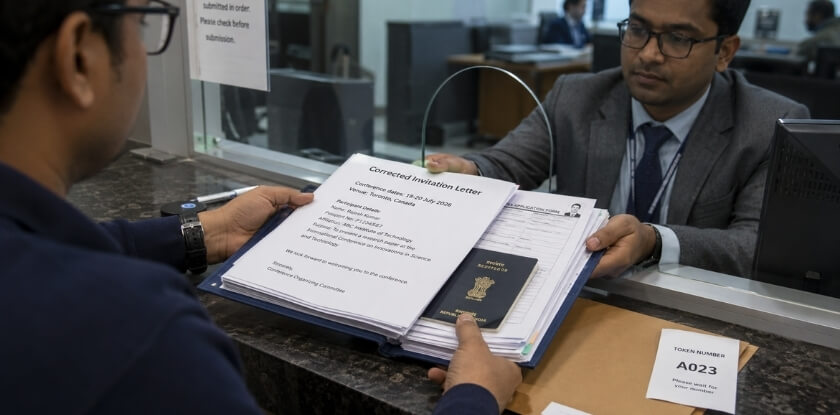
How Long Does It Take to Receive a Corrected Letter
There is no standard time. It depends on the organizer’s internal process, and a team that needs sign-off from several people will take longer than one that can re-issue the file itself.
| Situation | Likely speed | Why |
|---|---|---|
| Simple fix (name, date, venue) | Usually quickest | One field changed on an existing template, then re-signed |
| Guest speaker with a direct coordinator | Can be faster | A named contact manages your travel |
| General attendee via support email | Can take longer | Your message goes through a shared inbox, so follow up if you hear nothing |
| Visa category or purpose change | Likely slowest | May need extra sign-off |
| Conference very close to its start date | Can be slow | Staff are busy with logistics on the ground |
A Realistic Timeline
On day 1, confirm the error and email the organizer with proof. On day 2, follow up if you have heard nothing. If there is still no reply by day 3 or 4, escalate. Once you have the letter, allow another day to check it against your passport and update your application package, so do not leave the request until the final week before your appointment.
When It Takes Longer
Large conferences may need a corrected letter approved, stamped or signed by someone who is not immediately available. If the director is traveling or the committee is in another time zone, even a simple fix can take longer. A visa category correction can need extra sign-off, so raise it first.
What You Can Do to Speed Things Up
- Be specific in your first email. State what is wrong, what it should say and why it is urgent, for example that your visa deadline is in five days.
- Provide everything upfront. Attach your passport copy or any document confirming the correct information. Every follow-up question costs a day.
- Request confirmation when the letter is sent. Some organizers mark the task as done internally before the email actually goes out.
- Ask about format early. If you need official letterhead, a signature and a seal, say so immediately. A digitally signed PDF may come faster than a physically signed copy, and some embassies accept either, but confirm with the consulate.
- Escalate after 48 hours. If you have heard nothing and your deadline is close, go to the conference director, program chair or whoever signed the original. Say you cannot submit your application without the corrected document and give a date.
After You Receive the Corrected Letter
Read it in full before sending anything. Check every field that was wrong and scan the rest too, since corrections sometimes introduce new errors. Update your application package and keep both the original and the corrected version, because some embassies ask to see the full document trail. If you already sent the old letter to an employer, sponsor or travel agent, send them the corrected one too. If you plan to use it for more than one visa application, note that one invitation letter can be reused for family members who apply together, but not for a later trip or a different country.
How This Affects Your Visa Application Timeline
If you are mid-application and waiting for a corrected letter, tell the visa section so. Telling the office early gives it the chance to say how it wants the document, though there is no guarantee and rules vary by mission. If the correction is significant, such as a visa category change, submit an explanation letter with the corrected version. Check the official website of your embassy or consulate for guidance on updated documents, since each mission handles this differently.
From our experience at MS International: Our invitation letter is issued within 3 to 5 business days after payment clears, and it must show your full legal name exactly as in your passport, with no nicknames or titles. Our team may contact you if details are missing or names do not match. A US$50 administrative fee may apply to modifications or corrections requested after the letter has been issued, and our refund policy asks you to report errors in name spelling, contact details or identification information as soon as possible because corrections may not always be permitted once processing has begun. Check the letter the day it arrives, and ask for a correction before you book flights or an appointment.
FAQ
Spotted a typo in your name or a wrong venue address on the letter? What follows weighs how serious the mistake is, whether to tell the visa office, and whether you can fix the PDF yourself.
Will a small typo in my name actually cause a visa rejection?
It can. Officers compare your documents with each other, and a name that differs from your passport is a flag, so your file may be delayed or questioned. Outcomes vary by embassy, so ask for a corrected letter even for a one-letter typo.
What if the organizer says they can’t issue a corrected letter in time?
Ask the organizer for a signed explanation letter on official letterhead that states the error and the correct information, and send it with the original. It does not remove the mismatch, so check with your embassy or consulate before the appointment.
Do I need to disclose the error when I submit my visa application?
Yes, if you include both the original and a corrected letter. A brief cover note saying which document supersedes the other helps the officer process your application without confusion.
What counts as a “venue error”: does it matter if the city is right but the address is wrong?
Both can matter. A wrong street address is usually less serious than a wrong city or country, but if it does not match the event’s official website it can prompt questions. Request a corrected letter either way.
Can I use an email from the organizer as a substitute for a corrected letter?
Usually not. An informal email is seldom enough for a visa application. The corrected document should be on official letterhead, signed, and include contact details so the embassy can verify it. An email thread is useful as extra proof.
What if I’m a guest speaker and the error is in my title or speaker status?
Contact the organizer directly and explain that it could affect your visa classification. Ask for a corrected letter that accurately reflects your role, especially if your visa category is tied to it.
What happens if I discover the error after I’ve already submitted my visa application?
Contact the embassy or visa office now and ask how to send the corrected letter. For a Canada application, IRCC says to use its web form to send an error correction, unless IRCC has told you to use email or mail. Acting early shows good faith.
Does MS International charge to correct an invitation letter?
Yes, a US$50 administrative fee may apply to corrections or modifications requested after the letter has been issued. Registering with your passport name and checking your details before payment helps you avoid it.
Can I correct the typo in the PDF myself?
No. Only the organizer should issue a corrected letter. Editing a document yourself can look like tampering, even for an obvious typo, and that is far more serious than the original mistake. Ask the organizer to reissue it.
How do I know whether the error is serious enough to act on?
A wrong name, date or visa category directly affects processing, so fix those. A formatting slip that does not appear on your passport or visa form is lower risk. When in doubt, ask for a correction.
Final Thoughts
Errors in invitation letters are common and almost always fixable. Catch the problem early, check every letter the day it arrives, write to the organizer with the exact correction, and keep a clear paper trail. If your application is already in motion, send an explanation letter with the corrected one so the embassy has the context.
Disclaimer: This article is general information, not legal or immigration advice. Embassy requirements change and differ by country, so confirm the current rules with the official immigration authority before you apply.