
After you register for a conference, you often find you need a formal invitation letter before you can move on. It may be for a visa application, your employer’s travel approval, a university funding office, or a co-author who needs proof of your trip. A registration confirmation shows you signed up, but it rarely carries the weight of a letter on official letterhead. So the practical question is how to ask for that letter without sending three follow-up emails.
Quick answer: To request a conference invitation letter, email the organizer with a clear subject line, your full name as it appears on your passport, your registration or acceptance reference, what the letter is for, and the date you need it. Keep it short and polite, and attach your registration confirmation. Seven ready-to-send templates for attendees, speakers, students, employers and groups are below.
Fact-checked by the MS International Editorial Team. Last verified against official sources: October 2026.
This guide is about the email itself: what to write, which subject line to use, and which template fits your situation. The wider process of asking, and what to do if an organizer refuses, is a separate topic.
What Should a Request Email Include?
A good request email states who you are, why you are attending, what the letter must say and when you need it. Everything else is detail.
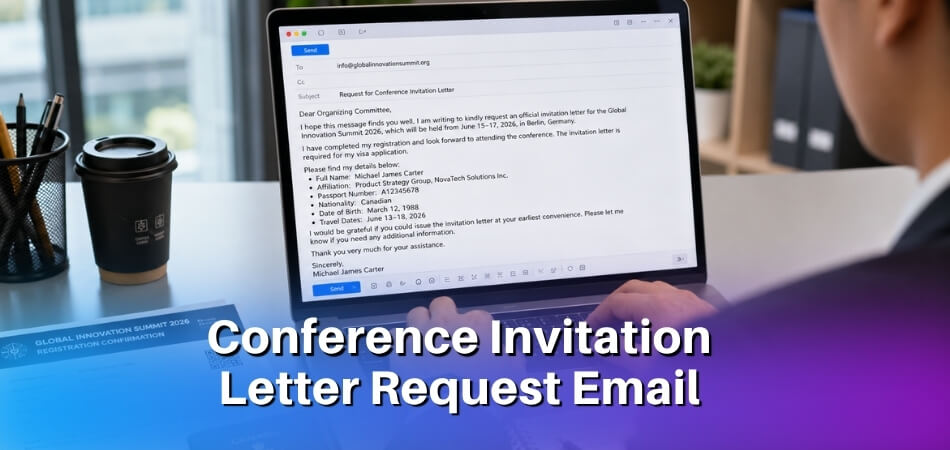
A conference invitation letter is an official document from the organizer or program committee confirming that a named person is registered for, or accepted at, a specific event. It normally shows your name, the conference name, dates and location. The table lists what to put in your email and why the organizer needs it.
| Include | Why the organizer needs it |
|---|---|
| Full name and affiliation | Used on the letterhead. Write your institution’s name the way you want it printed. |
| Registration or acceptance reference | Lets the organizer confirm you are a real participant. Add your paper title or submission ID if you are presenting. |
| Purpose of the letter | Visa, employer approval and funding bodies need slightly different wording. Name the embassy if it is for a visa. |
| Details the letter must show | Conference dates, venue address, your role, and anything the embassy or funder has asked for. Do not assume the organizer knows what a visa file needs. |
| Passport details, if asked | Some organizers ask for nationality, passport number, and issue and expiry dates before they prepare a visa letter. Check the conference’s visa or invitation page first, because it often lists exactly what to send. |
| Event code, for Canada | If the conference is in Canada and registered with IRCC, the organizer can give you an event code. IRCC asks hosts to put the code in the invitation letter and participants to enter it on the visa application, so ask whether the event has one. |
| Your deadline | A firm date, not “as soon as possible”. Mention your visa appointment or funding deadline. |
| Attachments | Registration confirmation, and your acceptance letter if you are presenting. Add any form the embassy or funder gave you. Nothing else. |
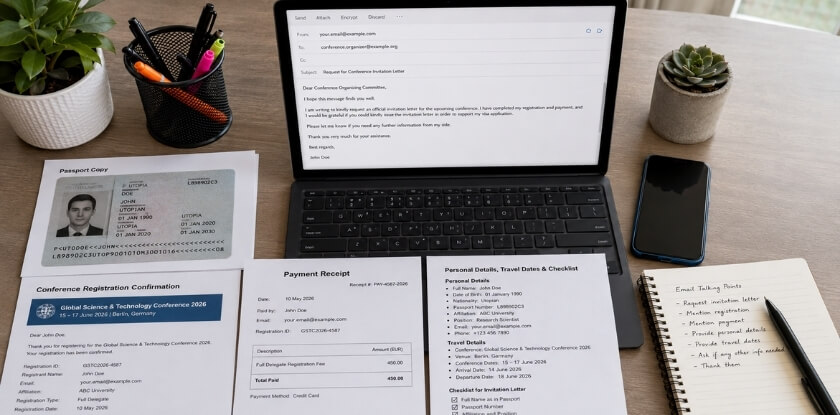
If the letter must be on letterhead or carry a signature, say so in the first email. Asking for a reformatted version later costs days you may not have.
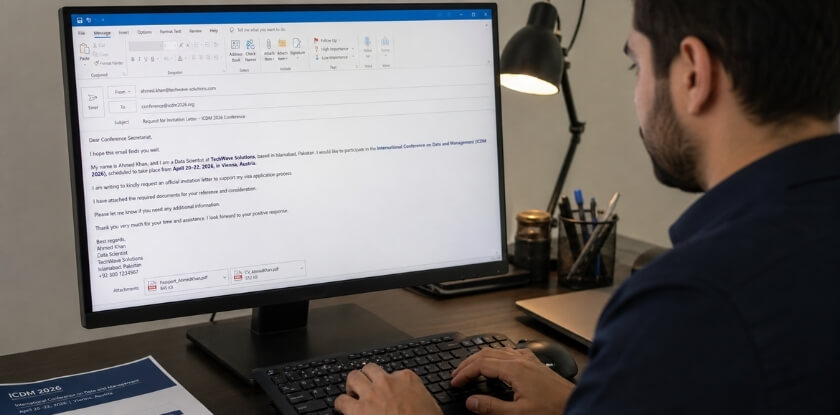
Two extra details help when the letter is for a visa. First, name the embassy or consulate you will apply to, since some have wording they prefer and the organizer can only match it if they know. Second, if you are presenting, attach the acceptance letter, because it gives the invitation more weight and lets the organizer quote your paper title and role. If your registration name differs from your passport name, point that out in the email instead of hoping nobody notices.
The letter supports your visa file but does not decide it. IRCC says a letter of invitation does not guarantee that a visa will be issued. Special rules can also apply on top of any letter: for Canada, IRCC is not finalizing applications from people whose last country of residence is the Democratic Republic of the Congo, South Sudan or Uganda until 27 November 2026, whatever letter they hold.
If you are not registered yet and your employer must approve first, say so honestly and ask what the organizer needs from you. Some organizers will issue a provisional document, others require payment first. Do not assume either, and do not promise payment dates you cannot keep.
From our experience at MS International: The invitation letter is issued after your payment clears, within 3 to 5 business days, and you do not need to send a separate request. Give your name exactly as it appears on your passport: the team may contact you if details are missing or names do not match, and a US$50 fee may apply to corrections after the letter is issued.
Which Subject Line Gets Your Email Answered?
Use a subject line that holds the request, your name and the event, so the organizer can route it without opening it. Vague lines such as “Request” or “Question” are easy to defer. If the conference page asks for a specific subject line, use theirs instead of the examples below.
| Situation | Example subject line |
|---|---|
| Attendee, visa | Visa Invitation Letter – [Full Name] – [Conference Name] [Year] |
| Speaker or presenter | Presenter Letter – Paper [ID] – [Full Name] – [Conference Name] |
| Student | Student Attendee Letter – [Full Name] – [Conference Name] |
| Employer or funding | Travel Approval Letter – [Full Name] – [Conference Name] |
| Group | Group Invitation Letter Request – [Number] Attendees – [Conference Name] |
| Follow-up | Follow-Up: Letter Request of [Date] – [Full Name] – [Conference Name] |
When Should You Send the Request?
Send it as soon as your registration is confirmed, and earlier if a visa is involved. Sending before you are registered can make the letter predate your confirmation, which raises questions with embassies and HR teams.
| Purpose | Send the request | Why |
|---|---|---|
| Visa application | At least 8 to 12 weeks before the conference | Visa processing varies widely by country and consulate, so check the official processing estimate for your case and work backwards. |
| Employer approval | 2 to 3 weeks before the internal deadline | Your timeline is set by internal approval cycles, not embassy waits. |
| University or funding body | As soon as you have acceptance or registration | Funders often have fixed submission windows. |
| Group or co-authors | Earlier than you think | The organizer must produce several letters, so turnaround multiplies. |
| Online conference | As soon as you register | Less urgent, but internal approvals can still be slow. |
For an in-person conference the stakes are higher, because deadlines outside your control (visa appointment slots, embassy processing, budget submission dates) all depend on the letter arriving. State the date you need it, not just the date of the conference. Asking early also leaves room if the organizer needs to ask you for a missing detail. These figures are our general guidance, not a rule of any embassy.
Which Template Fits Your Situation?
Pick the template closest to your case and replace every bracketed field. Do not send placeholder text.
Template 1: Registered Attendee Needing a Visa Letter
This is the most detailed version, because embassy reviewers expect clear names, dates and registration status.
Subject line: Visa Invitation Letter – [Full Name] – [Conference Name] [Year]
Dear [Organizer / Registration Team],
My name is [Full Name], and I am registered to attend [Conference Name] in [City, Country] from [Start Date] to [End Date]. My registration confirmation number is [XXXX].
I would like to request an official invitation letter for my visa application to the [Name of Embassy or Consulate]. It would help if the letter could show:
- My full name exactly as on my passport: [Full Name]
- The conference dates and the venue address
- That I am a registered participant and that the registration fee is paid
- The organizer’s contact details, on official letterhead
I need the letter by [date] to meet my visa application deadline. My registration confirmation is attached. Please tell me if you need anything else from me.
Sincerely,
[Full Name]
[Institution]
[Email] | [Phone]
Send your documents as PDF attachments, so you do not need a second email if the consulate wants to see both.
Template 2: Speaker or Presenter With an Accepted Paper
A presenter should mention the paper, because the letter can then state the presentation role.
Subject line: Presenter Letter – Paper [ID] – [Full Name] – [Conference Name]
Dear [Program Committee / Organizer],
I am [Full Name], a [title, e.g., doctoral researcher] at [Institution]. My paper “[Paper Title]” (submission ID: [XXXX]) has been accepted for presentation at [Conference Name], held on [dates] in [city, country].
Could you please issue an official invitation letter confirming my role as a presenting author, the conference dates and location, and the title of my paper? I need it for [my visa application to the [Country] Embassy / my travel grant application].
I would be grateful to have it by [date]. My acceptance letter and registration confirmation are attached.
Thank you for your time.
[Full Name]
[Institution, Department]
[Email] | [Phone]
Template 3: Student Attendee
Students often need the letter for a funding office or a supervisor’s sign-off as well as a visa, so say which one applies and name your supervisor.
Subject line: Student Attendee Letter – [Full Name] – [Conference Name]
Dear [Organizer],
I am a [Master’s / PhD] student at [University], studying [field] under the supervision of [Supervisor’s Name]. I am registered for [Conference Name] on [dates] in [city], registration number [XXXX].
I am requesting an invitation letter that confirms my registration and the conference details. I will submit it to [my university’s travel funding office / the embassy of [Country]] together with my student documents.
Could the letter be on official letterhead and show my full name as on my passport? I need it by [date].
Thank you for your help.
[Full Name]
[Student ID, if relevant]
[University, Department]
[Email]
Template 4: Employer Approval
Employer approvals do not need consulate-level detail. Confirm that the conference is real, the dates and your role.
Subject line: Travel Approval Letter – [Full Name] – [Conference Name]
Dear [Name / Organizer],
I am registered to attend [Conference Name] on [dates] in [city] and my employer has asked for a formal invitation letter as part of the approval process.
Could you please send a brief letter confirming my registration and the conference dates? I would need it by [date]. My registration confirmation number is [XXXX].
Thank you,
[Full Name]
[Email] | [Phone]
Template 5: University or Funding Body
Funders often need the letter to name your role, such as presenter, session chair or invited speaker, because that decides whether the trip qualifies under the grant. Some universities and funders also want the letter signed by a named representative of the organizing or programme committee, so ask for that in the first email.
Subject line: Grant Documentation Letter – [Full Name] – [Conference Name]
Dear [Program Committee / Organizer],
I am [Full Name] of [University / Department], accepted as a [presenter / invited speaker / session chair] at [Conference Name], to be held on [dates] in [city, country].
I am requesting an official invitation letter on letterhead for submission to [Research Office / Funding Body] with my travel grant application under [grant name or reference, if any]. Please include:
- My participation role (and paper title if relevant)
- Conference dates and location
- Confirmation of registration or acceptance
- Contact details of the organizing committee
I need the letter by [date]. My acceptance letter and registration confirmation are attached.
Yours sincerely,
[Full Name]
[Position, Department, University]
[Email] | [Phone]
Template 6: Group or Co-Author Request
Send one email with everyone listed. Five separate emails from five co-authors slow the organizer down.
Subject line: Group Invitation Letter Request – [Number] Attendees – [Conference Name]
Dear [Organizer / Program Committee],
We are [number] researchers attending [Conference Name] on [dates] in [city] as co-authors of the accepted paper “[Paper Title]” (reference: [XXXX]). We would like individual invitation letters for the attendees below.
- [Full Name 1] – Presenting Author – Registration No. [XXXX] – for: visa application
- [Full Name 2] – Co-Author – Registration No. [XXXX] – for: visa application
- [Full Name 3] – Co-Author – Registration No. [XXXX] – for: employer or funding approval
A single group letter would be fine for the employer and funding requests, but the visa letters need to be individual. We need them by [date], and all registration confirmations are attached.
Best regards,
[Full Name, Lead Contact]
[Institution]
[Email] | [Phone]
Template 7: Online Conference Attendee
Say clearly that the event is virtual so the letter does not read as if you are travelling.
Subject line: Confirmation Letter Request – Online Attendance – [Full Name] – [Conference Name]
Dear [Organizer],
I am registered for the online conference [Conference Name] on [dates], registration number [XXXX]. My employer / university needs a short letter confirming my registration and that the event is held online.
Could you send it by [date]?
Thank you,
[Full Name]
[Email]
What a Filled-In Request Looks Like
Seeing real values helps more than brackets. This is Template 1 completed for an imaginary attendee, conference and university, so you can judge the right length and tone.
Subject line: Visa Invitation Letter – Amina Yusuf – Example Research Conference 2027
Dear Registration Team,
My name is Amina Yusuf, and I am registered to attend the Example Research Conference in [City] from 14 to 16 March 2027. My registration number is ERC-1042.
I am applying for a visitor visa at the Canadian visa office in my country and would like an official invitation letter showing my passport name, the conference dates, the venue address and that my registration fee is paid. I need it by 10 January 2027. My registration confirmation is attached.
Kind regards,
Amina Yusuf
Example University
It is about 100 words. That is enough: nothing is missing and nothing is padded.
Wording That Helps and Wording That Hurts
| Instead of | Write |
|---|---|
| “I need a letter urgently, please reply ASAP.” | “I need the letter by 10 January for my visa appointment.” |
| “Send me an invitation.” | “Please issue an official invitation letter confirming my registration and the conference dates.” |
| “Hi,” with no name or reference | “Dear Registration Team,” followed by your full name and registration number. |
| A long personal story about your trip | One sentence on the purpose, such as “for my visa application”. |
| “You must include my hotel and flights.” | “If possible, please confirm that accommodation is arranged by me.” Ask, do not demand. |
A request that reads as easy to say yes to is more likely to get a quick reply.
Who Should You Write To?
Write to the person who can issue or sign the document, and change the tone to suit them. Look for a visa or invitation letter page on the conference website first: it often names the contact and the details to send, and it beats any general template.
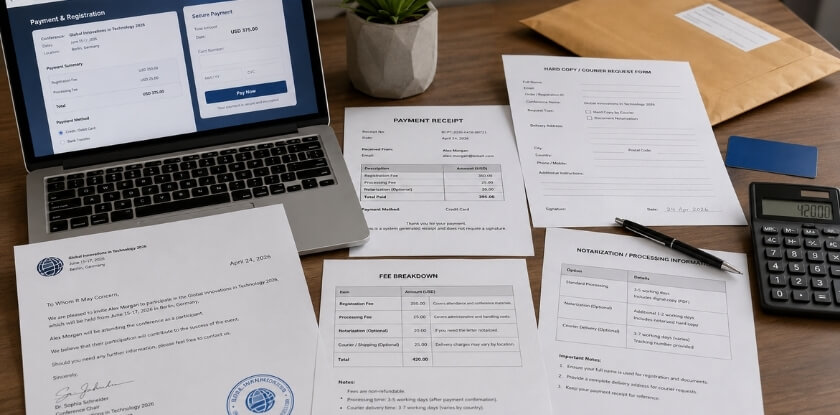
- The conference organizer. The usual recipient. Keep it short and task-focused: who you are, registration status, purpose, dates. Use the registration or admin contact on the conference website, because the program committee reviews submissions and often does not handle letters. A few conferences name the program chairs for letter requests, so follow what the site says.
- An admin contact at the organizing institution. If you are routed to one, treat it as a formal administrative request and spell out what a visa support letter should contain.
- Your employer or funding body. Here you are asking them to support your attendance, not to issue the conference letter. Explain why the event matters to your work, and keep any budget request separate from the letter request.
- A co-author. The tone can be more direct. Name the paper and say exactly what you need, such as a note confirming joint work. Reference the conference’s own acceptance message, because the organizer needs to see you are a verified participant.
Does Your Request Change for an Online Conference?
The structure stays the same, but the purpose changes. For an in-person event the letter usually supports travel, so you name the embassy and give a firm date. For an online event the letter is normally for an employer or a funder who wants proof of attendance, so travel wording is not needed and the request can be shorter and less urgent. The letter still needs your registration confirmation and a clear statement that the event is virtual. The subject line, tone and follow-up rules are the same in both cases. Some employers and universities also want the letter to say that the event is a recognised academic or professional meeting, so ask the organizer to describe it in one line if your internal form requires that. If a funder needs proof that fees were paid, attach the payment receipt as well, because a letter alone may not show it.
How Long Does a Reply Take, and When Should You Follow Up?
Replies range from a day or two to a week or more, depending on who handles requests. Organizers with a registration system are usually fastest, and some generate the letter right after payment. Program committees are slower, because administrative email is not their main job. Employers and funders depend on internal workflows, so allow a few days to nearly two weeks.
Follow up after 5 to 7 business days, or 3 to 4 if your deadline is tight. Give co-authors and funding offices a full week. If a visa deadline is close, say so in the first email and ask the organizer to confirm receipt.
First Follow-Up Email
Reference your original message and date, restate the request in one sentence, and mention the deadline.
Subject line: Follow-Up: Letter Request of [Date] – [Full Name] – [Conference Name]
Dear [Name / Program Committee],
I am following up on my email of [date] requesting a conference invitation letter for [Conference Name]. Please let me know if you need any additional information from me.
My [visa application / employer approval] deadline is [date], so any guidance on timing would be appreciated.
Thank you again for your time.
[Your Name]
[Registration confirmation number]
Second Follow-Up Email
If there is still no answer after another five business days, send a shorter second note with “Second Follow-Up” added to the subject, and try another channel in parallel.
Subject line: Second Reminder: Letter Needed by [Date] – [Full Name]
Dear [Name],
I wrote on [date] and [date] about an invitation letter for [Conference Name]. I need it by [date] for [purpose]. Could you tell me who is the right person to handle this, or whether another address works better?
Thank you,
[Your Name]
[Registration number]
Check your spam folder first, and confirm the address matches the one on the conference website or your registration email. A general contact form, a registration helpdesk, or a phone number on the website can reach someone faster, and the acceptance letter sometimes names a different contact. Your own department or travel office may also have a routine for these letters. Writing to the wrong person is an easy way for a request to stall. Stop at two follow-ups, because daily messages or a sharper tone put volunteer or part-time organizers in an awkward position. For a group, let one person handle all follow-up.
What Mistakes Make a Request Fail?
Many problems come from missing information, not from a refusal.
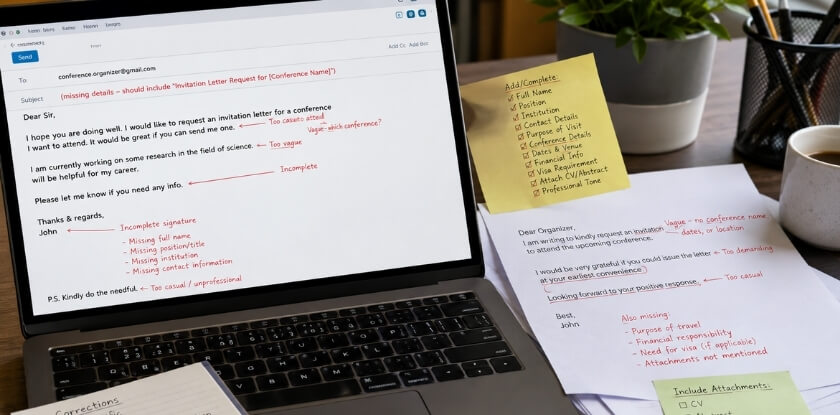
- Not saying what the letter is for. You may get a letter missing a key detail, such as your role or your paper title.
- Name mismatch. If the letter shows a name that differs from your passport, an embassy official may flag it. Give your passport name and mention it if your registration name differs.
- Combining two purposes in one request. A visa letter and an employer letter may need different content. Ask for them as two clear items, or send two emails.
- Assuming a standard format. Some organizers send a plain email, others a signed letter on letterhead. State up front if you need a wet signature or a reference number.
- Attaching everything you own. Send only the registration confirmation, the acceptance letter and any form the recipient requires.
- Listing a group badly. Without a clear list of names, registration numbers and purposes, at least one letter usually comes back with an error.
How Does This Work With MS International Conferences?
At MS International Conferences Inc. you do not need to write a request at all. The invitation letter process begins automatically once your payment clears, and the letter is issued within 3 to 5 business days, sent as a PDF to your registered email. Authors, presenters and registered listeners are all eligible.
| Item | MS International |
|---|---|
| Who gets a letter | Registered authors, presenters and listeners who have paid in full |
| Standard letter | Issued automatically after payment clears, within 3 to 5 business days |
| Cost of the standard letter | Free of charge to registered participants. Registration fees themselves are non-refundable |
| Correction after issue | A US$50 administrative fee may apply |
| Notarized letter (optional) | US$100, typically up to 10 business days, non-refundable once requested |
Check every name and passport detail before you submit so you avoid the correction fee, and treat the letter as supporting evidence only.
FAQ: Requesting a Conference Invitation Letter
Before you send the request to the organizer, a few practical points come up: the subject line, who to address, whether your travel dates belong in the letter and the next step if a follow-up gets no reply.
Do I need an invitation letter if the conference is free to attend?
Yes, if you travel internationally or need employer or university approval, the letter still serves a purpose. A free registration does not change visa or funding requirements.
Can I request the letter before I have paid the registration fee?
Usually not, though policies vary. Many organizers issue the letter only after payment or acceptance, so check the conference’s visa page or ask. At MS International the letter is issued after payment clears.
What subject line should I use for the request?
Use one line with the request, your name and the event, such as “Visa Invitation Letter – [Full Name] – [Conference Name]”. If the organizer asks for a specific subject line, use theirs.
Who should I email, the organizer or the program committee?
Email the organizer or the registration contact on the conference website. The program committee handles academic content, so administrative requests usually go to the organizing team, unless the site names the program chairs for letters.
Does the letter need to be on official letterhead for a visa?
Ask for it. Embassies expect documents that look official, so letterhead, a signature and the organizer’s contact details help. Request this in your first email.
Can one letter cover several attendees?
Sometimes. Some organizers issue a group letter, others one letter per registrant. Ask in your request, and expect visa letters to be individual.
Does the letter need my travel dates?
It should at least show the conference dates. If you can, ask the organizer to confirm your intended travel period too, so the consulate has a clear timeline.
What if I get no reply after a follow-up?
Send one more short follow-up after about five business days, then try another contact, such as a general info address, a listed chair or a helpdesk. Check your spam folder and state your deadline plainly.
Do online conferences need an invitation letter?
Rarely for visas, since nobody travels. Some employers or funders still want proof, and a confirmation email or your registration confirmation is usually enough.
Final Thoughts
A good request is specific, early and easy to act on. The organizer is usually a small team handling many emails, so a message that already contains the name, reference, purpose and deadline is easy to act on. Pick the template that matches your purpose, add your passport name and deadline, and attach your registration confirmation. If you hear nothing within a week, send one polite follow-up.
Disclaimer: This article is general information, not legal or immigration advice. An invitation letter supports an application but does not guarantee a visa. Always check the requirements of the embassy or authority you are applying to.