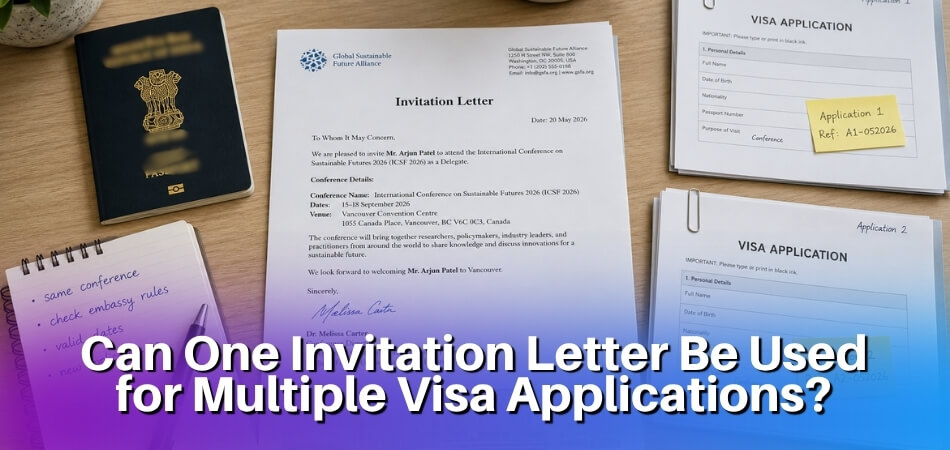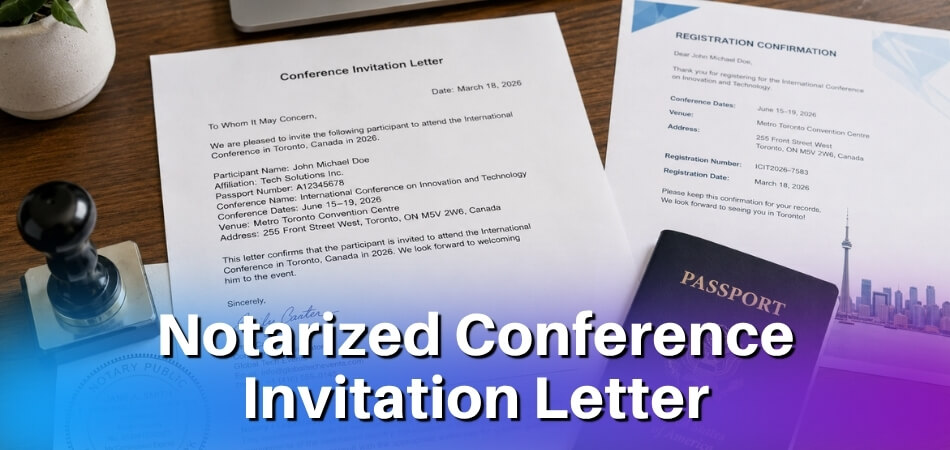

You have been accepted to an international conference, and then the email arrives from your visa application center, your department head or your HR office asking for a “conference invitation letter.” What is this document, who sends it, and how do you get one before your deadlines pile up?
Quick answer: A conference invitation letter is an official document from the conference organizers that confirms you are registered or accepted for a specific event, with its name, dates and venue. People use it as supporting evidence for visa applications, employer or university approval, funding requests and travel authorization. It is often requested but not always required, and it never guarantees a visa.
Fact-checked by the MS International Editorial Team. Last verified against official sources: October 2026.
This guide explains what the letter is, why people need it, what it contains, how to request it and how it differs from an acceptance letter. It ends with a template you can adapt.
What Is a Conference Invitation Letter?
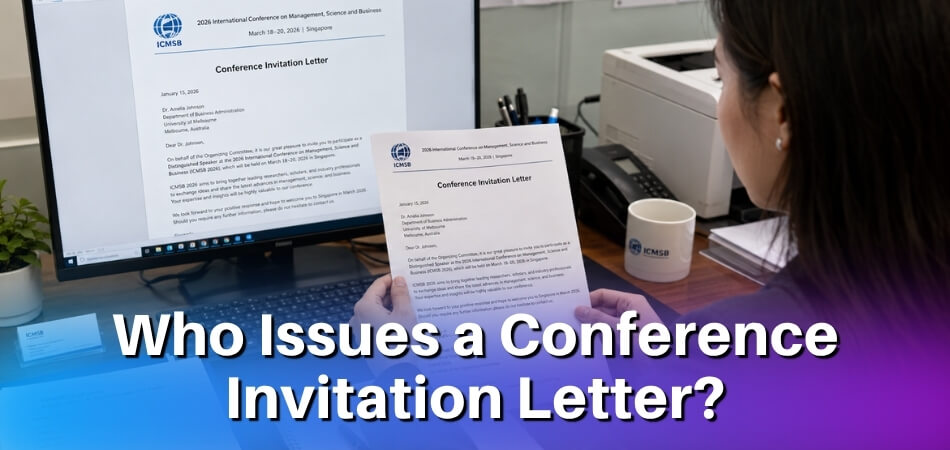
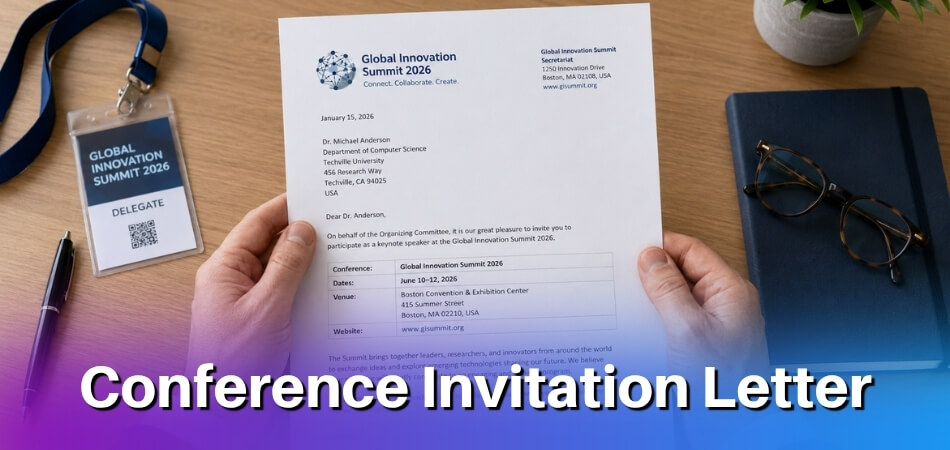
A conference invitation letter is an official document issued by a conference organizer, academic institution or professional body that formally invites you to attend or present at an event. It confirms your participation in writing, so a third party such as an embassy, employer or funder can see that the event is real and that you are expected there.
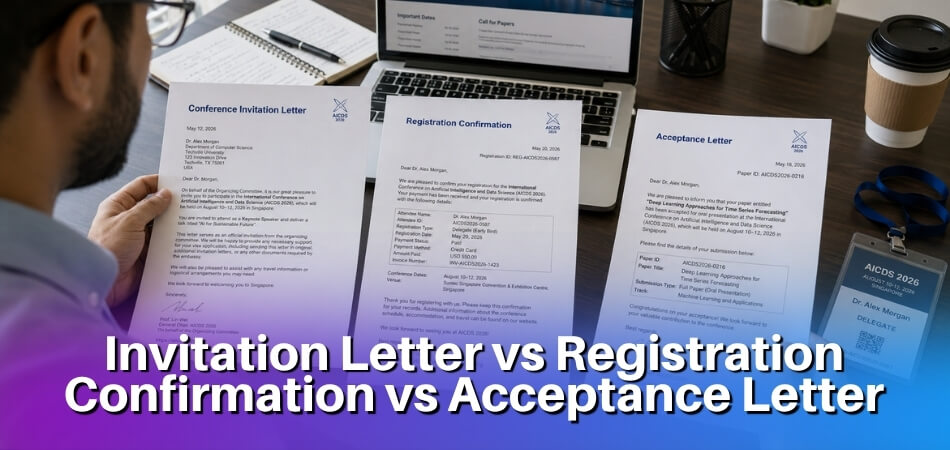
It is not the same as a conference acceptance letter, although people often confuse the two. The table below shows how the three conference documents differ.
| Document | What it proves | Written for |
|---|---|---|
| Registration confirmation | You paid or registered. It works like a receipt. | You and the organizer |
| Acceptance letter | Your paper or abstract passed review | Universities, grant committees, funders |
| Invitation letter | The organizers formally invite you to attend, with event details, on letterhead | Embassies, employers, finance and travel offices |
Funding bodies and travel committees often ask for the invitation letter because it shows that an identifiable organization has formally asked you to take part. It changes the story from “I want to go to a conference” to “I have been invited to participate in an international conference.”
Why Do You Need One? The 4 Main Use Cases
You need a conference invitation letter whenever someone other than you has to be convinced that the trip is genuine. Each audience wants something slightly different from the same document, so know your use case before you ask for it.
Visa Application
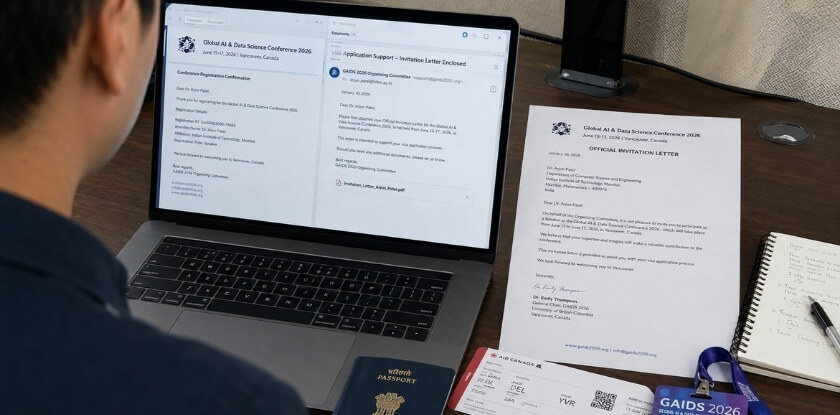
For most people travelling abroad, the visa is the first and most demanding step. Consulates ask for supporting documents that show the trip has a legitimate, time-limited purpose, and the invitation letter is one of the clearest. It confirms who invited you, where the event takes place, the dates and your role. Some missions also want proof of registration alongside it.
Do You Always Need One?
Not always. The embassy or immigration authority sets the rule for your destination, nationality and visa type, not the conference.
| Destination | What the official guidance says |
|---|---|
| United States, visitor visa | The State Department says a letter of invitation is not needed to apply. If you bring one to the interview, it is not one of the factors used to decide the visa. |
| Canada, visitor visa | IRCC says it sometimes asks applicants for a letter of invitation, and that a letter does not guarantee a visa. If the event is registered with IRCC, the organizer gives you an event code to enter on your visa application. |
| Any other country | Check the embassy or consulate page for your nationality. Its rules decide, not the conference’s. |
Even where no embassy asks for the letter, your employer, university or funder may still want it, as the sections below show.
Employer or University Approval
Before you book anything, you probably need sign-off from a manager, department chair or dean. They want to know the event is legitimate and that your absence is justified. A formal letter that references your paper or registration gives them something concrete to attach to the approval request. A conference website URL on its own is usually not enough.
Funding and Sponsorship Requests
Registration, travel and accommodation cost money, and many researchers apply for internal grants, departmental budgets or outside sponsorship. A letter that references your accepted paper or presentation strengthens the request because it shows you are contributing to the program and not just observing. A vague email confirmation from an event platform does not carry the same weight as a signed letter from the organizing institution. On its own, the letter does not mean the organizer will cover your fees, travel or accommodation.
Travel and Institutional Authorization
Even when money and visas are not an issue, many institutions require formal travel authorization. This is separate from funding approval. It is about liability, risk management and record keeping. The request usually needs the event name, location, dates and your reason for attending, and the invitation letter covers all of that in one document. Government-affiliated or publicly funded employers may make this paperwork mandatory under their own rules.
What a Conference Invitation Letter Should Include
Most invitation letters contain the sender’s details, your name and affiliation, the conference name, dates and venue, your role, and a signature. Formats vary by organizer, and if one element is missing the letter may not hold up with a visa officer or grants committee.

| Element | What to check |
|---|---|
| Sender | A named person with authority, such as a conference chair or administrative contact, with title, institution and contact details. A letter with no identifiable sender is nearly useless. |
| Your name and affiliation | Spelled exactly as in your passport or official ID, with your university, employer or organization. A mismatch can cause problems at the visa stage. |
| Conference details | Full conference name, dates, and the city, country and venue. “An upcoming international conference” is too vague. The official website URL and your registration number add credibility, and some embassies ask for them. |
| Your role | Presenter, session chair, registered delegate or another role. Include the acceptance letter if you have one. |
| Purpose statement | One or two sentences saying you are invited to attend in an official capacity. |
| Travel dates | The expected stay or the conference duration, which matters most for visa applications. |
| Signature and stamp | A handwritten or verified digital signature from an authorized representative, plus the institution’s seal or stamp if it has one. |
If you receive a letter with a missing affiliation, wrong dates or any other gap, ask the organizers for a revised version and say what the embassy or institution needs. It is a routine request. Some embassies expect specific wording, so check what your target consulate requires before you ask.
How to Request a Conference Invitation Letter
Register or submit your paper first, then email the organizers with your details and the purpose of the letter. Organizers issue letters to confirmed participants, not to people who are still thinking about attending.

Step 1: Register or Submit Your Paper
If you are presenting, submit your abstract or paper and wait for the acceptance letter. If you are attending without presenting, pay the registration fee and save the confirmation. Many organizers issue letters only to people who already appear in the registration system.
Step 2: Contact the Right Person
Look on the conference website under “Visa Information,” “Registration” or “Contact” for a dedicated address. If none is listed, write to the general organizing committee address and use a clear subject line such as “Invitation Letter Request, [Your Full Name], [Conference Name and Year].” Avoid social media and program-query forms, because staff who handle invitation letters usually work from a separate inbox.
Step 3: Send Complete Information
Put everything in your first message so the organizers do not have to follow up.
| Include | Detail |
|---|---|
| Full legal name | Exactly as in your passport |
| Passport number and nationality | Some consulates also ask for date of birth |
| Affiliation and position | For example PhD candidate or Associate Professor |
| Registration or submission number | So they can find you quickly |
| Purpose of the letter | Visa, university approval, employer authorization, funding or sponsorship |
| Required wording | Any specific text your embassy, university or funder needs |
Mentioning special wording upfront matters, because asking for a revision later takes longer than getting the letter right the first time.
Step 4: Follow Up Politely
Reply times vary by organizer. If you hear nothing after five to seven business days, send a short follow-up that restates any visa appointment or institutional deadline. If the registration platform has a support ticket system, use it as well, since it creates a paper trail. When the letter is for a visa, leave enough time between receiving it and your consulate appointment.
Common Mistakes to Avoid When Requesting an Invitation Letter
Avoidable mistakes include asking too late, asking vaguely and submitting the letter without checking it. Each is easy to prevent once you know it.
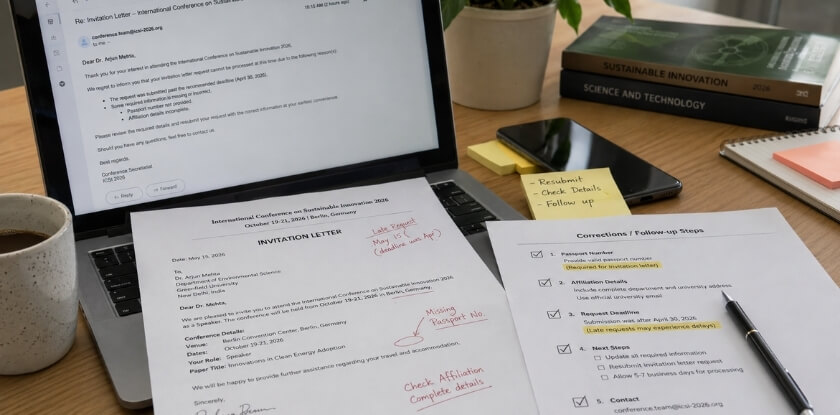
- Waiting too long. Organizers may be handling many similar requests, so a message sent a week before your visa appointment may not get a quick turnaround. Ask as soon as your registration is confirmed. Rushing often means settling for a generic letter that may not satisfy the consulate.
- Being vague. “Please send me an invitation letter” may get you a one-paragraph note without your affiliation, passport details or purpose. State your name, affiliation, attendance dates and why you need it.
- Asking for only one version. A visa letter needs travel dates and registration status. A funding letter may need fee amounts or the conference’s academic standing. An authorization letter may need to be addressed to your department head. If you need it for several purposes, say so in the first request.
- Not checking the letter. A typo in your name or a wrong date can make a visa officer doubt the document. Confirm that it is on letterhead and signed, because a plain email from a coordinator may not satisfy a consulate or travel office.
- Submitting it alone. For a visa you will typically also need your registration confirmation, accepted abstract, proof of accommodation and financial evidence. A funder may have its own letter requirements.
- Writing to the wrong team. Large conferences have separate registration, program and visa support teams. A vague email to the general inbox may take longer to reach the right person.
Invitation Letter vs. Acceptance Letter: What’s the Difference?
Where a visa office asks for a letter, the invitation letter is the one to send, while universities and funders usually want both documents. Consulates are not judging your research. They want to confirm that the event is real and that someone there expects you.
What Each Document Does
An acceptance letter confirms that your paper, abstract or presentation proposal passed review. It is an academic credential, and universities, grant committees and research funders use it to show that your participation is substantive.
An invitation letter is addressed to you, confirms the dates, venue and official conference name, and is written for an outside reader who knows nothing about the conference, such as an embassy, employer or finance department. The tone is more formal and explanatory.
Which One for Which Purpose
| Purpose | Document to use |
|---|---|
| Visa application | Invitation letter is the main document. The acceptance letter is a helpful extra. |
| University approval or travel authorization | Both. The acceptance letter proves academic value, the invitation letter confirms the logistics. |
| Funding or sponsorship | Both. Funders want to see that your work was accepted on merit and that a real event expects you. |
When One Document Does Both
Some conferences issue a single document that acknowledges your accepted paper and formally invites you. Read it carefully, because it must include the conference name, dates, venue and your name to work as an invitation letter. If it only confirms acceptance, ask the organizers for a separate invitation letter. When in doubt, ask which document they recommend for visa or institutional use.
Sample Conference Invitation Letter Template
Below is a general-purpose template you can adapt for an embassy, an HR office or a funding application. The organizers fill in the bracketed fields, and you confirm that the details match your registration or paper submission records.
[Conference Letterhead or Organization Name] [Full Address of the Conference Organization] [City, Country] [Date]
To Whom It May Concern,
We are pleased to invite [Full Name of Attendee], [Passport Number or Date of Birth as required], to attend the [Full Name of Conference], to be held at [Venue Name and Address] from [Start Date] to [End Date].
[Full Name of Attendee] has been accepted to [present a paper titled / participate as a delegate / attend as a registered participant] at this event. The conference focuses on [brief subject area, e.g., “advances in renewable energy engineering”] and draws participants from academic institutions, research organizations, and industry from around the world.
All conference fees, including registration, have been paid in full / will be covered by [organization name if applicable]. Accommodation arrangements have been made for the duration of the event / the attendee is responsible for their own accommodation and travel arrangements.
We respectfully request that the relevant authorities extend any courtesies necessary to facilitate [his/her/their] attendance. Should you require any additional information, please contact us at the details below.
Yours sincerely,
[Name of Signatory]
[Title, e.g., Conference Chair, Program Director]
[Organization Name]
[Email Address]
[Phone Number] [Website]
How to Use This Template
Send it to the organizers as a starting point if they do not have their own format. Many organizers have their own format, but smaller or regional events sometimes do not, and a draft saves time.
Before the letter goes anywhere official, check three things: the name matches your passport exactly, the dates are correct, and the signatory has an institutional email address and not a personal Gmail. Inconsistencies can raise questions at the embassy. If the letter goes to your employer, ask the organizers to add a line on the professional relevance of the event, such as “the conference directly addresses topics central to [your field].”
Adjusting the Template by Purpose
- For a visa application, add your passport number or date of birth (whichever the consulate requires), the full venue address and clear dates. Some embassies also want your registration status and a named contact at the organizing body. Check the consulate’s own document checklist.
- For university approval, the key element is confirmation that your paper was accepted or that you have a defined role. Attach the acceptance letter, since a department chair or grants office usually needs both.
- For a sponsorship or funding request, ask the organizers to state the registration fee and any other confirmed costs, such as a conference dinner or workshop fee. Concrete figures make it easier for a committee to approve a specific amount.
From our experience at MS International: At MS International Conferences Inc., the invitation letter process starts automatically once payment clears, and the letter is issued within 3 to 5 business days as a PDF to your registered email. Check your name and passport details carefully when you register, because a US$50 administrative fee may apply to corrections after the letter is issued. A notarized letter is optional and a separate paid service on request (US$100, typically up to 10 business days, non-refundable). Fees are non-refundable, a visa refusal does not create an automatic right to a refund, and each letter is issued only for the participant, conference, dates and location named in it. MS International conferences are held in person in the Greater Toronto Area.
FAQ
New to conference invitation letters? You might be unsure how long one takes, whether it can come before payment, if a PDF satisfies your employer, and whether a colleague can share yours.
Do I need an invitation letter to attend a conference abroad?
Not always. The US State Department says a letter of invitation is not needed to apply for a visitor visa, while IRCC says it sometimes asks Canadian visitor visa applicants for one. Check your destination embassy’s page, because your employer or funder may still want a letter.
Do all conferences issue invitation letters?
No, not automatically. Many conferences provide one to registered participants, but some small or regional events have no formal process. Start with the registration system or the organizers’ contact email.
How long does it take to get an invitation letter?
At MS International the letter is issued within 3 to 5 business days after payment clears. Other organizers set their own timing, so check the conference’s visa page and request it early.
Is an invitation letter the same as a visa support letter?
Often yes, because the two names overlap, but some organizers issue a separate, more formally worded “visa support letter.” Ask which document your embassy wants and say in your request that it is for a visa application.
Can I get an invitation letter before I pay the registration fee?
Usually not. Many organizers, MS International included, issue it only after registration and payment. If you need proof for funding first, ask for a registration or acceptance confirmation instead.
Does my employer or university need the original letter, or is a PDF fine?
A PDF is usually enough for employer or university approval. For a visa, check your embassy’s checklist, because some consulates may ask for a printed original with a wet signature.
What if the letter is missing information my embassy requires?
Ask the organizers to revise it. Be specific about what is missing, such as your passport number, exact dates or the venue address. At MS International a US$50 administrative fee may apply to corrections requested after the letter is issued.
Can a co-author or colleague use my invitation letter?
No. Each attendee needs a personal letter issued in their own name. A visa officer or HR department will notice at once if the name does not match.
Does an invitation letter guarantee a visa?
No. IRCC’s letter of invitation page states that a letter does not guarantee a visa, and the embassy or consulate makes the decision. Financial proof, ties to your home country and complete application forms matter just as much.
What if the conference has no letter template?
You can draft a letter in the standard format and ask the organizers to review it and sign it on official letterhead. Some conferences accept this. Make sure it includes your name, the event name and dates, the venue and organizer contact details.
Is the letter different for a presenter and a general attendee?
The structure is the same, but a presenter’s letter usually names the paper title and the presenter or speaker role. That detail can strengthen a funding or sponsorship request, so ask for it if it is missing.
Final Thoughts
A conference invitation letter is a simple document that carries real weight with visa offices, university approval chains and funding committees. Request it as soon as your registration or acceptance is confirmed, check every detail against your passport, and keep a copy with your other supporting documents.
Disclaimer: This article is general information, not legal or immigration advice. Visa rules, fees and document requirements change, so confirm them with the official embassy, consulate or immigration website for your destination before you apply.