
You submitted your conference paper and it got accepted, so where exactly did the proceedings go? The two terms get mixed up easily, whether you are preparing a first submission or trying a new venue such as an ACM, IEEE, or Springer event.
Quick answer: Conference proceedings is the published collection of papers from a conference, while a conference paper is one individual research work inside that collection. The proceedings usually carry an ISBN or ISSN and are sometimes indexed in databases such as Scopus, IEEE Xplore, or the ACM Digital Library. The paper is what gets peer reviewed, cited, and listed on your CV.
Fact-checked by the MS International Editorial Team. Last verified against official sources: October 2026.
Conference Proceedings vs Conference Paper: Key Differences
A conference paper is one research document written by an author or team and submitted to a conference. Conference proceedings is the published collection of the accepted papers from that event. The proceedings is the container; the paper is the content.
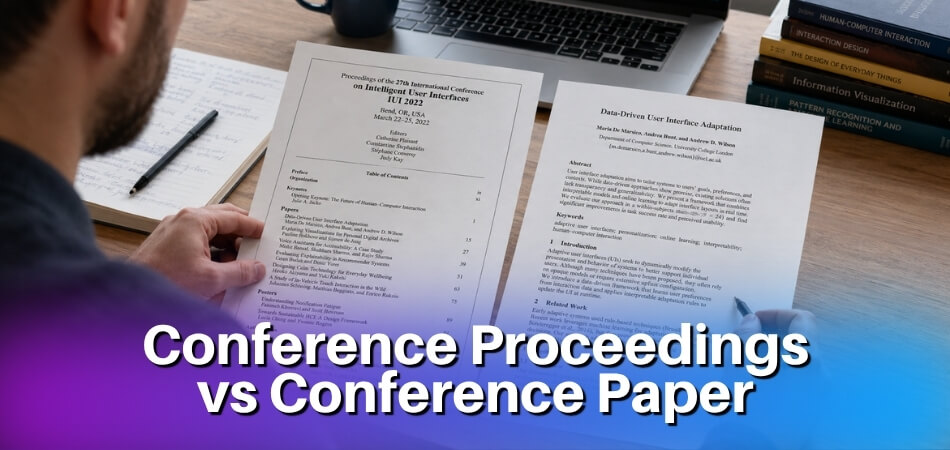
A conference paper goes through peer review and gets accepted or rejected. If it is accepted, the author usually presents it in a session or as a poster.
Conference proceedings is the book or digital archive that holds dozens or hundreds of those papers. It is published under the name of the organizing body or a publisher such as IEEE, ACM, or Springer, it normally carries an ISBN or ISSN, and it may be indexed in databases like Scopus, IEEE Xplore, or the ACM Digital Library.
So when someone says “my paper is in the proceedings,” they mean their individual paper is one entry inside that larger published volume. The table below puts the two side by side.
| Feature | Conference Paper | Conference Proceedings |
| What it is | A single research work submitted and presented at a conference | The collected volume of the accepted papers from that conference |
| Scope | One paper, one set of authors | Many papers from many authors |
| Written or compiled by | The author(s) | The publisher, conference organizer, or program committee |
| Format | Article format (abstract, methodology, results, references) | Book-like or journal-like compilation |
| Identifier | May carry a DOI; no ISBN or ISSN of its own | ISBN (book) or ISSN (serial) |
| Peer review | Yes, each paper is reviewed before acceptance | Not as a whole; the papers inside it are reviewed, and the standard varies by conference |
| Published by | Appears inside the proceedings; it is not published on its own | IEEE, ACM, Springer, a society, or the organizer |
| Indexing | Found through the indexed proceedings, or through citations in Google Scholar | The volume is what a database such as Scopus, IEEE Xplore, or the ACM Digital Library indexes |
| Length | Set by each conference’s call for papers; shorter than a journal article | Varies; one volume can run to hundreds of pages |
| Citation | You cite the individual paper and name the proceedings as its source | The publication context; you cite the whole volume only when you mean the volume itself |
| Academic value | Judged by citation impact, venue reputation, and indexing status | Judged by the same factors; the quality of the volume reflects on every paper in it |
A few points from the table are worth spelling out.
Identifiers work at different levels. The volume gets an ISBN (if published as a book) or an ISSN (if it is part of a recurring series). Individual papers can get a DOI, which is what you use when linking or citing. That is why a paper may be listed under both a DOI and an ISBN: they belong to different layers of the same publication.
Indexing is assigned to the venue, but it surfaces the paper. If the proceedings is not indexed in Scopus or another recognized database, your paper will not show up there, even if the peer review was legitimate. That matters for researchers whose institutions track indexed publications for promotion or funding.
Peer review applies to the paper, not the proceedings. A well-known publisher name does not prove that every paper in a volume was rigorously reviewed. Review standards vary by conference, so check the conference’s review process separately from its publisher.
The submission always targets the paper level. You submit a full paper (or sometimes an extended abstract) to the organizers, and the proceedings come together after the acceptance decisions, compiled by the publisher or the program committee.
What Is a Conference Paper and How to Identify One
A conference paper is original research written for presentation at an academic or professional conference. It is usually peer reviewed, presented as a talk or poster if accepted, and then published in the proceedings of that event.
Characteristics and Structure of a Conference Paper
The structure is recognizable, though the exact format varies by field and organizer. Many IEEE and ACM conferences give authors a template with set margins, column layouts, and section requirements.
A typical conference paper includes:
- Title and abstract. The abstract summarizes the problem, method, and findings, within the word limit the venue sets.
- Introduction. It frames the research question and explains why it matters.
- Related work. It places the paper within existing literature.
- Methodology. It describes what was done and how.
- Results and discussion. It presents the findings and interprets them.
- Conclusion. It wraps up the contributions and possible future work.
- References. They follow the style the venue asks for (IEEE style, ACM style, APA, and so on).
Conference papers are generally shorter than journal articles, and the page limit comes from each conference’s call for papers. At MS International, full papers normally run between four and twelve pages, including tables, figures, references, and appendices.
Peer review for conference papers is often faster than for journals, because it follows the conference schedule. That does not make it lenient: competitive conferences accept only part of what they receive.
One practical way to identify a conference paper is its metadata. A DOI pointing to IEEE Xplore, the ACM Digital Library, or a Springer proceedings volume usually means it is a conference paper. Such papers can often also be found in Scopus and Google Scholar, and in computer science and engineering their citations carry real academic weight.
Full Paper vs Conference Paper: What Is the Difference?
A conference paper is the general category: any paper accepted and presented at a conference. A full paper is a submission type, meaning a complete, fully developed research paper as opposed to a shorter format. A short paper is still a conference paper; it just represents earlier-stage work or a narrower contribution.
Many conferences accept several types of submission:
- Full papers. Complete research with methodology, results, and analysis.
- Short papers. Preliminary or partial research, with a lower page limit than a full paper.
- Extended abstracts. An abstract or a brief summary of a page or two.
- Posters. Presented at the conference, but may need only an abstract or a short summary for the proceedings.
So when a call for papers says “submit a full paper,” it wants a complete research document.
This matters for indexing. Scopus, for example, covers conferences that publish full-text papers, so a volume of abstracts alone is not eligible. An ISBN or ISSN on the volume does not guarantee that every submission type inside it is indexed, so check what the proceedings actually include.
A full paper is also not the same as a journal article. However thorough, it still appears in the proceedings, uses a conference citation format, and is treated differently in academic evaluation. Some institutions value the two equally and others do not, depending on the discipline and the criteria being applied.
What Are Conference Proceedings and What Do They Contain
Conference proceedings are the published record of a conference: a compiled volume, or set of volumes, holding the accepted papers presented at one event. If a conference paper is your individual contribution, the proceedings is the container that holds it alongside everyone else’s work.
Components Inside a Conference Proceedings Volume
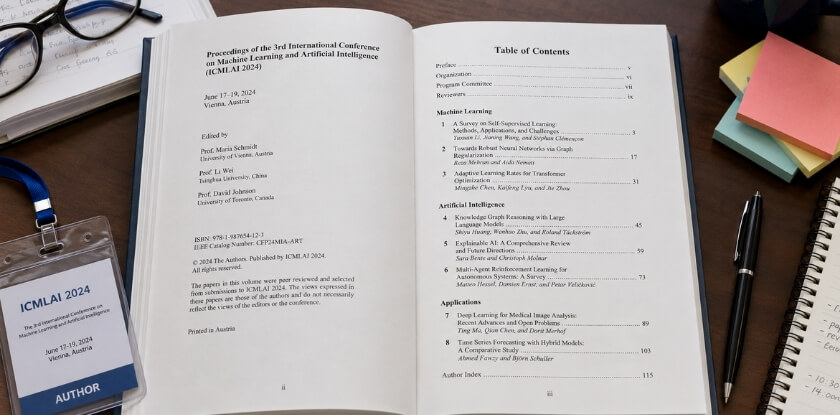
A proceedings volume is more structured than a stack of papers bundled into a PDF.
Most volumes open with front matter: the conference name, dates, location, the organizing committee and program chairs, and a preface from the chair. Readers and databases use this to verify the source, so it matters for citation.
The main body is the collection of accepted papers, usually grouped by topic or session track. Each paper typically includes the author list, affiliations, abstract, body, and references, and sometimes a short author bio. The volume also carries a formal identifier (an ISBN, an ISSN, or both), which lets databases catalog it as a citable publication.
Some volumes add supplementary material such as keynote transcripts, workshop summaries, poster abstracts, or panel notes. These are generally not peer reviewed to the same standard as the full papers, so notice which section of the proceedings your paper sits in. It can affect how the work is perceived.
Higher-quality proceedings tend to share a few traits:
- A documented peer review process, ideally with a stated acceptance rate
- Clear publication metadata (publisher, year, volume or issue identifiers)
- Indexing in recognized databases like Scopus, IEEE Xplore, or the ACM Digital Library
- Editorial oversight from a credible program committee
Who Publishes Proceedings: ACM, IEEE, Springer, and Others
The publisher shapes where a volume is indexed, how accessible it is, and how much weight it carries in evaluation.
- ACM (Association for Computing Machinery) publishes proceedings for hundreds of computing conferences in the ACM Digital Library. ACM uses a standard formatting template, and the library’s DOI system makes individual papers persistently citable.
- IEEE (Institute of Electrical and Electronics Engineers) does the same for engineering, electronics, and computer science. Its papers appear in IEEE Xplore, a primary database in those fields. Quality still varies across the many conferences IEEE sponsors.
- Springer publishes proceedings through its Lecture Notes in Computer Science (LNCS) series and other series. These are available on SpringerLink, and some volumes are also covered by Scopus.
Other credible publishers include Elsevier (through certain conference partnerships), USENIX (systems and security, with many proceedings freely available online), and independent professional societies that self-publish with ISSN registration.
University-hosted or small regional conferences sometimes self-publish without a major commercial publisher. That can still be legitimate, since many respectable workshops work this way, but such proceedings may not be indexed in Scopus, which affects citation impact and visibility.
The Process of Getting a Paper Included in Conference Proceedings
Your paper reaches the proceedings in five stages: submission and screening, peer review, camera-ready submission, registration, and identifier assignment. Missing any one can keep it out of the volume, so plan your timeline around all five.
Submission and Initial Screening
Most conferences that produce formal proceedings want a full paper, not just an abstract. Some events accept an abstract for presentation but include only full papers in the proceedings, so read the call for papers to see which applies.
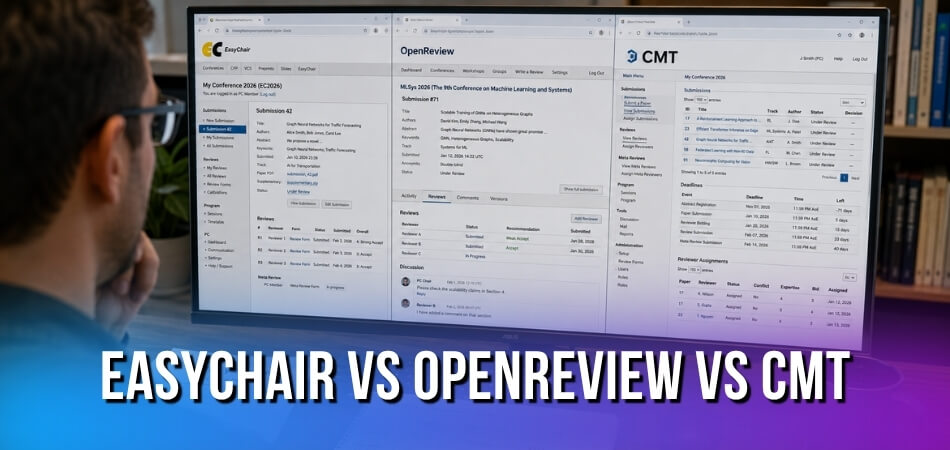
Submission usually goes through a conference management system. EasyChair is common at smaller events, while IEEE and ACM conferences often use their own portals. Format the paper to the conference template: IEEE and ACM both provide LaTeX and Word templates, and papers that deviate badly can be desk-rejected before peer review begins.
Peer Review
For proceedings to be indexed by Scopus, IEEE Xplore, or the ACM Digital Library, the conference must run a credible peer review. Several reviewers from the program committee usually assess each submission, and the outcome is typically one of these:
- Accept. The paper goes forward to the camera-ready stage.
- Accept with revisions. You fix the points the reviewers raise before the final version is collected.
- Major revisions with re-review. You get another round.
- Reject. The paper will not appear in the proceedings.
Competitiveness varies widely, and some conferences publish their acceptance rates while others do not. A low rate does not automatically signal quality and a high one does not signal a weak event, so look at the review process itself.
Camera-Ready Submission
After acceptance you submit a camera-ready version, the final formatted copy that goes into print and onto digital platforms. The conference sets a deadline, often only a few weeks away, to apply reviewer feedback and match the publisher’s template exactly.
This stage usually involves signing a copyright transfer agreement. IEEE and ACM publications typically ask you to transfer copyright or grant publication rights to the publisher, and Springer’s Lecture Notes series works in a similar way. Read what you sign, because it affects whether you can post the paper on your own site or in an institutional repository.
Registration Requirement
Many conferences require at least one author to register and pay the conference fee before the paper is included in the proceedings, even if that author cannot attend in person. Some organizers offer a paper-only registration rate, so check whether that option exists.
Why an Accepted Paper Can Still Be Left Out
Acceptance and inclusion are separate steps, and a paper can be accepted without appearing in the volume. Reasons that conference instructions commonly give include:
- No author completed registration by the deadline.
- The camera-ready file or copyright form arrived late or in the wrong format.
- The paper was not presented, at conferences that exclude papers that were not presented.
- The organizers chose only some papers for the published volume.
Check the accepted-paper email and the author instructions for the exact conditions, because they differ from one conference to the next.
ISBN, ISSN, and DOI Assignment
Once the camera-ready papers are collected, the publisher assigns identifiers. The volume receives an ISBN, and a recurring conference series may also carry an ISSN. Individual papers usually receive a DOI, which makes them permanently citable. IEEE Xplore and the ACM Digital Library assign DOIs through their own systems. The next section explains how the identifiers differ.
From our experience at MS International: our submissions follow APA format and go through double-blind peer review, with most review decisions returned within about 10 working days, although complex papers or revision rounds can take longer. A decision is an acceptance, a revision request, or a rejection. After acceptance, authors must complete author registration to confirm participation, and accepted papers presented in person at our events in the Greater Toronto Area may be considered for conference proceedings where applicable. Publication is not guaranteed by acceptance, registration, payment, or presentation, and the work must not be published or under review elsewhere.
Indexing and ISBN/ISSN: Where to Find Conference Proceedings
Check where a conference’s proceedings are indexed before you submit, because a paper in a non-indexed volume is hard for other researchers to find.
Scopus, IEEE Xplore, ACM Digital Library, and Google Scholar
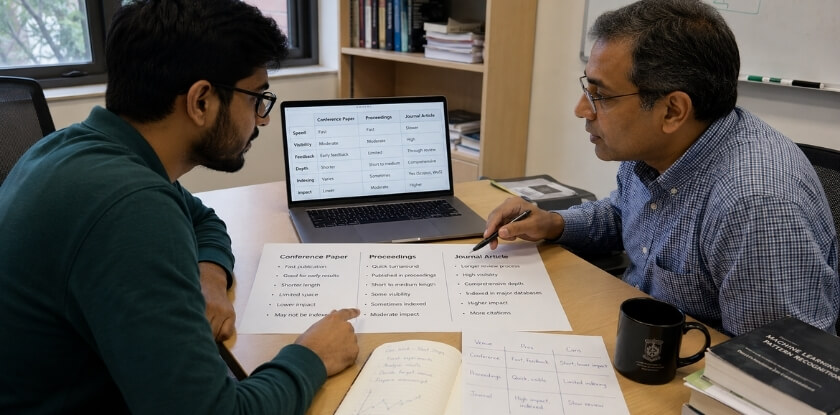
Each platform treats proceedings differently, and each carries different weight in evaluation.
| Platform | Best known for | What to remember |
| Scopus | The database most people mean by “indexed” | Coverage is selective: an independent Content Selection and Advisory Board reviews suggested titles, and conferences must publish full-text papers |
| IEEE Xplore | Engineering, computer science, and electronics | IEEE-sponsored and technically co-sponsored proceedings feed into it, and some are also covered by Scopus |
| ACM Digital Library | The computing community | Major venues such as SIGCOMM, SIGGRAPH, and CHI are searchable here |
| Google Scholar | Widest reach | It crawls freely available PDFs and repositories, so it is not formal indexing |
Scopus is the database institutions often mean when they ask whether a conference is “indexed.” When your proceedings are in Scopus, citations to your paper count in that database, and many universities use it when tallying indexed publications. Elsevier’s Scopus content page says conference material enters in two ways, as a special issue of a regular journal or as a dedicated proceeding, that proceedings may be serial or non-serial, and that Scopus covers conferences that publish full-text papers. It also says that only serial titles can be suggested to the Content Selection and Advisory Board. In practice, a recurring series with an ISSN can be proposed for coverage, while a one-off volume cannot be suggested on its own.
Google Scholar casts the widest net with little gatekeeping. A paper can appear there even if its proceedings are indexed nowhere else, which helps discoverability, but some formal assessments count only formal databases, so check what your institution accepts.
To check a claim yourself, use the free Source Title page on Scopus: search for the conference series or proceedings title, and open the entry to see the years covered. Scopus also offers a downloadable source title list, updated monthly. IEEE and ACM list their conference proceedings in their own libraries. If a conference says it is Scopus-indexed but you cannot find the series or the year there, treat the claim skeptically and ask the organizers for the exact source title.
ISBN vs ISSN: Which One Applies and When
Proceedings can carry an ISBN, an ISSN, or both, and the difference is not arbitrary.
An ISBN (International Standard Book Number) is, in the words of the International ISBN Agency, the unique identifier for every title, edition and format of a book. Most proceedings are one-time volumes, essentially books, so they typically receive an ISBN. A volume in Springer’s Lecture Notes in Computer Science series, for instance, gets its own ISBN.
An ISSN (International Standard Serial Number) identifies a continuing resource such as a journal or periodical, whatever its medium, according to the ISSN International Centre. Some conferences recur regularly and register an ISSN for the series, while each year’s volume may also carry its own ISBN. The ISSN Centre says that when a publication has both an ISSN and an ISBN, both should be shown.
The difference matters when you build a citation or check what kind of publication something is. A volume with only an ISBN is treated bibliographically as a book, while one with an ISSN has a serial identity and may be handled differently by databases.
Individual papers do not carry their own ISBN or ISSN, since those belong to the volume. Inside the volume a paper is identified by its page range, its DOI if assigned, or a handle in a database such as IEEE Xplore or the ACM Digital Library.
A valid ISBN or ISSN is a reasonable baseline check but not proof of quality, because an ISBN can be obtained without any editorial oversight. Indexing in Scopus or IEEE Xplore is the stronger signal.
Academic Value and Citation Impact of Conference Proceedings
Proceedings carry real academic weight, but how much depends on the venue, the field, and how strictly the papers were reviewed.
How Conference Papers Are Cited
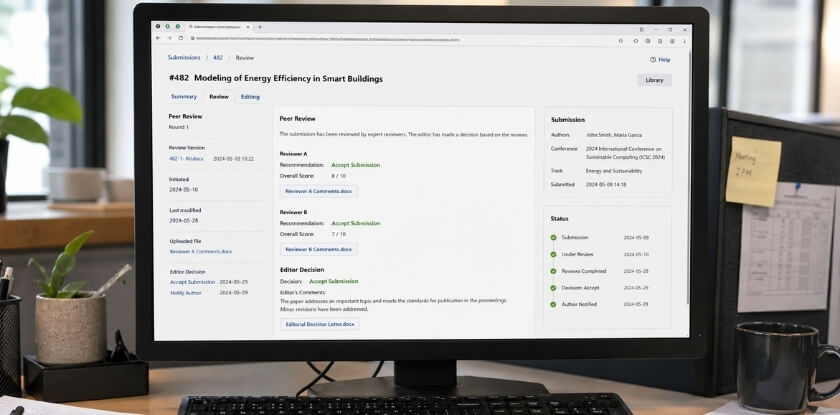
A paper in IEEE or ACM proceedings is cited much like a journal article. Researchers find it in IEEE Xplore or the ACM Digital Library, add it to a reference manager, and cite it with the conference name, year, and page numbers. Google Scholar picks up many major proceedings, so citation counts can build up the same way they do for journal work.
Cite the paper itself, not the volume. A reference to the individual paper gives its authors, title, the proceedings title, year, page range, and DOI if there is one. Cite the proceedings as a whole only when you mean the volume itself, for example its front matter or the editors’ preface, and then the editors take the place of the authors. Reference formatting details come from the style guide your venue or university requires.
The key difference from a journal is visibility. A paper in a well-indexed volume gets discovered, while one buried in an obscure PDF with no Scopus or Google Scholar presence is easy to miss.
Does a Conference Paper Count as a Publication?
For most academic purposes, yes. A peer-reviewed paper in indexed proceedings is a legitimate publication that counts toward your record, appears on grant applications, and carries weight in hiring and promotion in many fields.
Prestige is field-dependent. In computer science, top venues such as NeurIPS, CVPR, or SIGCOMM are often considered more competitive and timely than many journals. In the humanities and social sciences, journal articles usually still carry more weight and conference papers are seen as works in progress. Some societies also treat their proceedings as a lighter record: in a 2024 post, the International Society for Horticultural Science describes its proceedings as concise records, given a general review for readability, and distinct from journal papers that are rigorously reviewed for scientific content.
Citation Impact: What Actually Drives It
Four factors decide whether a conference paper collects meaningful citations.
- Indexing coverage. Papers in Scopus or IEEE Xplore are easier to find than those that exist only on a conference website.
- Peer review quality. A full paper through double-blind review at a selective conference carries more credibility than an extended abstract accepted at an open-submission event.
- Conference reputation. Established series such as Springer’s Lecture Notes in Computer Science are widely read, while a new event with no indexing history has no track record to show.
- Timeliness. Conference papers usually appear faster than journal articles, which matters in fast-moving fields.
Comparing Proceedings to Journal Articles
A sensible plan is to use the conference paper to establish priority and get early feedback, then develop the work into a journal submission. The journal version has to be a real extension. Journals expect substantial new content, and policies differ. Some journals name a minimum share of new material, while others leave “substantial” to the editor: the policy page of IEEE Transactions on Wireless Communications (updated 2017), for instance, says conference papers cannot be republished without substantial additional technical material, and that there is no quantitative threshold. The common rule is disclosure. Cite the conference version, say what is new, and check the journal’s prior-publication policy before you submit. Reusing the same data, text, or conclusions without a cross-reference is what counts as redundant publication.
Watch Out for Predatory Conferences
A predatory conference collects fees without real peer review, and it can damage your academic reputation if you publish there. Some conferences exist mainly to collect submission fees, not to advance knowledge.
What Makes a Conference Predatory
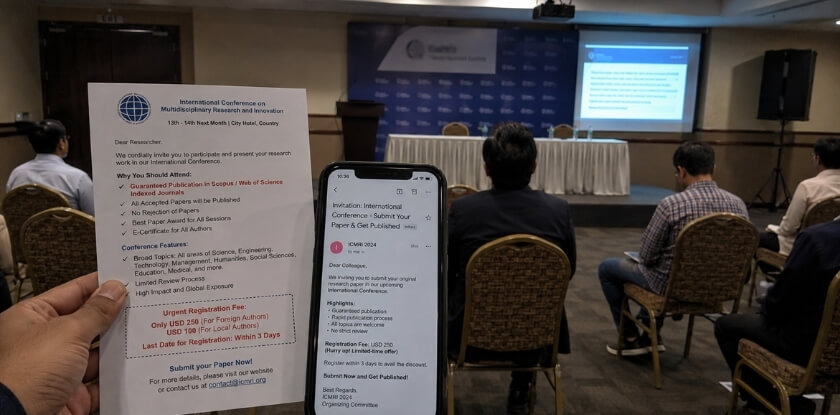
The defining trait is near-guaranteed acceptance with little or no peer review. You submit, you pay, your paper appears in the proceedings, and the organizers profit without scrutinizing your work. Their proceedings often copy the look of real ones, with an ISBN and a table of contents, but the review behind them is absent or meaningless.
Other red flags include:
- Spam invitation emails with flattering but vague praise for your “outstanding research”
- An unusually broad or mismatched scope, such as one conference covering physics, nursing, economics, and education at once
- Proceedings not indexed in Scopus, IEEE Xplore, or the ACM Digital Library, or promised indexing “after the conference”
- No clear affiliation with a recognized publisher like Springer, ACM, or IEEE
- Venue details that change, or venues listed as prestigious hotels with no academic institutional connection
- Registration and publication fees due before acceptance decisions are made
Why It Actually Matters
A paper in a predatory conference’s proceedings is unlikely to collect many citations. Google Scholar may index it, but a reputable database may not, and your institution may not count it toward your publication record. In some fields, an association with predatory venues can be treated as a credibility problem, not a simple mistake.
How to Check Before You Submit
- Verify the indexing status. Look up the proceedings on the Scopus Source Title page or in IEEE Xplore before submitting.
- Check the conference history. Legitimate recurring conferences have past editions with traceable proceedings and consistent organization. Confirm that earlier proceedings really appeared in the database the organizers claim. If you cannot find earlier editions, or the website was registered two months ago, that is a problem. In computer science, the CORE conference ranking portal is another place to look.
- Look at the program committee. Real conferences list reviewers with verifiable affiliations. An anonymous committee or vague affiliations suggest the review is not functioning.
- Ask colleagues in your field. Senior researchers often know which conferences in your area carry real value, and a short conversation can save you a lot of trouble.
Real peer review takes time. A promised decision within a week of submission, with no identifiable review mechanism, is one more warning sign.
Do Proceedings Count as Publications? FAQ
Fitting proceedings into your academic record comes down to peer review, ISBN or ISSN numbers, indexing, legitimacy and whether registration is needed for the paper to appear at all.
Are conference proceedings considered peer-reviewed publications?
Not automatically. Proceedings count as peer reviewed only when the conference runs a formal review of each paper. Others use light-touch reviewing or none at all, so check the stated review policy before you submit.
Do conference papers count as publications on a CV?
Yes, in most disciplines. Papers in indexed proceedings with real peer review count as publications. They are usually listed separately from journal articles but still add to your publication record.
Is a conference paper the same as a journal article?
No. A conference paper is shorter, tied to a specific event, and published in that event’s proceedings. A journal article follows a different editorial review, usually takes longer, and is often held to a higher originality standard. Some conferences feed special journal issues as a separate track.
Can conference proceedings be cited?
Yes. Cite the individual paper with the proceedings title, year, and page range, and cite the whole volume only when you mean the volume itself. Weight varies by field: computer science and engineering often value conference citations highly, while other disciplines favour journals.
Do proceedings have an ISBN or ISSN?
Either, or both. A one-off volume normally gets an ISBN, and a recurring conference series may also carry an ISSN. Individual papers get neither, though they may receive a DOI.
Does being in proceedings mean my paper is indexed?
No. Indexing is decided for the proceedings series or volume, not for each paper. Scopus, for example, covers conferences that publish full-text papers, so check the Scopus Source Title page or ask the organizers for the exact source title before submitting.
Are all conference proceedings legitimate?
No. Predatory conferences collect fees, skip meaningful peer review, and publish proceedings with little credibility. Such a paper is technically published but may not be indexed in a reputable database. Research the organizers carefully before submitting a full paper.
Do I have to register for my paper to appear in the proceedings?
Often yes. Inclusion is usually tied to at least one registered author, and that author does not always have to attend. Ask the organizer whether a paper-only rate exists.
Can a conference paper be published as a journal article later?
Often yes, if the journal version adds substantial new work. Tell the editor about the earlier paper when you submit. Thresholds vary by journal: some state a percentage of new material, others leave it to the editor.
Conclusion
A conference paper is your individual contribution, and the proceedings is the published collection that holds it. Getting the terms right saves you from mistakes in your CV, submission forms, and conversations with supervisors or journal editors.
Before you submit anywhere, check two things: where the proceedings are indexed and whether the venue runs genuine peer review. If a conference cannot answer both clearly, choose another one.