
Booking flights for a US conference is the easy part. Working out which kind of entry permission you actually need is where many travellers get stuck. The official names sound alike, and picking the wrong one can cost you time and money.
Quick answer: Most people attending a US conference need a B-1 or B-1/B-2 visitor visa, and travellers from Visa Waiver Program countries can use ESTA instead. There is no separate “conference visa”. Both routes are for short, unpaid trips. If a US source will pay you a salary or fee, you may need a different status, so confirm it before you book anything.
Fact-checked by the MS International Editorial Team. Last verified against official sources: October 2026.
The right choice depends on your passport, your role at the event (listener, unpaid speaker, paid speaker, exhibitor or organiser staff), how long you will stay, and who pays you. The officer looks at what you will actually do in the United States, not at the name of the event.
Which US Status Fits Your Conference Trip?
Start with your passport, then your role: ESTA if your country is in the Visa Waiver Program, a B-1 or B-1/B-2 visa if not, and a work-based status if you will be paid.
| Your situation | Usually suitable status |
| Passport from a Visa Waiver Program country, unpaid attendee or speaker, stay of 90 days or less | ESTA |
| Passport from any other country, professional or academic conference | B-1 (or B-1/B-2) visa |
| You already hold a valid B-1/B-2 visa | Use it, no new visa needed |
| Conference is purely social or recreational | B-2 may apply |
| US source pays you a salary, fee or contract | Visitor visa and ESTA are not enough |
Not sure which route applies to you? The State Department’s Visa Wizard asks for your purpose of travel: choose “Business” for a conference. Check the current Visa Waiver Program list on the State Department or CBP site, because it changes. Canada is not in the Visa Waiver Program, but Canadian citizens have their own exemption, so Canadians need no visa for a US conference and no ESTA for a short trip. Check two 2026 rules before you choose. First, since January 1, 2026, a presidential proclamation (No. 10998) partly suspends B-1/B-2 visas for nationals of 19 listed countries, so look up your nationality on the State Department site. It applies to people who did not already hold a valid visa on that date, and case-by-case exceptions exist for travel in the US national interest. Second, you should apply in your country of nationality or residence (rule applied from September 6, 2025), so booking an appointment in a third country may not work.
Main Visa Options for Attending a Conference in the USA
B-1 Business Visitor Visa
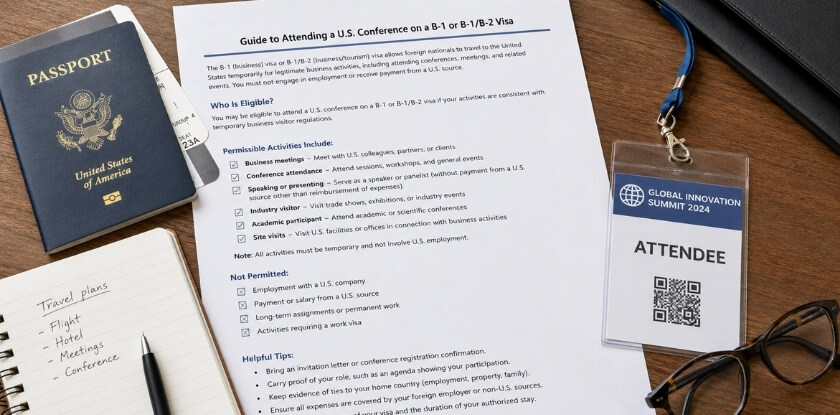
The B-1 visa is the standard choice for professional, academic, scientific and business conferences. State Department and CBP guidance lists attending a convention, conference or seminar as a permitted B-1 activity, as long as no salary or income comes from a US employer or business.
You can use B-1 to attend sessions, present a paper or poster without US employment, join business meetings, network, and discuss future collaboration. You cannot use it to take a job, work for a US company, or perform paid services.
B-1/B-2 Visitor Visa
Many travellers hold a combined B-1/B-2 visa, which covers short business activity and tourism together. A four-day conference in Chicago followed by two days of sightseeing fits this visa well, provided the visa and passport are valid and you can explain the trip at the port of entry.
ESTA Under the Visa Waiver Program
ESTA is an online travel authorisation, not a visa. Citizens of Visa Waiver Program countries can use it for a permitted business or professional event lasting 90 days or less, with no US employment or US salary. It costs about USD 40 per application on the official ESTA site (confirm the current amount before paying), and an approval is normally valid for two years or until the passport expires.
ESTA is quicker than a visa, but less flexible. The 90-day limit cannot simply be extended, and anyone with a past refusal or a complicated purpose may be safer applying for a B-1/B-2 visa.
B-2 Visitor Visa
B-2 is meant for tourism, family visits, medical treatment and social activities. If the conference relates to your work, study or field, B-1 is the better match.
Allowed Conference Activities on a Visitor Visa
A visitor visa or ESTA can usually be used for conference activities that are temporary, unpaid and part of professional exchange.
These are normally fine:
- Attending sessions, keynotes, workshops and panel discussions
- Presenting research or a paper without payment
- Meeting contacts and discussing future business or academic cooperation
- Short tourism before or after the event
When you present, carry proof such as an abstract acceptance letter, speaker invitation, event program or registration. Networking is also acceptable: discussion is allowed, but doing paid work in the United States is not.
Activities You Should Not Do on a Conference Visitor Visa
A B-1, B-1/B-2 or ESTA entry does not allow you to work in the United States, even if the trip starts as a conference visit.
Avoid these:
- Accepting a US job or working for a US company
- Providing paid consulting, training or client work
- Working as conference staff or managing a booth as assigned labour
- Providing technical support or event services
- Extending your stay to begin unauthorised work
Limited reimbursement of travel costs is treated differently from a salary or professional fee, but the details matter. If an organiser offers any payment, ask for the terms in writing before you accept.
Paid Speakers, Exhibitors and Organiser Staff: Which Status?
If a US organiser or company pays you for your time, a B-1 or ESTA may not be the right status, and the answer depends on who pays and for what.
| Role | What to check |
| Attendee | B-1 or ESTA is normally fine |
| Unpaid speaker or paper presenter | B-1 or ESTA, with an acceptance letter that states the role is unpaid |
| Speaker offered a fee or honorarium | Get written confirmation of the status before accepting |
| Exhibitor staff of a foreign company | State Department guidance ordinarily classes employees of foreign exhibitors at international fairs as B-1. Employees of US exhibitors are not eligible for B-1 |
| Organiser staff hired or paid by a US company | Needs a work-based status |
Honoraria are the grey area. The State Department’s Foreign Affairs Manual lets a B-1 visitor accept an honorarium and related incidental expenses only for usual academic activities, such as lecturing or guest teaching, and only if all of these are true:
- The activity lasts no longer than nine days at any single institution or organisation.
- The payer is a higher-education institution or a non-profit or government research organisation.
- The services are for the benefit of that payer.
- You have not accepted such payment from more than five institutions or organisations in the last six months.
A fee from a company or a commercial conference organiser is not covered by this rule, so do not assume it is allowed. Ask the consulate or an immigration lawyer, and ask the organiser to put the payment terms in the invitation letter.
If your work in the US is genuinely paid employment, the usual routes are a J-1 exchange visitor programme through an approved sponsor, an O-1 for people with extraordinary ability, or an H-1B for specialty-occupation employment. Each needs a US sponsor or petitioner and takes far longer than a visitor visa, so raise it with the organiser months ahead.
Before you accept any speaking role, put three questions to the organiser:
- Will I receive any payment, or only reimbursement of travel costs?
- Is the payer a US company, a US institution or a foreign body?
- Can the invitation letter describe my role and the payment terms in plain words?
The answers decide whether a visitor status is enough, so write them down before you apply.
Who Can Attend a US Conference on a Visitor Visa or ESTA?
A wide range of visitors can attend, as long as the visit is temporary and involves no unauthorised work.
Academic Researchers and Paper Presenters
Researchers can present papers, join poster sessions and meet other scholars. Carry the abstract acceptance letter, a university or employer letter, the presentation title, funding proof and your return plan.
Business Professionals and Entrepreneurs
Business visitors can attend trade shows, seminars and corporate conferences and meet potential partners. A company representative should carry an employer letter with job title, purpose of travel, approved leave dates and who pays. Founders may meet investors and discuss partnerships, but a visitor visa does not allow running a US business or managing staff in the US.
Doctors, Engineers, Educators and Specialists
Professionals can attend for learning and networking, but attending is not the same as practising. A doctor cannot treat patients on a visitor visa, and an engineer cannot do paid project work for a US company.
Students From Outside the United States
Students enrolled abroad can attend with a B-1/B-2 visa or ESTA if eligible. Prepare an enrolment certificate, a university letter, the conference acceptance or registration, proof of funding and evidence of ongoing studies.
Students Already in the USA
F-1 students may usually attend academic conferences related to their studies, but should talk to their Designated School Official if payment, off-campus work or travel outside the US is involved. J-1 exchange visitors should check with their programme sponsor first. Carry your passport, I-20 or DS-2019, student ID and conference registration.
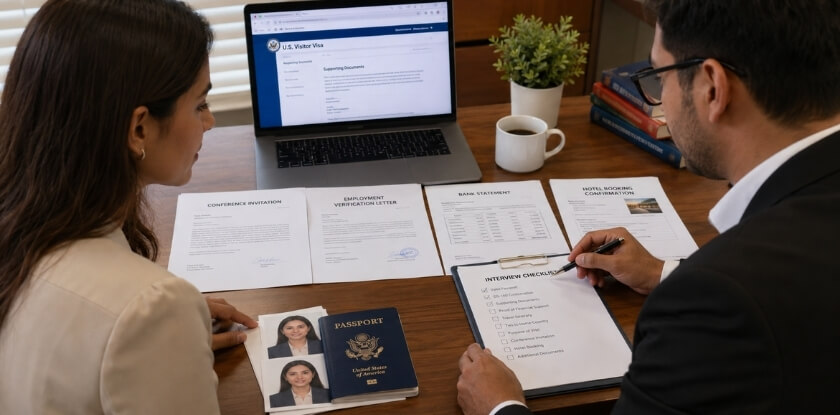
Required Documents for a US Conference Visa
A strong application proves your identity, the event purpose, your ability to pay, a temporary stay and a reason to return home.
| Document | Why it matters |
| Valid passport | Confirms identity and travel eligibility |
| DS-160 confirmation page | Shows the online visa form was submitted |
| Visa fee receipt | Confirms required payment |
| Conference invitation or registration | Proves the purpose of travel |
| Abstract or speaker acceptance | Supports your role at the event |
| Employer, school or business letter | Shows your current status |
| Bank statement or sponsorship proof | Shows you can afford the trip |
| Hotel and travel plan | Explains where and how long you will stay |
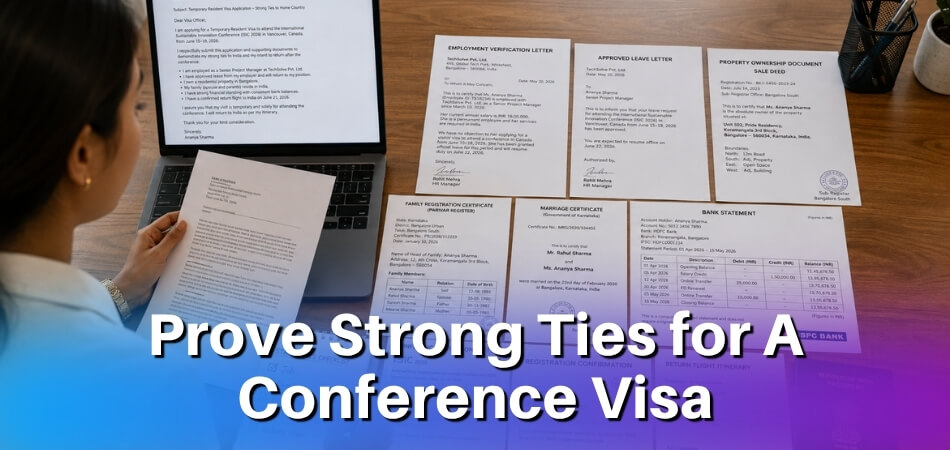
| Home country ties | Supports your intent to return |
Dates, employer name, funding source and purpose must match across your DS-160, invitation letter, interview answers and supporting papers.
What Should a Conference Invitation Letter Include?
A US conference invitation letter should be clear, specific and easy to verify. It should state:
- Your full name, role and presentation title if any
- Conference title, dates, venue or city, and organiser name
- Registration or invitation confirmation
- Whether participation is unpaid, or exactly what travel support is covered
- Organiser contact details
A vague letter creates doubt. A strong one answers who you are, why you are attending, where the event is and what you will do there.
Step-by-Step Process to Apply for a US Conference Visa
If you need a visa, the order is: pick the status, complete the DS-160, pay the fee, book the interview, then attend with matching documents.
- Choose the status. Use the table above. ESTA applicants skip steps 2 to 5 and apply online instead.
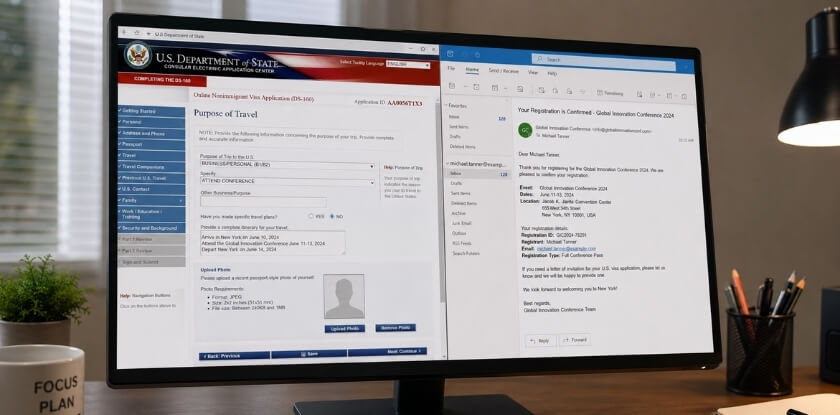
- Complete the DS-160. This is the online non-immigrant visa form. Be specific about your purpose: write that you are attending or presenting at a named conference, not just “business”.
- Pay the visa fee shown on the official State Department fee page.
- Book the interview through the official system for your location, in your country of nationality or residence.
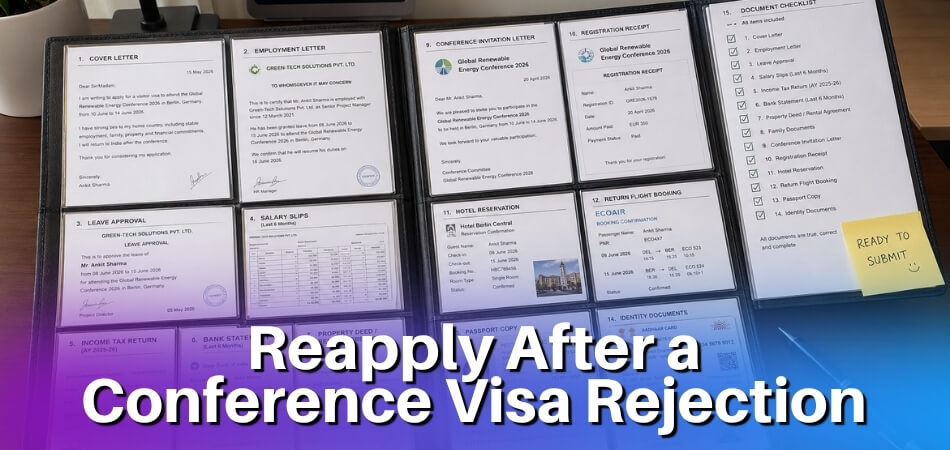
- Organise your documents by category: identity, conference purpose, employment or study, finances, travel plan and home ties. Each document should support a specific part of your case.
- Attend the interview. Expect questions about why you are attending, your role, who pays, how long you will stay, and whether you will be paid in the US. Answers to the common questions in a USA conference visa interview should be short, honest and match your DS-160, for example: “I am attending a four-day technology conference in Boston. My employer is paying, and I will return to work afterwards.”
- Track your passport. If approved, it may be kept for visa printing. Do not make final non-refundable plans until it is returned. If you are placed in administrative processing, follow the embassy instructions and send any requested documents quickly.
How Long Does It Take to Get a US Conference Visa?
Processing time depends mainly on interview wait times, embassy workload, case review and passport return, so some applicants finish in days and others wait weeks or months.
Appointment wait times vary by location and season, so check the State Department wait-time tool and apply as soon as your registration or invitation is ready. First-time applicants, presenters and people in busy locations should allow the most time. Buy non-refundable flights only after approval, because an invitation does not guarantee a visa.
How Much Does a US Conference Visa Cost?
The B visa application fee is USD 185 and ESTA is about USD 40.
| Item | B-1/B-2 visa | ESTA |
| Government fee | USD 185 (since June 17, 2023) | About USD 40 |
| Interview | Usually required | Not required |
| Stay limit | Decided at entry | Up to 90 days |
| Best for | Broader visitor travel | Short eligible trips |
Several 2026 details can change your budget or plan:
- Interview waivers were narrowed from October 1, 2025, so plan for an interview even if you applied before without one.
- For applicants from a list of countries, a visa bond of USD 10,000, 15,000 or 20,000 can be required. The programme became permanent on August 3, 2026. The State Department says the bond is returned if you leave the United States in line with the visa terms, or if you do not travel.
- A pilot expedited appointment option costs an extra USD 750 and runs until December 31, 2026. Availability depends on your post.
Other costs to expect: passport renewal and photos, translation, courier, travel and a hotel near the interview location, plus conference registration, flights and accommodation after approval.
Can You Use an Existing B-1/B-2 Visa for a Conference?
Yes, a valid B-1/B-2 visa can be used for a conference if the activity fits visitor rules. You do not need a new visa only because the purpose is a conference.
Before travelling, check visa and passport validity, conference dates, hotel booking, return plan, funding documents, and whether your role involves payment. At the port of entry, carry your invitation, registration confirmation and proof of employment or study, and keep the explanation simple: “I am attending a three-day academic conference in Seattle and returning home two days later.”
What If Your Conference Plans Change?
A change in plans does not always make your visa unusable. If dates change, carry the updated details and make sure the new dates still look like a temporary visit. If the conference is cancelled, do not claim you are attending it, though you may travel for another permitted purpose if your plan is truthful. The same visa can be used for a different conference if that event fits visitor rules; bring the documents for the new event.
Can Family Members Travel With You?
Yes, but each person needs their own visa or ESTA. Your conference status does not cover a spouse, children, parents or relatives.
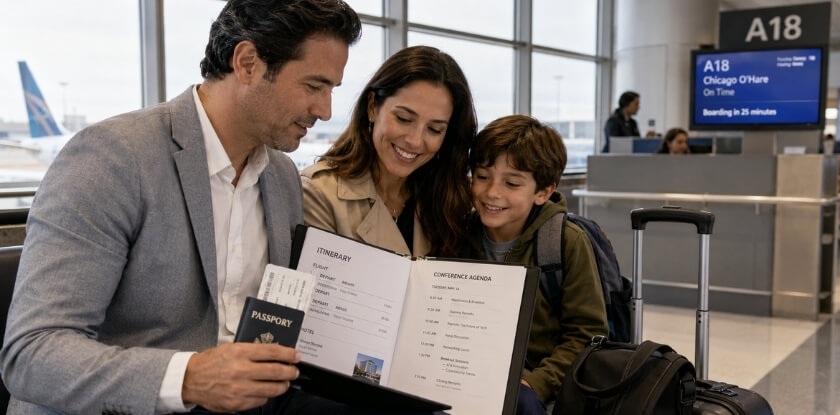
Family members may travel for tourism while you attend, with an honest purpose that is separate from yours. They should carry a passport, valid visa or ESTA, hotel details, return travel plan, financial proof, and relationship proof if useful. A family trip is easier to explain when the dates are reasonable and everyone returns together.
Common Reasons for US Conference Visa Refusal
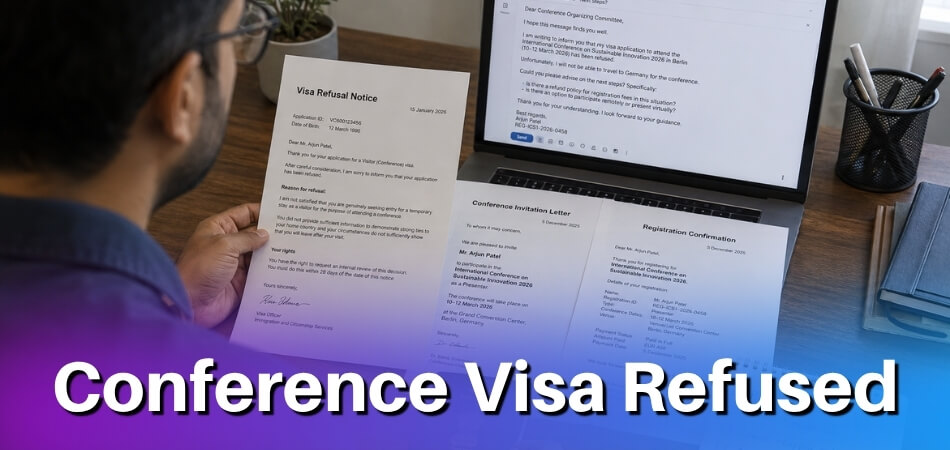
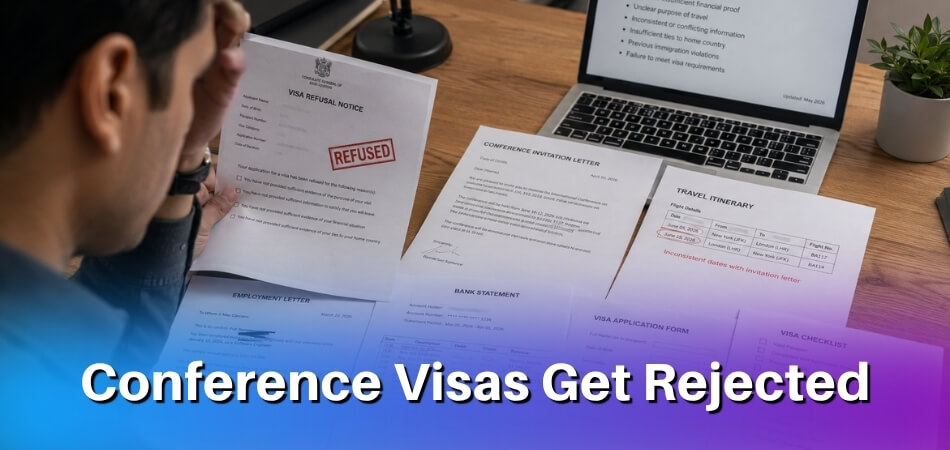
A visa may be refused when the officer is not satisfied that your purpose is clear, temporary and allowed. A refusal does not mean the conference is fake or that you can never qualify. It means the case did not prove eligibility that time, so if you reapply, show what has changed.
| Common problem | What helps |
| Weak home country ties | Show employment, study, business or family ties |
| Unclear conference purpose | Carry a clear invitation and explain your role without exaggeration |
| Inconsistent DS-160 information | Use accurate details that match your documents |
| Insufficient or unclear funding | Show who pays for the trip |
| Suspicion of unauthorised work | Do not describe paid duties; avoid mentioning work you are not authorised to do |
| Long stay that does not match the event | Keep the stay length reasonable |
The strongest applications show a natural link between your background and the event, such as a lecturer presenting research, a software engineer at a technology summit, or a business owner at a trade event.
From our experience at MS International: before you apply, ask the organiser to state in writing whether your role is unpaid, whether only travel costs are reimbursed, and the exact event dates. A letter helps your case, but it cannot guarantee approval or decide your status for you.
Frequently Asked Questions (FAQ)
Choosing between ESTA and a B-1 for an American conference affects what you can do there, including presenting a paper, taking a speaking fee, adding tourism and attending more than one event.
Do I need a visa to attend a conference in the USA?
Yes, unless you qualify for ESTA under the Visa Waiver Program. Everyone else normally applies for a B-1 or B-1/B-2 visitor visa.
Is there a special US conference visa?
No. Conference travellers use the existing B-1, B-1/B-2 or ESTA routes, and the officer judges the activity you describe.
Can I present a paper on a B-1 visa?
Yes, if the presentation is unpaid and the conference is temporary and professional or academic. Carry your abstract acceptance letter and the programme page that lists your talk.
Can I receive payment for speaking?
Only in narrow cases. A B-1 visitor may take an academic honorarium from a university or non-profit research body for up to nine days at one institution, and from no more than five in six months. A company fee is not covered.
Is ESTA enough for a conference in the US?
Yes, if your country is in the Visa Waiver Program, your stay is 90 days or less and nobody in the US pays you. Attending sessions and presenting unpaid are normal business-visitor activities.
How much does a US conference visa cost?
Budget USD 185 if you need a B-1/B-2 visa, or roughly USD 40 if ESTA is enough for you. A visa bond or the optional USD 750 expedited appointment can add to that for some applicants.
Can I attend more than one conference?
Yes, on a valid visitor visa, if each event fits visitor rules and your total stay is reasonable.
Can I do tourism on the same trip?
Yes, short tourism before or after the conference is usually acceptable on B-1/B-2 or ESTA, provided the whole visit stays temporary.
Should I book flights before visa approval?
It is safer not to buy non-refundable flights until the visa or ESTA is approved. Use flexible or refundable bookings where possible, because an invitation does not guarantee approval.
Can a previous refusal affect my application?
Yes, but it does not automatically block approval. Answer honestly and show what has changed.
Is travel insurance required?
No, it is not usually required for a visitor visa, but it is strongly recommended because medical care in the United States can be expensive.
Final Takeaway
For most conference trips, the answer is a B-1 or valid B-1/B-2 visa, or ESTA if your country is in the Visa Waiver Program. The deciding factor is payment: unpaid attending and presenting fits visitor rules, while a US salary or service fee does not. Confirm current fees and rules with the State Department, CBP and your consulate before you apply.
Disclaimer: This article is general information and not legal or immigration advice. Rules, fees and processing times change, so check official US government sources or consult a licensed immigration professional for your situation.