
You open a conference submission page and the guidelines ask for an extended abstract, while you only have the regular abstract ready. It is a common moment of doubt, and the two terms are easy to mix up. This article sorts out what each one is and when to use it.
Quick answer: An abstract is a short summary, usually 150 to 300 words, of a paper that already exists or will exist. An extended abstract is a longer standalone submission, often 500 to 1,500 words or 1 to 4 pages, that reviewers judge on its own merits. Limits differ by event, so always check the call for papers.
Last verified against official sources: October 2026.
Both formats summarize research, but they are written, reviewed and used differently. Sending one when the call asks for the other is an easy way to lose a place on the programme.
Abstract vs Extended Abstract at a Glance
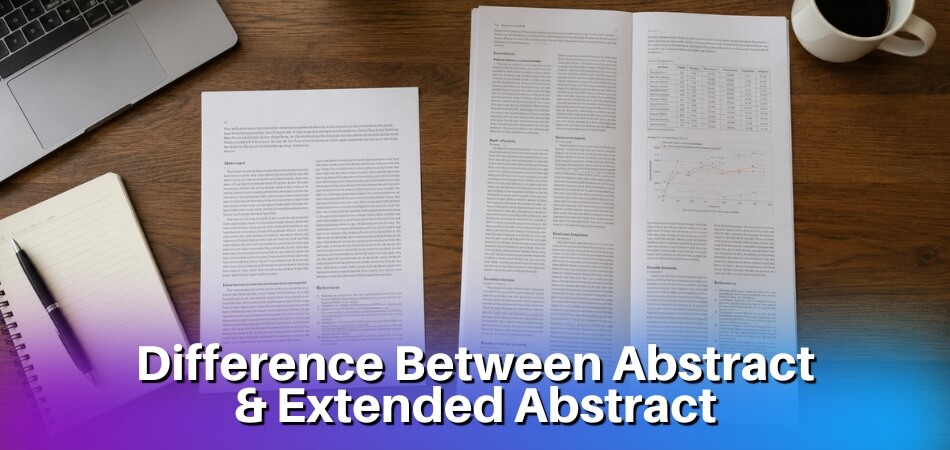
An abstract summarizes a paper. An extended abstract is the submission itself, sitting between that summary and a full paper. The table gives typical ranges only; the call for papers always has the final say.
Side-by-Side Comparison
| Feature | Abstract | Extended Abstract |
| Typical length | 150 to 300 words | 500 to 1,500 words, or 1 to 4 pages (some calls allow up to 6 pages or about 3,000 words) |
| Contains results | Usually, if informative | Yes, often preliminary |
| Standalone submission | Sometimes (many conferences review only an abstract) | Frequently |
| Structure | One paragraph, or labelled sections if the venue requires a structured abstract | Short sections: introduction, background, method, results, conclusion, sometimes references |
| Reviewed as | A quick check of topic and fit | A short paper |
The core distinction is scope. An abstract summarizes an argument in a few sentences. An extended abstract makes an independent scholarly case that can be evaluated, and at some events published in the proceedings, without any full paper behind it.
What Is a Standard Abstract?
A standard abstract is the short summary at the start of a research paper, journal article or conference submission. It tells readers whether the full paper is worth their time. Most venues set a hard limit between 150 and 300 words, and some set it lower, such as 250 words. APA Style, the format MS International asks authors to follow, tells authors to limit an abstract to 250 words unless told otherwise and to write it as one paragraph without an indent. It adds that journals and instructors may set different limits.
An abstract must stand alone. It has to make sense without the paper, so every sentence needs to carry weight.
Descriptive Abstract vs Informative Abstract
A descriptive abstract says what the paper is about without reporting what it found. It reads like a teaser: “This paper examines the relationship between X and Y in the context of Z.” It is often under 100 words and is more common in humanities and some social science fields, where the argument unfolds through interpretation.
An informative abstract covers the problem, method, key results and conclusion within the word limit. It is the usual format in STEM fields, computer science and most peer-reviewed journals. Reviewers use it as a first filter, so a descriptive abstract can look thin there. If the guidelines do not say which type they want, informative is the safer choice.
Both types can be used for either format. For an extended abstract, reviewers almost always expect the informative approach, because they want to see what you found, not only what you studied. A descriptive extended abstract is sometimes accepted at a humanities event, but it works against you in STEM fields.
Structured vs Unstructured Layout
Many abstracts are a single flowing paragraph. Some journals, and most medical and clinical conferences, require labelled sections (Background, Methods, Results, Conclusion) with the same tight word count. Extended abstracts in computer science often follow a paper-like layout instead, while humanities and social science versions tend to stay as prose with more argument and depth than a standard abstract needs.
What Is an Extended Abstract?
An extended abstract sits between a standard abstract and a full paper. It gives your method, preliminary or complete findings and the significance of your contribution, but stops well short of a manuscript. Committees use it because it reveals far more about the actual research than a 250-word summary can.

Real calls vary a lot. Some ask for about 500 words, some for one page, many for two to four pages, and a few allow six pages or around 3,000 words. Some humanities and social science events label a piece of only 500 to 800 words an “extended abstract.” The label does not guarantee the length, so read the guidelines of that specific event.
Unlike a standard abstract, it usually has section-level structure: a brief introduction, related work or background, method, results (or expected results if the work is in progress) and a short conclusion. Some venues require references, and some templates also ask for a short summary at the top, before the sections. That structure lets evaluators check whether your methods are sound without waiting for a full paper.
Extended Abstract Compared With a Full Paper
A full paper carries the complete burden of proof. Every claim is supported, the related work is thorough, the method is detailed enough to replicate, results are fully reported and the discussion states limitations. Length depends on the field and venue (MS International asks for full papers of about four to twelve pages including references).
An extended abstract is selective by design. A two-page version might describe your algorithm, report key benchmark results and sketch the comparison with prior work, but it will not carry the full experimental setup, edge-case analysis or complete literature review. You are making a targeted pitch: here is the problem, here is what we did, here is why it matters.
Acceptance of an extended abstract also does not always carry the same weight as a full paper acceptance at the same event, and some venues count the two separately. That is no reason to avoid the format, since it is the right one for many tracks, but know what each acceptance represents when you describe it on a CV.
Some events let an extended abstract serve as a placeholder while the full paper is still in progress. This is common in fast-moving fields where research cycles are shorter than annual conference deadlines.
Key Differences Between Abstract and Extended Abstract
Length is the visible difference, shown in the table above. The differences that change how you write are depth, independence and how each is judged. Submitting the wrong format, or writing one as if it were the other, is a common reason for rejection.
Length and Word Count
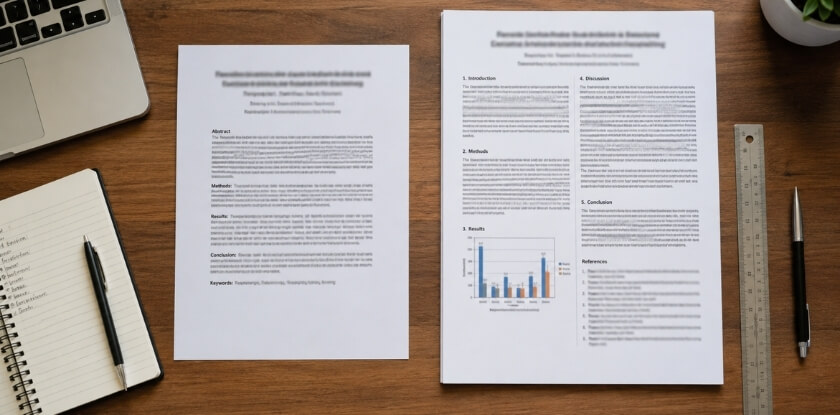
The most obvious difference is size: roughly 150 to 300 words against 500 to 1,500 words or 1 to 4 pages. The extra length is there to carry real content: method details, selected results and a brief discussion of implications. Some calls set a formatted page limit instead of a word count, so check which one your event uses.
How Real Events Set the Limits
Published calls show how much the numbers move between events. Each row below is that event’s own rule.
| Event | Abstract | Extended abstract |
| University of Colombo Annual Research Conference 2024 | Not more than 300 words | Not more than 1,500 words, excluding references |
| Carbon 2022 | Short abstract of up to 500 words, pasted into the submission form | Optional PDF on the event template, length up to the author but typically two pages |
| American Marketing Association proceedings (competitive papers) | Full papers carry an abstract of up to 50 words | Four main sections of up to 200 words each, no reference list |
The Colombo guidelines also require both to report original research. At Carbon 2022 the extended abstracts were collated with a DOI after the conference, so one event treated them as a permanent record. The American Marketing Association encourages the extended abstract for authors who plan to publish the full work elsewhere. None of these figures is a standard, which is why the call for papers always decides.
Depth of Content
A standard abstract states what you did and what you found. An extended abstract also explains how you did it and why the findings hold. In a full paper those details live across several sections; here they are compressed into a few focused paragraphs. Reviewers expect enough method detail to judge validity, which a 200-word abstract cannot provide.
Standalone Value
A standard abstract summarizes something that exists elsewhere, and readers who want details can find the paper. An extended abstract must deliver enough substance that a program committee can evaluate the work without anything else. That is a different writing task, and treating it as a longer summary usually produces a weak submission.
Where Each One Is Used
| Format | Typical context |
| Standard abstract | Journal submission, full paper, thesis, database indexing, conference programme entry |
| Extended abstract | Conference submission, workshop proposal, peer review before a full paper exists |
Standard abstracts are read after the full paper exists. Extended abstracts often stand alone, submitted when no full paper has been written yet. That is a significant structural difference in how each is written and evaluated.
How This Differs from Journal Abstract Evaluation
For a journal, the abstract is not evaluated in isolation. It is read as part of the full paper, helping the editor decide whether to send it out and helping reviewers orient themselves. An extended abstract is the submission. It is reviewed on its own, and where it is accepted it may be published without a full paper, so the standard is closer to that of a short paper. Reviewers know they are adding that content to a permanent record, which is why the criteria are often more rigorous than first-time submitters expect. Many conferences also review standard abstracts alone for a presentation slot, but that is a fit check on topic and relevance rather than a review of the method. A few journals also use the term “extended abstract” for an expanded summary of 800 to 1,000 words printed alongside the full article, so the label alone does not tell you the format.
Where Extended Abstracts Are Used: Academic Fields Overview
The extended abstract is not universal. Some disciplines rely on it heavily and others barely use it, so judge from the call rather than from habit.
Computer Science and Engineering
These fields use extended abstracts more than most. Research moves fast, and conference proceedings carry more weight than journals in many subfields, so some events treat a two to six page extended abstract as the submission itself and review it directly rather than as a preview of something longer. Other events in the same fields, including many workshops, run non-archival tracks where the abstract is only posted on the event website. Check which one you are entering.
Humanities and Social Sciences
Most humanities journals expect a standard abstract of about 150 to 250 words attached to a full manuscript. Extended abstracts appear mainly at conferences as a selection tool: you submit 500 to 1,000 words so the committee can decide whether your argument merits a slot. Here the extended abstract is a gatekeeping document, not a publication in itself.
In social sciences it depends on the field. Sociology and political science conferences often use short abstracts of 200 to 300 words for initial selection, while linguistics and communication studies sometimes request longer versions closer to the computer science model, especially at interdisciplinary events.
STEM Fields Outside Computer Science
Biology, chemistry and physics conferences typically ask for standard abstracts for poster and oral submissions, usually under 300 words. Some engineering symposia and applied science meetings request one or two page extended versions when the committee needs more technical detail to judge feasibility. Medical and clinical conferences usually use structured abstracts with labelled sections rather than free-form extended prose.
Interdisciplinary and Mixed Conferences
These are where format confusion is most common. A conference bridging computer science and social science, or STEM and humanities, may have guidelines that match neither community’s habits. “Extended abstract” can mean a two-page technical summary or a 1,000-word argumentative overview. Read the call closely, and when in doubt look at accepted submissions from previous years, which show the real format better than ambiguous wording.
Extended Abstract Peer Review and Evaluation Criteria
An extended abstract is evaluated almost like a short paper, while a standard abstract is usually scanned for relevance and fit. That difference decides how you prepare each.
What Reviewers Are Actually Looking For
Criteria vary by field and event, but committees usually assess a similar set of points.
Clarity of the research question. Define a specific problem and say why it matters. Vague framing such as “this paper explores issues in X” tends to sink a submission early.
Methodological soundness. You do not need full detail, but reviewers need enough to judge whether the method fits the question.
Significance of contribution. What is new? If reviewers cannot find a clear contribution within the first few paragraphs, the submission is usually rejected whatever its other merits.
Preliminary results or grounding. Claims with no evidence at all score lower. You do not need a complete dataset, but you need something concrete, such as tentative results or a theoretical anchor.
How Acceptance Rates Factor In
There is no universal acceptance rate for extended abstracts. Rates differ widely between events and tracks, and competitive events can be selective, so write as if reviewers are comparing you against a large pool. An extended abstract that reads like a rough draft is passed over even when the research is solid.
Peer Review Format for Extended Abstracts
Review format varies: single-blind, double-blind or light-touch review are all used. Feedback is often a few sentences per criterion, and decision cycles follow the conference timeline. At MS International the review is double-blind and decisions normally come within about 10 working days (see the section on our process below), but other organisers set their own schedule.
Common Reasons Extended Abstracts Get Rejected
Scope too broad. Covering three related studies in 1,500 words gives none of them depth. Pick the single strongest contribution.
Missing related work. Even a brief note on how your work sits against existing literature signals scholarly awareness. Skipping it reads as a gap.
A long descriptive abstract in disguise. High on context, low on method and findings. Reviewers notice the difference immediately.
Weak conclusion. Ending on “future work will address this” without stating what you showed or expect to show leaves reviewers unconvinced.
Extended Abstract Example (Annotated)
Seeing an example is often more useful than another paragraph of explanation. The annotated extended abstract below is fictional and modelled on a computer science submission of roughly 600 words, which sits inside the typical range. Each section is labelled so you can see what role it plays. Annotations appear in brackets after each passage.
Sample Extended Abstract
Title: Predicting Student Dropout Risk in Online Learning Environments Using Lightweight Transformer Models
Authors: J. Martinez, S. Okonkwo, R. Patel Affiliation: Department of Computer Science, University of Westmere Submitted to: a conference on educational data mining
Introduction
Student dropout in online courses remains a persistent problem across higher education institutions worldwide. Existing prediction systems tend to rely on deep learning architectures that require substantial computational resources, making deployment difficult for institutions with limited infrastructure.
[This opening gives context and identifies the gap. You tell the reviewer why the work matters before saying a word about method. Two sentences is enough.]
This paper presents a lightweight transformer-based model trained on behavioral engagement signals (login frequency, video completion rate, forum participation) that achieves competitive dropout prediction accuracy while running on standard CPU hardware.
[One sentence summarizes the entire contribution. The reviewer now knows what the paper does, and specific features are named rather than left vague.]
Problem Statement
Current approaches, including LSTM-based and full BERT-scale models, require GPU clusters or cloud infrastructure that most mid-size institutions cannot sustain. Existing lightweight alternatives sacrifice too much accuracy to be practically useful. There is no widely adopted solution that balances both constraints simultaneously.
[Three sentences, each doing work. This is the research gap stated precisely enough for a reviewer to judge whether the paper addresses it.]
Methods
We trained a four-layer transformer model with a reduced attention head count (4 heads, embedding dimension 128) on a dataset of 14,200 students drawn from three public universities across two academic years. The dataset was split 70/15/15 for training, validation and testing. Dropout ground truth was defined as non-completion of the enrolled term after week six.
[Specific numbers and definitions. This is what separates an extended abstract from a standard one: the reviewer can assess methodological soundness without the full paper. A standard abstract would say “a large dataset”; this one says 14,200 students across three institutions.]
Data preprocessing involved handling class imbalance via SMOTE oversampling on the training split only, to avoid data leakage. Engagement signals were extracted from LMS logs using a seven-day rolling aggregation window.
[Two sentences on preprocessing. A full paper would give a page to this; an extended abstract gives enough for peer review, not a replication guide.]
Results
On the held-out test set, the model achieved an F1 score of 0.81 and an AUC-ROC of 0.87. Compared to a full BERT baseline, our model uses 94% fewer parameters and runs inference in under 40ms per student record on a standard laptop CPU.
[Quantified results, stated directly. This is essential in an extended abstract for a STEM or computer science event, because reviewers need numbers to judge whether acceptance is warranted.]
Performance degraded by roughly 4 percentage points (F1) when tested on a fourth institution not seen during training, which we discuss as a generalizability limitation.
[An honest limitation. It signals rigor rather than overselling, and reviewers notice when obvious weaknesses are left out.]
Discussion
The results suggest that transformer architectures can be meaningfully scaled down for applied educational contexts without catastrophic accuracy loss. The 4-point generalization gap points toward a need for domain adaptation strategies in future work, particularly for institutions with non-Western student demographic profiles where behavioral patterns may differ.
[This interprets the results and points to where the research goes next, rather than restating them.]
Conclusion
This work demonstrates a viable path toward dropout prediction systems that institutions can actually deploy. The model is lightweight enough for on-premise hosting, accurate enough to generate actionable alerts, and the training pipeline can be reproduced with publicly available tools. Code and the anonymized dataset will be released upon acceptance.
[The conclusion closes cleanly without restating everything. Promising code and data on acceptance is common in STEM submissions and signals transparency.]
References
[5 citations listed, omitted here for brevity]
[Even a short extended abstract usually carries a few references. Some events allow only 3 to 8 citations, so check the guidelines.]
What the Annotated Example Shows
Every section earns its place. There is no background section drifting into a literature review. The problem statement defines the gap, the methods let the reviewer assess validity, and the results deliver evidence.
Specificity is the main difference from a standard abstract. The standard abstract for this paper might say “we trained a transformer model on student engagement data and achieved strong predictive accuracy.” The extended version gives 14,200 students, F1 of 0.81, a four-layer architecture and 94% parameter reduction. That detail is what makes meaningful review possible.
Length discipline matters. Each section is compressed but not vague. You are not writing a short paper; you are writing a structured preview that gives reviewers enough to decide.
For humanities or social science submissions the method section looks different (qualitative framing, theoretical lens, sources such as interviews or archival material), but the logic holds: give reviewers enough to judge the work, not everything you know.
How to Convert an Extended Abstract into a Full Paper
Expanding an extended abstract into a full paper is a structural rethink, not just added length. The extended abstract got you through the door as a compressed argument; the full paper is where you make the whole case.

What You Already Have
Most of the skeleton exists: research question, compressed method, key results and conclusion map directly onto full paper sections. The gap is evidence and depth. An extended abstract often states findings without fully demonstrating them, while a full paper must show the work through raw data, statistical tests, full experimental setups or detailed case analyses.
Section-by-Section Expansion
Introduction. Two or three sentences become a proper placement of your work in the literature, the specific gap and why your approach addresses it. This section usually grows the most.
Related Work. Extended abstracts often skip this or give a few citations. The full paper needs a focused account of the work yours builds on or responds to, not a list of everything published.
Methodology. Usually the most underdeveloped part. Another researcher should be able to replicate your process, so specify tools, parameters, dataset sizes and evaluation metrics.
Results. Present the data itself with tables, figures and analysis, and walk through it systematically rather than announcing the headline finding.
Discussion. Many extended abstracts fold discussion into the conclusion. The full paper separates them: interpret the results, address limitations, compare with prior work and consider implications.
Conclusion. This can stay close to your extended abstract version, now referring to the fuller argument.
Handling the Word Count Jump
The jump from roughly 500 to 1,500 words to a full paper of several thousand words can feel daunting, but the added content is almost entirely substantive: literature review, complete methods, full results and discussion. Do not pad the introduction or conclusion to fill space. Reviewers notice, and the expansion belongs in the sections that were deliberately compressed.
Tone and Framing
An extended abstract often has a slight sales quality because it is trying to secure acceptance. A full paper can be more measured: acknowledge complexity, note unexpected findings and say what the research does not resolve. In humanities and social science work, the compressed form can force overstatement, so use the extra space to qualify your conclusions.
Before You Submit the Full Paper
Check whether your extended abstract was published in proceedings, and read that event’s copyright and prior publication policy. The ICMJE recommendations say that an abstract or poster shown at a scientific meeting does not stop a journal from considering the full report, but COPE notes that policies differ on whether conference abstracts and papers count as prior publication. So disclose the earlier version, for example in a cover letter or author note, and say how the two documents relate. Revisit your title and keywords too, since a compressed argument can push authors toward titles narrower than the full scope.
Abstract vs Summary: A Quick Clarification
A summary recaps something that already exists, while an abstract is a formal, standalone piece tied to a research paper or conference submission. The terms are often swapped, but treating them as synonyms causes real confusion.
What a Summary Is
A summary is written after reading or finishing something, to restate its main points for someone who has not read it. It appears in book reports, literature reviews, annotated bibliographies and lecture notes. Length is flexible, the audience can be general and there is no standard format.
What an Abstract Does Differently
An abstract follows conventions: word limits, structure and sometimes explicit section labels. Its goal is to help readers decide whether the full paper is worth reading, which is a different purpose from “here is what this text said.” Nobody accepts or rejects a conference submission based on a summary.
Why the Confusion Persists
An abstract does summarize, so the functions overlap. In some humanities and social science writing, and in academic traditions translated into English, “summary” is used loosely to mean the abstract. The practical test is context: if you are submitting to peer review, you are writing an abstract with all its structural and word-count obligations, and if you are describing a source in your notes or a literature review, you are writing a summary.
Common Mistakes Writers Make
Both formats get rejected for consistent reasons, and often the problem is a mismatch between what the document is and how the writer treated it.
Treating an Extended Abstract Like a Shortened Paper
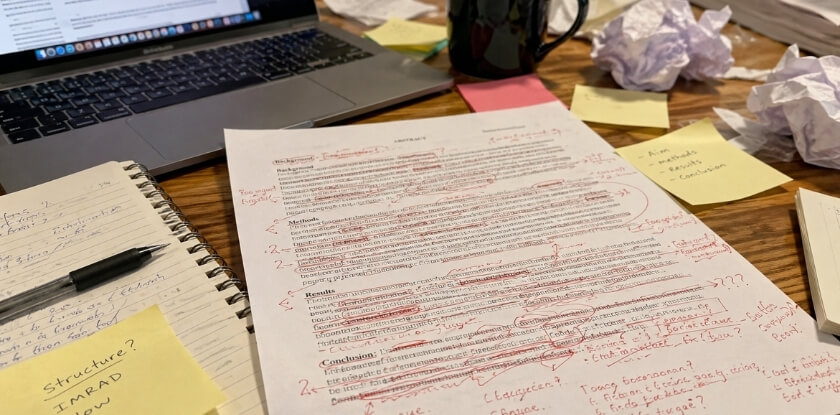
Writers take a draft full paper, cut it to 2 to 4 pages and submit it. The result reads as amputated rather than complete. An extended abstract needs a clear contribution, a method and a result, framed concisely. It is a different document with different priorities.
Treating a Standard Abstract Like a Teaser
Some writers describe the problem at length, hint at the approach and stop, leaving out the findings. An informative abstract should contain the key result: if someone reads only your abstract, they should know what you found, not just what you studied. Descriptive abstracts are the exception, used mainly in humanities and social sciences.
Ignoring the Word Limit
Submitting 350 words when the limit is 250, or 500 when it is 300, signals that you did not read the instructions. Going over usually means the text lacks focus. Identify the one central finding, cut secondary results and remove any sentence that restates another.
Burying the Contribution
Vague openings such as “Machine learning has been widely applied in many domains” tell the reviewer nothing. State the contribution in the first two or three sentences. Prefer “We found that…” over “It was found that…”: passive voice is not wrong, but overusing it makes abstracts harder to judge quickly.
Writing the Extended Abstract After the Paper Is Already Finalized
When the extended abstract is written as an afterthought, authors often give the introduction, methods and results one paragraph each. Instead, foreground the most evaluable content: the method and the core findings. Reviewers care whether the work looks promising and well executed, not whether every paper section is represented.
Forgetting the Audience
An abstract written for a general journal can be pitched too broadly for a specialist conference, and the reverse. Narrow technical venues can assume domain knowledge; interdisciplinary journals usually cannot. Calibrate vocabulary and assumed background to the readership, so reviewers spend their effort evaluating rather than decoding.
Copying the Introduction
An introduction contextualizes and an abstract summarizes. Pulling sentences from the introduction gives you text that sets the scene but never says what happened in the study. Read your abstract in isolation: if it could sit in front of a paper with completely different results, it is not specific enough.
How Abstracts and Papers Work at MS International Conferences
At MS International Conferences, authors can submit abstracts, full papers, case studies and review papers. The work must be original and must not have been published or be under review at another conference, journal or publication. Our guidelines ask that an abstract clearly explain the work’s purpose, method, key findings, significance and relevance to the selected conference, and that authors follow the official template and APA format.
Every submission goes through double-blind peer review. The editorial team screens it for scope, formatting and completeness, reviewers evaluate originality, methodology, clarity and relevance, and the decision arrives by email as an acceptance, a revision request or a rejection. Review normally takes about 10 working days.
From our experience at MS International: our submission page lists abstracts, full papers, case studies and review papers as the types we accept, and it does not define “extended abstract” as a separate type. A text with no method or findings does not meet the abstract description above. If an event page gives its own length, follow it exactly. Work that is under review elsewhere cannot be submitted to us.
FAQ
Deciding on an extended abstract involves word count, whether it counts as a publication, how peer review differs, whether the full paper can still be published and when to write it relative to the paper.
Do all conferences accept extended abstracts?
No. Extended abstracts are common at computer science and some social science events, but many journals and humanities conferences accept only a standard abstract attached to a full paper. Check the call for papers before you write anything.
What is the typical word count for an extended abstract?
Most calls ask for about 500 to 1,500 words or 1 to 4 pages, though some allow up to 6 pages or around 3,000 words. A standard abstract is usually 150 to 300 words. The event’s guidelines set the real limit, so ask the organizers if the portal does not say.
Can an extended abstract count as a publication?
Sometimes. It counts only if the event publishes it in proceedings; at a non-archival event it is not a publication. Even then, it is generally weighted below a peer-reviewed journal article, so label it clearly on a CV and check the event’s policy.
Is an extended abstract the same as an informative abstract?
No. An informative abstract is a type of standard abstract that includes findings and conclusions. An extended abstract is a standalone short paper with sections and enough detail to be evaluated independently.
What is the acceptance rate difference between abstract-only and extended abstract submissions?
There is no universal figure. Rates vary by event and track, and because reviewers see more of your work, the criteria for an extended abstract are usually stricter than for a standard abstract.
Can I still publish the full paper after submitting an extended abstract?
Usually yes, but the journal’s policy decides. The ICMJE recommendations allow journals to consider a full report after a meeting abstract, and COPE advises disclosing earlier versions. MS International requires work not to be previously published, so ask us first if your extended abstract appeared in proceedings.
Does peer review work the same way for extended abstracts?
The process is similar, but reviewers focus on methodological soundness and the plausibility of preliminary results. They are often judging whether the work deserves a presentation slot, not whether the paper is ready to publish.
Should I write the extended abstract before or after the full paper?
Either order works. Write it first if the research is early-stage, and after the paper if the paper is finished, using the key findings rather than the introduction as raw material.
What is the difference between an extended abstract and a descriptive abstract?
A descriptive abstract says what topics the paper covers without giving findings. An extended abstract gives substance: method, results and conclusions in condensed form. They serve different purposes.
Final Thoughts
An abstract belongs with journal papers and most conference paper packages, while an extended abstract is a standalone deliverable that reviewers use to judge your work before a full paper exists. If you are unsure which one an event wants, check the call for the word limit and whether it asks for references, figures or a method section. A 250-word limit with no structure guidance means a standard abstract; a 1,000-word limit with section headings means an extended abstract.