
Most people walk into a US visa interview worried about the one question they cannot answer. The questions are usually more ordinary than that, and they follow a familiar pattern. Preparing for the pattern works better than memorizing lines.
Quick answer: The most common questions in a USA conference visa interview cover why you are travelling, which conference you will attend, who pays, how long you will stay, and why you will return home. Officers usually ask only a few of them, and your answers must match your DS-160 and your documents. Short, honest, specific answers work best.
Fact-checked by the MS International Editorial Team. Last verified against official sources: October 2026.
The goal is not to memorize perfect answers. Understand your own travel plan, explain it plainly, and keep it consistent with what you wrote in the DS-160.
What a USA Conference Visa Interview Is Really Checking
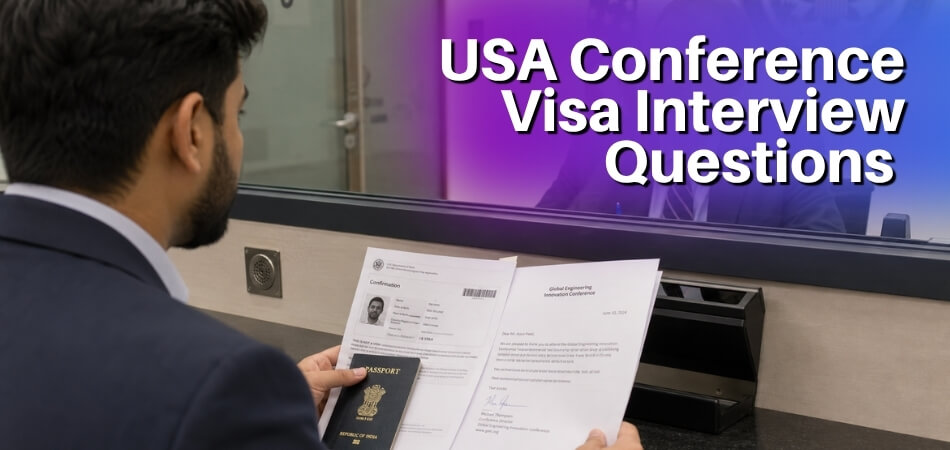
The officer is confirming three things: the event is real, your trip is temporary, and you have good reasons to go home afterwards. Most questions fall into the five areas below.
Your Purpose of Travel
Name the conference, the city, the dates, and your role (attendee, presenter, speaker, researcher or business participant). Link the event to your current job, study or business. “I want to visit the USA” is a weak answer; the conference must be the main reason.
Your Conference Details and Invitation
Know the organizer, venue, agenda and your registration status. If you hold an invitation letter or paper acceptance letter, your spoken answers should match it. Be ready to say which conference it is, who runs it, where and when it happens, why it matters to you, and whether you attend, present or speak.
Your Ability to Pay for the Trip
Expect a question on who pays for the flight, hotel, registration fee and local costs. You may be self-funded, or supported by an employer, university or other sponsor. Whatever you say, your bank statements, income proof or sponsor letter must back it up.
Your Travel Schedule and Accommodation Plan
A short stay around the event is easier to explain than a long visit with unclear plans. Know your arrival date, departure date, hotel name and address, and roughly how far it is from the venue. If you arrive early or leave late, give a brief reason.
Your Reasons to Return Home After the Event
Return intent is one of the most important parts of the interview. The officer may ask about your job, business, studies, family or property. Strong ties include full-time employment with approved leave, an active business with ongoing client projects, university enrollment, teaching or research duties, and family or financial commitments. Your answer should show that your main life stays in your home country.
Key Details You Should Know Before the Interview
Most conference visitors apply for a B-1 (business visitor) visa, usually issued together with B-2 as a B-1/B-2 visitor visa. Citizens of Visa Waiver Program countries can travel to a conference for up to 90 days with an approved ESTA instead of a visa, so they have no consular interview; this article is for applicants who need a B visa. Other countries’ embassies, when they interview at all, ask conference visa interview questions about the same areas: travel purpose, home ties, who pays and your documents. Before the interview, understand your visa purpose, reread your DS-160 and organize documents that support your answers.
Visa Category Usually Used for Conference Travel
The B-1 category covers short activities such as attending conferences, business meetings, conventions, seminars and consultations. Your visit must be temporary. Do not describe your plan as working in the United States, taking a job or earning a salary or income from a U.S. company or employer.
Difference Between Attending, Presenting, Networking, and Working
Use accurate words. Paid labor is the line you must not cross.
| Activity | Meaning |
| Attending | Joining sessions, speeches, panels and workshops |
| Presenting | Sharing a paper, poster, research or professional topic |
| Networking | Meeting professionals or academics during the event |
| Working | Paid labor or employment, which is not conference participation |
Say “attend,” “present,” “join sessions” or “take part in discussions” when describing normal conference activity.
Why Your DS-160 Answers Must Match Your Spoken Answers
Officers can compare what you say with what you submitted, so a mismatch raises doubt quickly. Before your appointment, check these details in your DS-160: job title, employer or business name, income, conference name, travel dates, U.S. address or hotel, sponsor details, previous travel, and any U.S. relatives or contacts. If something changed after submission, explain it clearly and bring updated proof.
How Officers Compare Your Documents With Your Interview Responses
You may not be asked to show every paper, but your documents should support each answer. Keep your answers short first and show documents only when asked.
| Topic | Supporting Documents |
| Conference purpose | Invitation, registration, agenda, acceptance letter |
| Employment or business | Job letter, leave approval, business registration |
| Funding | Bank statement, salary slip, sponsor letter |
| Travel plan | Hotel booking, itinerary, venue address |
| Return intent | Work, study, business, family or property proof |
2026 Rules That Can Change Your Interview
Recent U.S. policy changes mean you should check your own situation before booking. Interview waivers are narrower, some nationalities face extra restrictions, and a few countries now have visa bonds.
- Interview waivers: Since October 1, 2025, almost all nonimmigrant visa applicants need an in-person interview. The main exception for visitor visas is renewing a B-1, B-2 or B-1/B-2 visa within 12 months of its expiry, and even then the officer can still ask you to attend. First-time applicants should plan to be interviewed.
- Where you apply: Since 6 September 2025, the State Department asks nonimmigrant visa applicants to schedule the interview in their country of nationality or residence. Applying elsewhere can mean longer waits and non-refundable fees, and residence-based applicants must be able to show they live there. Check your embassy’s instructions before choosing a location.
- Visa bonds: From 3 August 2026, a permanent visa bond program applies to B-1/B-2 applicants who are nationals of listed countries, including Nigeria. The officer sets the bond at $10,000, $15,000 or $20,000 and refuses the visa under section 221(g) until it is posted, paid through Pay.gov with Form I-352. You must enter and leave the United States through a commercial airport, and the bond is returned on departure if you follow its terms. Check whether your country is listed.
- Travel restrictions: Presidential Proclamation 10998 partially suspends issuance of B-1/B-2 visas to nationals of 19 countries, including Nigeria, from 1 January 2026. It does not cancel visas issued before that date. If your nationality is listed, check for exceptions before paying any fee.
- Extra charges: The visitor visa application fee is listed as $185. A separate Visa Integrity Fee has been reported, but its rollout has been uneven by post, so confirm what applies to you on the embassy website.
Common USA Conference Visa Interview Questions and Sample Answer Strategy
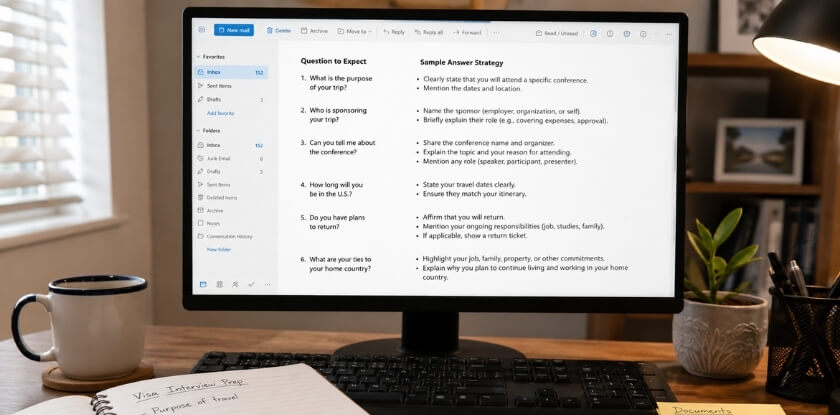
These are the questions applicants report most often, and the likely questions for a B-1 conference visa interview cover purpose, conference details, job, funding, stay and return. Each answer below is a pattern to adapt with your own facts, not a script to recite.
Questions About Your Travel Purpose
Common questions: What is the purpose of your visit? Why are you attending this conference? How is the event related to your work or study?
Sample answer:
“I am traveling to attend [Conference Name] in [City]. The event is related to my work in [Field], and I plan to return home after the conference.”
Questions About the Conference or Event
Common questions: Which conference are you attending? Who is organizing it? Where will it be held? What topics will be covered?
Sample answer:
“I am attending [Conference Name] from [Start Date] to [End Date]. The sessions focus on [Topic], which is relevant to my current work.”
Questions About Your Invitation or Registration
Common questions: Who invited you? Have you registered? Are you attending or presenting? Did you pay the conference fee?
Sample answer:
“I registered through the official conference process and received confirmation from the organizers. I have the invitation letter and registration proof with me.”
Questions About Your Profession, Studies, or Business
Common questions: What do you do? Where do you work or study? How does the conference help you?
Sample answer:
“My current role is [Job Title] at [Company Name]. The conference topics match my responsibilities, and I plan to use the knowledge after returning.”
Questions About Trip Funding and Expenses
Common questions: Who is paying for your trip? Can you afford the visit? What expenses are covered?
Self-funded answer:
“I will pay from my personal savings. I have my bank statements and income documents with me.”
Sponsored answer:
“My employer will cover the registration, flight, hotel and basic expenses. I have the sponsorship letter with me.”
Questions About Hotel, Flights, and Length of Stay
Common questions: How long will you stay? Where will you stay? When will you return?
Sample answer:
“I plan to stay from [Arrival Date] to [Departure Date]. The conference runs from [Start Date] to [End Date], and my hotel is near the venue.”
Questions About Family, Employment, Property, or Other Home Ties
Common questions: Why will you return home? Do you have family in your country? What responsibilities do you have?
Sample answer:
“My job and family responsibilities are in my home country. I have approved leave for this trip and will return after the conference.”
Questions About Previous International Travel
Common questions: Have you traveled abroad before? Did you return on time? Have you ever been denied a visa?
Sample answer:
“Yes, I have traveled to [Country] for [Purpose] and returned within the permitted time.”
If this is your first trip: “This is my first international trip, but my conference documents, travel plan, funding proof and return responsibilities are prepared.”
Questions About Relatives or Contacts in the United States
Common questions: Do you have relatives in the USA? Will you meet anyone there? Are you staying with someone? Is anyone travelling with you?
Sample answer:
“My main purpose is attending the conference. I will stay at the hotel listed in my travel plan and return after the event.”
If you do have relatives there, say so honestly when asked.
How to Answer Conference Visa Questions Using a Simple Formula
Use this order: direct answer, conference connection, short timeline, return reason. Keep most answers to two to four sentences.
State the Direct Answer First
Answer the exact question before adding detail. Say “I am attending [Conference Name] in [City],” then add one useful point: “It is related to my work in [Field].”
Connect the Trip to Your Professional or Academic Purpose
Explain why the conference matters to your situation. Useful lines include “The sessions are related to my current work,” “My paper was accepted for presentation,” “The event covers topics useful for my business,” or “The conference supports my academic research.”
Mention the Short Travel Timeline
Make the stay sound organized and temporary: “The conference is from [Start Date] to [End Date]. I will arrive one day before and leave after the event.”
End With Your Return Plan or Home-Country Responsibility
A short return statement strengthens many answers: “I will return to continue my job,” “I need to return to manage my business,” “I will resume my classes after the event,” or “I have ongoing family and professional responsibilities at home.”
Sample Answers by Applicant Profile
Your answer must match your real profile. The proof for each profile is listed in the documents section below.
Employee Attending a Company-Sponsored Conference
Sample answer:
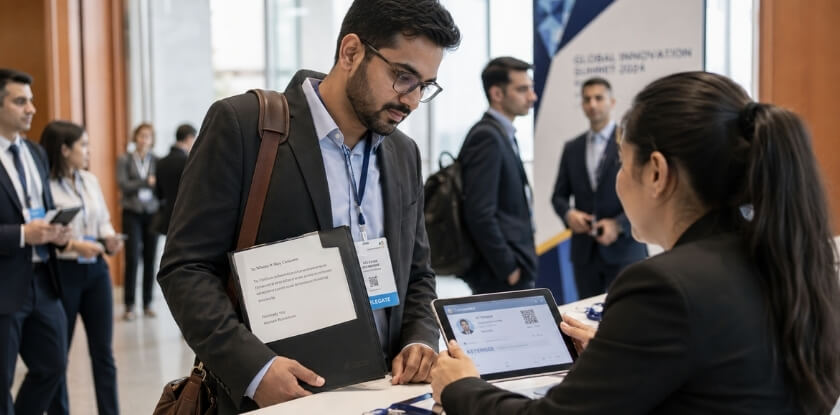
“I work as a [Job Title] at [Company Name]. My employer selected me to attend [Conference Name] because it is related to my work. The company will cover my travel expenses, and I will return after the event to continue my duties.”
Self-Employed Applicant or Business Owner
Sample answer:
“I own [Business Name], which operates in [Industry]. I am attending the conference to learn about topics related to my business. I will pay for the trip myself and return to manage my clients, projects and operations.”
Freelancer or Independent Consultant
Sample answer:
“I work as a freelance [Profession]. The conference is related to my field and will help me improve my professional knowledge. I will fund the trip myself and return to continue my client work.”
Professor, Lecturer, Researcher, or Academic Presenter
Sample answer:
“I am a [Professor/Lecturer/Researcher] at [Institution Name]. I am attending [Conference Name] to join academic sessions and present my work on [Topic]. I will return to continue my teaching and research duties.”
Student Attending an Academic or Professional Conference
Sample answer:
“I am studying [Subject] at [Institution Name]. I am attending the conference because it is related to my academic field. I will return after the event to continue my classes.”
First-Time Traveler to the United States
Sample answer:
“Yes, this is my first trip to the United States. I am traveling only for [Conference Name]. My stay is planned around the event, and I will return because my main responsibilities are in my home country.”
Applicant Who Recently Changed Jobs
Sample answer:
“I recently joined [Company Name] as a [Job Title]. The conference is related to my new role, and my employer approved my participation. I will return after the event to continue my position.”
Applicant With a Sponsor Paying for the Trip
Sample answer:
“My [Sponsor Relationship] will support my trip expenses, including [Expenses]. I am attending the conference because it relates to my [work/study/field]. I have the sponsor letter and financial documents with me.”
Difficult USA Conference Visa Interview Questions to Prepare For
Some questions test your honesty and your real intention to return. Answer them calmly, truthfully and briefly.
“Why Do You Need to Attend This Conference in the United States?”
Best response focus: the specific value of the conference.
“The conference covers topics directly related to my work in [Field]. I plan to attend sessions on [Topic] and use the knowledge after returning home.”
“Why Not Attend a Similar Event in Your Own Country?”
Best response focus: explain what makes this event relevant, without criticizing local events.
“There are events in my country, but this conference includes specific sessions and speakers related to my current work. That is why this event is useful for me.”
“What Will You Do If Your Visa Is Refused?”
Best response focus: show that you are not desperate to enter the United States.
“If my visa is refused, I will continue my work at home and look for other professional learning opportunities. This conference is useful, but my main responsibilities remain in my country.”
“How Can We Know You Will Return After the Conference?”
Best response focus: real responsibilities.
“I have a full-time job at [Company Name], and my leave is approved only for the conference period. I will return to continue my work.”
“Have You Ever Been Denied a Visa Before?”
Be honest. If yes: “Yes, I was refused a visa in [Year]. I disclosed it in my application. My current situation is different, and I have brought updated supporting documents.” If not: “No, I have not been denied a visa before.”
“Have You Ever Overstayed a Visa?”
If no, say so directly. If yes, explain briefly and honestly. Do not hide it.
“Do You Have Any Immigration or Legal History?”
Answer truthfully. If there is no issue, say so. If there was one, say what happened, when, and whether it was resolved.
“Who Helped You Complete Your Visa Application?”
Receiving help is acceptable, but you must understand what was submitted.
“I provided the information and reviewed the application before submission. [Person/Office] helped me with the form process.”
Questions About Conference Plans and Daily Itinerary
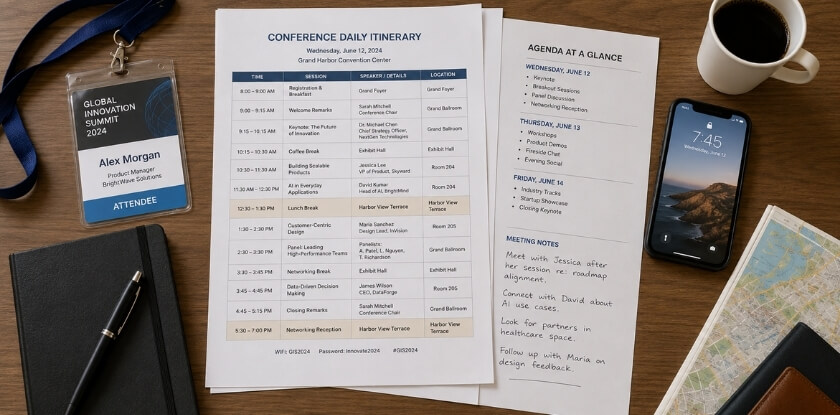
Itinerary questions check that your schedule is realistic and tied to the event. You do not need a minute-by-minute plan, only the main activities.
Why Your Travel Dates Should Match the Conference Schedule
Arriving a day before and leaving a day after the event is easy to explain; a long stay is not.
“The conference is from [Start Date] to [End Date]. I plan to arrive on [Arrival Date] and leave on [Departure Date].”
How to Explain Your Daily Plan During the Event
Mention what is on the agenda: registration, opening session, keynotes, workshops, panels, your presentation, networking sessions and the closing session.
“I will attend the main sessions, workshops and professional discussions listed in the conference agenda.”
How to Answer Questions About Sightseeing or Extra Activities
Be honest, but keep the conference as the main purpose.
“My main purpose is the conference. If time allows, I may visit a nearby place, but it will not affect my event schedule or return date.”
How to Explain Meetings, Networking, or Workshops
Describe these as part of the event, not as employment.
“I may attend networking sessions and workshops included in the program. These are for professional learning and discussion, not paid work.”
What to Say If Your Stay Includes Days Before or After the Conference
Give a practical reason: “I will arrive one day early to check in and attend the first session on time,” or “I will leave the day after the conference because of flight timing.”
Documents to Carry for a USA Conference Visa Interview
Your documents should prove identity, event purpose, funding, travel plan and home-country ties. Check your embassy’s instructions for the exact list, as requirements vary by post.
Mandatory Documents
| Document | Purpose |
| Valid passport | Confirms identity and travel eligibility |
| DS-160 confirmation | Confirms submitted visa application |
| Appointment confirmation | Confirms interview schedule |
| Visa fee receipt | Shows fee payment |
| U.S. visa photo | May be required if photo upload is not accepted |
Conference-Related Documents
Carry the invitation letter, registration confirmation, fee payment receipt, event agenda, venue details, organizer information, and a paper or abstract acceptance letter if you are presenting.
Employment, Business, or Academic Proof
For employees: employment letter, leave approval, salary slips, company sponsorship letter.
For business owners: business registration, trade license, tax documents, business bank statements.
For students or academics: enrollment certificate, student ID, institutional letter, permission letter, research acceptance proof.
Financial Proof and Sponsorship Documents
If self-funded: bank statements, salary slips, income proof, tax documents.
If sponsored: sponsor letter, sponsor bank statements, relationship proof, company or institution funding letter.
Travel and Accommodation Documents
Prepare a hotel booking, tentative flight itinerary, return travel plan, venue address, and travel insurance if you have arranged it.
Home-Country Tie Documents
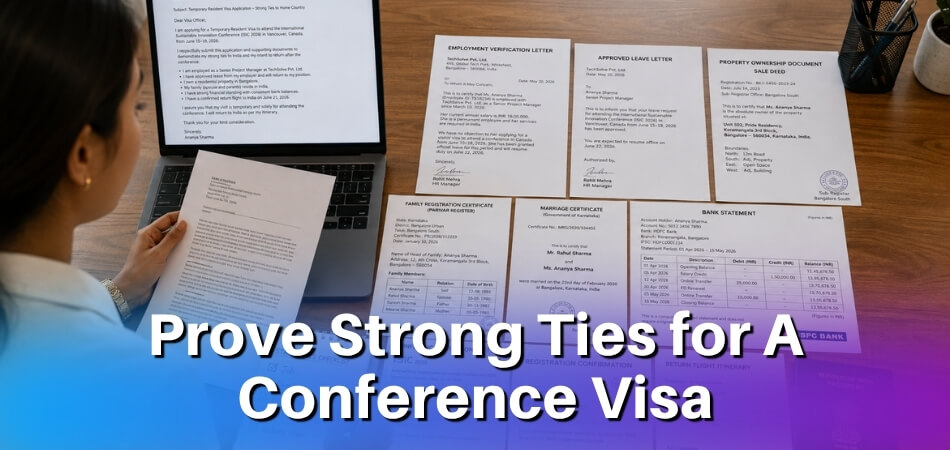
Besides the employment, business or academic proof above, useful ties include client contracts, family documents, property documents and tax records.
How to Organize Documents for Quick Access
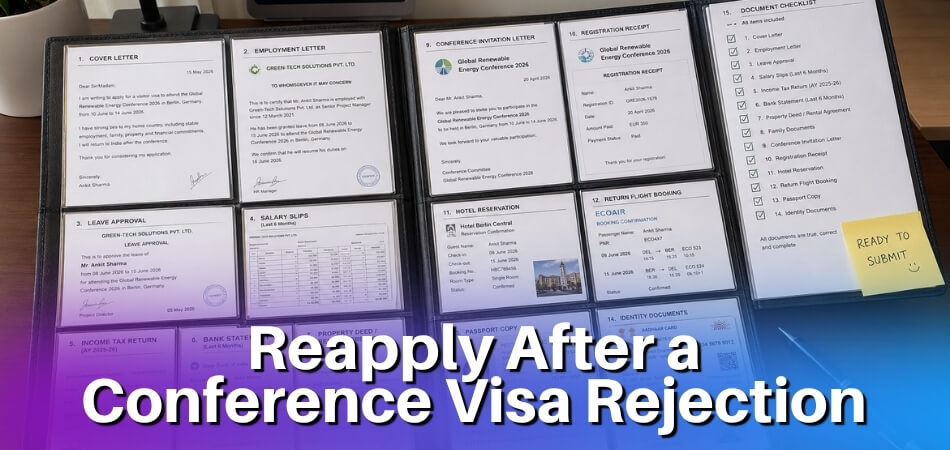
Use one simple folder in this order:
- Passport and appointment papers
- DS-160 and fee receipt
- Conference documents
- Employment, business or academic proof
- Financial documents
- Hotel and travel plan
- Home-country tie documents
From our experience at MS International: We issue invitation letters for our own in-person conferences in the Greater Toronto Area, within 3 to 5 business days after payment clears, so for a USA conference you need the invitation or registration proof from that event’s organizer. Our own letter supports an application but does not guarantee a visa, and it does not replace your funding and home-tie documents. The consular officer decides.
Mistakes That Can Hurt Your Conference Visa Interview
Refusals often follow answers that are unclear, inconsistent or unsupported. These are the mistakes to avoid:
- Answers that conflict with the DS-160: job title, salary, sponsor, dates, U.S. address and conference name must all match.
- Sounding unsure about the conference: if you cannot explain the event, your purpose looks weak.
- Overexplaining: answer the question first, then add one or two useful details.
- Vague funding: do not say “I will manage somehow.” Say exactly who pays and keep the proof ready.
- No real reasons to return: a promise is not enough. Mention actual work, business, study, family or property.
- Unnecessary stories or guessing: skip long background, do not say you want to “explore opportunities”, and never guess a fact you do not know.
- Treating the trip like tourism: limited sightseeing may be fine if truthful, but the conference stays the main reason.
- Hiding a past refusal, overstay or immigration issue: an honest answer is safer than trying to look perfect.
Practical Tips for a Confident Interview
Preparation, clear documents and truthful answers matter more than polish. Follow these tips before and during your interview:
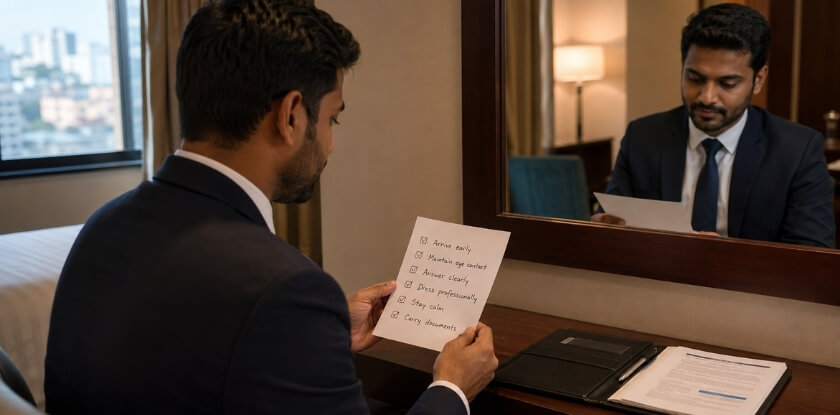
- Practice key points, not a script. Memorized answers sound unnatural.
- Stay calm and factual. Listen carefully, answer only what is asked, and do not argue, interrupt or guess.
- Arrive early and follow embassy security rules. Many locations restrict phones, large bags, electronics and sealed items, so check your embassy’s rules first.
- Dress neatly. Your outfit does not decide the result, but it shows respect.
- Ask for repetition if needed. “Could you please repeat the question?” is better than a wrong answer.
FAQs About USA Conference Visa Interview Questions
Sitting a US conference visa interview raises practical doubts about its length, answers that differ from your DS-160, a weak invitation letter, interview waivers and what 214(b) or 221(g) means afterwards.
How Long Does a USA Conference Visa Interview Usually Take?
Most interviews are short, often only a few minutes, and there is no official length. The wait for an appointment is separate and differs by embassy. Be ready to explain your conference, funding, travel plan and return intent clearly.
Can I Attend a Conference in the USA With a Visitor Visa?
Yes, attending a conference is a permitted B-1 activity on a visitor visa. Keep to conference participation, do no paid work and take no salary from a U.S. company. Citizens of Visa Waiver Program countries use ESTA instead.
Do I Need Confirmed Flight Tickets Before the Interview?
Usually not. A realistic itinerary is safer than buying expensive non-refundable tickets before the visa is approved, unless your embassy tells you otherwise.
What If My Company Is Paying for My Conference Trip?
Say your company is sponsoring the trip, and carry a letter confirming covered expenses, your leave approval and why you were chosen to go.
What If I Am Paying for the Trip Myself?
Explain that you pay from your own savings or income. Carry bank statements, salary slips, tax papers or business income proof.
Can I Skip the Interview With an Interview Waiver?
Rarely, and mainly for some B-1/B-2 renewals within 12 months of expiry. Officers can still ask you to attend, so book and prepare as if you will be interviewed, and check your embassy page before you travel.
What Happens If My Answers Do Not Match My DS-160?
A mismatch raises doubt and can lead to a refusal, and errors in the form itself may mean correcting the DS-160 and rescheduling. Review it before the appointment and explain any genuine change with proof.
Can a Weak Invitation Letter Affect My Interview?
Yes, an unclear invitation weakens your purpose. Support it with registration proof, the agenda, organizer details, a payment receipt or an acceptance letter.
Is Travel Insurance Required for a USA Conference Visa Interview?
No, it is not a visa requirement for the interview. It can show preparation, so mention it only if it is relevant or the officer asks.
Can I Get an Earlier Appointment Because My Conference Is Close?
Usually not. The State Department says travel for a business, academic or professional conference does not qualify for an emergency expedited appointment, so book a regular slot early. A State Department pilot running to 31 December 2026 lets applicants at a few posts pay an extra US$750 for an earlier appointment, but it does not mean approval.
What Do 214(b) and 221(g) Mean After the Interview?
A 214(b) refusal means the officer was not satisfied that you will return home after the trip. You can reapply with new evidence or a real change in circumstances. A 221(g) refusal is not final: the case is held for missing documents or administrative processing.
What Should I Do If I Do Not Know the Answer to a Question?
Do not guess. Say you are not sure, or ask the officer to repeat the question. An honest answer beats an inaccurate one.
Final Thoughts
Know your conference name, venue, dates, organizer and role, and make sure your funding and return reasons are backed by documents. Review your DS-160, practice short answers, stay honest and calm, and show that your visit is temporary.
Disclaimer: This article is general information, not legal or immigration advice. Visa rules, fees, and processing times change. Confirm the current requirements on the official U.S. Department of State travel.state.gov website and your local U.S. embassy or consulate website before you apply.