
You have a conference to attend abroad, and the first thing you search for is the visa. The trouble is that the name you expect often does not exist on the official forms. That gap confuses a lot of first-time travellers, so let us clear it up.
Quick answer: A conference visa is permission to enter a country temporarily to attend or speak at a formal event. Most countries do not issue a separate “conference visa”. They cover conferences under a visitor, business visitor or short-stay visa, or an electronic authorization. Which one you need depends on your passport and the destination, so check the host country’s official immigration site first.
Fact-checked by the MS International Editorial Team. Last verified against official sources: October 2026.
The name on the visa matters less than what it allows. Some destinations list conferences as a permitted activity for ordinary visitors, others use a business visitor category, and a few have a dedicated event visa. Your job is to match your role (attendee, speaker, exhibitor, official delegate) to a category that covers it, then prove the trip is real, temporary and funded.
What Does a Conference Visa Mean?
A conference visa means permission to enter a foreign country temporarily for an organized event such as a conference, seminar, workshop, academic meeting or business program. It is not meant for long-term employment, permanent residence or full-time study.

Immigration officers want to know why you are travelling, where the event takes place, how long you will stay, who invited you and how you will pay for the visit. The visa, together with your documents, answers those questions. Entering under the right category is what makes your visit lawful, particularly if you are presenting research, speaking or representing a company. Carry the invitation letter, registration proof, return ticket, hotel booking, proof of funds and event agenda in your hand luggage.
What Activities a Conference Visa Usually Covers
It usually covers event activities: attending keynotes and workshops, presenting research, meeting other delegates, visiting the exhibition area and joining scheduled programs.
It does not usually allow full-time work, local employment, running a business or unrelated paid activity. Some countries tolerate a few days of tourism before or after the event within the approved stay, but never assume it. Check the visa conditions.
How Long a Conference Visa Usually Allows You to Stay
The stay is normally based on the event dates plus a reasonable travel window. Visa validity and permitted stay are not the same thing: a visa may be valid for several months while each visit is limited to a shorter period. Your arrival date, conference dates, accommodation and return ticket should line up. A realistic plan is easier to approve than a vague or unusually long one.
Which Countries Actually Issue a Conference Visa?
Very few. India is the clearest example of a visa officially called a “Conference Visa”; Canada, the United Kingdom and the United States handle conferences under a visitor or business category. Looking at how four popular destinations do it shows why the label on the form matters less than the activity it allows.
| Destination | How a conference is handled |
| India | A separate Conference Visa for a foreigner whose sole purpose is to attend a conference, seminar or workshop. Events run by NGOs or private bodies need clearance from the relevant ministry first. Exhibitors and internal meetings of international organizations fall under a Business Visa instead. An e-Conference Visa valid for 30 days exists for events organized by government bodies. |
| Canada | Attending conferences is a business visitor activity, for stays of less than 6 months. You need a visitor visa or an eTA, depending on your nationality and how you travel. |
| United Kingdom | Standard Visitor, for up to 6 months. Attending conferences and seminars is permitted, but being paid to speak is only allowed as a permitted paid engagement. |
| United States | No visa carries the name. The B-1 business visitor category covers attending a professional or business conference, and travellers from visa waiver countries use ESTA. |
If your destination is not listed, look for the category that names conferences, seminars or meetings as a permitted activity. In the visa process for attending conferences in Australia, for example, that means an ETA, an eVisitor or a Visitor visa (subclass 600) in the Business Visitor stream.
Who Needs a Conference Visa?
You need one if your main reason for visiting another country is to attend, speak at or take part in a formal event, and your nationality requires a visa for that country. Some travellers use a business visitor category, some need a specific event visa, and others qualify for visa-free entry or an electronic authorization (for example an eTA or ESTA). Check the host country’s official rules before you apply.

International Conference Attendees
General attendees of academic conferences, business events, medical meetings or technology expos need to show that the trip is temporary and tied to a real event. The usual proof is an invitation letter, registration confirmation, itinerary, accommodation and financial evidence.
Speakers, Presenters, and Panelists
Speakers need stronger event proof because they take an active role: a speaker invitation, accepted abstract, session details or confirmation from the organizer.
If an honorarium, travel support or sponsorship is involved, the category needs extra attention. Some countries allow unpaid speaking under visitor rules and restrict paid engagements, so ask the organizer exactly what you will receive and check it against the rules.
Researchers, Academics, and Students
Academics and students may add university enrollment proof, an employment letter, a paper acceptance letter, supervisor approval or funding evidence. Students should show they will return to their studies, for example through ongoing enrollment, exam dates and family ties.
Business Professionals and Industry Delegates
A company letter should state your job title, why you are attending, who is paying, your travel dates and your link to the event.
Government, NGO, and Organizational Representatives
Officials and NGO staff attending policy, health, education or development events may need an official nomination letter or a letter from their organization proving their role.
Conference Visa vs Tourist Visa: What Is the Difference?
A conference visa is for event-related travel, while a tourist visa is for leisure. Officers judge whether your documents match your stated purpose. If your papers show a conference but your visa category does not cover that activity, expect questions.
| Area | Conference Visa | Tourist Visa |
| Main purpose | Conference, seminar, workshop or formal event | Vacation, sightseeing or leisure |
| Key document | Invitation letter or registration proof | Travel itinerary or tourism plan |
| Event proof | Usually required | Usually not required |
| Professional link | Often helpful | Usually less important |
| Work permission | Generally not allowed | Generally not allowed |
In both cases the officer wants to see a genuine temporary visitor with enough funds and a clear intention to leave on time. For a conference visa, they also look for a believable link between your profile and the event, such as a researcher at an academic symposium or a doctor at a healthcare conference.
Can You Attend a Conference on a Tourist Visa?
Sometimes, but only if the host country allows it. Some countries accept short, unpaid conference attendance under ordinary visitor rules. Others require a business visitor visa or event-specific authorization. Passive attendance is treated differently from active participation, so speakers, presenters, exhibitors, paid participants and official representatives face stricter conditions than regular delegates.

Common Types of Conference Visas
Conference visas are usually described by how many entries they allow and how long you can stay, not by a special “conference” label. Names differ by country, so focus on whether the category allows conference attendance.
Single-Entry and Multiple-Entry Visas
A single-entry visa allows one entry. Once you leave, it usually cannot be used again, even if the validity date has not passed. It suits one conference in one country.
A multiple-entry visa lets you enter more than once during its validity. It helps if you have repeated events or plan to leave and re-enter, but you should explain why you need it and support the request with an event calendar and invitation documents.
Short-Term and Extended Stay
Most conference travel needs only a short stay. A longer stay is only realistic when you have several approved events or a workshop series, and not every country offers it. Include a detailed schedule, accommodation, funding and a clear reason for the extra time.
Transit Visa for Conference Travel
A transit visa may be needed if your route includes a stop in another country. It depends on your nationality, the layover airport and whether you pass through immigration. Check transit rules if you change airports, collect luggage or have a long layover.
Visa Options for Family Members Traveling With You
Family members usually need their own visa or authorization, and your conference visa does not automatically cover a spouse, child or companion. Their applications should reflect their real purpose, such as tourism or a temporary visit, with relationship proof, financial documents and accommodation details.
Basic Eligibility Requirements for a Conference Visa
Eligibility depends on the host country, but most applicants must prove a genuine event purpose, a temporary stay, enough money and a reason to return home. Meeting the requirements does not guarantee approval. The decision rests on your documents, profile, travel history and, where required, your interview answers.
- Valid passport. Many countries expect it to stay valid beyond your planned return date and to have blank pages. Renew it first if it is damaged or close to expiry.
- Invitation letter or registration proof. It shows the event is real.
- Financial support. Bank statements, salary slips, sponsorship letters, employer or university funding, or scholarship documents. If someone else pays, add a sponsor letter and proof they can cover the costs.
- Travel plan and accommodation. Dates should match the conference schedule. A long stay without explanation weakens the application.
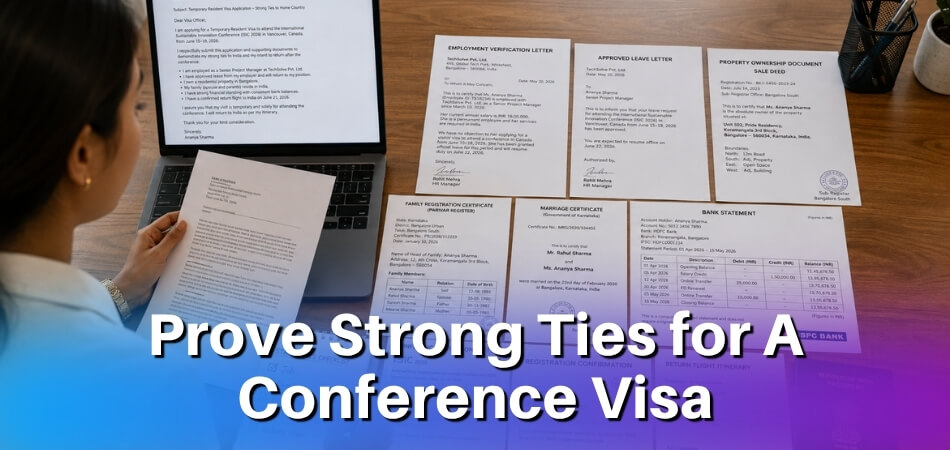
- Ties to your home country. Employment, business, enrollment, family, property or commitments after the trip. This matters most for applicants with limited travel history or self-funded trips.
- Health insurance or medical requirements. Some countries require insurance, medical exams or vaccination proof. Even when optional, insurance is useful because medical care abroad can be expensive.
Documents Commonly Required for a Conference Visa Application
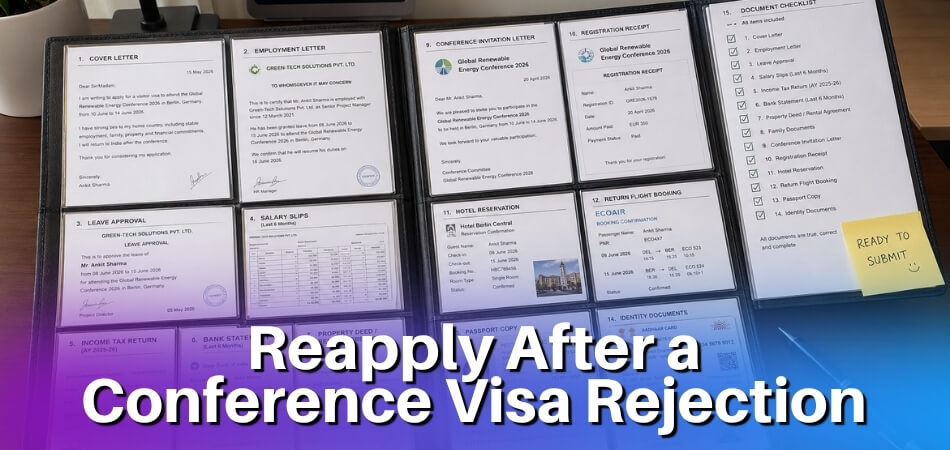
The documents should prove identity, event purpose, finances, accommodation, travel plans and intention to return. Missing or inconsistent papers can delay or weaken an application. Our conference visa document checklist covers each item in more detail.

Common documents include:
- Completed visa application form
- Valid passport and recent photographs
- Conference invitation letter
- Registration confirmation or payment receipt
- Event agenda or speaker confirmation, if relevant
- Employment, study or business proof
- Bank statements or sponsorship documents
- Travel itinerary and accommodation proof
- Return or onward travel plan
- Health insurance, if required
The invitation letter is often the strongest document. Ideally it is on official letterhead and includes your name, the event title, dates, venue, your role and the organizer’s contact details. It also states any support the organizer provides, such as accommodation, meals, a fee waiver or funding.
An employer letter can mention your role, approved leave and return date. A university letter can confirm enrollment, academic status and permission to attend. Your financial records should look realistic: funds, hotel cost, flights, conference fee and daily expenses should add up. Avoid unexplained large deposits.
How to Apply for a Conference Visa
Confirm the correct visa category, prepare event proof, complete the application, pay the fee, attend any appointment and wait for a decision.

Step 1: Check the Host Country’s Visa Rules
Find out whether your nationality needs a visa, then confirm the right category for conference attendance. Review the application method, fees, processing time, appointments, biometrics, transit rules and document checklist, using only the official embassy, consulate, immigration or authorized visa center instructions. Look-alike commercial sites exist, so check that the web address belongs to a government or an authorized visa center. Do this before booking non-refundable flights or hotels.
Step 2: Collect the Required Documents
Build a file that tells one clear story: you are attending a specific conference temporarily and will return home afterwards.
Step 3: Complete the Application Form
Your name, passport number, birth date, travel dates, host-country address, employment details and visit purpose must match your supporting documents. Answer truthfully about previous refusals and travel history, because misleading answers can harm current and future applications.
Step 4: Pay the Visa Fee
Fees are paid online, at an embassy or through a visa application center, depending on the country. Keep the receipt for submission, tracking or appointment confirmation.
Step 5: Attend a Visa Appointment or Interview if Required
Some countries require biometrics, document submission or an interview. Expect questions such as why you are attending, who invited you, who is paying, what you do at home and when you will return. Answer directly and consistently with your documents.
Step 6: Track the Application and Check the Decision
Use the official tracking system if there is one, and respond quickly to requests for more documents. When approved, check your name, passport number, validity, number of entries and allowed stay, and report errors before you travel.
How Long Does a Conference Visa Take to Process?
From a few days to several weeks or months, depending on the country, season, your profile and your documents. There is no universal timeline, so look up the current estimate on the official site of the embassy or immigration authority you are applying to.
Embassy workload, appointment availability, nationality, country of residence, biometrics, interviews, travel history, previous refusals, background checks and holidays all affect timing.
Conference dates are fixed, so apply early. That gives you time to get the invitation letter, bank statements and employer or university letters, fix errors and answer extra requests. If the event is close, check whether urgent processing exists, ask the organizer for a strong invitation letter and send a complete file with proof of the event dates. Some embassies do not expedite applications because of late planning, so a clean application is still your best option.
What Happens if Your Conference Visa Is Refused or Canceled?
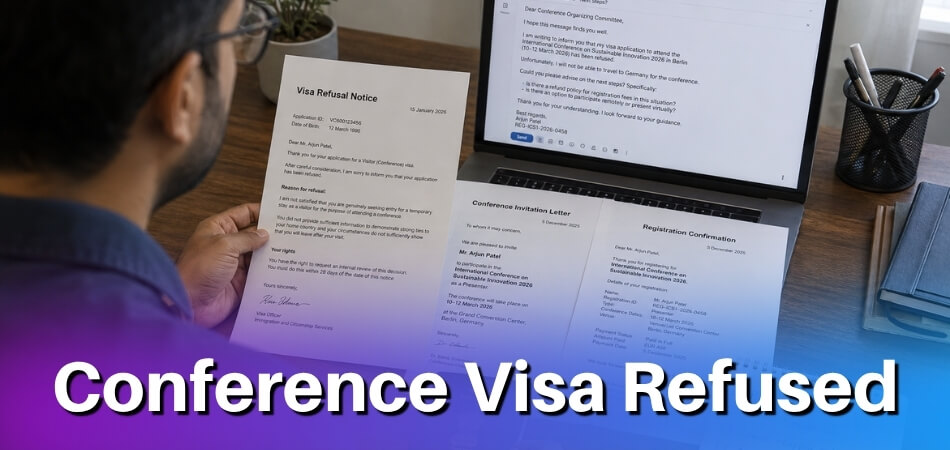
Read the official reason first, then decide whether to fix the problem and reapply, appeal or choose another option. A refusal does not always end your chances of attending future conferences. Do not reapply with the same weak file.
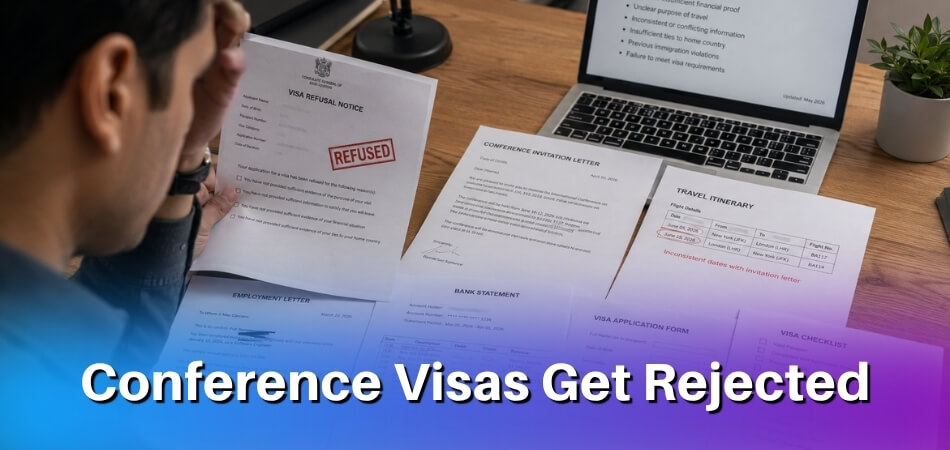
Common reasons include weak event proof, a missing invitation letter, insufficient or unexplained funds, weak home ties, inconsistent travel dates, the wrong visa category, incomplete forms, doubts about your return and earlier immigration concerns.
| Refusal Issue | Better Supporting Evidence |
| Weak event purpose | Invitation letter, registration receipt, event agenda, speaker confirmation |
| Insufficient funds | Updated bank statements, salary slips, sponsor letter, funding approval |
| Weak return ties | Employment letter, study proof, property evidence, approved leave |
| Unclear travel plan | Itinerary, hotel booking, event schedule, return ticket |
| Wrong visa type | Correct category with a clear conference explanation |
Check whether the country allows reapplication, appeal or reconsideration. Some appeals have strict deadlines and may not accept new evidence. If the reason is unclear, contact the embassy, consulate or visa center through official channels.
Professional visa advice can help after repeated refusals, a complex immigration history or urgent travel. If reapplying is not realistic, consider attending virtually, deferring your registration, asking for an invitation to a future edition or choosing another conference with better timing.
Can You Extend a Conference Visa?
In some countries yes, but extensions are not guaranteed and usually must be requested, with a valid reason, before your authorized stay ends.

Possible grounds include a medical issue, flight disruption, an extended event or an emergency. You may need a valid passport, your current visa record, the extension form, financial proof, accommodation details, insurance, a new return plan and documents explaining the reason.
If your purpose changes to work, study or another event, you may need a new visa, and some countries do not let visitors change status from inside the country.
Do not overstay. It can lead to fines, removal orders, future refusals or entry bans. Know your last authorized day, apply for any extension before the deadline and leave on time if it is not granted.
Practical Tips to Improve Your Conference Visa Application
A strong application is clear, consistent and backed by documents that match your stated purpose. The officer should grasp your trip quickly: a specific event, a temporary stay, a return home.
- Choose the correct visa type, especially if you are speaking, exhibiting or receiving support.
- Keep details consistent. Names, passport number, travel and event dates, hotel, employer and sponsor details must match across all documents.
- Keep your stay reasonable and in line with the conference schedule.
- Avoid document overload. Send useful evidence, not unrelated certificates that make the file confusing.
From our experience at MS International: many attendees search for a “conference visa”. What we provide is an invitation letter that supports a visitor or business visa application. The visa itself is always decided by the destination country’s government, so apply for the visa type that country lists for short business visits. Our letter is issued within 3 to 5 business days after payment clears, and a US$50 administrative fee may apply to corrections requested after it is issued. It supports your application but does not guarantee a visa or entry, and our events are held in person in the Greater Toronto Area.
Frequently Asked Questions About Conference Visas
New to conference travel? Whether you need a separate visa at all, its place next to business and tourist visas, students and family members, a delayed invitation letter and entry at the border are the starting points.
Do I always need a conference visa to attend an international conference?
No. It depends on your nationality, the destination and your role. Some countries allow conference attendance under a visitor or business visitor visa, an electronic authorization or visa-free entry.
Is a conference visa the same as a business visa?
Not always. In India a Conference Visa is a separate category from the Business Visa, while in Canada, the UK and the US attending a conference falls under the business or visitor category. Check which one your destination uses.
Can I travel for tourism after the conference ends?
Only if your visa conditions allow it. Some countries permit short leisure activity within the approved stay, while others restrict you to the declared purpose. Check before planning extra days.
Can family members travel with me on a conference visa?
No, they usually need their own visa or authorization that reflects their own purpose, such as tourism or a temporary visit.
What should I do if my conference invitation letter is delayed?
Contact the organizer and ask for a formal invitation or registration confirmation as soon as possible. Make sure it shows your name, event dates, venue, organizer details and role.
Can students apply for a conference visa?
Yes, with a valid reason to attend. Expect to provide enrollment proof, conference registration or acceptance documents, financial evidence and proof that you will return to your studies.
Can I attend a conference on a tourist visa?
Sometimes, depending on the host country. Some countries accept short, unpaid attendance under ordinary visitor rules, while others require a business visitor category. Declare your real purpose, and ask the embassy if the organizer will pay or reimburse you.
Does a conference visa guarantee entry into the country?
No. A visa only lets you travel to the port of entry and ask to be admitted. The border officer decides whether you enter and for how long, so carry your invitation letter and registration proof.
Final Thoughts on Conference Visas
A conference visa lets you travel legally for a professional, academic, business or institutional event, but only if your visa category, invitation letter and supporting documents all tell the same story: a temporary visit for a specific event. Every country has its own rules, so confirm them on the official site first, apply early and choose the correct category.
Disclaimer: This article is general information, not legal or immigration advice. Visa rules, fees, and processing times change. Confirm the current requirements on the official immigration website of the country you are visiting before you apply.