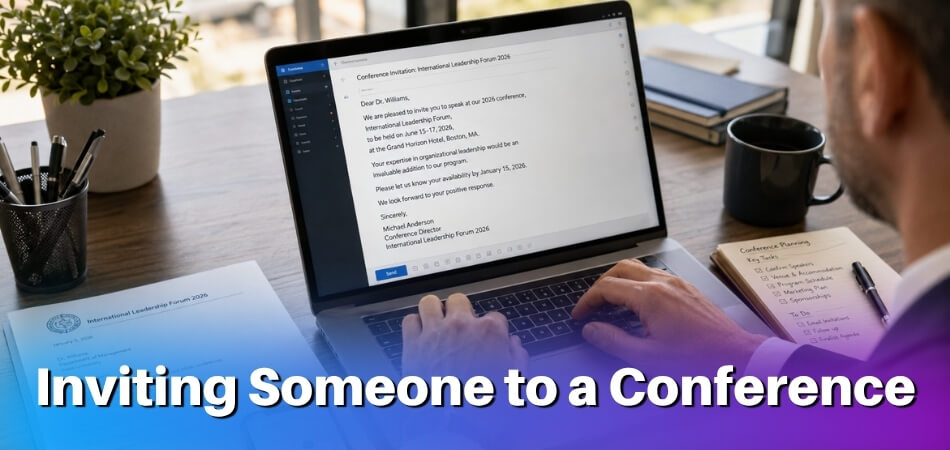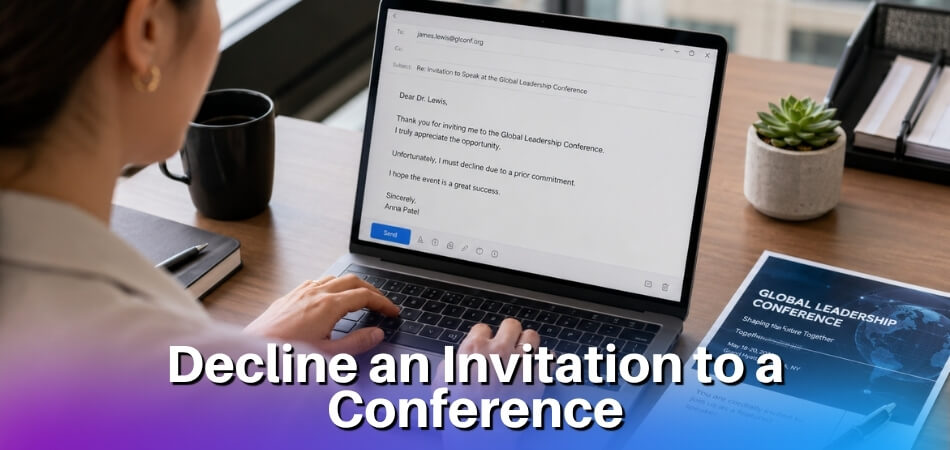

An invitation to a conference is flattering, and it also starts a quiet clock. Organizers are juggling many replies, and yours is one they will remember, for good or bad reasons. A little thought before you start typing goes a long way.
Quick answer: To reply to a conference invitation, answer within two business days, name the event and your role, and state your decision in the first or second sentence. Put all your questions in one message. If you cannot decide yet, send a short holding reply with a date. If the organizer stays silent, follow up once after five business days.
A conference invitation lands in your inbox. You read it twice, maybe three times, and then you open a blank email and stare at it. Too formal and you sound like a robot. Too casual and you look like you have not taken it seriously. Say nothing for a week and you have already made an impression, just not the right one.
How you answer, whether you are asked to attend as a delegate, join a panel or give a keynote, shows how you work. A vague reply, a missed RSVP or a last-minute cancellation with no explanation can hurt your relationship with an organizer before you have met. This guide covers the situations you are likely to face, and each comes with a template you can adapt in a few minutes.
Which reply do you need?
| Your situation | What to send | When |
| You want to go | Acceptance email with role and logistics | Within 2 business days |
| You cannot go | Short, warm decline | As soon as you know |
| You need approval or have a clash to sort out | Holding reply with a firm date | Within 2 business days |
| The invitation is vague about your role or the details | Clarification request, 2 or 3 questions | Within 2 business days |
| You accepted, then something came up | Cancellation, plus a call for a high-profile role | Immediately |
| No answer to your reply | One short follow-up in the same thread | After 5 business days |
The Four-Part Structure of a Good Reply
Whatever your decision, the organizer needs three things from you: your decision, your timeline, and any open questions. A reply that has four short parts covers almost every case.

Line 1: thank them briefly for the invitation. Line 2: state your decision plainly. Line 3: handle logistics, such as travel, session topic or platform requirements. Line 4: close with a next step or a request for confirmation. Most replies that go wrong are either too vague (“I’ll get back to you soon”) or too long, with the actual answer buried in paragraph three.
The Two-Business-Day Guideline
Two business days is a common guideline in professional communication, not an official rule. Organizers are juggling speaker schedules, printing and venue capacity, so a reply that takes a week causes real problems, especially for academic and international conferences where travel is booked early.
If the invitation names a reply date or a reply method, such as an online form or a specific email address, follow that first. It overrides any general guideline. Published guides vary from a few business days to a week, so two business days keeps you on the safe side.
If you need longer, say you are waiting on a budget approval before committing to an in-person event, send a short holding reply within the same two days and give a specific date. That keeps the loop open without leaving the organizer in the dark.
Keep the Reply Short
You do not need three paragraphs about your schedule, heavy flattery or apologies that run longer than the reply. Four to six sentences is usually enough. Professional email etiquette is about clarity, not length. If you are declining, one brief honest reason is plenty. Organizers remember who communicated well, and who ghosted them.
Why Your Reply to a Conference Invitation Matters More Than You Think
Your reply is often the first direct contact you have with the organizer. Before they have heard you speak, they have read your email.
If you are invited as a keynote speaker or panelist, the organizer is about to trust you with part of their event. A clear acceptance answers questions they have not asked yet: are you easy to work with, and will you be reliable on the day? A thoughtful decline that explains your situation and, where possible, suggests an alternative leaves the door open for next time. A non-reply does not.
There are practical reasons too. Hotel blocks, catering numbers, printed programs and visa invitation letters for international delegates all depend on knowing who is coming. Organizer teams for virtual events are often smaller and handle tech checks, slide submissions and scheduling at once. Conference circles, especially in academic and industry communities, are smaller than they look, and a reputation for prompt, clear replies tends to stick.
A poorly worded reply can also cost you. If you forget to raise travel in your acceptance, you may end up paying for something the organizer expected to cover. If you do not ask about a vague role, you could arrive expecting a 30-minute talk and find yourself on a panel with five others.
Key Elements Every Conference Invitation Reply Should Include
A well-structured reply saves back-and-forth emails. Miss one of these elements and you will probably get a follow-up asking for it.
- The specific event. Conference name, date and your invited role (speaker, panelist, attendee).
- Your decision, stated plainly. Not hedged, not buried in pleasantries.
- What they need from you. Bio, headshot, session title, dietary requirements, AV needs for a virtual event.
- A contact point. Who handles follow-up on each side.
- Guests and special needs. If the invitation allows a guest, say how many people will attend. If it asks about dietary or accessibility needs, answer in the same reply.
Proper Salutation and Greeting
Use the name of the person who signed the invitation. “Dear Dr. Patel” lands better than “Dear Sir/Madam”. If the invitation came from a committee with no named contact, “Dear Conference Committee” works. Stay formal for academic and international invitations. A little warmth such as “Thank you for reaching out” is fine.
Acknowledgment of the Invitation
Your second sentence should reference the invitation specifically. Do not just say “thanks for the email”. Mention the conference name, the role, or both. For example: “Thank you for inviting me to speak at the Global Health Innovation Summit.” It confirms the right email reached the right person.
Clear Acceptance or Declination
Say yes or no clearly. When accepting, state it outright: “I’m pleased to accept.” When declining, be direct without over-explaining: “Unfortunately I’m unable to attend” is enough. “I’d love to, but need to check a few things first” is a delay, not a reply. If you truly need information first, say so and make a clarification request your actual response.
If the invitation came as a calendar request, the Accept, Tentative or Decline button is not enough on its own. A button carries no role, travel or logistics detail, so send a short written reply as well.
Event Name, Date and Your Role
Repeat these details back, even though the organizer knows them. If you were invited as a panelist but the email mentions a keynote somewhere, flag it now.
Logistics or Clarification Needs
Bundle your questions in one numbered list instead of sending three emails over two days. Typical items are travel and accommodation (arranged by the organizer or reimbursed), virtual platform details, session length and format, the deadline for slides or abstracts, and whether the session will be recorded.
Professional Closing
End with a line such as “Please let me know if you need anything else from my side”. Then add your full name, title, organization and contact details. A proper signature is what gets copied into the conference program and speaker bios. For a first reply to someone you have not met, sign off with “Best regards”, “Sincerely” or “With appreciation”, not “Cheers”.
How to Accept a Conference Invitation Step by Step
Accept within two business days, confirm your role and ask about next steps in the same message. A vague “yes, I’ll be there” leaves gaps for the organizer and for you.
Step 1: Reply Fast, Even if Details Are Pending
If you need time to sort out logistics, send a quick note: “I’ve received the invitation and am confirming my attendance. I will follow up with details within two days.” Waiting a week signals disorganization.
Step 2: Confirm Your Role
Do not assume the organizer remembers exactly what they offered. A keynote speaker should confirm the session title, date and duration. A panelist should name the panel and ask who else is on it, because that affects preparation. A delegate should confirm the registration category. One specific sentence is enough: “I’m happy to confirm my participation as a keynote speaker for the Session 2 opening address on March 14th.” This matters most at conferences where several tracks run at once.
Step 3: Ask About Travel and Accommodation Early
If the conference covers your travel, your acceptance is the right place to raise it, not a separate message three weeks later. Hotel blocks fill up, flight prices move, and organizers often have a booking portal you will not find on your own. The details are in the travel section below. Skip it for virtual events.
Step 4: Agree on Next Steps
Ask what happens next. Is there a speaker form, a bio and headshot deadline, a tech check, or a session outline due? If you do not ask, nothing gets scheduled until someone chases you. A solid closing is: “Please let me know what you need from me and by when, so I can submit everything well ahead of schedule.” It also gives the organizer permission to send you a checklist.
Acceptance Email Template (In-Person or Virtual)
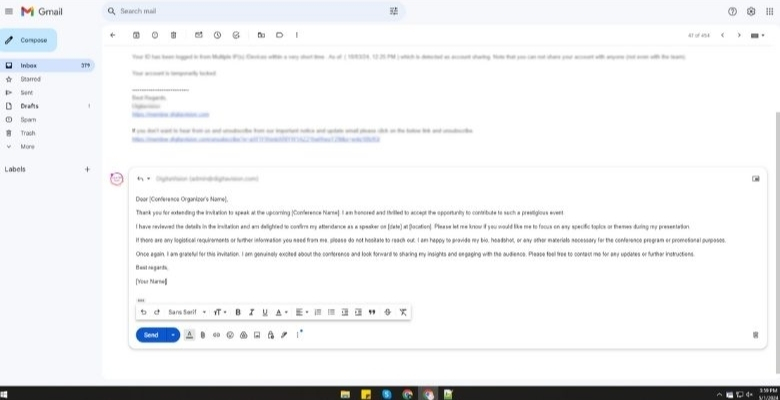
Use the lines that fit your event and delete the rest. Do not leave placeholders in the final email.
Subject: Re: Invitation to [Conference Name] – Acceptance
Dear [Organizer’s Name],
Thank you for the invitation to [speak / join the panel / attend] at [Conference Name] on [dates]. I’m pleased to accept.
A few quick confirmations from my side:
- My role and session: I understand I will be [role], for about [X minutes]. Please correct me if that is off.
- In-person only: I will be travelling from [city/country] and plan to arrive on [date] and leave on [date]. Will the organizers cover travel and accommodation, or should I book independently and claim expenses? Is there a speaker hotel block, and a deadline for submitting travel details?
- Virtual only: I note my slot as [time] in [my time zone]. Could you send the platform link and login details, and confirm whether I am presenting live or pre-recorded? I am happy to join a tech check.
I will have my [slides / abstract / bio] ready by [date] if you need them in advance. Please let me know if there is anything else you need from me.
Best regards,
[Your Full Name]
[Title, Organization]
[Email | Phone]
Keep the list short, with three questions at most. If you are a keynote speaker, say whether you need specific AV, and for an academic event add your abstract or paper title so the program is unambiguous.
How to Decline a Conference Invitation Professionally
Decline as early as you can, in a few honest sentences. A clean decline is almost always appreciated more than a late acceptance or a no-show.

When and How to Say No Without Burning Bridges
If you know within two days that you cannot attend, say so then. Waiting two weeks to decline is a bigger problem than the decline itself, because it leaves the organizer in limbo on speaker slots and attendee numbers. You do not owe a long explanation. Scheduling conflict, prior commitment or budget limits are all legitimate.
A few things keep the relationship intact:
- Acknowledge the invitation. One sentence such as “This looks like a strong program” costs nothing.
- Be specific if it helps. “I’m presenting at another conference that weekend” is more credible than “prior commitment”.
- Leave the door open only if you mean it. If you would consider a future edition or another contribution, such as a recorded session, say so. If not, skip it.
- Apologize once. Three apologies in four sentences reads as performative.
Academic and international organizers often have a small pool of qualified speakers, so a warm decline matters even more there. If you are a keynote speaker who was already confirmed or contracted, a written decline alone is not enough. Talk to the organizer first, then send the email as a record.
Decline Email Template
This works whether you are declining as a speaker, panelist or attendee.
Subject: Re: Invitation to [Conference Name] – [Your Name]
Dear [Organizer’s Name],
Thank you for the invitation to [Conference Name] on [dates]. I have looked through the program and it is clearly a well-put-together event.
Unfortunately, I will not be able to attend this year due to [brief reason: a prior speaking commitment / a scheduling conflict / budget constraints for travel and accommodation]. I’m sorry to miss it.
I hope the event goes well. [Specific detail, for example: “the panel on X looks particularly strong.”] Please do keep me in mind for future editions.
Best regards,
[Your Full Name]
[Title, Organization]
[Contact Information]
Short, warm, done. Do not offer alternatives unless you will follow through. For an online event, where travel is not the obstacle, be a little more specific: “I have back-to-back commitments that week and can’t give the session the attention it deserves” is more convincing than “scheduling conflict”, as long as it is true.
If You Declined and Want to Change Your Answer
Contact the organizer straight away, say that you declined earlier and ask whether a place is still open. Do not assume your slot was held, and do not turn up without written confirmation. Two sentences are enough, and the answer depends on whether the organizer has already filled the space.
How to Reply to a Virtual or Online Conference Invitation
Replying to a virtual invitation looks almost identical to replying to an in-person one, with the same tone and structure. The difference is that tech and time-zone details replace travel details.
| Topic | In-person invitation | Virtual invitation |
| Logistics to confirm | Travel, hotel, visa paperwork | Platform (Zoom, Teams, Webex, StreamYard), login details, green room |
| Time | Local session time | Session time in your own time zone, in writing |
| Format | Stage, panel or workshop room | Live, pre-recorded, or a live panel mixed with recordings |
| Preparation | Rehearsal or AV check on site | Tech check, often 24 to 48 hours before |
| Reply window | 2 business days | 2 business days |
Time Zones Are the Biggest Trap
Time zones cause more confusion in virtual and international replies than anything else. Confirm the session time in your own time zone, explicitly: “I want to confirm my slot is 2:00 PM GMT+6, which is 8:00 AM UTC.” It takes five seconds and prevents a real mess.
Format and Tech Questions to Ask
Ask whether you are pre-recording, presenting live or joining a live panel while others are recorded. Virtual conferences mix these constantly. If a tech check is mentioned, acknowledge it. If not, ask whether one is planned. Use the acceptance template above and keep only the virtual lines.
How to Ask for More Time Before Giving Your Decision
You may ask for a few extra days, but send a holding reply within two business days and give a specific date. Silence reads as disinterest, or worse, rudeness.
When It Is Acceptable to Request Extra Time
There are legitimate reasons. The decision may affect your organization and need internal approval, an international trip may need visa arrangements or institutional funding, travel logistics may be unconfirmed, or a conflicting commitment may still be unresolved. These are real constraints, not excuses.
Do not ask for more time when you already know the answer is no. That only postpones an awkward conversation and wastes the organizer’s time. If you know you cannot attend, decline now.
Keep the timeframe honest. If you said Friday, reply on Friday, even if your answer is still pending and you need to ask for one more day.
‘Needs More Time’ Reply Template
Subject: Re: Invitation to [Conference Name] – [Your Name]
Dear [Name],
Thank you for the invitation to [conference name / speaking role] on [date].
I’m genuinely interested and want to give you a considered response rather than a hasty one. I’m currently waiting on [brief reason, for example: internal scheduling confirmation / travel approval / a prior commitment that is still being resolved] before I can confirm.
Would it be possible to have until [specific date, ideally within 3 to 5 business days] to give you a definite answer? I’ll be in touch by then at the latest. Please let me know if that timeline creates any difficulty on your end.
Thank you for your understanding.
Best regards,
[Your Name]
[Title / Organization]
[Contact details]
Notice that it names a date rather than “soon”, gives the reason in one line, and checks that the timeline works for the organizer. If the organizer is in another time zone, add yours next to the date.
How to Request Clarification About Your Role or Conference Details
Ask when the invitation is unclear about your role, the dates or the format, and ask before you commit. Many people either guess and accept anyway, or go silent because they do not know how to ask without looking disorganized.

What to Ask Without Coming Across as Unprepared
Reread the original email first, because the answer may already be in it. What is genuinely reasonable to ask:
- Your exact role. “We’d love for you to participate” could mean 45 minutes alone, a seat on a panel, or a networking dinner. Try: “Could you confirm whether I would be presenting solo or as part of a panel?”
- Session timing and duration. If you travel internationally, speaking at 8 AM on day one rather than 3 PM on day two changes your plans.
- Format and audience size. A live stream to 2,000 people is different from a recording for 40 attendees, and a boardroom is different from an auditorium.
- Travel and accommodation details. Who books, is there a per diem, and what is the deadline for submitting expenses?
- Submission deadlines. Academic invitations often require an abstract, slide deck or bio within a set window. If none is mentioned, ask.
Keep it to two or three questions per email. If you have ten, the invitation was unusually thin, but you should still prioritize what you need before you can reply. A quick acknowledgment such as “Thank you for the invitation, I have a couple of questions before I can confirm” is better than a week of silence.
One thing to avoid: do not frame questions as objections. “I don’t see why I’d need to submit a bio two weeks out” reads very differently from “Could you tell me the deadline for the speaker bio?”
Clarification Request Email Template
Subject: Re: Invitation to [Conference Name] – A Few Quick Questions
Dear [Organizer’s Name],
Thank you for inviting me to [Conference Name]. I appreciate being considered.
Before I confirm my participation, I have a couple of questions:
- Could you specify what my role would involve? The invitation mentioned participation, and I want to understand whether this is a keynote, a panel session or another format.
- What is the expected duration of my session, and is there a time slot already assigned?
- [Optional: will the conference cover travel and accommodation, or would I arrange that independently?]
Once I have this information, I will be happy to confirm promptly.
Best regards,
[Your Name]
[Title / Organization]
[Email / Phone]
Cut question three if it does not apply. “Confirm promptly” shows you are gathering facts, not stalling. For academic invitations, it is also common to ask whether the organizer wants a bio, headshot or abstract with your RSVP, so you do not get a follow-up request three days later.
How to Ask About Travel and Accommodation in Your Reply
Fold the question into your acceptance email, because organizers expect it and one email with one clear ask works best. This applies mainly to in-person events and international conferences.
What to Include Without Overcomplicating the Email
- Travel dates. Say when you would arrive and leave, for example the day before the conference and the day after.
- What you need to know. Ask whether the organizer covers flights, hotel or both, or whether you book and submit receipts. Vague questions get vague answers.
- Your location. A line such as “I will be flying from Toronto” helps them plan.
- Deadlines. If the event is six weeks away and you need to book flights, ask for the deadline or a booking link.
Do not attach a full itinerary or ask about airport transfers in the first email, because that can wait. Do not negotiate fees in the same message unless the organizer raised them first, as it muddies the conversation. Ask whether support is available after confirming your interest. “I’ll attend if you cover flights and hotel” sounds transactional. The sample questions are in the acceptance template above.
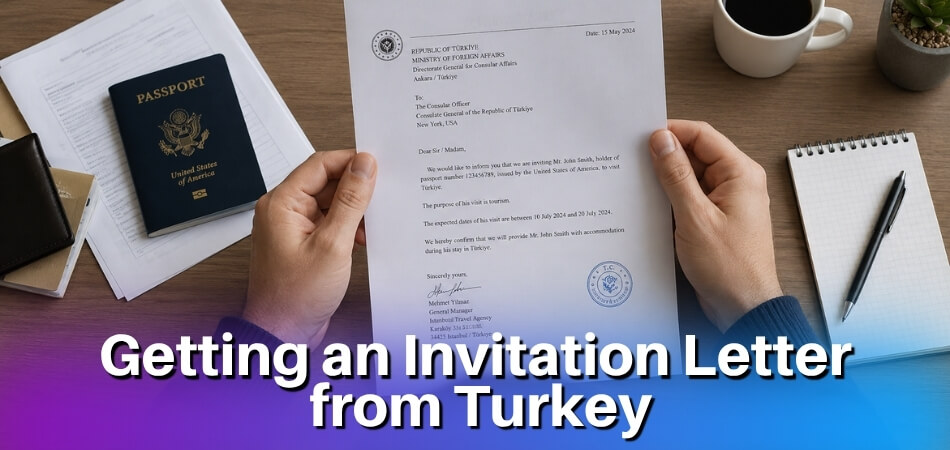
If you will need a visa, say so in your reply and ask whether the organizer issues an invitation letter and when. Many organizers issue it only after registration is complete, so asking early avoids a last-minute scramble. A visa office does not always ask for one, and Canada’s immigration department says a letter of invitation does not guarantee a visa.
Keep to three questions at most. Even if you are a keynote speaker and expect the organizer to cover travel, ask explicitly, because assumptions cause billing problems later.
How to Handle a Last-Minute Cancellation or Withdrawal
Tell the organizer as early as you can, even if that means 24 hours before. Silence is the worst option. An organizer scrambling to fill a panel seat or rearrange a keynote needs every hour you can give.
How to Apologize and Exit Gracefully
Keep it short. They need to know you are out, why in one sentence, and whether you can reduce the damage.
- Say it upfront. The first line should make clear you cannot attend.
- Give the real reason, briefly. “A medical situation” or “an unavoidable work commitment” is enough.
- Acknowledge the inconvenience. Genuinely, without excessive guilt. They built a schedule around you.
- Offer something if you can. A replacement speaker, a pre-recorded video, or 20 minutes remotely. A virtual format often makes the last option easy. Even offering once shows good faith.
- Leave the door open only if you mean it. Empty offers are easy to spot.
Name the session or talk you are withdrawing, check the event’s withdrawal and refund policy, and ask whether a colleague or co-author may take your place. Rules differ by conference, and some registrations are non-refundable or non-transferable.
One clear apology is professional. Five reads as noise. If you are a keynote speaker or have a named session, follow the email with a phone call or direct message. That is not always needed for a standard attendee RSVP, but for a high-visibility role it is the right call.
Last-Minute Cancellation Email Template
Subject: Cancellation – [Your Name] / [Conference Name] on [Date]
Dear [Organizer’s Name],
I’m writing to let you know that I need to withdraw from [Conference Name], scheduled for [date]. I’m very sorry for the short notice.
[One sentence reason, for example: “An unexpected medical situation has come up that requires my full attention over the next several days.”]
I understand this creates a real inconvenience at this stage of your planning. If it helps, I’m happy to [suggest a replacement / provide written remarks / present by video call for part of the session].
I hope we can connect at a future event. Thank you again for the invitation, and I wish you a successful conference.
Best regards,
[Your Full Name]
[Title, Organization]
[Phone number, optional but useful for urgent follow-up]
Notes on the template:
- The subject line is blunt on purpose. Organizers get a flood of email before an event, and “cancellation” gets read immediately.
- Keep the reason to one sentence. This is not the place for a story.
- The offer to help is optional but appreciated, even if the organizer cannot use it.
- If an earlier travel request was approved, add a line confirming you will not use those arrangements. It saves the organizer one more email.
How to Send a Follow-Up Email When You Have Received No Response
If your reply gets no answer, follow up once, in the same thread, after five business days. If the event is less than two weeks away, shorten that to two or three days. It happens more than it should, especially with large academic conferences where the organizing team is stretched.

When to Follow Up and Exactly What to Say
Do not restate your whole reply. The organizer almost certainly has it. Your job is to get a quick confirmation.
- Reply to your original thread. A new chain makes the organizer hunt for your previous message.
- Name the event. Organizers often run several events. Put the conference, date and your role in the first line.
- Ask a closed question. “Could you confirm receipt of my reply?” beats “Just checking in”.
- Do not apologize for following up. “Sorry to bother you” undercuts you. An RSVP follow-up is normal.
Before you chase, check your sent folder and your spam folder for a bounced message or an automatic reply. Until you have written confirmation, avoid booking non-refundable travel, and keep a copy of your original reply.
If the follow-up also goes unanswered for two business days, try a different contact: the event coordinator, a second address on the conference site, or a LinkedIn message if you have a direct connection.
Follow-Up Email Template
Subject: Follow-Up: [Your Name] – Reply to [Conference Name] Invitation
Hi [Organizer’s Name],
I wanted to follow up on the email I sent on [date] regarding your invitation to [Conference Name] on [event date].
I confirmed my [acceptance / attendance / participation as a panelist] in that message but have not received a confirmation from your end. Could you let me know if you received it?
Happy to resend if anything got lost.
Best regards,
[Your Full Name]
[Title / Organization]
[Contact Number]
No re-explanation and no reattached documents unless asked. If your original reply included a travel question that is still open, add one sentence: “I also had a question about travel arrangements, which is in the original email.”
International Conference Invitations: Cultural Etiquette You Should Know
Match the register of the invitation you received, and adjust for the organizer’s region. These are general tendencies, not rules, and individuals vary.
Formal vs. Informal Tone by Region
| Region | Typical expectation | What to do |
| Japan, South Korea, East Asia | High formality, indirect refusals | Use full titles (Professor, Dr., Director), avoid contractions, lead with gratitude. Decline softly: “I regret that my schedule does not permit attendance” sits better than “I can’t make it”. |
| Germany, Austria, Switzerland | Direct, within a formal structure | Use the full title and surname (Herr, Frau, Professor). Get to the point, but keep the professional framing. A chatty tone can feel unprofessional. |
| United States, Canada | Relatively relaxed | Professional but conversational. Use the organizer’s first name if they used yours. Informal does not mean sloppy. |
| Middle East, South Asia | Relationship-building language expected | Open with a genuine expression of honor or appreciation. Match the formality of a senior academic or government-linked body. |
| Latin America, Southern Europe | Warmer, more personal | A brief personal note, such as having followed their work, lands well. |
One practical rule: look at how the original invitation was written and match it. If they wrote formally, reply formally. Also check the organizer’s time zone before sending. A reply you send on a normal Tuesday afternoon may land in the middle of their night. It is not a dealbreaker, but noticing it shows consideration.
Special Tips for Academic Conference Invitations
Whether you are invited as a keynote speaker, panelist or presenter, a few unspoken rules apply.
- Acknowledge the committee. Academic conferences are usually run by program committees. Name the organizing or scientific committee if it is listed. It shows you read the invitation.
- State presentation requirements early. As a keynote speaker, say in the same email what you need: AV setup, slide format, speaking time. Waiting for a later email wastes the organizer’s time.
- Abstract and paper deadlines are firm. If your acceptance depends on a deadline extension, say so clearly and early. Accepting and then quietly missing the deadline damages your reputation across conferences.
- Check indexing and approval. For international academic conferences, check whether the proceedings are indexed in Scopus or Web of Science if that matters to you, and whether you need institutional approval. Saying “I am awaiting institutional approval and will confirm within three to five business days” is normal.
- Do not sit on a keynote invitation. Organizers working to fill speaker slots may move to their next choice if you wait two weeks, and they remember the delay.
If the organizers are native speakers of another language, one correct line in that language, such as “We look forward to visiting [City]”, signals genuine interest. If you cannot write it correctly, skip it.
Common Mistakes to Avoid When Replying to a Conference Invitation
The most damaging mistakes are the small ones that organizers notice quickly. Several others, such as waiting too long, giving a vague answer and over-explaining, are covered in the sections above.

| Mistake | Why it hurts | Do this instead |
| “I’ll try to make it” | It is not an RSVP, so the organizer has to chase you | Say yes, no, or a specific date by which you will decide |
| Ignoring your role | The organizer cannot tell whether you understood the invitation | Name it: “I’m happy to confirm my participation as a panelist on the Day 2 morning session” |
| Wrong tone for the audience | Casual with a formal university, or stiff with a relaxed community event | Read the invitation. Its tone is usually the tone they want back |
| No contact details | The organizer cannot reach you quickly, and time zones make email-only slow | Add a phone number or preferred contact method in your signature |
| An uncustomized template | It shows when a reply was not written for their event | Add the conference name, date, city and role |
| Going quiet after accepting | Preparation requirements go unmet | Follow up after five business days if you hear nothing |
| Replying to the wrong person | Invitations often come from an assistant, but the RSVP contact may be someone else. Your reply can sit unread for weeks | Check the body of the email for the event contact before you hit reply |
From our experience at MS International: organizers can only plan around replies they can act on. When a delegate needs a visa, we need their confirmed registration and correct personal details before we can prepare the invitation letter. At MS International the letter is issued within 3 to 5 business days after payment clears, and it supports a visa application but does not guarantee approval. A reply that gives your full name as it appears on your passport, your role and any early questions saves a round of emails.
Frequently Asked Questions (FAQ)
Your reply to an organizer can lead to follow-ups of its own, like negotiating terms, asking for the agenda first, cancelling at the last minute after accepting, or hearing nothing back.
How quickly should I reply to a conference invitation?
Reply within two business days, or by the date in the invitation if it names one. This is a common professional guideline, not an official rule. If you need longer, send a short acknowledgment within that time and say when the full answer will follow.
What if I accepted but now need to cancel last minute?
Send your cancellation in writing as soon as you know, naming the session you are withdrawing, because the organizer needs time to update the program and find a replacement. Give a one-sentence reason, apologize once and offer help. Check the withdrawal and refund policy.
Do I need to reply to every conference invitation?
Yes. No rule forces you, but a short reply, even a decline, is the professional default. A two-sentence decline is better than silence: an early no lets the organizer fill your place, while silence leaves them planning around you.
Is there a difference between replying as a keynote speaker and as a panelist?
The format is similar, but the questions differ. A keynote speaker clarifies session length, topic focus, AV needs and travel support. A panelist asks about the discussion format, the moderator and the angle they are meant to represent.
Can I negotiate the terms in my acceptance email?
Yes, politely, in the same email as your acceptance. Name specific items such as travel, accommodation, recording of your session or use of your slides, and ask for any agreement in writing. Do not assume an honorarium or reimbursement unless it is confirmed.
What should I do if I haven’t heard back after sending my reply?
Wait five business days, then send one short follow-up in the same thread asking whether they received your reply. Send only one, because a second starts to feel like pressure. Check your sent and spam folders first, and avoid non-refundable travel until you have written confirmation.
Can I change my answer after declining an invitation?
Possibly, if the place is still open. Contact the organizer at once, say that you declined earlier and ask whether you can still take part. Wait for a written yes before making plans.
Is it acceptable to ask about the agenda before confirming?
Yes. A clarification request before you confirm shows you take the commitment seriously. Ask about your speaking slot, the expected audience and the session format, because they decide whether you are the right fit.
Does replying to a virtual conference invitation require anything different?
Yes. Confirm the time zone, the platform, whether the session will be recorded and any technical requirements. Virtual logistics unravel quickly if these are not pinned down early.
Should I use an RSVP email template or write from scratch?
Start from a template, then personalize it. A template makes sure you cover your decision, your questions and your availability, but a fully templated reply reads as generic. Change the details and add one line about why you are looking forward to the event.
Final Thoughts: Reply With Confidence
Every reply you send says something about you before you walk into the room or join the call. Reply within two business days, be clear about your decision, and put your questions in one message. If something changes later, tell the organizer early and honestly, and offer what help you can.
Treat the templates in this guide as a starting point and make them yours with the right name, event, date and role. Read your draft out loud before sending. If it sounds stiff, rewrite it.