
You gave your fingerprints and photo, and now the waiting starts. Plenty of applicants refresh the IRCC portal every few hours hoping a passport request appears, and clear timelines for this one stage are hard to find.
Quick answer: IRCC does not publish a set time between biometrics and a passport request. Applicants commonly report anywhere from about 3 weeks to 3 months, because the request only comes after the officer has reviewed the whole file and found it approvable. Check the IRCC processing times for your application type, and use the web form if you are well past it.
Fact-checked by the MS International Editorial Team. Last verified against official sources: October 2026.
This article covers only the passport-request stage: the usual range, what delays it, how biometrics validity fits in, what to send once the request arrives, and when to contact IRCC. It is about the request IRCC sends after a visa application, not about applying for a passport of your own. Visa-exempt nationals who come only to visit are exempt from biometrics, so this stage applies to applicants who apply for a visa.
How Long After Biometrics Does a Passport Request Arrive?
Most applicants report a wait of several weeks, and a straightforward visitor file can be quicker than a study or work file. There is no official figure for this gap, so treat every number you read, including the ones below, as an applicant report and not an IRCC promise.
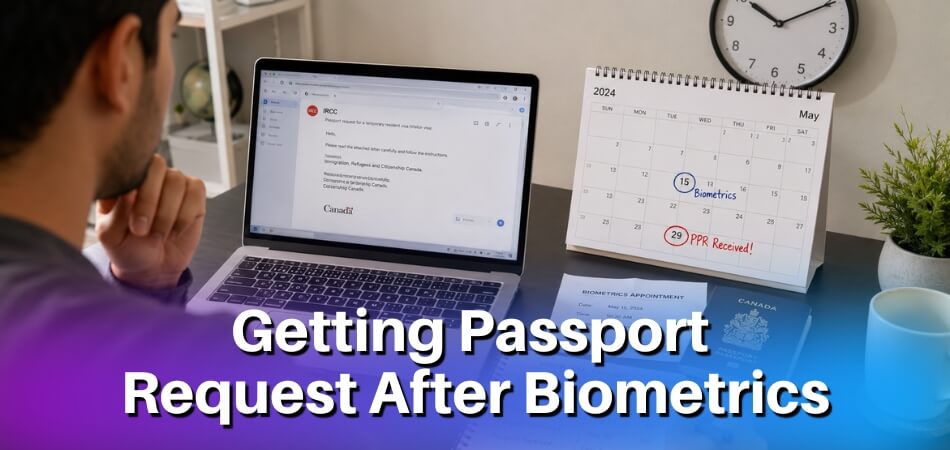
A passport request does not appear the moment your biometrics are processed. Biometrics are one piece of the file. IRCC still has to finish background checks, review any medical examination results and assess the whole application before it asks for your passport. The biometrics appointment is a checkpoint, not the finish line.
The clock that matters is the processing time for your application type, shown in IRCC’s processing times tool. IRCC says that estimate starts when it receives your complete application, includes the time it takes you to give biometrics, and is “not a maximum or a guarantee”. The wait after biometrics sits inside that overall time.
A few things consistently push the wait longer:
- Incomplete documents or a request for more information. If IRCC flags something, the file waits until you respond.
- A pending medical examination, where one is required. If your results have not been received or cleared, the application stays on hold.
- Office workload. Volumes vary by office and by season.
Seeing “received” or “in process” on the portal tells you little about how close you are. The portal confirms that documents arrived, but it does not show which review stage your file is at. IRCC says the status tool may not show some activity on your file for weeks, and some steps, such as security checks, never appear in it.
If you are past the posted processing time with no update, submit an inquiry through the IRCC web form (details in the contact section below).
Is Anything Pausing Passport Requests Right Now?
Yes, for applicants whose last country of residence is the Democratic Republic of the Congo, South Sudan or Uganda. IRCC’s temporary Ebola measures run from 27 May 2026 until 23:59:59 ET on 27 November 2026. Applications from these residents continue to be processed, but none will be finalized at this time, so no visa is issued during the measures.
The test is the last country of residence you listed on your application, not your citizenship. If it applies to you, IRCC says not to send your passport to a visa application centre until the measures end, because the centres cannot process passports for finalizing these applications. A passport sent anyway will be returned, and you may have to pay additional fees. For everyone else this does not apply. Read the IRCC page for the latest wording before you act, because the end date has been extended once already.
From Biometrics to Passport Request: How the Process Works
What Does IRCC Do After You Give Your Biometrics?
Your application goes back into the queue for an officer to review. Your fingerprints and photo are sent electronically from the Visa Application Centre (VAC) to IRCC, so you send nothing yourself.
The officer then goes through the whole file: your personal history, your ties to your home country, travel history, medical results if they were submitted, and the documents from your original application. Workload differs between offices and streams, so how fast an officer reaches your file depends on where your application is handled.
During this stage your portal status may stay the same for a long time. The portal updates at key points, not continuously, so a quiet status usually means the file is waiting in the review queue.
If documents are incomplete or medical results have not arrived, the review can stall, and IRCC will not issue a passport request until the file looks approvable.
What Does a Passport Request Mean?
A passport request asks you to submit your passport so IRCC can place the visa in it. It is a strong sign that the application has been approved, but it is not the visa itself. The visa is added after IRCC receives and processes your passport, and IRCC says you cannot travel to Canada until the visa is placed in the passport you submit.
The request comes from the visa office handling your file, usually as a message in your IRCC account, and it states the deadline and how to send your passport. It can only follow a full review: biometrics on record, any required medical complete, background checks cleared and an officer satisfied the file is approvable. If one of those is missing, the officer waits or sends a different message asking for more information.
Email and portal messages do not always arrive at the same moment. If an email looks like a passport request, log in promptly to confirm it and check the exact deadline, because missing it can complicate your application.
Processing Time: What Makes the Wait Longer or Shorter
The wait is driven by visa office workload, medical clearance and document quality, and the first two are outside your control.
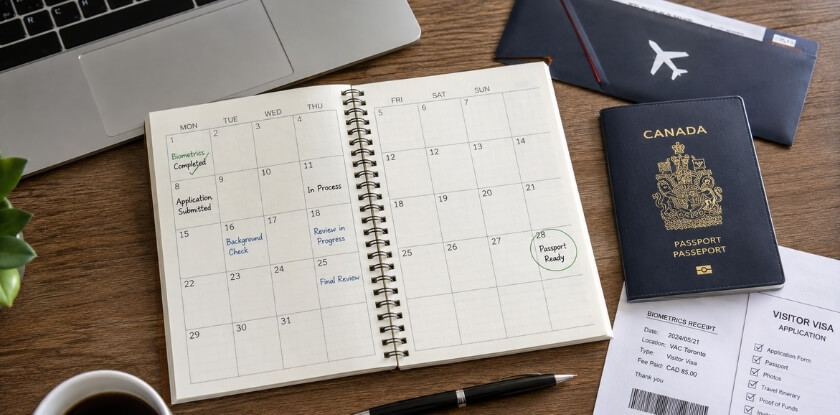
Why the Wait Varies
Any number you see for this stage is an average across many different cases. Because IRCC’s own estimate includes the time you take to give biometrics, the part you control is how quickly you book the appointment.
Visa office workload is probably the biggest variable. IRCC says its estimates depend on how many applications are in the queue, how many staff process that application type and how many applications it expects, so a file that enters a busy queue may sit behind earlier ones.
A pending medical holds up almost everything downstream, but many conference visitors never need one. IRCC says that for a stay of 6 months or less you generally do not need an immigration medical exam unless you plan to work in certain jobs. IRCC also says medical exam results are valid for 12 months, and if you do not arrive within that period you may need another exam. If you do need one and completed your exam but the results are not linked to your file, the status will sit still even after biometrics. Look in your account for a sign that results were received, and if nothing shows weeks after the exam, ask through the web form.
Incomplete documents are a quieter cause. IRCC lists an incomplete or complex application among the reasons a file takes longer, and IRCC says it will contact you if it needs more information or documents. Check your account messages so a request does not sit unseen.
Security and background checks have no fixed schedule. If your file triggers extra screening, the request waits until it ends, and the portal simply keeps showing “in progress”. An inquiry will not speed this up, but you can contact IRCC once you are well past the posted processing time.
The pandemic years were much slower, with collection sites closed and a large backlog afterwards. Do not assume any of the temporary COVID-era biometrics extensions still apply. Regional disruption, such as a visa office relocating or running at reduced capacity, can also slow every file in that queue.
Practical Tips to Receive Your Passport Request Faster
You cannot speed up IRCC’s review, but you can avoid self-inflicted delays.
- Submit a complete application. An unsigned form, a photo that does not meet the specification or a document without a certified translation can stall a file.
- Book biometrics as soon as the instruction letter arrives. IRCC gives you 30 days from the date on the letter to give them, and every day you wait is added to your overall wait. Book the first slot that works and bring the instruction letter and your passport.
- Keep your medical current, if you need one. Results are valid for 12 months, so an exam that expires before you arrive forces a repeat.
- Check your account yourself. IRCC puts the letter with passport instructions in your account, and an email alert can end up in spam. Do not leave this entirely to an agent.
Online vs. In-Person Biometrics: Does It Change the Wait?
No, the way you gave your biometrics does not change how fast IRCC reviews your file once it has them. What changes is whether you need an appointment at all.
For most applicants, including those in Bangladesh and India, biometrics are given in person at a VAC. There is no purely online route for these applicants. What people call “online biometrics” usually means biometrics already on file from an earlier application, which IRCC reuses without a new appointment (validity rules are in the next section).
If you need a new appointment, the file does not move until the VAC has taken your biometrics and sent them on. Appointment delays in busy cities can add weeks before IRCC even starts, so applicants who postpone the appointment by two or three weeks are delaying their own passport request by the same amount. Once IRCC has everything, the review itself is the same whether the biometrics are fresh or four years old.
If your portal has been quiet and you are unsure whether the VAC has sent your data, check that the appointment is complete first. Occasional transmission delays do not show clearly on the portal, and an IRCC inquiry can confirm whether your data arrived.
Biometrics Validity: How Long Does One Submission Stay Valid?
Biometrics stay valid for 10 years, and one submission covers several applications in that window. The 10 years run from the date you gave them, not from the date a visa was approved. If a Bangladeshi applicant gave biometrics in 2019 for a study permit, they remain valid for a new visitor visa, study permit or work permit application made before 2029. Permanent residence applications are different: they always need new biometrics.
Age works the other way from what some guides say. Children under 14 and applicants over 79 are exempt from giving biometrics, and IRCC judges age on the date you submit your application. Check the IRCC biometrics pages for your own situation.
What Happens When Your Biometrics Are Still Valid
If your biometrics are on file and have not expired, IRCC does not send a new instruction letter. This removes one waiting period before the next stage, whether that is a medical, a document request or the passport request itself.
A missing instruction letter does not mean something went wrong. Check your biometrics date first before contacting IRCC. A refusal also does not reset the clock: if you applied in 2020, were refused and are reapplying now, your 2020 biometrics almost certainly still count.
When Fresh Biometrics Are Needed
Fresh biometrics are needed once the 10 years have passed. IRCC also says you can give them voluntarily when you apply if you want a visa or permit for a longer period, because it cannot issue one for more than 10 years from the date you last gave biometrics. If your status shows no movement after the standard processing time, submit an inquiry.
What Documents Do You Need to Submit After a Passport Request?
Send your passport exactly as the request letter says, and meet its deadline. The letter states how long you have. IRCC’s visitor visa page gives no standard number of days, so the date in your own letter is the only one that counts. Missing it risks delay.
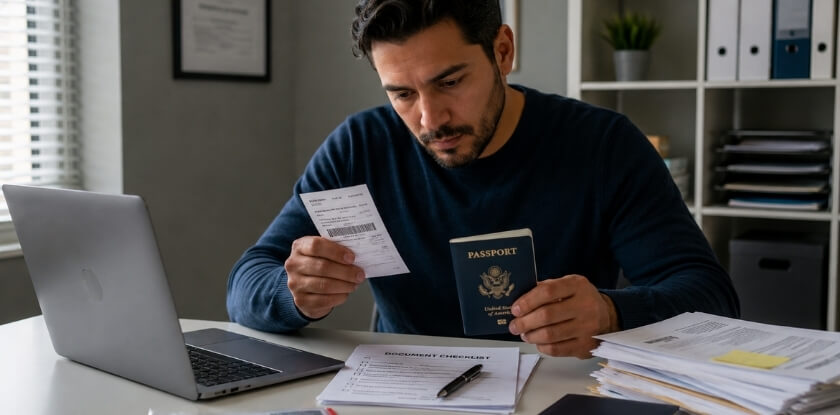
What you typically send:
- Your original passport. It should be current and have enough blank pages for the visa. Older passports that show travel history or earlier Canadian visas are often sent too, and this is generally good practice.
- The passport request letter. Print the message from your account and put it on top of the package so staff can match it to your file.
- Photographs. Some offices ask for fresh passport-size photos at this stage, even if you gave photos earlier, so follow the letter.
- Anything else the letter lists. This can include updated travel history, a letter of explanation, proof of funds, or a new medical if your original one has expired (IRCC says medical exam results are valid for 12 months).
- A passport submission form, if the office requires one. Check the instructions for your country of citizenship.
Send the same passport you used in your application. IRCC says a newer passport may delay processing and does not mean a longer visa validity, because the officer decides the expiry date.
Do not send your passport before a request has actually been issued. Confirm in your account that the request is active, because sending it early creates unnecessary risk.
If you applied through a VAC, as many applicants in Bangladesh and India do, follow the VAC’s courier, sealing and labelling instructions. Keep photocopies of everything you send, including every page of the passport, so any later IRCC inquiry is easier to resolve.
Bangladeshi and Indian Applicants: What Applicants Report
The ranges below come from applicant reports in forums and community groups, not from IRCC. Use them to calibrate your expectations, not to plan around.
| Applicant group | Reported wait after biometrics |
|---|---|
| Bangladesh, visitor visa | Around 3 to 5 weeks |
| Bangladesh, student visa | Often 4 to 8 weeks, sometimes closer to 3 months |
| India, visitor visa | As quick as about 3 weeks for clean files |
| India, study or work permit | About 4 to 12 weeks, up to 10 to 12 weeks with a medical |
Bangladeshi Applicants
Most applicants from Bangladesh give biometrics at the VAC in Dhaka, and the appointment itself is straightforward. The unpredictable part is the wait that follows. Which visa category you applied for and which office handles your file make the biggest difference, and student files tend to run longer, especially when the medical results take time to link to your profile.
A common pattern is confusion over a silent portal. Unless it shows a specific issue or asks for documents, silence usually just means the file is in the review queue, so there is no need for an inquiry before the standard processing window has passed.
Financial proof and travel-history requirements can be interpreted differently from one file to the next, so incomplete-document flags are a frequent cause of delay. The passport request waits until the extra information you send has been processed.
Indian Passport Holders
Indian applicants are one of the largest groups applying for Canadian visas, and biometrics are usually given at a VFS Global centre. Processing pace can shift from month to month. Seeing “biometrics received” does not always lead to visible movement for several weeks, because the review starts in earnest only once every component, including the medical, is in.
If a medical was completed before biometrics, your wait afterwards may be shorter because that piece is already in the system. Whichever country you apply from, check the current IRCC processing time for your application type, and only reach out once your wait is past it. IRCC says calling will not help your application get processed faster.
If Your Passport Request Is Delayed: When and How to Contact IRCC
Contact IRCC once you are past the posted processing time for your application type, using the web form, and check your account first.

How Long Should You Wait Before Reaching Out?
The posted processing time is your baseline. IRCC’s web form has an option for asking about an application that is past its normal processing time, and IRCC says that if you applied and have not heard recently, no action is needed. Send one inquiry only, because IRCC says submitting another web form will not speed things up.
Check These Things First
Before submitting an inquiry, look at your own account.
- See whether the status has moved to something like a decision, and open your account messages. A passport request can already be there without an email alert.
- Confirm your biometrics are still valid. If there was a gap since your original submission, IRCC may be waiting on fresh ones.
- If you used a representative, check whether incomplete documents or missing forms are flagged in the portal, as an incomplete application is one reason IRCC gives for a longer wait.
Where and How to Submit an Inquiry
The main channel is the IRCC web form on the official Canada.ca website. You will need your application number and your UCI (Unique Client Identifier). For a visitor visa, choose “Temporary Resident Visa” in the form, not “Visitor Record”.
Be specific. Give the date you completed biometrics, the visa office, your application category and your current portal status. A vague message such as “I haven’t heard anything” tends to get a generic reply, while dates and reference numbers get reviewed faster.
IRCC’s client support line, 1-888-242-2100, is for callers within Canada, and agents can confirm basic status but usually cannot push a case forward. There is no phone number for applicants outside Canada, so people applying from Bangladesh or India use the web form.
A Note on Third-Party Help
Forums and Facebook groups are useful for calibrating expectations, but only IRCC itself, or a licensed immigration consultant or lawyer, can act on your file. Paying an informal “agent” to follow up rarely accomplishes anything and can muddle your correspondence. If the delay is far beyond the norm, a regulated Canadian immigration consultant (RCIC) or lawyer is a better investment than repeated web form messages.
How to Track Your Application Status Using the IRCC Web Portal
Log in to the IRCC account you applied with (the IRCC Portal with your email, or the secure account with GCKey or a Sign-In Partner), select your application, and read both the status line and the messages inbox.
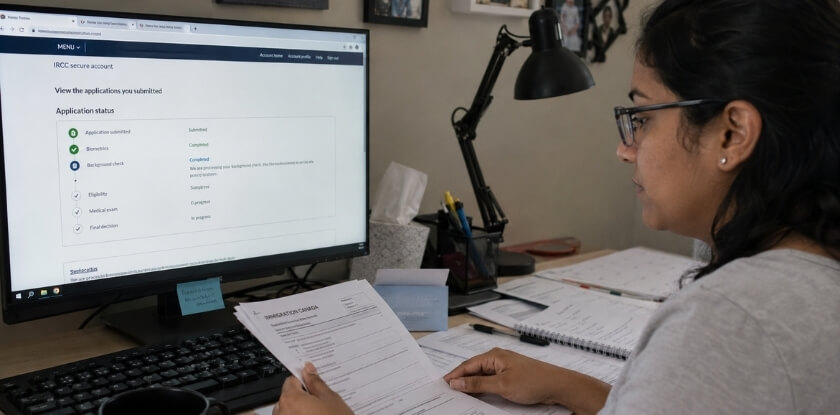
What the Status Messages Mean
Wording changes over time, so read the message in your own account rather than relying on a list from a forum. In general:
- Received or in process. IRCC has your application and no decision has been made.
- More information or correspondence sent. Open your messages immediately. This can be a passport request, a medical letter or another document request.
- Decision made. The application is approved or refused.
Where to Find the Actual Passport Request Letter
The status screen only shows a short phrase. The letter itself, with instructions on how and where to send your passport, sits in your secure account messages, not in your email. Some applicants have found the status changed while the notification email landed in spam, so check the portal directly.
How Often Should You Check?
Once a day is enough. IRCC says the status tool may not show some activity for weeks, so refreshing every hour changes nothing. If the status has not moved for several weeks past the standard processing time, that is the point to consider an inquiry.
Family Applications
Each family member has their own status line. A passport request for the principal applicant does not mean the others have one, and requests can arrive days apart, so check each application separately. Sending passports at different times is a common cause of avoidable delay, so submit them as each request arrives and keep a note of every deadline.
From our experience at MS International: we do not give delegates a date for a passport request, because IRCC sets none. Apply early, keep your passport available after biometrics until the request arrives, and avoid non-refundable flights or hotel bookings until the visa is in hand.
FAQ
The stretch after fingerprinting and before a passport request brings its own worries: a status that has not moved, biometrics validity running out, the deadline to respond and whether to book flights yet.
How long after biometrics should I expect a passport request?
IRCC publishes no set time for this stage, and applicants commonly report about 3 weeks to 3 months. Visitor files tend to be quicker, and study and work files with a medical tend to take longer. Compare your own wait with the processing time for your application type.
Does completing biometrics mean my application is almost approved?
No. Biometrics are one step, and IRCC still has to complete security screening, review your documents and possibly your medical before issuing a passport request. Being asked for biometrics only means the application is moving forward.
What if my biometrics validity period expires before I get a passport request?
Biometrics are valid for 10 years, so an application being processed inside that window needs no repeat. If yours were given more than 10 years ago, IRCC may ask for new ones. Children under 14 and applicants over 79 are exempt.
Can I speed up the process after biometrics?
There is no reliable way to speed up IRCC’s review. The best you can do is answer any request quickly, keep your contact details current in your account and make sure documents were complete from the start. If you are well past the posted processing time, a web form inquiry is an option.
Do in-person and online biometrics lead to different wait times?
No. The wait after biometrics is driven by the visa office reviewing your file, not by how the biometrics were collected. Reusing valid existing biometrics only saves you the appointment step.
I received a passport request. How long do I have to respond?
The deadline is the date in your request letter. IRCC’s visitor visa page sets no standard number of days, so do not rely on a figure from a forum. Respond early and allow courier time if you send a passport from Bangladesh or India.
My application status hasn’t changed since biometrics. Is that normal?
Yes, it can be normal. The status often stays unchanged for weeks while the file waits in the review queue or goes through checks you cannot see. Ask through the web form only once you are past the posted processing time.
What happens if I miss the passport request deadline?
IRCC’s visitor visa page does not say what happens if you miss the date, so treat it as firm and expect delay. If you cannot meet it, contact IRCC through the web form before it passes, because an extension is not guaranteed. Check your account often after biometrics so you do not miss the request.
Can I book flights once I get a passport request?
No. A passport request is not the visa. IRCC says you cannot travel to Canada until the visa is placed in the passport you submit, so wait for the visa before you commit to non-refundable travel.
Do I send the same passport I applied with?
Yes, send the passport you provided in your application. A newer one may slow the file. If your passport has changed since you applied, read your letter and ask IRCC through the web form before you send anything.
Conclusion: Your Next Steps After Submitting Biometrics
Confirm in your IRCC account that your biometrics were received, then watch your messages and spam folder for a passport request or a document request. Keep your passport and required documents ready, because the deadline can be short. If the status is unchanged past the posted processing time, submit one inquiry through the official IRCC web form, and follow the request instructions carefully once it arrives. If your last country of residence is the Democratic Republic of the Congo, South Sudan or Uganda, read the current IRCC measures first.
Disclaimer: This article is general information, not legal or immigration advice. Processing times and rules change, so confirm details with IRCC or a licensed immigration professional before you act.