
Your abstract submission deadline is tomorrow. Your data collection is still running. Your analysis is weeks away from being complete. Every researcher who has attended a conference knows this moment: the calendar and the research timeline refuse to line up, and you wonder whether it is even legitimate to submit anything at all.
Quick answer: Often yes, but the call for papers decides. Many conferences accept an abstract before your results are final if you state the research question and method clearly and label any findings as preliminary or expected. Some calls require results. Posters and humanities tracks are the most flexible, while STEM oral sessions often want at least early data.
Below you will find which fields and conference types allow incomplete abstracts, how to structure yours, what language to use around preliminary and expected results, and how to handle the ethical questions that come with submitting before you know what your data will show.
Can You Submit an Abstract to a Conference Without the Results?
You can often submit a conference abstract without final results, but not at every conference. Many conferences in STEM, social sciences, and humanities accept abstracts that present preliminary results or clearly stated expected results, as long as the methodology is sound and the research question is well defined. Others, especially clinical and some STEM meetings, ask for results in the abstract itself.
The key is transparency. Your abstract should reflect where your research stands at the time of submission. If data collection is ongoing, say so. If you are presenting projected findings, frame them as expected contributions rather than confirmed outcomes. Reviewers understand that research takes time. They are judging whether your project is credible, relevant, and likely to be ready by the conference date.
This approach is especially common for PhD students and early-career researchers, who often submit months before their work is finished. A poster or oral slot gives you a target date and pushes the work forward. Many conference programs allow for this reality.
Two things matter most. Your methodology must be concrete, so reviewers trust that you have a real plan, and your abstract must be honest about what you have versus what you expect. Presenting speculative results as confirmed findings is an ethics problem. Clearly signalling that “results are in progress” generally is not.
A quick policy check before you submit saves trouble later. Look in the call for papers for four things: whether results are required, whether work in progress is allowed or has its own track, which formats (poster, oral, short paper) are open to unfinished work, and what the withdrawal rules are. If any of these is unclear, send the organisers a short email, since they would rather answer one question now than handle a surprise later. Check the conference withdrawal policy before you submit. If your research stalls, you need to know how to withdraw without professional penalty.
When a Results-Free Abstract Is Acceptable, From the Conference’s Perspective
It depends on the field, the presentation format, and the timing of the deadline. Conferences are not uniform, and knowing where you stand before you submit saves a lot of anxiety.
When the Conference Deadline Arrives Before Your Research Is Complete
This is extremely common. Data collection runs long, lab results get delayed, a co-author’s section stalls, and the conference timeline does not pause for any of it. Many conferences set abstract deadlines months before the event so committees have time to review, assign sessions, and plan logistics. For many researchers that means submitting well before the study wraps up.
Committees know this. They look at whether the research question is clear, the methodology is sound, and the work will likely be presentable by the conference date. A well-written abstract with preliminary results and a clear expected contribution can be fully competitive.
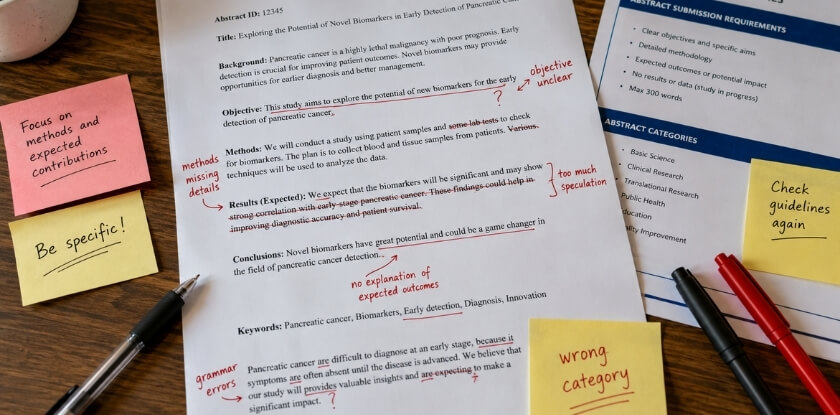
What does not work is a vague results section that makes the research look underdeveloped. Show what you have found so far, even if it is early-stage, and explain what you expect to confirm or contribute by the time you present.
When the Call Requires Results
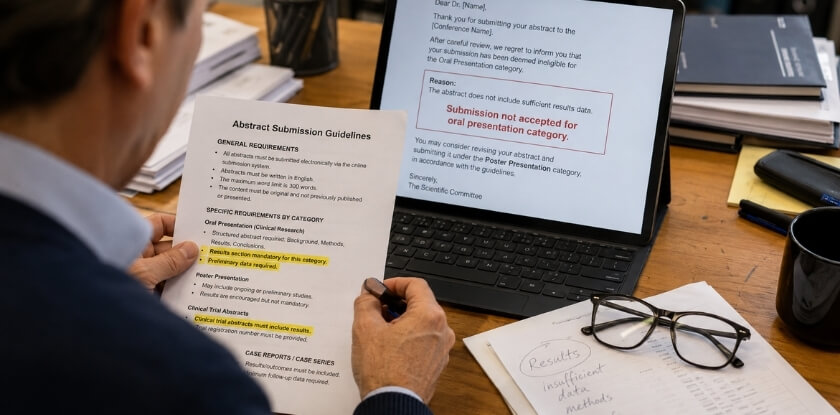
Some calls say so outright. The call for the 10th EMCA conference, for example, states that abstracts “must contain a clear statement of the purpose of the work, the methods used, the results, and conclusions.” Read the submission rules before you write a word, because an abstract that is strong in every other way can still be rejected for missing a required section.
If the call requires results and you do not have them, you have three options: wait for a later deadline or a later edition, choose a conference whose call allows work in progress, or ask the organisers whether a poster or work-in-progress category exists.
A late-breaking track is not a shortcut. These are separate rounds for results that were not ready by the regular deadline, and the rules differ. The European Association of Urology congress, for example, asks for a placeholder abstract by the regular deadline and requires “robust, final data” for the late-breaking submission, so preliminary or incomplete data is not accepted there. Read that conference’s own late-breaking call.
Differences by Field: STEM, Humanities, and Social Sciences
Norms vary significantly across disciplines, so the same abstract can land differently depending on your field. The table gives the short version, and the notes below it add the detail.
| Field | What reviewers usually expect | Results-free abstract |
|---|---|---|
| STEM | At least preliminary results: experiments run, data collected, something concrete found | Riskier, especially for oral slots. Computational and theoretical work may be judged on methodology and expected contribution |
| Humanities | A thesis and a line of inquiry; the argument matters more than measurable data | Generally the most accepting. Many humanities conferences exist to develop ideas through discussion |
| Social sciences | Quantitative work mirrors STEM; qualitative work is accepted more often mid-process | Somewhere between the two. Qualitative posters are the easiest fit |
In STEM, reviewers want to see that experiments have been run, data has been collected, and something concrete has emerged, even if the full analysis is ongoing. A purely theoretical proposal with no empirical data can raise flags, particularly for oral slots, although computational and theoretical work sometimes runs under different expectations, where a well-developed methodology and expected contribution can carry an abstract.
In the humanities, the abstract often emphasises argument and interpretation rather than data, so it can present a thesis and a line of inquiry without announcing measurable results. Incomplete work is often the point of these meetings. In quantitative social science, reviewers want to see that data collection is underway and that preliminary findings support the direction of the work, while qualitative research is more often accepted mid-process, particularly as a poster.
If you are unsure about a specific conference, look at abstracts in previous years’ programs. They show quickly how finished the work usually is at submission time. Some calls also define “work in progress” themselves, for example as projects with a method in place and data still being collected, so read the definition in the call.
Poster vs. Oral Presentation: Which Format Gives You More Flexibility
A poster gives you more flexibility. Posters are widely understood as a format for work in progress: a place to share developing findings, gather feedback, and test ideas with peers. For a PhD student mid-dissertation or a researcher running a multi-year study, a poster is the natural home for preliminary results.
Oral presentations carry higher expectations. These slots go to work the committee believes will be complete, polished, and defensible by the conference date. Results do not have to be fully analysed at submission, but the abstract must make a credible case that they will be. A thin results section needs a strong background and a compelling methodology to offset it.
Online events have lower logistical stakes, but the same distinction between posters and oral slots usually holds, and each call sets its own rules. A competitive in-person conference will normally apply stricter scrutiny to oral slots.
If you are not sure your research will be far enough along for an oral slot, apply for a poster. You can always present stronger work later. A poster that generates good discussion beats an oral presentation you are not ready to give.
How to Write a Descriptive Abstract Without Results
A descriptive abstract states what your paper will do, its purpose, its approach, and what you expect to find or contribute, without reporting finished data. Many conference calls explicitly invite this format for early-stage work. The challenge is to be clear and credible enough that reviewers can judge whether the work belongs in the program.
Structure: Background → Purpose → Methodology → Expected Contribution
Most conference abstracts follow this four-part logic, whether or not the sections are labelled. Sticking to the sequence helps reviewers follow your thinking quickly.
Background. One or two sentences placing your research in context. What gap, problem, or debate does it respond to? Keep it tight: reviewers do not need a literature review, just enough to see why the study matters.
Purpose. What the research is trying to do. “This study examines…” or “This paper investigates…” works fine. Be specific about scope: population, phenomenon, historical period, or data type.
Methodology. How you are doing it. For a study that is underway this is usually the most developed part. Reviewers assess whether your approach is sound, so be precise. Name your method (qualitative interviews, a randomized controlled trial, archival analysis, computational modelling), your sample or dataset, and your tools or frameworks.
Expected contribution. What the research will add, phrased as an anticipated outcome: “The findings are expected to…”, “This study will contribute to our understanding of…”, “Results are anticipated to inform policy on…”. You are making a credible claim about direction, not announcing a discovery.
When no results exist, STEM reviewers tend to weight the methodology most heavily. In humanities and social sciences, the framing and theoretical contribution matter just as much.
How to Write Preliminary Results or Expected Results the Right Way (and the Ethical Way)
If your data collection has started, share what you have honestly. Preliminary results are entirely legitimate; just be transparent about their status. If you have not collected data yet, expected results should follow logically from your design and the existing literature.
- Label them accurately. Write “preliminary findings suggest” or “initial data indicate a trend toward”, not “the study found”. Presenting partial data as final is a research ethics violation, and it leaves you exposed if findings shift before the conference.
- Say plainly that results are pending. One published guide to conference abstracts suggests a line such as “If accepted, these data will be shared at the annual meeting”, and warns that reviewers will then look harder at the objectives and methods. Make those two parts your strongest.
- Anchor expected results in your method. “Based on prior studies of X and the cohort size in this study, we expect to find Y” is credible. “The results will show Z” with no basis is not.
- Be proportionate. With one pilot interview or two survey responses, do not call them preliminary findings. Say a pilot was conducted, mention what it suggested, and describe the full study as underway.
- Avoid inflated confidence. Reviewers at serious conferences know results can go the other way. Overstating certainty about expected outcomes does not strengthen your abstract, it raises questions about your judgement.
Poster reviewers often expect less complete data than oral reviewers, though this varies. Check the call and, if you can, ask a supervisor or co-author who has submitted to that venue.
Sample Abstract Written Without Results
Here is a sample abstract for an educational psychology study that has not yet collected its full dataset. It uses the structure above and handles the missing results honestly.
Sample abstract
Metacognitive strategy instruction has been linked to improved academic performance in secondary students, yet most intervention studies have been conducted in Western European or North American contexts. Whether similar effects occur in under-resourced school settings in sub-Saharan Africa remains poorly understood.
This study examines the effect of a structured metacognitive intervention on reading comprehension and self-regulated learning behaviours among Grade 8 students in rural Tanzania. The intervention spans eight weeks and involves explicit strategy instruction delivered by trained classroom teachers.
A randomized controlled design assigns 240 students across four schools to intervention or waitlist-control conditions. Pre- and post-intervention assessments use validated comprehension measures alongside a self-report scale for metacognitive awareness adapted for the local language context.
Data collection is currently underway. Based on the intervention design and existing literature on strategy instruction in low-resource environments, we expect to find moderate positive effects on comprehension scores and increased self-report of planning and monitoring strategies. Findings are anticipated to inform teacher training frameworks in similar contexts and contribute to a growing body of evidence on intervention transferability across educational settings.
This abstract has no final data. It does have a clearly motivated question, a specific and rigorous method, and expected results grounded in the study design rather than invented. That is what reviewers can evaluate at the deadline stage.
What You Need to Know Before You Submit
Two practical issues can trip up a well-prepared researcher: whether you have clearance to submit, and whether the conference format changes what is expected.

Getting Permission from Your Supervisor or Co-Authors
If you are a PhD student or early-career researcher, talk to your supervisor before you submit. This is more than courtesy. A supervisor listed as co-author has their name on whatever the abstract claims, and they may have views on whether the project is far enough along to show publicly. Co-authors have a legitimate stake in what is submitted under their names. Some supervisors are comfortable with preliminary results being presented and even encourage it as a way to get early feedback; others prefer to wait until findings are more settled. You need to know which camp yours is in. If the abstract describes expected contributions, those claims must reflect what your methodology can genuinely deliver.
Keep the conversation simple. Show the draft, name the conference and deadline, and ask whether they are happy for it to go out. That sign-off protects you if the abstract is accepted and a co-author later objects to what was promised. It is also a useful check against overpromising, which is the main risk when writing about unfinished work. Send it early enough for a proper read, ideally a week before the deadline.
If you have no co-author, you can still submit alone. Sole submitters are common, though in some fields co-authoring with your supervisor is standard.
Will an Abstract Without Results Affect Publishing the Paper Later?
Usually not. The ICMJE recommendations say they do not prevent journals from considering a complete report after a preliminary report such as an abstract or poster displayed at a scientific meeting, and that a journal may consider a paper that was presented at a meeting but not published in full. Each journal sets its own policy, though, so check the one you plan to target, and do not publish new data tables or figures in press reports of your talk.
Differences in Abstract Rules Between Online and In-Person Conferences
Format affects more than travel logistics. It can change how strictly an abstract is scrutinised, what happens if your results do not materialise, and what type of presentation you will be expected to give. If you submit without results to an in-person event and are accepted, be confident your research will have moved forward meaningfully by the conference date, and read the withdrawal policy carefully, because repeated withdrawals can affect your reputation in a field.
| Format | What to expect |
|---|---|
| In-person, oral | Firmer expectations of complete work by the event, because committees allocate room space, schedule slots, and print programs. Some conferences charge a fee for late withdrawal |
| In-person, poster | Generally forgiving of work in progress; reviewers often expect preliminary rather than final results |
| Online | Varies widely. Some mirror in-person rules exactly, others have early-career or work-in-progress tracks. Read the call rather than assuming it is more relaxed |
Humanities conferences, online or in person, often treat the abstract as an argument or interpretive proposal, so a results-free submission fits naturally. STEM abstracts tend to expect at least a methodology section and some preliminary results, even without the full dataset.
From our experience at MS International: Our author submission page asks that an abstract explain the work’s purpose, method, key findings, significance, and relevance to the conference, and that the work has not been published or be under review elsewhere. Submissions go through double-blind peer review, and the decision arrives by email as acceptance, revision, or rejection. Most review decisions are returned within about 10 working days, so submit well before the deadline to leave time for any revision. If you have no findings yet, say what stage the study is at, and if you are unsure whether a particular conference accepts early-stage work, ask the organisers before you submit.
What to Do If Your Abstract Is Accepted But You Still Don’t Have Data
Getting an acceptance email is exciting, until you realise your data collection is still months away. This can happen to anyone on a long-term project, especially PhD students and early-career researchers. Manage it deliberately rather than hoping it works out.
Check the Conference’s Withdrawal Policy Immediately
Do this first. Many conferences publish a withdrawal policy with the submission deadline, and the rules vary. Some allow penalty-free withdrawal up to a stated date. Others record a “no-show”, and some list your talk in a printed program and expect you to follow through. The Society for Reproductive Investigation’s published policy, for example, requires the lead author to inform the society in writing before the meeting, and an unexcused no-show can lead to a 24-month bar on submitting abstracts to its annual meeting.
Mark a personal decision date on your calendar, a day by which you will either commit fully or withdraw. Leaving it vague until the last minute creates worse problems.
Have an Honest Conversation with Your Supervisor or Co-Author
Tell them as soon as the acceptance arrives. They may see more clearly than you whether the timeline is realistic, and one who knows the circuit can advise whether a poster would give you more room than an oral slot. Do not wait until two weeks before the event. Early conversations keep options open.
Assess What You’ll Realistically Have by Presentation Day
Be specific. Map out what you expect to have collected, analysed, and interpreted by the day you present. “Some preliminary results” is not specific enough to plan around.
If your methodology is complete and you will have at least partial findings, frame the talk around those and position the rest honestly as ongoing. STEM conferences are generally comfortable with this framing when the methods are solid. Humanities and social sciences conferences vary more, so check whether similar presentations appeared in that conference’s earlier programs. If you expect to have nothing at all (no data, no preliminary results, no fieldwork), that changes things. An empty-handed talk at a conference expecting substantive findings is unfair to the audience and reflects poorly on you and your co-authors.
Prepare for What You Can Honestly Present
Build the presentation around what you actually know by then.
- Lead with your methodology. A well-developed, original design carries real intellectual weight with specialists.
- Present preliminary results as exactly that. Phrases like “early analysis suggests” or “these patterns are preliminary and subject to further data collection” signal rigour, not weakness.
- Say where you are in the timeline. A slide or a clear spoken statement is enough. Academic audiences appreciate candour.
- Prepare for questions about missing data. Someone in the room will ask about findings you do not have yet. Have a short, composed answer that explains your timeline without over-apologising or overpromising.
Consider Requesting a Format Change
Ask the organisers whether you can switch from an oral talk to a poster, or from a full paper slot to a short paper slot. Some will agree when asked well in advance with a brief explanation. Some policies also say whether a replacement presenter is allowed, so ask. A poster session in person or a pre-recorded short talk online both suit developing research, because they invite conversation rather than demanding a complete narrative.
If Withdrawal Becomes Necessary, Do It Early
If you reach your decision date and cannot see a path to presenting something of value, withdraw. Contact the organisers directly, say briefly that the research timeline has shifted, and apologise for the inconvenience. Keep it short and professional.
Withdrawing early frees the slot, keeps your credibility with the committee, and keeps your record clean. Withdrawing three days before the event, or simply not showing up, damages both the conference and your reputation in that community. Submitting before results exist is accepted practice; presenting fabricated or overstated findings to fill a slot is not.
Special Advice for Early-Career Researchers and PhD Students
Submitting before your results are in feels riskier when you are still building a reputation. A few targeted habits help.
Don’t Overcommit on What You’ll Show
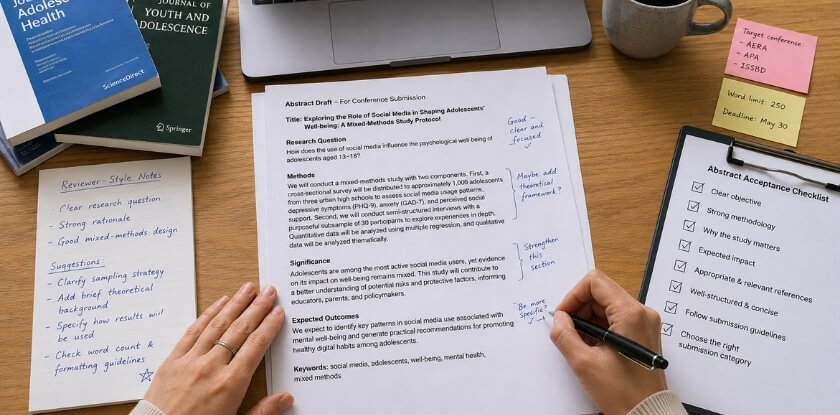
Early-career researchers often feel pressure to sound further along than they are. An abstract that promises fully analysed data when you have only partial findings creates a problem you will manage for months. Be specific: “Pilot data collected from 60 participants suggest a trend toward X, which full data collection will test” is honest and still compelling. Vagueness is not your friend, but neither is overpromising.
Use the Abstract Submission Deadline Strategically
Many early-career researchers wait until the last day to submit, which leaves no time for feedback. Aim for a finished draft a week before the deadline so that someone you trust can read it properly. A rushed abstract that skips the background, the method, or the statement of expected contribution is a harder sell when you have no data to anchor it.
Know the Conference’s Withdrawal Policy Before You Commit
Check it the moment your abstract is accepted. Some conferences are flexible if you contact them early; others print your presentation in the program and expect you to follow through. For a PhD student, withdrawing with adequate notice and a clear reason is a very different matter from simply not showing up, so read the policy, mark the dates, and plan around them.
Choose the Right Presentation Format
Without complete results, a poster is usually a better fit than an oral talk. You can explain your method in detail, share what you have, and discuss the expected contribution without being held to a polished narrative arc. An oral talk with gaps is less forgiving in front of a live audience, online or in person.
Research Ethics Applies Here Too
Ethics covers more than how you run the study. Stating that data collection is complete when it is not, or that results support a conclusion you have not run, is misrepresentation at any career stage. A descriptive abstract that frames outcomes as expected rather than confirmed is ethically sound, and reviewers generally respect honesty about where a project stands.
FAQ
Submitting before the data is in means weighing ethics, how to flag pending results, what happens if results change after acceptance and if a poster slot gives more room than an oral one.
Can I submit a conference abstract with no results at all?
It depends on the call. Humanities and social sciences conferences often accept abstracts with a research question, framework, and expected contribution but no data. Many STEM and clinical calls require at least preliminary results, and some reject abstracts without a results section.
What’s the difference between a descriptive abstract and one with preliminary results?
A descriptive abstract states the question, approach, and expected contribution without reporting findings. An abstract with preliminary results adds early data or partial analysis, labelled as preliminary. Which one is acceptable depends on the call, so check the submission guidelines.
What if my results change after my abstract is accepted?
That is normal in research. Present what you actually found and briefly explain how your approach evolved if it did. You are not bound to report the findings you predicted in the abstract.
Should I mention in the abstract that results are still pending?
Yes, if the guidelines ask for it, and it is a good idea when it is not obvious. Phrases such as “expected results”, “data collection is underway”, or “if accepted, these data will be shared at the meeting” tell reviewers the work is in progress.
Is it ethical to submit if I’m not sure I’ll have results in time?
Yes, as long as you are confident the research will be ready before the presentation date. Submitting speculatively, with no realistic plan to finish, is where ethical problems start. Know the withdrawal policy so you have options if the timeline slips.
Do poster presentations have more flexibility than oral presentations?
Generally yes. Poster sessions are widely seen as a forum for work in progress, so reviewers are more receptive to abstracts without final results. Oral presentations carry a higher expectation that the work is substantially complete, although some calls accept work in progress for oral slots too.
I’m a PhD student with no co-author. Can I still submit?
Yes. Being a sole submitter is not a barrier. Talk to your supervisor first, since they can advise whether the work is ready to present.
Can I submit the same abstract to multiple conferences?
Often no. Some conferences prohibit simultaneous submission, and AIAA’s policy withdraws overlapping submissions. MS International requires that work is not published or under review elsewhere. Read each call, ask the organisers when in doubt, and disclose earlier submissions.
What happens if my abstract is accepted and I withdraw?
Tell the organisers in writing as soon as you know, and follow the conference’s withdrawal policy. Withdrawing early is far better than not showing up, because some societies sanction unexcused no-shows and repeated withdrawals can affect your reputation.
Will presenting an abstract without results stop a journal from publishing my paper later?
Usually not. The ICMJE recommendations do not prevent journals from considering a complete report after an abstract or poster shown at a scientific meeting. Each journal has its own policy, so check the one you plan to submit to.
Does the abstract submission deadline ever get extended?
Occasionally, but do not count on it. Follow the conference’s official channels in the weeks before the deadline to catch any announced extension.
Final Thoughts
Submitting a conference abstract without final results is a normal part of academic life, and many conferences are set up to accommodate it. What matters is being honest about where your research stands, clear about your methodology, and realistic about what you promise.
If your abstract is accepted, treat that as a commitment to show up with something substantive. Preliminary results, partial findings, or a well-reasoned argument can all anchor a strong poster or oral presentation.