
A conference ticket is only the start of what an event can cost you in money, time, and energy. Before you register, it helps to know where the real drawbacks sit.
Quick answer: The main disadvantages of conferences are high total cost, time away from work, travel fatigue, information overload, crowded venues, and the risk of joining an event that does not fit your goals or is poorly run. Most of these can be reduced by checking the agenda and organizer first, budgeting for every expense, and choosing sessions in advance. A well-matched conference can still be worth it.
What Does “Conference Disadvantage” Mean?
A conference disadvantage is any factor that reduces the value, comfort, accessibility, or return on investment of attending or hosting a conference. These drawbacks affect attendees, speakers, sponsors, exhibitors, and organizers in different ways.
For attendees, the main concern is usually whether the event is worth the cost and time. For organizers, the challenges involve venue planning, audience engagement, speaker coordination, safety, technology, and overall event quality. The attendee side is covered in detail in the section on main disadvantages below.
Common Challenges Organizers Face
Organizers face their own disadvantages, especially with large or international events. A successful event needs careful planning, budgeting, communication, and risk management.
- Budget pressure: Venue rental, speaker fees, marketing, staffing, catering, and technology can create high operating costs.
- Logistics management: Organizers must coordinate schedules, registrations, sessions, equipment, and attendee support.
- Audience engagement: Keeping attendees interested throughout the event can be difficult, especially in long programs.
- Technical problems: Audio, video, livestreaming, Wi-Fi, and event apps can fail if not properly tested.
- Safety and privacy concerns: Large gatherings may require security planning, data protection, and emergency procedures.
Instead of treating a conference as automatically valuable, evaluate its purpose, cost, format, quality, and expected outcome before committing.
Why Do People Still Attend Conferences Despite the Drawbacks?
People still attend conferences because the right event can offer learning, networking, visibility, and professional growth that are difficult to get from online research or daily work. Even with the cost, travel, and time commitment, conferences give direct access to experts, peers, organizations, and industry updates.

A conference becomes worthwhile when the expected outcome is clear. An attendee may join to learn about new trends, meet potential partners, explore academic ideas, discover business opportunities, or improve career direction. In these cases the benefits can outweigh the drawbacks if the event is relevant, credible, and well planned.
Learning and Professional Development Value
Conferences give attendees access to structured learning through keynote sessions, panel discussions, workshops, presentations, and expert-led sessions. Instead of searching for scattered information, attendees can learn from people who are actively working in the field.
This can be useful for:
- Understanding current industry trends
- Learning practical skills from experienced speakers
- Exploring new research, tools, or methods
- Comparing different expert opinions
- Staying updated on changes within a profession or academic field
The learning value still depends on the quality of the agenda. If the sessions are too general, poorly organized, or unrelated to your goals, the event may feel less useful.
Networking and Industry Exposure
One major reason people attend conferences is networking. Professionals, researchers, business owners, students, speakers, exhibitors, and decision-makers meet in one place, which can lead to collaborations, referrals, partnerships, or career opportunities.
Conference networking lets attendees:
- Meet people from the same field
- Speak directly with speakers or experts
- Discover organizations, services, or projects
- Join discussions that may not happen online
- Build relationships beyond emails or social media
Networking is not automatic, though. Attendees usually get better results when they decide who they want to meet before the event.
Career, Business, and Academic Opportunities
Conferences can support career growth, business development, and academic visibility. A professional may attend to find job leads, a business owner may look for clients or partners, and a researcher may present work to receive feedback or recognition.
Depending on the type of event, conferences may help attendees:
- Share research or professional experience
- Improve personal visibility in a field
- Meet recruiters, clients, sponsors, or collaborators
- Learn about funding, publication, or partnership opportunities
- Gain confidence by joining professional discussions
These opportunities explain why many people still value conferences despite the disadvantages. Without a clear goal, even a well-known conference can become expensive, tiring, and less productive.
What Are the Main Disadvantages of Conference Attendance?
The main disadvantages of conference attendance are cost, time commitment, information overload, travel stress, limited interaction, and the possibility of low event value. These issues do not affect every attendee equally. The real outcome depends on relevance, speaker quality, agenda, location, networking access, and total cost.
High Costs for Registration, Travel, and Accommodation
Cost is one of the biggest disadvantages of conference attendance. Even when the ticket price seems affordable, the total expense grows quickly once travel, hotel stays, meals, local transport, visa-related costs, and extra event activities are included.
This is hard for students, small business owners, early-career professionals, independent researchers, and organizations with limited budgets. Cancellation rules add risk. Policies differ by organizer: some refund in full before a set date, then reduce the refund, then give nothing, and some treat fees as non-refundable from the start. A change of plans can therefore mean losing the money.
Time Away From Work, Study, or Personal Responsibilities
Conferences often take one or more days away from your regular schedule. This can affect work deadlines, academic responsibilities, client communication, business operations, or family commitments.
The time cost is not limited to the event itself. You may also need time for travel, preparation, recovery, and follow-up, which makes attendance stressful unless it is planned in advance.
Information Overload From Too Many Sessions
Information overload happens when attendees receive more content than they can understand, organize, or remember. Many conferences run several sessions, panels, workshops, and presentations within a short period.
As a result, attendees may struggle to decide which sessions matter most and leave with many notes but no clear action plan. This is more likely when the agenda covers too many topics or when sessions overlap.
Crowded Venues and Limited Personal Interaction
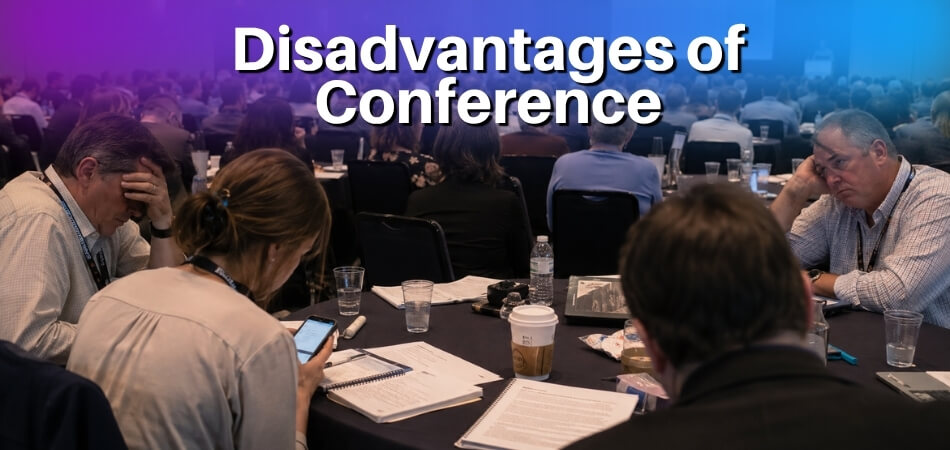
Large conferences can feel noisy and hard to get around. Long registration lines, packed session rooms, busy exhibition halls, and short breaks reduce comfort and focus.
In a very large room you may not see the speaker well, and question time can go to the first or loudest voices, a point raised in a 2020 eLife article on conference formats. Crowds also limit personal interaction. Speakers, exhibitors, and industry leaders are often surrounded by other people, so meaningful conversations are harder to start and keep going.
Networking Pressure and Unequal Access to Opportunities
Networking is often promoted as a major benefit, but it can also be a disadvantage. Some attendees feel pressure to introduce themselves, join conversations, exchange contact details, or make a strong impression in a short time.
Access is not equal either. Experienced professionals, sponsors, speakers, or well-known attendees may receive more attention than newcomers, which can make conferences feel less welcoming for students, first-time attendees, or people who are not confident in social settings.
Travel Fatigue and Physical Exhaustion
Travel can make conference attendance tiring, especially when the event is in another city or country. Long flights, early schedules, time zone changes, hotel stays, and full-day sessions affect energy and concentration.
Late social events, short sleep, and finding your way around an unfamiliar city add to the strain. Even with a strong agenda, tired attendees find it harder to focus, participate, network, or remember key points.
Visa and Entry Risk for International Events
If you must cross a border, a visa decision can come after you have already paid for registration or travel. An invitation letter from the organizer can support an application, but it does not guarantee visa approval or entry. The Government of Canada’s page on letters of invitation (read October 2026) says the same: a letter of invitation does not guarantee a visa.
This is a real cost of international conferences: processing time varies by country, and a refusal can mean a lost registration fee. Rules and processing times change, so check the destination government’s official page before you pay for anything. Apply early and avoid booking non-refundable travel until the decision arrives.
Presenting Pressure for Speakers
If you plan to present, nerves and preparation time are part of the cost, especially early in a career. Presentation slots can be limited, and a talk that goes badly in front of peers feels more exposed than a weak session you only watched. Practice your talk and know your slot before you travel.
Language and Communication Barriers
At international conferences, language differences can create communication challenges. Attendees who are not fluent in the event language may find it harder to follow presentations, ask questions, join discussions, or network confidently.
Barriers also appear when speakers use heavy jargon or academic terms, which can make a conference less useful for beginners or for attendees from related but different fields.
Limited Relevance if the Conference Is Poorly Matched
A conference can be disappointing if its content does not match your goals, experience level, or professional background. A beginner may struggle at a highly technical event, while an experienced professional may find basic sessions too general.
A poor match wastes time and money. Reviewing the agenda, speaker list, target audience, and session topics before registering is the best protection.
Risk of Low-Quality or Predatory Conferences
Some conferences have weak organization, unclear agendas, poor speaker quality, or little real academic or professional value. In academic and professional fields there is also a risk of predatory conferences, which focus more on collecting fees than on genuine knowledge-sharing or networking. Be careful when an event has vague details, unrealistic promises, poor communication, unknown organizers, or little information about speakers and review processes.
Digital Distractions During Virtual or Hybrid Events
Virtual and hybrid conferences reduce travel costs, but they bring screen fatigue, unstable connections, weak engagement, time zone clashes, and distractions from home or work. Online attendees may also feel less connected than people in the room, and the by-type section below lists these formats in more detail.
Security, Privacy, and Data Concerns
Large conferences can carry security and privacy risks. Attendees share personal details during registration, use event apps, connect to public Wi-Fi, and talk with unfamiliar people or organizations.
For organizers, data protection and attendee safety are core responsibilities. Weak privacy practices, poor access control, or unsecured digital platforms reduce trust in the event.
Environmental Impact From Travel, Energy Use, and Waste
Conferences create environmental concerns through air travel, ground transportation, venue energy use, printed materials, food waste, and promotional items. Larger international events may have a bigger footprint because many attendees travel long distances. A University of Bristol study reported by Times Higher Education (28 October 2022) put one passenger’s round trip between New York (JFK) and London Heathrow at 1,130 kg of CO2, against 15 to 20 kg for the IT use of a whole two-day online conference. The study was commissioned by the event’s host and compared the online event only with a single flight, so treat it as an illustration, not a full comparison.
This does not mean conferences should be avoided completely, but it shows why responsible planning matters. Virtual access, less printing, local sourcing, and better waste management can reduce the impact.
Disadvantages of Conferences by Type
Different types of conferences have different disadvantages. An in-person conference may be expensive and tiring, while a virtual conference may feel less engaging. Academic, industry, trade, and networking events each come with challenges linked to their format, audience, and purpose.

Knowing these differences helps you choose the right event instead of assuming every conference offers the same value.
In-Person Conferences
In-person conferences often provide stronger face-to-face interaction, but they usually require more money, time, and travel planning.
Common disadvantages include:
- Higher costs for travel, hotels, meals, and local transport
- Time away from work, study, or business responsibilities
- Travel fatigue from long-distance trips
- Crowded venues and busy schedules
- Limited flexibility if sessions overlap or change suddenly
In-person events can be valuable, but they are harder to attend without a clear budget and schedule.
Virtual Conferences
Virtual conferences are easier to access, but they may not provide the same engagement as physical events. You can join from anywhere, but staying focused online can be difficult.
Common disadvantages include:
- Screen fatigue from long online sessions
- Internet or platform-related technical issues
- Fewer natural networking opportunities
- More distractions from home, school, or work
- Lower motivation to participate actively
- Inconvenient session times across time zones
- An in-person schedule copied online without redesign
Virtual events work best when the agenda is focused, sessions are interactive, and attendees set aside dedicated time to join.
Hybrid Conferences
Hybrid conferences combine in-person and online participation, but they can create an uneven experience. In-person attendees may get more direct access to speakers, exhibitors, and networking activities than virtual attendees.
Common disadvantages include:
- Online participants may feel less included
- Technical problems can affect livestreams or recordings
- Networking may favor people attending physically
- Organizers may struggle to balance both audiences
- Session quality may vary between live and digital formats
A hybrid conference needs strong planning to make both groups feel equally supported.
Academic Conferences
Academic conferences allow researchers, students, and scholars to share knowledge, but they may also be costly, competitive, or hard for newcomers to find their way around.
Common disadvantages include:
- Registration and travel costs can be high for students
- Sessions may be too specialized for general audiences
- Presentation slots may be limited
- Some events may offer little value if poorly reviewed or organized
- New researchers may find networking intimidating
Academic attendees should check the organizer, review process, speaker list, and publication opportunities before committing.
Industry Conferences
Industry conferences focus on business trends, professional insights, and sector-specific developments. However, they can sometimes feel promotional rather than educational.
Common disadvantages include:
- Sessions may focus heavily on company promotion
- Tickets can be expensive for independent professionals
- Popular speakers may be difficult to approach
- Content may be too basic or too advanced for some attendees
- Networking may favor established professionals or sponsors
These conferences are more useful when the agenda offers practical insights instead of only sales-focused presentations.
Trade Shows and Expos
Trade shows and expos are built around products, services, exhibitors, and business connections. They help you discover solutions, but they can also feel commercial and busy.
Common disadvantages include:
- Heavy focus on sales and promotion
- Packed exhibition halls
- Limited educational depth in some sessions
- Difficulty comparing many vendors at once
- Pressure from exhibitors or sales representatives
Prepare a list of products, services, or companies you want to explore before entering the expo area.
Professional Development Conferences
Professional development conferences are created to improve skills and knowledge, but their value depends on the quality of the training and how relevant it is to your career stage.
Common disadvantages include:
- Workshops may repeat basic information
- Sessions may not provide enough practical application
- Certificates may have limited value if the organizer is not credible
- The event may not match your actual skill level
- Follow-up learning support may be limited
Review the session outcomes, trainer background, and whether the skills taught are directly useful, since a conference covers broad themes while training builds one specific skill.
Networking Conferences
Networking conferences focus mainly on building professional relationships. This can be useful, but the experience may be uncomfortable or unproductive without preparation.
Common disadvantages include:
- Pressure to start conversations with strangers
- Short interaction time with important contacts
- Unequal access to high-value connections
- Less value for attendees without clear networking goals
- Difficulty maintaining relationships after the event
Networking events work best when attendees know who they want to meet, what they want to discuss, and how they will follow up.
Are Conferences Worth It for Everyone?
Conferences are not worth it for everyone in every situation. They are most useful when the event clearly supports your learning goals, career plans, research needs, business interests, or networking objectives. If the event is too expensive, poorly matched, or unclear in value, it may not be the best use of your time or money.
Judge a conference by its expected return: new knowledge, professional contacts, client opportunities, academic exposure, industry updates, or practical skills. Without a clear reason for attending, even a popular conference can feel overwhelming.
When Attending a Conference May Be Worthwhile
Attending is worthwhile when the event offers clear value that matches your purpose. A conference may be worth attending if:
- The sessions directly match your professional, academic, or business interests.
- The speakers are credible and experienced in the topic area.
- You can meet people who may support your career, research, or business growth.
- The event provides practical knowledge you can apply after attending.
- Your organization, institution, or employer supports the cost.
- You have a plan for which sessions to attend and who to connect with.
- The conference offers access to resources, discussions, or opportunities you cannot easily get elsewhere.
In these cases the benefits may outweigh the disadvantages because the event has a clear purpose and measurable value.
When Attending a Conference May Not Be the Best Option
A conference may not be the best option when the cost, time, or effort is higher than the expected benefit. This can happen when attendees register without checking the event details. It may not be worth attending if:
- The agenda is vague or does not match your goals.
- The total cost is too high for your budget.
- The speakers, organizers, or sponsors lack credibility.
- The event promises unrealistic outcomes.
- You are attending only because others are going.
- The sessions repeat information you already know.
- You cannot spare the time needed for travel, attendance, and follow-up.
- A webinar, online course, industry report, or local event could meet the same need more efficiently.
In these situations, attending may lead to frustration, low return, and unnecessary expense.
Questions to Ask Before Registering
A few practical questions help you decide whether the conference is worth your investment:
- What is my main reason for attending this conference?
- Does the agenda match my current goals?
- Are the speakers, organizers, and partners credible?
- What is the full cost, including travel, accommodation, meals, and extra fees?
- What is the cancellation and refund policy, and what is the last date for any refund?
- Will I have enough time to attend properly without creating stress?
- Are there specific people, companies, or sessions I want to connect with?
- Can I get similar value from a virtual event, course, report, or smaller local program?
- What will I do after the conference to apply what I learned?
If the answers are clear, the conference may be a strong choice. If they are uncertain, compare other options before deciding.
How Can You Reduce the Disadvantages of Conferences?
You can reduce the disadvantages of conferences by setting clear goals, choosing the right event, planning your budget, reviewing the agenda, and preparing your networking in advance. Problems become easier to manage when you know what you want from the event.

The goal is not to attend everything, but to focus on the activities that support your purpose.
Set a Clear Purpose Before Attending
Before registering, decide why you want to attend. Your purpose may include:
- Learning about a specific topic
- Meeting professionals in your field
- Finding business or research opportunities
- Presenting your work
- Exploring industry trends
- Building confidence and visibility
A specific goal makes it easier to choose sessions, plan meetings, and measure the value of the conference afterward.
Choose the Right Conference for Your Goals
A conference may be popular but still not match your needs. Before registering, check the event topic and target audience, the agenda and session titles, speaker backgrounds, organizer credibility, location and format, registration cost, networking opportunities, and reviews or details from past events. Choosing well reduces the risk of attending a conference that is too basic, too advanced, too commercial, or unrelated to your goals.
Create a Realistic Conference Budget
A conference budget should include more than the registration fee. Many attendees underestimate the total and feel financial pressure later. Include these possible expenses:
- Registration fee
- Flights, train tickets, or other travel costs
- Hotel or accommodation
- Meals and refreshments
- Local transportation
- Visa or document-related costs, if needed
- Printing, business cards, or presentation materials
- Extra workshops or paid networking sessions
A realistic budget shows whether the event is financially reasonable before you commit. Note the cancellation deadline too, so you know how much you could lose if plans change.
Review the Agenda Before the Event
Reviewing the agenda in advance helps you avoid confusion and prevents information overload. Look for sessions that match your purpose, skill level, and interests. If two sessions run at the same time, choose the one that offers the strongest value or is harder to access later.
Prioritize Sessions Instead of Attending Everything
Trying to attend every session leads to tiredness and poor focus. Select the most relevant ones and leave space for breaks, networking, and reflection. You can divide sessions into three groups:
- Must-attend sessions
- Useful but optional sessions
- Sessions you can skip or watch later if recordings are available
This keeps you focused and avoids feeling overwhelmed by a busy schedule.
Plan Networking in Advance
Networking becomes easier when you prepare. Instead of waiting for random conversations, identify the people, companies, speakers, or exhibitors you want to meet. You can prepare by:
- Updating your professional profile
- Preparing a short introduction
- Listing people or organizations you want to connect with
- Reaching out before the event when possible
- Preparing a few useful questions
- Keeping contact details organized
Planned networking reduces pressure and increases the chance of meaningful conversations.
Take Breaks to Avoid Burnout
Long sessions, travel, and constant interaction wear you down, so protect your energy and attention. Short breaks between sessions let you review notes, drink water, respond to urgent messages, or simply rest. A rested attendee understands, participates, and remembers more.
Track Key Takeaways and Follow-Up Actions
A conference is more valuable when you record what you learned and act on it afterward. Without follow-up, useful ideas and contacts are quickly forgotten. During or after the event, note:
- Important ideas from sessions
- Names of useful contacts
- Questions to research later
- Tools, books, or resources mentioned
- Business or academic opportunities
- Actions you need to take after returning
This turns attendance into a practical outcome instead of a temporary experience.
Check Organizer Credibility Before Registering
Checking the organizer helps you avoid low-quality or predatory conferences. A credible conference usually gives clear information about its speakers, agenda, venue, partners, review process, and contact details.

Be careful if the event has:
- Vague speaker information
- Poorly written or unclear event pages
- Unrealistic promises
- No clear organizer background
- Limited contact details
- Pressure to register quickly
- Unclear refund or participation policies
Careful checking protects your time, money, and professional reputation.
Use Virtual Options When Travel Is Not Practical
If travel is too expensive, stressful, or time-consuming, a virtual option may be more practical. Online participation reduces costs while still giving access to useful sessions. Virtual attendance may be a better choice when:
- The main goal is learning, not networking
- Travel costs are too high
- You have limited time
- The event provides recordings
- The platform supports Q&A or chat
- You cannot be away from work or family responsibilities
Virtual options may not fully replace in-person networking, but they remove several of the biggest disadvantages of conference attendance.
Conference Disadvantages vs. Possible Solutions
Most conference disadvantages can be reduced with the right preparation. Identify the possible problem before the event and use a practical solution that protects your time, money, energy, and learning outcome.
| Conference Disadvantage | Possible Solution |
| High registration and travel costs | Compare total expenses before registering and look for early-bird pricing, virtual access, or employer support. |
| Time away from work or study | Choose only the most relevant event and plan your schedule before and after the conference. |
| Too many sessions and topics | Review the agenda early and prioritize sessions that match your goals. |
| Crowded venues | Arrive early, plan meeting points, and avoid overloading your schedule. |
| Limited personal interaction | Contact key people before the event and prepare short, clear conversation starters. |
| Travel fatigue | Allow enough rest time, avoid unnecessary activities, and keep your schedule realistic. |
| Visa and entry risk | Apply early, ask the organizer about an invitation letter, and delay non-refundable travel bookings until the decision arrives. |
| Refund and cancellation risk | Read the cancellation policy and deadlines before paying, and ask whether a substitute attendee is allowed. |
| Language barriers | Review session details in advance and choose events that offer clear communication, translation, or accessible materials. |
| Poorly matched content | Check the target audience, agenda, speaker list, and event theme before registering. |
| Risk of low-quality conferences | Research the organizer, past events, speakers, partners, and registration policies. |
| Weak virtual engagement | Attend from a quiet place, turn off distractions, and participate in chats, polls, or Q&A sessions. |
| Privacy and security concerns | Use secure internet connections, avoid oversharing personal data, and check the event’s privacy practices. |
| Environmental impact | Choose virtual access when possible, reduce printed materials, and support events with responsible planning. |
Conferences are not automatically good or bad. Their value depends on how well the event matches your goals and how carefully you prepare.
From our experience at MS International: Our conferences are held in person in the Greater Toronto Area. Under our refund policy, registration fees are non-refundable and non-transferable, with rare exceptions approved in writing, and the policy asks participants to review the conference details, dates and fees before registering. Listener registration lets you attend without presenting. For international participants, the invitation letter is issued within 3 to 5 business days after payment clears. It supports a visa application but does not guarantee a visa or entry, and it does not mean the organizer provides sponsorship.
FAQ About Conference Disadvantages
Weighing a conference against its downsides? Cost, lost time, language barriers, crowded networking, environmental impact and refunds if you cannot go are the drawbacks worth checking.
What is the biggest disadvantage of attending a conference?
Total cost is often the first drawback to weigh, but the biggest one depends on your situation. Registration, travel, hotel, meals, and time away from work add up quickly, while for others a poor match with their goals costs more than money.
Why can conferences be expensive?
Conferences are expensive because the registration fee is only one part of the cost. You may also pay for transport, hotel stays, food, visa-related documents, workshop add-ons, and time away from work or business.
Can conferences waste time?
Yes, conferences can waste time if the event does not match your goals. A conference feels unproductive when the sessions are too general, the agenda is poorly organized, or the networking opportunities are not useful for your field.
What problems do virtual conferences have?
Virtual conferences mainly suffer from screen fatigue, weak networking, internet issues, low engagement, and distractions from home or work. Time zones can also leave you with inconvenient session times. They are often easier to attend than in-person events, but may feel less interactive.
How do language barriers affect international conferences?
Language barriers make it harder to follow presentations, ask questions, join discussions, or network with confidence. The effect is stronger at international conferences where participants come from different countries and professional backgrounds.
Are large conferences harder for networking?
Yes, large conferences can be harder for networking because many attendees compete for limited time with speakers, exhibitors, and industry leaders. Short breaks make meaningful conversations even more difficult.
What are the environmental concerns of conferences?
Conferences add to emissions and waste mainly through attendee travel, especially flights. Venue energy, paper, and single-use items add more, and international events weigh heavier when many people fly in.
Can I get a refund if I cannot attend a conference?
It depends on the organizer’s policy and deadline. Some refund fully before a set date, some refund part, and some treat fees as non-refundable. Cancel in writing early, and ask whether a substitute attendee is allowed. Read the policy before you pay.
How can attendees avoid conference disadvantages?
Set clear goals, check the organizer’s credibility, and budget for every expense. Also review the agenda, plan your networking, take breaks, and follow up after the event.
Conclusion
You should be aware of conference disadvantages, but you do not need to avoid conferences completely because of them. Costs, time commitment, travel stress, visa risk, crowded venues, information overload, and low-quality events can reduce the value of attending, but most of these problems can be managed with careful planning.
Judge each conference by its purpose, credibility, agenda, audience, and total cost. If the event supports your learning, career, business, or academic goals, it may still be a worthwhile investment. If it does not, a virtual event, local workshop, webinar, or online course may be a better option.