
You have finished most of your research, the results look solid, and now you are looking at a list of deadlines and wondering whether to submit to a workshop or to the main track of a conference. The choice affects your CV, how easily people find your paper on Google Scholar, DBLP or Scopus, and what you can do with the work later, such as a journal extension.
Quick answer: A workshop paper is usually shorter, reviewed more lightly and aimed at early or niche work, while a conference paper is a complete contribution that goes through full peer review and normally carries more weight. Choose a workshop for feedback on work in progress. Choose a conference for finished results. Always check whether the workshop is archival.
Last verified against official sources: October 2026.
This guide compares the two across review, acceptance rate, indexing, CV value and journal extension, so you can decide before the next deadline.
Workshop Paper vs Conference Paper: Key Differences at a Glance
The main difference is maturity. A workshop paper presents early, narrow or exploratory work to a focused community, and a conference paper presents a complete, self-contained contribution. The table shows the factors researchers weigh most often.
| Factor | Workshop Paper | Conference Paper |
| Scope | Narrow, exploratory, or in-progress work | Complete, self-contained research contribution |
| Length | Set by each workshop’s call for papers; often shorter than a main-track paper | Set by the conference; CVPR 2025, for example, limits main papers to eight pages plus references |
| Review rigor | Often lighter, with fewer reviewers or shorter feedback, but it varies by workshop | Full peer review; NeurIPS and CVPR, for example, review double-blind |
| Acceptance rate | Often higher, but it varies widely by workshop | Lower at competitive venues (NeurIPS 2024 accepted about 25.8%, CVPR 2025 about 22.1%) |
| Proceedings | Archival or non-archival, depending on the workshop | Normally published in official proceedings |
| Indexing and citations | Depends on whether the proceedings are indexed; a paper posted only on a workshop website is harder to find | Depends on whether the proceedings are indexed; official proceedings give the best chance |
| Weight on a CV | Often read as supplementary; useful early in a career | Usually counts for more with hiring and grant panels, though norms vary by field |
| Journal extension | A common starting point; whether it counts as prior publication depends on the venue’s rules | Possible, but journals expect substantial new content |
Two points matter most before you submit anywhere. First, a high acceptance rate at a workshop is not a flaw: workshops exist to surface early ideas and start discussion. In that sense a workshop sits between a main conference and a forum, which is built around open discussion rather than a planned agenda. Some readers will still take a workshop acceptance as “work in progress” more than “validated contribution”. Second, find out whether the workshop is archival. An archival workshop publishes accepted papers in formal proceedings, usually through a publisher with a DOI. A non-archival workshop presents papers without formal publication, typically by posting them on a workshop website, and that often leaves you free to submit the work elsewhere. The call for papers states which one applies, and the rest of this article builds on that detail.
Which One Should You Submit To: Decision Criteria
Submit to the venue that matches where your research is now, not where you hope it will be in six months. A half-finished idea with promising early results and a fully validated study call for different venues, and the wrong choice wastes your time and the reviewers’ time.
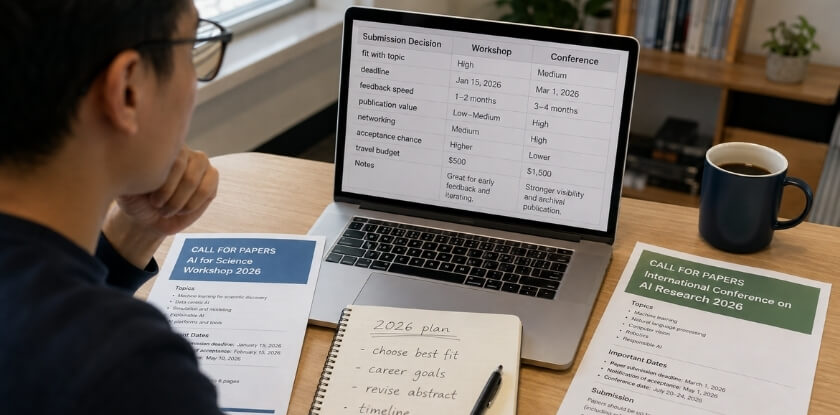
| Your situation | Better choice |
| Early-stage work, incomplete experiments | Workshop |
| Seeking feedback before a major submission | Workshop |
| Fully validated study, clear contribution | Conference |
| Work needs high citation value and indexing | Conference |
| PhD student building initial CV entries | Workshop (to start) |
| Research is niche or interdisciplinary | Workshop |
| Targeting Scopus or DBLP indexing | Conference, or an archival workshop whose proceedings are indexed |
| Want a clear path to journal extension | Conference |
Submit to a Workshop When
A workshop is the right venue when your experiments are still running, your results are preliminary, or your framework still has gaps. Reviewers at workshops expect work in progress, and you get structured feedback from people who care about the same niche problem.
- Your contribution is narrow or exploratory. Workshops attract focused sub-communities. If your work fits a specific theme rather than the broad scope of a full conference, it belongs there.
- You want a low-stakes trial run. A workshop lets you test your framing, find weak spots in your method and sharpen the argument before you target a high-prestige venue.
- You are planning a journal extension. Papers from workshops without published proceedings are often not treated as prior publication, so you can build on the feedback and submit a fuller version later. Some venues do count them, as the table in the extension section below shows, so check the target journal’s policy first.
- You need a CV entry. A workshop paper is a legitimate academic output, though it often carries less weight than a full conference paper when committees compare candidates.
Submit to a Conference When
A full conference paper is the right target when the experiments are done, the results hold up and the contribution is clearly defined.
- Indexing and citations matter. Papers in official, indexed proceedings are easier to find, cite and build on than a paper that exists only on a workshop website.
- You need a standalone contribution. Conference papers are expected to answer a clear question and be judged on their own merits. Workshop papers often lean on the broader event’s context.
- Your career stage calls for it. A senior PhD researcher going on the job market in twelve months will usually want conference papers on the CV. Check what hiring and fellowship committees in your field expect.
- You are aiming at a journal. Many journals in computer science and AI invite extended versions of conference papers, and a complete conference paper gives a cleaner base than a workshop seed.
Acceptance Rate: Workshop vs Conference
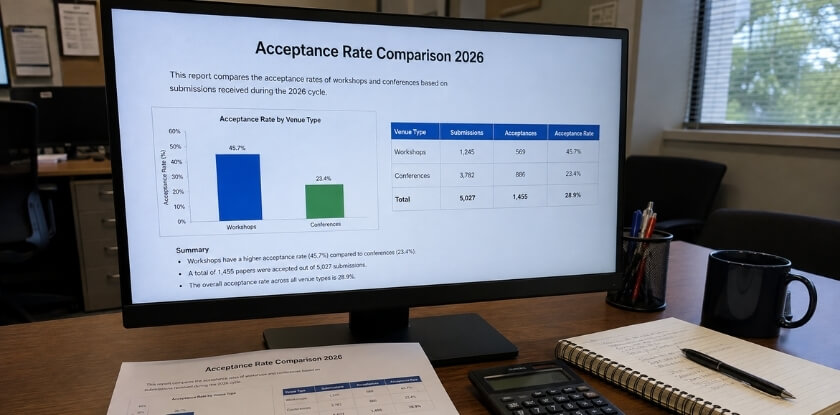
Workshops usually accept a larger share of submissions than competitive main conferences, but the range is wide, so check each venue’s own record rather than assuming “workshop” means easy.
What the Numbers Look Like
Top venues are selective. NeurIPS 2024 accepted about 25.8% of 15,671 main-track submissions according to its official fact sheet, and CVPR 2025 accepted about 22.1% of 13,008 valid submissions, and other selective venues can sit lower. Workshop rates depend on scope, committee size and audience. A well-established workshop can be nearly as competitive as a main track, while a newer or smaller one may accept almost everything that clears a basic quality bar, so look at the specific workshop’s history.
Why the Gap Exists
The gap is not simply lower standards. Workshop review is typically lighter, often with fewer reviewers and shorter, less structured feedback, and the criteria lean toward relevance and interest to the community rather than the full novelty and rigor bar of a main track. That makes workshops useful for exploratory or narrowly specialised work, such as an interesting negative result, a dataset contribution or an early-stage system that might not survive main-conference review but deserves a fair hearing.
How It Affects Your Strategy
A higher acceptance rate can cost you some prestige and citation value. Two or three strong papers in indexed conference proceedings can outweigh a longer list of workshop papers when a committee reviews your portfolio. If your acceptance odds at the main conference look reasonable for the work’s maturity, submit there. If the paper is early-stage or experimental in ways the main track is unlikely to reward, a workshop is a deliberate choice about where the work belongs now, not a fallback. Submitting to the main track too early and being rejected helps nobody.
Citation, Indexing, and Academic Weight
Whether a paper is indexed depends on whether its proceedings are covered by the database, not on the word “workshop” or “conference” in the venue name. How much a paper adds to your record depends on whether it is indexed and whether others can find and cite it.
Are Workshop Papers Indexed?
It depends on the workshop. Some workshops publish formal proceedings, which can be indexed in the same way as other proceedings. CVPR, for example, publishes a separate proceedings for its workshops. Others post accepted papers only on the workshop website or on arXiv. Do not assume that co-location with a major conference guarantees indexing.
Scopus, for example, takes conference material either as a special issue of a journal or as a dedicated conference proceeding, and it covers conferences that publish full-text papers, not abstracts only. Its Source Title list, which is updated monthly, shows whether a proceedings title is covered. Google Scholar lists conference papers among the scholarly material it can include, but each paper needs its own page or file that a visitor can read without signing in, with the title, first author and year clearly given. A workshop site that only shows a programme page may not meet that.
| Where the paper appears | What to expect |
| Official conference proceedings | Can be indexed if the proceedings are covered, usually with a publisher page and a persistent identifier such as a DOI |
| Workshop with formal proceedings | May be indexed; confirm in the call for papers and in the database |
| Workshop website or arXiv only | May be found by Google Scholar if the page meets its inclusion rules; not a Scopus source by itself |
Before submitting to a workshop, search for the previous edition’s proceedings title in the Scopus Source Title list. That is the indexing that matters most for institutional metrics, grant applications and many PhD evaluations. Google Scholar alone may not be enough if your programme explicitly requires indexed publications.
How Much Does Citation Value Differ?
Workshop papers do get cited, but there is no guarantee. Papers in formal proceedings are easier to search and reference. A paper that sits only on a workshop website is harder to find and easier to overlook during a literature review, and workshop sites can disappear when organisers change institutions, a point made in a 2009 blog post on workshop proceedings by the database researcher Panos Ipeirotis.
If your results are strong enough for a conference submission, the lower indexing and citation ceiling of a non-archival workshop is a real cost. If the work is preliminary and you want fast feedback before a journal extension, it is a reasonable trade-off.
The Value of a Workshop Paper on Your CV or Resume
A workshop paper is a legitimate entry on a CV, but it reads as a smaller one than a conference paper, so label it honestly. Readers can usually tell from the venue name that it is a workshop, and that is context to manage, not something to hide.
What It Signals
For a PhD researcher or early-career researcher with no publications yet, a workshop paper at a respected event shows that your work passed review and received feedback from experts. What it does not signal is the same level of completed, independent research as a full conference paper. Workshop papers are often works in progress, negative results or position pieces, so an accurate description matters more than the venue name.
How to List It Correctly
Clarity matters most. List workshop papers in their own section, or label them clearly in a combined list with the workshop name included. A line such as “Workshop on Efficient Deep Learning, NeurIPS 2024” is informative. One that buries or omits the word “workshop” creates a misleading impression.
- Use the right section label. Common choices are “Workshop Papers”, “Refereed Workshop Papers” or “Workshop and Short Papers”. Avoid putting them under “Peer-Reviewed Publications” with no qualifier, even if they were peer reviewed.
- Include the indexing source if relevant. If the paper is indexed on DBLP, Scopus or Google Scholar you can say so. Some institutions and funders require indexed publications, so check your own requirements.
- Do not inflate the venue name. A line such as “Workshop on X, co-located with NeurIPS” reads very differently from “Proceedings of NeurIPS”, and both can be honest entries. Writing “NeurIPS 2024” when the accurate citation is a workshop co-located with NeurIPS misrepresents the venue.
When a Workshop Paper Helps
- You are applying for a PhD programme. It shows concretely that you can produce and communicate research, and it can be stronger evidence than a preprint that has not been reviewed.
- You are early in a new research area. It shows you have submitted work and received expert feedback, not just claimed an interest.
- You need to show output during a dry period. A workshop paper from year two shows continued productivity while a longer project matures.
- The workshop is attached to a top-tier venue. Co-location with a prominent conference adds context, though it does not change the workshop’s own review and publication status.
Where It Has Limited Impact
Some workshop papers never collect a single citation, so if you want citable work that builds your h-index, a conference paper in indexed proceedings is the better target. Some institutions give little credit for workshop papers toward required output, so check the norms of your field and your target institutions before relying on them.
The best use of a workshop paper is as one step in a longer arc: workshop paper now, full conference paper in the same area next cycle, journal extension after that. A committee reading your CV in year four or five will see that progression.
Extending a Workshop Paper Later: What Opportunities Exist?
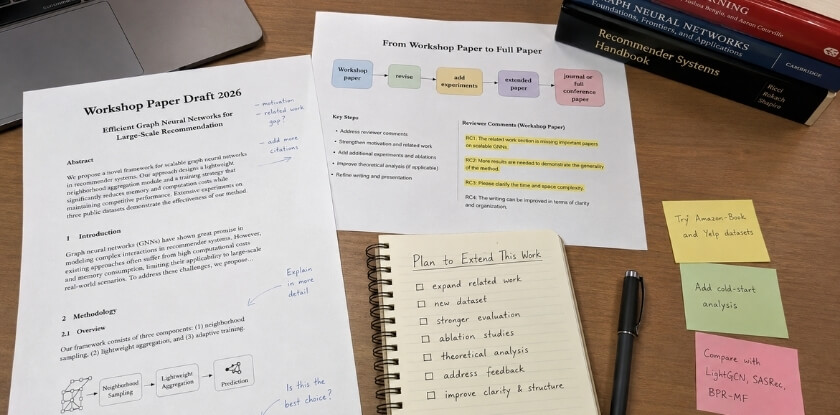
You can extend a workshop paper into a full conference paper or a journal article, provided the later version adds substantial new work and the venues’ prior-publication rules allow it. For many researchers the workshop is the first step of a longer publication path.
From Workshop to Full Conference Paper
The common route is to present at the workshop, collect feedback from reviewers and attendees, strengthen the work and submit an expanded version to a standalone conference. Workshop reviewers are usually active researchers who will say plainly if your evaluation is thin or your framing is off, which is useful before a full submission cycle.
How Venues Treat an Earlier Workshop Version
The same workshop paper can be fine at one venue and count as prior publication at another, so read the target conference’s own policy before you submit. These are published rules from four venues.
| Venue and edition | What its policy says about workshop papers |
| NeurIPS 2025 call for papers | Papers previously presented at workshops are permitted, so long as they did not appear in conference proceedings, a journal or a book. The dual-submission policy applies for the whole review period. |
| ICLR 2025 FAQ | Papers presented at workshops, meaning venues without publication proceedings, do not violate the dual-submission policy. Posting to arXiv during review is allowed. |
| ACL double-submission policy (November 2020 update) | Papers that appeared at a workshop do not count as previously published work if the new submission extends them. Authors must list the earlier papers and explain the extension, and a paper submitted elsewhere must say so on the title page. |
| CVPR 2025 author guidelines | Peer-reviewed workshop papers longer than four pages, excluding references, count as publications even if they do not appear in proceedings. Overlap of 20 percent or more with a paper under review elsewhere is not allowed, and arXiv preprints are not counted as publications. |
Rules differ by venue and change over time, so read the current call for papers, and ask the organisers if it is unclear. If a venue allows a dual submission, say so in both submissions.
Developing Into a Journal Article
Workshop papers suit journal extension because they are often preliminary: you have tested the core idea, and a journal asks for broader evaluation, deeper related work and a more rigorous design. Some journals welcome extended versions of conference and workshop papers if you cite the earlier version, disclose it to the editor and add substantial new content. IEEE policy 8.1.7.E, as explained by the IEEE Communications Society, allows republication with sufficient material beyond the original conference publication.
Some journals state a figure for new material, but not all do. The IEEE Communications Society says it has no quantitative threshold and leaves the judgment to the editorial board, so check the author guidelines of the journal you have in mind.
What Counts as “Substantial” Extension
A submission that is barely more than the workshop paper with an extra paragraph is unlikely to pass as an extension. A credible extension usually includes one or more of the following.
- New experiments on additional datasets or baselines
- A theoretical analysis that was not in the shorter version
- A significant expansion of the related work
- A user study or ablation study that supports the core claims
- Revised methodology based on feedback from the workshop
The bar differs by journal and field, so read the author guidelines.
Indexing and Timing
A complete conference paper typically needs more new contributions than a short workshop paper before a journal sees the later version as a genuine extension and not a duplicate. The extended article gets its own indexing record, separate from the workshop paper. The workshop paper stays on your CV as a distinct entry showing early dissemination, and the journal version shows you took the work to completion. Listing them together signals a coherent research trajectory.
Do not wait too long. In fast-moving fields a workshop paper that was novel in year one can look incremental by year three. Attend the workshop in person if you can, because audience questions and hallway conversations give you material for the extended version.

Which Is Better for PhD Students and Early-Career Researchers?
Early in a PhD a workshop paper is often a sensible start, and from about the third year conference papers in indexed proceedings should take priority. Where you are in your programme matters more than any general rule.
Early in Your PhD: Build Momentum First
In the first two years, getting published at all matters more than getting published somewhere prestigious. A workshop at a major venue puts your work in front of active researchers in your area and gives you structured feedback. Many students use a workshop paper as a low-stakes test of an idea: you get reviewer comments, learn how your framing lands and have something concrete on your CV while the research matures.
Mid-PhD: Start Prioritizing Conference Papers
By your third year you want peer-reviewed conference papers in indexed venues. Indexed, well-known proceedings carry real weight when you apply for postdocs, faculty posts or industry research roles, because a committee scanning your list quickly will see that your work cleared a competitive bar. If you plan a journal extension, a strong conference paper gives you a recognised foundation, and a workshop paper can lead there too, though less directly.
If the choice is between a solid but incomplete result at a workshop now and waiting one cycle to submit a complete result to a conference, the conference paper is usually worth the wait.
The CV Question
For someone building a record from scratch, even a workshop paper at a credible venue is meaningful. Label it as a workshop paper, not as a conference paper, because clarity about venue type reflects well on your judgment. Workshop papers in indexed proceedings still count as peer-reviewed output, though they are not equivalent to a main-track paper.
Top Conference Workshops vs Standalone Conferences (NeurIPS and CVPR Examples)
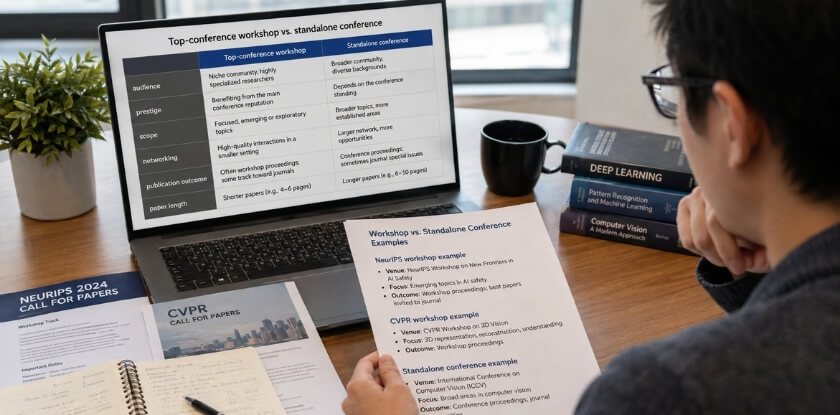
A workshop at NeurIPS, CVPR, ICLR or ICML borrows visibility from a very competitive event, but it is still a workshop with its own review process and its own publication weight.
What a Workshop at a Top Conference Means
Your paper is presented to an audience that came for the main conference, and the venue name travels with the paper on your CV. For an early-career researcher that context is valuable even if citation value stays modest. The workshop still has its own acceptance rate, so a NeurIPS workshop paper is not the same as a main-track NeurIPS paper.
How to Weigh the Trade-off
The two options do not map onto “better” and “worse”. They serve different purposes.
- Audience. A mid-tier standalone conference may look more prestigious on paper, but the audience at a top-venue workshop may sit closer to your subfield.
- Acceptance rate. Some workshops are tighter than many standalone conferences that call themselves competitive, while others accept most submissions. Check the specific workshop’s track record.
- Indexing. Standalone conference proceedings are usually published through a publisher or series. Workshop papers vary, so if indexing matters for your institution, verify it before submitting.
The Workshop Ecosystem at NeurIPS and CVPR
Both NeurIPS and CVPR host workshops alongside the main conference, and each workshop sets its own call for papers, review process and publication policy. CVPR publishes its workshop papers in a separate workshops proceedings. A NeurIPS workshop paper, by contrast, is permitted in a later NeurIPS submission as long as it did not appear in conference proceedings. For a preliminary result you plan to extend, either can put you in front of the people who will later review your full paper.
When a Standalone Conference Is Stronger
A standalone conference makes more sense when no workshop exists for your topic, when you need formally indexed, citable publication for institutional requirements, or when the paper is complete enough that a workshop would undersell it. In some fields, standalone conferences are the main venues and workshops are secondary. Field norms vary, so check where leading researchers in your area publish.
From our experience at MS International: Our conferences accept abstracts, full papers, case studies, review papers and professional presentations. Full papers should normally be four to twelve pages in APA format, including tables, figures and references, and every submission goes through double-blind review. The decision (acceptance, revision request or rejection) is sent by email, and most review decisions are returned within about 10 working days. Submitted work must not have been previously published or be under review by another conference, journal or publication. Accepted papers may be considered for conference proceedings where applicable, and authors still complete registration before presenting.
FAQ: Workshop Paper vs Conference Paper
Workshop or main conference? Archival status, Scopus indexing, review standards, acceptance rates and the effect on a later journal version all matter, particularly for a PhD researcher with few publications.
Is a workshop paper considered a real publication?
It depends on the workshop. A peer-reviewed paper in official proceedings with a publisher and a DOI is a publication, while a paper posted only on a workshop website is closer to a preprint. Label it clearly as a workshop paper on your CV.
What does archival mean for a workshop?
Archival means accepted papers are published in formal proceedings, usually with a publisher and a DOI. Non-archival means they are presented without formal publication, which often leaves you free to submit the work elsewhere. The call for papers states which one applies.
Can I submit the same paper to both a workshop and a conference?
Only if both calls for papers allow it, because many venues forbid parallel submission. Some venues count peer-reviewed workshop papers as prior publication (CVPR 2025 does for papers over four pages), while others do not in some cases (ACL for an extended version, NeurIPS 2025 for workshops without proceedings). Read both policies and disclose the overlap.
Do workshop papers get indexed in Scopus?
Some do and some do not. Scopus covers conference papers published in a dedicated proceedings with full-text papers, so it depends on the workshop’s proceedings. Search the proceedings title in the Scopus Source Title list before you submit.
How much does acceptance rate matter when choosing a venue?
It matters, but it is not the only factor. Who publishes at the venue and who reads it count as much. A respected workshop with a moderate acceptance rate can mean more than a weak standalone conference with a low one.
Will a workshop paper hurt my chances of publishing an extended version in a journal?
Generally no, if the journal version adds substantial new content and you disclose the earlier paper. Thresholds differ by journal, and the IEEE Communications Society, for example, sets no quantitative figure, so check the author guidelines and mention the workshop version in your cover letter.
Does peer review at workshops meet the same standard as at conferences?
Not always. Review varies by workshop, and many are lighter than a main-track review. That suits early-stage work but can affect citation value and how the paper is perceived in grant and tenure reviews, so check the call for papers.
Is it worth submitting to a workshop as a PhD researcher with few publications?
Yes, often. It puts your ideas in front of the right community early, gives you feedback and appears on your record. Pair it with a plan to develop the work into a full paper.
Final Verdict: Workshop Paper or Conference Paper?
Choose a workshop paper when your research is still developing and you want feedback from a focused community. Choose a conference paper when your study is complete and you want stronger indexing, citation potential and academic weight.
Match the venue to the maturity of your work and your longer-term goal, and check the call for papers for the review type, proceedings and prior-publication rules before you submit.