
Conferences and training courses both count as professional development, yet they solve different problems, and picking the wrong one wastes time and budget. This guide compares conference vs training side by side so you can match the choice to your goal.
Quick answer: A conference is a broad professional event built for networking, industry trends, and expert talks, while training is a structured program that builds one specific skill through practice and feedback. Choose a conference when you need contacts and direction. Choose training when you need an ability you can apply at work right away.
What Is the Main Difference Between a Conference and Training?
The main difference between a conference and training is the purpose. A conference is designed for networking, knowledge sharing, industry exposure, and professional discussion, while training is designed to build specific skills through structured learning.
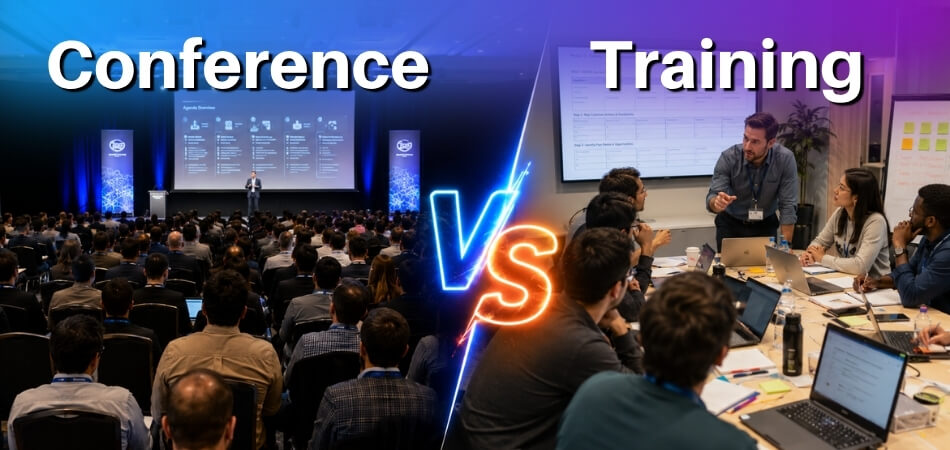
Both support professional development, but they do it in different ways. A conference gives attendees access to speakers, peers, exhibitors, research, market trends, and new ideas. Training gives participants a focused learning path, usually led by an instructor, trainer, or subject expert.
A conference is the better choice when your goal is to meet people, understand industry direction, explore opportunities, or learn from a range of expert perspectives. Training is the better choice when your goal is to improve a defined skill, learn a tool, understand a process, or strengthen job performance.
| Area | Conference | Training |
| Main goal | Networking, ideas, and industry insight | Skill development and practical learning |
| Format | Keynotes, panels, sessions, exhibitions | Lessons, exercises, demonstrations, assessments |
| Audience | Often larger and more diverse | Usually smaller and more focused |
| Learning style | Broad and discussion-based | Structured and application-based |
| Best for | Trends, contacts, visibility, collaboration | Skills, confidence, performance, role readiness |
| Common result | New contacts and broader awareness | Improved ability and clearer practical knowledge |
In simple terms, conferences help professionals understand what is happening in their field. Training helps them become better at doing something specific within that field.
What Is a Conference?
A conference is a professional event where people from a specific field, industry, academic area, or business community gather to exchange knowledge, discuss important topics, and build connections. It usually covers a broad theme instead of one narrow skill. Merriam-Webster (entry read October 2026) gives the everyday meaning as a meeting of two or more persons for discussing matters of common concern, and a professional conference is that idea at a larger scale.
Conferences can focus on subjects such as business management, digital marketing, cybersecurity, healthcare, education, engineering, human resources, technology, academic research, and entrepreneurship. Depending on the event, attendees may join keynote sessions, panel discussions, breakout sessions, workshops, networking activities, and exhibitions.
Common Features of a Conference
Most conferences include elements that support knowledge sharing, visibility, and networking, such as:
- Keynote speeches from leaders, researchers, executives, or subject experts
- Panel discussions where speakers compare views on an important topic
- Breakout sessions focused on smaller themes within the main event
- Research or paper presentations, especially at academic conferences
- Workshops or interactive sessions, depending on the agenda
- Networking sessions for meeting peers, speakers, sponsors, and organizations
- Exhibitor areas where companies or institutions display tools, products, or services
- Question-and-answer segments that allow attendees to engage with speakers
What Professionals Usually Gain From Conferences
Professionals usually attend conferences for industry exposure, new connections, and broader learning. A well-matched conference helps attendees understand current trends and challenges, learn from experienced speakers, meet peers, clients, employers, collaborators, vendors, or partners, and explore tools, services, and market practices. It also lets them share research or business experience, improve visibility in an academic or industry community, and find ideas for future projects, partnerships, or career moves.
For many professionals, a conference is valuable because it combines learning with access. It allows them to hear expert perspectives while meeting people they may not encounter in their daily work environment.
What Is Training?
Training is a structured learning experience designed to improve a specific skill, knowledge area, process, or professional ability. Unlike a conference, which usually covers broader industry topics, training focuses on helping participants become more capable in a defined area. Merriam-Webster’s simple definition (entry read October 2026) describes training as a process by which someone is taught the skills that are needed for an art, profession, or job.

Training may teach technical knowledge, workplace skills, leadership methods, software use, compliance practices, communication techniques, or role-specific procedures. It can be delivered in person, online, or through a blended format.
Common Features of Training Programs
Most training programs are built around focused instruction and practical improvement. Common features include:
- Defined learning objectives that explain what participants should learn
- Step-by-step lessons led by a trainer, instructor, or subject expert
- Hands-on exercises that help participants apply new knowledge
- Case studies or examples connected to real workplace situations
- Group discussions for problem-solving and shared learning
- Assessments, quizzes, or feedback to measure progress
- Learning materials such as slides, worksheets, manuals, or online resources
- Certificates of completion, when provided by the organizer
Training sessions are often smaller than conferences, which allows for more direct interaction between the instructor and participants. This makes training useful when learners need practice, correction, feedback, or a detailed explanation.
What Professionals Usually Gain From Training
Professionals choose training when they want measurable skill development. It helps them improve job-related skills, learn a new tool, method, or technical process, and build confidence in tasks that need accuracy or practice. It can also strengthen soft skills such as communication, teamwork, or problem-solving, prepare people for promotions or role changes, fill knowledge gaps that limit productivity, and keep them aligned with updated industry practices.
Conference Vs Training: Quick Comparison Table
A conference is best for broad exposure, networking, and industry updates. Training is best for focused learning, skill development, and practical improvement. The table below adds the points the first table does not cover.
| Comparison Point | Conference | Training |
| Main focus | Wider industry or academic understanding | Targeted skill improvement |
| Interaction | Networking, Q&A, group discussions | Direct instruction, practice, trainer feedback |
| Learning depth | Broad, but may not go deep into one skill | Deeper within a defined subject |
| Networking value | Usually high | Usually moderate |
| Exhibitors | Common at many industry events | Less common |
| Typical costs | Registration, travel, accommodation, meals | Enrollment, materials, software, certification |
| Common outcome | Connections, insights, and collaboration opportunities | Better skills, confidence, and job performance |
The right option depends on the outcome you want. Choose a conference when you need access to people and ideas. Choose training when you need structured learning and practical ability.
Types of Conferences Professionals Can Attend
Professionals can attend different types of conferences depending on their field, career stage, learning goals, and networking needs.

Academic Conferences
Academic conferences focus on research, scholarship, and knowledge exchange within a specific field of study. They are commonly attended by researchers, professors, graduate students, subject experts, and academic institutions.
These conferences often include research paper presentations, poster sessions, expert panels, methodology discussions, and academic networking. They are useful for professionals who want to present findings, receive feedback, follow new research developments, or connect with scholars working on similar topics.
Business Conferences
Business conferences bring together entrepreneurs, executives, managers, consultants, and professionals to discuss business growth, leadership, strategy, and market trends.
They may cover business management, marketing strategy, finance, human resources, entrepreneurship, customer experience, and industry-specific challenges. A business conference is valuable for professionals who want to learn from experienced leaders, understand market direction, discover growth strategies, and meet potential clients, partners, or investors.
Technology Conferences
Technology conferences focus on digital innovation, tools, systems, software, and emerging technology trends. They are often attended by IT professionals, software developers, cybersecurity specialists, engineers, product managers, data professionals, and business leaders involved in digital transformation.
Common topics include cybersecurity, artificial intelligence, cloud computing, data analytics, software development, digital marketing technology, engineering innovation, automation, and workflow tools. These events help professionals stay updated in fast-changing technical environments.
Trade Shows and Industry Expos
Trade shows and industry expos combine conference-style learning with product or service exhibitions. They are usually built around a specific industry and often include vendors, suppliers, buyers, manufacturers, service providers, and decision-makers.
These events may include exhibitor booths, product demonstrations, supplier meetings, buyer-seller networking, industry presentations, and market discussions. Trade shows are useful for professionals who want to compare products, meet suppliers, explore business opportunities, or understand what competitors and vendors are offering.
Types of Training Programs Professionals Can Attend
Professionals can attend different types of training programs based on the skill they want to improve, the role they want to prepare for, or the knowledge gap they need to close. Training may focus on technical ability, workplace communication, leadership, or flexible online learning.
Technical Training
Technical training helps professionals build job-specific knowledge or practical ability in a specialized field. It is common in industries where tools, systems, standards, and methods change frequently.
Technical training may cover software platforms, cybersecurity practices, engineering tools, data analysis, digital marketing systems, healthcare procedures, IT infrastructure, equipment use, or industry-specific workflows. It is useful when a professional needs to perform a task more accurately, use a tool more confidently, or stay updated with workplace requirements.
Soft Skills Training
Soft skills training focuses on interpersonal and behavioral abilities that affect workplace performance. These skills matter in almost every profession because they influence communication, teamwork, problem-solving, and responsibility.
Soft skills training may include communication, teamwork, conflict resolution, time management, adaptability, presentation skills, professional etiquette, and decision-making. It is valuable for professionals who want to work better with others, improve workplace relationships, or become more effective in client-facing, team-based, or management roles.
Leadership Training
Leadership training helps professionals guide teams, make decisions, manage responsibilities, and support organizational goals. It is useful for current managers, future leaders, supervisors, project leads, and professionals preparing for promotion.
Leadership training may cover strategic thinking, delegation, motivation, feedback, team management, conflict handling, change management, and performance conversations. It helps professionals move from individual contribution to team or organizational leadership.
Online Training
Online training allows professionals to learn through digital platforms, virtual classrooms, webinars, or self-paced courses. It is often chosen for flexibility, accessibility, and convenience.
Online training may include live virtual sessions, recorded lessons, interactive modules, webinars, digital assignments, assessments, downloadable resources, and discussion forums.
Conference Vs Training: Detailed Differences
The detailed difference between conference and training comes down to purpose, structure, audience, interaction, learning depth, networking value, and expected outcome. The tables above give the short version, so each point below adds only the detail behind it.
Purpose and Learning Goal
A conference is designed to inform, connect, and expose attendees to broader ideas. Training is designed to teach, guide, and improve specific skills.
At a conference, attendees may want to understand industry trends, hear expert opinions, explore research, or identify opportunities. In training, participants usually join to improve a skill, understand a process, or prepare for a defined responsibility.
Format and Event Structure
Conferences usually include multiple sessions and speaker-led activities, while training follows a more organized learning path.
At a conference, attendees often choose sessions based on their interests and move between keynotes, panels, presentations, exhibitions, networking breaks, and optional workshops. Training is more sequential. Participants move through lessons, examples, exercises, discussions, and assessments in a planned order.
Audience Size and Participation Style
Conferences often attract larger audiences, while training is usually smaller and more focused.
Conferences range from small gatherings to very large events, and at the large ones participation can feel less personal. Training usually works better with smaller groups because learners need guidance, practice, feedback, and direct answers to detailed questions.
Networking Opportunities
Conferences usually provide stronger networking opportunities than training.
A conference is often built around professional interaction. Attendees may meet speakers, exhibitors, sponsors, employers, clients, researchers, vendors, or peers from different regions and organizations. Training can also create connections, but those connections are usually limited to the instructor and other participants.
Skill Development Depth
Training usually provides deeper skill development than a conference.
A conference can introduce useful ideas, but it may not give enough time to practice one skill in depth. Training is built for learning by doing, with more time to ask questions, complete exercises, and receive feedback.
Industry Exposure and Trend Awareness
Conferences usually provide stronger exposure to industry trends, market changes, new research, and emerging tools.
Because conferences bring together many experts and organizations, they can show what is changing across a profession or sector. Training can include updated information, but its scope is narrower. It focuses on helping participants understand or perform a specific task.
Cost, Time, and Commitment
Both conferences and training require time and budget, but the type of commitment is different.
Conference spending tends to go beyond the ticket, because travel and time away from work add up. Training spending tends to sit in fees, materials, software access, certification, and scheduled class time. The best value depends on whether the event matches the professional goal.
Outcomes and Professional Value
A conference often leads to new contacts, ideas, visibility, and strategic awareness. Training often leads to stronger skills, better confidence, and improved job performance.
The outcome of a conference may be less immediate but still valuable. A conversation or presentation can support future collaboration, research, business growth, or career movement. The outcome of training is usually more direct because participants should be able to apply what they learned to a task, project, role, or workplace challenge.
Is Training the Same as a Conference?
No, training is not the same as a conference. Training is a focused learning program for skill improvement, while a conference is a broader professional event for knowledge sharing, networking, and industry exposure.
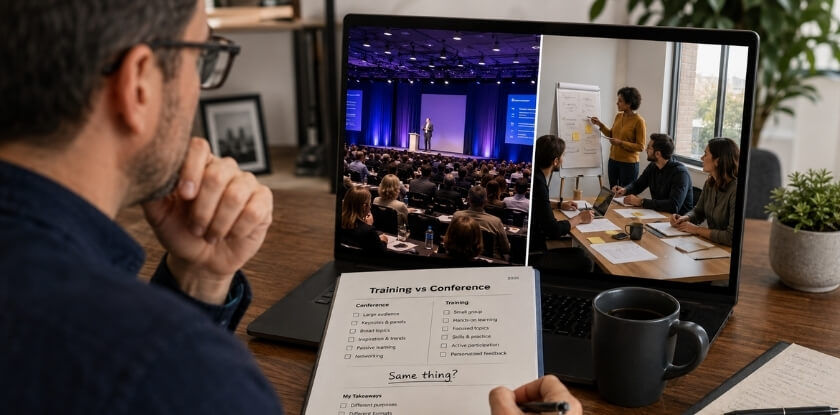
The two may look similar because both can include speakers, sessions, learning materials, and professional discussions. A training program is usually designed around a clear learning outcome, while a conference is designed around a broader theme. The easiest way to separate them is by asking: What should the attendee gain by the end?
- If the goal is to learn how to do something better, it is likely training.
- If the goal is to learn what is happening in a field and meet relevant people, it is likely a conference.
Some events may include both. For example, a conference may offer a short workshop or training-style session as part of the agenda. In that case, the overall event is still a conference, but one part may function like training.
Event names are also used loosely. A one-day session may be called a conference, and a hands-on class may be called a workshop. Judge an event by its agenda, group size, and expected outcome rather than by its label.
Where Workshops, Seminars, and Symposia Fit
A workshop sits between the two: it is hands-on like training but usually smaller and shorter than a conference. The INOMICS guide to academic event types (2019) describes the common pattern:
- Workshop: smaller than a conference, usually a day or two, focused on one topic, and more hands-on.
- Seminar: a small, discussion-based meeting that may last only an hour or two.
- Symposium: often described as a smaller conference on one issue, though the term is not used the same way everywhere.
Unlike a conference, a colloquium is usually a small academic meeting where one talk is followed by open discussion. Training that is led by an instructor who teaches a group is different from a workshop where peers work through a problem together, so read the description before you register.
When Should You Attend a Conference?
You should attend a conference when your main goal is to expand your professional network, learn from multiple experts, understand industry trends, or discover new opportunities. A conference is most useful when broad exposure matters more than step-by-step skill practice.
Best Situations for Choosing a Conference
A conference may be the right choice when you want to:
- Meet professionals in your industry and build useful contacts
- Learn about new trends, challenges, or opportunities
- Hear from experts, executives, researchers, or thought leaders
- Explore tools, services, or technologies through exhibitors or sponsors
- Present research, ideas, or professional experience
- Find collaboration opportunities with peers, institutions, or organizations
- Improve professional visibility within an industry or academic community
- Compare different perspectives before making business, research, or career decisions
A conference is also helpful when you feel limited by your usual work environment. Meeting people from other organizations, regions, or professional backgrounds can reveal ideas that may not appear in daily routines.
Who Benefits Most From Conferences?
Conferences benefit professionals who need connections, exposure, insight, or visibility. They are often a good fit for:
- Business owners looking for partnerships, clients, or market insight
- Managers and executives tracking industry direction
- Researchers and academics presenting or exploring new studies
- Students and early-career professionals building networks
- Consultants and service providers meeting potential clients
- Technology professionals following new tools and innovations
- Healthcare, education, engineering, HR, and marketing professionals seeking updated knowledge
- Organizations wanting to increase brand presence or industry involvement
A conference is not always the best option when you need detailed instruction on one skill. However, it is a strong choice when you want to connect learning with opportunity, visibility, and professional relationships.
When Should You Choose Training?
You should choose training when your main goal is to improve a specific skill, learn a process, strengthen job performance, or prepare for a role that requires practical ability. Training is the better option when focused learning matters more than broad networking.

Best Situations for Choosing Training
Training may be the right choice when you want to:
- Develop a specific professional skill that supports your current or future role
- Improve workplace performance in a measurable area
- Learn a tool, system, method, or technical process
- Prepare for a promotion, new job, or added responsibility
- Close a knowledge gap that affects confidence or productivity
- Receive guided instruction from a trainer or subject expert
- Practice through exercises, examples, or real-world scenarios
- Earn a certificate of completion when the program offers one
Training is also useful when an organization needs consistency. A team may attend training to follow the same process, use the same software, improve customer service, or strengthen compliance knowledge.
Who Benefits Most From Training?
Training benefits professionals who need practical improvement, structured instruction, and clearer ability in a defined area. It is often a good fit for:
- Employees learning new job responsibilities
- Professionals preparing for promotion or career change
- Managers building leadership or communication skills
- Technical workers learning updated tools, systems, or methods
- Teams that need shared workplace practices
- Early-career professionals building confidence in core skills
- Business owners improving operations, marketing, or management abilities
- Remote learners who need flexible online learning options
Training may not offer the same level of industry networking as a conference, but it can deliver stronger skill growth. When the goal is to perform better, solve a specific problem, or learn something in depth, training is usually the stronger choice.
Pros and Cons of Conferences
Conferences offer strong networking, industry exposure, and access to expert insights, but they can also require higher costs, travel time, and careful planning.
Advantages of Conferences
Conferences can support professional growth in several ways:
- Networking with industry professionals: Attendees can meet peers, speakers, exhibitors, sponsors, researchers, business leaders, and potential collaborators.
- Exposure to new ideas and trends: Conferences highlight emerging topics, market changes, current research, business practices, and industry challenges.
- Access to expert perspectives: Keynotes, panels, and presentations allow attendees to learn from experienced professionals.
- Opportunities for collaboration: A conference can help people find research partners, business contacts, suppliers, clients, or future project opportunities.
- Professional visibility: Presenting, asking strong questions, or representing an organization can improve recognition within a field.
- Product and service discovery: Events with exhibitors can help attendees compare tools, technologies, vendors, or services.
Disadvantages of Conferences
Conferences also have limitations:
- Higher total cost: Registration, travel, accommodation, meals, and time away from work can be expensive.
- Limited skill practice: Many sessions share information but do not provide enough time for hands-on learning.
- Information overload: A packed agenda can make it difficult to absorb and apply everything.
- Variable session quality: The value of each session depends on the speaker, topic, structure, and relevance.
- Large event size: Bigger conferences can be hard to find your way around, especially for first-time attendees.
- Unclear return if poorly planned: Without goals, attendees may leave with notes and business cards but little follow-up.
A conference is most valuable when you prepare before attending. Reviewing the agenda, choosing relevant sessions, planning networking goals, and following up with contacts can make the experience more useful.
Pros and Cons of Training
Training offers focused skill development, practical learning, and clearer performance improvement, but it may have a narrower scope than a conference.
Advantages of Training
Training can be highly valuable when a professional needs structured improvement. Key advantages include:
- Focused skill development: Training improves a defined skill, process, tool, or knowledge area.
- Practical learning: Many programs include exercises, examples, demonstrations, and hands-on activities.
- Improved job performance: Participants can apply new knowledge directly to workplace tasks.
- Greater confidence: Guided instruction helps learners understand what to do and how to do it correctly.
- Personalized learning opportunities: Smaller groups may allow more questions, feedback, and instructor interaction.
- Career preparation: Training can support promotions, new roles, or changing job requirements.
- Possible certification: Some programs provide certificates that may support professional credibility.
- Team consistency: Organizations can use training to help employees follow the same standards or practices.
Disadvantages of Training
Training also has limits:
- Narrower focus: Training usually concentrates on one skill or topic, so it may not provide wider industry exposure.
- Limited networking: Participants may connect with trainers and classmates, but networking is usually smaller than at a conference.
- Time commitment: Some programs require hours, days, weeks, or ongoing practice.
- Cost considerations: Fees, materials, software, certification costs, or time away from work may affect accessibility.
- Different quality levels: The value depends on the trainer, curriculum, delivery method, and relevance of examples.
- Requires active effort: Learners must participate, practice, and apply the lessons to gain real value.
- Not always recognized equally: A certificate or completion record may not carry the same weight across every industry or employer.
Training is most useful when the goal is clear before enrolling. Choose training that matches a real skill gap, offers practical learning, and provides outcomes that can be applied in a current or future role.
Conference or Training: Which One Is Better for Career Growth?
Neither a conference nor training is automatically better for career growth. The better choice depends on whether your current goal is to build connections and industry awareness or improve a specific professional skill.
A conference can support career growth by helping you meet people, understand trends, discover opportunities, and become more visible in your field. This is useful if you are looking for collaborations, clients, research exposure, partnerships, or a broader understanding of your industry.
Training can support career growth by helping you become more capable in a specific area. This is useful when you need to improve performance, qualify for a new responsibility, strengthen confidence, or prepare for a career move.
| Career Goal | Better Option |
| Build professional contacts | Conference |
| Learn a specific skill | Training |
| Understand industry trends | Conference |
| Improve job performance | Training |
| Meet speakers, vendors, or potential partners | Conference |
| Practice a method, tool, or process | Training |
| Increase visibility in a field | Conference |
| Prepare for a new role or responsibility | Training |
For career growth, choose a conference when you need exposure and relationships. Choose training when you need capability and practical improvement.
How to Choose Between a Conference and Training
To choose between a conference and training, start with your main goal. Choose a conference if you need networking, industry insight, or professional exposure. Choose training if you need structured learning, hands-on practice, or improvement in a specific skill.
Define Your Professional Goal
Your goal should guide the decision first. Pick the option that serves the one outcome you most need, using the career goal table above as a quick test. A clear goal prevents you from choosing an event only because it sounds popular or convenient.
Compare Learning Depth With Networking Value
Conferences are stronger for networking and broad exposure, while training is stronger for deeper learning and practical improvement.
A conference may introduce many topics, people, and ideas. Training may not offer the same range of contacts, but it usually gives more time for explanation, practice, and skill-building.
| Priority | Better Choice |
| Learning from several speakers | Conference |
| Getting instructor feedback | Training |
Match the Option With What You Already Know
Training is the safer start when a topic is new to you, and a conference works better once you know the basics. A short conference session shares ideas and examples rather than teaching a subject from the beginning, so it is easier to follow when you already have some background. Training builds that base step by step, and a conference can then show you where the field is moving.
Consider Budget and Time Availability
Both options can require money and time, so compare the full commitment before deciding.
For a conference, consider registration, travel, accommodation, meals, local transportation, and time away from work. For training, consider enrollment, materials, software, assessments, certificate fees, and time needed for practice after the session. Ask whether your employer or professional body will cover the fee, and list the sessions you plan to attend or the skills you plan to gain so you can explain the value.
Review the Event Format and Expected Outcomes
Before registering, check whether the format matches the outcome you want.
For a conference, review the agenda, speaker background, networking opportunities, exhibitor presence, audience type, and participation options. For training, review learning objectives, trainer experience, curriculum structure, exercises, assessments, certificate details, and support materials.
This step helps avoid mismatched expectations. A conference may be excellent for exposure but weak for hands-on learning. Training may be excellent for skill development but limited for networking.
Match the Option With Your Career Stage
Your career stage can also influence the better choice.
Early-career professionals may benefit from training when they need core skills, confidence, and job readiness. They may benefit from conferences when they want to meet people and understand the wider industry.
Mid-career professionals may use training to strengthen specialized skills or prepare for leadership. Conferences can help them build visibility, partnerships, and strategic awareness.
Senior professionals, executives, researchers, and business owners may attend conferences for decision-making insight, collaboration, market awareness, or public presence. They may choose training when they need to adapt to new tools, regulations, technologies, or management methods.
Can You Benefit From Both Conferences and Training?
Yes, professionals can benefit from both conferences and training because they support different parts of career development. Conferences help with networking, industry awareness, and exposure to new ideas. Training helps with skill improvement, practical learning, and stronger job performance.
A conference may help you discover a new trend, tool, or challenge in your field. Training can then help you build the ability needed to respond to that trend or use that tool effectively.
For example:
- A marketing professional may attend a digital marketing conference to learn about current strategies, then complete training on analytics, SEO, or advertising platforms.
- A healthcare professional may attend a healthcare conference to understand industry updates, then take training on a specific procedure, system, or compliance area.
- A business manager may attend a business conference to explore leadership trends, then join leadership training to improve team management skills.
- A cybersecurity professional may attend a technology or cybersecurity conference to learn about emerging risks, then complete technical training to strengthen practical defense skills.
From our experience at MS International: Our events are in-person conferences in the Greater Toronto Area, not training courses. People register as presenting authors or as listeners, and a listener registration suits someone who mainly wants to hear the sessions and meet other attendees. Registration fees are non-refundable and non-transferable, so read the agenda and the registration details before you pay. If you need an invitation letter, it is issued within 3 to 5 business days after payment clears. It supports a visa application but does not guarantee approval.
FAQ: Conference vs Training
Torn between a conference and a training course? Cost, certificates, where workshops and seminars fit and which suits a beginner or a career move are the points to compare.
What is the difference between a conference and training?
The purpose is different. A conference gives you access to people, ideas, and industry direction, while training gives you structured practice and feedback on one skill.
Is a workshop a conference or training?
A workshop is closer to training when it is hands-on and focused on one topic, but the label is used loosely, so check the agenda. Many conferences include a workshop session, but the event as a whole is still a conference.
Should I attend a conference or take training to advance my career?
Neither is better in every case. Choose a conference to build contacts and see where your industry is heading, and choose training to gain a skill you can use in your current or next role.
Which costs more, a conference or training?
It depends on the event, so compare the full commitment. Conferences can cost more in total once travel and accommodation are added, while training costs sit mostly in fees and materials.
Do conferences and training programs give certificates?
Many training programs give a certificate of completion, but only when the organizer provides one. Conferences may also issue attendance or presentation certificates, depending on the organizer, so check before you register.
Is a seminar the same as a conference?
No. A seminar is usually a small, discussion-based meeting on one topic that may last an hour or two, while a conference is larger and runs as a set of sessions, often over several days.
Should a beginner choose a conference or training?
A beginner should usually start with training. It teaches a topic step by step, while conference sessions are short and are easier to follow once you know the basics.
Can I do both a conference and training?
Yes. A common pattern is to attend a conference to spot a new trend or tool, then take training to build the skill needed to use it.
Final Takeaway: Conference Vs Training
The key difference between conference and training is that a conference helps professionals gain broader industry insight and build connections, while training helps them develop specific skills through structured learning.
If you need networking, exposure, and strategic awareness, choose a conference. If you need practical learning, skill development, and direct application, choose training. For long-term growth, both can be valuable: conferences show where your industry is going, while training helps you build the skills needed to keep up with that direction.