
An invitation to speak lands in your inbox, and halfway down there is a line about a registration fee. Suspicion is a fair first reaction, because predatory organizers do charge eager first-time presenters for a slot and give back little more than a certificate. But plenty of respected academic and professional events also ask presenters to register, and nobody in those fields thinks twice about it.
Quick answer: Yes, at most academic conferences paying a presenter registration fee is normal, because acceptance comes from peer review and the fee covers your attendance, not your slot. At established industry events, invited speakers usually do not pay. A fee becomes a red flag when it buys guaranteed acceptance, with no real review, no clear call for papers and no verifiable track record.
Last verified against official sources: October 2026.
This article is about judging a fee, not just whether one exists: what is normal in each sector, what a fee should include, and how to tell a real event from a pay-to-present scheme.
Is It Normal to Pay to Present?
Yes, often, but it depends on the sector. Academic presenters are usually expected to register and pay; industry speakers usually are not; and a fee that buys acceptance is never normal.

The One Test: What Is the Fee For?
A normal fee pays for your attendance and the running of the event: venue, program, review administration and sometimes proceedings. Your place on the program is earned by the review or the invitation. A pay-to-present scheme turns that around: the fee is the product, and almost everyone who pays gets in.
That is also why a scam looks similar at first glance. It has a website, an impressive-sounding committee and an acceptance email that arrives suspiciously fast. The difference shows up when you ask who reviewed your work, who will be in the room and what the fee includes. As a rule of thumb, if a conference makes its money mainly by charging speakers rather than by attracting attendees, treat that as a red flag.
First-Time and Aspiring Speakers
If you are building a track record, paying a modest registration fee to present at a legitimate event is not unusual. You get practice, a credit for your CV and some networking value. The only real question is whether the event is credible enough to make that worthwhile, which the rest of this article helps you judge.
Academic Conferences vs. Professional and Industry Conferences: The Fee Norm Differs
Short answer: academic events charge presenters, established industry events usually do not. What is standard in one setting would be a warning sign in the other.
Academic Conferences (Registration Fee as a Presenter)
At an academic conference, the presenter pays registration, and that has been the norm for years. Learned societies, universities and nonprofit associations rely on registration income to cover the venue, review administration and proceedings.

After you submit to a call for papers, pass review and are accepted, you are expected to complete author registration, usually at the same rate as other attendees and sometimes slightly discounted. Presenting does not exempt you, and your acceptance letter normally says so.
What makes this legitimate is the review. Acceptance is earned, not purchased, and the fee covers your attendance, not your slot. Fees vary widely by field, country and prestige, and large multi-day international events cost considerably more than small regional ones. Student and early-career rates are common and worth asking about.
Organizers also use the fee to make sure presenters turn up. The FAQ for the IAIA 2016 annual conference says that requiring presenters to register and pay helps guarantee that the people in the final program attend, and reports that the policy cut last-minute drops and no-shows by over 50%. Technical societies write the same logic into policy. The IEEE ICASSP 2022 conference policies say each paper must be covered by at least one registration at the full rate, one author’s full registration can cover at most four papers, and a paper that is not presented is not published on IEEE Xplore.
Professional and Industry Conferences
At a well-established industry conference, speakers are often not expected to pay. They may get complimentary registration, and larger events sometimes add a speaker honorarium or covered travel, because speakers draw attendees and lend credibility. Simon Willison’s 2013 answer to this same question says for-profit commercial conferences are usually free for speakers and often pay a stipend, and that a request for payment there is only convincing if the event is very prestigious. If a well-known industry conference asks you to pay a full ticket price on top of delivering a session, that is worth questioning. Invited and keynote speakers are the clearest case: if the organizer approached you, expect the terms (registration, travel, honorarium) to be agreed and put in writing.
Smaller or newer industry events vary. Some give speakers a discounted rate, some ask panelists and workshop facilitators to cover their own registration, and that is worth weighing but is not automatically a scam. It turns into a problem when the event charges a flat, non-negotiable “speaker fee” to secure your slot, has no track record, and fills its agenda with paying speakers instead of curating it.
Fee Structure Comparison at a Glance
Treat this as a general guide, not fixed figures, and confirm details with the organizer.
| Conference Type | Who Typically Pays | Typical Fee Level | Red Flag Level |
| Academic conference (peer-reviewed) | Presenter pays registration after acceptance | Moderate to high, varies by field and location | Low if the review is genuine |
| Academic conference (predatory) | Presenter pays; acceptance is near-instant | Moderate to high | High: acceptance without real review |
| Major industry conference | Organizer covers invited speakers (complimentary registration, often an honorarium) | Speaker pays nothing or is paid | High if asked to pay for the slot |
| Mid-tier professional conference | Speaker may pay a discounted registration | Low to moderate | Medium: depends on credibility and what is included |
| Niche or emerging industry event | Varies; sometimes standard registration | Low to moderate | Low to medium: check the organizer and audience |
| Pay-to-present scheme | Presenter pays to secure a slot | Variable, often not transparent | Very high: no curation, no real audience |
What Is a Reasonable Speaking or Presenter Fee?
There is no universal figure, but a reasonable fee is one that matches what other attendees pay and is clearly tied to what you receive.

At Academic Conferences
Presenter fees usually sit in the same range as general registration, sometimes slightly discounted, sometimes identical. As one dated example, the University of Canberra’s AUBEA 2025 event page listed author registration at AUD 850 (non-student) and AUD 550 (student) until 31 October 2025, rising to AUD 950 and AUD 600 afterwards. That fee covered both days of sessions, refreshments, lunches, a welcome reception and the conference dinner, and at least one author of each accepted paper had to register for the paper to appear in the proceedings. Treat it as a model of what a fee page should spell out, not as a typical price, and check each event’s own fee page. Departments and research grants sometimes cover this cost, so ask before paying out of pocket.
What is normal: one presenter fee that mirrors what other attendees pay. What is not: presenters charged much more than non-presenting attendees for no clear reason, or fees with no visible conference behind them.
At Professional and Industry Conferences
At most established events, a speaker the organizer invited, or one whose proposal was chosen through a formal call, should expect free registration, an honorarium, or both. Honoraria range from a modest travel stipend at smaller events to much larger fees for headline keynotes at major ones. Workshops and pre-conference training sometimes carry separate fees because they are sold as educational products, which is standard.
Paying a presenter fee can be acceptable if you submitted a proposal, were accepted, and the event runs on a registration-covers-all model. If the event instead recruited you, promised “exposure” and then asked for several hundred dollars for the privilege, scrutinize it carefully.
What a Fee Should Include
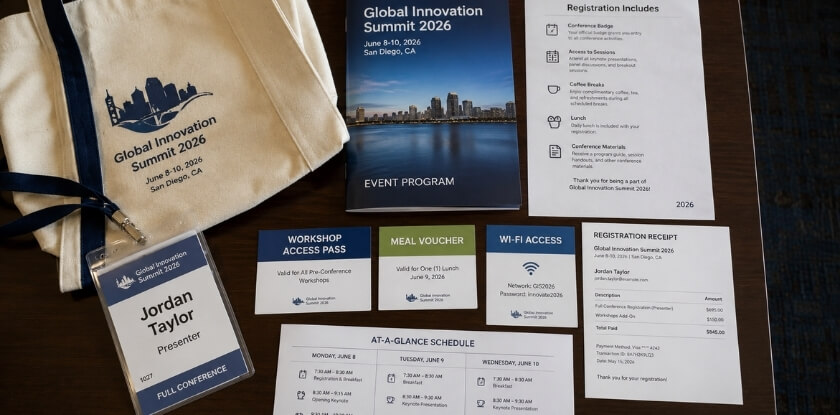
Ask what the fee covers: all conference days, meals, workshops, proceedings, a speaker dinner or networking session. A fee that gives you real access to other sessions and senior practitioners is easier to defend. A fee that only puts your name on a program is harder to justify, and an unpublished price list is a problem in itself. Also ask whether it is the same rate the public pays or a discounted presenter rate, whether it is waived once you are accepted as a speaker (a question the Think. Check. Attend. checklist asks directly), and whether one registration covers one paper or several, since events set their own caps. Audience counts too: as a hypothetical example, several hundred dollars to speak to 50 highly relevant decision-makers can be worth it, while the same fee to present to 200 generalists at an event with no clear focus is a harder case to make.
How to Spot a Predatory or Pay-to-Present Scam Conference
Not every conference that charges presenters is a scam, but predatory ones are real and getting more polished. Two or three of the signs below together deserve serious caution.
The Invitation Arrives Out of Nowhere
Legitimate organizers do sometimes approach speakers. But a cold email with flattery, urgency and a registration link is the most common opening of a pay-to-present scheme. It often names you, mentions a paper or job title, and says you have been “selected”. If it skips the call for papers and goes straight to payment, that is a serious problem, because real peer review does not shortcut the submission stage for one person.
The Peer Review Is Superficial or Fake
A credible academic conference puts abstracts or papers through genuine review: reviewers evaluate, may ask for revisions, and can reject. Watch for:
- Acceptance within 24 to 48 hours of submission, with no revision requests
- An identical boilerplate acceptance letter with your name and title pasted in
- No named program committee, or listed members who do not seem to know the conference exists
- A conference that accepts everything, every year
- An unfamiliar publisher or no clear proceedings route
Real review takes days to weeks at the very least and often longer, so instant acceptance with no feedback is a warning.
The Organizer Is Hard to Verify
Do a basic credibility check before you pay anything. Search the conference name with words like “predatory” or “scam”, check for a real institutional affiliation, and look at past proceedings. Library guides commonly point to the Think. Check. Attend. checklist, an initiative introduced by Knowledge E. Its questions include whether you know the society or association organizing the event, whether the venue is easy to identify, whether this is the first time the conference has been held, and whether it is clear what fees will be charged and whether they are waived for accepted speakers. It also asks whether the editorial committee is listed, whether the type of peer review is clear, and whether it is clear where the proceedings will be published and whether the publisher belongs to a recognized initiative such as COPE, DOAJ or OASPA.
Beall’s List of predatory publishers is a dated starting point at best: its author took it offline in January 2017, so it does not reflect today’s events.
If an organizer runs dozens of conferences across unrelated fields (cardiology, mechanical engineering and education policy in one portfolio), be wary. That pattern suggests collecting presenter fees, not building a field. If proceedings are said to be indexed, check the database itself instead of trusting the conference website.
The Fees Are Vague or Escalate After Acceptance
A legitimate conference publishes its fees before you submit. Be careful if:
- Fees only appear after you are told you are accepted
- Add-on charges stack up (proceedings inclusion, a certificate of presentation, extra page fees)
- You are pressured to register quickly because “spots are limited”
The danger is real: a first-time presenter can spend a lot on such an event and leave with no audience, no proceedings and a certificate from an organization nobody recognizes.
The Program Looks Thin or Chaotic
Look at programs from previous years. A real event has structured sessions, a clear theme and enough attendees to make networking possible. Signs of a hollow one:
- One or two days of dozens of back-to-back 10-minute talks and no plenary sessions
- Vague past attendance (“hundreds of participants from around the world”)
- A venue confirmed very late, or changed repeatedly
- Listed keynote speakers who are unknown or did not attend in earlier years
No Honorarium Is Normal, but No Speaker Support Is Not
In academic settings, speakers covering their own registration and travel is standard, and professional events vary. A complete lack of support is not: no A/V help, no briefing, no handbook, no organised schedule. If the only message you get is a payment confirmation and a video link, you are paying for a line on your CV that will not hold up to scrutiny.
Free vs. Paid Conferences: Which Should You Present At?
Short answer: the credible versus not-credible question matters more than free versus paid. Price only decides how much risk you take on.

When Free Conferences Are the Smarter Choice
A free-to-present event carries lower financial risk, so your main investment is preparation time.
- Your topic is early-stage. A free or low-cost event lets you test new material without financial pressure, and the feedback is still valuable.
- The audience matches your goals. A free regional industry event with 200 of your target clients can beat a paid international academic conference where nobody will ever hire you. Audience matters more than ticket price.
- You are building a track record. A verified event with a real call for papers on your CV is useful even if you only break even.
A free event with an irrelevant audience still costs you, just in time.
When Paying to Present Makes Sense
Paid arrangements are common on academic and professional circuits. The question is whether the whole outlay is worth it.
- The conference has verifiable credibility. Check the organizer’s history, past attendance and, if proceedings are promised, how they are published. Real review plus a documented publication route can justify a fee if publication credit or promotion requirements are in play.
- The return is concrete. You can name what you need (a client, a publishing credit, a partnership) and see a realistic path to it. The next section shows how to test that.
- The networking is concrete too. If the event reliably draws decision-makers in your field, that alone can justify a paid spot. If the organizer cannot say who usually attends, that is a problem.
When You Should Walk Away
Walk away if a conference charges a presenting fee with no transparency about how fees are used, no real review and no verifiable past events. The scam model depends on eager researchers and new speakers overlooking red flags they would normally catch. Also walk away if the return only works through “maybe I will meet someone who knows someone” or “maybe the proceedings will be indexed eventually”. A legitimate organizer answers direct questions about attendance, past speakers and how the fee is structured. If those are deflected, the event fails the most basic credibility check.
Calculating ROI Before You Commit (For Aspiring and New Speakers)
Short answer: add up the full cost, name one realistic outcome, and see whether the first covers the second. Return is not only revenue: it includes leads, visibility and career momentum, but be honest about what you will actually get.
Start With the Hard Costs
Registration is only one line. Add flights, hotel, ground transport, meals and time away from paid work. Here is an illustrative example, with made-up round numbers:
| Cost item (example) | Amount |
| Presenter registration fee | $400 |
| Flights | $350 |
| Two nights of hotel | $300 |
| Meals | $100 |
| Time away from paid work (8 billable hours at $150) | $1,200 |
| Total cost to present | $2,350 |
The number is there so you can judge the upside honestly, not to scare you off.
Identify Your Realistic Return
Be specific. “Exposure” is not an answer. Returns usually fall into a few groups:
- Direct business leads. In a room of 80 people in your target niche, converting even 2% gives you one or two potential clients. What is an average contract worth to you?
- Credential and visibility value. A credit at a credible academic or industry event carries weight on your website, LinkedIn and proposals, and it compounds over time.
- Networking value. Would you want a relationship with the other speakers? One strong connection can outweigh the whole cost; a roster of unknowns may not.
- Content you can reuse. A recorded talk can become a video, a blog series or a course module.
The Simple Breakeven Check
Compare the spend with other uses of the same money too, such as a targeted ad campaign, a workshop you host yourself, or attending a higher-tier event as an audience member. Then divide your total cost by the value of one client or outcome. If one new client is worth $5,000 to you and your total cost is $2,350, you need less than half a client to break even, a reasonable target for a room of interested professionals. If the same cost buys you 30 people from companies with no budget for your services, the math does not close, and no amount of “exposure” changes that.
When ROI Thinking Changes for New Speakers
Early in a speaking career, pure financial return is not always the right lens. Your first talks mostly build the track record that later gets you paid to speak. For a first-time presenter, credibility, confidence and a speaking credit are real assets. Losing money on an event that gives you a recording, a speaker bio and two follow-up invitations can be worth it, if the invitations lead somewhere.
The mistake is paying significant fees at events with no review, no credible audience and no verifiable history. That is not building a credential; it is closer to a pay-to-present scam than a career investment.
Four Questions Before You Sign Up
- Is the conference verifiably legitimate: real past events, real attendees, a published call for papers or selection criteria?
- What is my total cost, including registration, travel, time and any honorarium I am giving up?
- Can I name at least two specific outcomes I expect, specific enough that I would recognize them if they happened?
- If none of those outcomes happen, can I absorb the cost without serious strain?
If you cannot answer the first question, the problem is not the conference. You have not yet defined what you need from it.
Tips for First-Time or Aspiring Presenters
A few habits will save you money, protect your credibility and get more from each opportunity.
Do Your Research Before You Apply
Spend twenty minutes on due diligence before you submit. A legitimate academic conference lists its call-for-papers timeline, review criteria and often its acceptance rate. A legitimate industry conference has identifiable sponsors, earlier editions and speakers who actually work in the field. If you cannot find any of that, treat it as a warning sign.
Start With Smaller, Lower-Stakes Events
Your first talk does not need to be at a national event. Local meetups, regional gatherings and association chapter meetings let you test material, build a speaking history and get honest feedback. Many charge speakers nothing or a nominal fee. After one or two talks you can apply to larger events with a stronger proposal.
Treat the Abstract Like the Pitch It Is
Organizers read dozens or hundreds of abstracts, and a vague one gets rejected however good the talk is. Say what attendees will know afterwards, name the problem you solve, and show you have done this before. If the event has a formal abstract format, follow it exactly. Organizers who run serious review notice when you do not.
Ask About Honorarium or Travel Support
Many first-time presenters assume they should not ask about compensation, and that assumption costs them money over time. Honoraria are not only for celebrity keynotes; some mid-sized industry events pay speakers with specialist expertise. Ask politely at the invitation or acceptance stage, and the worst answer is no.
Hello [Organizer Name], thank you for accepting my proposal. Before I confirm, could you tell me whether there is a speaker honorarium, a registration waiver or any travel support for presenters? Thank you, [Your Name]
Build a Speaking History Deliberately
Keep a simple record of the conference, date, talk title and any feedback. It helps you write stronger proposals and gives you material for your bio. Do not pad it with events that have no review or audience: one solid talk at a credible event does more for your reputation than five at events nobody in your field has heard of.
Ask Other Speakers What They Think
If you are unsure about an event, contact someone who has presented there. Ask whether the audience was engaged, the organization professional, the networking useful and whether they would go back. That is more reliable than anything on the conference website, and it takes about five minutes.
From our experience at MS International: Presenting authors submit work for double-blind review, which typically takes about 10 working days and ends in acceptance, a revision request or rejection. Keynote and invited roles are arranged separately, and an author ticket does not create one. The event pages currently show Author Early Bird US$499, Author Regular US$599 and Listener US$499 for attending without presenting. Registrations are non-refundable and non-transferable, with rare exceptions approved in writing, and an honorarium, travel reimbursement or free registration should not be assumed unless it is confirmed in writing. Our events are in person in the Greater Toronto Area, and approved speakers receive a certificate after presenting.
FAQ: Paying to Present at a Conference
Being asked for a presenter fee can feel like a red flag, which is why fee waivers, legitimate calls for papers, quick credibility checks and the cost-benefit sums deserve attention.
Do I have to pay to present at a conference?
At most academic conferences, yes: you pay the presenter registration fee after acceptance. At established professional and industry conferences you generally should not, and organizers often cover registration or offer an honorarium. Invited and keynote speakers are usually handled separately.
Is a presenter registration fee the same as a pay-to-present scam?
No. A legitimate fee funds the event, review and proceedings, and your slot is earned through review. A predatory event takes almost everyone who pays, with little or no real review, a fabricated committee and no genuine audience. The fee looks similar; the credibility does not.
What if the conference waives my registration fee, does that count as compensation?
Partly. A waiver saves the fee but covers nothing else: travel, accommodation and lost work time still come from you. For a new speaker building a portfolio it is a fair start; for an established professional it is rarely enough alone. Check each organizer’s terms, since waivers are not universal.
How do I know if a conference has gone through a legitimate call for papers?
Look for a defined submission deadline, named reviewers or an editorial board, and a described review process. If your abstract was accepted within 24 to 48 hours with no feedback, the review almost certainly did not happen.
Can a first-time presenter reasonably pay to speak?
Yes, in the right context. A credentialed, peer-reviewed conference in your field is a fair place to pay the registration fee. At professional or industry events, look first for ones that do not charge speakers at all; they exist at every level.
What is a quick way to check conference credibility?
Work through the Think. Check. Attend. checklist, then confirm that past editions actually ran and that fees and the review process are published. If proceedings are said to be indexed, check the database itself. If nothing verifiable turns up, treat it as a red flag.
Should I expect a speaking fee at an industry conference?
At large, well-funded industry events, expect at least covered registration, and often travel, hotel or an honorarium. Smaller events may have no budget for that but typically do not charge you either. If one asks you to pay and offers nothing back, ask why before you commit.
How do I calculate whether presenting is worth the cost?
Add every direct cost (registration, travel, accommodation, materials, lost work time), then estimate a realistic return from named opportunities. If you cannot see a credible path to recovering the spend, the return is probably negative. The ROI section above has a worked example.
Are all paid presenter opportunities bad?
No. The problem is payment combined with no real vetting and no meaningful audience. Paying to present peer-reviewed research at a legitimate academic conference is a normal part of academic life. Paying to read a slide deck to an empty room run by an organizer who contacted you cold is not.
Do presenters pay at MS International conferences?
Yes, presenting authors pay the author registration shown on the event page. Review is double-blind, and fees are non-refundable except in rare cases approved in writing, so read the event page before paying.
Final Thoughts
Paying to present is neither always wrong nor always fine. What matters is whether the conference is credible, whether the fee is proportionate and what you get back. An hour of checking usually tells you which kind of event you are dealing with. If the numbers do not add up and the organizer cannot answer basic questions about attendance or selection, walk away: there are better rooms to speak in.