
Two letters turn up in visa paperwork, and the names are sometimes used as if they meant the same thing. Sending the wrong one, or leaving one out, can leave the officer with questions your file does not answer. Here is how the two compare.
Quick answer: An invitation letter explains why you are visiting and who is inviting you, while a letter of sponsorship explains who will pay for the trip and which costs they will cover. Both can support a visa application, but they answer different questions. Some applicants need both, and neither one guarantees a visa.
Fact-checked by the MS International Editorial Team. Last verified against official sources: October 2026.
If the visa officer needs to understand the reason for your travel, an invitation letter helps. If the question is money, a sponsorship letter helps. For conference travel, family visits, academic trips and business travel, you may need both.
Invitation Letter vs Sponsorship Letter: Key Comparison
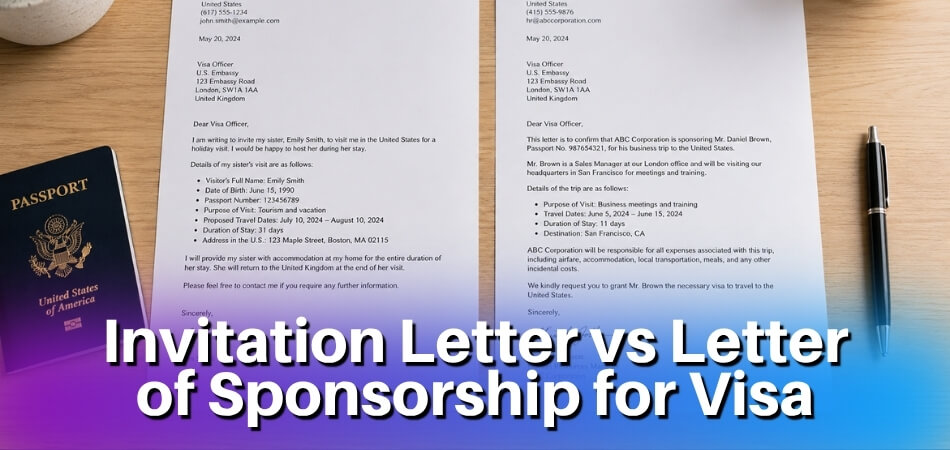
An invitation letter supports the reason for travel, and a sponsorship letter supports the financial side of the trip. One focuses on the host and the visit, the other on the sponsor and who pays.
| Feature | Invitation Letter | Sponsorship Letter |
| Question it answers | Why is the applicant traveling? | Who is paying for the applicant’s travel? |
| Written by | Host, event organizer, company, institution, or family member | Sponsor, employer, family member, organization, or institution |
| What it shows | Purpose of the visit and the link to the host | Who covers which expenses, and that they can afford it |
| Financial responsibility | None by itself, unless the host states that they will pay | Yes, the sponsor states the costs they agree to cover |
| Weight with the visa officer | Supporting evidence of the purpose; the officer still decides | Supporting evidence of funding, only as strong as the proof attached |
| Typical use | Conferences, business meetings, family visits, academic events | Employer-funded trips, family-supported travel, scholarships, sponsored events |
| Key details | Host details, applicant details, travel dates, visit purpose | Sponsor details, relationship, expenses covered, proof of funds |
| Required or optional | Depends on the visa type and embassy rules | Depends on the applicant’s finances and embassy rules |
For example, a conference organizer may invite you to attend an event while your employer pays for your flight, hotel and registration fees. The invitation letter then confirms the event, and the sponsorship letter confirms the funding.
What Official Sources Say
Rules differ by country, so treat these points as examples and always read the official checklist for your visa:
- Canada: IRCC says it may ask for a letter of invitation from someone in Canada, and that the letter does not guarantee a visa. IRCC’s letter of invitation guide asks the writer to say where the visitor will stay and how the visitor will pay for things. For a Super Visa, the letter must include a promise of financial support for the visit. IRCC also says writing a letter of invitation does not make the writer legally responsible for the visitor once they enter Canada, but it asks writers to write in good faith.
- United States: The State Department’s visitor visa page says a letter of invitation is not required for a visitor visa.
- United Kingdom: GOV.UK says attendees of business events or conferences should provide a letter of invitation from the organiser. Its list of documents is not exhaustive, and providing them does not guarantee success. If someone else pays for your travel, maintenance or accommodation, it says to show what support they provide, that the sponsor has enough funds, and your relationship to them.
Sponsorship Letter vs Certificate of Sponsorship
A visitor’s sponsorship letter is an ordinary supporting letter, one type of visa letter of support. The UK certificate of sponsorship is a different thing: GOV.UK describes it as an electronic record, not a physical document, that an employer assigns to each foreign worker it employs, and the worker needs its number to apply for a work visa. A letter from a host or employer for a short visit is not that record.
Can You Submit Both Letters?
Yes, you can submit both when each one explains a different part of your application. This is useful when one person or organization invites you and another pays. Submitting both does not guarantee approval, but it shows the purpose of travel and the financial arrangement side by side.
What Is an Invitation Letter for a Visa Application?
An invitation letter for a visa application is a document from a host, organization, event organizer, company, or institution that confirms why the applicant is invited to visit. It helps the embassy understand the purpose, location, dates and context of the trip.

When an Invitation Letter Is Used
Use one when you need to show that your visit has a clear and genuine purpose. It commonly supports business meetings, conferences and seminars, family visits, academic events, professional training and official visits.
It does not replace other visa requirements. It makes the travel purpose easier to verify, and it should stay consistent with your visa application form.
Who Can Write an Invitation Letter?
The person or organization inviting the applicant writes it. That may be a family member or friend, a conference or event organizer, a business partner, an employer, a university or school, or a training provider. The host should give correct contact details so the embassy can verify the information if needed.
What Is a Letter of Sponsorship for a Visa Application?
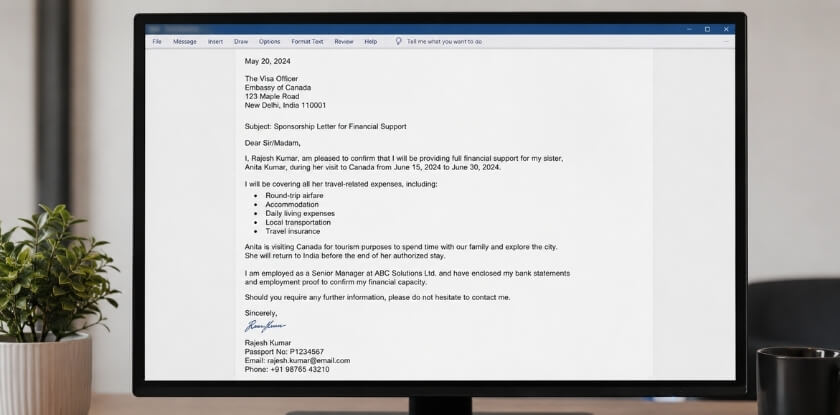
A letter of sponsorship for a visa application is a document from a person, employer, organization, or institution confirming that they will financially support the applicant’s trip. It helps the embassy see who will pay and whether the promised support is credible.
Who Can Sponsor a Visa Applicant?
A sponsor should have a clear relationship with the applicant and be able to prove financial ability. Common sponsors are parents or guardians, a spouse or relatives, an employer, a university or school, a conference organizer, a business partner, or a company or organization. The sponsor should be able to explain why they support the trip and provide documents confirming their identity and finances.
What Expenses Can a Sponsor Cover?
A sponsor may cover the whole trip or only specific costs, and the letter should say which. Common examples:
- Airfare and local transportation
- Hotel or accommodation
- Meals and daily expenses
- Conference or event registration fees
- Medical or travel insurance, if required
- Emergency expenses during the stay
Clear expense details make the arrangement easier for the embassy to review. The letter should be backed by financial evidence such as bank statements, employment proof or income documents.
Which Letter Do You Need for Your Visa Application?
You need an invitation letter when the embassy must verify your travel purpose, and a sponsorship letter when someone else will pay for your trip. Some applicants need only one letter, and others need both, depending on visa type, destination and finances.
Choose an Invitation Letter to Prove Travel Purpose
It confirms who invited you, why you are visiting, where the visit takes place, how long you plan to stay, and how the trip connects to your visa category. This is common for conferences, meetings, family visits and organized programs.
Choose a Sponsorship Letter When Someone Else Is Paying
It confirms who the sponsor is, what they will cover, for how long, whether they can afford it, and which financial proof is attached. If you are paying for everything yourself, your own bank statements usually take its place.
Check Embassy Requirements Before Submission
Visa requirements vary by country and visa category. Some embassies ask for original letters, notarized copies, financial documents, proof of relationship or specific wording. The two names are not always used the same way, so follow the wording of the checklist you are given: if it asks for a sponsorship letter, state who pays and what they cover; if it asks for an invitation letter, state the host, purpose and dates. Match your letters to the official checklist so the application is complete.
When Do You Need Both an Invitation Letter and a Sponsorship Letter?
You need both when the embassy must verify two separate things: the purpose of your visit and the source of your funding. This is common when one party invites you and another pays.
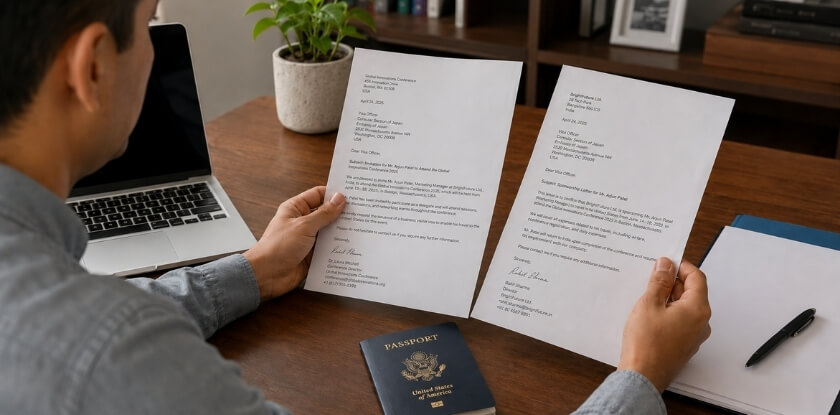
| Situation | Invitation letter from | Sponsorship letter from |
| Conference or business travel | Event organizer | Employer |
| Family visit with financial support | Relative (host) | Same relative, or another family member |
| Student or academic travel | School, university or program | Parents or guardians |
| Event that invites but does not pay | Organizer | Employer, family member, institution or organization |
Conference or Business Travel With Employer Funding
The invitation letter confirms the event or business purpose, and the sponsorship letter confirms that your employer covers the costs. Supporting documents may include registration proof, an employer letter or a travel approval.
Family Visit With Financial Support
If the same relative is both host and sponsor, one detailed letter may be enough in some cases, but separate letters can make purpose and funding clearer. The documents should explain your relationship with the host, where you will stay, who pays, and how long the visit lasts.
Academic or Student Travel Supported by Parents
The school or program letter confirms the academic purpose, while the sponsorship letter shows that the student has funding for travel, accommodation and daily expenses.
Events Where the Organizer Invites but Does Not Pay
Some conferences, seminars, workshops and training programs provide invitation letters but do not cover travel costs. In that case you need a separate sponsorship letter from an employer, family member, institution or organization.
What to Include in an Invitation Letter
An invitation letter should clearly identify the host, the applicant, the reason for travel and the planned visit dates. The goal is to help the embassy verify that the trip has a genuine, organized purpose.
- Host details: full name, address, phone number, email address, organization name if applicable, and position or relationship to the applicant.
- Applicant details: full name, passport number, nationality and current address if needed, so the letter matches the visa form and passport.
- Purpose of visit: stated in direct language, such as attending a conference, joining a business meeting, visiting family or taking part in training. It must match the visa application form.
- Travel dates and length of stay: arrival date, departure date and total stay. If dates are not final, give the expected period and keep it consistent with the rest of the file.
- Relationship between host and applicant: family, business, academic, event registration or professional invitation.
- Signature: the host’s signature, printed name and contact details, which make verification easier.
What to Include in a Sponsorship Letter
A sponsorship letter should explain who the sponsor is, how they are connected to the applicant and which travel expenses they will cover. It should come with proof that the sponsor can pay.
- Sponsor details: full name, address, phone number, email address, occupation or organization name, and proof of identity if required.
- Relationship to the applicant: parent, spouse, relative, employer, school, organization or event sponsor, consistent with documents such as a family record, employment letter or registration confirmation.
- Financial responsibility statement: a simple, formal and specific sentence that the sponsor agrees to support the applicant during the stated visit period.
- Expenses covered: an itemized list, so the officer sees exactly what the sponsor pays for and what the applicant still pays.
- Duration of support: the travel dates or period, matching the visa form, invitation letter and travel plan.
- Signature and date: the sponsor’s signature, printed name, date and contact details.
Supporting Documents for an Invitation Letter and Sponsorship Letter
Supporting documents prove that the information in each letter is accurate. An invitation letter needs evidence of the host, event or relationship, while a sponsorship letter needs financial proof from the sponsor.
| Letter | Common supporting documents |
| Invitation letter | Host’s passport, ID or residence proof; event registration confirmation; conference invitation or acceptance letter; business meeting confirmation; hotel details if provided by the host; host organization details |
| Sponsorship letter | Recent bank statements; payslips or income proof; employment letter; tax documents if required; business registration or income proof; sponsor’s passport, ID or residence proof |
Proof of Relationship or Event Registration
If the host or sponsor has a personal connection with the applicant, include proof where required, such as a birth certificate, marriage certificate or family record. For conference, business or academic travel, attach registration confirmation, an acceptance letter, a meeting schedule or program details.
Why Supporting Evidence Matters
A letter alone may not be enough if the embassy cannot verify the details. Evidence ties the applicant, host, sponsor, travel purpose and funding plan together in one clear file. For bank statements, IRCC’s guidance asks for the bank’s name and contact details, the account holder’s name and address, and at least 6 months of account details including balances, so ask your sponsor to prepare theirs the same way.
Sample Invitation Letter and Sponsorship Letter Format
Use sample letters as structure guides, not as text to copy word for word. Each letter should match the real travel purpose, dates, host or sponsor details and embassy requirements. To draft one from scratch, follow the steps for writing a visa support letter.
Simple Invitation Letter Format
To
The Visa Officer
[Embassy or Consulate Name]
[Country]
Subject: Invitation Letter for [Applicant’s Full Name]
Dear Visa Officer,
I, [Host’s Full Name], currently residing at [Host’s Address], am inviting [Applicant’s Full Name], passport number [Passport Number], to visit [City/Country] from [Start Date] to [End Date].
The purpose of the visit is [conference/business meeting/family visit/academic event/training/program details]. I confirm that I am inviting the applicant for this purpose and can be contacted for verification if needed.
Host contact details:
Phone: [Phone Number]
Email: [Email Address]
Sincerely,
[Host’s Full Name]
[Signature]
[Date]
Simple Sponsorship Letter Format
To
The Visa Officer
[Embassy or Consulate Name]
[Country]
Subject: Sponsorship Letter for [Applicant’s Full Name]
Dear Visa Officer,
I, [Sponsor’s Full Name], residing at [Sponsor’s Address], confirm that I will financially support [Applicant’s Full Name], passport number [Passport Number], during their visit to [Country] from [Start Date] to [End Date].
I will cover [airfare/accommodation/daily expenses/event fees/local transportation/other costs]. I have attached supporting financial documents to show my ability to provide this support.
Sponsor contact details:
Phone: [Phone Number]
Email: [Email Address]
Sincerely,
[Sponsor’s Full Name]
[Signature]
[Date]
Tips for Customizing Each Letter
Use the same names, dates, passport details, travel purpose and destination across all documents. Do not use a sample without editing it: generic wording, wrong dates or missing sponsor details make the application look careless. A good letter can be scanned in seconds: it shows who is writing, who is invited or supported, why the applicant travels, who pays if sponsorship applies, and how to reach the sender. Before submission, check that:
- The letter is signed.
- The travel dates match the visa form.
- The purpose of travel is clearly stated.
- The host or sponsor contact details are correct.
- Supporting documents are attached where required.
Common Mistakes to Avoid in Visa Support Letters
Small mistakes in names, dates, financial proof or formatting can lead to follow-up questions or delays. These are the ones that matter most for this pair of letters.
- Mismatched details: the invitation letter, sponsorship letter, flight plan and application form show different dates, names or passport numbers.
- Missing sender information: no signature, phone number, email address or date, so the embassy cannot contact the host or sponsor.
- Weak financial evidence: a promise to pay with no bank statements, payslips, tax records or business documents behind it.
- Unclear relationship: no proof such as a family record, employment letter, conference registration or school letter.
- Informal tone: casual phrases, emotional language or unnecessary stories instead of a short, formal structure.
- Mixing up the two roles: expecting an invitation letter to prove funds, or a sponsorship letter to prove the purpose of the visit.
FAQs About Invitation Letters and Sponsorship Letters for Visa Applications
Invitation and sponsorship letters are easy to mix up, so the points worth settling are whether one person can write both, whether several sponsors can back one applicant, and what a certificate of sponsorship is.
Is an invitation letter the same as a sponsorship letter?
No, an invitation letter is not the same as a sponsorship letter. An invitation letter explains the purpose of the visit, while a sponsorship letter explains who will cover the applicant’s travel expenses.
Can one person write both an invitation letter and a sponsorship letter?
Yes, one person can write both if they invite the applicant and also pay for the trip, either as one letter or as two. The letter should state the visit purpose and exactly which costs they cover. IRCC, for example, asks that a letter of invitation say how the visitor will pay.
Does a sponsorship letter guarantee visa approval?
No, a sponsorship letter does not guarantee visa approval. It supports only the financial part of the application. The applicant must still meet all visa requirements, including travel purpose, ties to the home country and eligibility.
Do invitation letters need to be notarized?
Not always. Some embassies accept signed invitation letters, while others may ask for notarized documents. Check the embassy instructions for your visa type.
Can I submit a visa application without these letters?
Sometimes, depending on the country. The US does not require an invitation letter for a visitor visa, IRCC asks for one only in some cases, and GOV.UK says conference attendees should provide one from the organiser. A letter adds clarity when the visit involves a host, event, sponsor or funded trip.
Are digital copies accepted for visa letters?
It depends on the system. Online applications ask for digital copies of your documents, and GOV.UK says to take digital images of originals rather than copies where possible. Some embassies still ask for printed or original letters at an appointment, so follow the embassy checklist.
Is a sponsorship letter the same as a certificate of sponsorship?
No. A sponsorship letter is a supporting letter from the person or organization paying for your trip. In the UK, a certificate of sponsorship is an electronic record that an employer assigns to a foreign worker it employs, for a work visa.
How early should I request these letters?
At least a few weeks before you apply. This gives the host or sponsor time to prepare the letter, attach documents and correct errors before submission.
Can multiple sponsors support one visa applicant?
Yes, if each sponsor clearly states what they will cover. Separate sponsorship letters are useful when more than one person or organization helps with costs.
Final Thoughts on Invitation Letters vs Sponsorship Letters
An invitation letter explains the reason for your visit, and a sponsorship letter confirms who covers your costs. If your host and sponsor are different, include both so the embassy can review your travel purpose and financial support clearly.
Make sure every letter matches your application form, dates and passport details. Neither letter guarantees approval, but accurate, well-prepared documents make your application easier to assess.
From our experience at MS International: The conference invitation letter from MS International Conferences Inc. confirms your registration and participation. It is issued automatically within 3 to 5 business days after payment clears, and a US$50 fee may apply to corrections requested after it is issued. It is not a sponsorship letter: it does not provide financial sponsorship or cover travel expenses, so if your employer or family is paying, you still need a separate sponsorship letter from them. You can use the invitation letter when asking an employer or university for funding, but it does not mean the organizer is providing sponsorship. Register with your name exactly as it appears on your passport, because MS International may contact you if details are missing or names do not match.
Disclaimer: This article is general information, not legal or immigration advice. Visa rules and requirements change, and each embassy decides every application. Always check the official government website for your destination before you apply.